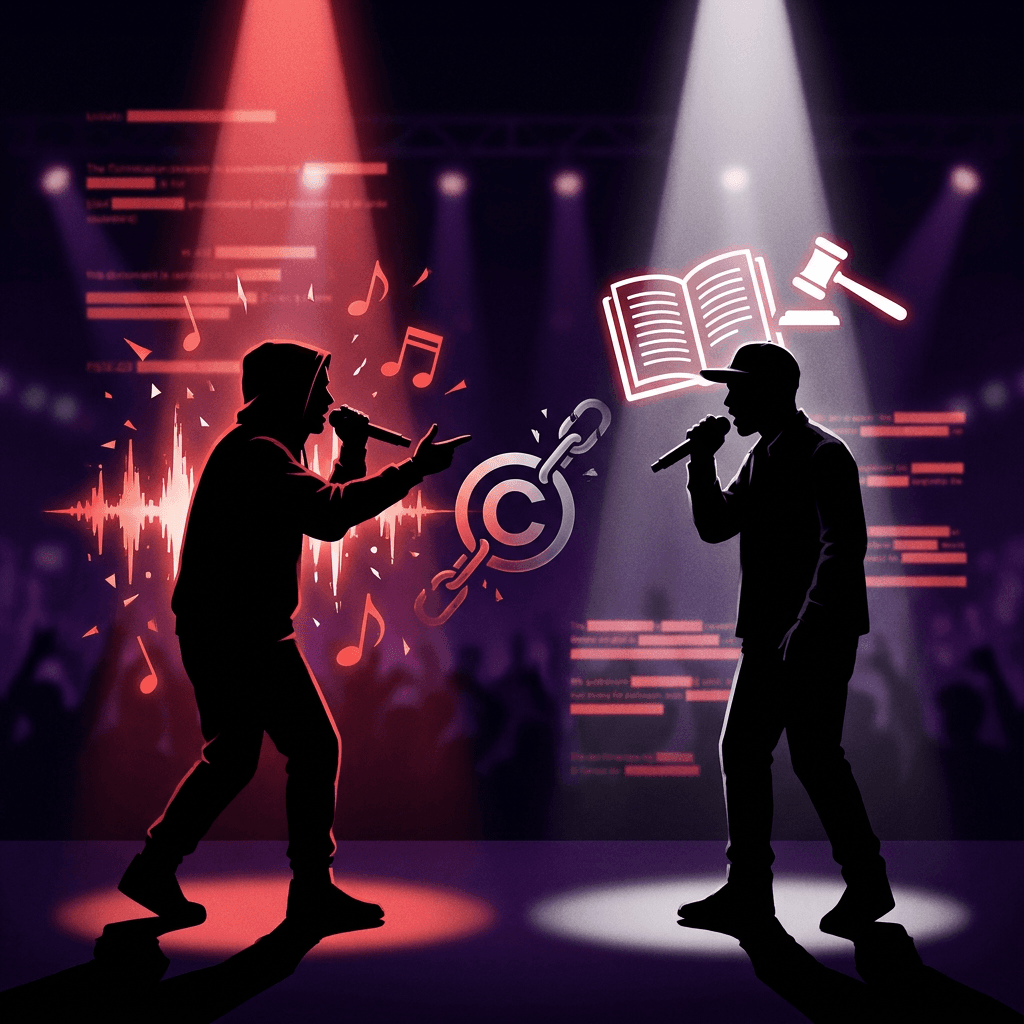
Are Lyrics Copyrighted? Legal Use Explained
Yes, song lyrics are almost always copyrighted the moment they’re written down or recorded, and in the U.S. willful infringement can expose you to up to $150,000 in statutory damages. If you’re building a diss track, roast video, meme, or AI-generated verse, that “just one bar” you want to borrow can carry real legal risk.
You’re probably here because you’ve got a line in your head already. Maybe it’s a killer punchline from a classic battle track. Maybe it’s the perfect caption for a TikTok roast. Maybe an AI tool spit out something suspiciously close to a famous verse, and now you’re wondering whether that’s genius or a lawsuit with a rhyme scheme.
The short version is simple. Are lyrics copyrighted? Yes. The useful version is where things get interesting, because lyric copyright works differently from what most creators assume. Giving credit doesn’t save you. Using only a few words doesn’t automatically save you. Even being funny doesn’t automatically save you.
What does help is understanding the rules before you hit upload.
That Fire Line You Want to Use Is a Legal Landmine
A creator is polishing a diss track at midnight. The beat is right, the target is obvious, and then the perfect bar pops up. The problem is that the bar belongs to someone else. In the studio it feels like a smart callback. In a copyright dispute, it can look like copying.
 A person wearing a yellow sweater writing in a notebook next to a legal document.
Creators in meme culture, roast videos, and battle content run into this all the time because lyrics feel public. They are everywhere. TikTok captions, reaction edits, gym playlists, wedding DJs, Twitch clips. But wide exposure does not turn lyrics into free raw material. A famous line works more like a branded logo on a hoodie. You may see it constantly, but ownership never left the original creator.
That confusion gets worse with AI. A lyric generator might hand back a line that sounds a little too familiar, especially if the prompt asks for something “in the style of” a well-known artist. If the result is recognizably close to an existing lyric, the risk does not disappear because a machine assembled it. For creators building fast-turnaround content, that means the draft phase matters. Saving your prompts, checking suspicious lines, and understanding how to copyright songs for free are part of the job now.
Why creators get this wrong
A few bad assumptions cause most of the trouble:
- It’s only one line: Short can still be memorable, and memorable is often what gets protected and noticed.
- I credited the artist: Credit shows respect. It does not create permission.
- I changed a few words: A cosmetic rewrite can still preserve the original expression.
- It’s a joke or meme: Comedy helps with audience reaction, not ownership rights.
The practical rule is simple. If the punch lands because people recognize somebody else’s wording, you are standing on shaky ground.
The diss track problem
Diss records thrive on reference. That is part of the sport. Callbacks, flips, interpolations, and quotable shots all help a track hit harder because the audience catches the subtext in real time. Copyright law, though, cares about who wrote the words, not whether the reference was clever.
That creates a real split between what works artistically and what works legally. A battle rapper can score points by echoing a famous phrase. A rights holder can hear the same phrase and hear unauthorized use. Businesses deal with the same tension in other creative fields, which is why this broader advice on protecting your business's IP is useful context.
For creators, the safer move is to build a fresh bar that carries the same force without lifting the original wording. Treat famous lyrics like high-voltage wire. Admire them, study why they work, even parody them carefully if the facts support that approach. But do not grab them bare-handed and assume the platform, the joke, or the AI tool will protect you.
How Copyright Automatically Protects Lyrics
The most important concept in this whole conversation is fixation. That’s the legal trigger. The second lyrics are fixed in a tangible form, copyright protection begins.
Write a hook in a notebook. Protected. Type bars into Notes or Google Docs. Protected. Record a rough mumble demo into your phone at 2:14 a.m. Protected.
 A flowchart infographic explaining how copyright laws automatically protect song lyrics upon creation and fixation.
Think of fixation like a digital birth certificate for a song’s words. You don’t need to file paperwork first to create the copyright. The act of creating and recording the lyric is what starts the protection.
What the law protects
Under both U.S. and UK law, song lyrics are automatically copyrighted as a literary work the instant they’re fixed in a tangible medium, without requiring registration or notice, and that protection lasts 70 years after the author’s death, as outlined in this overview of lyric copyright protection.
That means the overwhelming majority of lyrics you know from commercially released music are protected. Not because somebody stamped them with a seal. Because copyright law starts early and lasts a very long time.
What “automatic” does and doesn’t mean
Automatic protection gives the creator exclusive control over key uses. In plain English, that usually includes the right to:
- Copy the lyrics
- Distribute them
- Perform them publicly
- Authorize other people to use them
What it doesn’t mean is that everything becomes easy. Protection is automatic, but enforcement and ownership proof can still get messy, especially when multiple writers are involved or when a song starts life in a chaotic group session.
Write first, document second, register strategically. That’s how professionals avoid turning a creative win into an ownership argument.
If you’re serious about treating your writing like an asset, this practical guide on advice on protecting your business's IP is worth a read. It’s broader than music, but that’s useful. Creative work becomes business property fast.
What this means for your own lyrics
The good news is that your original words get this same protection too. If you write a roast verse from scratch and save it, you’ve created protectable material. Registration can still matter later, especially if enforcement becomes necessary, but the copyright itself doesn’t wait for paperwork.
If you want the step-by-step side of that process, this guide on how to copyright songs for free is a practical next stop.
Here’s the clean takeaway. Copyright isn’t some VIP perk for major-label writers. It shows up the minute the lyric becomes real.
Dissecting the copyright who owns what
Knowing that lyrics are protected is only half the game. The other half is knowing which copyright you’re touching.
 A close-up view of an intricate open-faced gold pocket watch with exposed clockwork gear mechanisms.
Creators often talk about “the song” like it’s one thing. Legally, it usually isn’t. Consider it a recipe and a plated dish. The recipe is the composition. The plated dish is the recording. You can run into one right, the other right, or both.
The two copyrights inside one song
Lyrics belong to the composition side. That composition usually includes melody plus lyrics. Separately, the actual recorded performance sits inside the sound recording copyright.
A concise guide from Music Admin explains that lyrics form one copyright within the musical composition, distinct from the sound recording, and printing lyrics requires a composition license from publishers rather than labels.
That distinction matters more than most creators realize.
| What you want to use | Right involved | Who usually controls it |
|---|---|---|
| The written lyric | Composition | Songwriter or publisher |
| The vocal audio from the song | Sound recording | Artist or label |
| Both lyric and actual audio clip | Both rights | Multiple parties |
Why permission gets confusing fast
Say you want to post a reel with a famous lyric on screen. You might not be touching the original audio at all, but you’re still using the composition.
Now say you sample the actual artist saying the line. Different problem. You’ve added the sound recording too.
That’s why creators send permission requests to the wrong place all the time. They ask a label for lyric use when the publisher controls that side. Or they assume getting access to the audio somehow clears the words. It doesn’t.
Who owns your own bars
Ownership gets trickier once co-writers enter the room. A producer suggests a line. Your friend writes the hook. Another collaborator cleans up the punchlines. Suddenly “my track” starts looking legally communal.
That’s why serious writers use split sheets and put agreements in writing while everyone still likes each other.
Here’s a useful explainer before you go deeper into licenses and rights management:
One more practical point. If your content uses only text lyrics, don’t assume the recording owner is the gatekeeper. If your content uses the actual master audio, don’t assume the songwriter alone can clear it. In music copyright, you often need the right key for the right lock.
The Gray Zone When You Can Use Lyrics Freely
This is the part everybody wants to hear. “Fine, lyrics are protected. But when can I use them anyway?”
The answer is sometimes, under doctrines like fair use in the U.S. The catch is that fair use is not a prepaid coupon code. It’s a legal defense argued after the fact if a dispute lands in front of a court.
 A scenic, misty country road lined with trees featuring autumn leaves under a blue sky.
The four things courts care about
Courts commonly weigh four factors:
-
Why you used it
Commentary, criticism, scholarship, and parody generally have a stronger argument than straight entertainment or commercial repackaging. -
What kind of work you borrowed from
Lyrics are expressive and creative, which usually gets stronger protection than dry factual material. -
How much you took
A short quote can still be risky if it’s the memorable heart of the song. -
Whether your use hurts the market for the original
If your version competes with, substitutes for, or undercuts the original work, your position gets weaker.
Two examples that look similar but aren’t
A reaction creator who puts a lyric on screen and breaks down why the line works as writing has a better fair use argument. The lyric is there to analyze it.
A meme page that slaps the same lyric over a viral face photo because it sounds cool is on thinner ice. The lyric is the entertainment product, not the object of commentary.
Fair use is strongest when the borrowed lyric is the subject of your point, not the decoration that makes your point interesting.
Where roast culture collides with fair use
Roasts and diss content often sit in the murkiest corner. Some are parody. Some are criticism. Some are just remixing famous lines for engagement.
A 2025 RIAA study found that 65% of viral rap memes infringe lyrics, with an average of 4 to 8 lines used, while only 12% face takedowns if they’re considered parody or repurpose the original under U.S. fair use. The same source notes that commercial uses, including monetized diss track parodies, often fail fair use tests because of market harm analysis, according to this summary of lyric use and fair use risk.
That’s a helpful reality check. Not because it gives you a bright-line answer, but because it shows how often creators drift into infringement while assuming short-form internet culture gives them a pass.
A quick gut-check table
| Use case | Risk level | Why |
|---|---|---|
| Reviewing a lyric and discussing its meaning | Lower | Commentary is central |
| Posting a famous line as a caption | Higher | The lyric is being reused for expression |
| Building a parody that targets the original song | Mixed | Could help, but context matters |
| Monetized diss content using recognizable borrowed bars | Higher | Commercial use and market harm issues |
The mistake people make most
They think that a simple change in context is sufficient. Courts usually want more than that. New setting alone isn’t magic. New meaning, new purpose, and real commentary matter much more.
If you’re asking whether a quote is probably fair use, the safest honest answer is this: if the lyric is doing most of the heavy lifting, your argument isn’t great.
Playing by the Rules How to License Lyrics Legally
If fair use feels foggy, licensing is the adult route. Less romantic, more paperwork, far fewer surprises.
When you license lyrics, you’re not arguing about whether your use is clever enough to qualify as exempt. You’re paying for permission from the people who control the rights. That’s cleaner, especially if your content is commercial, branded, or built to scale.
The common license lanes
Different uses can trigger different permissions:
- Print use covers reproducing lyrics in text form, such as merchandise, booklets, websites, or on-screen displays.
- Sync use comes into play when music is paired with visuals, such as videos, ads, or creator content.
- Mechanical licensing usually applies to reproducing and distributing a composition in audio form, such as a cover recording.
The labels here matter less than the practical point. You need permission that matches what you’re doing, not the permission you wish were close enough.
Where creators usually start
Typically, one begins by identifying the publisher that controls the composition. Performing rights databases can help you locate that information, and in some cases you’ll contact a publisher directly or work through an administrator.
That’s another reason originality is so attractive. Licensing can be done, but it takes time, attention, and often budget. If your meme or roast depends on moving fast, rights clearance can feel like trying to file taxes in the middle of a rap battle.
If you know your content will be commercial, get clearance before you build the campaign around someone else’s lyric.
Why original writing often wins
For creators, there’s a practical business argument here. Original bars don’t require a scavenger hunt through rights ownership. They don’t force you to guess whether your joke is sufficiently distinct. They don’t create upload anxiety.
If your project also touches recorded songs, this explainer on what is a cover version of a song helps separate lyric use from cover-related questions, which people mix up constantly.
Licensing is the safest route when you must use someone else’s words. But in a lot of creator workflows, writing fresh lines is faster, cheaper, and easier to own.
Diss Tracks AI and The New Copyright Battlefield
AI has taken an old copyright problem and poured lighter fluid on it.
In diss culture, borrowing has always been part of the air. References, flips, echoes, style imitation, and direct reply records are baked into the genre. AI changes the scale. A model can produce endless lyric-style outputs in seconds, and that raises a new question: when does “inspired by” slide into “memorized from”?
The major warning sign from the courts
A landmark German decision sharpened that issue. In GEMA v. OpenAI, the Munich I Regional Court ruled on November 11, 2025 that AI models reproducing copyrighted lyrics from training data via user prompts amounted to unauthorized public availability, and the court held the AI operator liable, rejecting the defense that the model only learned statistical patterns, as detailed in this analysis of the GEMA ruling and its implications for lyric training data.
That matters even if you’re not building an AI model yourself.
If you use an AI lyric tool and it outputs bars that are too close to protected songs, you may be staring at a chain of risk. The provider may face one set of problems. You, as the user publishing the output, may face another.
What creators should look for
The safest AI workflow is boring in the best possible way. You want systems and habits that reduce the odds of copied output.
Look for this:
- Editable drafts: If you can revise heavily, you increase the human authorship and reduce the chance of posting near-verbatim output.
- Originality checks: Tools and review habits that flag suspicious overlap are worth their weight in gold.
- Clear terms around ownership and use: If a platform is vague here, assume the legal footing is shaky.
- No dependence on recognizable borrowed lines: If the output feels like a tribute act with a photocopier, stop.
A smart companion step is running lyrics through a screening workflow before publication. This guide to an AI song checker is useful for creators who want another layer of review before they post.
The opportunity hiding inside the risk
AI is not automatically the villain here. Used carefully, it can help creators brainstorm structures, rhyme families, angles, and setups without lifting protected lyrics. That’s the upside. It can reduce writer’s block without turning your verse into a legal collage.
The legal environment is also broader than one country. If your content or business crosses borders, it helps to keep an eye on regional rules and emerging guidance. For that angle, this overview on understanding Israeli AI regulations is a useful example of how different jurisdictions are thinking through AI governance.
The key distinction is simple. AI that helps you create your own expression is useful. AI that spits back someone else’s expression is a liability wearing a futuristic outfit.
Your Action Plan for Staying Legally Sound
You post a roast reel at 11:47 p.m. By breakfast, the comments are flying, the clip is spreading, and one question starts to matter more than the punchline. Did you write that line, or did you borrow someone else’s?
That is the practical test.
For diss tracks, meme songs, parody clips, and AI-assisted verses, the safest habit is simple. Treat every lyric you did not write as protected until you can confirm otherwise. That one assumption cuts out a huge chunk of avoidable risk.
Then build from there.
Write original bars first. If you are using AI, use it like a writers’ room intern, not a photocopier. Ask for rhyme schemes, angle ideas, punch-up options, or alternate phrasing. If it gives you a line that sounds suspiciously familiar, do not polish it. Replace it.
Fair use deserves a sober view. Criticism, commentary, and parody can qualify, but fair use is a legal argument you make after a dispute starts, not a permission slip you wave before posting. For creators making diss content, that matters. The more your joke depends on a recognizable lyric doing the heavy lifting, the shakier your footing gets.
A few rules keep you out of the ditch:
- Treat famous lyrics like trademarked catchphrases in spirit. Their recognizability is what makes them tempting and risky.
- Separate lyric rights from sound recording rights. Rewriting text and sampling audio trigger different problems.
- Get collaborator terms in writing. Split sheets and usage permissions prevent ugly ownership fights later.
- Pause before monetizing a risky post. Sponsored content, ad revenue, and product tie-ins raise the temperature fast.
- Keep drafts and prompts. If AI helped shape your lyrics, records can help show your process and your originality.
Credit is good manners. It is not a legal shield. U.S. copyright law allows serious statutory penalties for willful infringement, and naming the artist does not cancel the problem.
If you are building a startup, creator brand, or music-adjacent business, this resource on legal guidance for Florida founders gives a practical view of registration, ownership, licensing, and enforcement issues.
The best closing rule is boring and profitable. If a line is doing numbers because it sounds like you, you can keep using it. If it sounds like somebody else’s classic with a new haircut, rework it before you hit publish.
Need bars that feel personal without leaning on someone else’s famous lines? DissTrack AI helps you generate original roast lyrics fast, so you can build battle-ready verses, creator callouts, and meme-worthy disses without starting from a borrowed punchline.