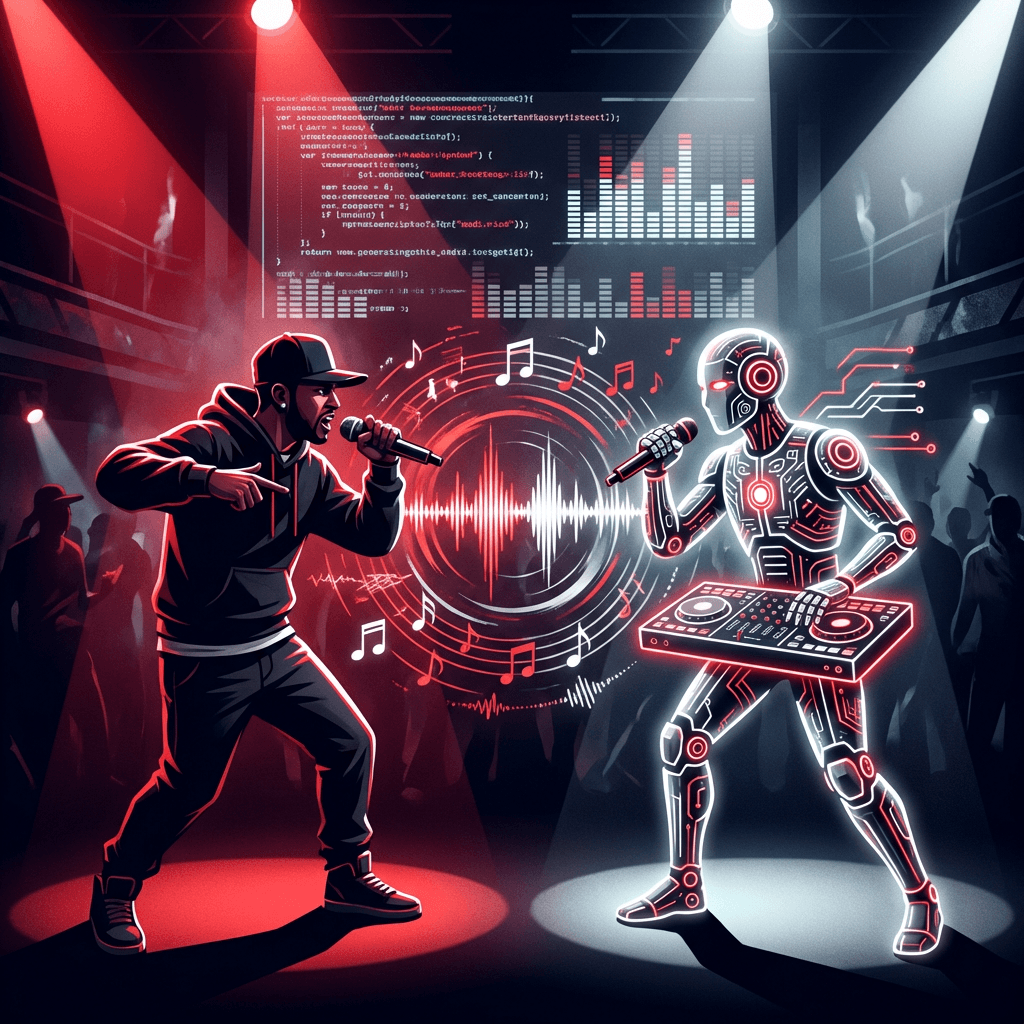
Artificial Intelligence Music Composition: Master AI Co-creation
Welcome to the new era of music creation, where artificial intelligence music composition is no longer just a wild sci-fi idea—it's your new creative sidekick. Picture a collaborator that’s listened to everything from Mozart to Migos and is ready to spitball melodies, harmonies, or even a fire diss track at a moment's notice. This is your guide to navigating this wild new world of sound.
Your New Co-Producer Is An AI
 A music production setup with a laptop displaying 'AI CO-PRODUCER', headphones, and a MIDI keyboard on a wooden desk.
Think of it this way: artificial intelligence music composition isn't here to take your job. It's here to give you an incredibly powerful co-producer that literally never gets tired or runs out of ideas. It's less about replacement and more about giving artists a massive creative boost.
And this isn't some niche hobby; it's a full-blown movement. The global AI music market was already valued at $294 million in 2022 and is expected to rocket forward with a compound annual growth rate of 28.6% through 2030. In fact, revenue from generative AI in music is on track to hit a staggering $3.1 billion by 2028. The sheer volume is mind-boggling; by late 2025, platforms like Deezer were reportedly getting over 50,000 AI-generated tracks submitted every single day. You can dive deeper into these predictions on the future of the music industry to get the full scope.
How Does It Work For Creators?
So, what does this actually look like when you're in the studio? In short, the AI handles the heavy lifting on the technical side, freeing you up to focus purely on your creative vision. Forget getting stuck on complex music theory or drowning in software settings—you can guide the AI with plain English.
You’re the director, and the AI is your entire orchestra, writing staff, and engineering team all rolled into one. You set the mood, pick the style, and call the shots. The AI brings it to life, serving up a draft that's ready for you to tweak and finalize.
This kind of partnership is a game-changer. It obliterates writer's block for seasoned producers and gives newcomers a way to jump right into making music. It’s the ultimate launchpad for ideas you can then mold into something that is uniquely yours.
The Different Tools at Your Fingertips
The world of AI music is already packed with different kinds of tools, each built for a specific job. Figuring out these categories is the first step to finding the perfect AI partner for your next project.
Don't worry, you don't need a computer science degree to get started. It's all about knowing what you want to achieve. Let’s break down the main players.
A Quick Guide To AI Music Generation Tools
To help you get your bearings, here's a quick rundown of the main types of AI music tools you'll encounter and what they're good for.
| Tool Type | What It Does | Best For |
|---|---|---|
| Prompt-Based Generators | Creates full tracks from a text description (e.g., "dark trap beat for a diss track"). | Quickly generating instrumentals, exploring new genres, and getting a song started from scratch. |
| Stem Separators | Splits a finished song into individual tracks like vocals, drums, and bass. | Making remixes, creating karaoke backing tracks, or isolating parts of a song to study them. |
| Lyric & Melody Assistants | Generates lyrical ideas, rhyming words, and melodic patterns based on your input. | Overcoming writer's block, finding the perfect hook, or brainstorming different song structures. |
These tools essentially give you a massive sandbox to play in. You can test out wild concepts, mash up completely different genres, and get a polished sound in a fraction of the time it used to take. This guide is all about turning you from a curious bystander into a confident creator who uses AI to turn up the volume on your own artistic voice.
How AI Learns to Write Killer Tracks
So, you're wondering how a computer can spit fire hot enough to end a career. It's not some black-box magic. What's happening under the hood is a fascinating process of learning, battling, and relentless refinement, all powered by what we call generative models.
Think of these models as the AI’s creative engine. They don't "feel" the disrespect, but they are absolute masters at recognizing patterns. By devouring mountains of music and lyrics, they figure out what makes a beat drop hard and what makes a punchline land with brutal impact. Let's get into the two main models running the show.
Transformers: The Musical Linguists
First on the scene are Transformers. You've probably heard about them powering chatbots, but it turns out they're lyrical geniuses in the making. Imagine a master linguist who not only knows every word in the dictionary but also understands sarcasm, rhythm, and how to set up a devastating multi-syllable rhyme. That’s a Transformer for music.
Instead of just looking at the last word or note, a Transformer sees the whole picture. It keeps the entire verse in its head at once, understanding how the first line sets up the last. This is a game-changer.
- For lyrics: This is how you get intricate rhyme schemes that don't fall apart after two bars. It helps the AI build a narrative, making sure each jab and insult escalates logically toward a knockout blow.
- For music: It gets that the moody chords in the verse need to build tension that explodes in the chorus. This creates a track that feels like a real song, not just a bunch of random loops.
This is why Transformer-based AI can produce lyrics and melodies that actually tell a story. They’ve learned the grammar of music and the art of the insult.
GANs: The Eternal Rap Battle
Now for the really fun part: Generative Adversarial Networks, or GANs. This is where the AI truly earns its stripes. The best way to think about a GAN is as an endless, digital rap battle between two AIs, locked in a room and forced to get better.
A GAN has two distinct personalities locked in a creative cage match:
- The Generator: This is your up-and-coming MC. Its one and only job is to create new music—a beat, a melody, a full 16-bar verse—and try to pass it off as legit.
- The Discriminator: This is the stone-faced, veteran producer in the corner. It's been fed a massive library of real, human-made music, and its job is to call out fakes. It listens to what the Generator spits and brutally declares "real" or "fake."
This constant conflict is what drives greatness. Every time the Discriminator rejects a track, the Generator goes back to the drawing board, learning from its mistakes. And as the Generator gets better, the Discriminator has to become an even harsher critic to keep up.
This digital dogfight forces the Generator to create tracks that are more and more indistinguishable from the real thing. It’s pure creative evolution, where only the most convincing and fire tracks survive.
The Importance of the Right Ingredients
Here’s the thing, though. These powerful models are nothing without the right training data. The old saying, "you are what you eat," has never been more true. The music an AI studies directly shapes its entire creative identity.
If you train an AI exclusively on the back catalogs of battle rap legends like 2Pac, Eminem, and Pusha T, it's going to learn the art of aggression, complex wordplay, and merciless delivery. It will excel at writing diss tracks because that's the only language it knows.
But if you fed that same model a diet of nothing but Bach and Beethoven, you'd get some beautiful, complex symphonies. Ask it for a punchline, and it would just stare back at you blankly. The dataset is the AI's entire education. It’s what gives it a point of view, and it's why specialized tools like DissTrack AI, trained on a deep history of rap, can deliver such authentic and devastating results for your lyrical warfare.
Getting AI Into Your Creative Groove
Okay, so the tech makes sense, and you get that the AI models are in a constant arms race to get better. But how do you actually use this stuff to make fire tracks? This is where we stop talking theory and start making music. Moving from knowing about artificial intelligence music composition to actually using it means weaving it right into your creative process.
Think of yourself as the director of a studio, and the AI is your insanely talented, but very literal, session musician. It won't do anything until you give it clear instructions. Your first job is to be a great director, and that all starts with the prompt.
From a Blank Slate to a First Beat
This is where you set the vibe. If you give the AI a lazy, vague prompt, you're going to get a lazy, vague beat back. It's that simple. Instead of just typing "make a diss track beat," you need to paint a picture with your words.
Let's imagine you're cooking up a diss for a friend who has a truly tragic sneaker collection. A killer prompt would look something like this:
"Generate a 90s East Coast boom-bap beat, 90 BPM, with a gritty, vinyl-sampled drum loop and a sinister bassline. The mood is confrontational but playful. Leave space for vocals in the verses. Make it sound like something off a classic Mobb Deep album."
See the difference? You’ve given the AI a genre, tempo, specific instruments, a mood, and even a legendary artist to copy. That’s how you get a beat that feels like a solid starting point, not just some generic loop.
Sorting Through the AI's Ideas
After you hit "generate," the AI will serve up a few different takes on your idea. Now, you switch hats. You're no longer the director; you're the A&R exec, sifting through demos to find the diamond in the rough. Not every track will be a certified banger right out of the gate. Some will be close, and some might be so weird they're just funny.
And that's totally cool! You're not looking for a finished song here. You're hunting for a spark.
- Listen for potential: Is there one melody that just sticks in your head? A drum pattern with a sick groove?
- Mix and match: Don't be afraid to Frankenstein your way to a great beat. Grab the bassline from one track, the drums from another, and a synth from a third.
- Embrace the edit: Think of the AI's output as raw clay. It’s on you to get your hands dirty and shape it into something special. This is where your real artistry shines.
This whole back-and-forth is pretty simple when you break it down. You feed in the ideas, the AI does its thing, and you get the raw material to work with.
 Flowchart showing the AI music learning process: data (music notes) feeds into a model (brain), producing music output (headphones).
This loop—from your prompt to the AI's output—is the engine that gives you a massive creative head start, all ready for your personal touch.
Adding the Human Element and Final Production
This is, without a doubt, the most important step. Once you’ve picked out your favorite AI-generated pieces, it’s time to pull them into your Digital Audio Workstation (DAW), whether that's Ableton, FL Studio, or Logic Pro. This is your playground. You slice, chop, rearrange, and layer in your own sounds to give the track a soul.
This hybrid workflow is quickly becoming the new normal. In fact, a whopping 87% of artists are using AI in their creative process as of 2026. The pros are getting on board, too. Recent survey data shows 47% of professional producers view AI as a 'creative assistant,' not a replacement. You can dig into more of these trends and see how AI is being used by artists in 2026.
Let the AI handle some of the grunt work, like mapping out a verse-chorus structure based on proven formulas—something we dive into in our guide to perfecting your rap song structure. That frees you up to focus on what matters: infusing the track with genuine emotion and the savage lines that make a diss track hit hard.
Finally, you lay down your vocals. Using a tool like DissTrack AI, you can even get lyrical ideas tailored to your target. From there, it's all you—your flow, your delivery, and your attitude. This blend of AI-powered ideas and raw human performance is the secret to creating a final track that truly slaps.
Crafting Savage Burns With DissTrack AI
Look, those general-purpose AI music tools are fun for noodling around, but when you need to land a lyrical knockout, you need a specialist. That's where DissTrack AI comes in. This thing was built from the ground up for one glorious purpose: crafting brutal, custom-tailored diss tracks that actually hit hard.
This isn't just another lyric generator spitting out cheesy rhymes. Think of it as a battle-rap sensei that’s been trained on the legends themselves—we're talking the wordplay of Eminem, the storytelling of 2Pac, and the cold-blooded delivery of Pusha T. It gets the art of the insult.
Let’s fire it up and cook up some lyrical heat for a friend, a rival, or just for the sheer fun of it.
Step 1: Name Your Target and Gather Your Ammo
Alright, first things first: you need a victim. For this little demonstration, let's pick on our imaginary friend, Bob. Bob’s a good dude, but he has a few fatal flaws we just can't let slide.
Next, you feed the AI the ammunition. The more specific the dirt you have, the more savage the burn will be. This is what separates a generic diss from a personal masterpiece.
- Target: Bob
- Ammunition: He microwaves his tea. He thinks cargo shorts are high fashion. He pronounces "meme" as "me-me."
With this kind of intel, the AI can get to work cooking up something that will make Bob seriously reconsider his life choices. This is the future of creative AI—hyper-personal and wickedly effective.
Step 2: Choose Your Style and Savagery
Here’s where it gets really good. You get to play producer and set the whole vibe for the track. This is where DissTrack AI really flexes, letting you dial in the perfect tone for your lyrical assault.
You can pick from a whole menu of styles, from Old School Boom Bap for that classic '90s feel to a modern Drill beat if you want something more aggressive. For poor Bob, let's stick with a classic vibe.
Then comes the most important dial: the savagery slider. This little control lets you take your track from a lighthearted poke to a full-blown verbal beatdown. For maximum effect on Bob, we’re cranking it straight to "Brutal."
Sample Output (Old School Boom Bap, Brutal Savagery): "Yo, heard you in the kitchen, committing a crime / Microwavin' tea, you wastin' my time / Callin' it a 'me-me,' man, the disrespect is real / While you rockin' cargo shorts, tell me how you feel?"
And just like that, you’ve got a verse that’s ready to deploy. It's pointed, it's personal, and it’s hilarious because it uses the exact ammo you provided. You can jump in and try it yourself with our AI rap battle generator to see what you can cook up in a few seconds.
The Power of Specialized AI
This whole process shows a huge shift happening in artificial intelligence music composition. By 2026, the game has moved way beyond generic, one-size-fits-all tools. We’re now seeing highly specialized models that are practically artist-driven.
Musicians are even training systems on their own unique work, turning AI into a co-producer that can help generate royalties. For you, using a tool like DissTrack AI, it means getting hyper-targeted roasts with surprisingly nuanced flow and wordplay you can edit on the fly. You can see how this is changing everything by diving into these emerging AI music industry trends.
This new reality puts some serious creative firepower in the hands of everyone from battle rap fans to streamers and music producers. You can create savage private roasts, export them for your own projects, and maybe even go viral—all without ever staring at a blank page. Whether you're settling a friendly score or making killer content, specialized AI is the ultimate secret weapon.
Creative Uses For AI Music Beyond Battle Rap
 A laptop displaying a sound wave and 'ENDLESS SOUNDSCAPES' sits on a desk with a phone and plant.
While cooking up the perfect diss track is a noble pursuit, the world of artificial intelligence music composition is so much bigger than just lyrical warfare. Think of AI as your personal, on-demand composer, ready to score every corner of your creative life—no beef required. It turns out the same tech that spits fire can also build an entire world of sound from scratch.
This is a massive unlock for content creators. If you're a YouTuber or Twitch streamer, you know the pain of digging through royalty-free music libraries for hours, only to settle for a track that kinda fits. With AI, you can generate a completely custom soundtrack in seconds. The magic is in the details.
Custom Soundtracks On Demand
Need a chill, lo-fi beat for your "study with me" stream? Just ask for one. Want a soaring, epic orchestral score for that ridiculous gaming montage you just cut together? A simple prompt gets you exactly that, perfectly matched to the mood and pace you're after. It’s like having a Hollywood composer on speed dial, minus the Hollywood budget.
This isn't just about dodging copyright strikes or saving a few hours. It’s about making your content genuinely better. The right music is the secret sauce that makes your videos feel professional and keeps people watching.
- For Vloggers: Create a signature intro and outro that becomes instantly recognizable as your brand.
- For Gamers: Generate high-octane tracks that match the intensity of your gameplay without ever getting stale.
- For Podcasters: Design custom stings, transitions, and background beds that give your show a slick, radio-quality finish.
The creative doors fly wide open once you realize AI can be your personal sound designer.
Shattering Creative Blocks For Producers
For any music producer, the blank screen is the ultimate enemy. You're staring at your DAW, waiting for that first spark of inspiration to hit. This is where AI music tools shine, acting as the ultimate creative wingman.
You don't have to use the entire AI-generated track. Think of it as a brainstorming machine. Spit out a dozen different chord progressions or drum patterns, grab the one that makes your ears perk up, and use it as the jumping-off point for your next banger.
This approach keeps you firmly in the producer's chair. The AI serves up the raw ingredients—a weird melody you never would have written, a complex rhythm you couldn't tap out—and you provide the human artistry, twisting and shaping it into something that is uniquely yours. It’s an incredible way to kickstart a session and keep ideas flowing, especially when you need some fresh rap ideas and lyrical inspiration to build a beat around.
Jingles, Ads, and Viral Audio
The fun doesn't stop with personal projects. For marketers and social media managers, AI is a shortcut to creating audio that sticks. Need a snappy, memorable jingle for a new ad campaign? AI can spitball dozens of options in the time it takes to make a coffee.
This is especially powerful in the lightning-fast world of TikTok and Instagram Reels. On these platforms, a unique sound can be the one thing that separates a video with 100 views from one that goes viral. Instead of piggybacking on an existing trend, you can create your own signature audio, giving your content a shot at becoming the trend itself. From catchy jingles to moody soundscapes, AI puts a full-blown audio production house right at your fingertips.
Navigating The Rules Of AI Music Creation
So you're cranking out tracks with AI. Awesome. But let's get one thing straight: this isn't the Wild West, and you can't just do whatever you want. As you start exploring artificial intelligence music composition, you’re walking into a space where creativity, technology, and the law are all trying to figure out the rules of the game.
The big, flashing question everyone keeps asking is, "If an AI makes a song, who actually owns it?" That's the million-dollar question, and frankly, the legal system is still scrambling to find an answer while the tech sprints ahead.
It helps to think about it this way: if you just press a button and an AI spits out a finished track with zero creative effort on your part, that song probably can’t be copyrighted. The U.S. Copyright Office has made it pretty clear that you need a human author to get that protection. But what happens when you’re not just pressing a button? What happens when you use AI as a collaborator?
The Human Touch And Copyright
Now we're talking. This is where the situation gets a lot better for creators. The magic phrase you need to burn into your brain is "meaningful human authorship."
Let's say an AI gives you a cool melody. If you then take that melody, write your own lyrics over it, arrange the song's structure, and lay down the vocals, you've created a new, hybrid work. You were the creative director.
Because your contributions are significant—or "more than de minimis," as the lawyers say—the parts you created are yours. You can't copyright the raw AI-generated bits, but you can absolutely copyright the final song that features your unique human stamp.
Understanding this difference is everything.
- AI as a Spark: Using an AI-generated chord progression to kickstart your own song is usually fine. The end result is a product of your labor.
- AI as the Finished Product: Releasing a track that's 100% AI-generated with no edits? You're entering a legal gray zone where you almost certainly have no claim to ownership.
This is exactly why tools offering commercial licenses for their outputs are so valuable. They give you a clear legal green light to use the AI-generated material in your projects, saving you from a world of potential headaches down the road.
This whole legal mess is why you have to read the terms of service for any AI tool you use. Some are just for messing around, while others, like DissTrack AI, have plans with commercial licenses so you can safely use your creations in videos you plan to monetize.
The Great Ethical Debate
Beyond the courtroom drama, a massive ethical argument is brewing. Is it fair to train AI models on a library of copyrighted music, often without paying or even asking the original artists for permission? This is the core conflict that will define the next chapter of AI music.
On one side, you have people arguing that training an AI is "fair use." They compare it to a human artist learning their craft by listening to thousands of songs and drawing inspiration. For them, it's just a necessary part of innovation.
On the other side, you have artists and record labels who call it what they see it as: mass-scale digital theft. They argue that if an AI learns to mimic an artist's signature style by analyzing their entire catalog, that artist deserves a cut. Lawsuits are already piling up, with major labels going after AI companies for feeding copyrighted lyrics and melodies into their models.
There’s no simple solution here, and this debate will shape how artificial intelligence music composition evolves. For now, the best thing you can do is be a smart and responsible creator. Stick with platforms that are upfront about their training data and are actively trying to build ethical systems that support artists. If you stay in the loop, you can tap into the incredible power of AI without stepping on the toes of the artists who inspired it all.
Got Questions About AI Music? We've Got Answers.
Jumping into artificial intelligence music composition can feel a little weird, we get it. Is it real art? Can you get sued? Is a robot coming for your gig? It's easy to get lost in the noise.
Let's cut through the hype and tackle the questions we hear all the time. No fluff, just straight talk from people who actually use this stuff.
Is It Cheating to Use AI for Music?
Let's be real: is using a synth cheating? What about a drum machine or a loop pack? Of course not. They're all just tools. AI is no different—it's just the newest, shiniest tool in the producer's toolkit.
Think of it as a collaborator that never sleeps and has heard literally millions of songs. The real magic happens when you step in. You’re the one guiding the AI with prompts, picking the best parts, and weaving it all together into something that slaps. AI gives you the starting blocks, but you’re the one running the race.
Can I Actually Make Money From AI-Generated Songs?
This is the big one, and the answer is a solid yes, but you have to play it smart. A track that is 100% AI-generated with zero creative input from you is usually off-limits for copyright. The US Copyright Office has been pretty clear that you need "meaningful human authorship" to claim ownership.
That means adding your own vocals, writing the lyrics, rearranging the beat, or mixing it in a unique way. Once you put your own creative stamp on it, you're in business.
The most important move you can make is to read the terms of service for whatever AI tool you're using. Many platforms, like DissTrack AI, give you a full commercial license with their paid plans. That's your golden ticket to monetize your creations without worrying.
So, Will AI Replace Human Musicians?
Nope. Not a chance. This is probably the biggest misconception out there. While an AI can spit out a technically perfect beat, it’s missing the one thing that truly matters: a soul.
Let's break it down:
- AI has no story: It has never been dumped, never won a rap battle, never felt the adrenaline of a crowd chanting its name. That raw, lived experience is what makes music connect with people.
- It’s a spark, not the whole fire: The pros are using AI to bust through writer's block and find new directions, not to do their jobs for them. It’s an idea generator, not a replacement artist.
- An AI can't rock a stage: Can you imagine a laptop headlining a festival? The energy, the stage presence, the connection with a live audience—that's a human-only gig.
At the end of the day, artificial intelligence music composition isn't a threat. It's a powerful creative partner that can help you make better music, faster.
Ready to cook up some lyrical fire without the writer's block? DissTrack AI gives you the power to generate custom, hard-hitting diss tracks in seconds. Start roasting now.