
Commercial License Fees Explained: What You Really Pay For
The roast you wrote for a group chat got reposted, pulled 40,000 views on Shorts, and now a supplement brand wants to sponsor the sequel. Someone in the replies says you're fine because the generator's pricing page mentions a commercial license. You open the terms, meet the words "mechanical," "synchronization" and "territory," and close the tab.
That gap between a plan label and an actual permission is where money and projects get lost. A commercial license fee isn't a single price you pay for the right to earn. It's a bundle of rights, and the bundle changes with what you do with the track, where you do it, and how large the operation is.
The order that works is simple. Price the use before you price the subscription: name the channel, find the right that covers it, then read the fee.
Commercial License Fees at a Glance
A commercial license fee buys permission for a use, not a badge on a plan. It works like a ticket: the seat, the venue and the night all change the price, even when the show is the same song. Four rights come up most often, and each is priced by a different mechanism.
| License type | What it covers | How the fee is set | Reference value |
|---|---|---|---|
| Mechanical | Making and distributing copies, including permanent downloads | Statutory rate set by copyright law | Quoted per work or per minute under the current schedule; confirm the live rate before quoting |
| Public performance | Playing music in venues, on broadcasts or in business spaces | Private deals between performing-rights organizations and businesses | No standard price; negotiated for the space, audience and term |
| Synchronization | Pairing music with video, ads, films, TV or games | Negotiated per deal | No standard price; set by budget, prominence, territory, duration and media |
| Streaming | Distribution on streaming platforms | Revenue share with rights holders | No per-track fee; the payment is a share of platform revenue |
Two rows run on schedules or formulas, and two are negotiated from scratch. Mechanical is the statutory one: copyright law sets the schedule, usually quoted per work or per minute, so a permanent download is priced by whichever measure the live schedule makes larger. Check the current schedule with the rights authority before a number goes into a budget. Public performance sits with performing-rights organizations and is priced for the room, not copied from a chart.
Three things move the price.
- The right being licensed. A mechanical right covers copies. A performance right covers the room. A sync right covers the pairing with pictures. Different rights, different counterparties, different logic.
- The use. Channel, territory and duration do most of the work. A track in a short regional ad buy and the same track in a global campaign are not the same product.
- The scale of the business. Longer runs, broader territories and bigger organizations pull the price up, and some licenses set revenue thresholds that change the terms outright.
Stack those variables and contracts get clause-heavy fast; a clear map of how IP licensing contracts work shows which clauses carry the scope. Read the table as a routing map: name the channel, find the row, then ask what moves that row's price.
Which Fee Applies
Two layers decide this: the work being licensed and whether a statute fixes the amount.
Music splits a track into two works. The musical composition is the lyric and melody; the sound recording is the captured performance. A diss track you write and record touches both, and a recording laid over someone else's beat can require permission at each layer. Clear one and skip the other, and the clearance is incomplete even though you paid something.
Where flat fees come from
Congress wrote the first compulsory mechanical royalty into the Copyright Act of 1909 at $0.02 for each part manufactured, and that figure held for nearly 70 years while music moved from sheet music to phonograph records. The rate has been reset many times since. For the 2018 to 2022 period, the U.S. statutory mechanical rate for physical phonorecords and permanent digital downloads was 9.1 cents per song, or 1.75 cents per minute of playing time for songs longer than five minutes, whichever was greater, as the Congressional Research Service report on music licensing documents.
Those 2018 to 2022 figures are history now. Quoting 9.1 cents in a current deal is like quoting an old postage rate: the schedule moved, and a buyer who cites a retired number looks like they haven't read the live one.
The split runs the same way for both layers of a track.
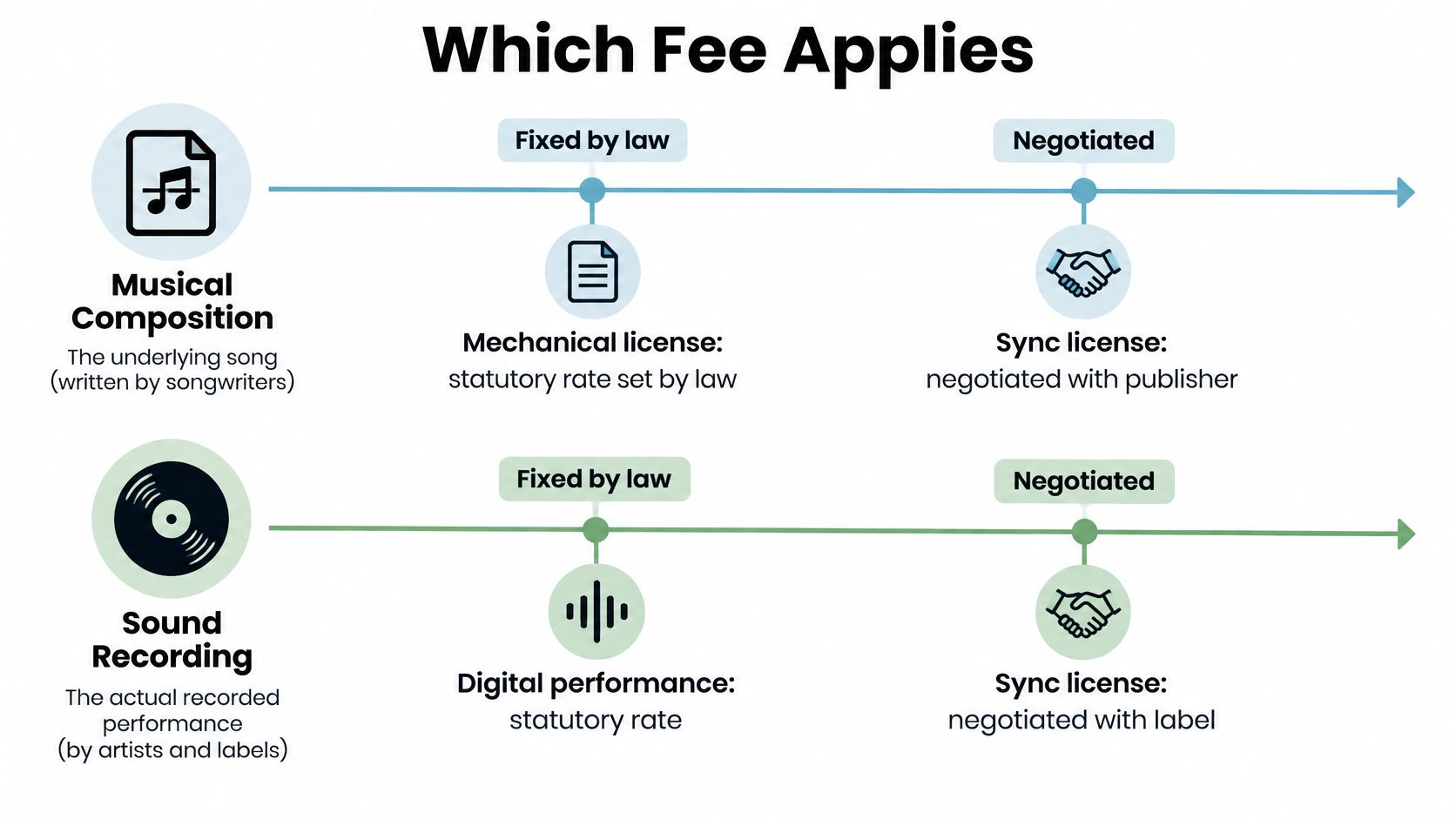 A diagram comparing fee types for musical compositions and sound recordings, detailing statutory and negotiated licensing.
The test: if a statute or a rate schedule names the amount, the fee is predictable. If two parties have to agree on it, it isn't.
Public performance sits on the negotiated side. Those fees come from private agreements between performing-rights organizations and the businesses that play music, broadcasters and venues included, so the number tracks the size of the room and the bargaining power on each side. Sync fees for ads, film, TV and games follow the same pattern with no statutory formula behind them at all.
The composition and the recording each spin off their own royalty stream, and Coto & Waddington's explanation of how music royalties work maps which stream pays whom.
So the fee that applies depends on the act. Sell a permanent download of a roast track and you owe the statutory mechanical rate, calculable before you publish. Put the same track under a sponsored video and you're in a negotiation with no ceiling. A license worth signing names both layers and states which mechanism governs each.
Why One Track Can Cost Different Amounts
A diss track dropped free in a group chat, the same track monetized on a streaming platform, and the same track laid under a paid media buy are three separate purchases. The audio never changed. The channel did, and each channel touches a different right with its own price logic.
The revenue split shows how unevenly money moves across those channels. The IFPI Global Music Report counted $29.6 billion in worldwide recorded-music revenue for 2024, up 4.8% year over year, with streaming contributing $20.4 billion, or 69.0% of the total. Performance-rights revenue reached $2.9 billion, up 5.9%, for a 9.7% share. Synchronization, the category covering music placed in film, television, advertising and games, totaled $650 million, or 2.2%.
| Revenue stream | 2024 total | Share of recorded-music revenue |
|---|---|---|
| Recorded music overall | $29.6 billion, up 4.8% | 100% |
| Streaming | $20.4 billion | 69.0% |
| Performance rights | $2.9 billion, up 5.9% | 9.7% |
| Synchronization | $650 million | 2.2% |
Read that table as a pricing map. Each row behaves differently at invoice time.
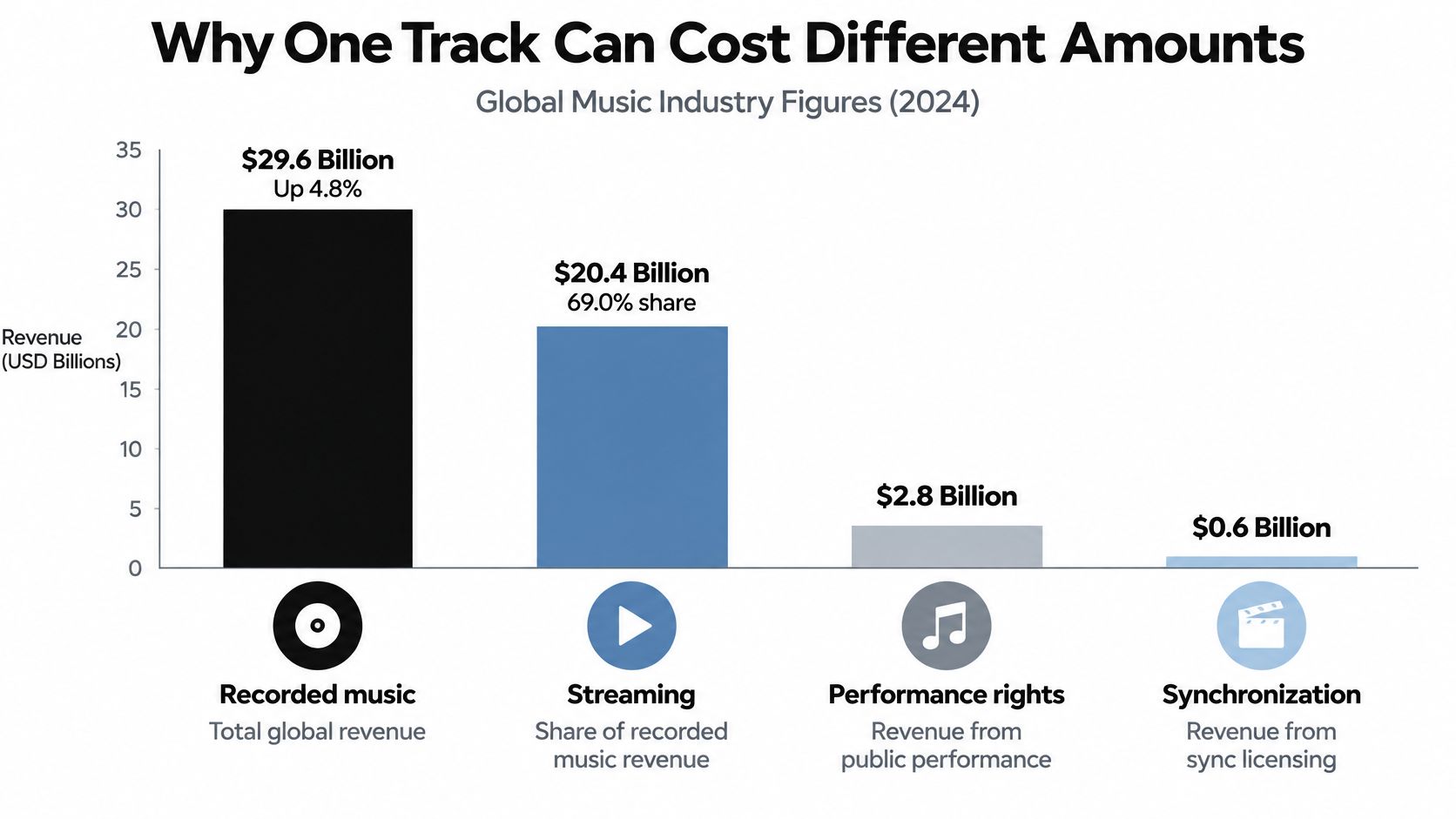 A bar chart titled Why One Track Can Cost Different Amounts showing 2024 global music industry revenue streams.
Streaming is the volume channel. Nearly seventy cents of every recorded-music dollar flows through it, and it pays through a revenue share rather than a per-track fee, so a platform payout never resembles a license invoice. Performance rights are the collected channel, gathered by organizations that track plays across venues and broadcasts. Synchronization is the smallest slice and the least predictable per use. Budget, prominence, territory, duration and media each push the number around, which is how a 2.2% category can produce the largest single invoice a creator ever sees.
A concert ticket and a tour T-shirt come from the same band on the same night, yet nobody expects the shirt to cost what the ticket costs. They are different products. Music rights behave the same way: one work, several products, several prices.
That is why ordering matters. Price the use first, the subscription second. A buyer who names the channel and the rights it touches can tell whether a quoted fee covers the actual product or a cheaper one wearing the same wrapper.
Video is where this bites hardest. The moment lyrics sit under moving pictures, the use becomes synchronization and clearance splits between the composition and the recording, which this breakdown of synchronization rights walks through layer by layer.
Practical rule: identify the channel first, then expect the fee to follow it. A fee quoted without a channel attached isn't a price yet, it's a guess.
Ownership Is Not the Same as Permission
 A person holding a photography license agreement document while sitting at a desk with a camera.
Paying a commercial license fee does not make the lyrics yours. It makes them usable. Pricing pages blur that line constantly, and buyers who miss it end up holding a lease while arguing about the deed.
The U.S. Copyright Office draws the limit clearly. Purely AI-generated material, or material lacking sufficient human control over the expressive elements, isn't copyrightable, and prompts alone generally don't supply that control, per its guidance on AI and copyright. Copyright can attach to human contributions such as creative selection, arrangement, editing and modification. Your raw output and your edited version can therefore stand on different legal footing.
A commercial license works like a rental key. It opens the building, lets you move your furniture in, and lets you host guests. The architect still owns the walls. No matter how many years you stay, the lease never turns into a deed, and a landlord who promises otherwise is promising something he cannot hand over.
Read every fee the same way: it prices a bundle of named permissions, not the song itself. The word "commercial" on a pricing page tells you almost nothing about which uses sit inside that bundle, so the useful question is never "is this licensed?" but "licensed for what?"
What a fair set of terms spells out
- Permission, stated plainly. Use, publish, monetize and distribute, with channels named rather than compressed into "commercial use."
- A human edit requirement. Meaningful revision plus records of what changed, because those revisions are what any copyright claim would rest on.
- A no-imitation clause. Nothing that puts a living artist's voice or protected lyrics into the output.
- Scope terms. Worldwide or regional, perpetual or term-limited, transferable, sublicensable, and valid for advertising, sponsored content, client work, recordings, live performance and social monetization.
A license buys permission. It does not manufacture ownership.
Other creative fields run into the identical split. Sculpty on commercial-use cat licenses deals with the same gap between what a fee lets you do with an asset and who holds rights in it.
So ask a provider one question and listen for two answers: am I allowed to publish and monetize this, and do I own the copyright in it? A license that answers the first clearly and declines to promise the second is being honest with you. One that merges them is selling something it cannot deliver.
A Rights Matrix to Match Each Use to Its Fee
A single plan label collapses about seven separate questions into one word. Creators and agencies need to know whether a track can go into paid ads, client work, podcasts, films, livestreams or music platforms, whether it can be registered with Content ID, and whether the permission survives a cancellation or a change to the provider's model.
Adobe's licensing guidance is a useful calibration. Commercial status can arise when content is delivered to a client, employer or brand, even without paid promotion, and "royalty-free" still means licensed rather than unrestricted, as its music licensing FAQ for creators explains.
| Use | Permission to check | Separate clearance usually needed? | Main fee driver |
|---|---|---|---|
| Private roast for friends | Personal use only | No | None beyond the plan itself |
| Monetized social video | Commercial social monetization | Check platform Content ID rules | Reach and channel |
| Paid ad or sponsored post | Advertising and paid placement | Yes, often synchronization | Budget, territory and duration |
| Client deliverable | Client work and transfer terms | Yes, if the client receives rights | Scope and exclusivity |
| Released song or download | Distribution and mechanical use | Yes, mechanical rates apply | Per work or per minute |
| Broadcast or live venue | Public performance | Yes, through performing-rights organizations | Per business location |
Reading the matrix with a real job
Say a two-person agency takes a contract to write a 45-second intro for a client's podcast. The channel is a client deliverable, so it's row four. Permission to check is client work and transfer terms, separate clearance is needed if the client receives rights, and scope plus exclusivity set the fee.
Then the client asks whether the same intro can run as a paid ad next quarter. That's a different row. Advertising and paid placement usually drags synchronization in behind it, so budget, territory and duration take over the pricing. The jump from podcast intro to paid ad is exactly where a cheap license stops covering the work.
Three questions to ask of every row
- Does the license name this channel, or does it only name "commercial use"?
- Does a second rights holder need to clear it, such as a performing-rights organization, a sync buyer or a distributor?
- Does the permission survive cancellation, a plan downgrade or a model change?
Contrarian note: a pricier tier can hand you broader contractual permission without making the output defensible as exclusive intellectual property. You're buying room to operate, not a deed.
Save the matrix and check the row before you publish, not after the invoice arrives.
When a Free Roast Becomes a Paid Project
A sponsored post is the moment many creators discover what their license excludes. The clip is the same clip, the file identical down to the byte. The channel changed, and the channel is what the terms price.
Plan pages rarely list the restrictions that void a purchase: advertising, broadcast, film and television, streaming distribution, paid media, Content ID registration and revenue thresholds. Published structures diverge sharply. Some licenses permit online and offline commercial use but carve out film, television, radio and major games. Others limit monetization to selected social platforms, exclude advertising and paid placements, or bar streaming release and Content ID claims, as Adobe's comparison of music types for video projects shows across license categories.
The threshold nobody reads
Some providers write an annual-revenue threshold into their community terms, so identical generated output can carry different commercial requirements depending on how large the buyer's business is. Two people generate the same lyrics and owe different things.
The line works like a tax bracket. The song stays the same, but crossing a revenue figure puts the buyer in a new category with new obligations, and no invoice arrives to warn you the bracket changed.
| Upgrade trigger | What to check before publishing |
|---|---|
| Sponsored post | Paid promotion channel, attribution and whether the license covers social monetization |
| Client deliverable | Transfer terms and whether the client receives any rights |
| Paid ad | Advertising and paid placement coverage, territory and duration |
| Released song | Mechanical and distribution coverage and Content ID rules |
| Monetized catalog asset | Revenue threshold and whether existing outputs become covered after upgrading |
Run four checks against any trigger. Does the license cover the new channel at all? Is attribution required, and where does the credit go? If you upgrade, do tracks you already made become covered, or does coverage start with the next generation? And can you sublicense, because a client deliverable usually means passing rights onward to somebody else.
The check that saves money: before you pay, confirm whether upgrading covers work you already published or only what you publish next.
When upgrading is the answer, the test still costs nothing. DissTrack AI offers a free trial with no credit card required, so you can generate against the actual brief before a paid tier becomes necessary.
Free-license terms trip people up the same way, looking permissive until the conditions kick in, and this guide to Creative Commons music shows where those conditions bite.
Cheap licensing gets expensive at the handoff. Once a track moves from social entertainment into advertising, client work or music distribution, a second compliance cost arrives that never appeared on the comparison page.
Confirm the Right License Before You Publish
Three checks, in order, before anything goes live.
- Name the channel and the audience. Private roast, sponsored post, client deliverable, paid ad, released song, broadcast or venue. Write it as one sentence. "Commercial use" isn't a channel and won't match any row.
- Match the channel to its row and find the second rights holder. Performing-rights organizations for performance, a sync buyer for video, a distributor for release. If someone else must clear it, your provider's license doesn't finish the job.
- Confirm the written terms cover territory, duration, format and sublicensing. Then confirm whether generated audio is included or only lyric text, because those can be licensed separately.
Why the written term beats the pricing page
The pricing page tells you what you pay. The terms tell you what you bought. Choose the tier whose written terms cover the channel you named, not the cheapest plan in the stack.
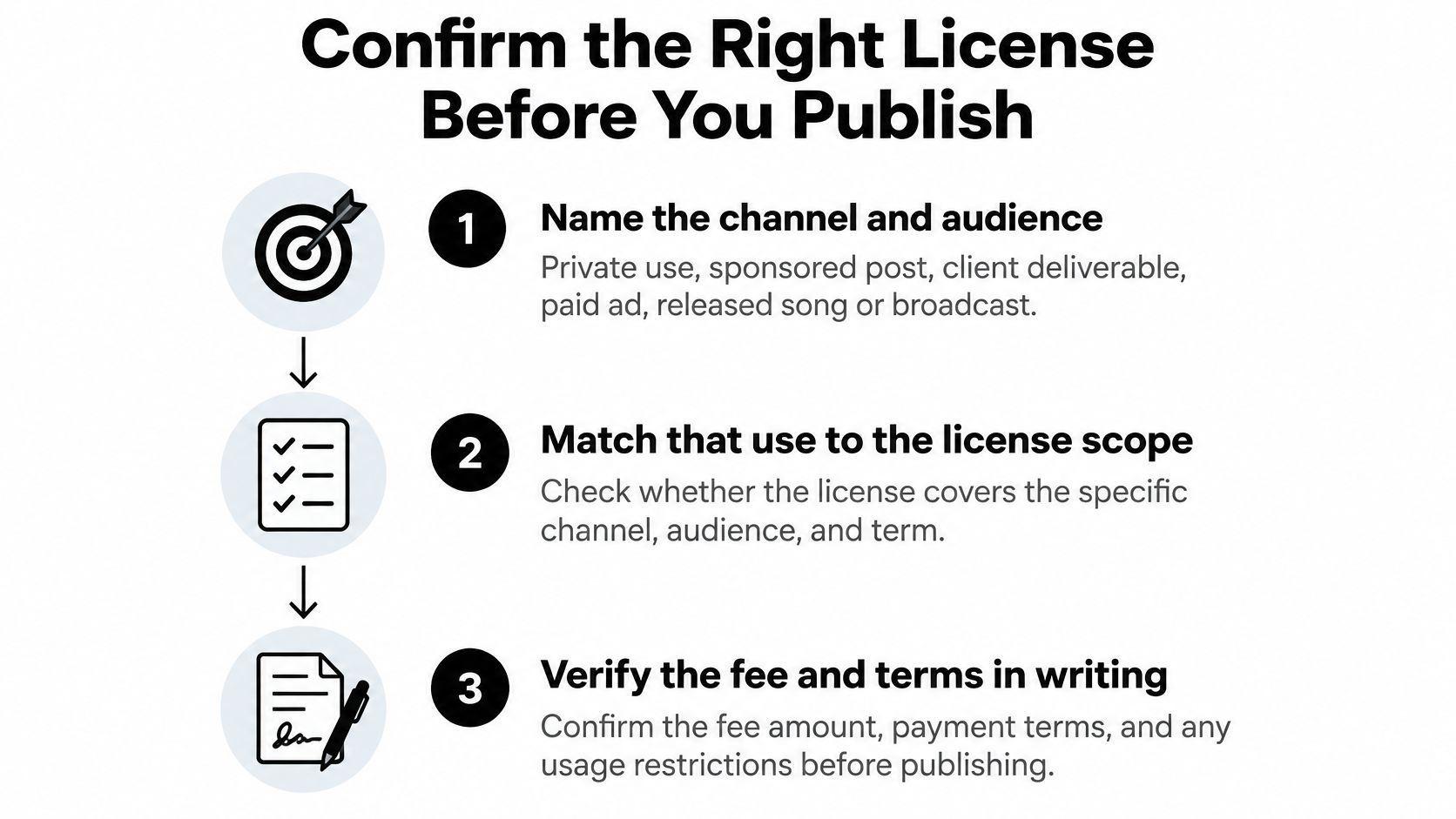 A three-step infographic showing how to verify commercial license terms before publishing content online.
At DissTrack AI, every plan carries a commercial license, the free one included, so the upgrade question is about generation volume rather than getting permission. Pro runs $9.99 a month for 15 tracks and Creator $29.99 for 100, yearly billing takes 20% off, and a free trial needs no credit card.
If the track is a re-recorded take on an existing song rather than a fresh roast, the picture shifts again, and what makes a cover version of a song explains where that line falls.
The order matters more than the price: use, then row, then terms, then publish.
Pick the use, check its row, get the scope confirmed in writing, and only then hit post.
DissTrack AI turns a name, a relationship and three inside jokes into structured verses in seconds, across styles from West Coast to Drill, and every plan including the free one comes with a commercial license so you can try it before spending anything. If a roast is heading for a sponsored post, a client deliverable or a released track, generate it, check the matching row in the matrix, and confirm the terms that cover that channel. Start with the free trial at DissTrack AI and write the verse before the licensing conversation gets serious.