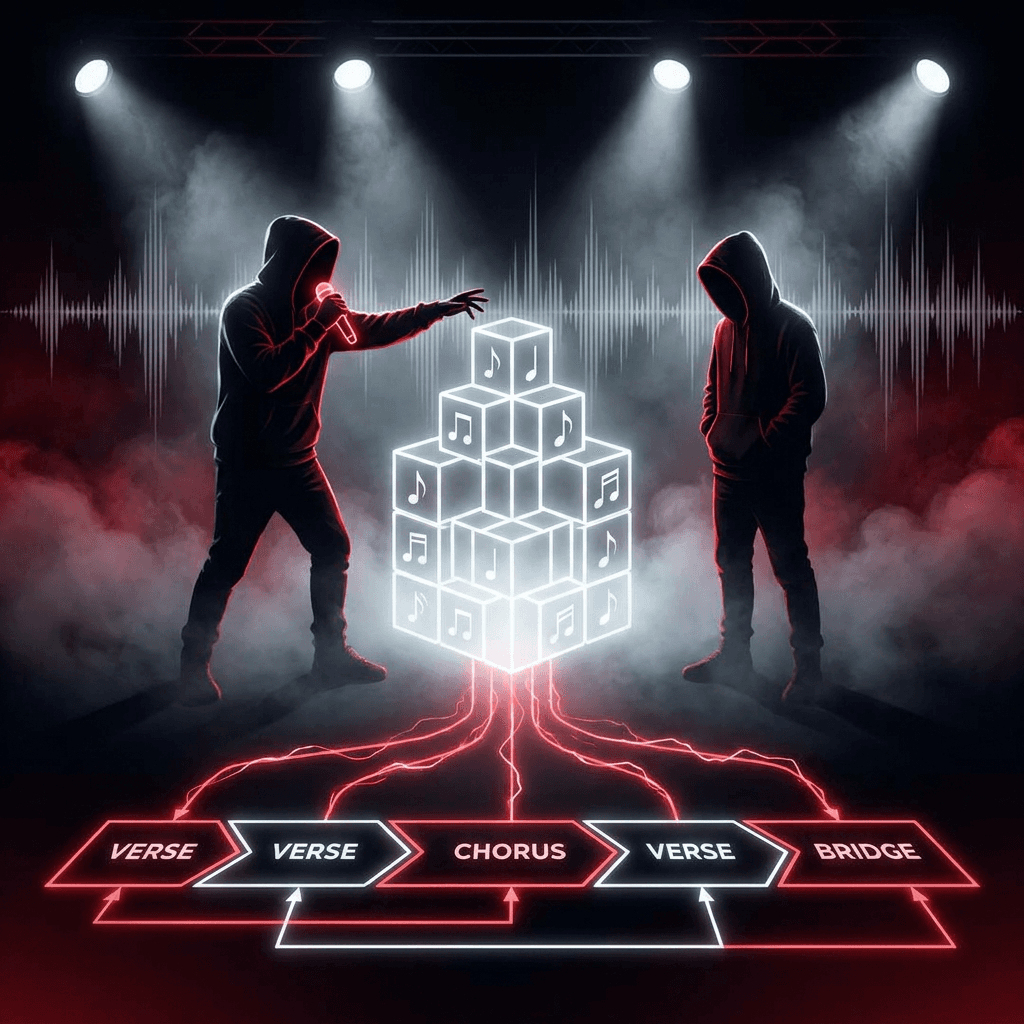
How to Structure a Song: From Bars to a Banger
You've got the loop. The drums knock, the bass is mean, and your first bars are talking reckless in the right way. Then the session stalls out. You can rap a hard 8, maybe even a clean 16, but turning that into a full record feels like trying to build a house from one brick and a lot of confidence.
That's where structure saves you.
A lot of artists hear “song structure” and think rules, school, and somebody trying to sand the edges off the art. In the studio, it's the opposite. Structure is how you decide when the punch lands, when the hook takes over, when the beat breathes, and when the listener gets pulled back in before they can drift. If you're making rap, hip-hop, drill, or a diss record, that matters even more because your track lives or dies on momentum.
Generic songwriting advice usually talks like every song is a diary entry with chords under it. That's not how a lot of rap gets built. Sometimes the mission isn't storytelling. It's pressure. It's presence. It's making every few bars feel like another hit to the chin.
You Have Fire Bars Now What
The usual problem isn't lack of talent. It's unfinished architecture.
A rapper walks in with a killer verse. A producer has a beat with crazy bounce. Everybody nods for the first minute. Then somebody asks the annoying but necessary question: “What's the hook?” After that comes the second one: “Are we doing another verse, or is this the part where the beat switches?” That's the moment where raw ideas either become records or stay voice notes forever.
Why good songs still fall apart
A lot of unfinished tracks fail for one of these reasons:
- The verse does all the work. You wrote strong bars, but there's no release, no contrast, no section people remember after one listen.
- The hook shows up too weak. In rap, the hook isn't decoration. It's the banner everyone carries out of the song.
- Everything sits at one energy level. Same cadence, same beat density, same vocal pressure. Even hard records can get flat if nothing changes.
- The arrangement doesn't support the lyric goal. A reflective verse structure won't help if the record is supposed to sound like a public execution.
Practical rule: If the listener can't tell when the song turns a corner, you probably don't have a structure problem on paper. You have an arrangement problem in the speakers.
Structure is a weapon, not a cage
The artists who sound effortless usually know exactly where each section earns its spot. They know where to bring the drums in, where to strip the beat, where to double the vocal, and where to stop rapping and let the hook do the heavy lifting.
That's the answer to how to structure a song. You're not filling boxes. You're controlling impact.
For rap, that means building around bars, breath, bounce, and replay value. For drill, it means keeping momentum violent and clean. For a diss track, it means treating structure like combat strategy. Every section needs a job, and if it doesn't have one, cut it.
Decoding the DNA of a Hit Song
The cleanest way to think about structure is this: every part of the song either sets up, delivers, switches, or exits.
 An infographic titled Decoding a Hit Song's DNA showing the five essential structural parts of a song.
The backbone underneath all of that is the 4-bar feel. According to Sonicbids on modern song form and bar structure, modern popular music commonly follows a strict multiples-of-4 bar rule, with sections like intros often at 4 bars, verses at 8 bars, and choruses at 16 bars. The same analysis notes that this matters in rap and diss tracks because the 4-bar foundation gives you precise places to land punchlines and rhyme schemes.
Intro
The intro's job is simple. It opens the door and tells the listener what room they just walked into.
In rap, a good intro doesn't overstay. It might be the sample alone, drums filtering in, an audio tag, a spoken line, or a stripped-down version of the hook melody. If your beat already has attitude, let the intro frame it instead of explaining it.
Use the intro to do one of two things:
- Build anticipation with less information than the full beat
- Hit immediately if the track's identity is obvious from the first sound
If the song starts with all the energy at once, make sure that choice is intentional. Otherwise you leave yourself nowhere to climb.
Verse
The verse is where you prove you can rap, but it also has to move the record forward.
A weak verse dumps bars in a pile. A strong verse develops pressure. Maybe the first few lines set the tone, the middle stacks details or threats, and the last bars tee up the hook. In hip-hop, the verse can tell story, flex, roast, or paint scene. In drill, it often works best when it keeps advancing the aggression without sounding crowded.
Chorus
The chorus, or hook, is the memory center.
This is the part people repeat badly in the car and still feel right about. It can be sung, chanted, layered, shouted, or half-rapped. It does not need to be complicated. It needs to be clear.
The hook should sound like the song's thesis, not a side note.
If your verse has detail, the hook should have identity. If your verse is technical, the hook should be easy to grab. Don't waste your strongest phrase in bar 11 of the second verse if it belongs in the hook.
Bridge and outro
The bridge gives the song a turn. Not every rap record needs one, but when it works, it adds contrast before the final return. That could mean a beat switch, a half-time feel, a new melodic texture, or a sharper lyrical angle.
The outro is your exit. Fade, final chant, ad-lib run, beat tail, or one last ugly line. However you leave, leave on purpose.
Proven Song Structures That Always Work
Some arrangements survive because they keep doing the job. You don't need to reinvent the floor plan every session.
The strongest default blueprint is ABABCB, which means Verse, Chorus, Verse, Chorus, Bridge, Chorus. Splice's breakdown of ABABCB song structure describes it as the single most common format in modern commercial music and the benchmark for hit construction. The same piece explains why it works: repeated chorus sections build familiarity, and the bridge adds contrast so the song doesn't turn into wallpaper.
The blueprint most rappers should start with
If you don't know how to structure a song yet, start here:
| Structure Name | Arrangement | Ideal Use Case |
|---|---|---|
| Standard ABABCB | Verse, Chorus, Verse, Chorus, Bridge, Chorus | Full songs with a clear hook and enough lyrical variety to justify a late switch |
| No-bridge rap format | Verse, Chorus, Verse, Chorus, Outro | Straight rap records that need focus more than contrast |
| Hook-first format | Chorus, Verse, Chorus, Verse, Chorus | Tracks built around a sticky phrase or club-friendly repetition |
| Long-form bar showcase | Verse, Verse, Chorus, Verse, Chorus | Cypher-style songs where bars lead and the hook is secondary |
That first format is battle-tested for a reason. The listener gets orientation fast. The verses carry content. The chorus returns before people forget it. The bridge makes the final hook feel earned instead of recycled.
If you want a deeper look at arranging sections for rap specifically, this guide on rap song structure is useful alongside your own session notes.
When to skip parts
Not every section belongs in every song.
Skip the bridge if the beat doesn't want one. Skip the second verse if the hook already said enough and another full 16 would drag. Add a pre-hook phrase only if it increases tension instead of stalling momentum.
Here's the trade-off:
- More sections give more contrast. That helps with dynamics and replay.
- Fewer sections keep pressure high. That helps when the record's whole point is direct impact.
A structure “works” when it supports the song's goal. Not when it checks every traditional box.
What usually fails
The most common miss is forcing a pop arrangement onto a rap idea that wants to stay raw.
The second common miss is making every section the same length because it looks neat in the DAW. Clean grids are nice. Better records are nicer. If one hook needs to hit and leave, let it. If the final section deserves extra ad-libs and a tail, give it room.
Keep Them Hooked From Intro to Outro
A good structure on paper can still sound dead if the energy never moves.
 An asphalt road winds through a lush green mountainous landscape under a bright, cloudy sky.
That's where arrangement and pacing do the work. According to Columbia's work on music structure analysis, one of the biggest structuring pitfalls is repetition fatigue. The same source points to practical fixes like changing dynamics, adding new instruments, shifting rhythmic pulse, and using marker labeling and color-coding in your DAW to visualize the arrangement.
Control tension instead of chasing loudness
A lot of up-and-coming artists try to make every section harder than the last by just stacking more sound. More hats. More doubles. More 808 movement. More ad-libs. That usually turns into clutter.
Better move: create contrast.
- Pull drums before the hook. Even half a bar of space can make the chorus feel bigger.
- Change vocal attack. A calm verse into a barked hook hits harder than shouting for the whole song.
- Add one fresh element. A counter melody, a new percussion loop, or a background chant can wake up a repeat section.
- Shift the groove. A half-time feel changes the body of the section without rewriting the whole beat.
Use your DAW like an arranger
The fastest studio trick for structure isn't glamorous. Label your sections.
Color the intro one color, verses another, hooks another, bridge another. Drop markers exactly where transitions happen. Once you can see the record, you'll hear weak spots faster. If the timeline looks like one long block of the same thing, it probably sounds that way too.
Here's a good arrangement mindset in action:
Tiny transitions make big records
You don't always need a beat switch. Sometimes one smart transition does the job.
A reverse crash into the hook. A drum fill before the verse. A quick vocal mute before the punchline. A filtered sample opening up right when the chorus lands. Those are small moves, but they tell the listener something changed.
If the section change only exists in your session layout and not in the sound, the listener won't respect it.
Keep asking one question: does each section feel earned? If not, don't just add more bars. Change the moment.
The Diss Track Blueprint Structuring for Savagery
Diss tracks play by different rules because the mission is different.
Most songwriting advice assumes the verse carries a story and the bridge gives you an emotional break. That's fine for a reflective record. It's weak medicine for a song built to apply pressure. Existing guidance often misses that problem, and this discussion of standard song structure limits highlights exactly that gap for punchline-driven formats like diss tracks, especially where pre-choruses can kill momentum in drill or trap.
 An infographic titled The Diss Track Blueprint listing five essential songwriting techniques for creating rap diss tracks.
Stop treating the diss like a normal song
In a diss record, the verse isn't just a place to “say your part.” It's ammo delivery.
That changes the structure immediately. You usually don't want a long ramp into the main idea. You want direct contact. In drill and trap, that often means skipping the pre-chorus entirely. A drawn-out setup can make the record feel polite, and that's not what this lane is for.
A stronger diss arrangement often looks like this:
- Short intro
- Verse loaded with direct shots
- Hook that repeats the central disrespect
- Second verse that escalates
- Final section that either switches energy or stacks the harshest lines
The bridge should escalate, not soften
In pop, the bridge often takes a scenic route. In a diss track, the bridge can be where you sharpen the blade.
Use it for a beat strip, a mockery chant, a direct-address section, or a slower delivery that makes every word sting more. If your song has a “most disrespectful moment,” save a lane for it instead of wasting it halfway through the first verse.
For more ideas on arranging bars, hooks, and escalation in aggressive formats, this breakdown of song lyric structure is a practical companion.
A clean diss template
Try this in your next session:
- Open fast. No long cinematic intro unless it adds menace.
- Land a punch every few bars. Don't let the verse drift into filler.
- Make the hook repeat the ugliest clear idea. Not your cleverest line. Your clearest one.
- Escalate in the second half. New angle, more direct naming, harder delivery, or a beat feel change.
- Leave a final scar. Outro tag, spoken line, or one last bar that people quote back.
A diss track doesn't need more emotion. It needs better targeting and cleaner pacing.
Your Turn to Build a Banger
You're in the session, the beat is right, the verse is talking, and then the record stalls because nobody knows what comes after bar 16. That's where a lot of rap songs lose their teeth. Bars alone do not finish records. Arrangement does.
The artists who close songs make section decisions early. They know what the hook has to carry, where the second verse needs a new angle, and when a beat switch, drop, or stripped-out moment will make the record hit harder. In rap, hip-hop, and drill, structure is less about storytelling formulas and more about pressure, replay value, and placement of your best lines.
Build from function, not habit
A lot of generic songwriting advice tells you to map an emotional arc like you're writing a pop ballad. That can help in melodic records. It can also water down a punchline track.
Start with the job of the section.
- Find the line that deserves to come back. That usually becomes the hook, the post-hook, or the last thing people quote.
- Check where the beat starts feeling flat. Add contrast there, cut bars there, or switch the cadence there.
- Decide what the record is selling. Story, flex, disrespect, pain, energy. The structure should serve that job.
- Save one strong moment for late in the song. If every best line lands in the first verse, the record peaks too early.
That's how strong rap records get built in real sessions. Piece by piece, with each section earning its spot.
Use tools like a producer, not a passenger
Writers use different workflows. Some mark out the full arrangement in the DAW before they write. Some write the hook first so they know what the verses have to support. Some sketch a rough draft, then cut whole sections once they hear what the beat wants.
Tools like DissTrack AI can help generate structured lyrics with clear sections, rhyme patterns, and alternate angles, especially if you're shaping a battle record or punch-heavy idea. If you need help turning rough generated text into something you can record and arrange, this guide on turning AI lyrics into a song is a useful next step.
 Screenshot from https://aidisstrackgenerator.com
The fastest way to get better at structure
Run an experiment on one beat.
Build three versions of the same idea. Cut one as a straight verse-hook-verse record. Cut one with the hook up front so the audience gets the payoff early. Cut one like a diss record, with shorter transitions, tighter hooks, and a last section built to leave damage.
You'll hear the lesson faster than you'll read it.
Structure is what turns a page of bars into a record people replay, perform, and remember. In punchline-driven genres, that matters more than following some neat story template that was never built for this lane.