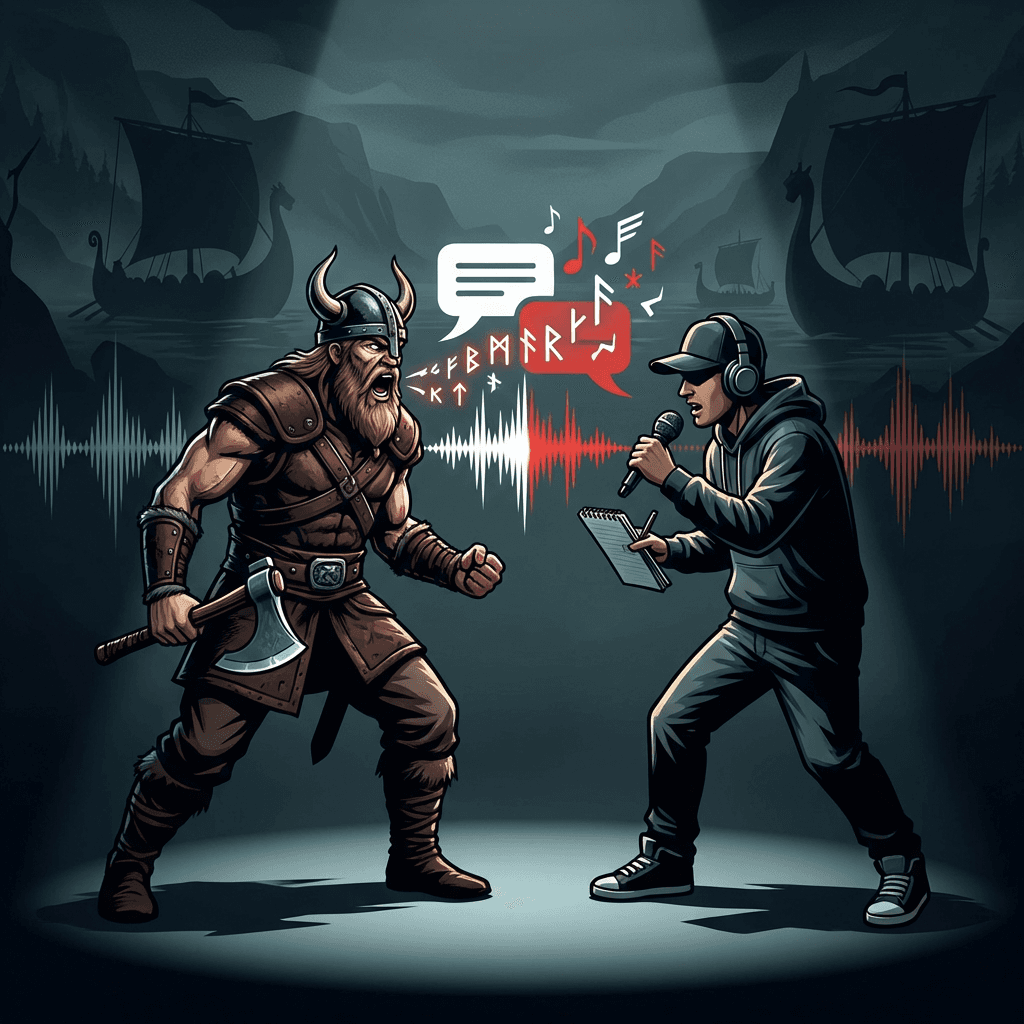
7 Viking Battle Cries & How to Use Them in Diss Tracks
You’re staring at a beat, a blank text box, and a target who needs to get smoked. The problem isn’t anger. You’ve got that. The problem is form. Most creators come in too wordy, too random, or too online. They throw memes, inside jokes, and weak insults into a verse and call it a diss. It lands like a group chat argument, not a strike.
That’s where viking battle cries get useful.
The Norse understood something battle rappers, streamers, and short-form creators still learn the hard way. A shout isn’t just sound. It’s timing, rhythm, identity, intimidation, and group energy compressed into a few syllables. In one documented discussion of battle cry phenomena, coordinated chanting by troops increased combat performance by up to 11% during engagement. That matters because it reframes the cry as a tactical tool, not theater.
The battlefield changed. The mechanics didn’t. A crowd chant at a live event, a repeated hook on TikTok, a savage opener in a YouTube diss, a stream alert the whole chat spams. Same principle. Hit fast. Hit together. Make the other side feel the pressure before your best line even lands.
Historical viking battle cries also sit in a weird blind spot online. Popular content leans toward modern recreations and entertainment edits, while people still ask what real Vikings shouted. That gap is useful for creators because it gives you a fresher palette than the usual recycled “I’m a savage” bars. You can borrow the structure, the energy, and the psychology without sounding like everybody else with a preset drill template.
So don’t treat this like museum content. Treat it like a field manual for lyrical warfare. These seven cries are valuable because each one maps to a different diss-track function: the charge, the invocation, the gore-shot, the flex, the principled attack, the craft-heavy humiliation, and the victory lap.
1. Úti á! (Out! / Forward!)
If you want one lesson from viking battle cries that transfers instantly to diss tracks, take this one. Short beats long. A clean command beats a cluttered setup. “Úti á!” works because it doesn’t explain itself. It moves people.
That’s exactly how strong diss records open. Think about the songs that hit immediately. The first line doesn’t arrive politely. It kicks the door in. In battle rap, the opening bar often decides whether the room leans in or checks out. In Shorts and TikTok, it decides whether the viewer scrolls.
 A man dressed in Viking style clothing wearing a fur cloak running and shouting near the ocean.
A lot of creators miss this because they confuse complexity with force. They write eight bars of exposition before the first real hit. By then, the moment’s gone.
How to use it in modern bars
Use “Úti á!” logic for your hook, your first bar, or your ad-lib pattern. Not as cosplay. As compression. Strip your idea to its hardest version, then say it in the fewest words possible.
If you’re building a roast with the AI rap battle generator, the “Battle Rap” style tag proves useful. Feed it a target, add one defining weakness, and force the output toward one-line attacks instead of long narrative setups. You want impact first, explanation second.
A practical formula works well here:
- Lead with a verdict: Start with what the opponent is, not how you discovered it.
- Use repeatable phrasing: If the line can become a chant, a comment spam, or a caption, it’s stronger.
- Stack sound, not clutter: Alliteration and internal rhyme can sharpen a short line without bloating it.
Practical rule: If your opener needs a footnote, it’s not an opener. It’s a paragraph.
This cry also works well for creators making clips. A compact phrase survives editing. It survives crowd noise. It survives reaction content. Long bars often die when they get chopped into snippets. Short attack phrases travel.
What works and what doesn’t
What works is aggressive simplicity. One phrase. One accusation. One repeated pressure point. That’s why the strongest diss hooks often feel obvious in hindsight. They were built to stick, not to impress a writing workshop.
What doesn’t work is fake minimalism. Some people hear “keep it short” and write something generic like “you’re weak” or “you’re done.” That’s brief, but it’s dead. The line still needs personality. Add texture through rhythm, not extra explanation.
Use this when you need instant momentum. Don’t use it if your entire strategy depends on layered references the audience won’t catch in real time. “Úti á!” is a battering ram. It’s not a legal brief.
2. Fyrir Óðinn! (For Odin!)
Some battle cries don’t just move bodies. They enlarge the meaning of the fight. “Fyrir Óðinn!” does that. It pulls a warrior into something bigger than personal fear. The cry says, in effect, this isn’t only about me. I stand for a force, a code, a tribe, a god, a banner.
That same move is lethal in diss writing.
A weak diss says, “I don’t like you.” A stronger diss says, “You represent everything fake about this scene.” Once your bars frame the target as a symbol of a larger problem, the attack scales. The audience stops hearing a personal spat and starts hearing a verdict.
Turn a personal roast into ideological warfare
Modern creators have an opportunity to get much smarter. You don’t always need a harsher insult. Sometimes you need a larger frame. If you’re roasting a content creator, don’t just hit their voice or outfit. Hit what they represent: clout-chasing, fake hustle, copied formats, industry politics, audience manipulation.
That’s the “For Odin” move in modern form. You invoke a larger authority, whether that’s authenticity, lyricism, your city, your crew, your mentor, your style lineage, or the culture itself.
A few smart applications:
- Invoke a code: Frame your attack around loyalty, originality, craft, or discipline.
- Invoke a lineage: Reference the kind of artist you’re trying to stand beside, not just the person you’re dissing.
- Invoke shared identity: If your audience already hates a pattern, name that pattern and make your target wear it.
This style suits longer YouTube disses and records with layered commentary. It also works in collabs where multiple artists attack from a shared angle. The energy becomes collective instead of merely personal.
You’re more dangerous when the audience feels like you’re defending something, not just venting.
The trade-off
There’s a line between grandeur and corniness. If you overinflate the stakes, the diss starts sounding theatrical in a bad way. Suddenly you’re talking like every minor beef is the fall of Rome. Nobody buys it.
So keep the authority specific. Use inside references your audience recognizes. If you’re generating with AI, load the prompt with names, scene politics, recurring habits, and community-coded details. “He’s fake” is weak. “He built his whole persona by remixing smaller creators and calling it innovation” is attack framing.
This is also one of the best lanes for medium-high savagery. You don’t need nonstop gore. You need conviction. The power comes from making the listener feel that the target deserves public correction.
Used well, “Fyrir Óðinn!” gives your diss moral altitude. Used badly, it sounds like costume drama. The difference is whether your claim points to something real your audience already senses.
3. Valrauðr! (Blood-Red! / Slaughter!)
This is the savage setting people think they want before they’ve written anything dangerous themselves. “Valrauðr!” is pure intimidation energy. It doesn’t suggest pressure. It announces damage.
In modern diss tracks, this is the shock lane. The bars are graphic, direct, hostile, and impossible to mistake for playful banter. This is the mode people reach for when they want a clip to explode in reaction channels or in ruthless group chats.
The upside is obvious. Nothing gets attention faster than a line that sounds like it crossed a line on purpose.
Shock works when it’s attached to craft
Plenty of creators fail here because they confuse offensiveness with force. They write the lyrical version of someone yelling in all caps. That isn’t scary. It’s sloppy. “Valrauðr!” energy only works when the brutality arrives with control.
The best way to do it is to make the line visual, specific, and rhythmically tight. If the audience can see it and quote it, the line lands. If it’s just random hostility, it doesn’t.
Use this mode carefully when you’re building in Trap or Drill. The tonal fit is natural. The drums already carry menace. But platform matters. A line that gets cheers in a private server may get buried, flagged, or instantly rejected on a mainstream short-form platform.
Where creators go wrong
Here’s the common mistake set:
- They overdo every line: If all sixteen bars scream at maximum level, none of them stand out.
- They abandon wit: Shock without wordplay feels juvenile fast.
- They ignore context: Dark humor among friends is one thing. Public upload strategy is another.
A better pattern is to use one or two “Valrauðr!” bars as kill shots inside a more controlled verse. Build tension, then unload. That gives the brutal moment contrast. Contrast makes violence feel bigger.
Don’t publish your most reckless version first. Generate hard, then edit for platform, audience, and replay value.
If you’re making content for friends or niche communities, this mode can be hilarious and devastating. If you’re building a public brand, check whether the aggression supports your persona. Some creators can sell savage energy. Others sound like they’re trying on someone else’s armor.
There’s also a reputation trade-off. Extreme disses get attention, but they can flatten your range if that’s all you do. If every track is blood and fire, people stop hearing the details. Save this cry for moments that deserve escalation. “Valrauðr!” should feel like a blade leaving the sheath, not background noise.
4. Herjann! (Warrior/Fighter!)
Some of the best disses don’t attack first. They establish authority. “Herjann!” is that energy. It’s the warrior naming himself as a force. No divine appeal. No theatrical blood spray. Just earned presence.
This is an important distinction in battle writing. There’s a version of confidence that sounds rented. Then there’s a version built from receipts. “Herjann!” belongs to the second category.
Self-assertion only works if it’s believable
A strong flex section does more than say “I’m better.” It gives the audience reasons to accept the claim. In rap terms, that might be skill, longevity, consistency, live performance, wit, output, audience command, or survival through multiple clashes.
That’s why this lane fits classic credibility records so well. The attack comes from standing, not scrambling. You’re not asking for a crown. You’re speaking like someone who already has territory.
When using AI, feed it your actual wins. Real performances. Real releases. Real scene details. Real in-jokes that signal status. If you leave the prompt vague, the output becomes generic self-praise. If you specify your edge, the bars feel inhabited.
A few strong prompt ingredients for “Herjann!” style writing:
- Track record: Past battles, releases, events, or community status.
- Specific competence: Flow, pen, stage presence, consistency, or production skill.
- Target contrast: Their talk versus your proof.
Why this approach ages well
Public attacks built on self-command often last longer than pure mud-slinging. The bars still work even if the original beef cools off, because they communicate identity. They tell listeners who you are under pressure.
That’s also why medium-high savagery usually beats full chaos here. You want steel, not tantrum. A “Herjann!” diss should feel like someone tightening a glove before a fight, not smashing furniture.
Confidence lands harder when the listener can trace it to something you’ve actually done.
The trap is over-claiming. If you talk like an untouchable legend and your audience knows you’re still unproven, they’ll turn on you instantly. Better to over-deliver on a narrow claim than exaggerate across the board. “Nobody in this lane can outwrite me on a one-minute clip” is stronger than “I run the whole genre” if the first claim is real.
Use this cry when your best weapon is credibility. Not outrage. Not shock. Not mythology. A diss built with “Herjann!” energy tells the opponent they picked a fight with someone who already knows how to survive one.
5. Drengr! (Bold/Brave One!)
Not every devastating diss has to sound bloodthirsty. “Drengr!” points at a different kind of strength. Courage. Honor. Audacity. The person who says the risky thing because it needs saying.
This matters more than people think. A lot of weak disses fail because they target easy flaws. Cheap jokes. Surface insults. Low-hanging fruit. Anyone can make those. It takes a bolder writer to press on hypocrisy, expose contradiction, or challenge a powerful figure without hiding behind vagueness.
That’s the “Drengr!” lane. Fearless, but not reckless.
Use bravery as a lyrical advantage
This style works best when your criticism is defensible. You’re not just trying to sting. You’re trying to reveal. If your opponent sells authenticity while copying everyone around them, hit that contradiction. If a platform talks community while burying smaller creators, make that the angle. If an artist acts untouchable but ducks direct competition, say it plainly.
For newer writers, this is also one of the healthiest paths because it trains real battle instincts. You learn how to stand on an argument, not just an insult. If you need help sharpening that instinct, a practical primer on how to freestyle rap for beginners can help you build the confidence to attack ideas in motion instead of freezing on punchlines.
The strongest “Drengr!” disses usually include:
- A clear accusation: No fog. Name the contradiction.
- A reason it matters: Tell the audience why they should care.
- A measured tone: Let precision carry the weight.
Why this builds loyalty
Audiences remember creators who take principled risks. Not because every line is the meanest, but because the attack feels grounded. It feels like someone put their name on a stance.
That makes this cry ideal for commentary creators, streamers, scene critics, and artists who want long-term respect more than short-term uproar. If your bars have a moral spine, people replay them for more than the insults.
The trade-off is speed. “Drengr!” punches don’t always go viral as fast as pure savagery. They often need listeners to process them. But they age better, and they can deepen your audience instead of just spiking reactions.
The boldest line in a diss often isn’t the cruelest one. It’s the one you can defend in public the next day.
Use medium savagery here. Let the courage come from clarity. If you start foaming at the mouth, you lose the very quality that makes this cry powerful. “Drengr!” isn’t blind rage. It’s composure under risk.
6. Skaldarníðr! (Poet’s Spite / Skald’s Fury!)
Viking battle cries hold particular interest for rappers. The Norse didn’t just value physical violence. They valued the skald, the poet who could preserve glory or ruin reputation through language. That matters because modern diss culture still runs on the same engine. The ultimate weapon is the pen.
“Skaldarníðr!” is the craft-heavy attack. Wordplay as humiliation. Structure as dominance. The listener doesn’t just hear aggression. They hear command.
 A bearded man in traditional clothing writes by a fire while shouting in the rain.
The smartest diss writers don’t waste lines
This mode is ideal if you want replay value. A savage line gets a reaction once. A layered line keeps getting quoted because people keep catching more in it. Double meanings, internal rhymes, mirrored phrasing, reversals, callback jokes, and compact storytelling all belong here.
If you’re using AI for this style, don’t stop at first output. Generate variations. Compare rhyme density. Lift one phrase from version A, a setup from version B, and a closer from version C. Then tighten the syllables manually. That’s how you get bars that feel authored instead of merely produced.
For sharper starting material, tools like the AI insult generator can help surface attack angles and phrasing you can later refine into actual rap structure.
Craft beats volume
Under-editing occurs frequently. It is often believed that more bars mean more damage. Usually the opposite is true. Dense writing wants selection. The nastiest crafted disses often cut half the draft.
Here’s a useful filter:
- Keep lines with layers: If a bar insults, characterizes, and sounds good, it stays.
- Cut obvious filler: Transition bars that only move the verse along usually weaken the whole.
- Preserve voice: Technical writing without personality sounds like a rhyme exercise.
“Write like a skald, not a spam account.”
This cry is perfect for YouTube releases, streaming tracks, artist portfolios, and any moment where you want people to respect the writing after the first laugh fades. It’s also the best counter to the idea that AI-generated disses have to sound generic. They only sound generic if you accept the first average answer.
The trade-off is accessibility. Hyper-crafted bars don’t always hit instantly in fast-scrolling environments. Some listeners need a second spin. That’s fine if your goal is authority. “Skaldarníðr!” is for creators who want to be known as dangerous writers, not just loud ones.
7. Framganga! (Forward/Victory! / Onward to Triumph!)
A lot of diss tracks get stuck in reaction mode. They spend all their energy talking about the opponent. “Framganga!” fixes that. It points forward. It says the story isn’t their failure. It’s your rise.
That shift is underrated. Once your verse starts projecting inevitability, the target shrinks. They stop looking like a rival and start looking like a delay. That’s a different level of psychological pressure.
Turn the diss into a future narrative
This mode works especially well when you’re launching something. A series. A campaign. A new era. A crew identity. You’re not merely roasting someone for the timeline. You’re using the clash to position yourself as what comes next.
That gives the track more life. The bars still function after the immediate conflict because they carry momentum. They say, “While you’re defending your name, I’m building mine.”
The visual logic matters too. Future-facing disses pair well with cinematic rollout content, episodic releases, and narrative captions. They don’t just tear down. They recruit.
 A person in a black cloak standing on a grassy hill with a scenic landscape background.
Why confidence often beats aggression
This is one of the few battle modes where lower savagery can make you sound stronger. If you’re too angry, you look entangled. If you sound certain, you look above the fight.
That doesn’t mean go soft. It means frame the target as already fading. Use contrast. Their stagnation versus your movement. Their repetition versus your evolution. Their local noise versus your growing reach.
A few effective “Framganga!” tactics:
- Predict your own ascent: Speak like success is underway, not hypothetical.
- Demote the opponent’s role: They aren’t your equal. They’re part of your origin story.
- Build installment logic: If you drop multiple tracks or clips, each one should show increased control.
This style is excellent for crews, collective channels, and artists who understand branding. It turns the diss into narrative architecture.
The risk is sounding smug before you’ve earned it. Future talk has to feel attached to movement people can already see. If you haven’t built any visible momentum, the prophecy sounds fake. But if you’ve got even a small wave forming, “Framganga!” can make that wave feel inevitable.
7 Viking Battle Cries Compared
| Style | Implementation Complexity 🔄 | Resource Requirements ⚡ | Expected Outcomes 📊 | Effectiveness ⭐ | Ideal Use Cases / Tips 💡 |
|---|---|---|---|---|---|
| Úti á! (Out! / Forward!) | Low, simple, punchy hook | Low, short lines; strong delivery | Immediate crowd engagement; viral hooks | ⭐⭐⭐⭐ | Best for TikTok/shorts, battle openers; use high energy delivery |
| Fyrir Óðinn! (For Odin!) | Medium, needs thematic framing | Medium, cultural/reference research | Adds narrative depth and ideological weight | ⭐⭐⭐⭐ | Artist-focused roasts, long-form videos; include clear cultural anchors |
| Valrauðr! (Blood-Red! / Slaughter!) | Medium, careful boundary management | Low–Medium, shock value over craft | High virality with high platform/ethical risk 📉 | ⭐⭐⭐⭐ | Use sparingly; content warnings, platform checks, balance with skill |
| Herjann! (Warrior/Fighter!) | Medium, requires verified credibility | Medium, background/examples to cite | Durable authority and long-term respect | ⭐⭐⭐⭐ | Artist-to-artist battles, industry disputes; cite real achievements |
| Drengr! (Bold/Brave One!) | Medium, careful target selection | Medium, evidence/context needed | Builds loyal following and principled reputation | ⭐⭐⭐ | Call-outs needing moral high ground; use defensible claims |
| Skaldarníðr! (Skald's Fury!) | High, demands strong lyricism & craft | High, time for writing and revision | Lasting reputation; multi-layered impact | ⭐⭐⭐⭐⭐ | Best for serious artists/portfolios; iterate variations and focus on wordplay |
| Framganga! (Forward/Victory!) | Medium, needs momentum framing | Medium, campaign/series planning | Positions creator as inevitable winner; sustainable growth | ⭐⭐⭐⭐ | Team/crew launches, legacy-building series; frame future dominance and follow-through |
Forge Your Own Legacy: The Modern Skald's Arsenal
The value of viking battle cries isn’t nostalgia. It’s function. Each cry compresses a different kind of pressure. One rallies. One sanctifies. One horrifies. One establishes authority. One rewards courage. One weaponizes craft. One claims the future. If you understand those roles, you stop writing random disses and start building targeted ones.
That’s the biggest shift I’d recommend to any creator making roast content, battle verses, stream bits, or full diss tracks. Stop asking, “How do I make this meaner?” Start asking, “What job does this line need to do?” If the job is instant momentum, borrow from “Úti á!” If the job is moral scale, work from “Fyrir Óðinn!” If the job is layered humiliation, sharpen “Skaldarníðr!” Every strong attack has a design logic behind it.
There’s also a reason this ancient material feels fresh in content strategy. Real viking battle cries remain underexplored in popular media compared with music-led recreations and TV-driven edits, even though people keep asking what real Vikings shouted and saga material does preserve examples such as “Forward, forward Christmen, crossmen, kingsmen!” from the Orkneyinga Saga at the Battle of Summerdale. One discussion of that content gap points to modern entertainment dominance around the topic, including Peyton Parrish’s “Battle Cries,” which has over 50 million YouTube views. For creators, that means there’s still room to do something less obvious and more distinct.
That gap matters on modern platforms. Most diss content looks and sounds interchangeable because everybody reaches for the same references, the same drill presets, the same rage language, the same recycled “smoke pack” posture. Viking battle cries offer a stronger creative shortcut. Not because you need to roleplay as a Norse raider, but because these cries force you to think in hard, memorable units of psychology. Charge. Belonging. Fear. Status. Honor. Wit. Momentum.
Use that framework when you prompt AI. Don’t just ask for a “savage diss.” That’s lazy input, and lazy input gets generic output. Ask for a hook with the compressed, charging force of “Úti á!” Ask for a second verse built on “Herjann!” energy, where the speaker asserts superiority through proven wins. Ask for a bridge that channels “Drengr!” by exposing hypocrisy with calm boldness. AI gets better when your intent gets sharper.
Then edit like a human who wants ownership. Change the obvious phrasing. Keep the angles that sound like you. Replace broad insults with details your audience recognizes. Test lines out loud. If a phrase doesn’t feel good in your mouth, it won’t feel good in the listener’s ear either. Delivery still decides whether a bar lives or dies.
That last step is where creators often leave power on the table. The battle cry wasn’t just written. It was performed. Volume, timing, breath, repetition, and group response all mattered. The same is true now. A ruthless line can flop if the delivery is flat. A simpler line can explode if the cadence is right. If you’re turning these ideas into short-form content, knowing how to do voiceovers on TikTok helps because the vocal layer often does as much damage as the lyric.
So take the lesson the Vikings understood early. Words aren’t decoration. They’re force multipliers. Used well, they make your side feel bigger and the other side feel smaller before the main strike even lands. Build your hooks like commands. Build your verses like pressure systems. Build your persona like a banner people want to follow. That’s how modern skalds make noise that matters.
If you want battle-ready lyrics without staring at a blank screen, try DissTrack AI. It gives you personalized roast bars, multiple style options, adjustable savagery, and fast variations you can shape into your own voice. It’s one of the easiest ways to turn a rough attack angle into a clean diss, a viral short, or a full track worth releasing.