
Advanced Rap Techniques: A Practical Guide to Sharper Bars
You can already write a clean 16, but the room still passes you by. The verse looks tight on paper, the cadence feels solid in your head, then somebody else walks in with denser rhyme chains, cleaner breath control, and a line that lands like it was built for the beat instead of parked on top of it. That gap usually isn't talent. It's advanced rap techniques, and the good news is that they're trainable.
The biggest shift is learning to build bars the way producers build records, with structure, layering, and intent. Modern rap increasingly rewards denser internal rhyme, broader vocabulary, and more strategic phrasing than older, simpler writing patterns, and one analysis found rhyme density rose 34.2% from the 1980s to the 2020s, with average rhymes per line moving from 1.73 to 2.32, while vocabulary diversity also rose 23.7% in the same span (study on lyrical complexity). That doesn't mean speed wins. It means precision wins.
If you've been looking for a practical way to tighten verses, sharpen angles, and stop sounding flat over a beat, this is the lane. I'd also keep a notebook open while checking out video production ideas from LunaBloom AI, because the same discipline that makes a verse land usually makes a performance clip hit harder too. The point is simple, learnable craft, not mystery.
Why Most Rappers Plateau and How Advanced Technique Fixes It
A lot of rappers hit a ceiling after the basics feel comfortable. They can rhyme, stay in time, and freestyle enough to get through a session, but their bars start sounding predictable because the writing never moves past matching end words.
That plateau usually comes from technical habits, not from a shortage of ideas. A verse can carry real content and still lose the room if the rhymes sit in obvious places, the accents miss the beat, or the delivery stays in one shape too long.
Density beats decoration
Analysts working in lyric-complexity research have tracked a steady rise in rhyme density, broader vocabulary, and more complex writing patterns in rap over time, which lines up with what listeners respond to in the room. The practical takeaway is simple, verses that feel considered and layered usually travel further than verses that only sound loud (lyric complexity analysis).
That is why this guide focuses on measurable technique. If you can hear where your rhymes sit, how your breath moves, and how your words line up with the bar, you can correct weak spots instead of guessing at them. That separates writing bars from engineering them.
Practical rule: if a verse only sounds good when you read it silently, it is still not finished.
A plateau is fixable because the problem is mechanical. Once you control rhyme placement, meter, pitch, and angles, your writing gets more options instead of more limits. A battle-ready verse comes from repetition, pressure testing, and honest revision.
Use the same mindset when you build other creative assets. I keep a notebook open while checking video production ideas from LunaBloom AI, because the same discipline that makes a verse land usually makes a performance clip hit harder too. If the hook, framing, and pacing are sharp, the work feels intentional before anyone even processes the details.
An AI generator can help here if you treat it like a sparring partner. Feed it a rough angle, ask for alternate rhyme clusters, then keep what survives contact with your ear and your beat. It should pressure-test your choices, not write your verse for you.
The Anatomy of an Elite Bar and How to Score Your Own
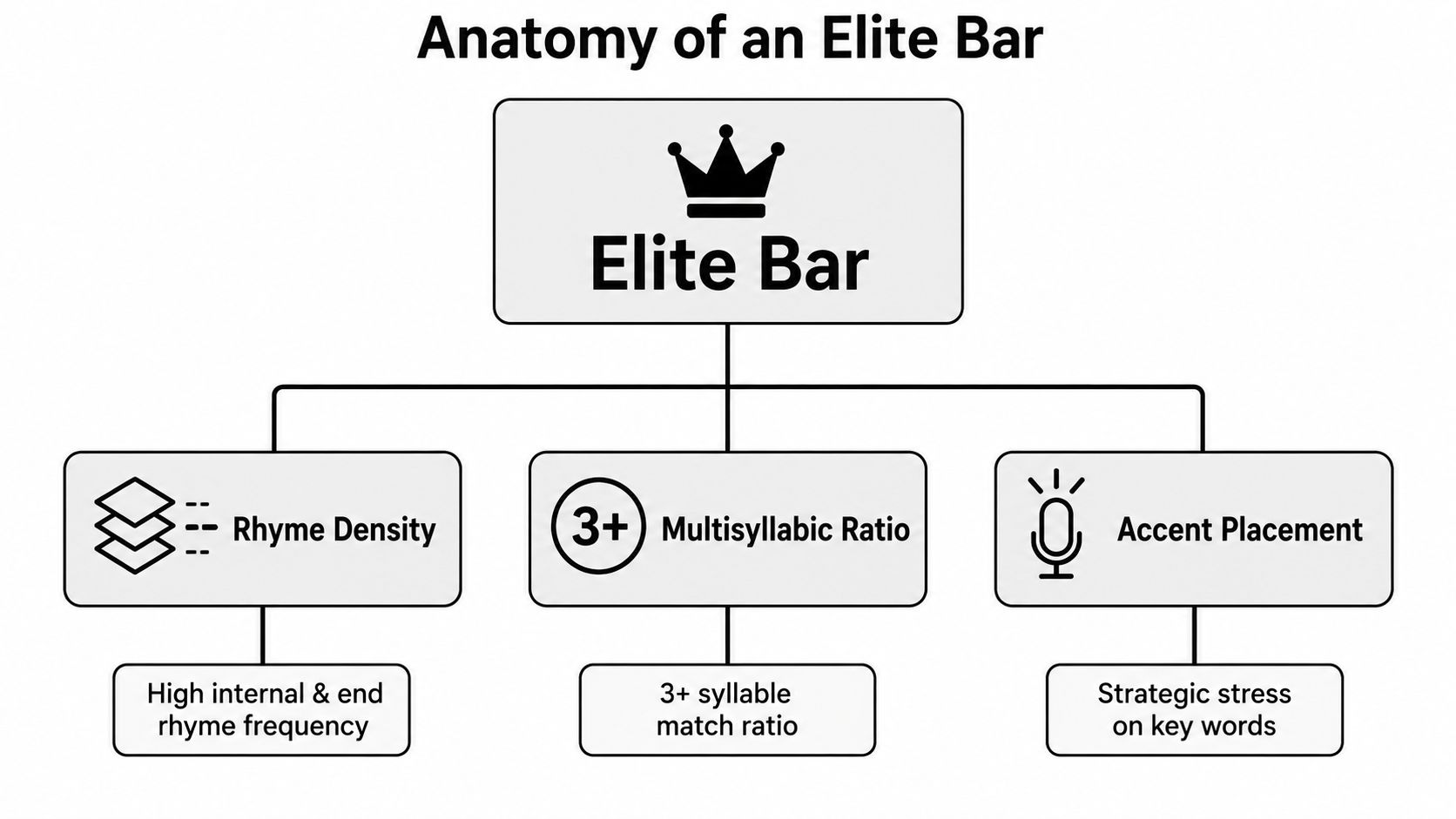 A diagram illustrating the anatomy of an elite rap bar, highlighting rhyme density, multisyllabic ratio, and accent placement.
Run a bar like you are grading it for the room, not for the page. A clean line can still miss if the accents are off, the rhyme load is thin, or the sentence ends in the wrong place. What separates a throwaway from an elite bar is control over rhyme density, multisyllabic rhyme ratio, accent placement, syntactic alignment, and pitch contour. Rap-flow research also points to the timing of rhyming syllables, the timing of accented syllables, how syntax fits bar boundaries, and how many syllables land per beat as core metrical variables (flow research overview).
A simple scoring rubric
Use this on any four bars.
| Variable | What to listen for | Pass or fail cue |
|---|---|---|
| Rhyme density | How often rhymes recur inside the line | More than just the last word doing the work |
| Multisyllabic ratio | How many rhymes stretch across more than one syllable | The rhyme sounds locked, not single-note |
| Accent placement | Which words the beat naturally highlights | Key words hit the pocket, not the gaps |
| Syntax alignment | Where your sentence ends versus where the bar ends | The thought resolves cleanly on the measure |
| Pitch contour | Where your voice rises, drops, or holds | The verse has shape, not monotone |
A quick self-score works best when you mark one bar at a time. Circle the stressed words, underline every internal rhyme, and draw a slash where the breath lands. If a line only gets interesting because of the final rhyme word, it is still underbuilt.
That same habit also shows you where the bar is carrying real weight and where it is coasting. I like to score a line twice, once on paper and once over the beat, because weak syntactic alignment often hides until the pocket starts moving. For a useful companion on multisyllabic rhyme practice, use this guide to multisyllabic rhymes and compare the patterns you hear against the patterns you write.
What a strong bar is doing at once
A strong bar usually handles three jobs at the same time. It paints an image, it sits inside meter, and it hides extra rhyme inside the phrase. That is the difference between a line that reads clean and a line that hits in performance.
Look at dense writing from an MC like Nas or Eminem when the verse is really moving. The line is usually carrying image, rhythm, and hidden rhyme together, so the listener catches the shape before they catch every piece of the construction. Eminem's debut Infinite was analyzed with rhyme density measured at 0.83 on opening bars and 0.40 across the album, with 58% multisyllabic rhymes in that comparison set, a useful reminder that technical control can show up even before the big commercial era (analysis of Infinite).
The best bars do not compete with the beat, they make the beat sound more precise.
Score your own four-bar run the same way every time. If two variables are weak, the line needs another revision before it is ready for a hook, a cipher, or a battle round. If the bar only sounds good when you read it on paper, it is still not finished.
Engineering Multisyllabic and Internal Rhymes
The fastest way to sound advanced is not to cram more words in. It's to make the rhyme pattern feel inevitable. Internal rhyme does that better than end rhyme alone because it gives the listener something to catch before the bar closes.
A weak couplet says the obvious thing twice. A stronger one plants rhyme in the middle, then resolves it at the end. That gives the ear a trail to follow.
Build from a target word
Start with one anchor word, then work backward. Pick a word with a clear vowel family, list companion sounds around it, and draft a phrase that lands at least two rhyme hits in the bar without breaking the meaning. Once you've got the skeleton, stress-test it against the beat by speaking it slowly and checking whether the consonants still stay crisp.
A usable process looks like this:
- Choose a target word. Pick the word you want the line to land on.
- Map the vowel family. Find near-sounds and slant matches.
- Place one internal rhyme early. Don't save everything for the last word.
- Add a second rhyme or echo. Keep it natural, not stuffed.
- Read it over the beat. If you lose clarity, trim the line.
The reason this works is simple. Multisyllabic rhyme gives the ear a pattern to hold onto, and the line starts feeling composed instead of assembled.
Rewrite a flat bar into a dense one
Flat, “I'm the nicest in the city, they can't test my game.”
Engineered, “I'm the nicest in the city, they can't press my name, every lesson I deliver makes the exit lane.”
The second version does more because the internal rhyme chain gives the line motion. The idea stays intact, but the sound pattern now carries the weight.
If you want a deeper rhyme lab, the internal-building logic in this multisyllabic rhyme guide fits well with the drill here, especially if you're trying to move from obvious end rhymes into tighter chain work.
Coach's note: if the rhyme gets so dense that the meaning gets blurry, you've overcooked it.
For practice, take one weak bar you already wrote and rewrite it three times. Each pass should add one more internal rhyme, slant rhyme, or echo, but the meaning has to survive every version. That's how you build a rhyme library that you can use in a session, not just admire in a notebook.
Cadence, Breath Control, and the Four Metrical Variables
Flow breaks when rappers treat it like mood instead of architecture. The beat does not care how heavy the verse feels in the room. It cares where the syllables land, which words take stress, and whether your lungs last through the last bar.
Rap-flow analysis points to four metrical variables that matter most, rhyme-syllable placement, accented-syllable placement, syntax alignment with bar boundaries, and syllables per beat. On the vocal side, strong delivery also depends on legato versus staccato feel, consonant clarity, and microtiming against the beat. That is a lot to hold at once, so the work needs a clear ladder, not guesswork.
Breath belongs in the plan, not the emergency
Set your breath points before you record. Do not wait until you are gasping halfway through a take and guessing where to inhale. If the line is dense, place the inhale at a syntactic break, not in the middle of a thought.
Pacing matters just as much. Start slow, rehearse the bars with deliberate consonant stress, then raise tempo only when the accents still sit where you placed them. The goal is not speed for its own sake, it is control at any speed.
Use this ladder on one eight-bar loop:
- Half speed first: speak the verse cleanly and mark every breath.
- Medium speed next: keep the same accent pattern, cut any filler.
- Full speed last: only increase tempo if the consonants still pop.
- Record a pass: listen for drift, rushed endings, or swallowed vowels.
What ruins good cadence
Three mistakes show up again and again. Overstuffing syllables makes the verse sound packed but sloppy. Drifting off-beat makes even clever writing feel unstable. Letting syntax fight the meter turns a good line into a mouthful.
A clean way to train this is to separate the writing pass from the performance pass. Draft the bar first, then speak it over the beat and mark where the breath, stress, and line break sit. If the bar only works on paper, the cadence is not finished. If you need a reference for vocal pacing and articulation drills, this voice-focused guide fits the same kind of practice.
The best cadence feels deliberate without sounding stiff. That comes from repetition, correction, and hearing your own timing against the beat until the pattern holds under pressure.
Metaphor, Wordplay, and Punchline Construction
Wordplay is where technique starts sounding like personality. A bar with a clean rhyme pattern is solid, but a bar with a layered image and a sharp turn sticks because the listener gets two or three meanings at once.
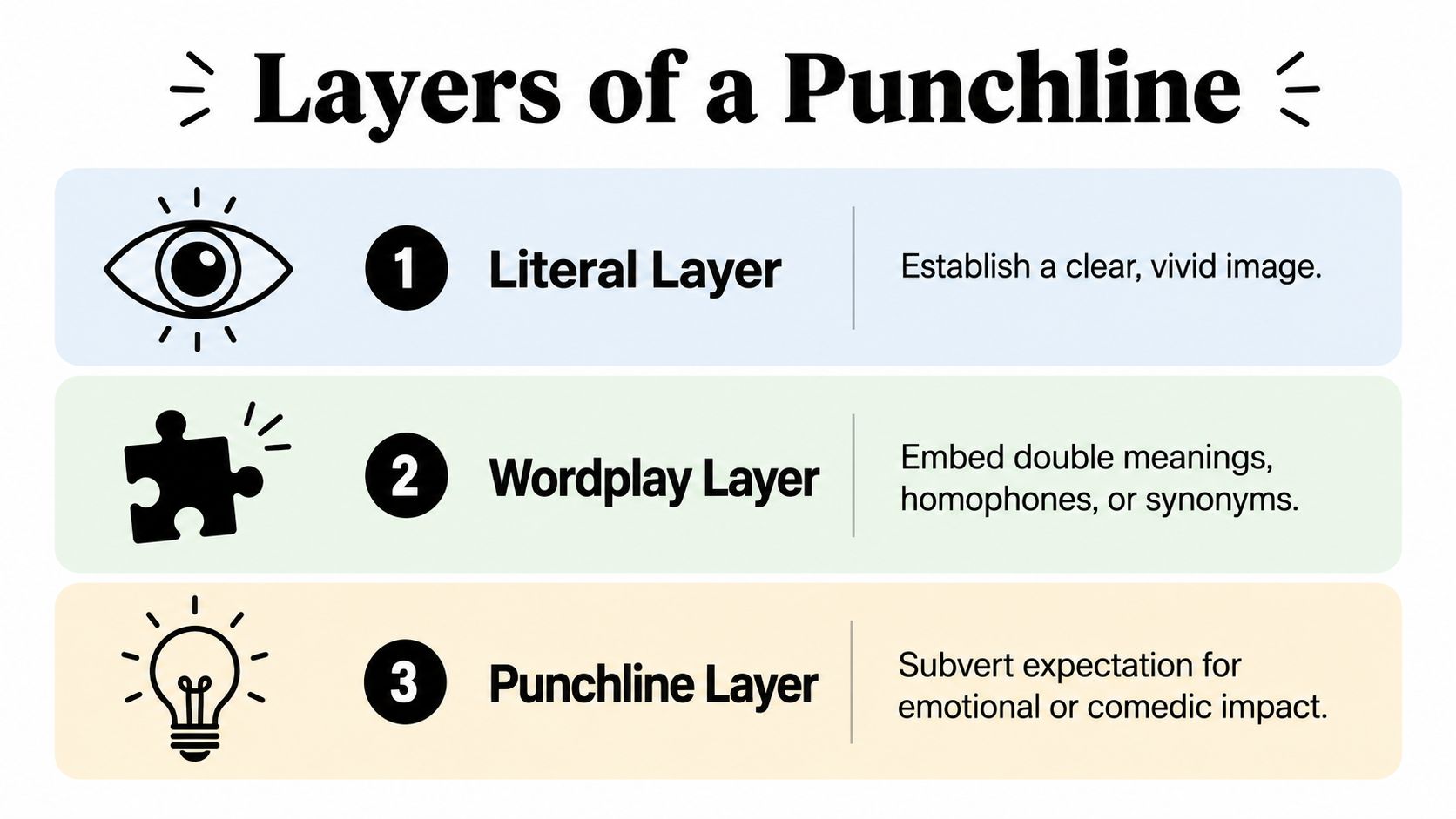 An infographic titled Layers of a Punchline showing three distinct steps for crafting effective comedic lines.
Build the line in layers
The strongest punchlines usually move through three layers. First, establish a literal image. Second, hide a double meaning, homophone, or synonym. Third, flip the expectation so the bar lands with a sharper emotional or comedic effect.
A weak bar says, “I'm on top of my game.”
A layered bar says, “I'm on top of the game, but I still stay low, like a roof leak hiding in plain sight.”
That second line works because the image is visible before the turn arrives. The listener gets the roof image, then the meaning shifts under it.
Delivery helps the setup
Punchlines usually land better when the voice helps the listener brace for the turn. A slight pause before the final word, a pitch rise, or a tighter consonant hit can signal that the end of the bar matters. Just don't decorate the line so much that the consonants disappear.
A good rewrite drill is straightforward. Take one of your own bars, keep the syllable count roughly intact, and add one homophone plus one metaphor without losing the original meaning. If you can do that, your writing starts carrying more weight per line.
For another practical breakdown of setup and payoff, this punchline guide is a useful companion when you're trying to tighten the mechanics before you chase bigger laughs or harder landings.
Rule of thumb: if the punchline needs a long explanation, it isn't finished yet.
Wordplay should feel like the bar found its own trapdoor. When it hits clean, the crowd hears the idea and the twist at the same time.
Building Battle-Ready Angles and Rebuttals
An angle is not just “talking about somebody.” It's a personalized route into their identity, habits, public persona, or contradictions, and it only works when the setup feels specific enough to sting. Battle rappers know this instinctively, but a lot of written content stops at the definition and never shows the workflow.
 Screenshot from https://aidisstrackgenerator.com
Turn raw info into a setup
Start with the target's name, persona, or public behavior. Then list five personal anchors, maybe a habit, a nickname, a known weakness, a public moment, and one detail that only close listeners would catch. Pick the two that carry the most emotional charge, then build a line that connects them through a rhyme pattern instead of naming them nakedly.
That's where the angle gets dangerous. If the listener can feel the setup coming, the bar has room to breathe before it lands. If the wording is too direct too early, you lose the sting and the line sounds like a caption.
A workable template looks like this:
- Research the target: name, persona, habits, public choices.
- List five anchors: personal details, not generic insults.
- Choose two with heat: the ones that create tension.
- Build the layered line: hide the angle inside rhyme and syntax.
- Leave a rebuttal slot: so the next bar can answer the first one.
Let the beat carry the insult
Angles work best when the rhyme pattern doesn't feel forced around the diss. The beat should still control the pocket. That means the insult has to sit inside the cadence, not step on it.
One practical way to speed up ideation is to use an AI sparring partner, not as a ghostwriter, but as a rough draft machine. A tool like DissTrack AI can generate personalized roast verses from a target's name, relationship, and inside jokes, then you can keep the angle, cut the filler, and rewrite the phrasing so it sounds like you.
If you want another benchmark for what a slick roast workflow looks like, PostSyncer's AI roast page is useful as a comparison point for how these generators package punchlines and structure.
Here's the kind of prompt that keeps the output usable: target name, relationship to you, one shared joke, one public habit, and the tone you want. What comes back should be treated as raw material. Keep a strong angle, rewrite any weak rhyme, and remove anything that sounds generic or overexplained.
The mistake is treating AI like a crutch. The smart move is treating it like a sparring partner that throws wild openings so you can sharpen your rebuttal, tighten the meter, and make the final bar sound human.
A Seven-Day Practice Plan and Performance Checklist
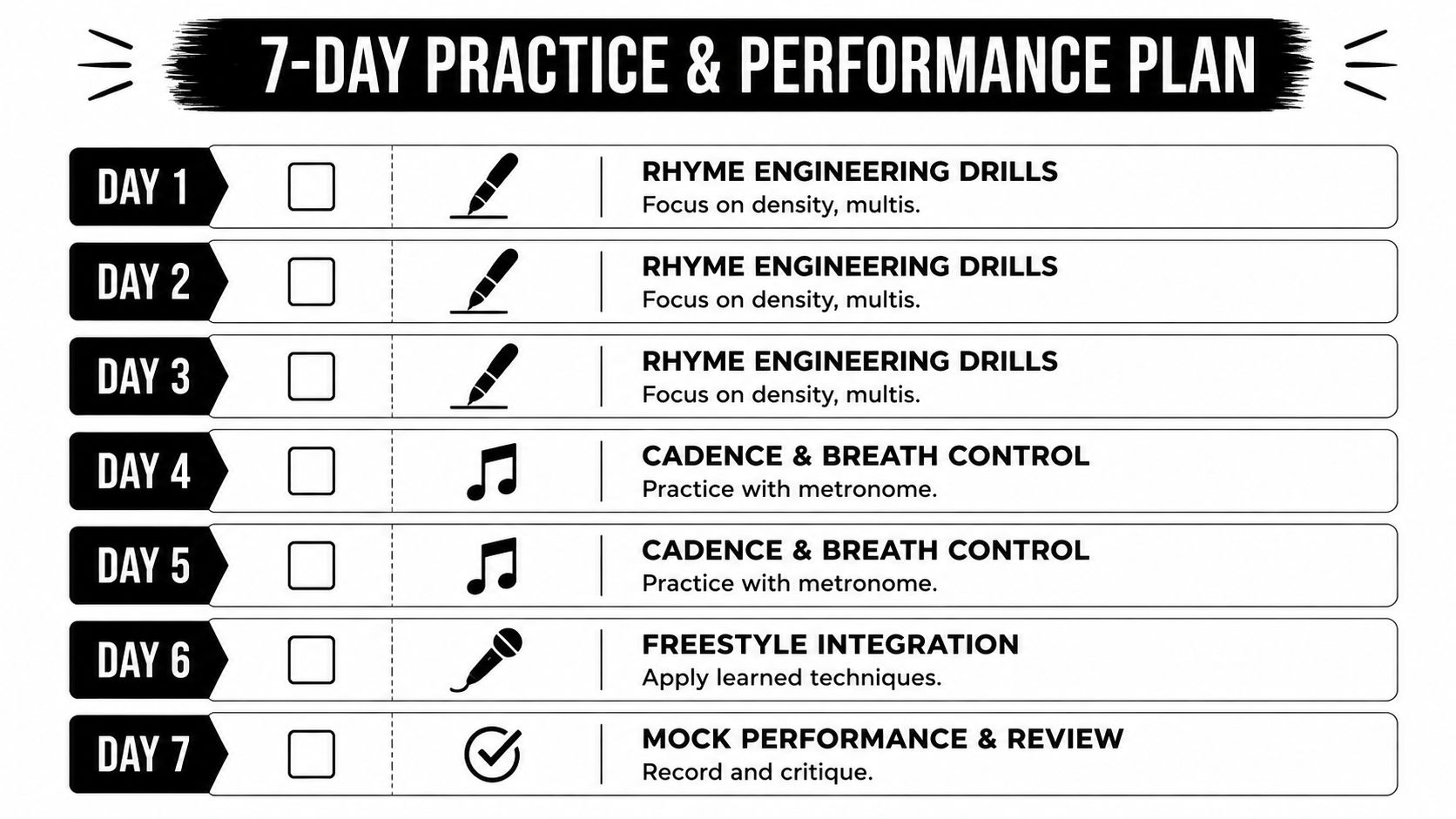 A 7-day practice and performance plan chart for rappers outlining daily drills to improve technical skills.
A week of focused reps beats a month of random writing. The trick is to stop treating rhyme, cadence, wordplay, and angles like separate homework assignments, because they stack in the booth whether you train them together or not. One strong eight-bar verse each week, scored against the bar anatomy rubric above, will expose more gaps than ten loose freestyles.
The weekly drill plan
- Day 1, Rhyme engineering: write four bars with at least one internal rhyme per bar. Keep it clean, no extra filler.
- Day 2, Multisyllabic focus: take one target word and generate three rhyme families around it. Speak each version out loud.
- Day 3, Rewrite day: choose a weak line and rewrite it twice, each version denser but still clear.
- Day 4, Cadence and breath control: rap one eight-bar loop at half speed, then medium speed, then full speed.
- Day 5, Meter check: mark accent placement and breath points on paper before recording.
- Day 6, Freestyle integration: freestyle for one beat cycle using one punchline and one angle.
- Day 7, Mock performance: record a full run, then listen back for off-beat lines, swallowed consonants, and breath failures.
What to check before you record
Your delivery only needs a few things to be booth-ready. Warm your voice, lock the beat in your head before the take starts, and decide which word in each bar carries the stress. If you go in cold, the first bad take usually creates a sloppy habit for the rest of the session.
Use this final checklist:
- Mic posture: stand or sit the same way you'll perform.
- Breath map: know where every inhale happens.
- Consonant focus: hit the hard sounds cleanly.
- Pitch control: keep contour intentional, not random.
- One mental cue: pick a single reminder, like “stay in the pocket.”
The biggest plateau comes from treating these skills as separate buckets. They aren't. Rhyme engineering feeds cadence, cadence feeds wordplay, wordplay feeds angles, and angles feed battles or records. If you want a daily sparring partner that throws new targets, new setups, and raw roast material at you, use DissTrack AI to draft, then edit the output until the verse sounds like your voice, your timing, and your pressure.
If you're serious about tightening your bars, open your notebook tonight, pick one eight-bar verse, and run the scoring rubric on it before you write anything new. Then take the roughest line and rebuild it with rhyme, cadence, and meaning all doing real work.