Commercial License NY: Can You Sell AI Lyrics?
For most uses in New York, you can use AI-generated lyrics commercially if the generator's license allows it, but no New York permit grants those rights or clears the beat, voice, or real person named in the track.
You've got a vicious verse, a beat that fits, and a sponsor willing to pay for the video. Then someone asks whether you have a commercial license, and suddenly you're searching government websites instead of fixing the hook. The useful question isn't just whether you can sell the lyrics. It's which parts of the finished release you have permission to use.
The Short Answer for Each Way You Use Lyrics
Commercial permission starts with the generator's terms, not a government certificate. You also need to avoid adding material you don't control, whether that's a borrowed backing track, a recognizable voice, or someone else's recording.
Treat the following classifications as a practical release screen, not a legal ruling. A private joke and a sponsored campaign deserve different scrutiny, even when the punchlines are identical.
Commercial Status by Use Case
| Use case | Commercial status | Check first |
|---|---|---|
| Private joke, never posted | No public use | Your AI provider's personal-use terms |
| Free social post, no ads or sales | Lower risk for original lyric text, not automatically safe | Beat source and whether the roasted person is identifiable |
| Monetized video with ads, sponsors or tips | Treat as commercial use | Commercial license terms, cleared beat, platform rules |
| Released on streaming services | Treat as a full commercial release | Cleared audio, distributor rights confirmation, performing-rights registration where appropriate |
| Sold as a product or delivered to a client | Commercial sale | Written client agreement and applicable business registration |
| Used in a brand advertisement | Highest scrutiny among these uses | Written consent for identifiable people where required, disclosures, cleared assets |
A private joke still needs to fit the tool's terms, but there's no public release to clear. Keep it private rather than assuming that sending it to a group chat guarantees it stays there.
A free social post isn't a rights-free zone. Removing the payment button doesn't turn an uncleared beat into your beat or make an identifiable target fictional.
For a monetized video, read commercial permission broadly enough to cover sponsorships and tips, not just advertising revenue. A brand can benefit from content even when viewers don't pay to watch it.
A streaming release needs a complete audio-rights review. Don't confuse registering eligible works for royalty collection with obtaining permission to use somebody else's material.
For client delivery, agree on what you're supplying: editable text, a recorded performance, a finished master, or some combination. Don't promise exclusive ownership merely because the client asked for an exclusive invoice.
A brand advertisement deserves the toughest review. A roast that feels like entertainment on your account can suggest endorsement when a company puts its logo beside it.
Practical rule: If money, a brand, or a public audience is involved, use a commercial-release review process. That's a cautious workflow, not a claim that every public post has the same legal status.
Lyric text is often the easiest layer to inspect. The trouble usually arrives wearing headphones: beats, voices, and recognizable targets.
Why New York Has No Single Commercial License
Search for commercial license NY, and you will find paperwork, not a magic permit. New York uses activity-specific and jurisdiction-specific requirements. Business authorization works like the shop's front-door paperwork, not a receipt proving you own everything on the shelves.
The New York business-licenses portal directs businesses toward Business Express, identifies entity formation, Tax Department registration, and appropriate insurance as foundational startup areas. It also explains that New York LLCs and corporations have an ongoing Biennial Statement obligation every two years.
Build Your Business Profile First
Before choosing permits, document your operating address, customer locations, sales channels, business structure, and New York employees or physical operations. A home-based lyric-writing business and a studio with public events should not use the same checklist.
A software platform without a studio, retail location, or regulated service may not need a specialized operating license. That does not erase entity, tax, consumer-protection, privacy, or contract obligations. Ask a New York accountant to classify what you sell rather than assuming every digital product has identical tax treatment.
Keep website terms separate from government paperwork. You can browse the site's copyright conditions as an example of how published content-use rules appear on a site. Permission still has to come from the relevant rights holder, and a business registration does none of that work. If your track uses a lyric text, a beat, a voice, or a named target, each layer needs its own clearance logic. A state filing will not turn someone else's contribution into yours.
New York Compliance Checks for a Lyrics Business
| Compliance area | Level | When it applies |
|---|---|---|
| Business Express questionnaire | State | Run first to identify applicable permits |
| Entity formation | State | Before operating as an LLC or corporation |
| Tax Department registration | State | Assess when selling; register when your activities require it |
| Appropriate insurance | State and activity-specific | Evaluate at startup; requirements follow operations, staffing, and applicable rules |
| Biennial Statement | State | Recurring filing for New York LLCs and corporations |
| Municipal permits | County, city, town or village | Check separately for your operating location |
Run Business Express, then contact the relevant municipality separately. Save the results with your business records. If your setup changes, such as adding employees or opening a physical studio, reassess the requirements rather than recycling the original answers. Treat this as business setup hygiene, not clearance for expression. For that, get advice from a lawyer when money, a brand, a public audience, or a recognizable person is in play.
Who Owns AI-Generated Lyrics
Permission to use lyrics and ownership of copyright aren't the same thing. A generator can give you contractual permission to exploit an output without guaranteeing that you can stop everyone else from using similar language.
US copyright generally requires human authorship. Don't assume that text produced entirely by a machine from a prompt qualifies for protection, or that typing a detailed prompt makes every resulting line exclusively yours. Have a copyright attorney assess the human contribution before promising enforceable exclusivity.
 A wooden workspace desk featuring a laptop, a closed journal, a pencil, and a coffee mug.
Commercial Permission Isn't an Ownership Certificate
Think of a machine that builds a sandcastle. You might have permission to use the result and sell tickets to see it, but that doesn't necessarily give you exclusive rights over its design. A commercial license answers what the provider permits, not every question copyright law asks.
Human rewriting can change the analysis. Original punchlines, rewritten passages, and creative arrangement may contain protectable human expression, but a cosmetic spelling change isn't a reliable ownership strategy.
For a closer look at that distinction, use this guide to copyrighting lyrics to a song when preparing your authorship records.
Keep Evidence of Your Contribution
Build a project folder that separates machine output from your creative work:
- Original generation: Save the prompt and untouched output before editing.
- Human revisions: Keep tracked changes or dated drafts showing rewritten lines and arrangement decisions.
- Accepted terms: Preserve the license version that applied when you generated and exported the material.
- Delivery record: Save export dates, final files, and the agreement describing what a client receives.
Read the contract for exclusive versus non-exclusive rights, resale, client delivery, and text versus audio coverage. Check whether free and paid tiers use different terms instead of assuming payment automatically buys ownership.
You can have permission to sell something without having the power to stop everyone else from copying it.
That distinction matters most when a client requests exclusivity. Promise only the rights you can document, and get legal review before signing warranties that go further.
The Rights Stack Behind Every Diss Track
A diss track is a sandwich with paperwork between the layers. You can own the filling and still have no right to serve the bread.
A New York business registration doesn't grant rights to copyrighted beats, samples, melodies, recordings, or lyrics. The New York Senate legislative materials on music licensing describe permission requirements for businesses using copyrighted music publicly and the role of performing-rights organizations in licensing public performance of represented works.
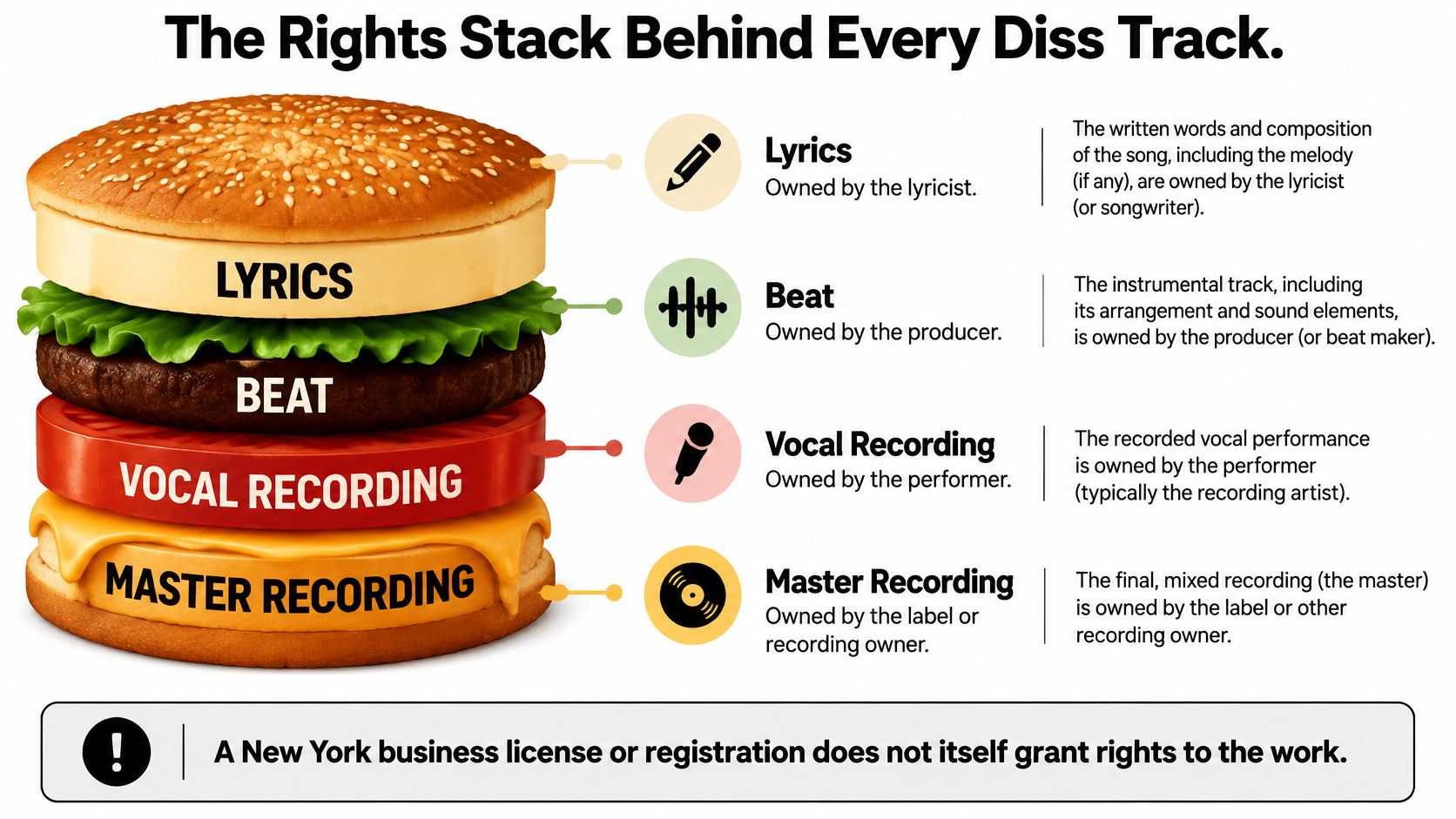 A burger illustration explaining the four layers of music rights behind a typical rap diss track.
The illustration is a useful starting point, not an ownership verdict. Contracts can assign rights differently, and AI-generated lyrics don't automatically have a human copyright owner.
Rights Layers in an AI Diss Track
| Rights layer | Who controls it | Typical risk | What you need |
|---|---|---|---|
| Lyric text | Your human contributions and the generator's contractual terms | Uncertain protection for purely machine-made text | Written terms granting commercial use |
| Beat or sample | Relevant producer, composer, publisher, or recording owner | High if uncleared | Beat license and any necessary sample clearances |
| Audio render or AI voice | Provider under its terms; other rights holders may also matter | Significant if output or impersonation rights are unclear | Confirmed output rights and any necessary person-specific permission |
| Target's name or likeness | The identifiable person may have applicable personal rights | Elevated in ads, merchandise, or apparent endorsements | Written consent where required and legal review |
| Public performance | Relevant rights holders, often represented by performing-rights organizations | Unlicensed public use | Applicable venue or platform licenses, with coverage confirmed |
Demand Asset-Specific Terms
A useful commercial tier should identify exactly what you receive: text, audio renders, backing tracks, voice permissions, and treatment of user inputs. It should also explain any promises about stylistic features rather than implying that a style label clears another artist's rights.
A text license isn't necessarily an audio license. Likewise, permission to export a synthetic vocal doesn't automatically authorize using a recognizable person's identity in an advertisement.
For a provider's customer agreement, use concrete boundaries:
- Inputs: Require users to confirm they control submitted prompts and samples, and prohibit uncleared recordings or inappropriate third-party personal data.
- Uses: Distinguish private creation, public performance, video synchronization, advertising, and redistribution.
- Records: Retain generation and export records that distinguish supplied assets from generated material.
For a beat, inspect the actual license rather than the download button. Confirm the project type, permitted distribution, credit obligations, and any restrictions on advertising or client work.
Bring ambiguous ownership chains to a music attorney. A producer's assurance that everything is fine is less useful than a signed document identifying what they control and what they authorize.
Real-Person Roasts and Name-Use Limits
Roasts work as comedy. They become dangerous when listeners think you're presenting evidence.
A line about someone dressing like a malfunctioning nightclub chandelier is plainly different from an accusation that they stole customer money. Keep the joke absurd, not a plausible allegation you can't support.
 An empty comedy club stage with a microphone stand and a wooden stool under warm stage lights.
Recognizable People Need a Different Review
New York restricts certain uses of a living person's identity for advertising or trade without written consent. Don't flatten that into a rule that every song mentioning someone requires permission. An artistic reference and a brand endorsement aren't interchangeable, and the distinction needs legal judgment.
Defamation presents a separate concern. A damaging statement presented as fact can create liability; calling the whole track comedy doesn't automatically fix a believable factual accusation. Obvious exaggeration and clearly expressed opinion are generally safer creative choices, not universal defenses.
Before public release, flag:
- Private details: Addresses, medical information, and other sensitive facts add exposure without improving the rhyme.
- Sexual material: Sexual claims about a real person deserve immediate legal scrutiny.
- Criminal accusations: Allegations of fraud, theft, abuse, or professional misconduct aren't harmless decorations.
- Minors: Remove identifying details and get counsel before proceeding with any identifiable young target.
- Faces on merchandise: Don't put a real person's image on products and assume a comedy label supplies permission.
Make the Target Fictional, Not Merely Renamed
A fictional composite gives you more creative room. Change the identifying circumstances, occupation, relationships, and backstory, not just the name. If everyone in the intended audience can identify the person, a substitute nickname accomplishes little.
Say a sponsored roast targets a fictional rival whose terrible parking has supposedly disrupted satellite navigation. You retain the competitive energy without inventing credible misconduct about an identifiable neighbor.
Release boundary: Have a New York attorney review monetized or branded material involving an identifiable person, especially accusations, imitation voices, private facts, or apparent endorsements.
Get consent that describes the intended use, including the advertisement, merchandise, or campaign. A casual agreement to be roasted at a party isn't a sensible substitute for release-specific paperwork.
Where Money, Platforms and Performance Rights Come In
Your upload can meet a distributor's submission requirements and still face a platform claim. Distribution acceptance, automated matching, and public-performance licensing are separate checks, carried out by different parties.
A distributor may ask you to confirm that you control the rights necessary for the release. Treat that confirmation as a contractual promise. Don't tick the box merely because you expect the file to pass an automated scan.
Follow the File and the Revenue
After upload, a platform may compare recognized audio against its reference material. A match can lead to a claim, restrictions, blocking, or a change in who receives advertising revenue, according to that platform's rules.
The practical sequence can look like this:
- Upload and review: The distributor or platform checks the submission and your rights declarations.
- Audio matching: A recognized backing track or recording may trigger a match.
- Claim or restriction: The platform applies its procedures, which can affect availability or monetization.
- Revenue handling: Earnings may be held, redirected, or adjusted while the issue is processed.
- Dispute: You submit relevant licenses if you believe the claim is wrong.
A match isn't a court ruling. Equally, the absence of a match isn't proof that you own the audio.
Different Rights Follow Different Uses
Performing-rights organizations handle public-performance permissions and royalty collection for represented works. That function doesn't clear samples, authorize a voice imitation, or replace a license for using music in an advertisement.
Reproduction and distribution raise other questions. This explanation of mechanical royalties helps distinguish those payments from performance income, so you don't treat every music payment as the same permission.
A free upload can still face removal or restrictions. Monetization adds revenue consequences, while a sponsored use may also exceed the scope of an otherwise valid asset license.
Check the current rules for each destination, including synthetic-voice disclosures and AI-content labels. A video accepted on YouTube doesn't receive automatic clearance for TikTok, Instagram, or a streaming distributor. Save the release-specific requirements with your project paperwork rather than relying on what worked for an earlier upload.
Confirm the Rights Before You Hit Publish
Make the release file as complete as the audio file. The point isn't to collect impressive-looking PDFs. It's to show why you're entitled to use each asset in this particular project.
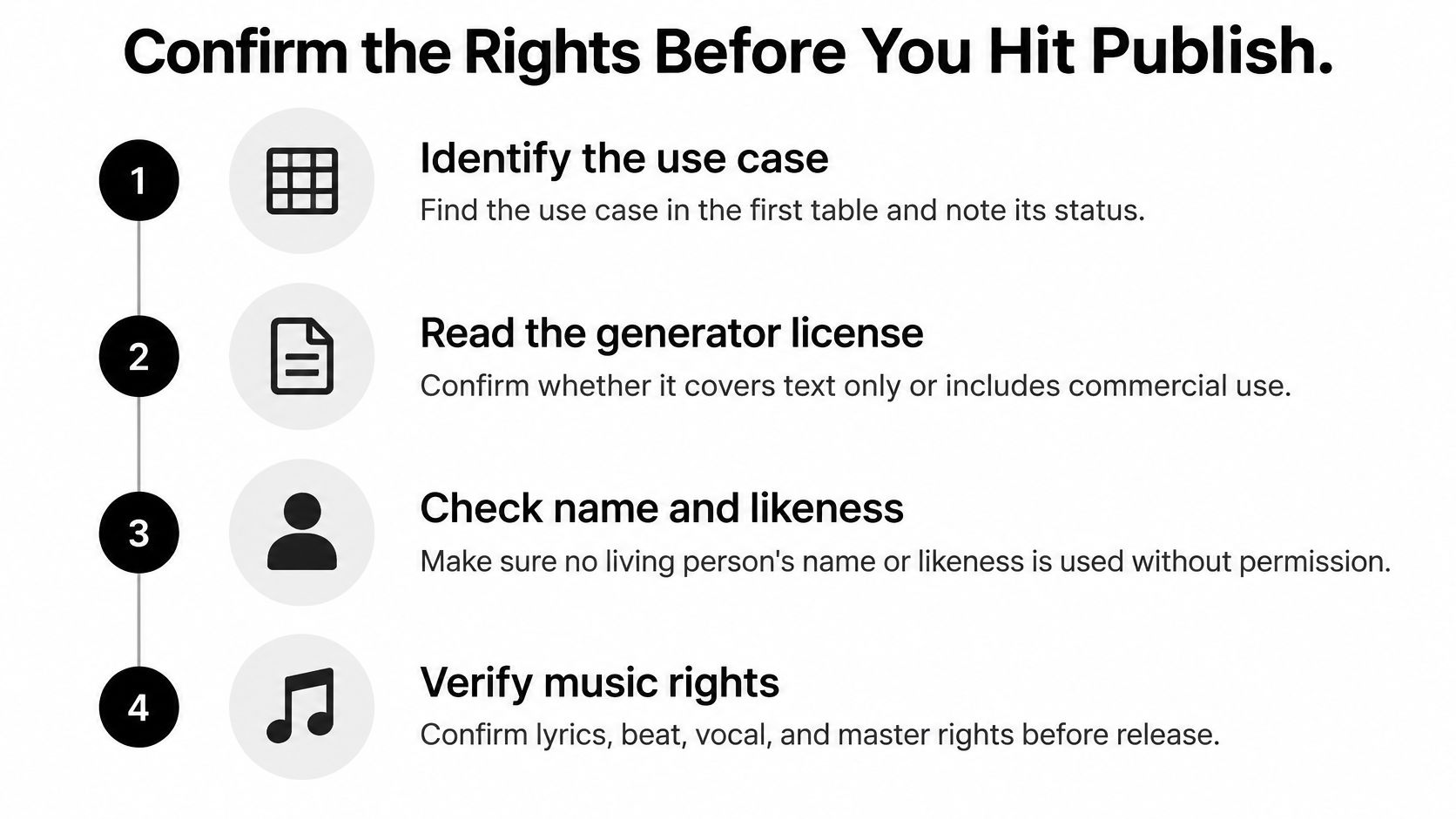 A checklist titled Confirm the Rights Before You Hit Publish with four steps for content creators.
Run the Release Routine
- Identify the use case. Write down the audience, destination, monetization, sponsor, and client. A private demo that becomes a campaign needs another review.
- Read the generator license. Confirm text, audio, voice, resale, and client-delivery coverage. Preserve the applicable free or paid tier's terms.
- Clear or replace borrowed assets. Attach the beat license, sample permissions, and voice authorizations to the final export. For video, assess synchronization rights rather than assuming an audio-release license is enough.
- Resolve real-person uses. Obtain appropriate written consent for advertising, merchandise, or sponsored appearances. Ask counsel whether an identifiable target creates other issues that consent alone won't resolve.
- Complete the business checks. Run Business Express, check municipal requirements, and establish the applicable tax registrations. Don't guess at tax treatment because delivery is digital.
- Archive the evidence. Keep prompts, original outputs, human edits, license versions, export dates, consents, and final files together. Give each release a clearly named folder.
- Get legal approval where the stakes justify it. Have a New York attorney review monetized or branded releases, particularly those involving recognizable people, borrowed music, or ownership warranties.
Choose Coverage, Not Just a Plan Name
Our Free, Pro, and Creator plans each include a commercial license, basic voice styles, and standard audio quality. Free and Creator include priority support; Pro includes email support. Compare the current commercial terms on our official pricing page before starting paid work, and confirm the scope of generated-text, audio, and client-delivery permissions you need. Our commercial license isn't clearance for third-party beats, voices, or real people, and this guide is general information, not legal advice; licensing terms can change.
Don't release with a missing permission because the deadline is inconvenient. Replace the asset, rewrite the target, or postpone publication until a qualified attorney can resolve the issue.
DissTrack AI helps you create personalized roast lyrics that you can edit into your own performance. Visit DissTrack AI to draft your next verse, then confirm the applicable commercial terms and clear the music, voice, and real-person uses before you publish.