
Atlanta Trap Music: Ultimate Guide to Sound & History
Atlanta trap music didn't just soundtrack the city, it helped turn Atlanta into the center of modern rap production. The counterintuitive part is that a style built from stripped-down drums, local street narratives, and underground momentum became one of the most exportable sounds in global pop. That tension is the reason Atlanta still matters, not only as a birthplace, but as a working ecosystem where producers, rappers, venues, and tourists keep remaking the genre in real time.
How Atlanta Became the Undisputed Capital of Trap Music
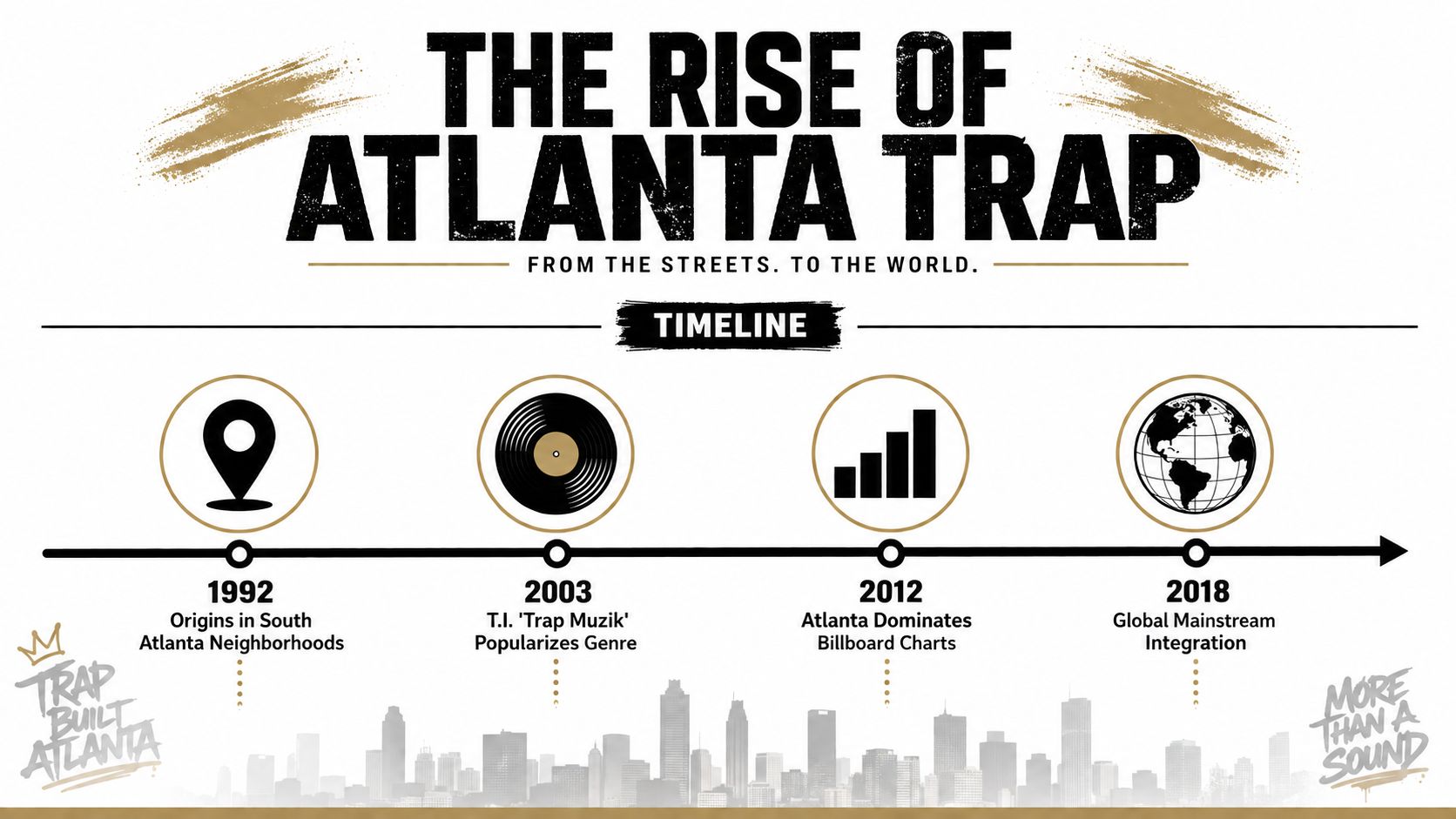 A timeline graphic depicting the rise of Atlanta Trap music from 1992 to 2018.
Gucci Mane's cold, conversational warnings, Jeezy's icy Southern grit, and T.I.’s street-reporting cadence gave Atlanta trap its first unmistakable outline. Those records came out of neighborhoods and studios where drum machines, mixtapes, and local block narratives all pulled in the same direction. Trap music emerged in Atlanta in the early 1990s as street-level storytelling wrapped in hard-hitting production, and Atlanta is now the #1 U.S. city for trap music production. The city still sits near the center of the genre's output, with 25% of all trap tracks on Spotify produced by Atlanta producers, a sign that Atlanta remains a working engine rather than a finished origin story.
The sound took hold because it matched the city's actual creative economy. Small studios, neighborhood producers, and club records fed one another, while rappers treated sharp drum programming and blunt detail as everyday language. Atlanta Magazine has framed trap as a genre born in the city, and streaming data shows the broader rap scene now accounts for 60% of Atlanta's music output, which makes the city's musical identity feel inseparable from trap's rise. A timeline graphic depicting the rise of Atlanta Trap music from 1992 to 2018.
By the 2010s, Atlanta's blueprint had moved from local code to global default. Trap-heavy artists were filling pop playlists, and hip-hop became the most popular form of music in the U.S. in 2018, which shows how far the city's rhythmic grammar traveled. The older street-realism that made trap feel so immediate sits in the history of gangsta rap, and this history of gangsta rap's evolution helps show how Atlanta inherited that language, sharpened it, and turned it into something cleaner, harder, and easier to export.
The tension is still visible in the city. Atlanta trap keeps documenting the street while also feeding a global market that packages the same grit for radio, festival stages, and brand campaigns. That friction is part of its power. The records sound local because they are local, but the culture around them keeps widening, and Atlanta remains the place where producers, rappers, venue owners, and industry scouts still test how much of the city's original pressure can survive commercial success.
The Sonic Blueprint of Atlanta Trap Production
The first thing you hear in Atlanta trap is not just a beat, it's a push and pull. The groove sits in a half-time feel, so the track may be written around 130 to 170 BPM in notation, but it lands to the ear closer to 65 to 85 BPM. That mismatch creates room for vocals to drift, snap, and double back without fighting the drums, and it's why trap can feel spacious and heavy at the same time, as described in technical breakdowns of the style.
Rhythm before ornament
The drum grid does most of the emotional work. Rapid hi-hat rolls often subdivide into 32nd- and 64th-note figures, while snares and claps hit the backbeat with a clean, almost clinical precision. Put that next to a Roland TR-808 kick and you get the familiar rolling pressure that lets the track feel both mechanical and alive.
Practical rule: If the hats are busy but the snare feels late, the beat starts breathing like Atlanta trap instead of just sounding fast.
Why the low end matters
The 808 is the signature voice, not just a drum. Producers often treat it as both kick and bass, tuning it below the 60 Hz region and stretching its decay so it behaves like a sustained line instead of a one-shot hit, a technique laid out in this production analysis. That choice clears the midrange, which is why vocals and lead synths can sit right in front while the sub keeps the room moving.
A useful way to hear the difference is to listen for what's missing. Atlanta trap doesn't crowd the center of the spectrum the way denser rap productions often do. It leaves a pocket for melody stabs, ominous synth layers, and vocal phrasing to cut through the fog.
For a visual breakdown of the rhythmic shape, this guide pairs well with a beat-making walkthrough for rap production.
Below, the classic arrangement is easier to spot in motion.
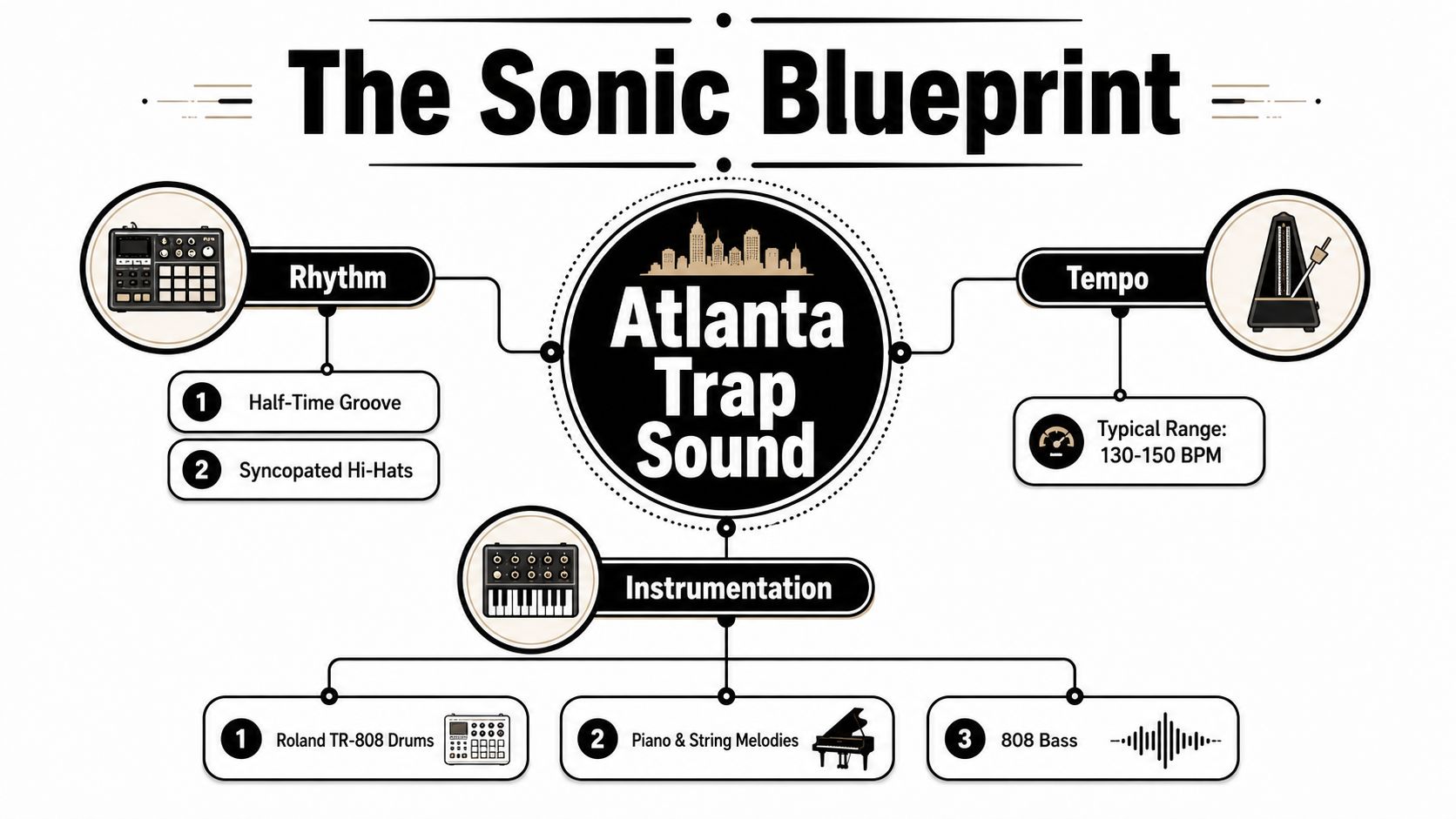 An infographic detailing the sonic elements of the Atlanta trap sound including rhythm, tempo, and instrumentation.
Production Techniques and DAW Tips for Trap Beats
The easiest trap beats to overcook are the ones with too much of everything. Atlanta producers usually get the opposite result by making one element carry weight and letting the rest stay lean. If you're building in FL Studio, Ableton, Logic, or anything else, start with the 808 and make every other choice support it.
Build the low end first
Tune the 808 to the key of the track, then let it act like a bass instrument, not just a drum sample. The goal is a line that holds the room, especially in club playback and car systems, while the rest of the arrangement stays open enough for the vocal to cut through. The production analysis from Splice notes the value of keeping the midrange sparse, and that's the design logic worth copying, especially if you're shaping low-end for the first time.
Mixing reality: If the vocal is fighting the 808, don't just turn one down. Clear the arrangement, then decide which note or synth really needs to stay.
Shape the drums like a conversation
Program the kick pattern around the 808 so they don't step on each other. Then add hi-hat rolls as accents, not wallpaper. The best rolls feel like punctuation, quick bursts that frame the snare and keep the verse moving without turning it into a blur.
Layering helps too, but only if each layer has a job.
- Use a monophonic lead synth for one sharp melodic line, then leave it alone so it reads like a vocal answer.
- Choose minor-key motifs when you want the beat to feel tense or nocturnal.
- Add orchestration stabs sparingly, because one cinematic hit can say more than a full string bed.
For producers who want quick workflows and app-based ideas, apps to make a beat is a practical companion piece. One option in that space is DissTrack AI, which can generate Atlanta trap beat ideas with 808 basslines, rapid hi-hat patterns, and minimal melodic content.
Milestone Artists and Tracks That Defined the Genre
Atlanta trap didn't evolve through one clean line. It moved because different artists solved different problems. T.I. gave the city a vocabulary that could sit inside mainstream rap without sanding off the grit. Jeezy pushed the street-reporting angle harder, while Gucci Mane turned repetition and personality into a whole creative universe, and that combination made the genre feel less like a novelty and more like a durable form.
The early template
The important move in the early 2000s was not just lyrical content, it was framing. These artists made trap sound like a place, a mood, and a mode of survival all at once. That opened the door for producers such as Shawty Redd and Zaytoven, who gave the records their contrast, hard drums under bright, haunted melodies. Their work made the beats memorable even when the verses were minimal or conversational.
The modern Atlanta lineage
Later, Metro Boomin refined that darkness into a more cinematic language. His name has become so closely tied to the city's trap identity that his records often feel like dispatches from Atlanta's sonic future, even when they revisit older styles. Recent coverage of his work notes that he didn't invent the sound, but he helped define it for a wider audience, especially by making it feel exciting even after years of repetition, which is exactly what a great producer does when a genre risks fossilizing.
If you want to hear the lineage clearly, move from the early mixtape era into the foggier, more ominous records of the 2010s, then into the tracks that pushed trap into pop and festival spaces. The arc isn't about one “best” era. It's about a city learning how to turn local code into exportable form without losing the pressure that made it feel dangerous in the first place.
Cultural Tensions and the Business of Trap Today
Trap's biggest misunderstanding is that it can be reduced to a lyrical subject list. Walk into an Atlanta studio night, and the argument is easier to hear than to summarize. One artist is trying to document the block with blunt detail, another is chasing a new drum texture, and a manager is already thinking about how the record travels outside the city. AJC's framing of trap as a story of the rise and tension of an Atlanta-born subgenre points to that deeper question, whether trap should be read as street documentation, sonic innovation, or a global commercial brand. Those three forces overlap, but they do not always sit comfortably together, and that friction is part of what keeps the music moving.
The city's rap economy now reaches far beyond a single scene, and streaming has helped turn Atlanta trap into part of the city's public identity. You hear that shift in the way venues, tourism pages, and neighborhood stories are all folded into the same pitch. Visitors are not only being sent to hear records, they are being guided toward places that frame trap as something to experience, photograph, and spend money around. Atlanta's own trap attractions make that packaging plain, especially in spaces like the Trap Music Museum, where the genre is presented as culture, memory, and commerce at once.
That commercial visibility changes the conversation about authenticity. Some listeners want the older street narrative preserved exactly as they remember it. Others care more about sound design, arrangement, and the way trap became a business model that helped Atlanta project itself to the world. Both camps are reacting to the same thing, a genre that can sound like a neighborhood report and a polished export in the same verse.
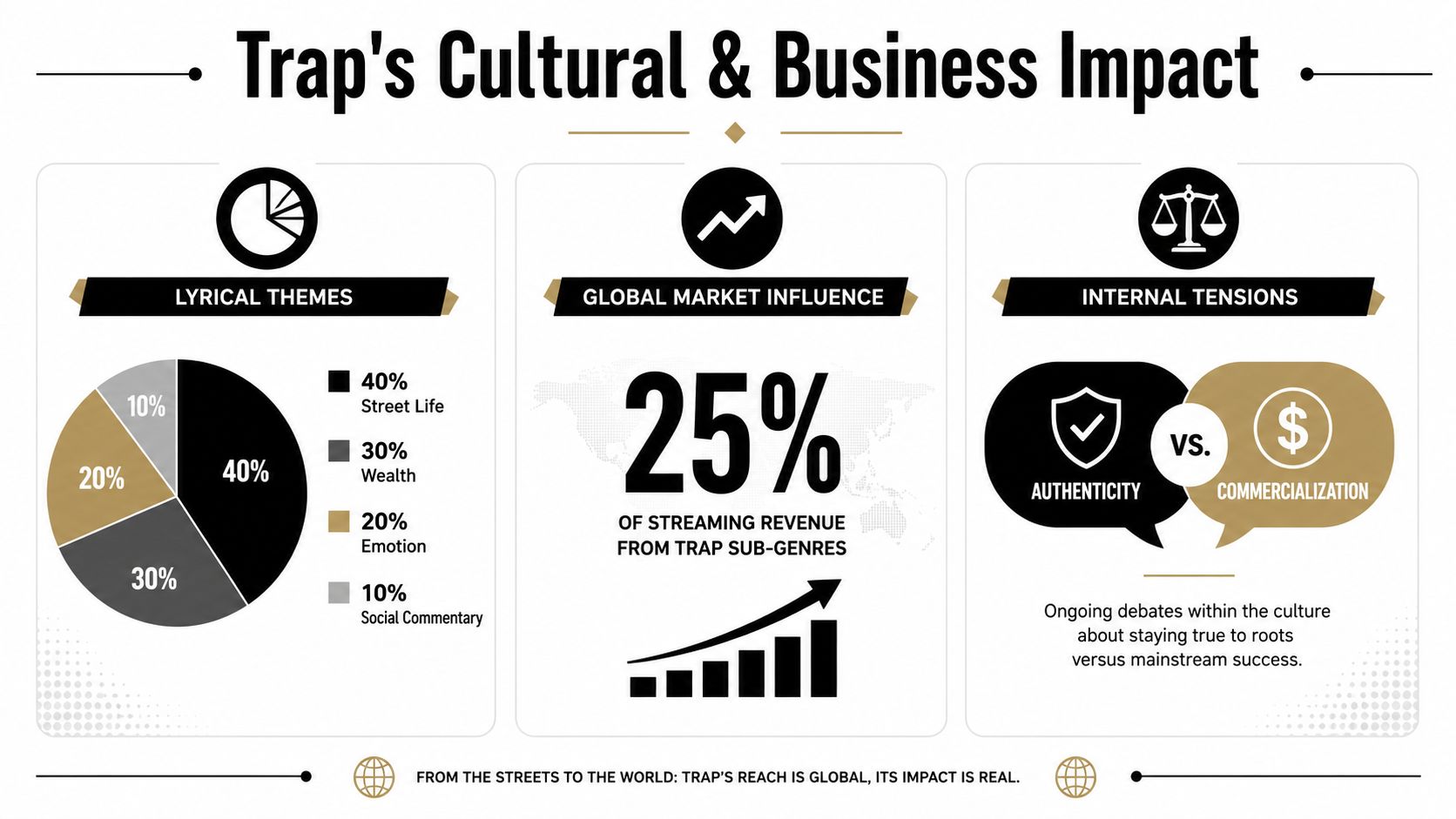 An infographic titled Trap's Cultural & Business Impact showing statistics on lyrical themes, market influence, and internal tensions.
That tension also shows up in how the city packages the business side of the culture. Clubs, listening rooms, branded experiences, and neighborhood lore all turn trap into something that can be consumed in person, not just streamed through headphones. For a practical look at how culture and commerce get organized around audience demand, how FLYP LTD handles merch offers a useful example of the business mechanics behind fan engagement.
Writing and Performing Atlanta-Style Trap Lyrics
Atlanta trap lyrics work best when the voice rides the drum pocket instead of sitting on top of it. That means the cadence has to breathe with the beat, especially when the beat uses rolling hi-hats and a heavy half-time feel. Triplet flows can feel natural here because they let the rapper skim across the grid without flattening the groove.
Build the verse around impact points
Write with the snare in mind. A good trap line often lands a keyword right before or on the backbeat, so the bar feels like it closes with force. Ad-libs then become percussion of their own, not just decoration, because they fill gaps between phrases and make the delivery feel more animated.
Keep the hook short enough that the crowd can repeat it after one listen. If the chorus needs a diagram, it's too busy.
Move beyond one subject lane
Atlanta trap has room for flexing, survival stories, emotional bluntness, and regional pride. The strongest writing usually mixes two of those at once, because that keeps the voice from becoming one-note. Repetition helps here, too, especially when a phrase returns like a tag and locks into the beat's looped structure.
If you're building a writing process, start with a cadence pattern, then test where the punchline lands, then trim any line that crowds the pocket. That approach keeps the verse aligned with the production, which is the trick behind a lot of memorable Atlanta records.
Essential Listening Playlists and Producer Resources
The cleanest way to hear Atlanta trap evolve is to listen by function, not just by era. Start with early records that establish the street-documentary tone, then move into the glossy, producer-led era, then into the more melodic and pop-facing records that made the style travel farther. That sequence helps you hear how the same city kept retooling its own template.
What to listen to first
For listeners, build three short playlists. One should focus on the early-2000s foundation, one on the decade when trap became dominant, and one on the current wave of Atlanta artists and producers who keep the sound sharp. You'll hear the same skeleton in all three, but the texture changes, the drums get cleaner, the melodies get more cinematic, and the vocal delivery gets more fluid.
What producers should borrow
If you're making beats, the most useful resources are the ones that help you hear details quickly. Sample packs with clean 808s, hi-hat rolls, and dark piano stabs are a practical starting point. Tutorials from Atlanta producers matter because they show how the city's sound is built in real sessions, not just in theory.
For writers and content creators who want quick idea generation, DissTrack AI can also produce Atlanta trap as a style tag, which makes it a useful tool for sketching hooks or rough lyrical concepts around the genre's signature bounce. It won't replace taste, but it can speed up the first draft.
The deeper lesson is simple. Atlanta trap lives where memory, technique, and commerce keep colliding. If you want to understand it, listen like a historian, produce like a technician, and write like someone who knows the room is always part of the record.
If you want to turn these ideas into something playable, visit DissTrack AI and start generating trap-inspired lyrics or beat concepts with the kind of cadence and attitude this city made famous. It's built for fast drafts, sharper punchlines, and genre-aware ideas that can help you move from a concept to a finished track without staring at a blank page.