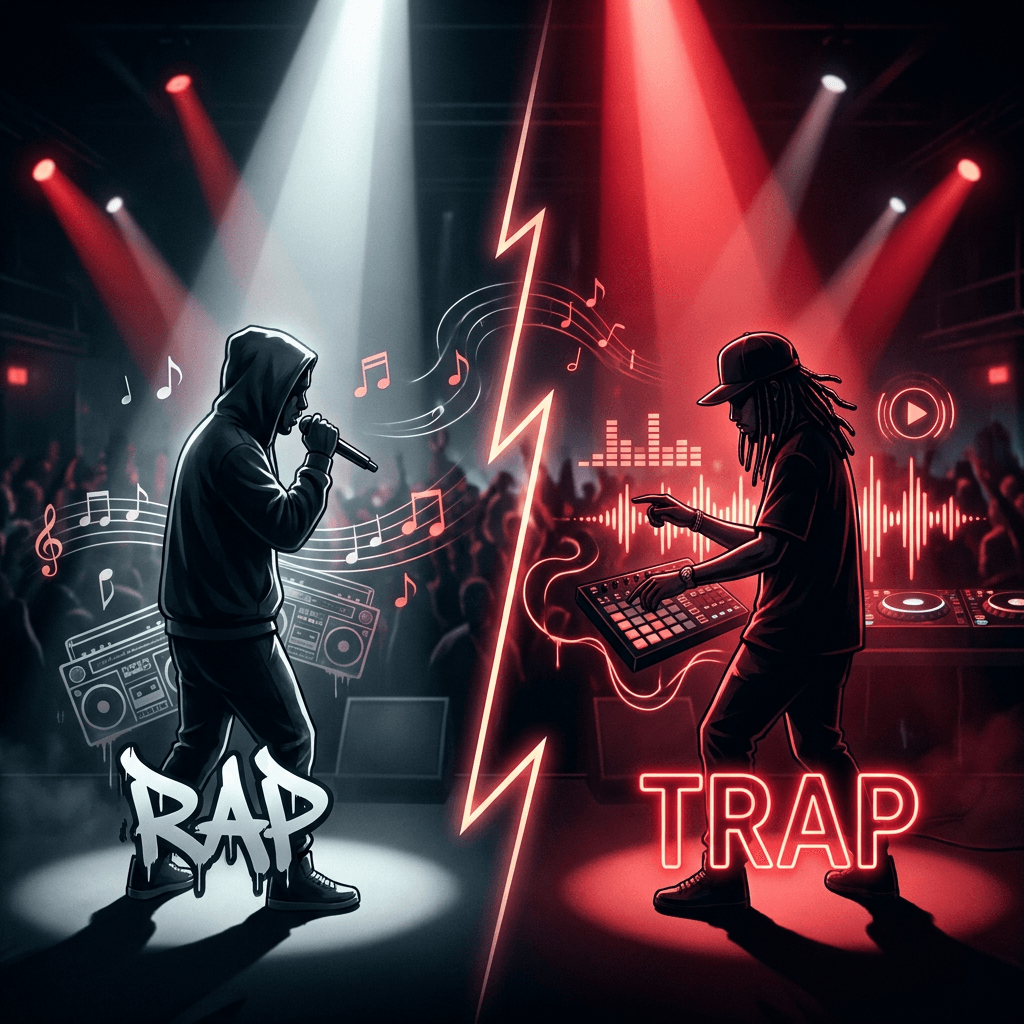
Rap vs Trap: Key Differences and How to Choose
The usual advice about rap vs trap goes something like this: rap is about lyrics, trap is about beats. That's tidy, memorable, and wrong enough to wreck your next verse. Trap can carry sharp writing, and a supposedly lyrical rap track can have a hook simpler than a doorbell.
The useful distinction is delivery, writing, and production. Separate those layers and you can keep the same target, joke, and punchline while changing how the diss moves. You don't need a different personality for every beat. You need to know where to put the words.
Rap and Trap Side by Side
Rap is the broad vocal and lyrical practice inside hip-hop; trap is a production-led branch that grew out of it. Britannica's trap music overview describes a style whose Southern roots and recognizable sound sit within hip-hop, not outside it.
Rap and trap at a glance
| Element | Rap (broad) | Trap |
|---|---|---|
| Origin | Hip-hop's vocal practice, commercially introduced to a national audience through Rapper's Delight | Later Southern U.S. branch, centered on Atlanta |
| Core sound | Sampled loops and breaks, flexible grooves, plus other production approaches | Programmed kick and snare, rapid hi-hat rolls, pitched 808 bass |
| Vocal feel | Can favor dense, multisyllabic, conversational bars | Often favors spacious placement, repeated hooks, melodic or chanted delivery |
| Typical themes | Battles, storytelling, politics, social life | Street economies, ambition, nightlife and excess, as tendencies rather than rules |
Start with origin: you're comparing a broad practice with a particular branch, not rival inventions. The core-sound row gives you the strongest identification clues. The vocal row describes common approaches, while the themes row is the least reliable way to classify anything.
Those are tendencies, not entry requirements. A political verse doesn't stop being trap because nobody mentions money. A sung hook doesn't erase the rapping around it.
The visual distinction is straightforward:
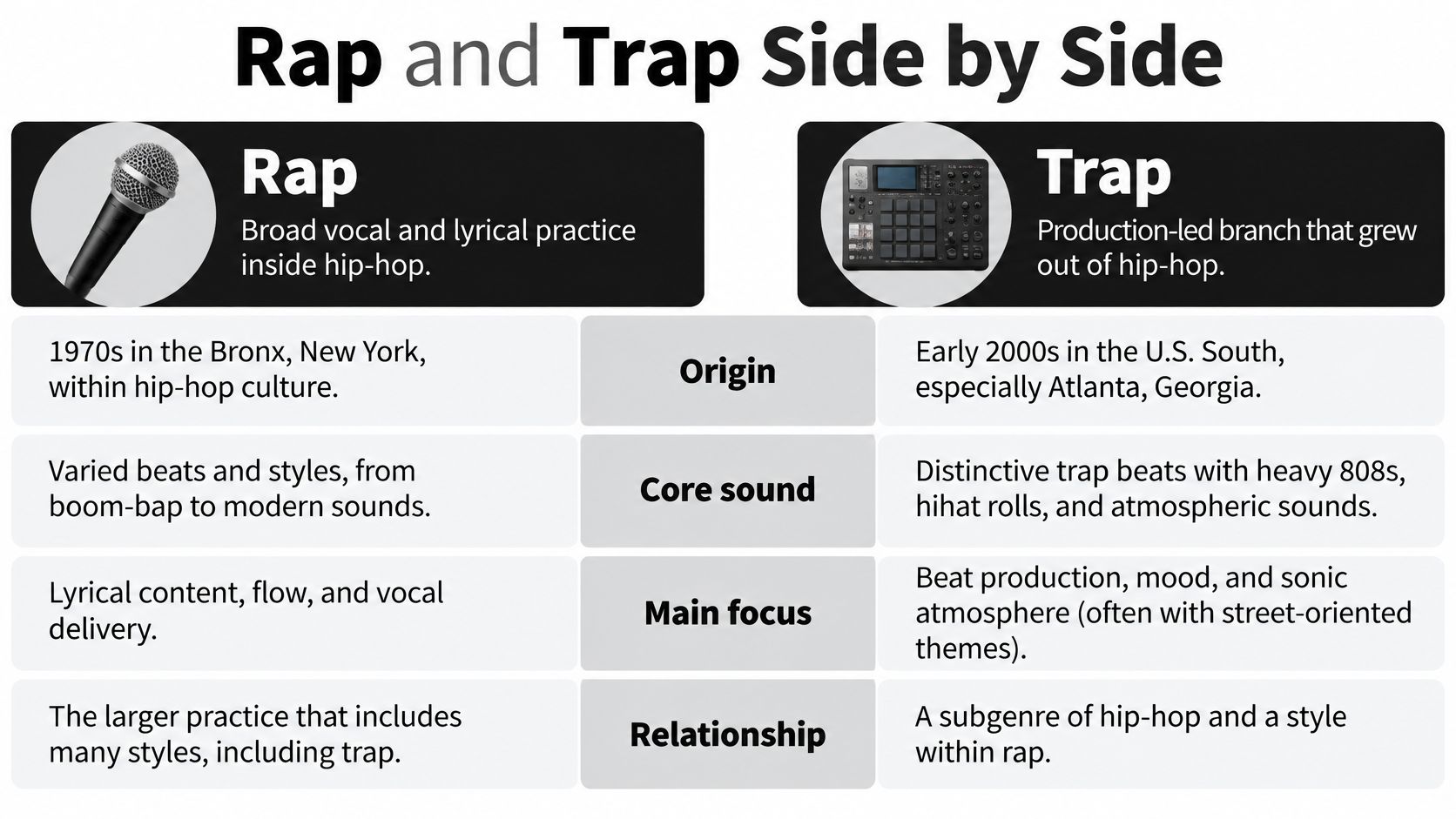 A comparison chart outlining the key differences between rap and trap music genres across several categories.
Keep the joke, change the vehicle
Say your friend calls himself a boss but can't organize the group chat. Over boom bap, you might build a conversational setup full of internal rhymes. Over trap, you could reduce it to a clipped accusation and a repeatable payoff. Melodic trap lets you sing the mockery; drill lets you interrupt it with sharper rhythmic stops.
The target and core punchline haven't changed. The arrangement and performance have.
A track can be both rap and trap. Calling it trap narrows the description; it doesn't cancel the rap.
Use the table like a producer's checklist: identify the production core, listen to the vocal feel, then consider the themes. Starting with subject matter is how you mistake a costume for a musical structure.
Where Each Style Came From
The Sugarhill Gang's Rapper's Delight arrived in September 1979 as a roughly 15-minute single, helping take recorded rap to a national audience, as documented in MCFlow: A Digital Corpus of Rap Transcriptions. The commercial breakthrough mattered because listeners could encounter on record what had developed through live hip-hop performance.
Think records, microphones, and people building a performance together:
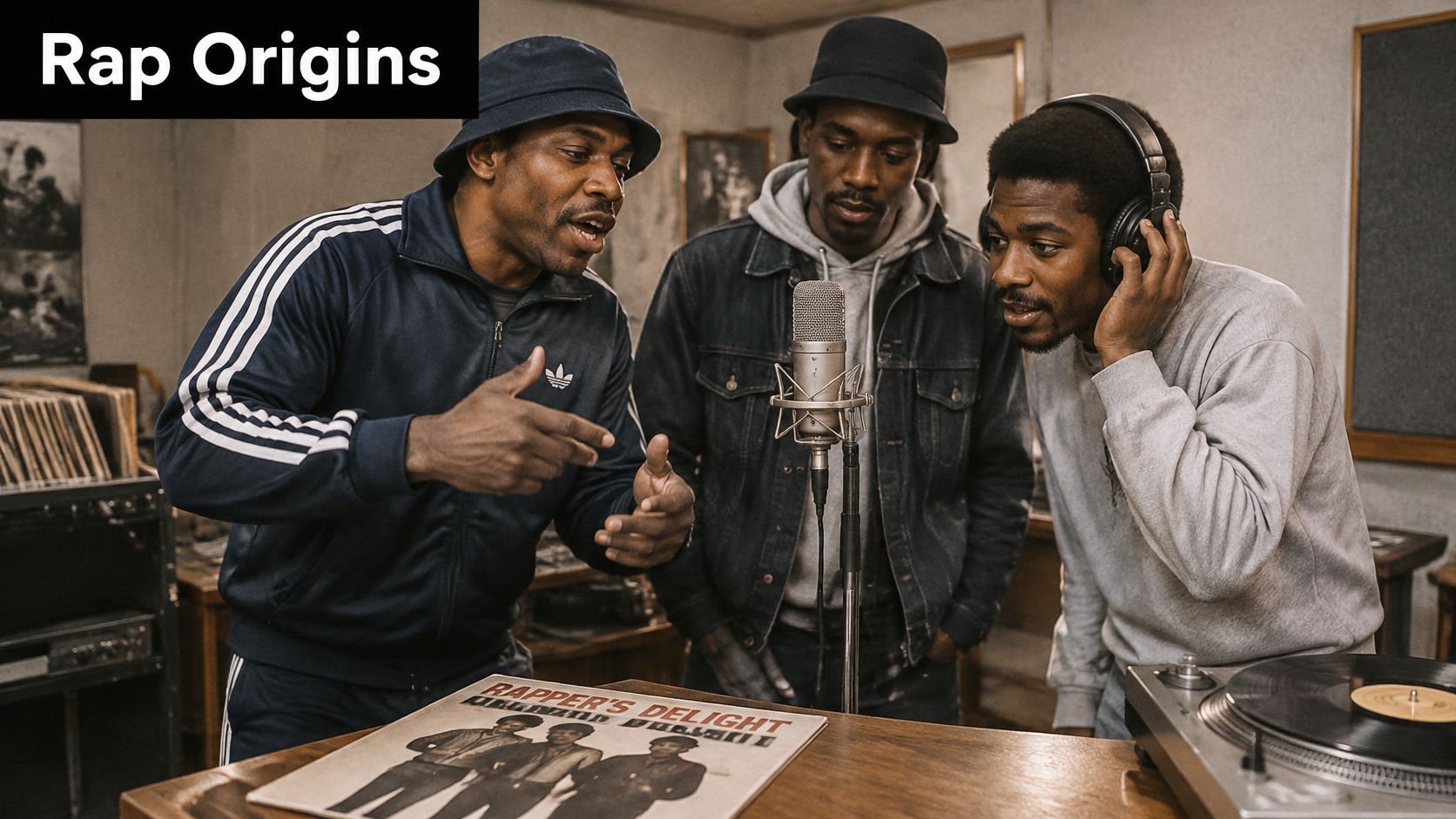 Three men in a recording studio collaborating on music production while looking at a vinyl record.
Kurtis Blow's The Breaks reached No. 87 on the Billboard Hot 100 in 1980, followed by Grandmaster Flash and the Furious Five's politically influential The Message in 1982, according to this published historical account of rap's commercial development. Those records point toward different possibilities: rhythmic entertainment and social commentary could both belong to rap.
From recorded performance to programmed production
Trap emerged later from Southern hip-hop, with darker textures, prominent bass, and writing associated with street economies. Producers could build loop-based arrangements and repeatable hooks with programmed percussion rather than assembling a full band.
That changed the working method as much as the sound. A producer could shape the relationship between percussion, bass, and voice directly inside an electronic arrangement. Empty space became something to place deliberately, not merely something left over.
For a listening break, focus on how the voice interacts with the backing track rather than judging the genre by the performer's image:
The friend-over-a-beat explanation is simple: rap is the umbrella; trap is a specialized sound beneath it. Their histories connect, but their names don't describe the same level of musical classification.
Tempo, Beats and Production Benchmarks
Genre labels don't set the tempo. A boom-bap loop can move at a brisk pace with a loose swing, while a trap track can feel slow over a faster grid. The useful benchmark is how the drums, bass, and vocal phrasing work together.
| Style | Typical BPM | Drum pattern | Bass |
|---|---|---|---|
| Boom-bap rap | A swung, mid-tempo pulse | Sampled drums, swung kick and snare | Sampled or live bass |
| Trap | 130–170, often 140–155, according to Music Production Wiki's trap guide | Half-time kick and snare, sixteenth- or thirty-second-note hi-hat rolls | Pitched, sustained 808 |
| Drill | A slower-feeling, fragmented pulse | Sparse kicks, shifting hi-hats, dark minor loops | Sliding 808 |
| Melodic trap | A trap-style pulse shaped around sung phrases | Trap-style kick and snare with melodic loops | Pitched 808 and synth bass |
Producers may count a beat at its slower pulse or its doubled equivalent, so the number in a project file doesn't identify the genre on its own. For help choosing a tempo for rap beats, start with the vocal's natural phrasing, then check how the drums support it.
Why trap feels spacious while the hats race
Trap pairs a broad, half-time kick-and-snare framework with faster percussion subdivisions. You can nod slowly to the main pulse while the hi-hats chatter above it. That contrast gives a vocal room to sound unhurried without making the beat feel empty.
At 140 BPM, count one, two, three, four against the project grid and listen for the main snare on three. That's a practical half-time check when you're counting against the intended faster grid.
The 808 often acts as a pitched, sustained bass instrument, carrying the root note rather than merely reinforcing the kick's attack. Tune it to the track, check how long each note rings, and shorten overlapping notes if the low end starts to blur.
Practical rule: If the bass is still speaking, don't assume the rapper needs to fill the silence.
Boom bap gives sampled drum texture and swing room to support a voice that pushes and pulls against the groove. Keep the performance's natural timing in view instead of quantizing every consonant.
Build around the pocket
Drill's sparse kicks, shifting hats, and sliding bass create a more fragmented pocket than a straightforward trap loop. The beat's interruptions and bass movement shape where a phrase can breathe.
Before writing, check three things:
- Bass clearance: Hum the bass notes and listen for sustained notes that collide.
- Vocal clearance: Speak the punchline over the busiest hat passage.
- Groove stability: Mute decorative percussion and check whether the main rhythm still supports your cadence.
For a practical guide to connecting drum choices with arrangement, see how to make rap beats.
Flow, Delivery and Lyrical Themes
Flow is the relationship between language and the beat, not a synonym for speed. A rapper can sound commanding with sparse words or lose the listener while delivering a dictionary at sprint pace.
The flow analysis published in Music Theory Spectrum treats vocal phrasing, linguistic segmentation, meter, and the repeating musical grid as interacting components. The useful question is where vocal events align with that grid, and where they deliberately don't.
Write the rhythm into the sentence
For a conversational rap verse, let sentence lengths change. Carry a thought across the bar line, tuck an internal rhyme into the middle, and delay an expected ending when the meaning benefits. Microtiming means placing syllables slightly ahead of or behind the beat, not accidentally losing time.
Trap offers room for a different emphasis: clipped phrases, repeated hook language, melodic contours, and bursts of triplet subdivision. None is mandatory. The mistake is copying the surface gesture without understanding the sentence, especially when a triplet pattern makes the important word sound like filler.
Use these editing checks:
- Syllables per bar: Count what you pronounce, including swallowed sounds and stretched words. Look for lines that suddenly require a different breathing technique.
- Duration contrast: Listen for the difference between short syllables and held ones. The Pairwise Variability Index, or PVI, describes that successive-duration variability; lower values suggest more even timing, while higher values indicate greater contrast.
- Rhyme placement: Circle the rhyme sounds and underline the words carrying the insult. They shouldn't compete for attention.
A high syllable count isn't a quality score. Neither is a higher PVI. These are diagnostic tools for identifying what a delivery does, not trophies for making it complicated.
For more control over internal and end-rhyme placement, work through our rap rhyme patterns guide. Build the sound pattern around the point you're making.
Let the subject survive the style
Rap can cover battles, politics, storytelling, or everyday social friction. Trap's familiar associations don't oblige you to invent a street biography to roast somebody's terrible cooking. Rhythm affects how you reveal a subject; it doesn't prescribe the subject itself.
Try this original line:
Dense delivery:
You call yourself the captain, but you're absent when the bill lands.
Spaced delivery:
Captain? / You vanished. / Bill came. / Abandoned.
The accusation stays recognizable. The dense version uses a flowing setup; the spaced version makes each fragment an opportunity for emphasis. Leave the strongest word exposed rather than hiding it under another rhyme.
Signature Artists and Example Tracks
Treat this as a listening playlist, not a filing cabinet. The groupings suggest what to study in each recording, and several tracks cross the boundaries implied by their labels.
Signature artists and example tracks
| Style | Artist | Example track |
|---|---|---|
| Old-school rap | The Sugarhill Gang | Rapper's Delight |
| Political rap | Grandmaster Flash and the Furious Five | The Message |
| Lyrical rap | Nas | N.Y. State of Mind |
| Lyrical rap | Eminem | Lose Yourself |
| Early trap | Young Jeezy | Soul Survivor |
| Drill-influenced trap | Chief Keef | Love Sosa |
| Melodic trap | Migos | Bad and Boujee |
| Melodic trap | Future | Mask Off |
With the earlier rap selections, listen for how performers organize the listener's attention through sentences, narrative details, and rhyme. Nas is useful for studying scene-setting; Eminem is useful for hearing how vocal urgency supports a dramatic premise. Don't reduce either lesson to cramming in more syllables.
With the trap selections, investigate the relationship between the lead vocal, repeated phrases, and the backing track. Chief Keef is a useful Chicago bridge toward drill rather than a tidy example of Atlanta trap. The melodic-trap grouping is broad, too: listen for differences in chanting, rapping, and melodic emphasis rather than assuming Migos and Future use identical techniques.
Listen like you're preparing a session
Play N.Y. State of Mind beside Mask Off, then compare Soul Survivor with Love Sosa. Keep playback loudness comfortable and roughly matched so the louder master doesn't win the argument before you've heard the arrangement.
- Drums first: Ignore the words and follow the kick, snare, and hats.
- Voice next: Notice whether a phrase ends with a drum hit, crosses it, or leaves a gap around it.
- Meaning last: Ask which words you remembered and how the performer made them stand out.
You can do this with short excerpts rather than full tracks. Sketch the rhythm with taps on a desk, then speak an original roast over that pattern without borrowing lyrics or imitating the artist's voice.
A useful reference gives you a technique to test, not an identity to wear.
Artists move between approaches, and even an individual recording can contain contrasting sections. Label the track to begin listening, then let the actual performance complicate your first impression.
How to Write a Diss in Each Style
A good style switch preserves the insult and rebuilds its timing. If changing the beat makes you abandon every specific detail, you probably wrote generic aggression rather than a personalized diss.
Use this workflow to keep the writing anchored:
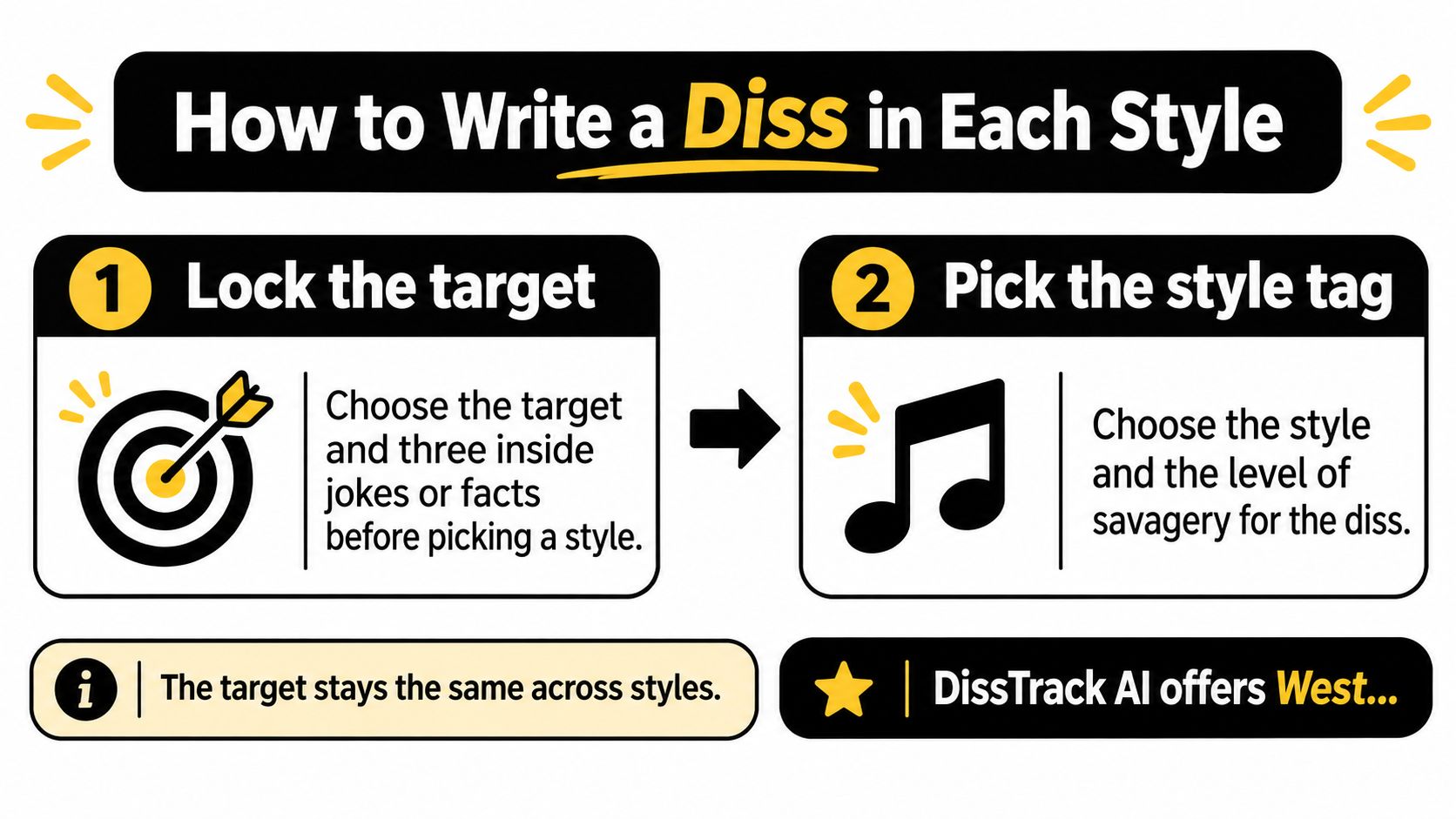 A colorful infographic guide showing how to write a rap diss track using AI tools.
Build the material before the performance
-
Lock the target and the details. Write down the person's relationship to you and a handful of recognizable habits or inside jokes before choosing a style. For a friendly roast, use material they'll recognize without exposing private information or inventing damaging allegations.
-
Choose the style and intensity. At DissTrack AI, step 2 lets you pick rap style tags and choose how savage the diss should be; available styles include West Coast Hip-Hop, Aggressive, Old School Boom Bap, Trap, Battle Rap, and Comedy Rap. Drill, Emo Rap, and UK Grime are also supported, so choose according to the performance you want rather than whichever tag sounds toughest.
-
Give the insult a setup and a turn. For example, a friend who buys expensive running shoes but refuses to walk anywhere gives you a clean contradiction to develop. Write the accusation plainly before decorating it with rhymes, because no rhyme scheme can rescue a punchline the audience doesn't understand.
Fit the attack to the instrumental
-
Set the flow, then place the payoff. For boom bap, try conversational setups, changing phrase lengths, and internal rhyme, with the decisive word near a strong snare accent. For trap, shorten the setup and audition the payoff against a bass entrance or a gap in the percussion; for drill, test the same words against the interrupted bounce rather than forcing uninterrupted bars.
-
Read the verse at the actual performance tempo. Mark breaths, remove connective clutter, and check whether the stressed syllable lands where you intended, not merely where the line ends on screen. If you have to swallow the punchline to finish the bar, cut the setup first; our guide to writing a battle rap song can help you shape the surrounding verse.
-
Compare variations and edit for your voice. Each generation includes multiple variations so you can pick the hardest bars, but don't keep a line solely because it looks clever on the page. Save a version for each style, perform them aloud, and keep the wording that sounds natural coming from you.
The final check is recognition. Would the target know exactly which habit you're roasting, and would an unfamiliar listener still understand the joke? If both answers are yes, you've got material worth arranging.
Choose the Right Style for Your Next Track
Choose the style for what the listener needs to notice. A quick roast clip needs an immediately understandable premise and a memorable payoff. A battle verse can ask the audience to follow a longer chain of setups, callbacks, and rhyme.
For short-form video, I'd start with trap when the hook and bass impact are central to the performance. Cut the introduction and make the first accusation intelligible without context. A huge backing track won't compensate for a joke that needs a paragraph of explanation.
For lyric-heavy disses, start with boom bap or a lyrical rap approach when you want the audience to catch internal rhymes and conversational detail. For a mixed audience, try trap production with denser writing in the verse and a simpler refrain. That's an arrangement decision, not a compromise in credibility.
Choose for the audience, not the badge
A 2026 Music Ally industry report cites a survey of nearly 1,600 independent artists in which more than 83% move between hip-hop subgenres. That supports a more useful creative mindset than treating every style choice as a permanent allegiance.
Consider the audience's language and reference points, too. A local phrase delivered naturally can do more work than imported slang that doesn't sound like you. Keep the recognizable joke; adapt its pacing and musical setting.
Our Free plan costs $0 forever and includes 1 diss track, and a free trial is available with no credit card required. To test your style choice before committing further, write a verse, perform it over contrasting beats, and compare which version makes the payoff clearer rather than merely louder.
DissTrack AI offers personalized diss tracks with selectable rap styles, adjustable savagery, and multiple variations to edit. Visit DissTrack AI, bring a target and a recognizable inside joke, and build a roast whose writing and delivery fit the beat.