How to Write Brutal Battle Rap Bars
The most popular advice about battle rap bars is also some of the least useful: write the cleverest verse you can, then trust the audience to catch up. That works on a page. It fails under stage lights, where the crowd is listening, reacting, talking over you, and deciding whether your angle matters before your next line arrives.
A winning bar isn't merely a clever sentence with a rhyme at the end. It's a compact performance mechanism. It gives the audience enough information to follow the setup, enough surprise to reward attention, and enough rhythmic control for the rapper to deliver the punch without tripping over it. Academic work describes battle rap as a performance practice combining wordplay, meaning-making, and measured delivery, while rhyme density and multisyllabic structure offer measurable ways to assess technical complexity (research on battle-rap co-creativity and rhyme structure).
The practical question, then, isn't “How do I write the most advanced line?” It's “How much meaning can I make land immediately, in my voice, against this opponent, in front of this crowd?” The following method treats every round as engineered live writing, from target selection and internal rhyme to AI-assisted brainstorming and final rehearsal.
The Two-Second Rule for Live Punchlines
A polished bar can die in the room. Layered references, intricate rhyme chains, and hidden connections may reward a close reading, yet still produce silence if the audience needs a breakdown before it recognizes the insult. Live writing starts with the crowd's reaction time, then builds complexity around that limit.
A practical battle-rap guide places the crowd's processing window at about two seconds before the next line arrives, so live punches often favor concise attacks and dual meanings that remain easy to grasp (the mechanics of rap punchlines). That constraint changes the writing process. Studio lyrics can benefit from repeated listening, headphones, annotation, and a beat that carries dense passages. A battle crowd must recognize the target first, absorb the turn next, and feel the emotional force before the round moves on.
Live rule: If the audience needs a replay to understand the punch, the line is carrying more puzzle than performance.
Write for recognition before admiration
A strong battle bar can hold two meanings, provided both have a visible path. The surface tells the crowd what behavior or flaw is under attack. The second layer sharpens that attack instead of hiding it behind references.
Suppose the target is unreliable preparation. A complicated reference to project management software, a historical event, and a niche internet meme may look impressive in a notebook. On stage, the crowd may hear only disconnected nouns. A more usable angle states the flaw plainly, masks the accusation with a familiar comparison, and ends with ordinary language that makes the damage unmistakable.
The final phrase gives the room its emotional cue. Listeners should not still be deciding whether the opponent seems incompetent. They should hear the verdict and experience the turn at once.
The opening establishes expectation, while the final stressed words tell the room when to react. Video creators face the same two-second window; guides on video hooks for SaaS marketers make the same argument about immediate comprehension and a clear payoff. Battle rap has a different subject and a harsher consequence, but the performance principle holds: attention fades when the point arrives too late.
Test the line without the page
Read every punch aloud at normal battle speed. A dense written line may look manageable in the mind, then collapse when breath, timing, and vocal stress enter the performance. Clean delivery exposes whether the audience can follow the thought.
Use this test:
- Recognition: Can a listener identify the target flaw immediately?
- Compression: Can you remove a phrase without weakening the attack?
- Stress: Which words receive the strongest vocal pressure?
- Reaction: Where can the crowd respond without forcing you to rush?
- Aftertaste: Does the line become meaner after the first interpretation?
The practical guide to writing rap punchlines can help generate and check ideas, but no tool replaces the live test. Record yourself on a phone, listen without looking at the lyrics, and mark the instant the punch becomes understandable. If that instant comes after the final word, shorten the setup or clarify the payoff.
AI works best here as a sparring partner for writer's block. Ask it for several setup routes around the same flaw, then reject anything that sounds generic, overexplained, or difficult to stress. Keep the judgment human. The tool can supply angles and phrasing, while the rapper decides whether the line fits the opponent, the room, and the intended reaction.
Speed creates momentum, but impact still depends on a distinct stress pattern. Let the setup move, then give the final phrase enough space for the room to register the insult. The most brutal bar is usually the one the audience decodes at the exact instant you expose it, not the one carrying the most information.
Engineering the Setup and Payoff Structure
A punchline earns its reaction before the final word. The setup gives the crowd a clear premise, then the payoff turns that premise against the opponent. Build backward from the insult you want remembered. Every earlier phrase should create expectation, rhythm, or misdirection that makes the ending feel both surprising and inevitable.
Battle-rap writing guidance recommends identifying the target word or trait first, mapping matching sounds around it, and saving a plain-English blow for the ending (setup, sound mapping, and delivery principles for battle lines). That reverse-engineering process keeps rhyme subordinate to the attack. A clever sound pattern cannot rescue an angle the room does not understand.
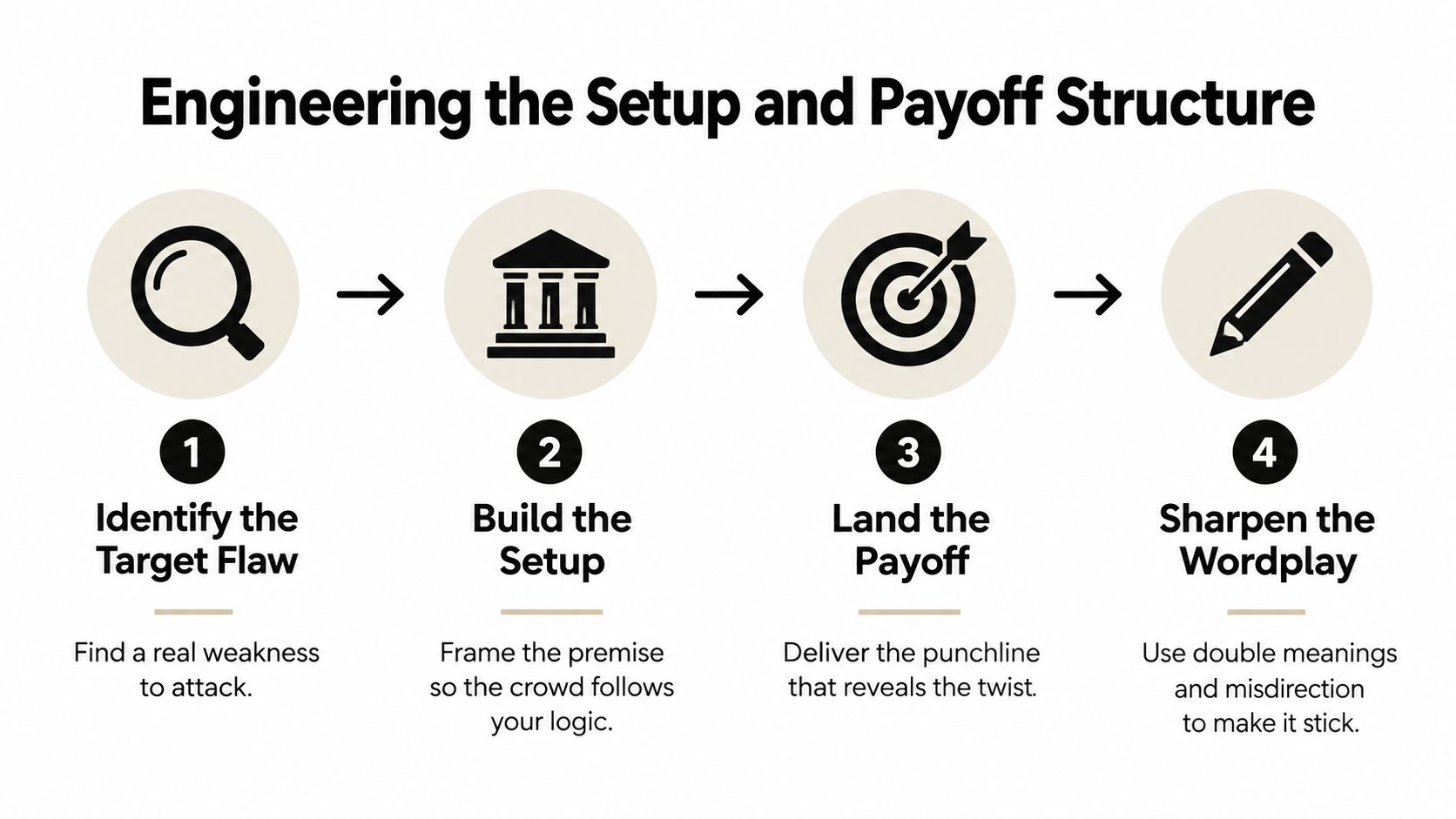 A diagram outlining a four-step process for engineering a setup and payoff structure for punchlines.
Start with the wound
Choose a concrete flaw rather than a broad dislike. “You're fake” is a conclusion, not an angle. “You change your personality whenever the room changes” gives you behavior to dramatize, repeat, and expose.
Write the plain-English payoff before searching for rhymes. “You don't have a style, you have different settings” identifies the core idea, even though it is not finished battle writing. From there, build a sound field around settings, switching, presence, pretending, and related vowel or consonant patterns.
List phrases that can approach the target sound. Exact rhyme is only one option. Approximate vowel matches, consonant echoes, and internal connections can all work if the pronunciation remains natural at battle pace. Read each candidate aloud. A rhyme that looks precise on the page but distorts your accent will cost more than it adds.
Build backward from the final phrase
The setup should create a reasonable expectation. The payoff redirects that expectation toward the opponent's flaw, with the final phrase carrying the clearest stress.
- Identify the target flaw. Choose behavior the crowd can understand without a biography lesson.
- Write the plain insult. Keep it conversational and emotionally obvious.
- Map the sound family. Collect words that support the payoff's vowels, consonants, and rhythm.
- Construct the setup backward. Supply enough context for the premise, then stop before explanation replaces tension.
Keep the setup short enough for two-second processing. A long preamble spends the room's attention on logistics instead of anticipation. Conceal the attack until the last phrase, while leaving enough of the subject visible for listeners to follow.
Coach's note: Misdirection works when the audience understands the road you put them on. It fails when the route becomes impossible to track.
A technical setup often needs a plain-language payoff. That change in texture gives the room a clean impact point and makes the insult easier to repeat after the bar. Dense wording followed by another dense phrase may impress the writer, yet it can blur the moment when the crowd should react. Leave space around the final stressed words.
Make the angle specific to the opponent
Generic insults can rhyme. Specific angles can win a round. Research the opponent's habits, public persona, repeated claims, and contradictions, then choose one detail that supports several interpretations. Mentioning everything you know dilutes the attack. One detail, interpreted several ways, reads as evidence of a larger weakness.
Avoid stacking unrelated attacks in one bar. If the setup concerns insecurity, keep the payoff connected to insecurity rather than switching to money and clothing halfway through. Each extra subject weakens the audience's expectation and makes the ending harder to process.
Test alternative endings aloud, first at writing speed and then at performance speed. The first ending often explains the joke. A later version may expose the character flaw with fewer words or a harder stress pattern. Choose the ending that makes the opponent look worse, not merely the one that rhymes most neatly. AI can generate several setup routes around the same flaw when writing stalls, but reject generic premises and keep the final angle specific to the opponent and the room.
Mastering Multisyllabic Rhymes and Internal Density
Multisyllabic rhyme earns its place only when it improves the live reaction. It can create rhythmic momentum, add texture to the delivery, and carry a setup toward a punch without forcing a predictable end rhyme. Technical analysis of battle rap treats rhyme density and multisyllabic structures as measurable performance features, so internal rhyme can shape the round's movement and help judges hear control (technical analysis of battle-rap co-creativity).
A multi matches sound across more than one syllable. Exact spelling is irrelevant. The sequence of stressed and unstressed sounds must feel deliberate in your accent and remain clear at performance speed.
Hear vowels before counting syllables
Start with vowel movement. Say the phrase naturally, then isolate its stressed sounds. A phrase with a strong a-e movement may connect with another phrase using similar vowel placement, even when the consonants differ. Add consonant echoes to tighten the pattern, but do not distort ordinary speech to protect the spelling.
Tap the stressed syllables while you say the line. The exercise shows whether the rhyme lands on your vocal beat or merely resembles one on the page. A multi that looks impressive in writing but requires an unnatural pronunciation will sound forced in the room.
Use internal rhymes to push the setup forward:
- Early echo: Place a near rhyme near the line's beginning.
- Middle pressure: Add another sound connection before the main pause.
- Final lock: Save the clearest rhyme or phrase for the payoff.
The crowd receives repeated sound cues, while the stress pattern still points toward one reaction point. Stress has a hierarchy. If every word receives equal force, the punch has no peak.
Build a working rhyme bank
Choose one target word and build groups instead of a single list. Sort options by exact sound, approximate sound, phrase, and meaning. The meaning group keeps technical choices tied to the angle. A perfect rhyme that says nothing about the opponent is wasted space.
Read each group at different speeds. Some phrases fit only a clipped cadence. Others need a pause before the final stressed syllable. Keep the options that still sound like something you would say in conversation.
The guide to multisyllabic rhymes helps with sound patterns, but rhyme hunting should serve the attack. A rare word does not win by itself. It wins when its sound makes the crowd recognize a familiar weakness from a sharper angle.
Bend pronunciation with discipline
Battle rappers stretch vowels, compress syllables, and use regional pronunciation. The adjustment must remain legible. If listeners hear a word being changed only to rescue a rhyme, the technique distracts from the insult.
Run three passes:
- Natural pass: Speak the phrase as you normally would.
- Rhythmic pass: Adjust spacing rather than pronunciation to fit the cadence.
- Performance pass: Add controlled vowel stretching only where it strengthens the payoff.
Do not fill every line with multis. Dense rhyme chains need contrast. A simpler phrase before the technical run gives the audience a stable point, and a plain-English ending lets the insult cut through the texture. Complexity should make the punch feel heavier, not force the crowd to locate it. Use AI as a sparring partner when a setup stalls: generate several sound and phrasing routes, then keep only the option that preserves natural stress and a specific attack.
The Shift from Freestyle to Scripted Crowd Engineering
Battle rap did not become more prepared because spontaneity stopped mattering. It changed because filmed battles rewarded material that could survive a room, a replay, and a clipped reaction. The December 1981 confrontation between Kool Moe Dee and Busy Bee Starski is often cited as an early landmark recorded battle. SMACK DVDs spread the format in the early 2000s, YouTube widened its reach in the mid-2000s, and the Ultimate Rap League became prominent around 2009 to 2010, as documented in the PBS history of battle rap.
That shift changed the writing job. A local cypher rewards fast presence and adaptable phrasing. A filmed league rewards a prepared sequence with clear stress, controlled pauses, and a payoff that still makes sense after repeated viewing. PBS reports that URL has accumulated over 650 million YouTube views over more than a decade, according to its overview of battle rap's digital audience. A bar now has to register in roughly two seconds, then remain quotable when the footage reaches a screen.
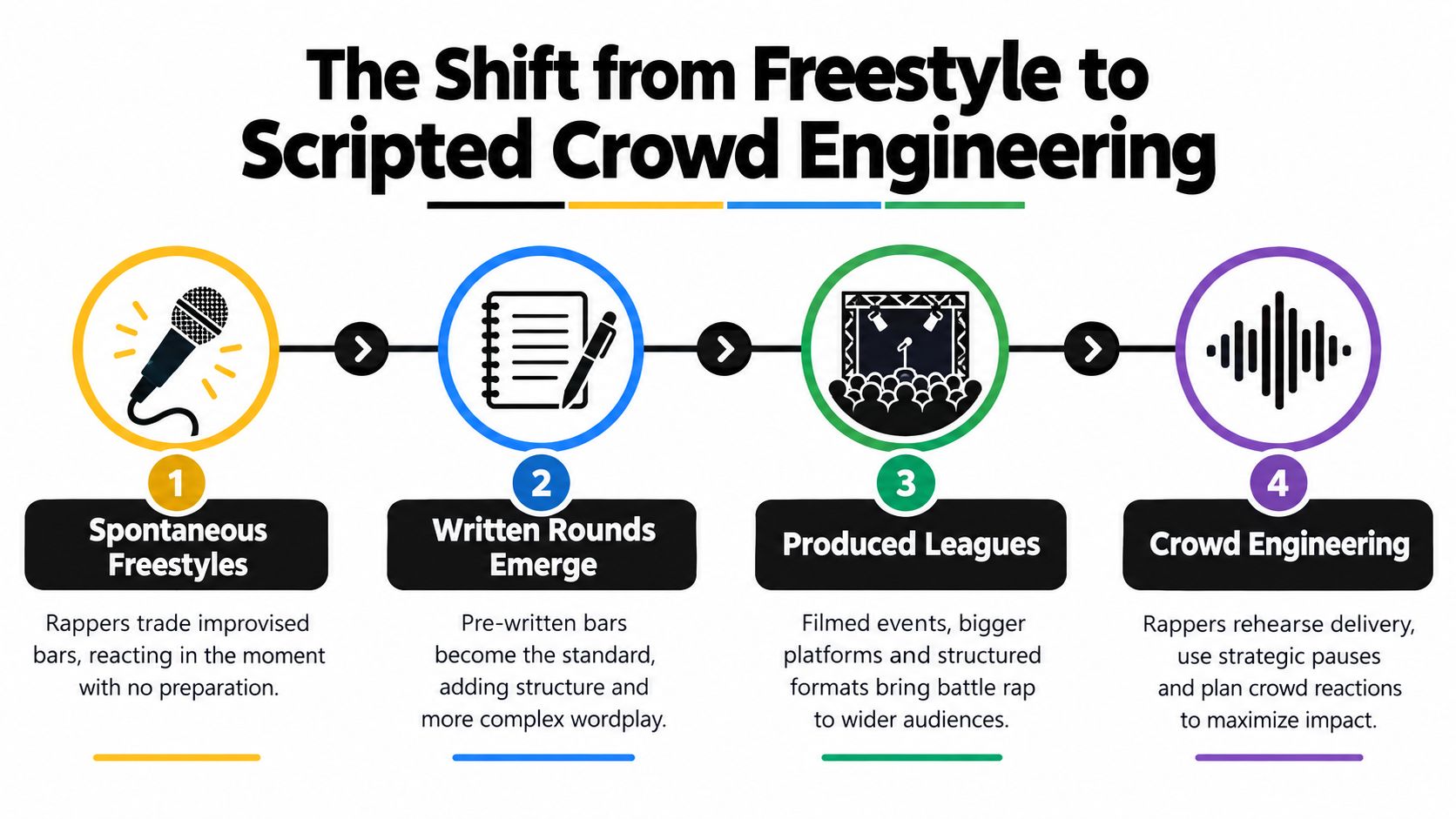 A four-step infographic illustrating the evolution of battle rap from improvised freestyles to scripted crowd engineering.
Preparation changed the writing
Analysis of scripted battle rap describes top battles as extended research projects, built around memorized three-round structures and deliberate crowd-pocket engineering (analysis of scripted battle rap and audience participation). Preparation gives the round a frame. Spontaneity still operates inside it, through reactions, pauses, tags, and small changes in emphasis.
A modern round works like a live production:
- Opening angle: Establish the opponent's central weakness.
- Escalation: Return to it with new evidence, comparisons, and wordplay.
- Peak moment: Deliver the most memorable sequence when attention is ready.
- Reset: Use a simpler bar or pause before changing direction.
Write for the crowd's timing, not only for the page. A strong reaction creates room for an extra tag. A flat response may mean the premise needs clearer wording, a harder stressed syllable, or less setup before the punch. Rehearse both outcomes so the next line remains usable.
The crowd is part of the composition. Write the reaction into the round, then rehearse the silence as carefully as the applause.
Digital distribution adds another constraint. According to PBS's history of battle rap, monetization of battle-rap viewership has declined sharply as attention shifted across platforms. The practical lesson is clear: build bars for an immediate room reaction, then check whether the key phrase remains understandable when isolated in a clip. That requires deliberate stress, clean syntax, and a payoff the listener can process without the full round around it.
Generating and Refining Angles with DissTrack AI
Writer's block in battle rap usually comes from a missing relationship between the target, the flaw, and the sound, rather than a shortage of vocabulary. An AI sparring partner can generate directions quickly, but your judgment, personal observation, and delivery still decide whether an angle survives in the room.
Use DissTrack AI as a variation engine. Enter the target's name, your relationship to them, and relevant inside jokes, then select a style such as Battle Rap, Old School Boom Bap, or UK Grime and adjust the tone. The platform generates structured roast lyrics and several possible approaches. Treat those drafts as prompts. The useful line is often the phrase that leads you toward a sharper bar, not text to copy unchanged.
 Screenshot from https://aidisstrackgenerator.com
Feed the tool an angle, not a biography
Give the generator material that can become a punch:
- Target identity: Name the opponent and your relationship to them.
- Observable flaw: Describe behavior rather than using a broad insult.
- Private context: Add an inside joke or recurring incident the audience can understand.
- Performance direction: Set the sound, mood, and level of aggression.
“Write brutal bars about my rival” gives the system no meaningful target. A stronger prompt specifies a rival who claims to be fearless but avoids every direct challenge, then asks for Battle Rap bars with a short setup and a clear final insult. That constraint gives you material to test against a live listener's two-second processing window.
The output remains raw material. Mark repeated themes, unexpected comparisons, and phrases with a promising vowel pattern. Cut anything that does not sound like you, relies on information the crowd lacks, or hides the payoff beneath unnecessary wording.
Turn variations into a writing conversation
Ask for alternatives instead of accepting the first draft. Request a shorter setup, a cleaner final phrase, a darker angle, or a version with internal rhymes. Then take the strongest concept away from the screen and rewrite it in your own cadence.
Authenticity returns during that rewrite. Replace generic comparisons with specific details, adjust the syllable stress to fit your breath, and remove words you would never say. AI can provide routes through a blank page. It cannot know which pause makes your room laugh, which reference will unsettle your opponent, or which phrase matches your natural stress.
The songwriting app guide provides broader ideas for using software during ideation. For battle rap, keep the workflow narrow: generate, select, personalize, perform, and cut.
Protect private information that should not be shared, and never present generated material as proof of something the opponent has not done. The strongest angle starts with a real flaw, gains force through precise technique, and reaches the crowd in a voice they recognize as yours.
Stress-Testing Your Delivery and Final Polish
A bar can look ruthless on the page and collapse in a room. Tongue-twisters, packed breaths, awkward stresses, and buried endings appear when the mouth has to carry the line at performance speed. Rehearsal belongs inside composition because a difficult line can fail live even when its idea is strong.
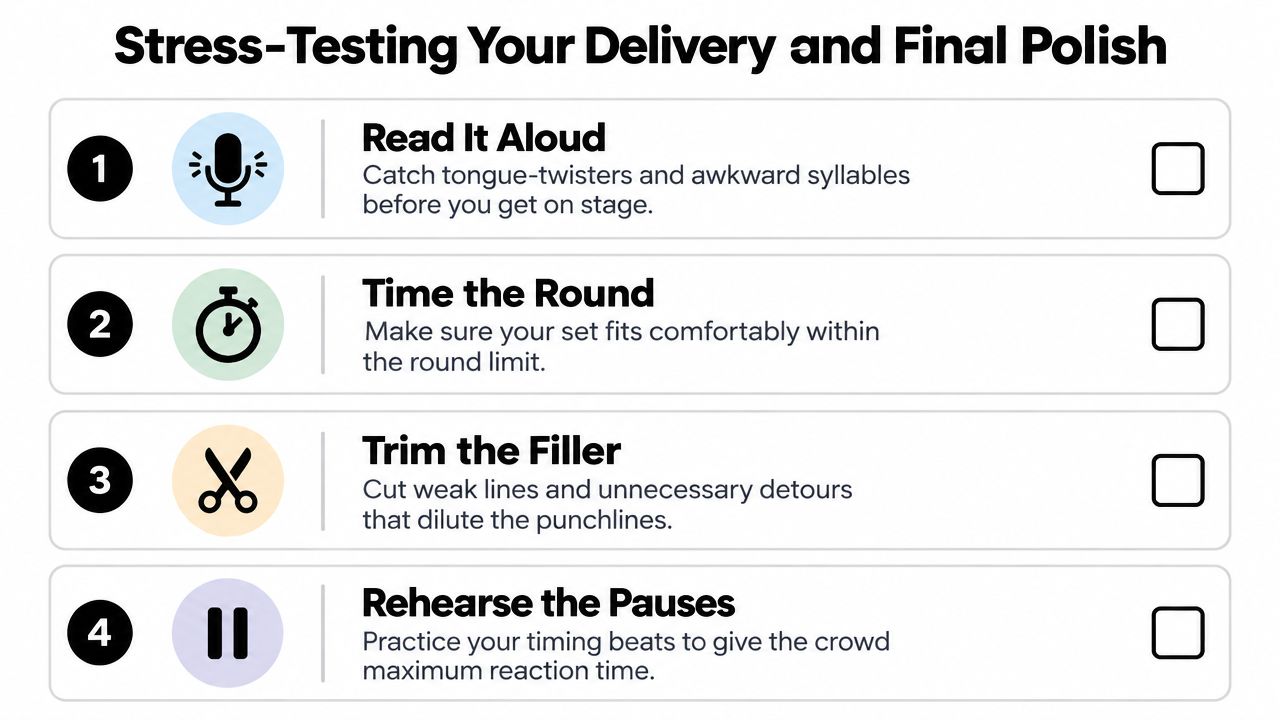 A checklist titled Stress-Testing Your Delivery and Final Polish with four steps for preparing a performance.
Read it as an opponent would hear it
Put the page away and record one complete take. Listen for every point where your authority drops, a consonant disappears, your breath runs short, or the final word arrives rushed. Mark those failures before changing the writing.
Stress should expose the meaning within the crowd's short processing window. Let function words move quickly, then give weight to the target's name, the central comparison, and the payoff. Equal emphasis across the setup and punch blurs the reaction point.
Treat pauses as punctuation. Silence before the final phrase can build anticipation, while silence after a weak word highlights the weakness. Practise both the pause and the recovery, including the moment when the crowd talks over you. A live round needs timing that survives interruption.
Cut what the mouth can't carry
Trim filler before cutting the idea. Remove repeated qualifiers, excess scene-setting, and rhyme words included only because they fit. A shorter bar gives you more breath control and lets the final consonants reach the room cleanly.
Run this checklist:
- Breath: Can you finish the setup without gasping before the payoff?
- Cadence: Do stressed syllables fall where your voice naturally hits hardest?
- Clarity: Will a listener understand the angle without seeing the lyrics?
- Reaction space: Is there a deliberate pause after the punch?
- Authenticity: Does the line sound like your character rather than a thesaurus?
- Resilience: Can you recover if the crowd covers part of it?
A strong round needs more than technical density. Evaluation can include rhyme complexity, coherence, emotional impact, audience engagement, and style authenticity, alongside the practical demands of performance. The angle gives the round direction, rhyme gives it movement, and delivery tells the room when the damage lands.
Use the rehearsal recording to make final cuts, then perform the revision again without stopping. If one line repeatedly breaks, trust the evidence. Replace it, simplify it, or move the punch to a phrase your mouth can deliver under pressure.
DissTrack AI helps generate personalized roast lyrics, test Battle Rap directions, and create variations when a blank page blocks your next angle. Use it for setup and rhyme ideas, then rewrite, rehearse, and sharpen the material in your own voice by visiting DissTrack AI.