
Battle Rap Schemes Explained: Rhyme Patterns That Hit Hard
The writer with more rhymes per line doesn't automatically take the round. Technical density in rap is measurable and it's been climbing for decades: a corpus study of 583,669 lyric lines from 104 English-language rap artists found Run-DMC's 1984 style averaged roughly 1.5 rhymes per line with only 6% of rhymes extending beyond two syllables, while Fabolous was measured at about 1.9 rhymes per line with 30% of his rhymes longer than two syllables. denser writer, bigger numbers, and yet plenty of technically loaded rounds die in the room.
Six Battle Rap Schemes at a Glance
Nearly every battle verse you've ever heard is built from a handful of rhyme blocks. Learn the blocks and you stop guessing at line endings and start choosing an effect.
| Scheme | Pattern | Best for | Example bar |
|---|---|---|---|
| AA couplet | Two lines end on one sound | Quick one-line roast | Your album's loud but nothing in it's true / Every verse you drop is trying way too hard to be new |
| AABB | Paired couplets | Setup then punch | You took the mic and froze like a fridge in June / Now you're on the floor and the crowd is in tune / Your set-up's loud, your punchline's late / You talk like someone who's never been great |
| ABAB | Alternating rhymes | Longer attacks that keep the ear guessing | Your crew talks big when the lights are bright / Backstage they hide from every fight / Every line you spit is borrowed light / Your name just sits there, cold as night |
| ABBA | Nested rhyme | Closing a thought like a loop | You came in loud and left with nothing new / Pack up your bars, the room is through / Brag all you want, the crowd can see / Your punchline's late, and that is overdue |
| AAAA | Monorhyme run | Relentless pressure to finish a round | You talk about the crowd but never pay the rent / You flex on stage, then hide inside your tent / Your bars are weak, your hype is spent / Your whole career is bent |
| Internal rhyme | Matches inside the line | Speed without losing the beat | Your name is lame, your rhymes are plain, you bring no heat, just cold rain |
Where these letters came from
The letters aren't a school exercise. Springer's research on rap structure identifies AA, AABB, ABAB, ABBA and AAAA as recognizable arrangements alongside internal and nested rhymes, growing out of a competitive verbal culture traced to the South Bronx in the mid-1970s. That same work separates battle rap from studio songwriting because battles usually run acapella or minimally engineered, which hands the performer room for cadence changes and rhythmic disruption a produced track won't allow.
So a scheme here has one job: make an attack legible to a crowd in real time. If you like naming the parts precisely, the David T.C. Tutoring Services vocabulary guide is a useful companion for rhetorical terms like antithesis and climax, which describe what your punchline is doing to the listener.
Say the bar aloud. If the last word feels like a landing rather than a stop, you picked the right scheme.
Why Rhyme Density Decides How Hard a Verse Hits
Density is the seasoning of a verse. Too little and the bar tastes like plain speech, too much and nobody can swallow it. The measure itself is simple: rhymed syllables per line.
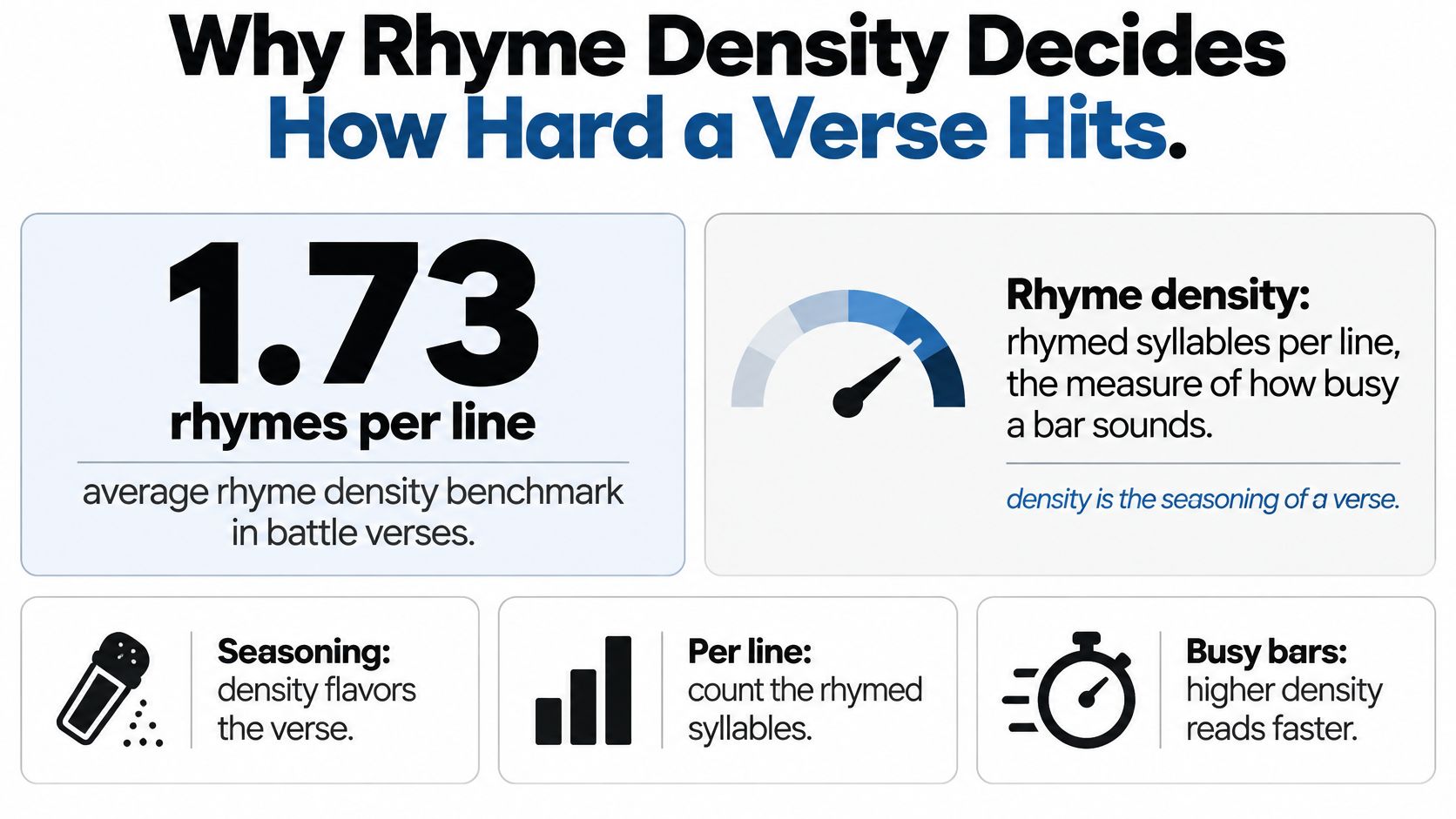 An infographic titled Why Rhyme Density Decides How Hard a Verse Hits, showcasing rap technical metrics.
The benchmark you're writing against
A large-scale computational analysis of rap rhyme reported average rhyme density rising from 1.73 rhymes per line in 1980s hip-hop to 2.32 in the 2020s, a 34.2% increase. The same analysis found rhymes containing three or more syllables grew from 8.3% of all rhymes in the 1980s to 27.6% by the 2010s. That second number is the one to sit with: multisyllabic rhymes now carry a big share of the weight, so matching a single syllable at the end of a line is the floor, not the flex.
Same line, two densities
Plain version: You sold the whole crowd a story that nobody bought.
Denser version: You sold the whole crowd a hollow little story, no glory, nobody bought.
Read both out loud. The second has more rhymed syllables, and it also has a mouthful in the middle that stalls your breath right where the punch should accelerate. That's the trade. Adding matches on unstressed syllables inflates your count without adding impact, and it can shove the meaning sideways until the bar is about the rhyme instead of about your opponent.
Score every draft on four things
- Rhymed syllables per line: count them, don't eyeball them. Two bars in the same couplet should sit at similar weight.
- Internal rhyme count: how many matches land inside the line rather than at the end.
- Share of multisyllabic rhymes: what fraction of your matches stretch past one syllable.
- Target relevance: does every bar serve the specific thing you're attacking, or is one bar just there because it rhymed?
Practical rule: if a denser rewrite makes you stumble or makes the joke harder to follow, keep the simpler line and add the density somewhere it doesn't fight the punch.
Before you record, answer three questions. Does the punch still land? Can a first-time listener follow the setup? Would the verse survive being said at half speed? A verse that only works fast isn't written, it's hidden.
How Flow Turns a Scheme Into a Live Hit
Two writers step up with the same end rhyme on the same word. One puts the punch on beat four and the room reacts before the next bar starts. The other buries the punch mid-bar, keeps talking, and the crowd hears a sentence instead of a hit. Identical scheme, opposite result.
Flow is the interaction of rhyme location, stressed syllables, syllable spread and beat placement. The MCFlow corpus paper treats speed, rhyme density, stressed-syllable position, rhyme position, phrase length, syncopation and syllable distribution across beats as measurable features, and found that approximately one quarter of stressed syllables are rhymed, with rhymes occurring disproportionately later in the measure, especially near beat four, where phrases commonly resolve.
Building the bar backward from beat four
That gives you a cause-and-effect rule you can use tonight. Put setup material across beats one to three. Hold your strongest semantic turn for the late-bar rhyme. Then vary your off-beat internal rhymes so the cadence doesn't turn into a metronome the crowd can predict by bar two.
Say your target is a rapper who talks about crowds he's never drawn. Beats one to three carry the observation, plain and unhurried: You count the heads in every room you enter. Beat four carries the flip on the anchor word: never center. The setup is information, the anchor is the verdict, and the gap between them is where the audience leans in.
Because battles usually run acapella, you've got more freedom to stretch or compress a phrase than a tightly engineered studio recording gives you. Use it. If your body doesn't know where beat four lives, hip hop dance classes at Encore Academy for the Performing Arts train the count in your feet, which is a faster route than counting on your fingers while you rap.
What a usable draft actually shows
A page of lyrics isn't a performance plan. A draft you can rehearse from marks four things:
- Syllable counts per phrase, so paired bars carry comparable weight.
- Stressed-syllable markers, so you know which words you're hitting.
- Rhyme positions, so you can see whether every anchor sits in the same spot.
- An alternate cadence for boom bap, trap, drill or grime, since each pockets the syllables differently.
Judge the rhyme in isolation and you'll keep the prettiest version. Judge it with the stresses marked and you'll keep the one that lands.
Delivery Modes That Change How a Scheme Lands
The question new writers ask most is the one nobody answers plainly: how do I turn a written scheme into a scheme that lands in a live battle? Delivery is the performance layer, and it's made of breath control, setup-to-punch timing, cadence changes, off-beat placement and knowing when to simplify a dense pattern.
Adams's analysis of flow in rap music, covering 124 songs, 86 rappers, 374 verses and 5,803 measures, found substantial variation between songs, which means a good scheme can't be judged apart from beat placement and delivery. The same scholarship describes the most effective flow as a balance between complexity and comprehensibility, not complexity alone.
Five modes worth testing on the same punchline:
| Delivery mode | Where stresses fall | Scheme that suits it | Main risk |
|---|---|---|---|
| Straight | On the main beats | AABB setup and punch | Predictable if overused |
| Triplet | Pushed into three-against-two feel | AAAA runs and internal rhyme | Words blur at speed |
| Delayed | Rhyme lands a beat late | ABBA loops and suspense | Audience loses the setup |
| Conversational | Natural speech stress | ABAB longer attacks | Punch can feel too quiet |
| Aggressive | Hit hard on every stress | AA one-line roasts | Breath runs out early |
The five-take recording test
Take one punchline, the same words every time, and record it in all five modes on your phone. Then listen back and mark three things on the page: the stressed syllables you hit, the rhyme anchors the ear catches, and the pauses where you breathed. Most writers discover their favorite written version is their weakest recorded one, usually because a triplet run swallowed the setup.
Fixing that is a mic problem as much as a writing problem, and learning to use your voice with deliberate projection and pacing changes which mode you can pull off. The strongest version is often the one a stranger understands on first listen.
Maximum density is not maximum impact.
Freestyle needs one frame, not six
Freestyle rewards improvisation, so don't try to hold a whole vocabulary in your head at once. Pick one scheme as a mental frame: AA for a quick comeback, ABAB for a longer answer. Rehearse three bars inside that frame before you step up, so when the beat drops the structure holds and you're only hunting words, not architecture.
How to Build a Battle Verse Around One Scheme
Build from the punch. Everything else in the verse exists to make one line inevitable.
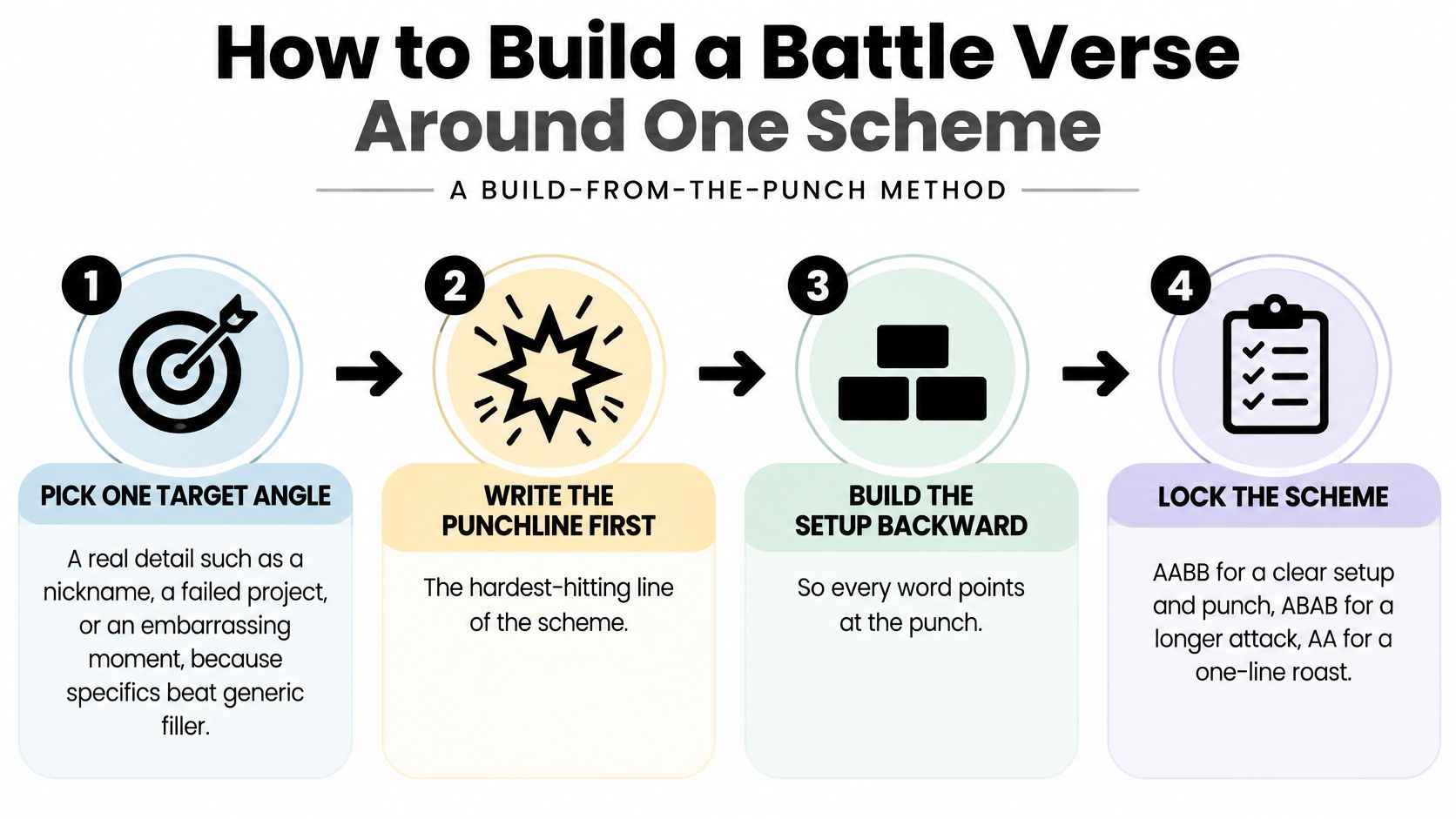 A four-step infographic illustrating the 'build-from-the-punch' method for writing effective rap battle verses.
- Pick one target angle. Use a real detail: a nickname, a failed project, an embarrassing moment. Specifics beat generic insults because the crowd can verify them. When you personalize a roast with our generator, you can feed it details such as Instagram handles, height, failed projects and embarrassing moments, and the same discipline applies to your own draft.
- Choose the scheme. AABB when you want a clean setup-and-punch rhythm, ABAB when the attack needs room to develop.
- Write the punch first. It's the destination, and writing it last is how writers end up settling for whatever rhymes. Sharpening that one line is its own craft, and how to write punchlines covers the setup-and-flip mechanics in depth.
- Build two or three setup bars on beats one to three. Keep the subject clear so nobody has to reconstruct your logic mid-round.
- Place the rhyme anchor on beat four, the late-bar spot where phrases resolve and the ear expects a verdict.
- Add off-beat internal rhymes and count syllables. Density that crowds the beat costs you the pocket.
- Say it aloud at three speeds and mark where your breath runs out. Slow, conversational, full pace.
- Cut the weakest bar. Eight tight bars beat twelve with one shrug in the middle.
What finished looks like
A finished eight-bar verse has a clear target, one scheme held all the way through, the punch on the last stress, and a version you can perform without gasping. Here's the procedure applied to one target: a rapper who calls himself King Cash and released a mixtape nobody finished.
Bars 1 and 2 (A): You crowned yourself King Cash, no throne, no crown, Tape dropped Friday, by Monday it was down. (anchor: beat 4)
Bars 3 and 4 (A): Eleven tracks of hooks you borrowed from the town, Even your own engineer put the headphones down. (anchor: beat 4)
Bars 5 and 6 (B): You booked a room, then begged the promoter for a slot, He read your name out loud and gave the stage to someone hot. (anchor: beat 4)
Bars 7 and 8 (B): King of what, exactly? A folder and a bot, The crown's a caption, and the caption's all you got. (anchor: beat 4)
Notice what the anchors do: down, down, hot, got all sit on the same late-bar stress, so the crowd learns where to expect the hit and you get the reaction on schedule.
Common Scheme Mistakes and How to Fix Them
Most broken verses fail in one of six ways, and every one of them is a desk fix, not a toughness fix.
- Rhyming for its own sake. The sound matches and the bar says nothing, usually because you searched for a rhyme before you knew your point. Check meaning first, then hunt sound.
- Punch word buried mid-line. You wrote a great final word and then kept talking past it, so the audience misses the landing. Move the strongest word to the stressed final beat and stop.
- One scheme held for sixteen bars. The ear figures out the pattern and stops listening for it. Switch to ABAB or a delayed rhyme after eight bars to reset attention.
- Rhymes on weak words. Anchoring on the or a makes the match sound forced because nothing meaningful is being emphasized. Anchor on nouns, verbs or names.
- Breath running out before the punch. You stacked syllables until the phrase became a sprint, and the verse collapses right at the payoff. Count syllables per phrase and break long bars into built-in pauses.
- Cutting the verse too late. Your best bar is sitting in a draft you abandoned because you edited in one pass. Keep a bank of spare punches and test them against the current setup.
The two-minute audit
Run the density count on your draft, then read it aloud at three speeds and mark every place you stumbled or gasped. Those two passes catch five of the six problems without anyone else in the room.
Coach's check: which of these six is in my draft right now? Name it before you rewrite anything, because fixing the wrong problem is how writers spend a week polishing a bar that should be deleted.
Pick a Scheme and Write Your First Battle Verse
Here's the workspace you're aiming at, a target, a style and a structured verse you can edit rather than a blank page.
 Screenshot from https://aidisstrackgenerator.com
Three moves get you from reading to writing. First, choose a starting scheme: AABB for a clear setup and punch, ABAB for a longer attack, AA for a one-line roast. Second, write your own draft around a real target detail, then run the density count and record it in the five delivery modes. Third, compare your draft against a generated version and note exactly where your stresses, rhyme anchors or punchline sit weaker.
Clarity is the whole game when there's this much competing noise. Chartmetric's 2024 Year in Music report counted an average of 28,700 tracks released globally each day in 2024, so a verse nobody can follow on first listen has no chance of traveling.
Use a generated draft as a reference, not a finish line
Our free tools include the AI Rap Generator, Rap Name Generator, AI Rap Battle Generator, AI Roast Generator and AI Rap Lyrics Generator, and the Free plan costs $0 forever with 1 diss track included. Pick a style tag such as Old School Boom Bap, Trap, Battle Rap, West Coast Hip-Hop, Aggressive or Comedy Rap, then check whether the generated stresses and anchors land where your beat style wants them. Boom bap and grime pocket syllables differently, and a bar that floats on one can drag on the other.
If you're turning the roast into content, the same clarity rule applies to the visuals, and it's worth taking time to compare faceless video tools so the captions and cuts land on your punch instead of stepping on it. Watch how a written scheme behaves in a real room before you finalize yours.
Keep your own target, imagery and voice in the final edit. The strongest verse is the one you can perform with confidence, not the one with the highest rhyme count.
Pick your scheme, write your punch first, and let DissTrack AI generate a structured battle verse with rhyme schemes and flow patterns you can measure your own draft against. Feed it a real detail about your target, choose Battle Rap or Old School Boom Bap, then record the same punchline straight, delayed and aggressive until you hear which one the crowd would catch. Start on the free plan and bring your best eight bars back to the mic.