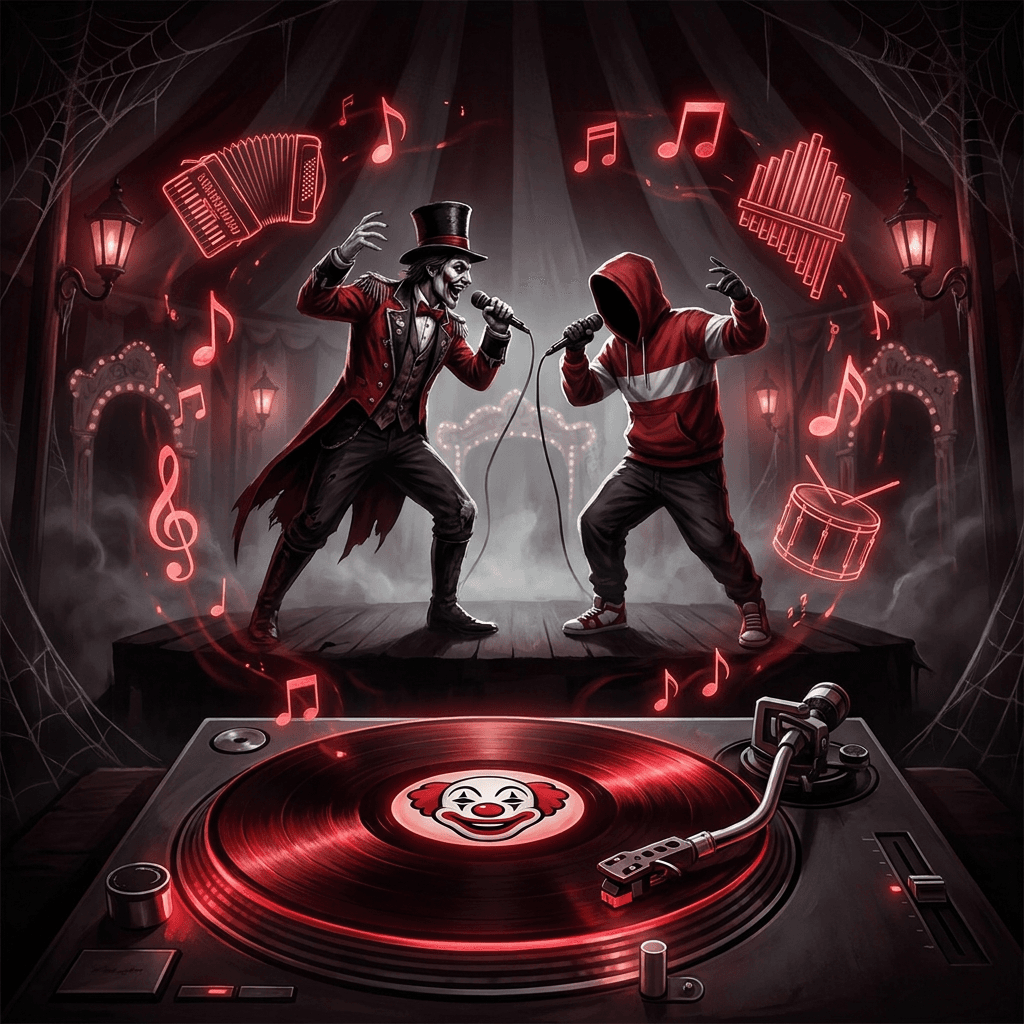
Circus Music Creepy: 7 Tracks That Will Haunt You
You're probably here because you need a track that says “childhood joy has gone terribly wrong,” and your current options are either too goofy, too generic, or legally sketchy. That slightly sour calliope, the lopsided waltz, the brass that sounds like it's leaking from a rusted carousel. When it works, creepy circus music does something few styles can do. It takes a familiar sound world and turns it hostile without needing a jump scare.
That's why circus music creepy enough for horror trailers, haunted attractions, indie games, and Halloween streams keeps showing up across modern media. It isn't an old formal genre so much as a deliberate trope. Media analysis has long pointed to the same trick: take classic circus language, slow it down, shift it into a minor key, and the funhouse turns into a threat. One early landmark is “Pink Elephants on Parade” in Dumbo, which used a circus-march feel in a minor key to make the sequence surreal and disturbing, and later games and films kept pushing the same idea through carnival horror scoring TV Tropes' creepy circus music overview.
The good news is you don't need to compose from scratch unless you want to. You can license polished tracks, grab free-attribution cuts, or build your own warped big-top cue from stems and loops. These are the tools and libraries I'd reach for when I need circus music creepy enough to unsettle people, but still useful in a real production.
1. PremiumBeat
 PremiumBeat
PremiumBeat is where I'd start if the brief says “give me creepy carnival, but make it clean, cinematic, and safe for client delivery.” It's a professional library, and that matters because this niche can go bad fast. A lot of creepy circus tracks collapse into novelty. PremiumBeat usually keeps the production polished enough for ads, teasers, trailers, and short-form branded content.
Tracks such as “Creepy Carnival” and “Circus of Fear” are the kind of names that make your search shorter. More important, the library tends to offer the practical versions editors need: full-length cuts, shorter edits, loops, and stems. That's the difference between dropping in a spooky cue and shaping one around a reveal, a title card, or a punchline.
What works here
- Stems save time: If the accordion is perfect but the bells are too cute, stems let you mute the sugar and keep the menace.
- Short edits are useful: Fifteen, thirty, and sixty-second versions matter when you're cutting promos or social spots.
- Licensing is clearer than most marketplaces: For web, social, and broader commercial uses, you can match the license to the job without playing detective.
Practical rule: If the project has a client, a deadline, and revision rounds, pay for the library that makes rights and deliverables obvious.
The trade-off is cost. Per-track licensing adds up if you're scoring a whole series, and some “spooky carnival” material still leans more Tim Burton whimsy than genuine dread. You need to preview carefully and listen for whether the track can hold tension once dialogue, screams, or voiceover sit on top.
If you're building your own version after studying references, even a basic production setup can get you there faster than you'd think. A beginner-friendly guide to the best program to make music for beginners is useful if you want to sketch custom organ, glockenspiel, and brass layers around a licensed bed.
2. AudioJungle
 AudioJungle
Sometimes you don't need a whole library strategy. You need one track, today, and you need checkout to take less time than your coffee cooling down. That's where AudioJungle's creepy circus listing earns its keep.
AudioJungle is a marketplace, not a tightly uniform catalog, so quality varies by seller. But for creepy circus music, that's not always a downside. This style benefits from oddball personality. A cue like “Scary Creepy Circus” with bells, accordion, and a waltz pulse gives you the recognizable grammar of the trope right away. No explaining required. The audience hears it and knows something under the tent wants them dead.
The real trade-off
The strength is speed and entry price. The weakness is consistency. One author gives you a sharp, mix-ready cue. Another gives you a thin sketch that sounds fine in headphones and falls apart under dialogue.
A few things make AudioJungle more usable than people assume:
- License tiers are spelled out: That's helpful when the same video might live on YouTube, a product page, and a paid campaign.
- Format info is usually visible on the item page: You can see what you're getting before you buy.
- Registration status can matter: If an item notes that it isn't registered in YouTube Content ID, that can reduce claim headaches.
Buy marketplace tracks with your edit already in mind. Don't shop by mood name alone. Shop by intro length, build shape, ending, and whether the cue leaves room for sound effects.
If you like generating unusual musical ideas and then replacing them with licensed cues later, there's a smart hybrid workflow here. Use AI for rough concepting, then purchase the track with rights that fit release. This primer on artificial intelligence music composition pairs well with that process.
3. AudioSparx
 AudioSparx
A creator cuts the trailer, finds one perfect creepy calliope cue, then hits the main problem on edit day two. Nothing else matches it. The teaser feels like one project, the full video feels like another, and the brand voice starts to wobble.
AudioSparx is useful for that exact production problem because it offers themed collections such as “Twisted Circus of Horror.” For episodic work, attractions, podcasts, game levels, and multi-part campaigns, a pack often beats cherry-picking isolated tracks from five different sellers.
The practical advantage is consistency. Creepy circus music can drift fast if you are not careful. One cue pushes detuned accordion and brushed snare. Another goes full synth slasher. Another sounds like novelty Halloween stock. A curated set keeps the instrumentation, harmony, and sense of menace in the same family, which saves time in the mix and makes the whole project feel authored.
That matters more than people think.
This category works best when it behaves like a toolkit, not a gimmick. You want an opener, a lower-energy bed, a transition sting, and maybe a tension loop you can cut around dialogue or sound design. AudioSparx is stronger in that use case than in the one-and-done trailer buy.
Where it earns its keep
AudioSparx makes the most sense when you need several related cues with different intensity levels. That is a better fit for recurring intros, chapter breaks, haunted queue lines, escape-room scenes, or gameplay states than for a single 30-second promo.
There is a trade-off. Packs raise the upfront cost. They also reduce the risk of wasting hours trying to force mismatched tracks into one sonic world. In post, I will pay a little more for cohesion if it cuts revision time and keeps me from rebuilding transitions by hand.
- Use packs for recurring formats: Series branding gets stronger when the same musical DNA returns in different forms.
- Use singles for short campaigns: One trailer or one social ad usually does not need a full themed set.
- Check edit flexibility before buying: Alternate mixes, loopable endings, and shorter versions matter more than clever track titles.
For indie games and interactive projects, this approach is especially practical because you can map related cues to rooms, enemy states, menus, and reveal moments without the score feeling stitched together. If you are building that kind of system, this guide on how to make music for a video game is a solid companion to using a prebuilt pack and adding your own stingers on top.
4. TunePocket
 TunePocket
A client sends the final cut at 11 p.m. The carnival teaser still needs music, the upload is due in the morning, and nobody wants a copyright dispute parked on a monetized channel. TunePocket's creepy circus collection is built for that kind of routine production reality.
What makes TunePocket useful is not just the mood of the tracks. It is the amount of licensing friction it removes for people who publish often. You can pull a creepy circus cue for one video, then come back for transitions, ambient beds, and cleaner background music for the rest of the month without changing vendors or relearning the license terms.
That matters more than creators like to admit. A good horror cue is easy to find. A usable horror cue, licensed in a way that does not slow down approvals, exports, and channel management, is harder.
Why it works for repeat production
TunePocket fits teams and solo creators who need speed and predictability. The catalog is smaller than the giant marketplaces, but that often helps in practice. I would rather sort through a tighter pool with decent tagging than burn an hour auditioning twenty tracks that all promise “twisted carnival” and deliver the same detuned waltz.
There is a trade-off. If the brief is extremely specific, maybe “1920s calliope, brush snare, creepy but still comic, under 90 BPM,” a broader marketplace can give you more edge cases. TunePocket is stronger when the core requirement is simpler: find something effective, clear the rights, cut the video, publish on time.
The creepy circus style also has more life than its old-movie reputation suggests. Playlist culture, horror creators, indie game trailers, escape-room promos, and Halloween event marketing still use it because the sound reads instantly. One warped organ, one lopsided rhythm, and the audience already knows the smile is not friendly.
The best subscription library saves time twice. Once when you find the track, and again when the license does not come back to bother you during release.
For creators building a repeatable workflow, that is TunePocket's real value. It works less like a novelty bin and more like a practical music shelf you can keep returning to.
5. Silverman Sound Studios
 Silverman Sound Studios
If your budget is somewhere between “tiny” and “please stop asking,” Silverman Sound Studios' “Skeleton Carnival” is one of the better free options around. It has the right ingredients: warped calliope energy, dark piano, and that slightly off-center toy-box shimmer that makes a carnival cue feel diseased rather than playful.
Legal practicality is important here. The free version is under CC BY 4.0, which means attribution is required. That's fine for many indie videos, prototypes, school projects, or low-budget horror shorts. It's less fine when the client hates credit lines, the platform layout makes attribution ugly, or the project is sponsored.
Free isn't frictionless
Silverman does something I appreciate. The licensing language and claim-help documentation are clear enough that you're not left interpreting vague copy like a cursed parchment. There's also a Pro License path if you want attribution removed and need better production assets such as WAV or stems.
That makes it a good stepping-stone resource. Test the mood with the free version. Upgrade when the project graduates.
- Great for prototypes: Need creepy circus music in a game jam build or proof-of-concept trailer? This works.
- Less ideal for polished brand work: Attribution can become the one detail everyone argues about at the worst possible moment.
- Strong sonic character: It sounds like an actual choice, not filler.
The main limitation is obvious. One track is one track. If your project needs several related cues, you'll have to source companions elsewhere or build around this one as a central motif.
6. Bensound
 Bensound
Bensound's “Creepy” track sits in a useful zone between approachable and strange. It leans into the freak-show palette with celesta, accordion, and music-box textures, which makes it a strong pick for creators who want carnival unease without going full slaughterhouse under the big top.
That tonal balance matters. Not every project wants pure terror. Some want theatrical menace, dark comedy, gothic whimsy, or “something is wrong with the puppet booth.” Bensound is often good at that in-between mood.
Where it fits best
This is a natural option for YouTube videos, spooky explainers, Halloween promos, escape-room ads, and stream intros that need to feel creepy but still legible. You can use the free tier with attribution, or pay for cleaner usage on monetized and client work.
Bensound also tends to think about the creator workflow. YouTube claim prevention guidance and channel whitelisting support are practical features, not marketing glitter. If you upload often, you'll care about that a lot more than whether the thumbnail art is cool.
There's also an audience side to this style that's easy to overlook. One Spotify playlist focused on creepy circus and carnival music has been cited with an average watch time of 4.2 minutes, which suggests listeners will stay with this sound when the mood is right as described in this playlist-based source. That doesn't mean every project should drench itself in glockenspiel dread. It does mean the aesthetic can hold attention when used deliberately.
Use with caution: If your visuals are already chaotic, pick the simpler circus cue. Music-box sparkle plus frenetic editing plus clown imagery can turn from eerie to corny in seconds.
Bensound is a good choice when you need creepy circus music that still knows how to behave on camera.
7. Pond5
Pond5's creepy circus marketplace is the rummage bin, treasure chest, and trapdoor all at once. It's huge. That's the appeal. You can audition a lot of “evil circus,” “haunted carnival,” and twisted fairground variants quickly, across a wide range of styles and budgets.
When I need options fast, Pond5 is useful because it lets me hear how different sellers interpret the same idea. Some tracks are full themes with melody and rise. Others are ambient beds with distant calliope, reverb-heavy toys, and metallic creaks. That spread is valuable when you're not sure whether the scene wants a tune or just a sickly atmosphere.
Vet before you buy
Big marketplaces reward careful listening. Don't assume a cheap cue is a bargain just because the preview starts strong. Listen for looping seams, harsh highs, awkward endings, and whether the “circus” element is present instead of implied by the title.
Filters help. BPM, duration, loop status, PRO status, and available versions can narrow the field. Item pages also often show whether a track has Content ID or collecting-society complications, which can save headaches later.
This is also where it helps to understand the trope rather than just the tag. The common transformation behind creepy circus music is still the same old move: tempo dragged down, key darkened, spectacle turned uncanny. The historical question of whether carnival music was originally perceived as creepy remains murky, and that gap is exactly why modern media creators have so much room to define the sound for themselves. A long-running AskHistorians discussion about whether carnival music was always seen as creepy captures that uncertainty well.
- Best for variety hunters: Lots of stylistic angles in one place.
- Best for budget flexibility: You can find simple ambiences or fuller cues.
- Worst for indecisive editors: Too many options can burn an afternoon.
If you know what you need, Pond5 is powerful. If you don't, it becomes the haunted hall of mirrors.
Creepy Circus Music: 7-Provider Comparison
| Provider | Complexity 🔄 | Resource needs ⚡ | Expected outcomes 📊 | Ideal use cases 💡 | Key advantages ⭐ |
|---|---|---|---|---|---|
| PremiumBeat | Moderate, per-track license selection and stem edits 🔄 | Paid per track; stems/versions save edit time ⚡ | High-production cinematic cues with clear rights for web/ads/TV/film 📊 | Broadcast, promos, films, projects needing polished single cues 💡 | Consistent vetted quality; clear tiered licenses; stems/loops for fast editing ⭐ |
| AudioJungle | Low, single-click marketplace purchases 🔄 | Low entry cost per track; no subscription needed ⚡ | Fast access to ready-to-use eerie cues; quality varies by author 📊 | One-off projects or quick turnover needs where budget matters 💡 | Very inexpensive and quick checkout; clear license tiers ⭐ |
| AudioSparx | Moderate, pack selection and licensing for multiple uses 🔄 | Higher upfront cost for packs but covers multiple cues ⚡ | Cohesive mini-library that maintains atmosphere across episodes 📊 | Series, episodic content, or longer projects needing consistent themes 💡 | Curated themed packs reduce sound-matching effort; commercial licensing available ⭐ |
| TunePocket | Low, straightforward membership or pay-as-you-go 🔄 | Affordable annual plans or small pay-per-download option ⚡ | Reliable pipeline of license-safe tracks for ongoing creators 📊 | YouTubers, marketers, indie creators needing recurring music supply 💡 | Clear pricing, channel whitelisting and good value for repeat use ⭐ |
| Silverman Sound Studios | Low, free CC option or paid Pro license for WAV/stems 🔄 | Free under CC BY 4.0 (attribution) or pay to remove attribution ⚡ | Unique, characterful single track; pro license adds stems/WAV and claim support 📊 | Budget projects, indie creators, or when a distinctive free cue is acceptable 💡 | Zero-cost access with transparent Content ID guidance; option to upgrade ⭐ |
| Bensound | Low, simple free-with-attribution or paid licensing 🔄 | Free tier with attribution; paid single licenses or subscription for monetization ⚡ | Creator-friendly, tagged tracks with predictable rights and broader catalog 📊 | YouTube creators, small clients, and projects needing easy clearance 💡 | Clear workflows for claims, all-access subscription available; decent library breadth ⭐ |
| Pond5 | Moderate-to-high, many sellers to vet; filtering required 🔄 | Variable pricing (very low to mid); subscription for volume buyers ⚡ | Extensive variety from ambiences to full themes; quality uneven 📊 | Auditioning many variants, volume sourcing, or finding niche textures 💡 | Huge selection, robust filters (BPM/duration/PRO status) and flexible pricing ⭐ |
Don't Be a Clown: Using Your Nightmare Soundtrack
A creepy circus track only works if you assign it a job. Don't drop it in because “clown equals horror.” Use it to do something specific. It can foreshadow a reveal, make a children's space feel contaminated, underline a villain with fake cheer, or push a scene into surreal territory without leaning on the same horror drones everyone else uses.
For short films, the best move is often restraint. Start with environmental sound, then bring in the circus element only when the story shifts. A detuned carousel loop under normal room tone is often scarier than blasting full carnival chaos from frame one. For tabletop sessions, haunted mazes, or Halloween streams, looping beds work better than big melodic pieces because they don't exhaust the room. In game work, assign variations by zone or threat level so the motif evolves instead of nagging the player.
Legally, the boring advice is the advice that saves projects. Read the license. Check whether attribution is required, whether monetized use is covered, whether client delivery is allowed, and whether your channel or ad account needs whitelisting. A free track with attribution can be perfect for a personal horror short and a complete disaster for a sponsored brand video. A cheap marketplace license can be ideal for one release and wrong for a distribution-heavy campaign.
For DIY sound design, the formula is simple enough to experiment with. Start with a bright, old-fashioned circus rhythm. Slow it down. Shift it minor. Add mechanical textures, toy percussion, thin accordion, pump organ, glockenspiel, or distant brass. Then remove anything too cheerful. The most effective circus music creepy enough to unsettle people usually feels half-familiar and half-rotten.
And if you want a sharp contrast, mix eras on purpose. A sinister calliope loop under a modern roast, meme edit, or battle-style promo can be weird in the best way. That kind of collision tends to stick.
For creators working on themed gifts, parody projects, or event-driven pieces, it's also worth looking at resources on writing songs for special occasions. The same principle applies here. Specific context beats generic mood every time.
If you want the other half of the chaos, the words instead of the music, try DissTrack AI. It's built for creators who need sharp, funny, brutal roast lyrics fast, whether you're cutting a battle-rap skit, a Halloween promo with attitude, or a bizarre carnival-themed diss that nobody will forget.