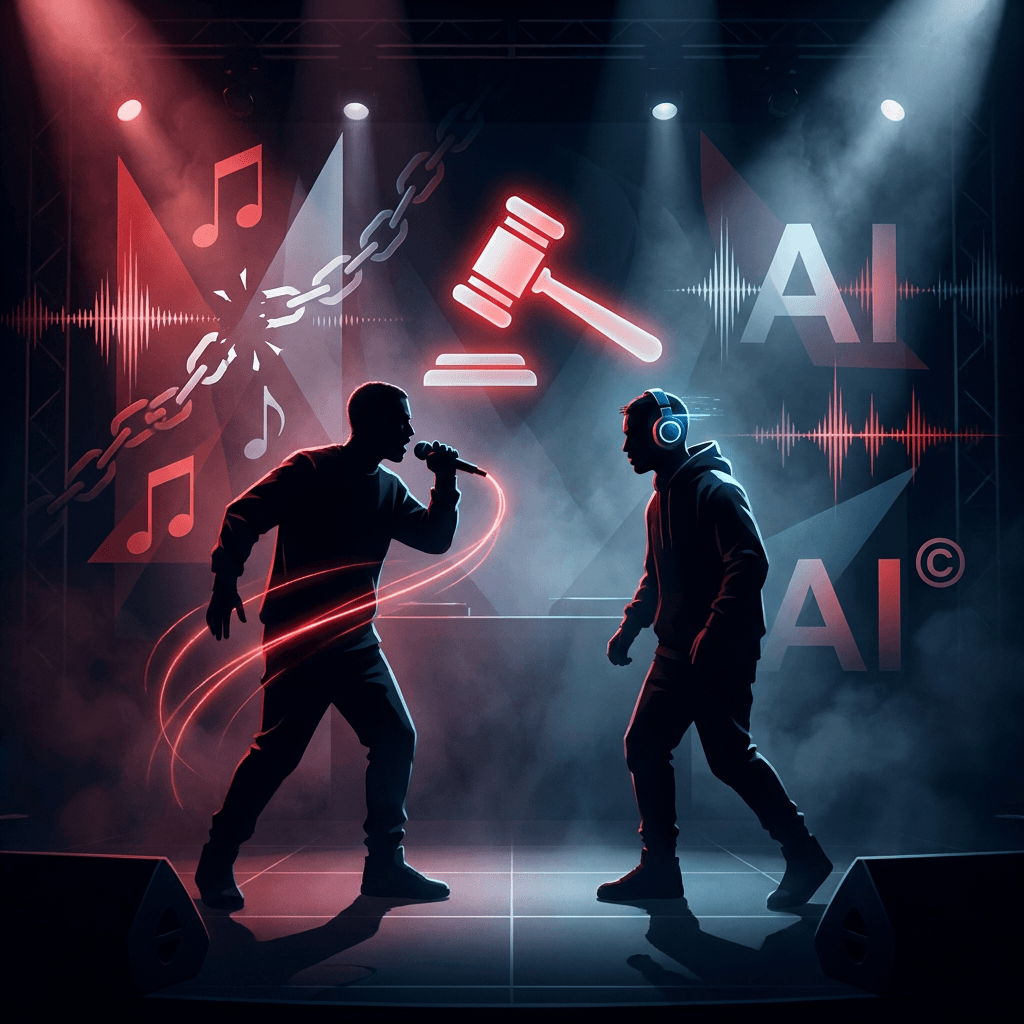
Commercial License NJ: Can You Use AI Lyrics Legally?
New Jersey does not issue a general commercial license for AI-generated lyrics, so commercial rights come from the generator's license terms plus your own clearance of everything else in the track. If you searched “commercial license NJ” meaning a commercial driver's license, this guide covers business and creative use; driver licensing is handled separately by the New Jersey Motor Vehicle Commission.
You've got a roast verse, a beat that knocks, and a sponsor asking whether they can post it tomorrow. Before you send the export, separate permission to use generated lyrics from permission to use the music, names, images, and borrowed material around them. A commercial license isn't a backstage pass for every element of the release.
Quick Answer on Commercial Use in New Jersey
You don't need a New Jersey lyric license, but you do need the right permissions for your particular project. Start with where the track will appear, who will earn from it, and whether another person's work or identity appears in the package.
A birthday roast and a sponsored campaign can use identical words yet create different problems. The party host wants a laugh; the sponsor wants content it can advertise, edit, repost, and possibly hand to an agency. That wider use needs a closer contract check.
Commercial use by project type
| Project type | Usually fine commercially? | Main check |
|---|---|---|
| Private roast for a party | Yes, no sale involved | Keep it private or clearly in good humor |
| Monetized YouTube or TikTok roast | Usually, if the plan covers commercial use | Confirm monetization rights and clear any music bed |
| Released single on streaming platforms | Usually, with permitted lyrics and a cleared beat | Add your own rewrites and match the beat license to distribution |
| Merch with lyric lines | Check carefully | Confirm resale rights; remove names suggesting endorsement |
| Paid brand or sponsor ad | Check carefully | Get written approval for promotional use of a real person's identity or implied brand endorsement |
| Lyrics stating a real person's wrongdoing as fact | No, not as an unchecked release | Remove false or unsupported allegations; comedy labels don't cure them |
“Usually fine” isn't a legal determination. A private performance can still cause harm, and rewriting lyrics doesn't automatically clear borrowed material. Treat the table as a release filter, not a referee waving every punch through.
Written approval matters most when you're borrowing rights, such as using a restricted beat in an advertisement, licensing lyric text to a customer, or presenting someone as associated with a sponsor. Merely mentioning a person or brand in expressive lyrics doesn't automatically require permission, but promotional use deserves a different review.
Practical rule: If money changes hands or a real person is named, confirm the rights before posting.
The useful question isn't whether you can monetize. Ask whether you can authorize this upload, this product, and this campaign without promising rights you don't control.
Why New Jersey Has No Universal Commercial License
New Jersey business registration and creative licensing solve different problems. Registration identifies the business and its obligations; a generator's contract addresses use of its output. Neither substitutes for the other.
The New Jersey business-registration guide describes the formation, federal identification, and state-registration process, including filing NJ-REG at least 15 business days before beginning operations. That's an operating deadline, not a waiting period that turns lyrics into cleared intellectual property.
Put the business setup in order
For an entity-based operation, the practical sequence is:
- Form or authorize the entity. Set up the company that will sign contracts and receive revenue; don't assume every solo creator must form an LLC.
- Obtain an IRS Employer Identification Number when applicable. Keep business identification consistent across banking, distribution, and tax records.
- Complete NJ-REG. Register the actual operation rather than looking for a special AI-lyrics permit.
- Address employer registration if you hire. A collaborator's invoice and an employee's payroll aren't interchangeable arrangements.
The home studio may look informal, but invoices, subscriptions, and sponsor agreements still need an identifiable business operator.
 A modern home office setup featuring a laptop, microphone, coffee mug, and notebook on a wooden desk.
Think of the distinction like a kitchen: the state regulates the business operation, not ownership of the recipe. Registering your operation doesn't establish that you own the hook.
Registration isn't the last tax task
The state's tax-registration guidance explains that taxable businesses need sales-tax authorization and that employers have withholding obligations. Don't assume every download, service, or bundle receives identical tax treatment.
Starting sales before the appropriate setup can complicate tax authorization and reporting. This week, decide how you're operating, check the applicable registration obligations, and complete the required setup before launching the business's paid releases.
What Your Generator's License Actually Grants
Read a generator's terms as a permission contract, not a compliment about how original your bars sound. Search the terms page for commercial use, output, ownership, restrictions, termination, and attribution.
The answers need to cover your actual workflow. Permission to publish a video doesn't necessarily include permission to sell editable lyric packs to other creators.
Questions your terms should answer
- Does commercial use cover the destination? Look for paid streams, monetized videos, advertising, and merchandise. A license covering social uploads may not expressly address printing a punchline on hoodies.
- Can you resell or sublicense the text? Selling a finished performance differs from selling the raw lyrics for someone else to reuse. A client commission may require rights you can pass along.
- Is the grant exclusive? Permission to use output doesn't necessarily stop another user from receiving similar language. Don't promise a sponsor an exclusive slogan without checking.
- What changes between tiers? Compare rights, not just generation allowances. With a hypothetical provider that restricts its free tier to personal use, a group-chat roast wouldn't automatically qualify for an advertisement after an upgrade; check whether the upgrade covers earlier output.
For creators testing a more self-managed workflow, Creators Toolbox's open source pilot steps for creatives offers a useful starting point. Keep the software license separate from any model, asset, or output-use conditions.
Read the restrictions as carefully as the grant
Ownership or assignment language addresses what the provider transfers or claims. Attribution language may require a credit. Content restrictions may prohibit harassment even when commercial use is otherwise allowed.
Check termination and takedown provisions too. Can the provider suspend access for a policy breach? Does cancellation affect previously generated work, future downloads, or continued use? Don't assume those are the same question.
A provider can authorize use of its output under its contract. It can't clear someone else's recording, protected lyrics, or identity merely by calling the output commercially usable.
If a line reproduces recognizable material, resolve that material separately. The commercial-use clause isn't a warranty that every possible release is infringement-free.
Who Owns the Lyrics, the Beat and the Hook
Purely AI-generated lyrics generally lack the human authorship needed for U.S. copyright protection. Commercial permission can therefore coexist with weak exclusive rights: you may be allowed to release a hook without having a strong copyright claim against someone who copies its unedited wording.
Human-written additions and sufficiently creative revisions can carry their own protection. That doesn't mean changing punctuation creates ownership of the entire output. Preserve drafts showing your expressive choices, including rewritten images, new verses, and original musical contributions.
Separate protection from permission
The guide to copyrighting song lyrics is a useful companion when organizing your authorship records. Describe what you wrote rather than treating a generator's ownership clause as proof that every line qualifies for registration.
Ownership and clearance by track element
| Element | Ownership or protection | Clearance step |
|---|---|---|
| AI-generated lyrics, unedited | Limited copyright protection; purely AI-authored material may be refused registration | Follow the platform's usage terms and save them |
| Lines you rewrite or add | Your sufficiently original human authorship can be protected | Keep dated drafts showing your contributions |
| Purchased beat | Producer's license terms set your usage rights | Choose a license matching the release and promotional use |
| Sampled hook or melody | Rights may belong to the composition owner and, for a sample, the recording owner | Clear the relevant sample or interpolation before release |
| Real artist or person named | Publicity and defamation concerns may arise | Avoid implied endorsement; obtain appropriate written permission for ads |
Buying a beat usually buys specified permission, not the producer's entire copyright. Look for restrictions on distribution, video use, advertising, modifications, and sublicensing before delivering files to a brand.
A replayed hook still needs attention
An interpolation recreates material from an existing composition rather than lifting its recording. Replaying a protected melody with new instruments or new words doesn't automatically remove the need for composition clearance.
By contrast, a general rhythmic feel, genre convention, or short commonplace phrase isn't automatically protected merely because another artist used it. Identify what you borrowed before assuming either that everything needs permission or that changing the sound clears everything.
For projects combining music and visuals, the AIMVG music copyright guide provides additional context for organizing those rights questions. Keep the composition, recording, and visual assets on separate lines in your permissions record.
The working rule is straightforward: document the parts you wrote, license the parts you bought, and clear protected material you borrowed.
Real People, Roasts and Publicity Risks
A Jersey Shore streamer tags a rival creator in a sponsored roast video. The punchline is about terrible freestyle timing, but the thumbnail places the rival's face beside the sponsor's product. Now the campaign raises an endorsement question that the lyrics alone didn't create.
Review the whole presentation, including the thumbnail, caption, tags, and sponsor placement.
 A professional microphone and headphones in a recording studio, highlighting the importance of clear audio communication.
Defamation risk concerns false factual assertions, not whether the target dislikes the joke. Saying someone's flow arrives after the bus leaves is obvious exaggeration; asserting that they were arrested or stole sponsor money is a different proposition.
A comedy label doesn't automatically neutralize a factual allegation. Nor does earning money automatically turn every reference to a person into an unlawful endorsement. Context matters, especially the difference between an expressive diss and advertising built around someone's identity.
Keep the battle on defensible ground
- Make exaggeration recognizable. Roast the delivery, outfit, or public performance without inventing misconduct.
- Leave private details out. Skip addresses, medical information, family disputes, and private messages used as ammunition.
- Separate ads from commentary. Don't suggest that the target supports a sponsor; obtain written consent for promotional identity use when appropriate.
- Review complaints promptly. Preserve the files and correspondence, pause promotion where sensible, and assess whether removal or correction is necessary.
- Focus on public behavior. A weak public freestyle gives you material without manufacturing a criminal history.
Use the video as a viewing break, not as a substitute for reviewing the actual release.
Your toughest punchline should survive without a false allegation.
This is general information, not legal advice. For a sponsored attack track, disputed accusation, or recognizable-person campaign, have a New Jersey attorney review the final creative and advertising context.
Pre-Release Checklist Before You Publish
Build a release folder before you schedule the upload. A folder containing the actual permissions is more useful than a chat message saying somebody probably cleared the beat.
Use the visual checklist as a reminder, then complete the detailed checks below. Registering repertoire with a performing rights organization may help administer eligible performance royalties, but it doesn't establish copyright ownership or replace clearance.
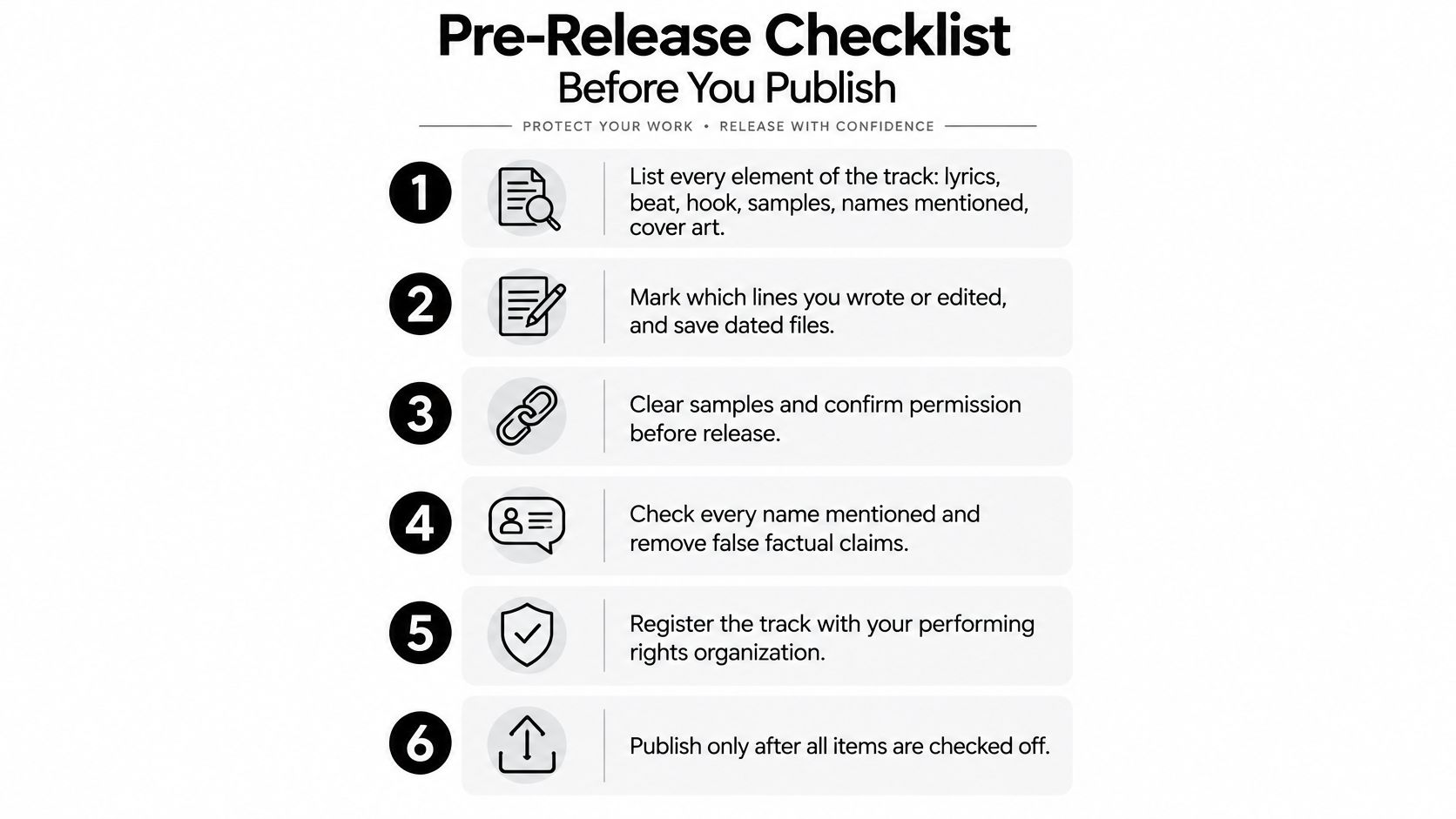 A six-step checklist for musicians to follow before releasing their music to ensure legal protection.
Run the release checks
-
Inventory the entire package. List lyrics, beat, hook, samples, names, cover art, and video assets so nothing escapes review just because it isn't audible.
-
Mark your human contributions. Save dated drafts and identify your rewritten lines, added verses, and original musical choices; these records distinguish your work from untouched output.
-
Match generator permission to the project. Confirm the applicable terms cover the planned stream, monetized video, merchandise, or advertisement, including any client delivery.
-
Read the beat license against the final use. Check the distributor, promotional placements, and video permissions rather than assuming the purchase receipt covers everything.
-
Resolve samples and interpolations. Obtain the appropriate owner's permission before release, or replace the material with something independently created and documented.
-
Review people and claims. Remove false factual allegations, unnecessary private details, and promotional identity uses that lack appropriate permission.
-
Confirm the business setup. Make sure the entity receiving revenue and signing agreements matches the operation's registration and tax arrangements.
-
Archive the evidence. Save terms, receipts, permissions, contributor agreements, and the approved master together so you can answer a distributor's or sponsor's rights question.
-
Recheck before repurposing. A new campaign may introduce a different use or different terms; review it before turning a personal upload into a paid advertisement.
Pairing the track with moving images deserves its own permission check. The synchronization-rights guide can help you distinguish that use from distributing audio alone.
A clean folder contains readable agreements, dated terms, identified contributors, and a final export that matches what was approved. If an unresolved permission is still sitting in an email draft, the track isn't release-ready.
Confirm Your Rights Before Releasing the Track
Release only when the permissions match the use. A commercial-use label answers part of the question; your final project still needs an appropriate beat license, defensible content, and clearance for protected material you've incorporated.
At DissTrack AI, our Free, Pro, and Creator plans all include a commercial license. Check the current pricing page alongside the applicable terms before a paid release, and preserve the version you relied on rather than assuming an older screenshot settles a new campaign.
Make the final decision on the finished track
Use your own rewrites to make the performance yours creatively and to document genuine human authorship. Then review the exact master, artwork, caption, and destination, not an earlier draft that lacked the sponsor tag or borrowed hook.
If you're also organizing revenue administration, distinguish permissions from payment collection with the mechanical-royalties guide. Collecting royalties doesn't cure a missing license.
Pick one finished track, run the checklist, and hold publication until every required permission is confirmed.
Build structured, editable roast verses with style tags such as Battle Rap, Drill, Old School Boom Bap, and UK Grime at DissTrack AI. Generations stay private until you choose to publish, so use that space to rewrite the bars, assemble your release folder, and confirm the rights before the track goes public.