8 Double Entendre Examples: From Clean to Cutting
A double entendre can make one line do two jobs at once. It gives readers a clear surface meaning, then rewards anyone who notices a second reading, whether that reading is comic, suggestive, literary, or hostile. The phrase entered English in the 17th century, with the Oxford English Dictionary's earliest commonly traced citation appearing in John Dryden's 1673 comedy Marriage a-la-Mode, although examples of layered wordplay appear much earlier, including in the 10th-century Exeter Book and 14th-century Chaucer (Grammarphobia's history of “double entendre”).
That history also explains an important distinction. A deliberate double entendre guides an audience toward two plausible meanings. Accidental ambiguity creates an unintended second reading, as in the classic headline “Children Make Nutritious Snacks,” where the grammar briefly suggests something far darker than the writer intended (YourDictionary's examples of double entendre). The examples below move through four tonal lanes, clean, risqué, literary, and diss-track specific, using five tests: surface meaning, hidden meaning, tone, audience risk, and adaptation.
DissTrack AI can generate variations from a target, relationship, inside joke, style tag, and chosen savagery level. Human editing still has to control context, consent, privacy, and boundaries. A clever second meaning should sharpen the line, not create a problem the writer never meant to publish.
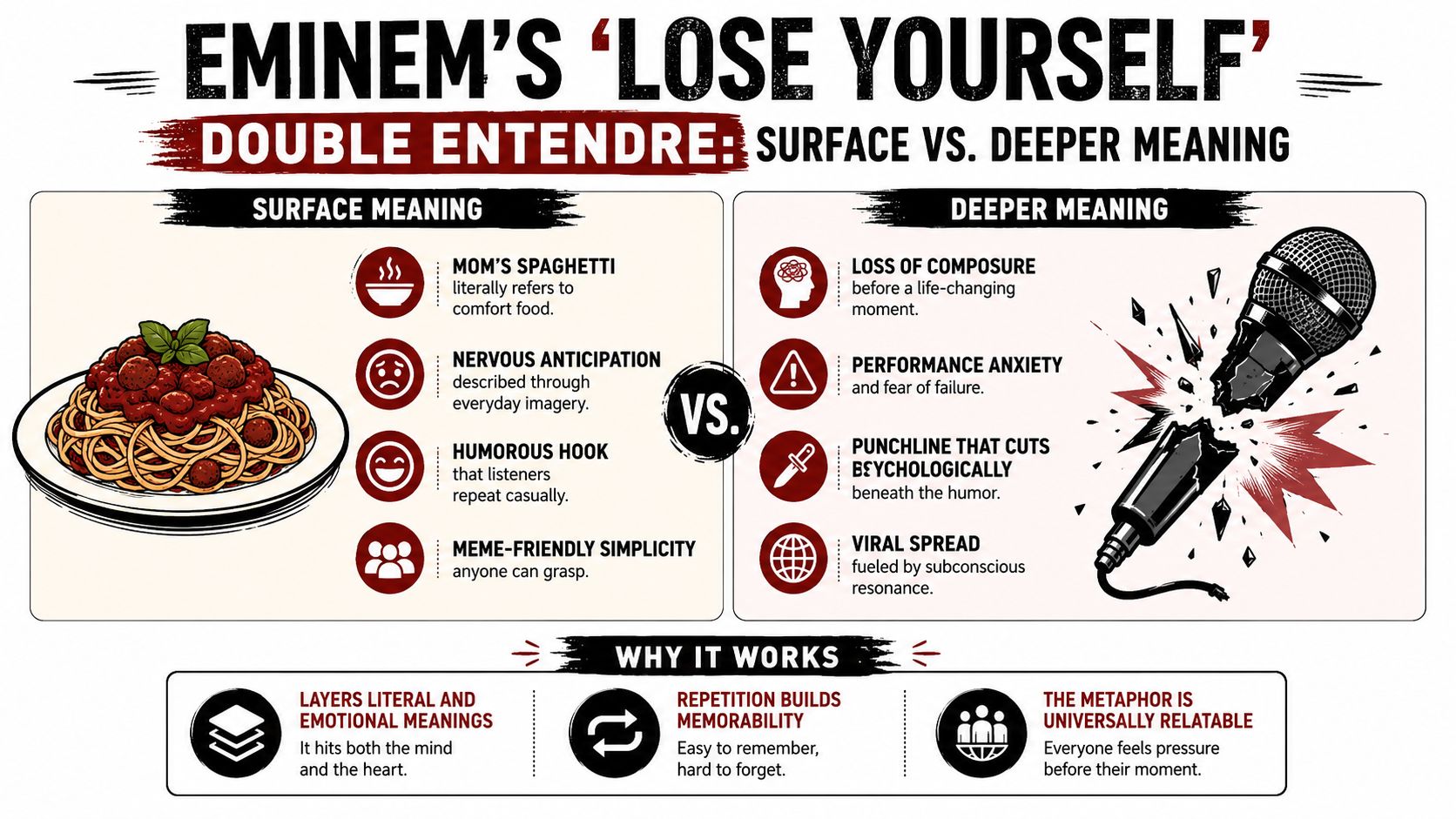
1. Eminem's “Lose Yourself” and “Mom's Spaghetti”
The phrase “mom's spaghetti” sounds like a simple comfort-food reference. In Eminem's “Lose Yourself,” however, it becomes a physical image for anxiety, pressure, and the loss of composure before a major performance. The food remains believable on the surface, while the bodily reaction underneath turns the image into a compact portrait of panic.
Why the ordinary image works
Everyday objects make strong double entendres because audiences understand the literal scene immediately. Everyone knows what a plate of spaghetti looks like, so the writer doesn't need to explain the image before using it as emotional shorthand. The second meaning arrives through context, repetition, and the character's fear of failure.
That repetition matters. The phrase keeps returning as the pressure rises, so it stops functioning as a random joke and starts tracking the performer's mental state. The result is clean enough to quote casually, funny enough to become a meme, and psychologically precise enough to support the song's larger tension.
The line also passes an important writing test: the literal meaning stands on its own. If a listener missed the metaphor, the food reference would still make sense. That independence keeps the wordplay accessible instead of making it feel like a puzzle built only for specialists.
Practical rule: Start with an object people can visualize instantly, then attach it to an emotion that's harder to name.
For a roast, you could compare someone's confidence to a collapsing lunch, a cracked phone screen, or a suitcase that won't close. Keep the object concrete, make the emotional connection recognizable, and read the line aloud to check whether the joke lands before the explanation arrives. The guide to rap punchlines and metaphors can help you develop that object-to-emotion connection.
DissTrack AI is useful here as a variation engine. Give it the target's defining habit and ask for clean, absurd, or battle-rap versions built around the same object. Keep the version whose literal picture remains clear even after the hidden insult is removed.
2. Nicki Minaj's “Anaconda” and sustained layering
Some double entendre examples depend on a single word. Nicki Minaj's “Anaconda” demonstrates a broader strategy, sustained layering, where the song's imagery keeps shifting between body confidence, desire, money, status, and predatory symbolism.
The title itself invites more than one reading. An anaconda is a snake, but the word also carries a sexualized association shaped by the song's context. The listener doesn't receive the second meaning in isolation. Production, delivery, repetition, and surrounding images keep signaling that the line should be read on more than one level.
Build a stack, not a pile
Sustained layering works when every meaning remains entertaining. The surface reading should still create a coherent scene, while the secondary reading adds attitude or pressure. If one layer collapses into a random reference, the audience stops hearing a unified voice and starts hearing unrelated cleverness.
This technique suits a diss because different listeners can take different rewards from the same bar. One person hears a boast about confidence. Another hears a sexual provocation. A third hears a comment about control, appetite, or status. The line travels well because it doesn't require every audience member to decode the same layer at the same moment.
Try building a small meaning map before writing:
- Body layer: What physical image does the phrase create?
- Power layer: Who controls the scene, and who gets reduced to an object?
- Money layer: Can the same image suggest value, ownership, or independence?
- Tone layer: Does the delivery make the line playful, threatening, or triumphant?
A clean adaptation might use a “heavy hitter” to describe both a strong performer and a powerful argument. A risqué version can use flirtation only where the audience expects it. A literary version can let an animal image represent appetite or domination. A rap-focused version can make the image recur in the hook, verse, and ad-libs.
Don't add layers merely to show technical skill. Each one should reinforce the speaker's character. A confident voice can carry provocative material; a hesitant voice may make the same wording sound accidental.
 An infographic illustrating the double entendre of Eminem's Lose Yourself, comparing surface-level meanings with deeper psychological interpretations.
3. 2Pac's “Hit ’Em Up” and the acronym beneath “Thug Life”
“Thug Life” turns a compact slogan into a stored argument. At first glance, it signals a hard-edged street identity. Its expanded acronym, The Hate U Give Little Infants Fucks Everybody, redirects that phrase toward childhood conditions, institutional neglect, and the violence that can follow.
The short form travels like a chant: brief, memorable, and visually striking, including in the tattoo associated with 2Pac. The longer form works like a hidden caption beneath the slogan. Once an audience learns it, every later appearance of “Thug Life” can suggest both the identity and the society that helped produce it.
Acronyms create this effect by separating public access from private depth. Someone can repeat the surface phrase without knowing its expansion. An informed listener hears the concealed claim at the same time. That split gives a writer a portable line with a larger idea packed inside.
Let the public phrase be easy to repeat, then make the hidden phrase explain why it matters.
Try the mechanism in different registers:
- Clean context: Build a positive campaign phrase whose initials reveal a message about teamwork.
- Literary context: Give a repeated title an expansion that exposes a character's private fear.
- Risqué context: Hide an adult joke inside an innocent slogan, only when the audience and platform support that reading.
- Rap context: Make the acronym reinterpret a target's public image as evidence against them.
The expansion must feel discovered, not manufactured. A forced backronym adds trivia, while a meaningful one sharpens the speaker's position. Visual reinforcement, such as a tattoo or graphic, can make the phrase memorable, but the words should carry the argument on their own.
This example also broadens the meaning of double entendre beyond sexual humor. Accounts of the history and literary use of double entendre describe the technique in writers such as Chaucer and Shakespeare, whose public and implied meanings could reach different audiences. In a diss, the aggressive surface draws attention; the concealed argument gives the line staying power.
4. Nas's “Ether” and technical wordplay
Nas's “Ether” makes sound carry an argument. The title echoes “either,” suggesting choice, division, and comparison, while the song turns ordinary language toward music, identity, insult, and superiority. The second meaning does not sit apart from the first. It sharpens the attack already present in the line.
A homophone works like a fork in the road. The listener hears one sound, then discovers another spelling or concept through context, annotation, or a lyric sheet. That delayed discovery can make a simple pronunciation feel like a trapdoor beneath the punchline.
Let the ear catch the phrase first, then give the mind a second route into it.
Start with the target's weakness and choose a word connected to it. Gather its homophones, alternate spellings, idioms, and technical meanings. Write one literal sentence for each route, combine the strongest pair into a grammatical line, and perform it aloud at the intended speed. If the sound becomes unclear, the cleverness disappears.
“God MC,” for example, can read as self-coronation and as a claim to extraordinary command of the craft. The boast stays intact, while the second reading raises the speaker's status from skilled professional to almost supernatural figure.
The same mechanism fits several registers:
- Clean context: Make “current” refer to electricity and present relevance in a classroom line.
- Literary context: Use “sole” for a foot and loneliness, allowing physical detail to expose private isolation.
- Risqué context: Choose a homophone whose adult subtext remains recoverable without making the surface sentence confusing.
- Rap context: Place the alternate meaning inside a rhyme so it questions a rival's image while advancing the attack.
Rappers must also protect the rhyme architecture. A sound-based joke can collapse if the cadence buries it, so the resource on multisyllabic rhymes helps when the meaning must survive inside a longer pattern.
 A vintage silver microphone sits on a wooden desk next to an open notebook and fountain pen.
5. Cardi B's “WAP” and explicit language as a bold claim
Cardi B's “WAP” turns explicit wording into a public statement of confidence, agency, humor, and control. The phrase carries its sexual meaning openly, while its framing adds a second message: the speaker decides how desire is named and presented.
The mechanism is explicit subtext. A risqué line can describe sexual content and still make a broader claim about voice, status, or ownership. The surface meaning supplies the charge. The speaker's certainty supplies the interpretation.
Explicit language works best when the provocative wording supports a clear position.
Tone determines that position. A confident delivery can make explicit material sound self-possessed. Humor can keep the line playful rather than preachy. Visuals and performance may steer the audience toward celebration, satire, provocation, or several readings at once.
Context sets the boundary. A line written for adults may fail on a brand account, school platform, or monetized video. Audience expectations and platform rules affect whether suggestion feels daring or careless. The writer has to control both the joke and the setting.
A quick test helps:
- Who will hear it? Friends, followers, clients, students, or strangers may read the same line differently.
- What does the surface statement say? Explicitness should sharpen the point, not replace it.
- Who controls the material? Do not turn another person's private information into a punchline.
- Would the line work without the shock? If the answer is no, strengthen the underlying idea.
Apply the mechanism by register:
- Clean writing: Replace explicit vocabulary with a confident image of ambition, performance, or appetite.
- Literary writing: Set public respectability against private desire, letting the tension create the second meaning.
- Risqué writing: State the adult layer clearly, then use tone to signal confidence, humor, or flirtation.
- Rap writing: Make the explicit phrase support a claim about control, hypocrisy, or self-definition.
The strongest line uses provocation to establish the speaker's position. The shock opens the door, but the idea gives the phrase a reason to stay.
6. Pusha T's “Infrared” and biographical metaphor
Biography can turn an ordinary word into a targeted double entendre. In Pusha T's “Infrared,” drug-dealing language works as literal street vocabulary while pointing toward authenticity, authorship, and the right to claim a rap identity. The words carry two loads at once, like a familiar object placed under a harsher light.
The technique gains force from a recognizable persona. “Transactions” and “products” mean little without context, but attached to a public history, they suggest reputation and conflict. The literal layer establishes credibility. The second layer redirects that credibility into an accusation.
Start with a detail you can defend. Public work, interviews, documented habits, and stated identities provide usable material. Rumor, private information, or invented legal claims create a different problem: the line may sound specific while resting on nothing solid.
A useful writing test is simple. Can the audience recognize the biographical detail, then see how the metaphor turns it against the subject? If both steps work, the reference feels earned.
A personal reference hits hardest when the audience knows both the résumé and the reversal.
The same mechanism changes with register:
- Clean writing: Turn a documented job, hobby, or habit into vocabulary for a light roast. A chef can be “serving” food and weak arguments.
- Literary writing: Let an occupation reflect a character's moral compromise. A manager might “close” deals while closing off another person's opportunities.
- Risqué writing: Use a public persona or flirtatious reputation, while leaving private sexual information alone.
- Rap writing: Borrow a technical term from the target's world, then redirect it toward inconsistency or weakness. A producer can “mix” tracks and excuses.
The first meaning must describe the person accurately. The second should reveal a contradiction, not deliver a generic insult. That distinction separates a biographical metaphor from a random personal attack.
Research strengthens the reversal. Read public interviews, examine the person's work, and check every detail before writing. The collection of notable diss tracks offers examples of rappers connecting personal details to broader attacks, but each new line still needs independent fact-checking.
DissTrack AI can generate angles from an inside joke or public trait. Treat its suggestions as drafts, then remove anything unverifiable, invasive, or more damaging than the creative context requires.
7. Queen Latifah's “Ladies First” and reclaimed language
“Ladies First” turns etiquette into authority. The phrase usually signals courtesy or order of service. In Queen Latifah's use, it also demands recognition, respect, and influence for women in a male-dominated industry. One expression therefore carries two directions: polite priority on the surface, structural change underneath.
Reclamation creates that second meaning by changing who controls a word. Language once used to push someone to the edge of the room can return as a badge, command, or cultural touchstone. The speaker does not erase the phrase's history. She redirects its force.
A short phrase travels well. Listeners can repeat it without needing a long explanation, while its larger argument about visibility, access, and power remains intact.
Reclaimed language works when the speaker's relationship to the phrase is clear, and the new meaning gives it direction.
Apply the mechanism to different writing goals:
- Clean writing: Turn “first” into both order of service and leadership in a workplace slogan. The line stays suitable for broad audiences while giving ordinary language a confident edge.
- Literary writing: Let a character repeat a dismissive label until repetition changes its emotional status. The phrase can mark self-definition, survival, or resistance.
- Risqué writing: Reclaim a term associated with judgment or sexual shame only when the speaker has a credible relationship to it. The tension should come from control and context, not casual provocation.
- Rap writing: Take an insult aimed at the speaker and make its attempted humiliation sound outdated. A hook can preserve the word's sting while redirecting the crowd's allegiance.
Use caution with slurs and identity-based insults. A clever reversal does not automatically remove harm. The speaker, audience, cultural context, and purpose determine whether reclamation feels deliberate or exploitative.
A strong reclaimed phrase offers three handles for the audience:
- Immediate clarity: The surface meaning is easy to grasp.
- Public usefulness: People can repeat it without a lecture.
- Moral direction: The second meaning points toward dignity, resistance, or accountability.
That combination lets a double entendre entertain while changing how a phrase feels. The audience joins in repeating the line, and repetition confirms the speaker's authority.
8. Jay-Z's “Takeover” and business language
“Takeover” turns corporate control into a rap threat. In acquisition vocabulary, it means gaining control of a company. In Jay-Z's diss-track context, it signals dominance in a competitive conflict. The opponent's status becomes an asset under review, a rival position open to replacement.
That mechanism gives business language its bite: calm terms carry aggressive intent. “Pen and ink” can name writing tools, contracts, documentation, or the authority to make a record permanent. Financial language can assess career value, while military language can frame a verse as an operation.
A single office term can establish the whole frame. “Acquisition” suggests claiming a rival's territory or audience. “Merger” can suggest competing identities collapsing into one. “Audit” promises a close examination of someone's story, with weaknesses and contradictions brought into view.
Writing move: pair one corporate term with one concrete consequence.
“Profit” becomes sharper beside reputation, because success then depends on what remains after the hype. “Contract” gains force beside authorship, making the speaker sound like the person who controls the official version of events. “Audit” works beside receipts, turning an insult into a promise of evidence rather than empty volume.
The contrast supports a nuanced diss. The diction sounds measured, almost suited to a boardroom, while the competitive meaning stays clear. A controlled delivery makes the threat feel planned. A sharper cadence restores urgency and keeps the line from sounding like a business presentation.
Use the technique differently by purpose:
- Clean writing: frame a workplace rivalry as an acquisition, keeping the language suitable for a broad audience.
- Literary writing: let a company's merger echo a character's loss of identity or changing loyalties.
- Risqué writing: use “assets,” “returns,” or “ownership” to suggest desire through negotiation and control, without spelling out the subtext.
- Rap writing: build a short chain of audit, receipts, and replacement, then let plain language deliver the final blow.
One well-placed term usually works better than a verse crowded with jargon. The business metaphor should sharpen the attack, not make the audience translate it.
 A black chess rook stands on a wooden desk overlooking a vast corporate cityscape from an office.
8-Example Double Entendre Comparison
| Example | 🔄 Implementation Complexity | ⚡ Resources & Delivery | ⭐ Expected Outcomes | 💡 Ideal Use Cases | 📊 Key Advantages |
|---|---|---|---|---|---|
| Eminem, "Mom's Spaghetti" | Low–Medium 🔄, simple metaphor with tight timing | Low ⚡, minimal production; delivery/timing critical | High ⭐⭐⭐⭐, memorable hook, strong viral/meme potential | Catchy hooks, battle lines, mass-appeal roasts | Universally relatable imagery; high shareability; emotional bite |
| Nicki Minaj, "Anaconda" | High 🔄, sustained multi-layered entendre throughout | Medium–High ⚡, strong production and calibrated delivery | High ⭐⭐⭐⭐, multi-demographic appeal; long tail discovery | Multi-platform clips, empowerment + provocative campaigns | Layered interpretations; longevity; drives organic discussion |
| 2Pac, "Thug Life" | Medium 🔄, acronym/hidden meaning embedding | Medium ⚡, contextual framing, supporting visuals help | Medium–High ⭐⭐⭐, elevates discourse; rewards close listeners | Social/political commentary within diss tracks | Philosophical depth; cultural resonance; memeable creed |
| Nas, "Ether" | High 🔄, homophones, technical wordplay, dense schemes | Medium–High ⚡, vocab mapping, precise delivery, production clarity | High for aficionados ⭐⭐⭐⭐, educational clip-ability; critical acclaim | Technical battle rap, lyrical showcases, educational breakdowns | Demonstrates mastery; rewards analysis; durable content for teachables |
| Cardi B, "WAP" | Low–Medium 🔄, explicit directness; tone/confidence essential | Medium ⚡, PR management; platform-policy considerations | Very high but polarizing ⭐⭐⭐⭐, massive virality, controversy | Bold, unapologetic roasts intended to grab attention | Reclaims language; huge cultural buzz; strong shareability |
| Pusha T, "Infrared" | Medium–High 🔄, biographical specificity & coded terms | High ⚡, research/verification; credibility-dependent delivery | High among informed fans ⭐⭐⭐⭐, cutting when accurate | Personal-targeted disses, insider takedowns, authenticity calls | Authenticity-driven hits; insider appeal; sustained analysis |
| Queen Latifah, "Ladies First" | Low–Medium 🔄, reclamation via simple phrasing | Low ⚡, straightforward production; cultural framing adds value | High long-term impact ⭐⭐⭐⭐, cross-generational resonance | Empowerment roasts, legacy/brand-positioning tracks | Reclaims language; broad appeal; positive cultural legacy |
| Jay‑Z, "Takeover" | Medium–High 🔄, business/military metaphors layered into bars | Medium ⚡, domain knowledge; balance of corporate & street tone | High ⭐⭐⭐⭐, credibility across cultural and business audiences | Targeting brands/creators, critiques of commercial inauthenticity | Bridges business + street credibility; sophisticated messaging |
Make the Second Meaning Earn Its Place
The best double entendre examples don't merely contain two interpretations. They make the second interpretation useful. It may reveal anxiety beneath a joke, turn a slogan into a social claim, expose hypocrisy, or make a competitive threat sound more precise. If the hidden meaning adds nothing, the line is showing off rather than communicating.
Start with the emotion or idea you want the audience to feel. Is the target nervous, vain, fake, controlling, overlooked, or overconfident? Name that target emotion before hunting for words. A clear emotional destination prevents the second meaning from becoming a random detour.
Next, list literal objects, activities, and terms connected to the idea. Anxiety might suggest spilled food, a shaking microphone, or a door that won't lock. Hypocrisy might suggest receipts, counterfeit goods, borrowed clothing, or a copied signature. Specific objects give the audience something to see before the metaphor asks them to interpret.
Then map the two meanings separately. Write one plain sentence for the surface reading and another for the hidden reading. If either sentence sounds unnatural, replace the word before forcing the line. Strong double entendres usually preserve grammar and plausibility in both readings, while accidental ambiguity often depends on a confusing attachment or an unintended grouping.
Choose the tone after the meanings are clear. A clean line can use comfort imagery or business language. A risqué line can rely on subtext, but it needs audience and platform awareness. A literary line can let context reveal the second layer. A diss track can use biography, acronyms, homophones, or sustained imagery, but it still needs a surface meaning that works without a footnote.
Read the line aloud. Delivery controls timing, emphasis, and whether the audience hears the second meaning as playful, threatening, or serious. Test the line with someone who understands the intended context, then remove any layer that feels forced, invasive, or needlessly offensive.
DissTrack AI can help generate several variations from a target, inside joke, relationship, and style tag such as Battle Rap, Old School Boom Bap, Trap, Drill, or UK Grime. Use those drafts as raw material. Edit for clarity, consent, privacy, factual accuracy, and the actual audience before you export or share anything.
The most reliable principles are simple:
- Specificity beats generic insult: A public habit or accurate detail creates a sharper reversal.
- The surface meaning must stand alone: Readers shouldn't need an explanation before the line works.
- Delivery guides interpretation: Rhythm and emphasis can reveal the second meaning without spelling it out.
- Every layer needs a job: Keep the hidden reading when it adds emotion, critique, humor, or strategic force.
- Risqué material needs boundaries: Adult language belongs only where the audience, platform, and context support it.
- Human judgment remains essential: An AI-generated phrase can be inventive, but you decide whether it is fair, clear, and worth publishing.
A useful final test is to ask, “Would this line still be good if nobody noticed the second meaning?” If the answer is yes, the surface is doing its work. If the answer is also yes when the hidden meaning is explained, you've built a line with real staying power.
DissTrack AI offers AI-generated roast lyrics built around double entendres, homophones, multisyllabic rhymes, inside jokes, and selectable rap styles. Enter your target and context, generate several punchline variations, then visit DissTrack AI to shape the strongest version for your audience and performance.