8 Diss Track Lines That Hit Harder Than a Chorus
Most bad diss track lines aren't bad because the writer can't rhyme. They're bad because the line has no job. It scans, it lands on the beat, it even gets a nod in the group chat, and then it evaporates, because it never answered anything, proved anything, or made anybody laugh.
That's a structural failure, and structure is fixable. A diss line does one of four jobs at a time. It answers an opponent, it proves you're the wittier person in the room, it gets a laugh, or it ends the argument. Every bar you can quote from memory is doing at least one of those, which is why it survived the car ride home.
The eight formats below aren't a quote dump. Each one reverse-engineers a canonical record into a reusable formula: the mechanic that makes it work, the way it fails when a less careful writer tries it, and a personalization move you can run on your own target tonight. It's the same discipline as adapting copy across social platforms, where the underlying mechanic transfers and the surface details don't.
Work through them in order and you'll be able to write in any of the eight styles about a person you know, instead of reciting somebody else's bars at a party where nobody has heard of the guy you're mad at.
1. The Callback Rebuttal (Jay-Z "Takeover" vs. Nas "Ether")
The cleanest way to win an argument is to let your opponent write half of it for you.
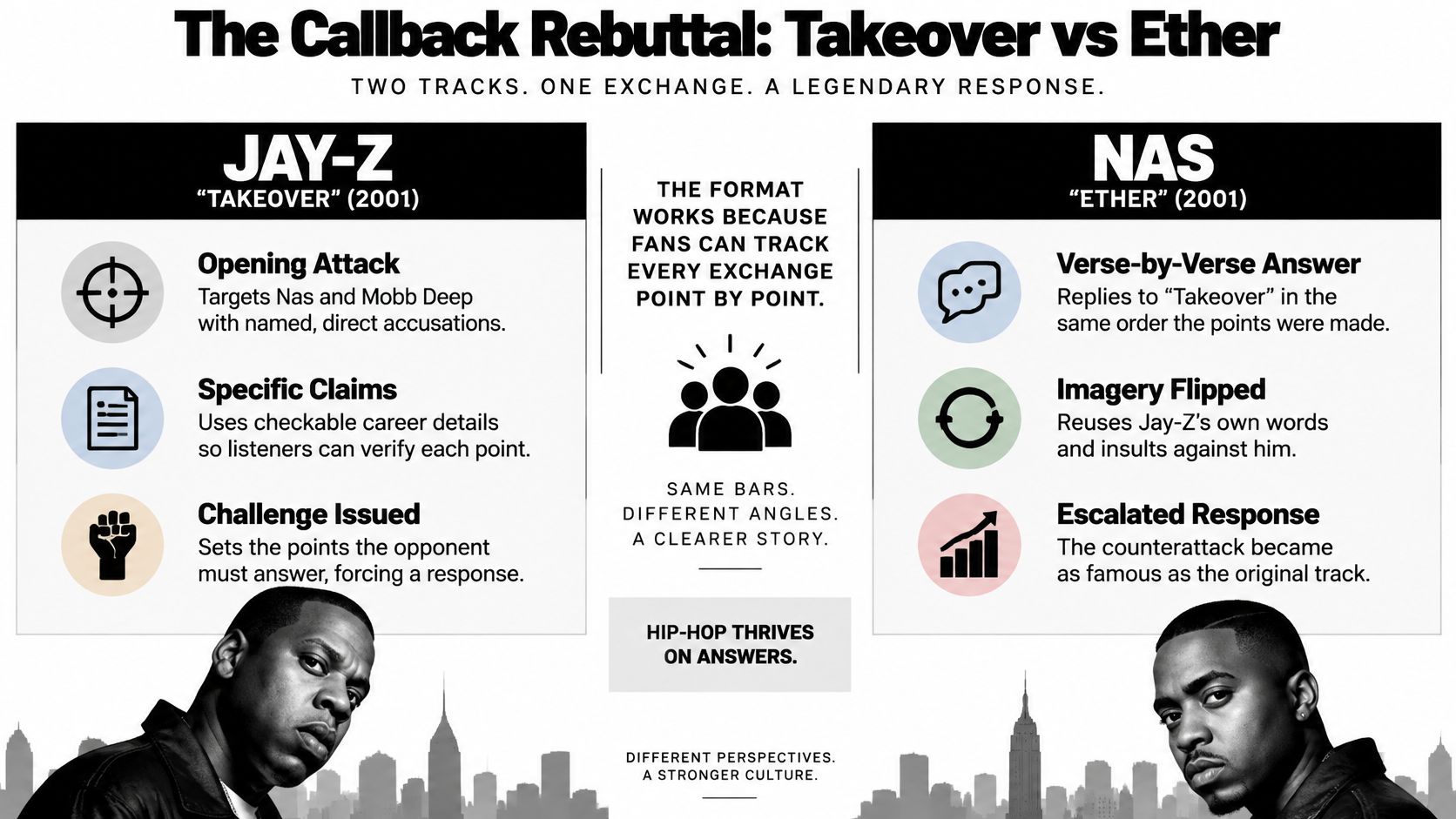 An infographic comparing the rap diss tracks Takeover by Jay-Z and Ether by Nas in 2001.
A callback rebuttal takes the target's own words, names, or images and hands them back sharpened. Jay-Z's 2001 "Takeover" went at Nas and Mobb Deep. Nas answered the same year with "Ether," reusing and inverting Jay-Z's material instead of opening a new front. Nobody needed a recap. The crowd had already memorized the source material, so every flipped line landed twice: once as an answer, once as proof that Nas had been listening closer than Jay-Z expected.
Why answering beats attacking
Diss tracks became a recognizable hip-hop format during the 1980s, growing out of live battle rap and call-out traditions, and the Roxanne Wars made the mechanic commercially visible. One record spawned a run of answer records, and listeners bought the conversation track by track. The rebuttal works because it borrows the opponent's setup. The setup is already famous, so all the writer has to supply is the twist.
Where it goes wrong is volume. A writer answers every line, including the ones nobody remembers, and the verse turns into a defensive checklist with no punchline of its own. The other failure is answering a line the audience never heard, which lands as a man arguing with a wall. Pick the lines the crowd can already recite and ignore the rest.
- Quote it, then flip it: take one specific phrase and turn it back on the person who said it.
- Keep their order: if they made three points, answer three points in sequence, so the crowd can track the exchange.
- One image per rebuttal: each answer should hang on a single concrete fact, not three half-facts.
Practical rule: If the audience can't hear the original line inside your answer, it's not a rebuttal. It's a new argument.
Your personalization move: pull one real line your target said, a text, a caption, a previous verse, and answer it point by point. Keep their phrasing visible inside yours so listeners hear both at once. Two minutes with a screenshot and you've got four bars.
2. Double-Meaning Wordplay (Kendrick Lamar "Not Like Us")
 A woman thinking while holding a pen next to a piano with an open notebook.
The line that outlived the beef is a pun. On 2024's "Not Like Us," Kendrick Lamar lands "Tryna strike a chord and it's probably A minor," which reads first as a music-theory joke about a failed attempt and then, on the replay, as something else entirely. That delay is the whole trick.
Why a second meaning beats a louder insult
A double meaning gives the listener a job. They solve it, they feel smart, and then they repeat it to somebody else, which is the only distribution that matters. Text is doing more of that work than ever: a MIDiA Research survey across the United States, United Kingdom, and Germany found 79% of music streamers use lyrics, rising to 88% among subscribers, and 55% of streaming-lyrics users said strong lyrics features would make them more likely to pay for a service. Replayable lines are the product.
It fails in three ways. The pun needs a footnote. The second meaning softens the insult instead of sharpening it. Or the wordplay is so busy that the target disappears, and you've written a clever bar about nobody.
- Pick the word first: choose a term with two live meanings and build the rest of the bar around the second one.
- Land it at the end: the pun goes on the last beat of the bar, never the middle.
- Test it cold: say it to someone who doesn't know your target. If they laugh, it works. If they ask what you meant, cut it.
If punchline timing is where you keep losing the room, this walkthrough on how to write punchlines covers the setup-payoff spacing that makes wordplay land.
Your personalization move: steal a word from your target's world, their job title, their hobby, the nickname they can't shake, and find its second meaning. A line about a bartender builds itself.
3. Personal Revelation Diss (Pusha T "The Story of Adidon")
Pusha T's 2018 "The Story of Adidon" aimed at Drake didn't win on wordplay. It won by changing the subject. The track publicly claimed Drake had a child he had kept hidden, and the title carried the reveal before a single bar played.
The reveal is the riskiest tool in the box
A reveal works because it converts a rap argument into a news story. The audience stops grading bars and starts discussing a fact, and the target has to respond to the fact rather than the record. That's a total shift of terrain, and it's why the format gets copied so badly.
The risk profile is different from every other entry on this list. A creator economy report on 2026 planning notes that short-form video now carries the strongest engagement across platforms, which means a private joke can be searchable, remixable, and permanently attached to a real person's name within a day. A line that's funny in a group chat is a different object once it's public and indexed.
Here's where I'd draw the line. Keep unverified claims about criminal behavior, sexual history, medical conditions, money, and identity out of the verse entirely. Not because you're soft. Because those are the claims that turn a roast into a problem you can't edit your way out of.
- Substitute the observable: swap the allegation for a quirk everyone can see, the cringe caption, the terrible car, the gym membership nobody believes in.
- Frame the exaggeration: make it obviously too big to be literal, so the joke reads as a joke.
- Review before posting: one read-through with a clear head catches the line you'd regret by Friday.
Use the reveal on a fictional target, on a version of a friend who signed off on it, or not at all.
Your personalization move: build the whole track around a harmless secret the target has already told everyone, like the playlist they defend. Same structure, none of the liability. For more records that pulled this off, this roundup of the greatest diss tracks shows how the reveal sits inside a full song.
4. Direct Confrontation Hook (2Pac "Hit 'Em Up")
2Pac's 1996 "Hit 'Em Up," aimed squarely at the Notorious B.I.G. and Bad Boy Records, did something simpler than every entry above it. It put the name in the chorus and repeated it until nobody could mishear the message.
Name it, then earn it
The mechanic is clarity. The hook states the target and the challenge in under four bars, and the verses supply the proof. That named-hook format sits at the core of hip-hop's vocabulary of opposition, the same tradition behind the origins of opp in hip-hop, and it's why a chorus with a name in it still cuts through a crowded feed.
The reach argument is settled. Future, Metro Boomin, and Kendrick Lamar's "Like That" hit No. 1 on the U.S. Billboard Hot 100 in 2024 with a first-week streaming total reported at 59.6 million, described in Yahoo Entertainment's chart coverage as the largest weekly streaming figure since Miley Cyrus's "Flowers" in early 2023. Discovery favors the bold, too: streaming services were named among the top three new-music discovery sources by 40% of surveyed global consumers in 2025, according to MIDiA Research.
The format fails when the name is the entire idea. Four bars of name-calling with no receipts is a tantrum with a beat. It also fails when the "threat" is specific enough to read as a real one, which is how creators lose accounts and gain lawyers. Say the name, then say what they did. That's the whole job.
Name goes in the chorus. Detail goes in verse one. Never confuse the two.
Your personalization move: put the target's actual nickname at the end of the hook line, where the snare cracks, then make bar one a concrete detail nobody can dispute. The nickname does the confrontation. The detail does the damage.
5. Inside-Joke and Specific-Detail Roast (Ice Cube "No Vaseline")
Ice Cube's 1991 "No Vaseline" went at his former N.W.A associates and their manager with business and personal specifics the audience already recognized. It's the blueprint for every roast that feels like a documentary instead of a tantrum.
Specificity is credibility
A vague insult sounds like an opinion. A specific one sounds like evidence. When you name the thing the target did, the audience becomes a witness, and witnesses do your arguing for you. That's why the best bar in a friend-group roast is almost always the one built on a real event nobody outside the group would know about.
It fails in three predictable ways. The detail is so private that no one in the room can decode it, and you spend the punchline explaining. The bar drifts from choices into appearance, family, or income, which reads as lazy rather than funny. Or you stack five details and land none of them, because a joke needs a single clean landing.
- Start with the story: one known event or habit is enough raw material for four bars.
- Keep the stakes small: group roasts stay funny when the target is laughing too.
- Pay it off: every detail in the setup needs a punchline that resolves it.
A detail that made you laugh in the group chat is only material. The bar is what makes it land for everybody else in the room.
Your personalization move: list three things the target did this year, the awful purchase, the cursed haircut, the fantasy league collapse. Pick the one with the funniest consequence, not the most embarrassing fact, and build the punchline backwards from that consequence.
6. Escalating Punchline Structure (Eminem "Killshot")
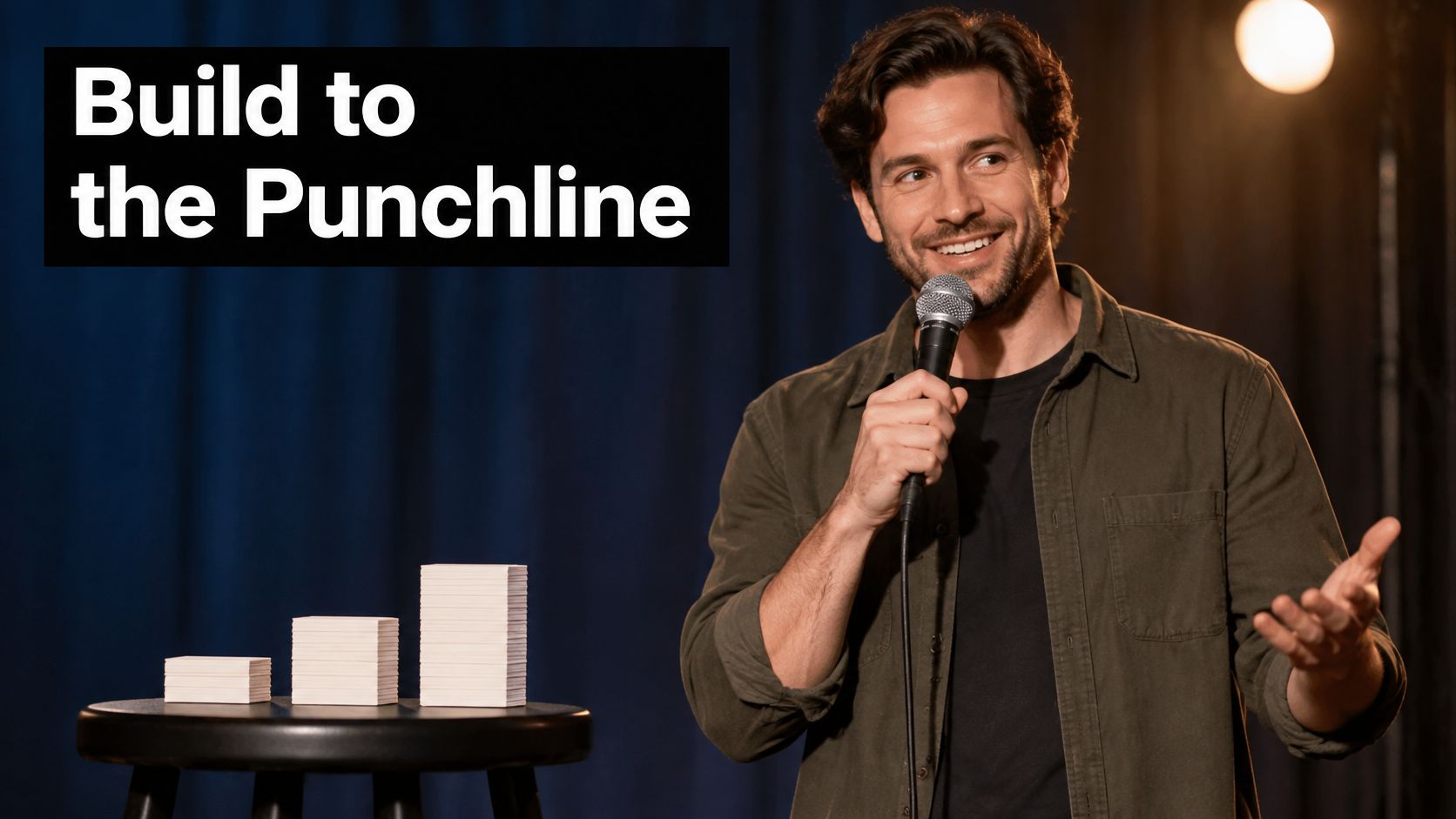 A smiling comedian performs on stage with a microphone in front of a stack of joke cards.
Eminem's 2018 "Killshot," aimed at Machine Gun Kelly, works less like a rant and more like a set list. Rapid-fire punches, each one heavier than the last, until the final bar lands like a verdict.
Order is the whole trick
The mechanic is sequencing. A verse of five equally sized insults feels flat no matter how good the insults are. Move the same five bars into mild-to-nuclear order and the room leans in, because the listener keeps expecting the ceiling to be higher than it is.
This is the structure that suits short clips best. A fifteen-second cut needs a climb inside those fifteen seconds, and escalation gives an editor a reason to keep the whole run rather than clipping one bar.
It fails when the biggest line comes first, because everything after it is an encore nobody asked for. It fails when five punchlines are the same joke in different hats. And it fails when "escalation" turns into volume and speed, which reads as panic rather than control.
- Write six, keep four: the two weakest go, even if the rhyme was nice.
- Rank by exposure: order punches by how much the target would hate hearing them in front of other people.
- Carry the scheme: keep the rhyme family moving across the run so the energy never resets.
Your personalization move: write your six punches, read them aloud in the target's voice, and put the one that makes you wince last. That wince is your ceiling.
7. Dense Multisyllabic Rhyme Battle (Eminem "Lose Yourself" Battle Style)
Eminem's internal rhyme patterns are the reason a verse can sound inevitable rather than written. Multisyllabic chains link three, four, five syllables across consecutive bars, and the insult rides on top of that machinery instead of fighting it.
Copy the genre, not the signature
Here's the part most writers get wrong. Style is fair game, identity isn't. The American Bar Association's analysis of style-based prompts notes that genre conventions like boom-bap drums or battle-rap cadence generally aren't copyrightable, while recognizable lyrics, melodies, or closely replicated expressive elements can create infringement risk, and using an artist's name commercially may raise separate publicity concerns. Turn "sounds like Eminem" into attributes: rhyme density, syllable count, tempo, tone. Not catchphrases, not song structures.
The technical scoring is measurable too. A computational rap-generation study ranks lines using rhyme, structural, and semantic features, with a rhyme detector that finds the longest matching vowel sequence between nearby words to catch multisyllabic assonance. The takeaway for writing: score rhyme and meaning separately, then rank your candidates instead of keeping the first draft.
It fails when the rhyme eats the insult. A bar that's all vowels and no target is a technical exercise, and breath points matter more than syllable count once you're performing.
- Write the last word first: decide each bar's endpoint, then fill the middle with the rhyme family.
- Read it aloud: if you can't get through it in one breath, the crowd can't follow it.
- Protect the point: the insult stays the clearest word in the bar.
Your personalization move: take your target's full name and force a four-syllable slant rhyme out of it, then build two bars around that sound. If the name doesn't rhyme, describe them with a phrase that does. More on building these chains in this guide to multisyllabic rhymes.
8. Comedic Roast Format (Battle Rap-Influenced Roast Verses)
 A charismatic comedian holding a microphone and telling funny roast lines to an audience in a club.
The roast verse borrows battle rap's skeleton and swaps the attack for laughs. Party roasts, meme pages, and shorts all run on it, and the economics are simple. One strong punchline beats a narrative nobody finishes.
Humor that survives being screenshotted
The mechanic is exaggeration plus recognition. The audience has to know the trait before you inflate it, so the joke lands twice: once for the truth and once for the size of it. That's why roast content travels on the platforms where people already spend their attention. TikTok was named among the top three new-music discovery sources by 37% of surveyed global consumers in 2025, according to Billboard's report on MIDiA's study, which tells you where a fifteen-second roast clip is going to be seen.
It fails when the joke punches down at something the target can't change. It fails when the inside reference needs a diagram. It fails hardest when there were no agreed limits before the writing started, because the writer chases shock and the room goes quiet.
Consent check: agree the off-limits topics out loud before anyone writes a bar. Thirty seconds of that conversation saves a friendship.
- Set limits first: money, family, appearance, and job are the usual exclusions for party roasts.
- Open with your best: in a roast, the first laugh buys you the next ninety seconds.
- Close with a callback: return to the opening joke with a twist and the set feels written rather than assembled.
Your personalization move: write the trait list before the bars, three things everyone in the room already knows, then exaggerate only the funniest one. Funny beats savage every time.
The 8 Diss Line Styles Side by Side
| Line Style | Signature Example | Best For | Writing Difficulty | Blowback Risk | Core Mechanic |
|---|---|---|---|---|---|
| Callback rebuttal | Nas, “Ether” (2001), responding to Jay-Z's “Takeover” | Track-by-track exchanges | High | High; can escalate personal attacks | Reuse and flip the opponent's specific lines, imagery, or claims |
| Double-meaning wordplay | Kendrick Lamar, “Not Like Us” (2024), “A minor” line | Quotable punchlines and short clips | High | Low to moderate | Make one phrase carry both a literal and figurative meaning |
| Personal revelation diss | Pusha T, “The Story of Adidon” (2018) | A dramatic narrative reveal | High | Very high; privacy and legal concerns | Center the track on a secret or allegation |
| Direct confrontation hook | 2Pac, “Hit ’Em Up” (1996) | Clear, high-energy performance | Low to moderate | Very high; can escalate real-world conflict | Name the target in a repeated, chantable chorus |
| Inside-joke and specific-detail roast | Ice Cube, “No Vaseline” (1991) | Friend-group roasts and context-rich jokes | Moderate | Moderate to high if details are sensitive | Use recognizable events, habits, or shared stories |
| Escalating punchline structure | Eminem, “Killshot” (2018) | Battle verses and short roast clips | Moderate to high | Moderate | Build from lighter jabs to a strong closing punchline |
| Dense multisyllabic rhyme battle | Eminem's internal rhyme patterns in battle and diss-oriented verses | Technical, polished verses | Very high | Low to moderate | Link internal and multisyllabic rhymes across bars |
| Comedic roast format | Friend-group roast battles and online comedy battle rap | Parties, memes, and short videos | Low to moderate | Moderate; depends on boundaries and subject matter | Use exaggerated, self-contained jokes with a lighthearted tone |
Turn These Eight Formats Into Your Own Bars
Pick the situation before you pick the format. Answering someone? Callback rebuttal. Want a line that gets quoted back at you? Double meaning. Need a room laughing? Comedic roast. Going nuclear? Direct confrontation hook, and only if you've got specifics to back the name.
Draft one bar per mechanic. Take the tips inside whichever entry fits and write a single bar for each of them, badly and fast. Four rough bars beat a blank page and a strong opinion about your own talent.
Personalize with one real detail. A specific thing the audience recognizes is worth more than four generic insults, and it's the only part of the verse nobody else can write.
Then run the checklist before anything goes public.
- Do get consent for roasts aimed at real people, especially friends.
- Do keep the target's actual choices in play and their unchangeable traits out.
- Do read the whole verse in the target's voice once. If it stings in a way that isn't funny, cut it.
- Don't publish unverified claims about crimes, sex, money, health, or identity.
- Don't reuse an artist's signature phrases or song structure, and don't assume a name is safe to use commercially.
- Don't post a private joke to a public feed without asking whether the target wants it indexed forever.
That's the difference between a line that lands and a line that follows somebody around. The mechanic is the easy part. Judgement is the craft.
If you'd rather not start from a blank page, DissTrack AI generates structured diss track lines from a name, a relationship, and a few inside details in about 30 seconds, with style tags and a savagery level you choose, and every generation stays private unless you decide to share it. The free plan includes one diss track, which is enough to test whether the workflow fits how you write.
Eight formats, one workflow: drop in the target's name, your relationship, and the details that make the roast yours, then pick a style like Battle Rap or UK Grime and set how savage the bars should run. DissTrack AI writes the verses with structure, rhyme schemes, and flow patterns, gives you multiple variations to choose from, and keeps every draft private until you publish it. Start with the free plan and see which of these eight formats your target deserves.