Emo Rap Lyrics: Themes, Structure, and How to Write Them
You're awake at 2 a.m., headphones pressed tight, replaying the same four lines because the artist said something you've felt but never managed to name. The beat has trap drums, the melody sounds bruised, and the vocal keeps slipping between a tune and a confession. That moment explains the power of emo rap lyrics better than the label “sad rap” ever could.
Emo rap doesn't rely on sadness alone. It turns private distress into specific images, repeatable hooks, melodic tension, and direct address. A missed call becomes a chorus. A bedroom becomes a stage. A thought that felt too embarrassing to say becomes the line listeners repeat in the car.
Why Emo Rap Lyrics Hit Different
The genre emerged from underground U.S. online scenes in the early-to-mid 2010s, especially SoundCloud and Bandcamp, before artists including Lil Peep, Trippie Redd, $uicideboy$, XXXTentacion, and Juice WRLD pushed it toward a wider audience. One genre chart counted 9,400 emo rap releases overall, including 2,441 releases in the 2010s and 6,942 in the 2020s, with 1,991 releases in 2023 alone. Those figures, reported in the historical overview of emo rap, show how quickly a scattered internet sound became a high-volume catalog.
The first reason the lyrics land is first-person framing. A conventional boast often asks you to admire the rapper. An emo rap confession asks you to occupy the rapper's head. “I” isn't just a grammatical choice. It turns heartbreak, isolation, or self-doubt into a direct address, as if the performer is leaving a voice note you weren't meant to hear.
That intimacy becomes more memorable when the writing uses simple, concrete objects. A phone, a bedroom ceiling, a passenger seat, a bottle, or a jacket left behind can carry more weight than a long explanation. The listener supplies the missing story from their own life.
Craft principle: Emotional specificity beats a large vocabulary. Name the object that proves the feeling.
The second reason is melodic borrowing from pop-punk and emo rock. Guitar loops, minor-key harmony, and hummable choruses give difficult thoughts a shape people can remember. A chorus can sound almost comforting even when its words describe collapse. That contradiction is central to the genre's appeal. The melody invites repetition, while the lyric keeps reopening the wound.
The third reason is sing-rap contrast. A verse may move with clipped rhythmic bars, then stretch one phrase into a fragile note. That switch resembles a racing pulse, calm for a moment and suddenly urgent. Production guides often describe emo rap as a blend of trap arrangements, guitar textures, 808 bass, and processed vocals, but the writer's job is to make the vocal change feel emotionally motivated. Studying chord progression basics can help you choose a harmonic bed that leaves room for those changes.
The strongest songs don't merely announce pain. They package it into language the listener can sing back.
The Core Themes That Define the Genre
Emo rap lyrics return to a recognizable emotional vocabulary because listeners recognize the situations beneath it. Romantic loss, substance escape, suicidal ideation, isolation, family fractures, and self-loathing often appear beside small flashes of hope. An analysis of 125 popular U.S. rap songs from 1998 to 2018 found that 75% referenced negative emotion, while 61% of those negative-emotion songs referenced mental-health themes such as depression or suicidal ideation. The findings appear in this peer-reviewed analysis of emotion and mental-health references in rap.
The important writing lesson is that a theme needs a physical handle. Consider the difference between “I'm lonely” and a line built around an unanswered phone. The second gives the listener a scene, a pronoun stance, and an implied relationship.
Romantic loss
Lil Peep's “Awful Things” turns attraction into a toxic loop. Its language doesn't present heartbreak as a clean ending. The speaker remains attached to the person and to the damage surrounding that attachment. That contradiction makes the emotion unstable, which is more interesting than straightforwardly declaring that someone left.
Try this structure:
“Your name still glows on the screen, but I don't call.”
The possessive “your” creates address. “Glows” gives the phone a visual presence, while “don't call” supplies restraint. The line hurts because the action is incomplete.
Substance escape and numbness
In songs associated with Lil Peep and Juice WRLD, drug imagery often functions as emotional shorthand. The substance isn't only an object. It represents an attempt to lower the volume of memory, regret, or fear. Writers should avoid treating that shorthand as a complete explanation. Show what the escape fails to remove.
A stronger image might be:
“I took the edge off, but your shadow stayed sharp.”
The contrast between “edge” and “sharp” makes the coping strategy fail inside the line. The image also avoids celebrating the substance.
Isolation and self-loathing
Juice WRLD's “All Girls Are the Same” compresses romantic disappointment into repetition and generalization. The sweeping statement reveals a speaker who's hurt enough to flatten different experiences into one conclusion. That is a character choice, not a universal truth.
A useful revision exercise is to write the exaggerated statement first, then expose the private sentence underneath:
“Everybody leaves. I'm scared you'll prove me right.”
The first clause sounds defensive. The second admits fear. That turn gives the listener a reason to stay with the verse.
Suicidal ideation and despair
XXXTentacion's “SAD!” places despair inside a highly repeatable hook. The title itself is blunt, almost too simple, but the song's emotional force comes from how that word becomes a public label for a private state. Emo rap often makes distress memorable through compressed phrases rather than lengthy diagnosis.
That compression requires responsibility. If a lyric describes suicidal thoughts, avoid presenting self-destruction as the only destination or as a glamorous identity. A song can portray danger, ask for help, reveal consequences, or leave space for survival without becoming dishonest.
Family fractures and flickers of hope
Family conflict often appears in the background rather than the chorus. One absent parent, one locked door, or one unanswered message can explain why the speaker distrusts intimacy. Hope works best when it stays small: answering a call, leaving the room, admitting fear, or choosing not to repeat a cycle.
The recurring themes persist because they're emotionally legible. The writer's task isn't to avoid every familiar subject. It's to give familiar pain a detail only this narrator could have noticed.
How Structure, Rhyme, and Flow Actually Work
Raw confession becomes a song through repetition and controlled variation. Emo rap hooks often use short phrases, clear vowel sounds, and recurring end words because the listener needs to remember them after one pass. The verse can carry more detail, but the chorus usually reduces the emotional argument to a line that survives outside the song.
A practical verse might follow a simple sixteen-bar shape:
- Bars one through four: establish the scene.
- Bars five through eight: introduce the contradiction or wound.
- Bars nine through twelve: intensify the image or change the flow.
- Bars thirteen through sixteen: deliver the line that reframes the hook.
End rhyme gives the listener a handrail. Internal rhyme adds movement inside the bar. Multisyllabic rhyme can make the writing feel polished, but it shouldn't bury the emotional sentence.
For example:
“Late-night, brake lights, your name in the rain /
Same fight, same night, I replay the blame.”
The repeated “late-night,” “brake lights,” “same fight,” and “same night” create internal echoes. The end sounds, “rain” and “blame,” remain accessible. The emotional information arrives through the images, not the rhyme alone.
The genre's production commonly uses trap-derived arrangements at about 130 to 170 BPM, often perceived in half-time, with minor-key harmony, guitar loops, 808 bass, and heavy Auto-Tune. These details are documented in this analysis of emo rap production and vocal delivery. Auto-Tune can function as texture, giving a note a glassy, unstable edge, rather than just correcting pitch. Sing-rap works because melody and cadence can trade places within one verse.
Structural mechanics across emo rap styles
| Element | Pop-Punk Adjacent | Trap-Rooted | Acoustic Demo |
|---|---|---|---|
| Harmony | Distorted guitar chords and a broad, chantable chorus | Minor guitar or piano loop under 808 bass | Sparse minor-key guitar with more exposed vocal space |
| Rhyme approach | Clear end rhymes built for group singing | Internal rhymes, repeated phrases, and cadence shifts | Fewer rhymes, more conversational phrasing |
| Tempo feel | Driving pulse with rock energy | Faster grid perceived in half-time | Flexible timing that follows the vocal |
| Vocal treatment | Layered melody, grit, and occasional shouted doubles | Auto-Tune, ad-libs, melodic rap, and rhythmic switches | Dry or lightly reverberated vocal with audible breath |
| Hook behavior | Big, immediate, and easy to sing | Looping, hypnotic, and rhythmically locked | Intimate, unstable, and dependent on phrasing |
Before you draft, map the rhyme sounds rather than forcing every line to rhyme. A resource such as these rhyme scheme examples can help you compare AABB, ABAB, and looser internal-rhyme patterns.
Practical rule: Let the hook carry the simplest language. Spend your complexity on the verse details and the transition into the final line.
Comparing the Voices of Lil Peep, Juice WRLD, and XXXTentacion
Lil Peep, Juice WRLD, and XXXTentacion share a confessional center, but they don't use the same emotional camera. Lil Peep often places the listener inside numbness, drug imagery, damaged romance, and softly muttered self-exposure. Juice WRLD tends to stretch regret into melodic hooks, using repetition to make heartbreak feel circular. XXXTentacion can pivot sharply between confrontation, vulnerability, anger, and prayer.
The available lyric analysis gives one useful measurement of that difference. It found that 15% of the words on Juice WRLD's Goodbye & Good Riddance were associated with sadness or fear, while XXXTentacion's “Pain = BESTFRIEND” reached 57% and “SAD!” reached 48%. These figures come from the comparative analysis of emotional vocabulary in rap lyrics. They measure lyrical word association, not the artists' actual mental health, and they shouldn't be treated as a clinical assessment.
| Artist | Signature track | Sadness or fear vocabulary | Dominant delivery |
|---|---|---|---|
| Lil Peep | “Awful Things” | Qualitatively prominent through numbness, loss, and drug imagery | Softly muttered confession with rock-inflected melody |
| Juice WRLD | “All Girls Are the Same” | 15% across Goodbye & Good Riddance, according to the cited analysis | Melodic hooks, elastic phrasing, and trap-rooted longing |
| XXXTentacion | “SAD!” | 48%, according to the cited analysis | Compressed hook language with exposed vulnerability |
| XXXTentacion | “Pain = BESTFRIEND” | 57%, according to the cited analysis | Abrasive and tender contrasts, often in the same emotional passage |
The comparison suggests that intensity isn't the same as volume. Lil Peep can sound wounded through understatement. Juice WRLD makes emotional vocabulary loop until it feels inescapable. XXXTentacion often creates impact by placing tenderness beside aggression.
Vocal texture also changes the meaning of a line. A strained, gravelly delivery can make a simple phrase sound physically difficult to say. Writers who want to understand that vocal quality can consult this guide to vocal analysis of gravelly voices, then decide whether their own performance needs breath, rasp, pitch correction, or restraint.
Writing Prompts You Can Use Right Now
Start with a feeling, not a genre label. “Emo rap” describes a toolkit, but numbness, jealousy, longing, or relief gives the song a direction.
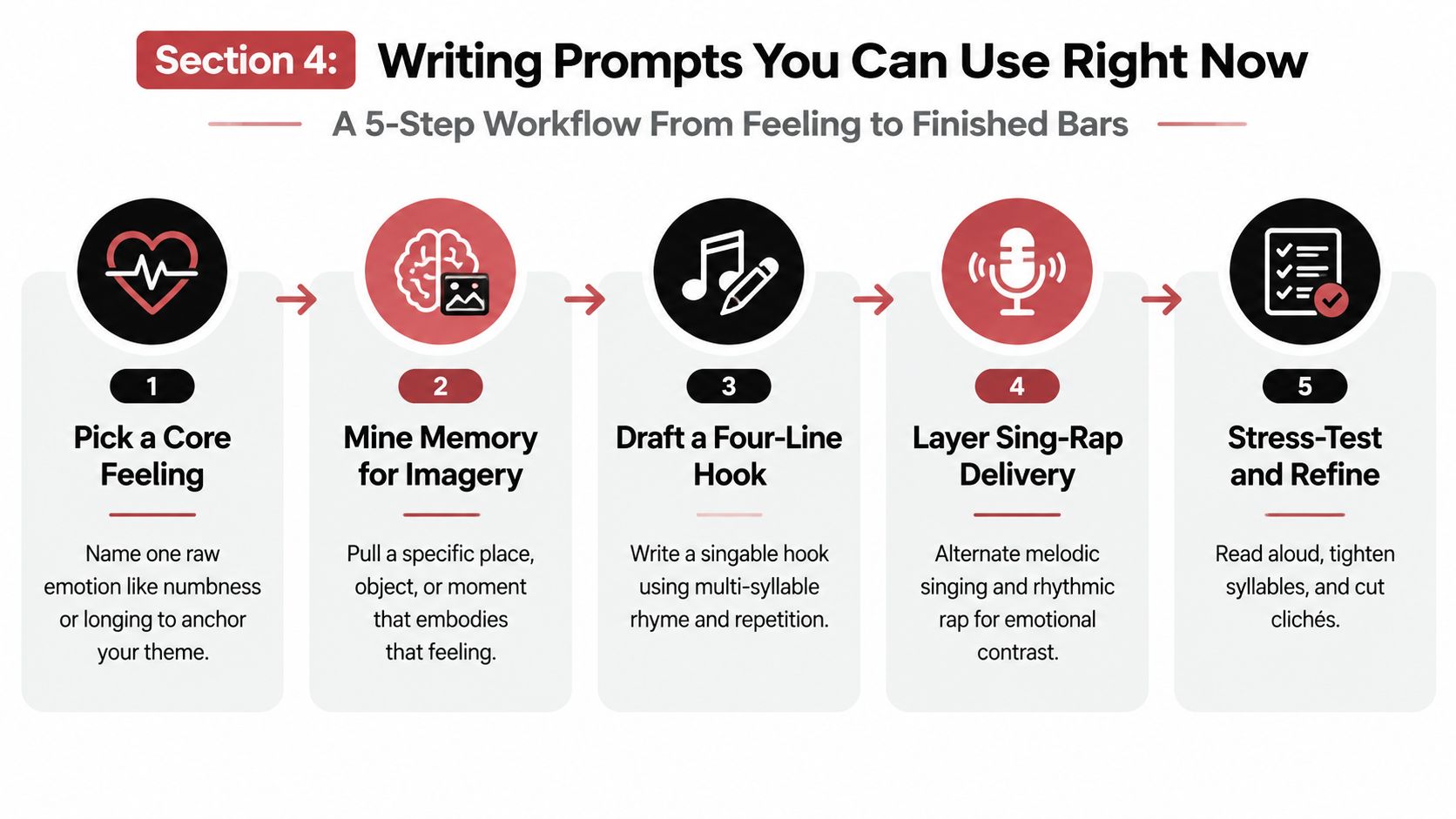 A five-step flowchart for writing song lyrics, from picking a core feeling to refining final bars.
Build the song in five passes
-
Pick one core feeling. Write the emotion at the top of the page. Don't choose “sad” if the sharper word is abandoned, ashamed, restless, or emotionally numb. One feeling keeps the images from competing.
-
Mine a memory for an object. Choose a place, object, or moment that embodies the emotion. A hallway light, a cracked screen, a bus window, or a hoodie on the floor gives you material that listeners can see.
-
Draft a four-line hook using AABA. Make lines one, two, and four share a rhyme family, then let line three interrupt the pattern. For example:
“I keep your picture by the bed, A
I hear your footsteps in my head, A
I tell my friends that I'm okay, B
Then check your name before I'm dead tired, A”The rhyme doesn't need to be perfect. The important move is repetition with a small disruption.
-
Layer a sing-rap verse over 130 to 145 BPM. That range sits inside the broader tempo description documented in the production research. Write the first half with clipped rhythmic bars, then stretch one key phrase into melody. Keep the verse more detailed than the hook, but return to the central image before the chorus.
-
Hum the hook without rapping it. If the words disappear when you hum, the melody may be carrying too many syllables. Cut filler, lengthen the strongest vowel, and test whether the emotional center still works without the beat.
For diss tracks, redirect the confession rather than abandoning it. The target becomes the source of pressure, but the narrator still reveals a wound, fear, or boundary. A melodic diss can say, “You knew where I was weak, so you aimed there,” then turn that admission into the punchline.
Use these prompts as starting points:
Write an emo rap diss track with a [tone] tone aimed at [target]. Center the hook on [emotional angle], use an AABA rhyme pattern, and make the final line of each chorus expose the target’s contradiction.Create a melodic trap diss track about [target], balancing heartbreak and confrontation. Use a repeatable four-line hook, internal rhymes in the verse, and a sing-rap delivery that shifts from [soft/aggressive] to [aggressive/soft].Generate a pop-punk adjacent emo rap roast for [target]. The emotional angle is [betrayal/jealousy/disappointment], the chorus should be easy to hum, and the verse should include specific but non-threatening details about [situation].
You can also compare generated drafts with your own notebook version. Tools such as DissTrack AI are designed to turn a target, relationship, inside joke, and style selection into structured roast lyrics that you can edit, with options that include Emo Rap alongside other rap styles. For broader lyric prompts and starting concepts, use these rap ideas and lyrics prompts.
Listen for where your draft sounds like a song rather than a diary entry. If the hook explains everything, remove one explanation and replace it with a revealing object.
Mistakes to Avoid and the Mental Health Conversation
Emo rap's mental-health vocabulary doesn't automatically glorify self-harm. It can function as a style marker, a narrative lens, or a compressed way to represent distress. The lyrical analysis described earlier found recurring topics including mental health, drug abuse, discontent, violence, and death, but a lyric's presence doesn't tell you whether it's autobiographical, therapeutic, fictional, or performative.
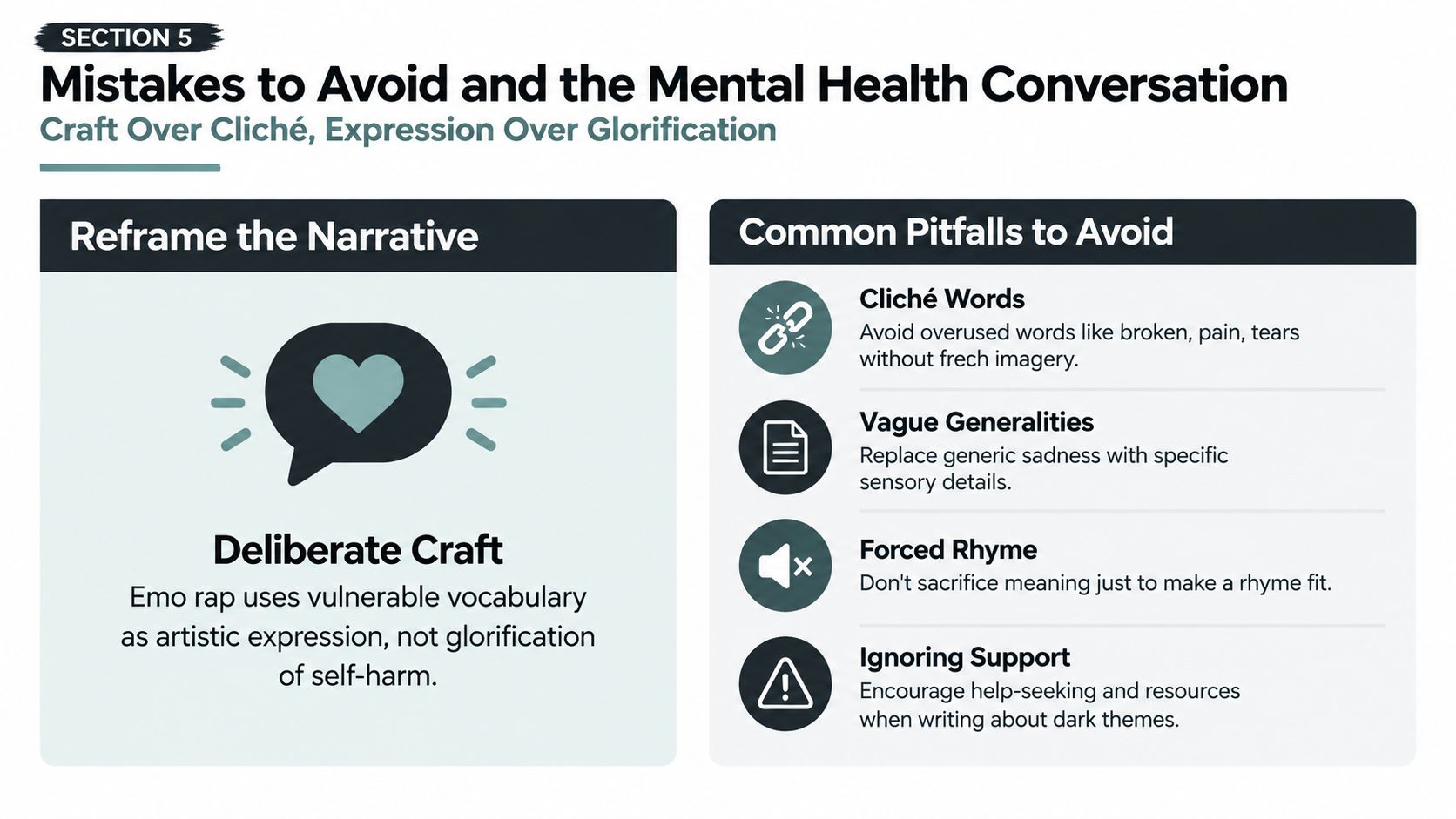 An infographic titled Mistakes to Avoid and the Mental Health Conversation, outlining tips for emo rap lyrics.
The craft problems are easier to solve when you name them plainly:
- Cliché language: “Broken,” “empty,” and “pain” can work, but they need a fresh image beside them. A cold sink, an untouched plate, or a phone facedown on the carpet tells us more.
- Vague generalities: Replace “I'm losing my mind” with the behavior that reveals it. Are you rereading an old message, missing sleep, or avoiding a room?
- Forced rhyme: A clever rhyme that changes the meaning usually weakens the song. Keep the emotional sentence and find a less obvious rhyme.
- Monotone sadness: A song can stay dark while its delivery changes. Whisper the pre-hook, sharpen the verse, and let the chorus open up.
- Borrowed identity: Study an artist's choices without copying their voice, biography, or signature phrases. Your details are the part no imitation can supply.
Writing about suicidal ideation or self-harm also calls for care in the finished track. Avoid instructions, romantic framing, or language that presents death as an inevitable reward. If the material reflects your current life rather than a fictional narrator, consider speaking with someone you trust or finding professional support, such as depression counselling in Kelowna, while using local emergency services or crisis resources when immediate danger is present.
Try this rewrite:
Generic: “I'm broken and empty in the dark.”
Textured: “The kitchen light stayed on till morning, and I never left the floor.”
The second line doesn't deny the darkness. It gives the listener a room, a duration, and an action. Specific craft can make a difficult subject more responsible because it moves away from empty spectacle and toward recognizable human experience.
Your Next Bar and Where to Take It
A strong emo rap draft can survive a simple checklist:
- Anchor a theme. Choose one emotion and one central image.
- Draft the hook. Use repetition, accessible vowels, and a loose multisyllabic rhyme pattern.
- Layer sing-rap delivery. Let the chorus stretch while the verse moves with sharper cadence.
- Stress-test the bar. Perform it aloud, remove filler, and check whether the image feels lived-in rather than borrowed.
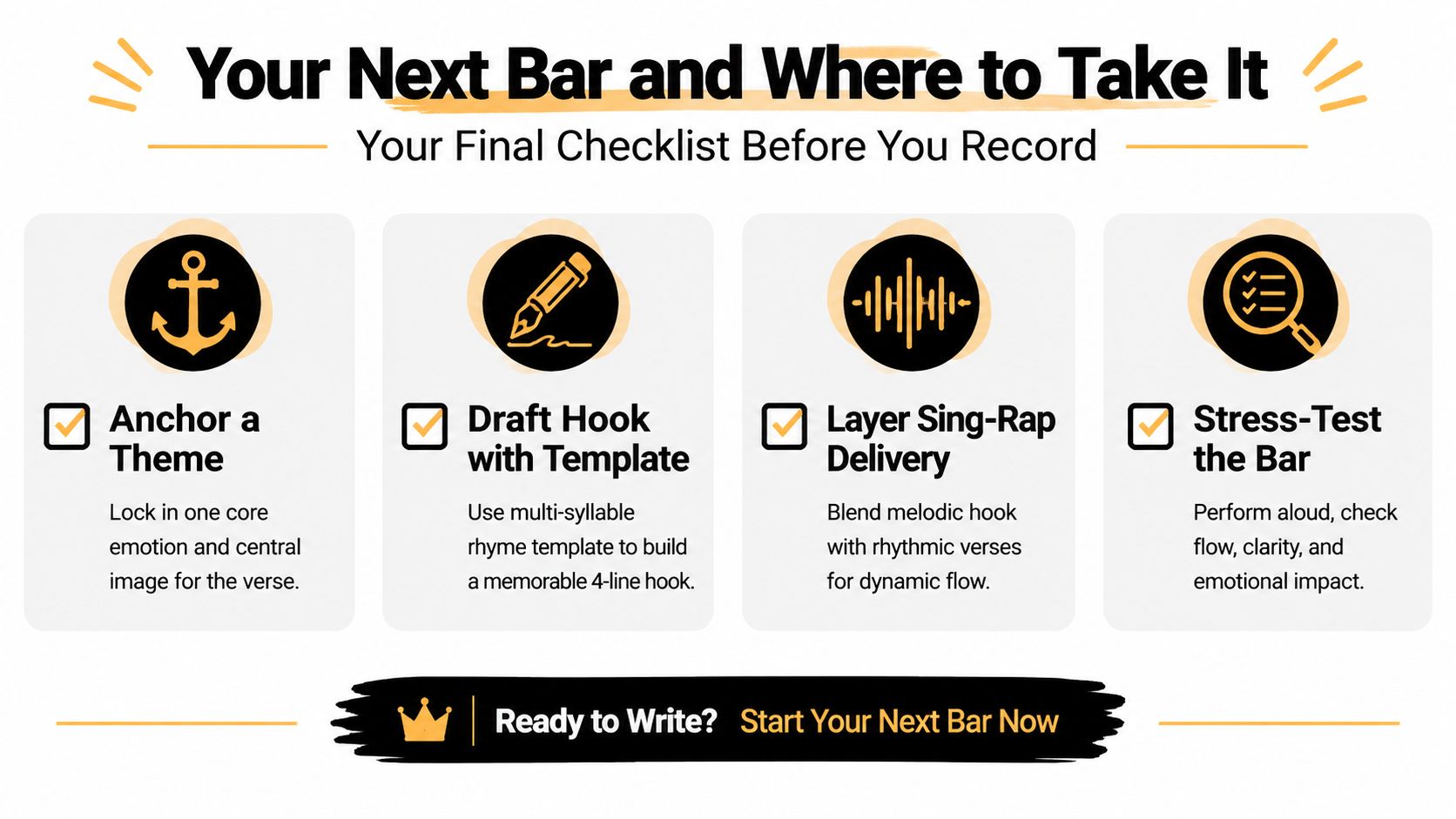 A creative checklist infographic for writing rap bars featuring four steps with icons for anchor, draft, layer, and stress-test.
The genre keeps changing because the delivery environment keeps changing. Recent commentary describes a move toward glossier production, melodic polish, and playlist-native arrangements, while artists such as midwxst, Iayze, and DC The Don have been cited as modernizing emo-adjacent sounds. That discussion appears in this video analysis of evolving emo rap trends. Treat those observations as scene commentary, not as a precise measurement of current listening behavior.
A useful listening log can make the change audible. Choose Lil Peep, Juice WRLD, and XXXTentacion, then write down the hook length, the main image, the rhyme sounds, and the moment where the vocal shifts. After that, draft one sixteen-bar verse from your own memory and create two versions, one intimate and one confrontational.
AI-assisted workflows can help you test cadence and imagery, but they shouldn't replace revision. Feed your concept into a generator, compare alternate hooks, keep the line that sounds most like your narrator, and delete anything that feels like a borrowed cliché. The point isn't to reproduce an old SoundCloud template. It's to make deliberate choices about tone, structure, melody, and honesty.
Your next bar can start with one object and one uncomfortable truth. Write both down, hum four lines around them, then record a rough take before you decide whether the song is finished.
DissTrack AI can turn a target, relationship, inside joke, and chosen style into structured diss lyrics you can revise for a melodic or emo rap concept. Visit DissTrack AI to generate a starting draft, test different emotional angles, and shape the strongest bars into your own voice.