
Freestyle Rap Drills and a Weekly Practice Plan
The beat drops, somebody nods you into the cypher, and every bar you rehearsed disappears. You can remember your childhood phone number, but apparently not a single word that rhymes with tonight. Your mouth keeps moving anyway. Unfortunately, it's mostly saying yo.
You don't need a mysterious freestyle gene. You need repeatable practice that makes recovering from a weak line feel ordinary, not catastrophic. Keep a phone recorder nearby, pick a beat you can count comfortably, and start treating freestyle rap like a skill you can train instead of an exam you keep accidentally taking.
Your Weekly Freestyle Practice Plan
Build your week around short, focused sessions, not a marathon of rapping until you hate your own voice. Use the following as a proposed practice schedule, with session lengths and constraints you can adjust around your breathing, attention, and availability.
The core is weekday practice, a performance slot, and a review. Saturday can mean an actual cypher, but your phone camera counts when nobody's available. Don't make access to a stage the admission fee for getting better.
Weekly freestyle practice schedule
| Day | Drill | Time | Main Skill |
|---|---|---|---|
| Monday | Eight-bar drill: memorized bars, then freestyle on the same loop | Suggested 20–25 min | Delivery under pressure |
| Tuesday | Constraint words: five target words in one 16-bar verse | Suggested 25 min | Vocabulary retrieval |
| Wednesday | Named-person prompt with playful roast angle | Suggested 20 min | Specific detail and punchlines |
| Thursday | Call-and-response battle, eight bars each | Suggested 30 min | Reaction speed and rebuttals |
| Friday | Same verse at 80, 90 and 100 BPM | Suggested 25 min | Cadence and tempo control |
| Saturday | Live cypher, open mic or phone-recorded performance | Suggested 30 min | Stage presence and endurance |
| Sunday | Review recordings and score four variables | Suggested 20 min | Self-assessment |
Treat each constraint as the assignment, not an optional decoration. During a target-word exercise, a complicated rhyme doesn't rescue you if you never reach the topic. During a rebuttal, a polished insult doesn't count as a response if it could've been delivered before your partner opened their mouth.
Make the challenge observable
For constraint words, choose objects you can describe, such as a kettle, sneaker, receipt, umbrella, and elevator. Build connections between them rather than announcing each noun like you're unloading groceries.
For call-and-response, have your partner leave you something specific to answer: a boast, a comparison, or a comment about the room. Reply to that detail before introducing your own attack. Solo practice works too: record a boast, play it back, then answer without pausing.
Practice rule: Finish the assigned exercise before chasing a highlight-worthy bar.
Tonight, only take on the Monday starter. Set a timer, record a take, and resist redesigning your whole artistic identity before you've pressed stop. Keep the recordings, including the awkward ones. Those are the useful receipts.
How to Run the Eight-Bar Freestyle Drill
Keep the beat constant so you can hear what changes in your delivery. Choose a backing track with an obvious phrase ending and enough space for your voice. For a starter setup, try a loop in the suggested 80–100 BPM range, with your phone a few feet away so playback captures both the beat and your words.
The comparison has a useful scientific foundation: an fMRI study of freestyle rap improvisation compared memorized and improvised delivery over an eight-bar backing track in 12 experienced male rappers, each with at least five years of professional experience. The study found increased medial prefrontal activity and reduced dorsolateral prefrontal activity during improvisation, interpreted as reduced conscious self-monitoring, not proof that switching off your inner critic automatically produces better lyrics.
Run the comparison
- Choose a fixed loop. Count its bars aloud before recording, then leave the backing track unchanged. A stable backing track makes timing problems easier to identify.
- Write a short verse matching the loop, then memorize it over the beat until you can finish without stopping. Paper helps you spot crowded lines before your lungs file a complaint.
- Record the memorized version. Try a repeat take to check whether the same words land consistently. Don't add vocal gymnastics just because the recorder's on.
- Restart the same beat and improvise new lyrics without notes. Keep going when a line turns weak, because recovery is part of the exercise.
- Repeat the spontaneous pass. For example, make a small batch of consecutive takes without listening between them. This keeps you generating instead of auditioning every sentence.
- Listen back and score rhythm, end rhymes, relevance, and novelty separately. Use simple labels such as shaky, steady, and strong so a funny punchline can't hide sloppy timing.
Use this visual as a companion for preparing and recording the loop.
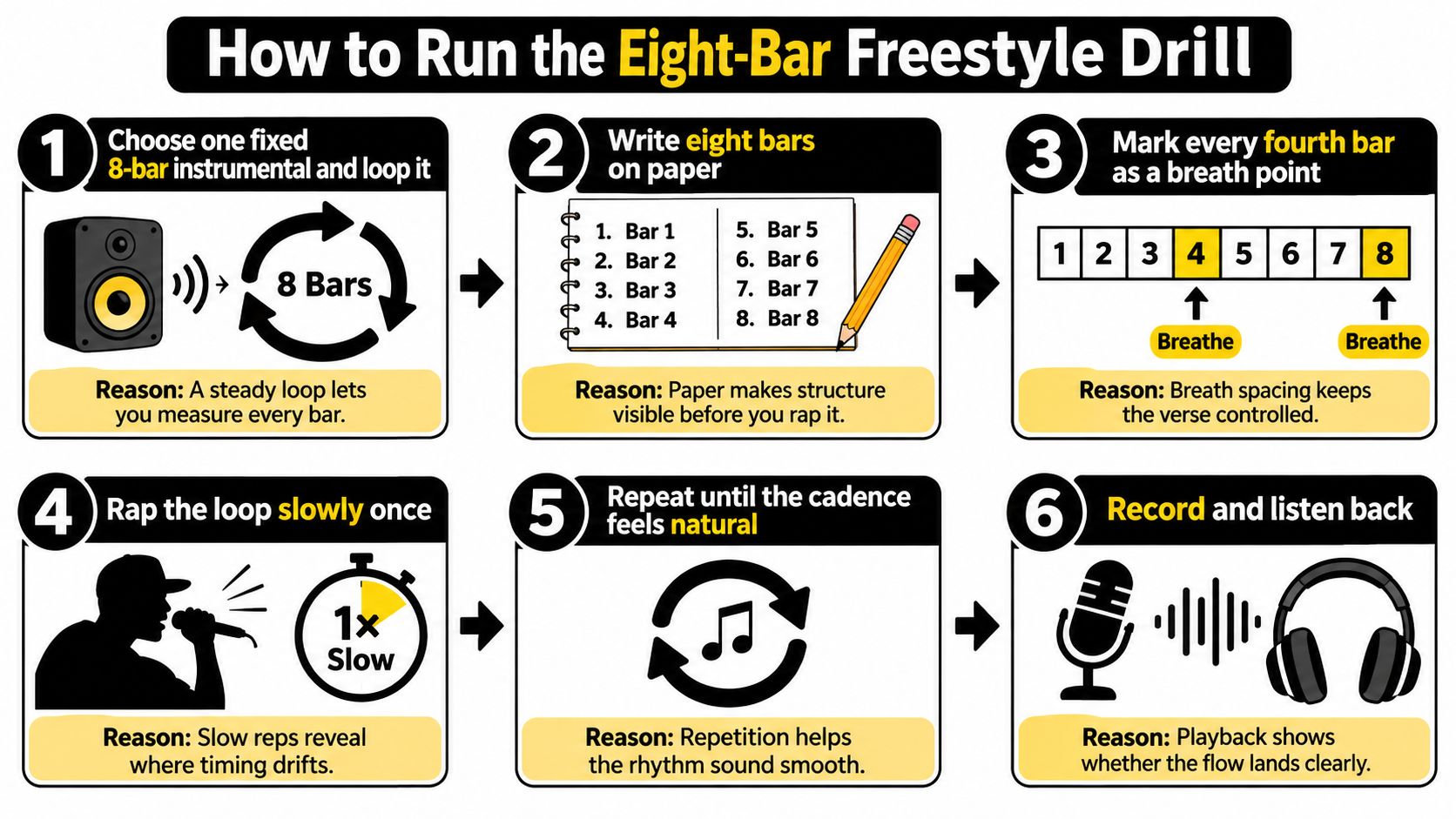 A six-step infographic guide titled How to Run the Eight-Bar Freestyle Drill for improving rap skills.
Generate first, edit afterward
The coaching principle is separate invention from repair. Don't stop mid-verse to replace a clumsy word. You'll spend the next entrance fixing the previous exit, and suddenly the whole verse is a traffic incident.
On playback, mark filler, missed landings, and ideas you abandoned too early. Rewrite those afterward, when you aren't also trying to stay on beat.
A healthy take doesn't need wall-to-wall punchlines. Listen for controlled landings, an unplanned rhyme connection, and an understandable idea in each bar. That's something you can develop, not just something you can brag about.
Flow, Cadence and Breath Without Overthinking
A listener can forgive a plain rhyme more easily than a verse that sounds like you're sprinting upstairs. Flow begins with control, not syllable accumulation.
Keep a notebook beside the recorder so your breathing and delivery choices become visible.
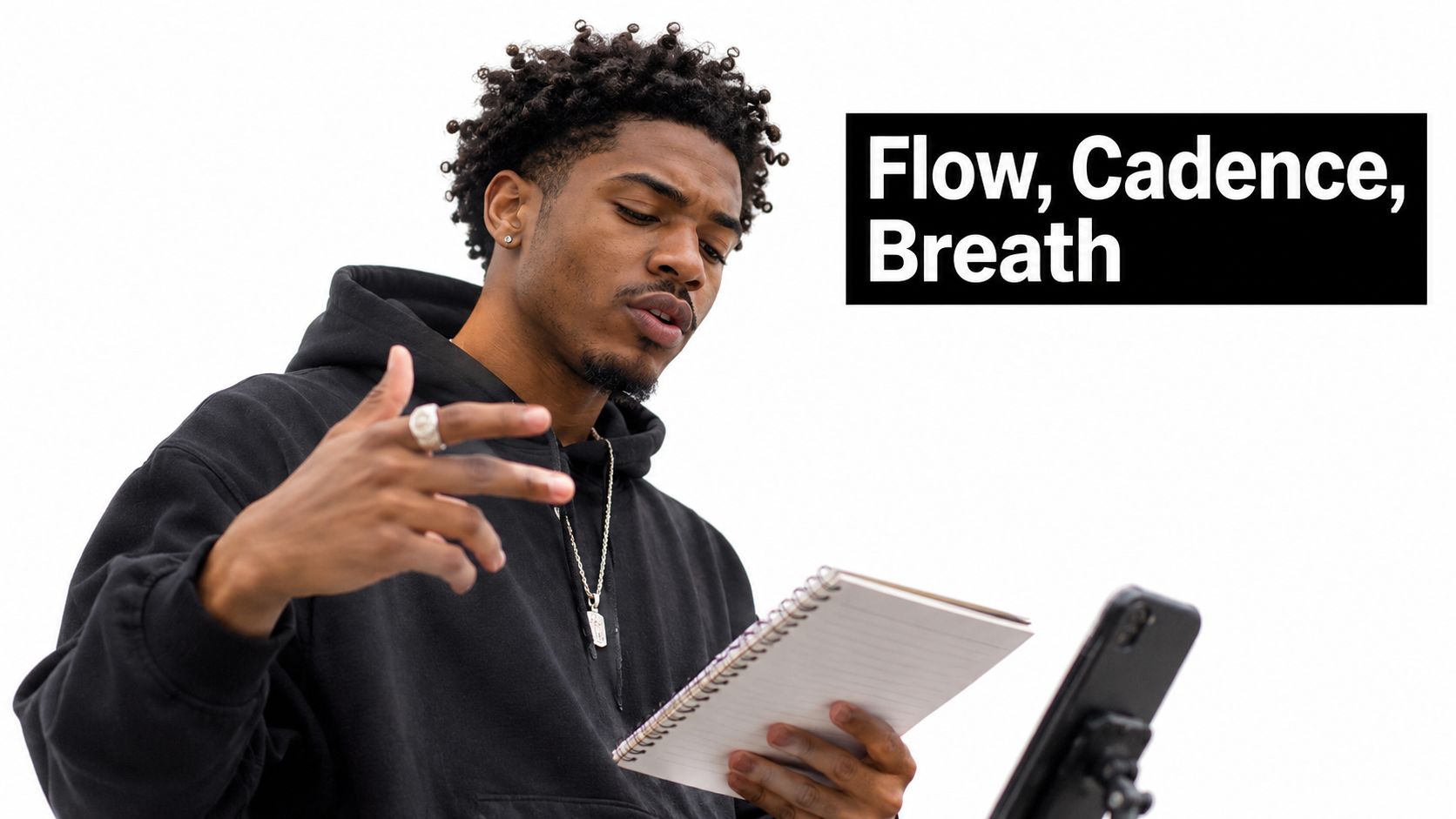 A young Black man wearing a black hoodie looks at a notebook while practicing his rap lyrics.
Breath: Mark planned breathing gaps on the page, then listen for where you inhale. As an exercise, try a marked breath every fourth bar, but breathe sooner when you need to. Don't preserve a layout at the expense of finishing comfortably.
Cadence: Choose where your final stressed syllable lands: directly on a beat or on the and between beats. Repeat that placement until it feels deliberate. The guide to using your voice offers a useful next step when you're working on delivery rather than merely changing words.
Add detail without stuffing the bar
Rhyme density means how much rhyming you fit into the verse, including rhymes inside a line. Start with an occasional internal rhyme instead of filling every gap. Build a rhyme family before rapping, such as late, plate, straight, weight, and gate, then find something worth saying with it.
Use the video as a listening break, then return to your own recording.
- Slow first: Reduce the tempo before attempting faster delivery.
- Change less: Swap a rhyme word before rewriting an otherwise workable line.
- Preserve natural stress: Shape the cadence around how you pronounce the words, while keeping your timing intentional.
- Mark the weak spot: Identify the least controlled bar instead of declaring the whole take terrible.
Use Friday's tempo exercise for unstable cadence. During Sunday's review, check whether your planned breath gaps survived the performance.
Fixing Freezes, Blank Bars and Overthinking
The beat keeps playing. Your friend's waiting. Your brain has decided this is an excellent time to become an empty warehouse.
Don't diagnose that moment as lack of talent. Find the specific failure first. Record the freeze, note its timestamp, and match what happened to the closest symptom below.
Freestyle freezes, causes and fixes
| Symptom | Likely Cause | Fix |
|---|---|---|
| Blank mid-bar | Stopping to edit a weak line | Keep moving with a filler word and fix it on replay |
| Rhyme runs dry | Thinking in one sound only | Write a rhyme-family list before the beat drops |
| Rushing the tempo | Chasing rhymes too fast | Count the beat aloud, lower the tempo, then re-enter |
| Same punchline every time | Relying on memorized stock lines | Retire one stock line each week |
| Nothing to say about a target | No prompt bank | Keep a list of three topics: job, food, hometown |
Fix the bottleneck, not your personality
A filler word is a temporary bridge, not a permanent address. Use it to stay in time, then move toward an actual image or statement. If you spend the rest of the verse apologizing for the weak line, you've turned a stumble into the topic.
When rhymes dry up, practice changing the sound rather than squeezing another line out of a dead rhyme family. You're allowed to leave fire behind. It'll survive without you.
For rushing, count aloud with the beat before adding lyrics. Lower the tempo until your words fit without frantic swallowing, then work upward. A fast mouth and a controlled cadence aren't the same thing.
Your next useful bar matters more than your previous imperfect one.
If your inner commentary follows you off the beat, Typist's YouTube takeaways on managing overthinking can serve as a separate reflection prompt. Keep that reflection outside the take, when it won't compete with the next entrance.
Stock punchlines need deliberate retirement because familiar lines are comfortable. Replace one with a detail from the current prompt, even if the new version is less polished. Expect occasional freezes; aim to shorten the recovery instead of demanding a flawless brain.
Using AI as a Sparring Partner Without Losing Authorship
If AI helped write the verse, do you still own it? There isn't a blanket answer that turns every generated line into protected human authorship.
The U.S. Copyright Office's report on AI copyrightability explains that prompts alone generally don't establish authorship, while sufficiently expressive human writing, arrangement, selection, or modification may qualify for protection. That's a contribution-based distinction, not a promise that changing a few words secures rights in the entire output.
Use this checklist to keep your creative decisions visible.
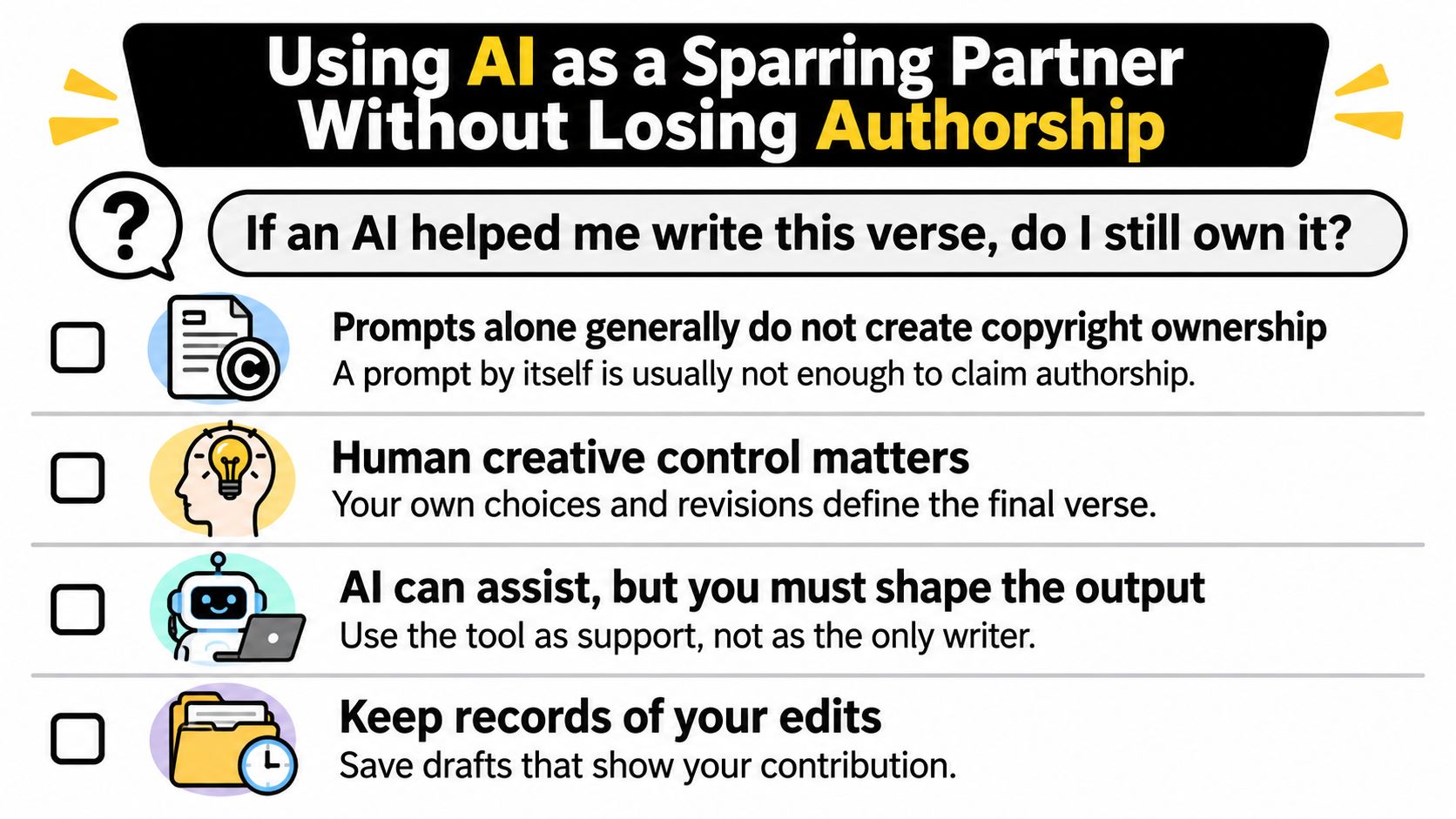 An infographic titled using AI as a sparring partner without losing authorship with tips for creators.
Ask for resistance, not a replacement voice
AI assistance doesn't automatically make practice inauthentic. Asking for awkward topics, unexpected rhyme families, or an opposing boast can give you something useful to react to. Reading generated lyrics verbatim, however, doesn't train spontaneous composition in the same way.
A useful request might ask for punchline premises about a fictional rapper who brags about luxury while borrowing everyone's charger. Request contrasting angles, not imitation of a named artist. For help making requests more specific, Zemith's guide to draft faster with better AI prompts can support the drafting stage.
- Request options: Ask for a batch of rhyme ideas or setups rather than a supposedly finished masterpiece.
- Select for meaning: Keep premises you'd say, not just impressive-looking rhyme chains.
- Rewrite substantially: Change the image, wording, setup, and ending until the line reflects your intent.
- Keep dated drafts: Preserve the generated suggestion and your revisions separately.
- Check resemblance: Drop recognizable borrowed lyrics rather than disguising them with synonyms.
The AI rap lyrics workflow guide can help organize that drafting process. Keep the distinction clear: an AI-generated suggestion is practice material; your live response is the improvisation.
Copyright rules differ by country, and contest, platform, and client requirements can differ too. Check applicable terms before publishing and disclose assistance when required. Documentation helps establish what you contributed, but it isn't a substitute for legal advice or a guarantee of protection.
Keeping Roasts Sharp Without Crossing the Line
A joke about your friend's terrible parking can get a laugh. Revealing their home address or family medical history turns a punchline into an invasion of privacy.
Aim at a chosen behavior, an inflated boast, a public stage persona, or a fictional trait. Before you share a clip, consider the target's comfort and the audience. A private joke can feel different once it's public.
Safe roast targets versus lines that cross
| Safe to Roast | Crosses the Line |
|---|---|
| Chosen behavior, such as terrible parking | Home address or private information |
| Boastful claims and public stage persona | Threats of harm |
| Fictional traits for a made-up character | Insults tied to protected traits |
| Verifiable facts the target would laugh at | Medical claims or family health history |
| Playful exaggeration of a known habit | Unverifiable accusations or fabricated allegations |
Use this boundary check before turning a friendly roast into a public clip.
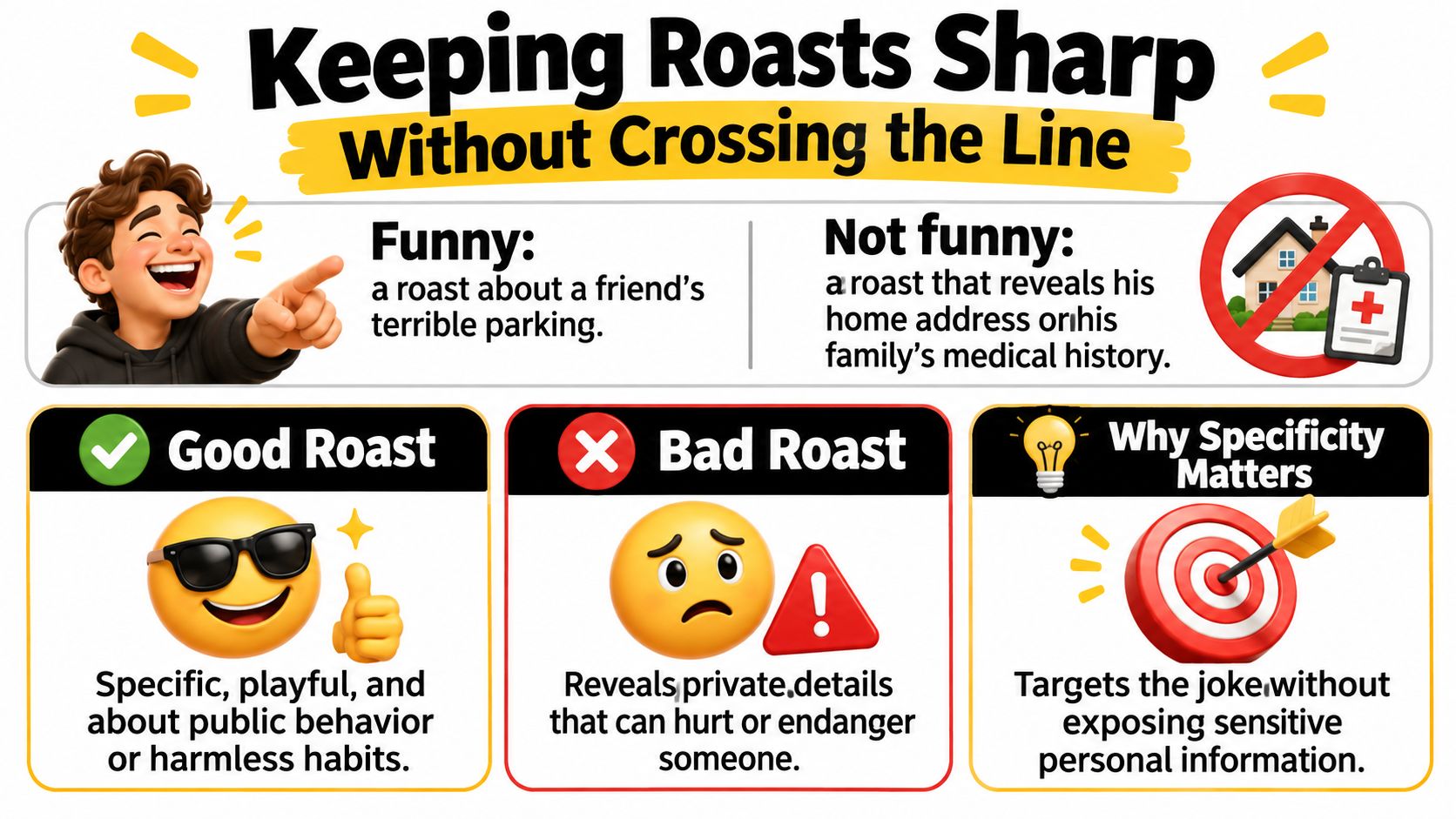 An infographic titled Keeping Roasts Sharp explaining the difference between good-natured, specific roasts and harmful, invasive personal jokes.
Turn the habit into an image
If your friend parks diagonally across the lines, joke that their car needs its own postcode. Don't turn the bit into a clue about where they live. If a real-person premise feels too personal, make the character fictional and remove identifying details.
The guide to roasting your best friend offers more ways to keep a premise playful. Friendship isn't automatic permission to publish every inside joke.
Before posting, check names and factual references, remove private details, and ask whether the target would enjoy the attention. If you're unsure, ask them or fictionalize further. A sharp roast gives the room a joke to remember, not a private detail to spread.
Test Your Bars Before the Next Cypher
Tonight, run the Monday exercise and save a memorized take alongside an improvised take. Give each a provisional assessment immediately afterward, then listen back and score rhythm, end rhymes, relevance, and novelty. Notice where your impression disagrees with the recording.
Keep a short practice log with the prompt, the weakest moment, and the freeze that appeared most often. Choose the next session's adjustment from that evidence. Don't add harder constraints when the basic problem is that you can't hear where the phrase ends.
Playback test: Could a listener follow the idea without reading your lyrics?
If you want a fresh named-person roast premise, use DissTrack AI as an editing aid. Each generation includes multiple variations; you can choose the strongest bars, edit them in the app, export lyrics as text, or regenerate until satisfied. Our Free plan costs $0 forever and includes 1 diss track, enough to test the structure against your own delivery.
Treat that output as a draft to rewrite, not a finished freestyle performance. Perform your edited version, preserve dated drafts, and give the final text a human review before posting. Don't let a tidy screen convince you a line works aloud.
Your job tonight isn't to win an imaginary championship. It's to finish the loop, hear what happened, and identify the next useful adjustment. Press record before you talk yourself into needing a better microphone.
DissTrack AI offers personalized roast drafts with multiple variations you can edit into practice material. Visit DissTrack AI, choose a playful premise, and turn the strongest setup into a verse you can deliver in your own voice.