
Freestyle Rapping Battles: Rules and Strategy
The beat drops, the circle tightens, and someone across from you just turned your name into a setup. The crowd is loud enough to scramble your thoughts, the clock is moving, and your next line has to do several jobs at once. It needs to answer the opponent, land rhythmically, make sense, and give the room a reason to react.
That pressure is the appeal of freestyle rapping battles. They compress word association, personal references, humor, rhythm, and status into short competitive performances. The strongest battlers aren't merely fast with insults. They hear the room, identify an opening, choose a rhyme path, and deliver a line that sounds inevitable even when it was built seconds ago.
Modern battle culture also demands a more precise definition of freestyle. Some battles are genuinely improvised, while others use written and rehearsed material, with spontaneous rebuttals added in the moment. Learning the difference matters because the preparation, judging, and risks change with the format. The history of the culture helps explain why, and cognitive training makes the skill less mysterious.
The Anatomy of a Freestyle Rapping Battle
The first MC steps forward and catches a word from the environment, perhaps a jacket, a judge, or the opponent's last gesture. The word becomes a sound, the sound becomes a rhyme, and the rhyme becomes an angle. Before the crowd has finished reacting, the other rapper has to decide whether to rebut that exact line, pivot to a prepared idea, or redirect attention with a stronger performance.
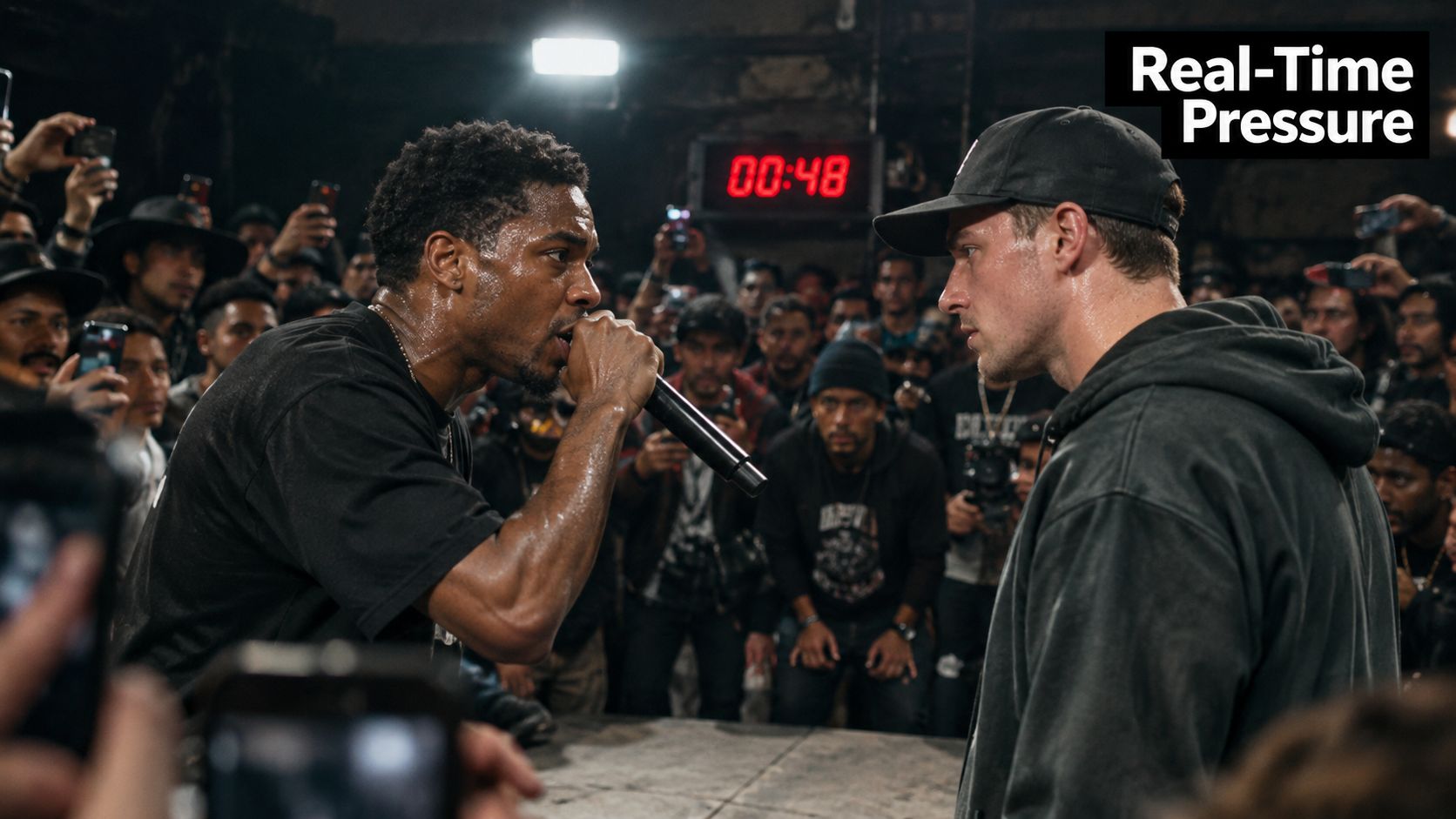 Two competitive rappers facing off in an intense freestyle rap battle performance before an engaged crowd.
A battle is a face-to-face contest between MCs. Each performer tries to outwit, outflow, and out-diss the opponent while winning the crowd through timing, wordplay, conviction, and control. The traditional setting rewards immediate reaction because the rapper isn't speaking into a vacuum. The opponent's claims, the surroundings, and audience feedback all become usable material.
Freestyle doesn't always mean completely unprepared
The popular image of freestyle assumes every syllable appears from nowhere. In practice, the word usually refers to an unrehearsed or partly unrehearsed performance. A modern battler may carry rhyme families, angles, transitions, and flexible punchlines into the room, then improvise the connective tissue around them.
That distinction isn't a technicality. Prepared material gives you precision, especially when a punchline depends on a layered scheme or exact syllable stress. Improvisation gives you responsiveness, allowing you to punish a mistake, answer a new claim, or turn an unexpected crowd moment into a weapon. The best preparation leaves room for both.
Practical rule: Prepare ideas and rhyme routes, not just isolated insults. A stored phrase is useful, but an adaptable angle survives pressure.
A strong battle bar usually has a target and a turn. The target might be an opponent's weak performance, contradiction, habit, or public image. The turn reframes that detail through metaphor, irony, exaggeration, or a sound pattern that makes the line memorable. Generic abuse can be loud, but opponent-specific writing gives the attack a reason to exist.
The format's foundational appeal remains unchanged from early cyphers. A performer must make rapid associations, maintain rhythm, use humor or personal references, and establish social authority in a compressed space. Whether the battle happens in a park, a venue, or a livestream, the audience is listening for the moment one MC proves they can process pressure better than the other.
From Bronx Cyphers to Global Digital Leagues
Freestyle battles grew from the early hip-hop culture that developed in New York City's South Bronx around 1970, amid severe urban disinvestment and poverty affecting major U.S. cities during the 1970s. Academic research describes hip-hop as a response to those conditions, with young people using DJing, breaking, graffiti, and rapping to create community recognition and competition. Research on hip-hop's social and cultural formation also places battle performance within older Afro-diasporic traditions of verbal competition and storytelling.
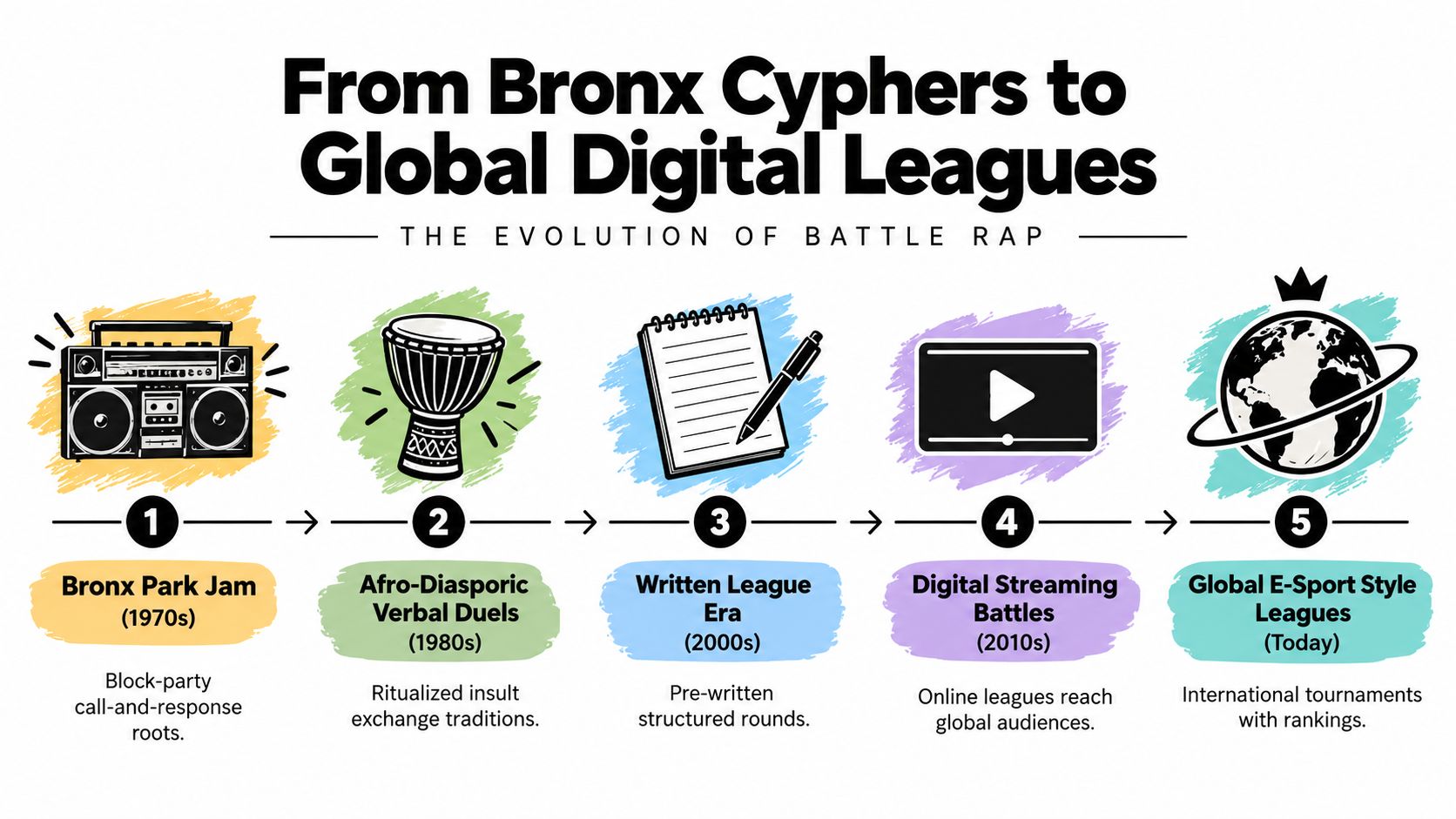 A timeline graphic showing the evolution of battle rap from Bronx park jams to global digital leagues.
Early battles weren't detached entertainment. They were public, face-to-face contests where MCs competed for recognition in front of people who knew the local personalities and could judge instantly. The cypher rewarded verbal agility, but it also rewarded awareness. A rapper who could connect an opponent's boast to the immediate environment had an edge over someone reciting generic rhymes.
The shift from crowd routine to direct dismantling
A major early milestone came in December 1981, when Kool Moe Dee challenged Busy Bee Starski in New York. Some accounts place the best-known version of the confrontation in December 1982, so the precise dating isn't fully standardized. The important historical shift is clearer than the date dispute. The battle moved toward longer, more pointed attacks focused on a specific opponent rather than only crowd-pleasing routines. The documented history of battle rap connects this change to the competitive expectations still familiar today, including punchlines, rebuttals, rhyme control, flow, originality, and crowd response.
That evolution changed the writer's job. A battle verse couldn't rely only on energy or a clever end rhyme. It needed an angle, a progression, and enough opponent-specific detail to feel impossible to reuse against anyone else. This is why personal references and rebuttals remain central even when the performance includes prepared material.
For readers interested in the broader production culture around hip-hop, Growing Up Hip Hop Atlanta at Encore offers useful context on how regional music communities support creative work beyond the battle circle.
The digital era extended that local practice without removing its competitive core. On August 19, 2008, King of the Dot uploaded its first YouTube battle, featuring Lavish Language and Young Blood. That documented milestone helped move battles from local rooms into searchable archives, recurring leagues, international fan communities, and online performance careers. Recordings, mixtapes, DVDs, radio, and online video each widened access, but online video made the exchanges easier to discover, replay, clip, and debate.
The lineage runs from Bronx-era cyphers to landmark early confrontations and then to global digital distribution. The technology changed the audience, while the central test stayed familiar: can an MC think, rhyme, perform, and answer under competitive pressure?
Navigating Different Battle Formats and Rules
A street cypher and a written league may both be called battles, but they reward different habits. Walking into one with the wrong preparation can make a skilled rapper look unready. Before writing a round, identify whether the event values spontaneous reaction, polished material, short-form impact, or some combination.
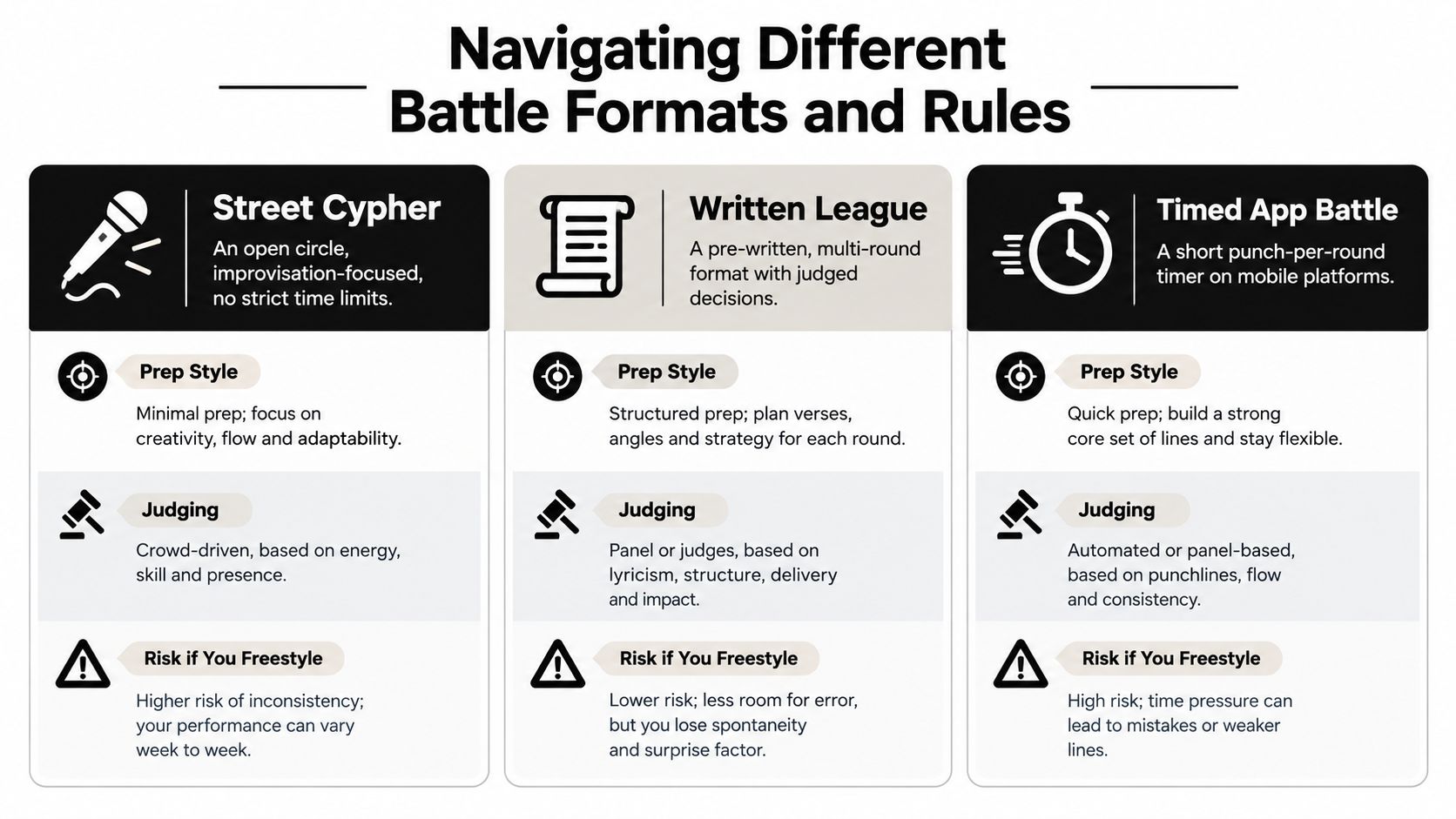 A comparison chart outlining the rules, prep styles, judging methods, and risks for freestyle rapping battle formats.
Street cypher
An open cypher is the most fluid environment. The circle may have loose turn-taking, a beat supplied by a DJ, or no fixed rhythm at all. The performer earns space by listening and contributing, not by waiting for a formally announced round.
Your preparation should focus on retrieval speed and adaptability. Build rhyme families around common objects, names, places, and emotions. Practice entering on different beats, changing cadence, and continuing after a weak line without showing panic. The risk of relying on memorized material is that it can sound disconnected from what just happened.
Judging is often informal. Crowd response matters, but so does social timing. A technically complex verse can lose the room if it ignores the previous rapper or takes too long to reach its point.
Written league
A written league rewards research, structure, memory, and controlled performance. Rounds are commonly prepared in advance, and contemporary battle culture often combines written material with improvised rebuttals rather than requiring every line to be invented live.
This format supports multi-layered schemes that would be difficult to construct cleanly under immediate pressure. You can test an angle, remove filler, mark breaths, and rehearse the exact stress pattern. The trade-off is exposure. If your delivery misses the intended emphasis, the writing can't rescue every moment.
Before competing, confirm the league's round structure, permitted materials, judging process, stage boundaries, and time signals. Don't assume another league's customs apply. A prepared rebuttal may be welcome in one room and treated as a distraction in another.
Timed digital battle
Short-form apps and social platforms compress the battle into brief exchanges. The performer has less room for a slow setup, so the opening needs to establish the angle quickly. A punch that takes too long to explain may work in a long round but disappear in a short clip.
Use a small number of flexible rhyme routes and rehearse several openings. Record yourself on a phone, then listen without watching the video. If the point isn't clear from the audio alone, tighten the setup. Digital delivery also requires awareness of clipping, captions, replay value, and the fact that material can circulate outside its original context.
| Format | Preparation | What earns the reaction | Main freestyle risk |
|---|---|---|---|
| Street cypher | Rhyme families and live drills | Timing, responsiveness, presence | Losing the thread after a blank |
| Written league | Detailed rounds and rehearsed delivery | Angles, schemes, rebuttals, performance | Sounding detached from the opponent |
| Timed digital battle | Short openings and compact punchlines | Immediate clarity and replayable moments | Sacrificing meaning for speed |
Room-reading rule: Match your density to the format. A line that needs breathing space can't be forced into a short timer without losing its impact.
Judging Criteria and Lyrical Architecture
A battle verse wins through more than insult severity. Judges and crowds respond to a combination of sound, timing, relevance, and persuasion. The technical goal isn't to cram every available rhyme into a bar. It's to make the architecture serve the attack.
Research on freestyle performance identifies rhyme density, internal-rhyme frequency, multisyllabic-rhyme use, syllable-stress alignment, and response latency as practical metrics for evaluating real-time generation. Research on computational evaluation of battle performance also emphasizes bar-level coherence and opponent-specific counters. A fast response with no semantic connection is still a weak response.
Build the sound before you decorate it
End rhyme gives the audience a landing point, but internal rhyme creates movement inside the bar. Multisyllabic rhymes add texture, although they can become awkward if the stresses don't align with the beat or speaking cadence. A guiding rhyme can support a monorhyme passage that is easier to assemble spontaneously, while internal and multisyllabic patterns keep that passage from becoming predictable.
Linguistic analysis treats phonological recurrence, metric licensing, figurative language, and persuasive framing as connected devices. Research on the language and structure of rap battles shows why a technically dense pattern still needs a clear angle. Sound helps the line stick, but meaning tells the crowd why it matters.
Write one idea in plain language before hiding it inside rhyme. If you can't state the attack without decoration, you may be polishing a sound pattern that has no target. Then test the line aloud and remove any syllable that crowds the breath or pulls stress away from the important word.
Score the bar on four dimensions
Use this table during revision. The examples are original practice examples, not quotations from a source.
| Evaluation metric | Definition | Winning example |
|---|---|---|
| Rhyme architecture | The organization of end rhymes, internals, multisyllabic patterns, and recurring sounds | “You chase a title, I revise the cycle, precise with the vital” uses connected sounds without relying on one bare end rhyme |
| Metric fit | How naturally stressed syllables land against the beat or speaking rhythm | “You talk big, then stall” places emphasis on short, clear impact points |
| Semantic relevance | How directly the line addresses this opponent rather than a generic target | A punch built from the opponent's repeated stage mistake carries more force than a reusable insult |
| Rhetorical impact | The quality of the turn, image, humor, contrast, and audience persuasion | “Your confidence is rented, and the lease just came due” reframes bravado as temporary |
Don't award yourself points for complexity alone. A dense rhyme that obscures the angle can underperform a simpler line with a sharper turn and better timing. Conversely, a clean punch becomes forgettable when every bar uses the same rhythm and sentence shape.
Coach's test: If the crowd understands the rhyme but can't explain the attack, the architecture is doing more work than the writing.
End-rhyme repetition is useful as a frame, not a complete strategy. Vary cadence, place internal echoes before the final word, and let a metaphor develop across several bars when the format allows it. The strongest scheme feels like one argument gathering force, not a pile of unrelated punches.
Training the Brain for Real-Time Improvisation
Freestyling feels mystical because the performer must retrieve language while controlling rhythm, movement, emotion, and self-presentation. It isn't a race to think faster. In an fMRI study of 12 experienced freestyle rappers, improvised lyrics produced increased activity in medial prefrontal, language, motor, and emotion-related regions, while activity in parts of the dorsolateral prefrontal cortex decreased compared with reciting memorized lyrics. A report on the brain during freestyle rap describes a pattern consistent with active language and performance coordination alongside reduced self-monitoring.
That finding gives beginners a practical direction. You don't train improvisation by demanding perfect punchlines from a blank mind. You train the links between sound, association, movement, and recovery, then add pressure gradually.
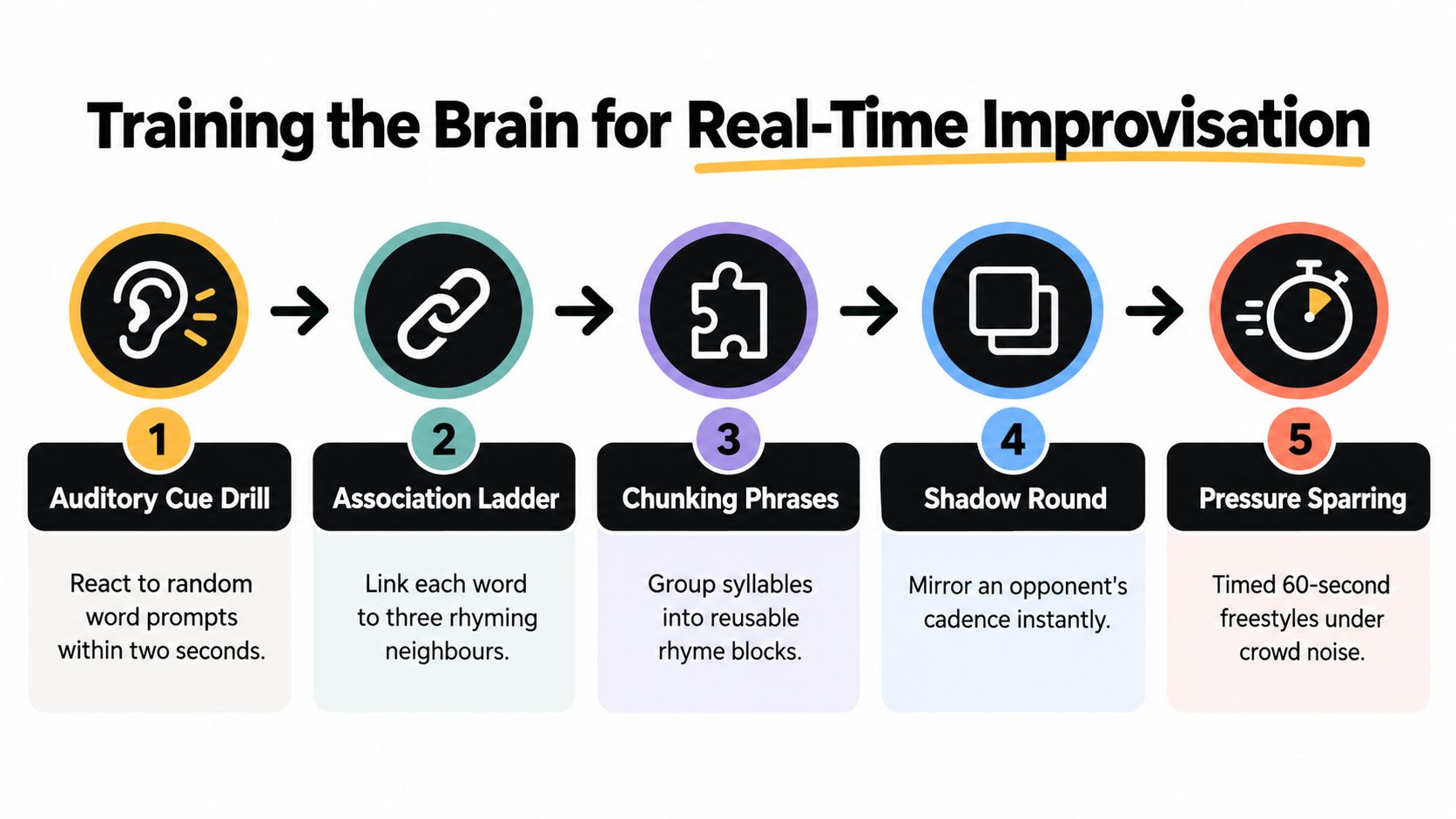 A diagram outlining five stages of training the brain for real-time freestyle rapping improvisation techniques.
Start with retrieval, not performance
Use a prompt drill with ordinary objects. Pick a word, produce a direct association, then connect that association to a rhyme family. Don't judge the first answer. Your first objective is to reduce the pause between hearing a cue and producing usable language.
Move into an association ladder. For each prompt, generate several semantic neighbors, then several rhyming neighbors, and finally a line that connects the two. This trains the exact bridge a battle requires: the opponent gives you meaning, while the rhyme gives you a route.
Chunk multisyllabic phrases into reusable blocks. A block might carry a stress pattern and a sound sequence that you can insert into different ideas. Memorizing isolated punchlines is less flexible than memorizing a few rhythmic shapes you can refill with new content.
Add an opponent and a recovery protocol
Shadow an imagined opponent's cadence. Copy the number of syllables, pauses, and emphasis without copying the words. Then switch the content to your own angle. This teaches your mouth and ear to adapt before you ask your writing brain to deliver an attack.
Practice a blank deliberately. Stop, breathe, repeat the last useful word, and use it as a bridge into a new association. The recovery should look like control, not apology. A simple transitional phrase can buy time while your retrieval system catches up, but it must lead somewhere.
For a beginner-friendly progression that expands these drills, use this guide to freestyling rap for beginners as a supplemental practice reference.
The training order matters:
- Cue response: React to random words without demanding a punchline.
- Sound mapping: Connect prompts to end rhymes, internal echoes, and multisyllabic options.
- Cadence control: Deliver the same idea with different stress patterns and pauses.
- Rebuttal practice: Answer a simulated claim using one specific detail.
- Pressure rounds: Add a timer, crowd noise, or a training partner only after the earlier links feel reliable.
Health research remains cautious about broad cognitive claims. A review of 63 music-activity studies found possible cognitive and well-being benefits but emphasized that varied methods make general conclusions difficult. The review and its discussion of music activity research supports disciplined training without proving that freestyle automatically improves intelligence.
Balancing Competitive Intensity and Boundaries
Aggression is part of battle rap, but aggression isn't the same as unrestricted harm. A line can be devastating because it exposes a contradiction, dismantles a boast, or makes an opponent's technique look ordinary. It doesn't need to target protected identity, encourage credible violence, reveal private information, or turn a consenting performance into real-world harassment.
The cognitive conditions that make freestyle exciting can also make it impulsive. Reduced self-monitoring helps performers take risks, while language, emotion, motivation, and movement remain active. That combination can produce authenticity, but it can also let a reckless line leave the room before the rapper has considered its consequences.
Attack the battle choice
Aim at material the opponent has placed in the competitive space. Their claim, delivery, preparation, contradiction, stage habit, or battle decision gives you a legitimate angle. A fictional target can create room for extreme theatricality without attaching the punch to a real person's private life.
Use a simple boundary check before recording or performing:
- Consent: Is the other person participating in the battle, or have you turned an uninvolved person into content?
- Target: Are you attacking choices and performance, or an identity category?
- Threat level: Does the line sound like a credible threat rather than theatrical competition?
- Privacy: Have you exposed an address, contact detail, medical fact, or private conversation?
- Audience: Could children, employers, or viewers outside the original room encounter the clip?
- Afterlife: Would the line still represent your judgment after someone reposts it without context?
This isn't about making every battle polite. It is about making the aggression specific, theatrical, and controllable. A boast can be absurd. A personal angle can be sharp. A threat, doxxing attempt, or identity-based attack creates a different category of risk and can overwhelm the performance itself.
Protect the punchline from the fallout
Streamers and creators need a review step because digital clips travel beyond the room. Listen to the recording without the crowd noise, read the transcript as plain text, and remove anything that depends on private facts or could be understood as a real instruction to harm someone.
For controlled practice, clean rap battle lyrics can help you build competitive angles around skill, behavior, and fictional scenarios while keeping the writing usable for a wider audience. Clean doesn't mean weak. It means the writer has to win through observation, framing, rhythm, and wit instead of relying on shock alone.
Using AI to Sharpen Your Lyrical Arsenal
Writer's block usually isn't a shortage of language. It is a failure to choose a direction. You have a target, a beat, and a blank page, but no angle feels strong enough to start. An AI tool can help by acting as a prompt engine, variation generator, or sparring partner, provided you treat its output as raw material rather than finished identity.
DissTrack AI can generate simulated multi-round battles between selected people or characters, including verses, punchlines, disses, and back-and-forth exchanges. Its freestyle mode is useful for creating off-the-dome practice prompts, while audio battle features can add AI voices and beats for rehearsal. The rapper still has to check the writing, remove generic material, protect private information, and reshape the cadence into something they can perform.
Use generation to create pressure, not dependence
Start with a narrow prompt. Give the tool a fictional opponent, a behavior to attack, a tonal boundary, and a style direction such as Old School Boom Bap or UK Grime. Ask for several angles rather than one supposedly perfect verse. Then keep only the concepts that reveal a useful connection you wouldn't have made immediately.
A practical workflow looks like this:
- Generate prompts: Ask for escalating opponent details, objects, contradictions, or rhyme seeds.
- Select the angle: Choose one idea that is specific enough to support a full exchange.
- Audit the rhyme: Mark end rhymes, internals, multisyllabic links, and stressed syllables.
- Rewrite the voice: Replace generic phrasing with your vocabulary, timing, and local references.
- Test the performance: Record the verse, listen for breath problems, and cut anything that only works on screen.
You can also keep an audio notebook of stray associations and environmental details. A resource on AI wearables for second-brain note-taking is relevant for creators who collect ideas while moving, although raw notes still need editing before they become battle material.
Use the AI freestyle rap generator when you need a structured starting point, then challenge every line. Does it answer the opponent? Can you say it cleanly? Is the metaphor yours, or does it sound interchangeable? AI can multiply options, but competitive credibility still comes from selection, revision, delivery, and the nerve to respond when the prepared plan breaks.
DissTrack AI offers simulated battle exchanges, freestyle prompts, style-based variations, and audio-oriented practice material for rappers, creators, and crews working through writer's block. Visit DissTrack AI to generate a practice opponent, refine your angles, and step into your next cypher with more options and a sharper plan.