Social Media for Artists: The 2026 Growth Playbook
Most advice about social media for artists begins and ends with “post consistently.” That advice is incomplete, and for many independent artists it's actively expensive. Posting more can fill your calendar while leaving your streams, ticket sales, commissions, mailing list, and creative practice exactly where they were.
Social media matters because the audience is enormous and fragmented. As of October 2023, 4.95 billion people used social media worldwide, equal to 61.4% of the global population, while the average user moved across 6.6 platforms each month and spent about 2 hours and 24 minutes per day there, according to Soundcharts' social media monitoring guide. The opportunity is real. So is the trap.
The working model is simple: social media should create a path from discovery to relationship to action. If a post earns attention but gives that attention nowhere useful to go, it may be entertaining, but it isn't necessarily building a career.
Why More Posts Rarely Mean More Career Growth
“Post more” sounds practical because it's easy to measure. You can count uploads, reels, stories, comments, and views. Career growth is harder to count because it happens through less visible actions, such as a listener joining your email list, a collector asking about availability, a promoter saving your contact, or a fan buying again.
Independent-artist trend coverage describes a painful contradiction: many artists spend 5 to 10 hours per week on social media and see almost no measurable effect on streaming, ticket sales, or career growth, as reported in MEIEA's artist-focused research. More activity doesn't automatically solve a weak offer, an unclear profile, or a missing conversion path.
 An overwhelmed artist sitting at a desk with sketches and a laptop showing data charts.
The follower-count mistake
Followers are useful as a rough sign of accumulated attention, but they don't tell you whether the right people care. A smaller group that replies, joins your mailing list, attends shows, commissions work, or buys releases has more career value than a large audience that scrolls past everything.
Artist marketing guidance from NYFA emphasizes consistency, predictable scheduling, engagement over follower count, and a focused set of recurring hashtags. Research on visual artists also identifies routine posting and active features such as comments, replies, Stories, and Highlights as important performance variables, as outlined in this Kennesaw State University study.
Practical rule: Every recurring content format needs a job. If you can't name the job, stop treating it as a priority.
Replace the feed with a funnel
Choose one business outcome for the next campaign or creative cycle. A musician might want Spotify profile visits, show inquiries, or email signups. A visual artist might want commission requests, gallery conversations, print sales, or collector appointments.
Then measure the steps that lead there:
- Discovery: Track reach, shares, profile visits, and saves.
- Relationship: Track replies, direct messages, email subscriptions, and repeat interaction.
- Conversion: Track link clicks, sales, booking inquiries, commission requests, or attendance.
- Creative cost: Track how much time the format takes to make and maintain.
This changes the question from “Did the post go viral?” to “Did this format attract the right person and move them somewhere I own?” The second question is less glamorous, but it protects your time and gives you a repeatable way to decide what deserves another week.
Building Content Pillars That Actually Convert
A useful content system starts with purpose, not aesthetics. Build three or four content pillars, with each pillar serving a different stage of the audience journey. Most artists need discovery content to attract strangers, connection content to make the work memorable, and monetization content to make the next action obvious.
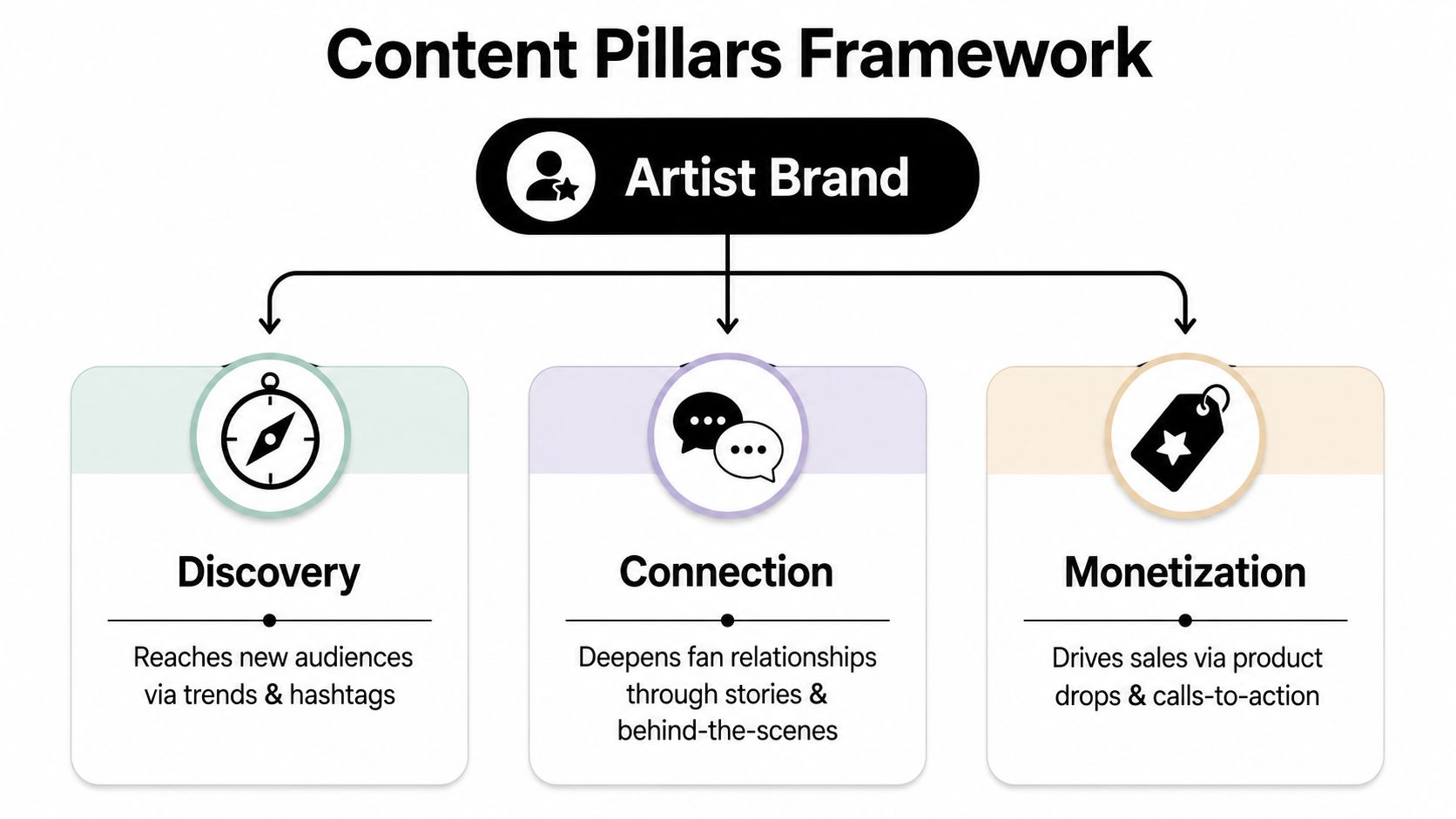 A diagram outlining the Content Pillars Framework for an artist brand, including Discovery, Connection, and Monetization pillars.
Discovery should earn the first pause
Discovery content is built for people who don't know you yet. For a musician, that could be a strong hook from an unreleased track, a live vocal moment, a reaction to a musical idea, or a short performance built around one memorable line. For a visual artist, it could be a time-lapse, a striking detail, a before-and-after process reveal, or a technique demonstration.
Short-form video is especially important for music discovery. Data cited by Soundcharts' Instagram analytics framework indicates that posting short-form video at least 3 times per week can produce 2.5x higher Spotify profile visits from external sources than posting once a week or less. The useful lesson isn't to publish empty videos on a schedule. It's to test repeatable formats that connect a compelling moment to a destination.
Connection gives the work a memory
Connection content explains why the work matters. Show the studio, the discarded draft, the sound behind a lyric, the reference that shaped a painting, or the decision that changed a final composition. Polished work proves competence. Process and context give people a reason to return.
A musician might pair a performance clip with a short story about the line's origin. A painter might show how a color changed the emotional temperature of a piece. A multidisciplinary creator can use one recurring series to connect music, image, writing, and performance without making every post feel like an advertisement.
Monetization needs clarity
Monetization content shouldn't apologize for selling. State what's available, who it's for, how to buy it, and when the opportunity closes. Use finished-work posts for available pieces, process posts for commissions, release clips for music purchases, and behind-the-scenes access for memberships or supporter programs.
Use recurring “sacred hashtags” selectively, rather than stuffing every caption with unrelated tags. Keep a simple audit for the last body of work:
- Discovery balance: Which posts reached people outside your existing audience?
- Connection balance: Which posts generated thoughtful replies or direct messages?
- Revenue balance: Which posts led to clicks, inquiries, or purchases?
- Production cost: Which formats consumed disproportionate creative energy?
If one pillar dominates your feed, fix the imbalance before adding another platform. A beautiful account with no offer is hard to buy from. A sales-heavy account with no human context is easy to ignore.
Platform Tactics for Every Artist Type
Choosing platforms by habit is one of the fastest ways to waste time. Match each platform to a specific audience behavior, then give it a format you can produce without damaging your primary creative work.
| Platform | Best For | Top Format | Artist Type Fit |
|---|---|---|---|
| Visual discovery, relationship building, direct inquiries | Reels, Stories, carousels, finished-work posts | Visual artists, musicians, photographers, multidisciplinary creators | |
| TikTok | Broad discovery and informal process content | Short performances, process clips, reactions, storytelling | Musicians, performers, makers, artists comfortable with quick context |
| YouTube | Searchable storytelling and deeper attention | Music videos, live sessions, tutorials, studio documentaries | Musicians, educators, visual artists with a process worth explaining |
| Twitter/X | Niche conversation and professional networking | Short commentary, work-in-progress updates, community replies | Writers, illustrators, producers, critics, subculture-focused artists |
| Behance | Portfolio discovery and commercial credibility | Case-study projects and polished project pages | Designers, illustrators, art directors, commercial artists |
| Bandcamp | Direct music sales and supporter relationships | Releases, liner notes, extras, artist updates | Independent musicians and labels |
Instagram and TikTok
Instagram works well when your profile can function as both a portfolio and a relationship hub. Use Reels for discovery, Stories for conversation and reminders, carousels for context, and pinned posts for your clearest introduction or current offer.
TikTok rewards a lower-polish approach. Process, personality, demonstrations, and strong openings often make better discovery material than a formal announcement. Repurpose the idea, not necessarily the exact export. A clip that works as a TikTok can become an Instagram Reel, a YouTube Short, or a longer explanation on YouTube.
YouTube, Behance, and Bandcamp
YouTube deserves attention when your work benefits from time. A full performance, production breakdown, studio tour, or technique lesson can build a deeper relationship than a short clip. Link the video to a clear action, such as listening, booking, subscribing, or viewing the full portfolio.
Behance isn't a substitute for a conversational social feed. It's a professional home for selected projects, useful when a client, recruiter, or collaborator needs to assess your thinking and execution. Bandcamp, meanwhile, is built around direct music discovery and purchase context. Give each release enough story, credits, artwork, and useful links to make support feel meaningful.
Twitter/X and the right level of effort
Twitter/X can work for artists whose careers depend on conversation, commentary, collaboration, and niche communities. It's less useful as a place to dump finished work without participating. Reply thoughtfully, share works in progress when you want feedback, and build relationships before asking for amplification.
For artists experimenting with hooks and short-form reach, this guide to going viral on social media can provide additional ideation prompts. Treat any trend advice as a test, not a command. A platform only earns more of your time when it produces meaningful movement toward your chosen goal.
A Realistic Weekly Posting and Engagement Routine
A posting schedule can consume the hours your audience is supposed to discover. Protect the work that makes the account worth following by separating making, preparing, publishing, and responding. Constant switching creates busywork, weakens concentration, and makes low-value posts feel necessary.
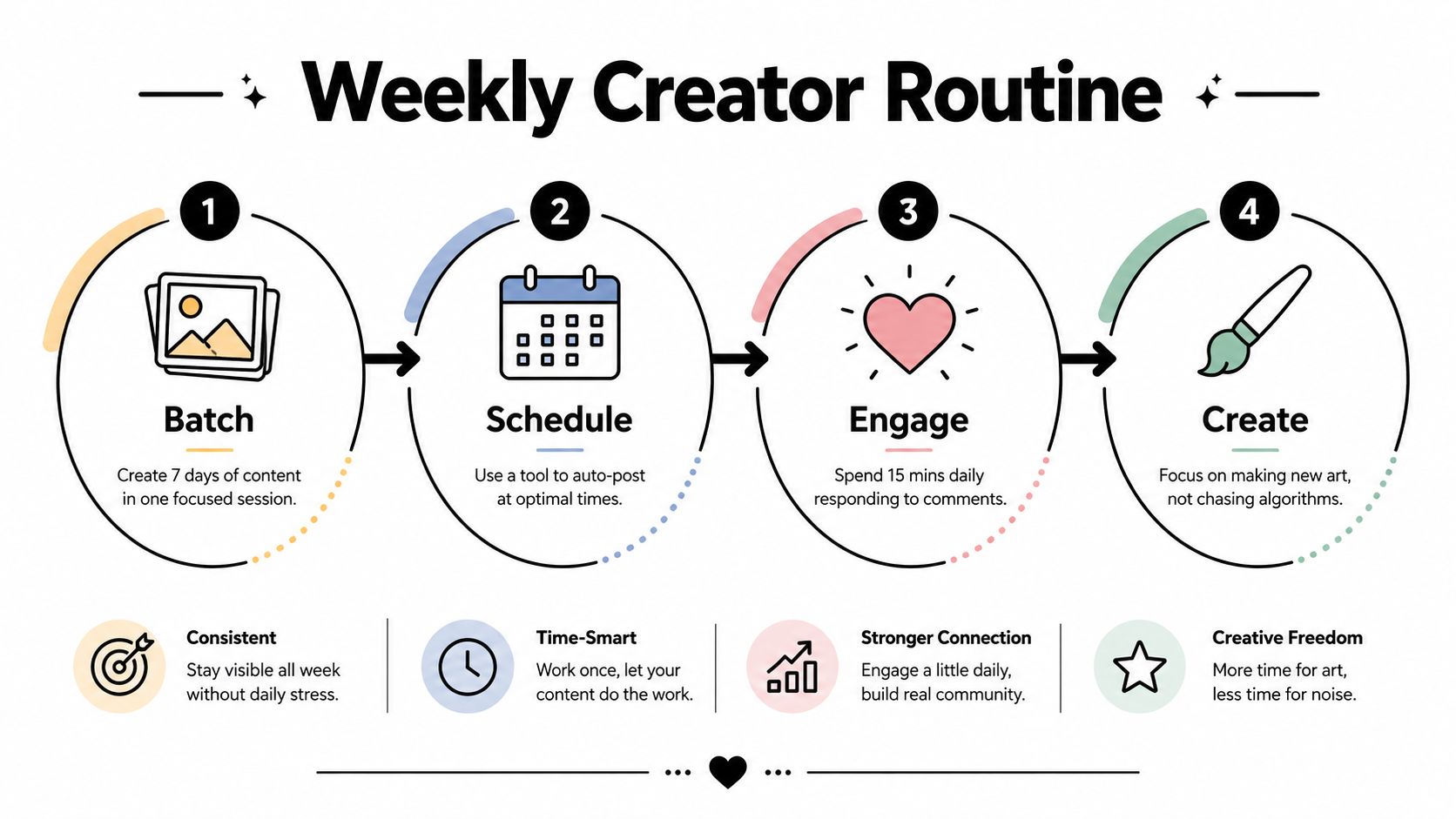 A four-step weekly creator routine infographic showing how to batch, schedule, engage, and create content effectively.
Batch the raw material
Use one focused session to capture material from work already underway. Film several angles of a painting, record sections of a rehearsal, photograph tools and details, or write down the story behind a new piece. A week of content should come from genuine creative activity, not seven unrelated ideas invented to satisfy a calendar.
Prepare captions and posts with a scheduling tool such as Meta Business Suite, Buffer, or Later, then publish only on the channels that support your current goal. Keep separate folders for raw clips, edited exports, captions, and finished posts. A basic system removes the daily panic that pushes artists toward content with little chance of creating a useful next action.
Give the week a shape
A workable rhythm might look like this:
- Planning session: Choose the week's primary business goal and select content that supports it.
- Batch session: Capture process, finished work, and one connection story while you are already in the studio or rehearsal space.
- Publishing windows: Release the strongest discovery formats on your primary platform, then adapt useful material for a secondary channel.
- Engagement windows: Check comments and messages during defined periods instead of leaving notifications open all day.
- Review window: Examine profile visits, replies, clicks, inquiries, and sales. Record which formats deserve another test.
The cadence should match your medium and capacity. For musicians, the earlier analytics guidance supports testing short-form video several times each week when Spotify profile visits are the conversion goal. Treat frequency as a variable to test against an outcome, not a rule that every artist must follow.
Make boundaries part of the strategy
Research on musicians describes social media as a source of networking and self-expression, while also associating it with comparison, trolling, algorithm uncertainty, and pressure to keep posting until offline work suffers, according to this study in the National Library of Medicine. Scheduled silence protects production time and reduces the chance that audience maintenance consumes the practice that creates the work.
Turn off nonessential notifications. Do not answer difficult messages while creating. Keep one day or block of time free from publishing, checking, and analytics. Consistency means people know when to expect useful activity. It does not give them unrestricted access to your attention.
Turning Engagement into Income and Opportunities
Likes are evidence of reaction, not payment. The practical path from attention to income has three layers: attract the right people, move interested people into a relationship you can reach directly, and make a relevant offer.
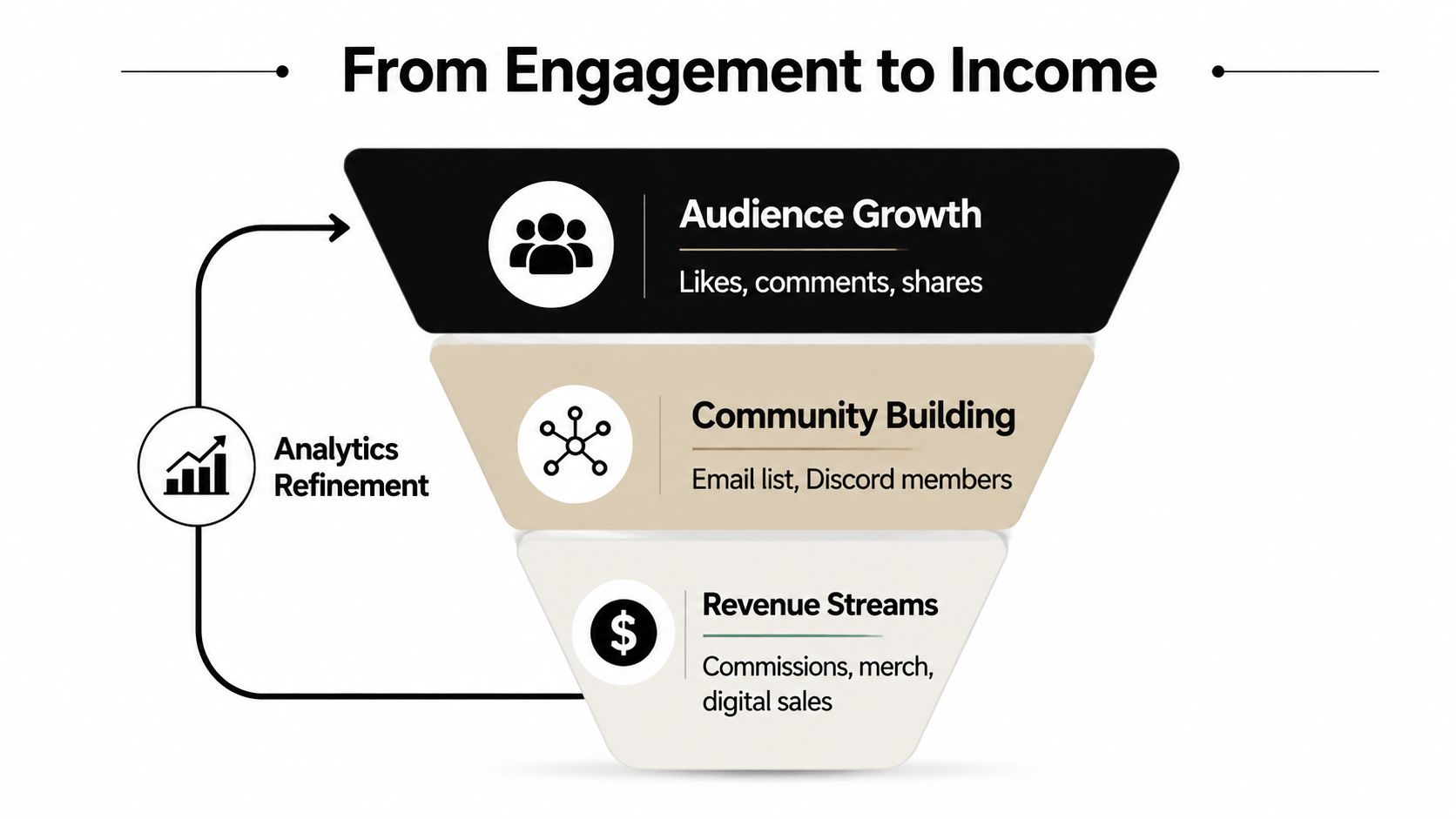 A funnel diagram illustrating the path from social media engagement to generating income for artists.
Build the conversion path before promotion
A musician might route a performance clip to a streaming profile, then invite serious supporters to an email list, Bandcamp page, membership, or show announcement. A visual artist might send process viewers to a commission page, print shop, portfolio, or collector list. A producer might turn a useful breakdown into inquiries for production, mixing, sync, or collaboration.
Make the next step visible in the profile and in the content itself. “Available for commissions” is clearer than a vague statement about being an artist. “Listen to the full track” is clearer than asking people to “support the journey.”
Use analytics as a feedback loop. Identify which formats bring profile visits, which prompts generate direct messages, and which landing pages produce inquiries. Then make more of the content that attracts buyers and collaborators, not merely the content that produces the biggest public reaction.
Measure the distance between attention and action. The shorter that distance becomes, the more useful your content system is.
Collaborate with a reason
The best collaboration isn't just an audience swap. Pair with someone whose work makes your offer more useful. A vocalist and producer can create a performance and a making-of breakdown. A painter and interior stylist can show how a piece changes a room. Two independent musicians can exchange live versions, co-write a short performance, or build a shared release moment.
Agree on the action before publishing. Decide whether the collaboration should drive listeners to a release, collectors to an available work, or professionals to a booking page. Afterward, compare the quality of inquiries, clicks, signups, and sales. If the audience overlap is weak, don't repeat the format just because the post looked busy.
Artists can also support direct music distribution through a platform like this guide to sharing a song on Spotify, provided the destination and call to action fit the campaign.
Place the video here when you want a visual example of the journey from audience response to a clearer next action.
Paid promotion belongs after the organic message has shown signs of fit. Don't pay to amplify a confusing offer, weak creative, or an audience that hasn't shown interest. First learn which content earns qualified action, then consider promotion when you can name the audience, destination, and result you want to evaluate.
Using AI Tools Without Losing Your Voice
AI is most useful when it removes repetitive friction, not when it replaces the part of the work only you can do. A musician with a half-formed concept can use a lyric generator to produce alternate rhyme patterns, hooks, or angles. The artist still chooses the emotional truth, cultural references, rhythm, delivery, and final wording.
A practical workflow starts with your material. Write the central idea, list the images you care about, describe the intended voice, and identify what the audience should feel. Use AI to generate variations around that brief, then cut aggressively. Keep the surprising phrase only if it sounds like something you would say, not because the software produced it quickly.
A controlled creative loop
- Bring the point of view: Supply your own theme, references, and boundaries.
- Generate options: Ask for different hooks, structures, captions, or short-form concepts.
- Edit by ear and eye: Replace generic language, sharpen images, and restore your natural phrasing.
- Adapt to the pillar: Turn one approved idea into a discovery clip, connection caption, or monetization prompt.
- Save the reusable system: Keep prompts and edits that help you start faster next time.
For a rapper creating roast content, DissTrack AI generates personalized diss lyrics from details such as a target's name, relationship, inside jokes, style tags, and desired savagery level. It produces structured verses with variations that can be edited, exported, or shared, while privacy settings keep generations private until the user chooses to publish.
The same principle applies to visual artists using brainstorming tools for titles, descriptions, storyboard ideas, or campaign variations. AI can widen the first draft. It can't supply your lived experience, and it shouldn't be allowed to flatten your voice. For a deeper look at keeping authorship in the process, use this guide to using your voice.
Protecting Your Mental Health While Growing Your Audience
A social strategy is sustainable only if you can keep making art while running it. Social media can support networking and self-expression, yet it also brings comparison, trolling, algorithm uncertainty, public scrutiny, uneven engagement, and burnout. Treat those costs as operating expenses, not personal failures.
Set boundaries before resentment appears. Choose publishing and reply windows, decide which criticism merits a response, and block or ignore the rest. Protect offline studio time. A quiet post measures distribution on that day, not the quality of your work.
Review the system regularly:
- Purpose: Does each active platform serve a specific career goal?
- Return: Does it create relationships, inquiries, sales, bookings, or useful discovery?
- Cost: How much attention and emotional energy does it take?
- Health: Does the routine leave room for making, resting, and living?
A format that produces anxiety without inquiries, sales, or meaningful relationships is consuming capacity without advancing the career. Remove it, even if its reach looks impressive. Keep formats that attract the right people and fit how you work. Growth becomes more dependable when your content system preserves the energy needed to continue.
DissTrack AI generates personalized roast lyrics, structured verses, and style variations that artists can edit into short-form performance or social content. Try DissTrack AI, then judge the result by whether it supports a conversion-focused pillar, not by whether it gives you another post.