10 Content Creator Tips for Bigger Reach and Revenue
A viral idea won't build a creator business by itself. Chasing every trend, posting on every platform, and hoping an algorithm notices you creates activity, not necessarily momentum. The stronger approach treats growth as an operating system: one sharp concept becomes platform-specific clips, live interaction, repeatable series, community experiences, products, and revenue.
That system matters because the creator economy has moved far beyond hobby status. One 2026 estimate places it above $250 billion, with a projection near $500 billion by 2030, while another summary places the current market between $205 billion and $323 billion, depending on what gets counted. More than 200 million people worldwide identify as creators, and roughly 50 million are described as professional or semi-professional, according to Yahoo Finance's 2026 creator economy summary.
The practical question isn't, “What should I post today?” It's, “How can I turn one strong idea into a dependable content and business loop?” The following content creator tips use roast content as a working example, but the underlying system applies to comedy, music, gaming, commentary, and short-form storytelling. Use this platform algorithm distribution guide as a useful reminder that distribution depends on how content fits each platform, not on copying the same upload everywhere.
1. Leverage Short-Form Video Platforms for Viral Diss Track Distribution
Short-form video gives a roast its fastest route to discovery, but only when the clip delivers its premise immediately. A diss track that takes too long to reach the punchline feels like an unfinished song, not a shareable moment. Build each clip around one memorable line, one visual reaction, and one reason for viewers to respond.
For TikTok, Instagram Reels, and YouTube Shorts, write a tight excerpt rather than squeezing an entire track into one upload. A DissTrack AI generation can provide several verse variations, then you can select the strongest bar, rewrite it in your own voice, and place it at the beginning or close to the beginning. Captions should carry the joke even when viewers watch without sound, while platform-native editing helps avoid the generic feel of a recycled export.
A useful production pass looks like this:
- Open with conflict: Put the target, challenge, or punchline on screen immediately.
- Make the frame readable: Use a clear face, subject, or graphic rather than a crowded montage.
- Invite participation: Ask viewers to duet, stitch, vote, or suggest the next target.
- Review safety before publishing: Remove private information, threats, identity-based insults, and claims you can't substantiate.
Practical rule: Treat the first seconds as the contract. Tell viewers what they're watching before asking them to stay.
Trending audio can help a clip fit a platform's culture, but it shouldn't bury the lyrics. Test a clean version with original sound and a trend-aware version, then compare meaningful responses such as comments, shares, and repeat viewers rather than relying on views alone. For additional guidance on shaping a roast into a discoverable clip, use this short-form diss track workflow.
 A young female content creator recording a video with her smartphone for social media engagement.
2. Build a Content Series Around Targeted Roast Battles
A single roast may attract attention. A named series gives people a reason to return.
Create a repeatable title such as “Chat Roast,” “Diss Track Tuesday,” or “Roasting Every NBA Team With AI Lyrics.” The title should tell viewers what changes from episode to episode and what stays consistent. Keep the opening visual, music sting, caption style, and closing question recognizable, while changing the target, angle, or audience prompt.
The strongest series balance structure with unpredictability. If every episode uses the same target type and joke pattern, viewers can predict the punchline before it lands. Rotate between fictional characters, willing friends, creator collaborators, and broader cultural subjects. Public figures may invite commentary, but personal acquaintances require clear consent, especially when the video could affect their reputation or relationships.
Batch production without flattening the personality
Batching helps protect consistency. Draft several episode concepts in one session, generate multiple lyrical directions, and record the introductions together. Don't publish every finished episode without a review pass. A batch can preserve your schedule while still allowing you to remove weak jokes, adjust tone, and respond to what the audience is discussing.
Use audience participation as the series engine:
- Nomination prompts: Ask viewers to suggest a willing participant or topic.
- Polls: Let the audience choose the next battle angle.
- Episode links: Point viewers toward earlier rounds so new arrivals can follow the story.
- Target responses: If a roast target replies, create a respectful follow-up instead of escalating automatically.
A recurring battle format also gives you a natural place to explain the creative process. Show how you choose a beat, reshape a line, or reject a joke that crosses a boundary. The battle rap song guide can support that development process, but your final episode should sound like your channel, not like a software demonstration.
3. Integrate Diss Tracks Into Live Streaming for Real-Time Engagement
Live content changes the value of a roast. A pre-recorded verse is polished and controlled. A live roast can make viewers feel involved because their prompt affects what happens next.
Set up a simple request pipeline before going live. Use a chat command to collect nominations, have a moderator remove unsafe prompts, and keep a short list of approved style options ready. In OBS or Streamlabs, test the generated audio, monitoring levels, and scene transitions before the audience arrives. A technically funny moment still fails if the stream clips, the music overwhelms the voice, or viewers can't understand the line.
Consent needs to be part of the format, not an afterthought. Give viewers an opt-out route, avoid targeting people who haven't agreed to participate, and never turn a personal disclosure from chat into a punchline. Moderators should reject prompts involving private details, protected characteristics, threats, sexual content involving minors, or allegations presented as fact.
A live roast should create pressure without creating harm.
Keep the interaction moving with a clear rhythm:
- Read the approved prompt.
- Confirm the target and tone.
- Generate or select the verse.
- Perform it with context.
- Let the target respond.
- Clip the strongest exchange for later distribution.
You can also use a raid or host as a collaboration cue, but ask permission before turning another creator into the subject of a joke. A voice-based performance workflow can help you shape delivery and personalization, especially when you're adapting text for your own performance. See these voice and performance workflow ideas before your next stream.
After the broadcast, save the best exchanges as vertical clips, quote cards, or a compilation. Live engagement then becomes a source of edited content rather than a separate workload.
4. Develop Cross-Platform Content Repurposing Workflows
Repurposing works when you preserve the idea and change the presentation. Copying the same caption, crop, length, and call to action across every platform usually makes the content feel like an afterthought.
Start with a high-quality master file. Keep the full audio, clean video, lyrics, project files, thumbnail assets, and alternate takes in an organized folder. Then create a platform map for the same diss track:
- TikTok: Lead with the sharpest joke and ask viewers for the next target.
- Instagram Reels: Emphasize visual identity, captions, and shareable reactions.
- YouTube Shorts: Use a clear title and connect the clip to a longer compilation or series.
- Twitch: Publish the live context, including chat reactions and the setup.
- Podcast or audio feed: Extract the performance with a short spoken introduction.
- Meme channels: Turn one lyric into a readable image or reaction template.
A Notion or Airtable board can track each version from edit to caption to publication. Buffer, Later, and Hootsuite can help schedule approved assets, but scheduling shouldn't replace platform review. Check audio rights, crop, text placement, comments, and disclosure requirements on each destination.
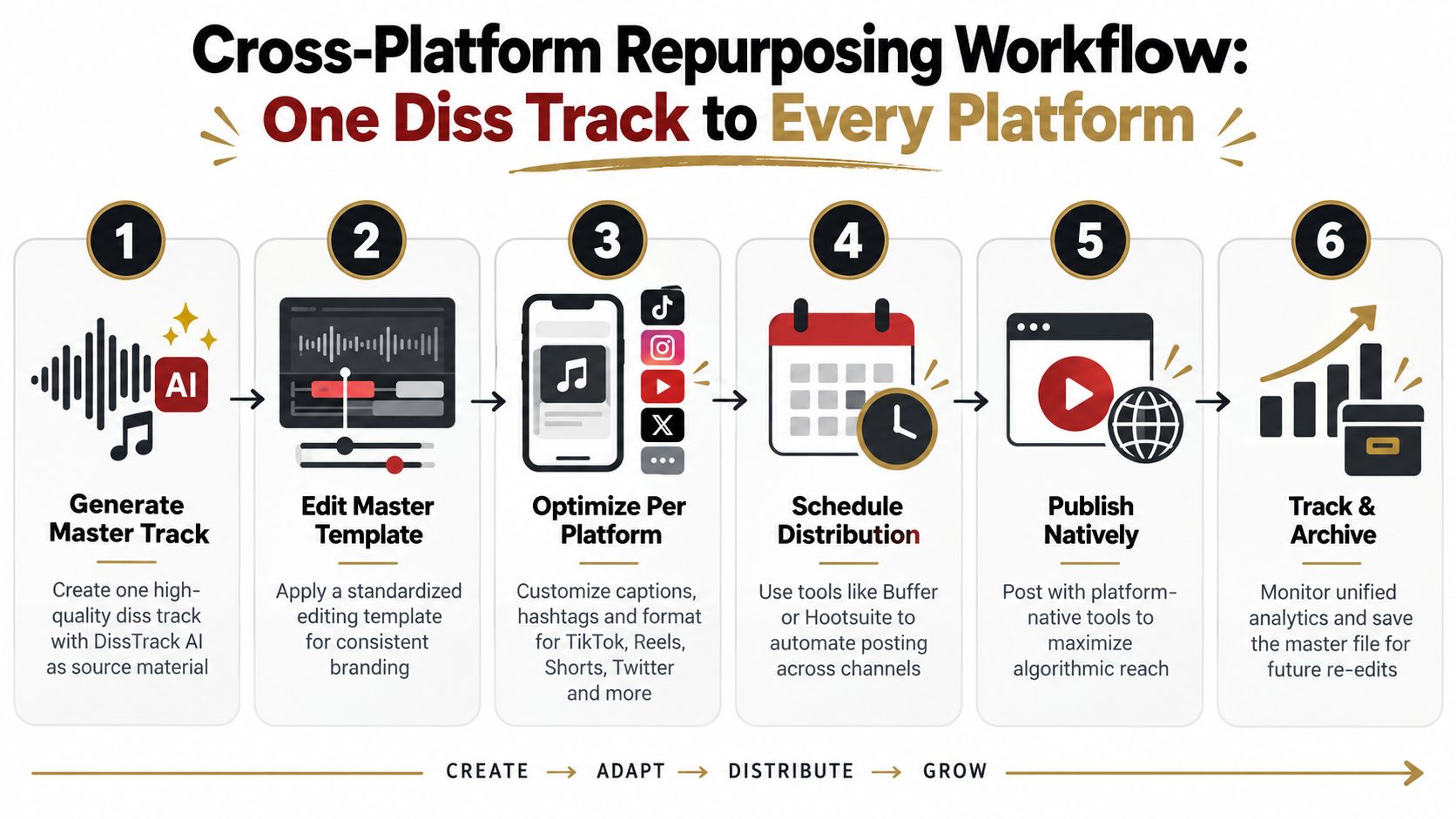 A six-step infographic showing a cross-platform repurposing workflow for distributing automated diss track content online.
One master, several edits. Repurpose the creative asset, not the exact upload.
Archive versions that performed well and versions that failed for different reasons. A weak result may reflect a poor hook, unsuitable formatting, or the wrong audience context, not a bad underlying idea. For practical help with video content clipping for TikTok, build a checklist that records the lesson from each edit.
5. Monetize Through Creator Partnerships and Brand Integrations
Sponsorships can fund production, but a brand integration that interrupts the joke damages both the content and the partnership. The best fit makes the product part of the scene, the challenge, or the performance without pretending that an advertisement is spontaneous audience banter.
A streamer might build a roast battle around a gaming sponsor, use an energy drink as part of a late-night writing challenge, or create a character roast connected to a mobile game. The concept should still work without the sponsor. If removing the product makes the episode collapse, the integration probably controls too much of the creative idea.
Prepare a media kit that explains your audience, formats, tone, content examples, and available placements. Don't promise results you haven't measured. Show brands the type of interaction your community creates, the platforms you use, and how you handle moderation and disclosure.
Protect trust while you sell
Mark sponsored content clearly in the video and description. Follow applicable advertising rules and platform requirements, and disclose affiliate relationships when they exist. A roast creator's humor can make disclosure feel awkward, but hiding a commercial relationship creates a bigger trust problem than a visible label.
Offer packages built around deliverables rather than vague exposure promises. For example, a package might include a short-form performance, a live mention, a community poll, and a follow-up clip. Keep usage rights, revision limits, exclusivity, deadlines, and approval responsibilities in writing.
Avoid accepting every category. A product that conflicts with your audience, tone, or values can make future partnerships harder. Sponsorship should strengthen the operating system by paying for repeatable production, not force you to abandon the format that attracted viewers.
6. Master Comment Section and Reply Engagement Strategies
Your comment section can become a second writers' room. Viewers reveal which line they noticed, which target they want next, and which joke they misunderstood. Replying with a short roast turns that feedback into another piece of content while rewarding the person who started the exchange.
Choose comments that are playful, specific, and safe to answer. A clever criticism can produce a better response than a compliment because it gives you a clear premise. Don't roast someone who appears distressed, shares sensitive information, or didn't understand that the original content was comedic. A reply can be sharp without being humiliating.
Use a simple response workflow:
- Filter: Remove prompts involving doxxing, threats, harassment, or private disputes.
- Select: Choose a comment with a clear comedic angle.
- Generate: Create several lyrical directions rather than accepting the first draft.
- Edit: Match the response to the commenter's actual tone.
- Notify: Tag or reply directly so the person can see the result.
- Extend: Pin a strong exchange or collect responses into a recurring compilation.
The comment itself should remain visible long enough for new viewers to understand the setup. If the platform supports reply videos, show the original comment on screen and keep the response concise. If it doesn't, use a caption card that preserves context without exposing personal details.
A weekly “best comment roast” gives the audience a reason to write better prompts. It also helps identify people who contribute consistently, which can lead to future collaborations, live participation, or community roles. The goal isn't to maximize replies at any cost. It's to make participation feel rewarding and keep the tone recognizable.
7. Create Merchandise and Physical Products Around Signature Roasts
Merchandise turns language into an object, but not every funny line belongs on a shirt. A strong product phrase needs to work without the original video, remain understandable after the trend fades, and avoid using someone else's name, image, lyrics, trademark, or private joke without permission.
Start with a small test collection built around your most recognizable original phrases. Print-on-demand services such as Printful and Merch by Amazon can reduce inventory risk because you don't need to order a large batch before validating interest. Review mockups carefully. A line that works in a caption may be too long for a chest print, unreadable on dark fabric, or awkward when separated from its visual context.
Turn a phrase into a product family
Think beyond a single shirt. A catchphrase might become a hoodie graphic, a hat, a poster, a sticker, or a digital bonus for community members. Keep the design system consistent so buyers can recognize the collection as yours.
Before publishing a product, check:
- Ownership: Confirm that the phrase and artwork are yours to use.
- Target privacy: Don't commercialize a roast aimed at a private person without permission.
- Readability: Test the design at thumbnail size and in real lighting.
- Fulfillment: Review sizing, delivery, returns, and customer support.
- Promotion: Show the item naturally during streams and community posts.
Limited releases can create urgency, but don't manufacture scarcity you can't honor. Tell buyers whether an item is permanently available, temporarily offered, or tied to a specific event. Customer photos can provide useful social proof after purchase, but ask for permission before reposting them.
For design directions beyond basic lyric shirts, explore these band merch ideas for 2026. The same principle applies to creator merchandise: sell the identity and shared joke, not just a screenshot of a viral moment.
 A stack of folded white, grey, and black t-shirts next to a coffee mug on a table.
8. Build Community Through Private Discord Channels and Early Access
Public reach is useful, but owned relationships create a more stable foundation. A private Discord server, membership space, or subscription community lets your most engaged viewers influence content before it reaches the public feed.
Give members benefits they can understand immediately. Early access to tracks, target voting, private roast battles, behind-the-scenes drafts, and live writing sessions all work because they offer participation rather than placing a paywall around existing posts. A private channel shouldn't feel like a silent archive of content that public followers already received.
Recent reporting from Circle points toward this shift in creator business models. Community builders are monetizing through memberships, 67% of members discover communities through social platforms, and 69% of creators cite member transformation as their top growth strategy, according to Circle's creator economy statistics. Those findings support a practical focus on what members become able to do, make, or experience, not only what they can watch.
Design the community before opening the door
Create clear roles for newcomers, regular participants, moderators, and trusted collaborators. Publish rules for consent, harassment, personal information, and target selection. Automate welcome messages and role assignment with Discord bots, but keep human moderation available for disputes and safety issues.
Ask members what they want, then act visibly on the answers. A monthly poll can choose the next battle theme, while a community roast event can give participants a structured stage. Recognize useful contributions publicly, but don't turn every interaction into a competition.
Pricing should reflect the work required to deliver the promised experience. Start with a simple offer, measure participation, and adjust only after you understand what members use. Recurring revenue becomes sustainable when the community has a repeatable reason to return, not when creators add more channels.
9. Develop Battle Rap Event Content and Tournament Series
Events create stakes that ordinary uploads lack. A tournament gives creators a bracket, an audience, a deadline, and a reason to promote each round. It also produces several content formats from one production effort, including live matches, interviews, highlight clips, reaction videos, and behind-the-scenes material.
Start with willing friends or known collaborators before inviting unfamiliar competitors. Participants should understand the tone, judging process, recording arrangements, release rights, and safety rules before they agree. Written consent matters especially when the event is filmed, monetized, or distributed across multiple platforms.
Build judging around visible criteria such as punchlines, delivery, flow, originality, and audience response. No scoring system removes subjectivity, but clear criteria make disagreements easier to manage. A moderator should also have authority to stop a round when a performer crosses into threats, targeted harassment, private information, or protected-characteristic attacks.
A practical event sequence looks like this:
- Recruit: Confirm competitors and collect stage names, availability, and consent.
- Promote: Release competitor introductions and short practice clips.
- Prepare: Test microphones, music levels, livestream scenes, backup recordings, and moderation.
- Run: Keep the bracket moving and explain judging decisions.
- Package: Edit each battle into vertical highlights, longer episodes, and reaction clips.
- Extend: Sell event-specific merchandise or invite viewers into the next community round.
Tournament software can help manage brackets, but the audience experience depends more on pacing and production clarity. If sponsors support the event, give them defined placements that don't interrupt the most important performances. Prize funding, tickets, and merchandise can support the event, but don't promise rewards until the budget and payment process are secure.
10. Leverage AI-Generated Content as a Sampling and Remixing Tool
AI-generated lyrics work best as raw material, not as a finished identity. A generator can help you escape writer's block, test rhyme directions, or find a surprising angle. Your contribution comes through selection, rewriting, performance, production, and judgment.
DissTrack AI lets users enter a target's name, relationship, and inside jokes, then choose styles such as West Coast, Old School Boom Bap, Trap, Battle Rap, Drill, Emo Rap, or UK Grime. It produces structured verses with variations that users can edit, export, or share. Treat those outputs as a writing room, not a substitute for your voice.
Build a human editing pass
Start by selecting the premise that best fits your audience. Then check the factual basis, remove private details, rewrite awkward phrasing, mark stressed syllables, and fit the verse to a beat. Read it aloud before recording. A line that looks clever on screen may sound clumsy at performance speed.
AI adoption is already widespread among creators. An Adobe survey of 16,000 people across multiple countries found that 86% of creators actively use generative AI, while 60% use more than one creative AI tool within the past three months, according to Adobe's creator survey. That supports a multi-tool workflow, with separate tools for ideation, editing, localization, audio, and final quality control.
Human judgment is the quality filter.
If you release an AI-assisted song, disclose the assistance where appropriate and verify the rights attached to every beat, voice, sample, image, and generated element. Don't imitate a living artist's identifiable voice or present synthetic material as an authentic recording. Current creator trend reporting also notes that pure AI-generated content is priced 40–60% below human equivalents, which makes originality and visible human involvement important to perceived value. See Later's 2026 creator economy predictions for that broader discussion.
10-Point Creator Strategy Comparison
| Strategy | 🔄 Implementation complexity | Resources required | 📊 Expected outcomes | 💡 Ideal use cases | ⭐ Key advantages |
|---|---|---|---|---|---|
| Leverage Short-Form Video Platforms for Viral Diss Track Distribution | Low–Medium, immediate start; needs consistent posting | Smartphone, DissTrack AI account, basic video editor | Rapid reach and shareability; high engagement; viral clips | Quick virality, meme/roast content, audience growth | ⭐⭐⭐⭐, ⚡ Fast growth with low production overhead |
| Build a Content Series Around Targeted Roast Battles | Medium, planning, episodic scheduling | Content calendar, DissTrack AI Pro/Creator plan, video editing | Loyal returning audience; better SEO and recommendation performance | Long-term brand building, episodic storytelling | ⭐⭐⭐⭐, Predictable retention and audience participation |
| Integrate Diss Tracks into Live Streaming for Real-Time Engagement | Low–Medium, same-day setup but needs moderation safeguards | DissTrack AI account (Pro), streaming software, stable internet, mods | Increased live engagement, clip-worthy moments, longer sessions | Interactive streams, chat-driven shows, raid/host interactions | ⭐⭐⭐⭐, Real-time interactivity and high clipability |
| Develop Cross-Platform Content Repurposing Workflows | Medium–High, 3–5 days to set up workflows, then scalable | DissTrack AI, video editor, scheduling tool (Buffer/Hootsuite), templates | Multi-channel reach, ~80% time savings vs per-platform creation | Scaling creators who publish to many platforms | ⭐⭐⭐⭐⭐, ⚡ Efficiency and consistent multi-platform presence |
| Monetize Through Creator Partnerships and Brand Integrations | Medium, outreach, negotiation, legal/FTC compliance | Media kit, brand contacts, outreach channels, legal guidance | Higher CPMs, sponsored revenue streams, affiliate deals | Established creators with clear audience demographics | ⭐⭐⭐⭐, Premium revenue potential; requires brand-safe content |
| Master Comment Section and Reply Engagement Strategies | Low, immediate to implement; scales with volume | DissTrack AI Pro+, moderation tools, time for responses | Boosted comments/replies, higher algorithmic visibility | Creators seeking high engagement and community activation | ⭐⭐⭐, Low-effort engagement loop; moderation burden increases |
| Create Merchandise and Physical Products Around Signature Roasts | Low–Medium, 1–2 weeks to launch initial products | Print-on-demand (Printful/Merch), design skills, Shopify, marketing budget | Additional revenue stream, brand visibility, fan loyalty | Viral catchphrases or signature lines with engaged fans | ⭐⭐⭐, Monetization from existing IP; fulfillment/service risks |
| Build Community Through Private Discord Channels and Early Access | Medium, ~2 weeks setup + ongoing community management | Discord, payment processor (Stripe/PayPal), community manager time | Recurring subscription revenue, deeper fan loyalty, feedback loop | Fan monetization, exclusive early-access models | ⭐⭐⭐⭐, Sustainable recurring revenue and high LTV |
| Develop Battle Rap Event Content and Tournament Series | High, 6–12 weeks planning, complex logistics | Event planning, venue, streaming equipment, prize budget, marketing | Premium ticket/sponsorship revenue, high production value content | Large-scale events, tournaments, hybrid IRL+streamed shows | ⭐⭐⭐⭐, High monetization potential; significant upfront risk |
| Leverage AI-Generated Content as Sampling and Remixing Tool | Medium, production workflows and legal clarity needed | DAW (Ableton/Logic), producer collaboration, distributor account | Streaming royalties, faster song production, playlist exposure | Musicians/producers using AI for ideation and songwriting | ⭐⭐⭐, Speeds songwriting and releases; requires editing and rights clarity |
Turn One Sharp Idea Into a Safer Creator Engine
The strongest content creator tips don't ask you to become a full-time trend chaser. They help you build a repeatable path from concept to distribution, interaction, revenue, and learning. Start with one format you can produce without exhausting yourself. A short roast series, comment-response format, live chat battle, or creator collaboration gives you a defined container for experimentation.
Produce a small test batch before you build a complicated brand system. Keep the opening structure consistent, but vary the target, visual treatment, delivery, and call to action. Review each piece for clarity, pacing, audience fit, and safety. Don't declare a format successful because one upload received attention. Look for signs that people understood the premise, shared the clip, returned for another episode, joined the conversation, or took an action connected to your business.
Adapt the strongest piece for multiple platforms. The TikTok version may prioritize a fast punchline, while the YouTube Short may need more setup. An Instagram Reel might lean into visual reactions, and a live version might invite the audience to nominate the next target. Save the clean master file and document what changed in each edit. That record becomes your operating manual.
Audience participation should remain opt-in. Invite viewers to submit prompts, vote on targets, or volunteer for a roast, but don't expose someone who hasn't agreed to be part of the joke. Review every submission for private information, threats, harassment, discriminatory language, sexual content involving minors, and unsupported accusations. A roast can be aggressive in style without becoming abusive in substance.
Copyright and commercial rules deserve the same attention. Check whether you have permission to use a beat, sample, photograph, logo, name, or voice. Label sponsorships and affiliate relationships clearly. Read each platform's current rules before publishing, particularly when a joke targets a real person or uses synthetic media. AI can help with ideation and lyrical experimentation, but it can't make the final judgment for you.
Measure the channel that creates meaningful engagement, not only the channel that produces the biggest reach. Community participation, repeat viewers, qualified partnership inquiries, product sales, and member retention may matter more to your business than a single spike. The creator economy's growth is substantial, but earnings remain uneven. One 2026 industry report says 48.7% of creators earn under $10,000 annually, 45.6% earn between $10,000 and $100,000, and only 5.7% earn $100,000 or more, as reported by Creator Economy Reports. Diversification isn't a buzzword in that environment. It's risk management.
Use DissTrack AI as one component in that system if its structured verses, style controls, private generation, and editable variations fit your workflow. Keep your voice in the writing, your judgment in the edit, and your responsibility in the publishing decision. That combination gives a sharp idea a better chance of becoming a durable creator engine.
DissTrack AI helps you generate personalized roast lyrics, test different battle rap styles, and turn one concept into editable content for videos, streams, replies, and music projects. Visit DissTrack AI to try a faster ideation workflow, then refine every line before you publish.