AI Lyrics Generator: Write Songs Faster in 2026
The strangest thing about an AI lyrics generator is that technical fluency doesn't guarantee a song will hit. Research comparing Markov chains, LSTM, and GRU systems across rock, pop, country, hip-hop, EDM, and R&B found that GRU produced the highest overall rhyme-density score, while LSTM delivered the strongest average readability in the Springer study of lyric-generation methods. In other words, the machine can understand patterns, but you still have to tell it what kind of damage you want done.
A vague prompt gets you greeting-card poetry with a drum loop in the background. A sharp prompt can produce usable angles, tighter schemes, and several directions for a real writer to attack. The difference comes from rhythm, rhyme density, structure, personal detail, and how aggressively you edit the first draft.
What an AI Lyrics Generator Actually Does
You type your friend's name, choose West Coast, turn the savagery up, and seconds later a diss track appears with verses, a hook, and a bridge. The first read can feel like magic. Then you notice the same recycled insults, the suspiciously convenient rhymes, and a line about “running the game” that belongs in a cereal commercial.
That output tells you what an AI lyrics generator really is. It's not a tiny rapper trapped inside a website. It's a language system predicting likely words and arranging them according to patterns it has learned from lyrical examples, prompts, genre labels, and structural instructions. Purpose-built tools are designed to handle songwriting conventions, while a general chatbot may understand language but miss the difference between a clean multisyllabic rhyme and two words that merely sound similar.
The better systems treat lyrics as performance writing, not ordinary prose. They account for sections such as verses, choruses, bridges, and outros. They can also respond to instructions about mood, genre, flow, rhyme pattern, and intensity. That doesn't mean every generated line scans perfectly. It means the tool has more useful controls for getting closer to a performable draft.
Why dedicated tools sound different
A generic model often reaches for obvious language because obvious language is statistically safe. Ask for a diss about a lazy roommate and you may receive “You never work, you never clean,” which is accurate but creatively bankrupt.
A specialized generator can work from more relevant inputs, such as battle-rap conventions, punchline placement, internal rhyme, and genre vocabulary. DissTrack AI, for example, lets users provide a target's name, relationship, and inside jokes, then select styles including Old School Boom Bap, Trap, Battle Rap, Drill, Emo Rap, and UK Grime. It also allows the user to tune the savagery level and generate structured variations.
Practical rule: Treat the first result as a crate of samples, not a finished record.
These tools have become useful for streamers, creators, party hosts, and rappers because they remove the blank-page delay. The human still supplies the target, context, taste, and final judgment. The generator supplies rapid options, rough structures, and unexpected connections.
The Technology Behind AI-Generated Lyrics
AI lyric systems predict language, but useful systems also track musical constraints. Older sequence models such as LSTM and GRU process words in order, carrying earlier information into later predictions. That helps them recognize recurring patterns, including a line moving toward a rhyme or a chorus returning to the same idea.
Transformers use attention to weigh relationships across a wider passage. A battle bar's payoff can depend on a setup several lines earlier, while a chorus may need to preserve an exact phrase as the surrounding verses change. That broader context helps, although it does not guarantee a natural flow or a sharp punchline.
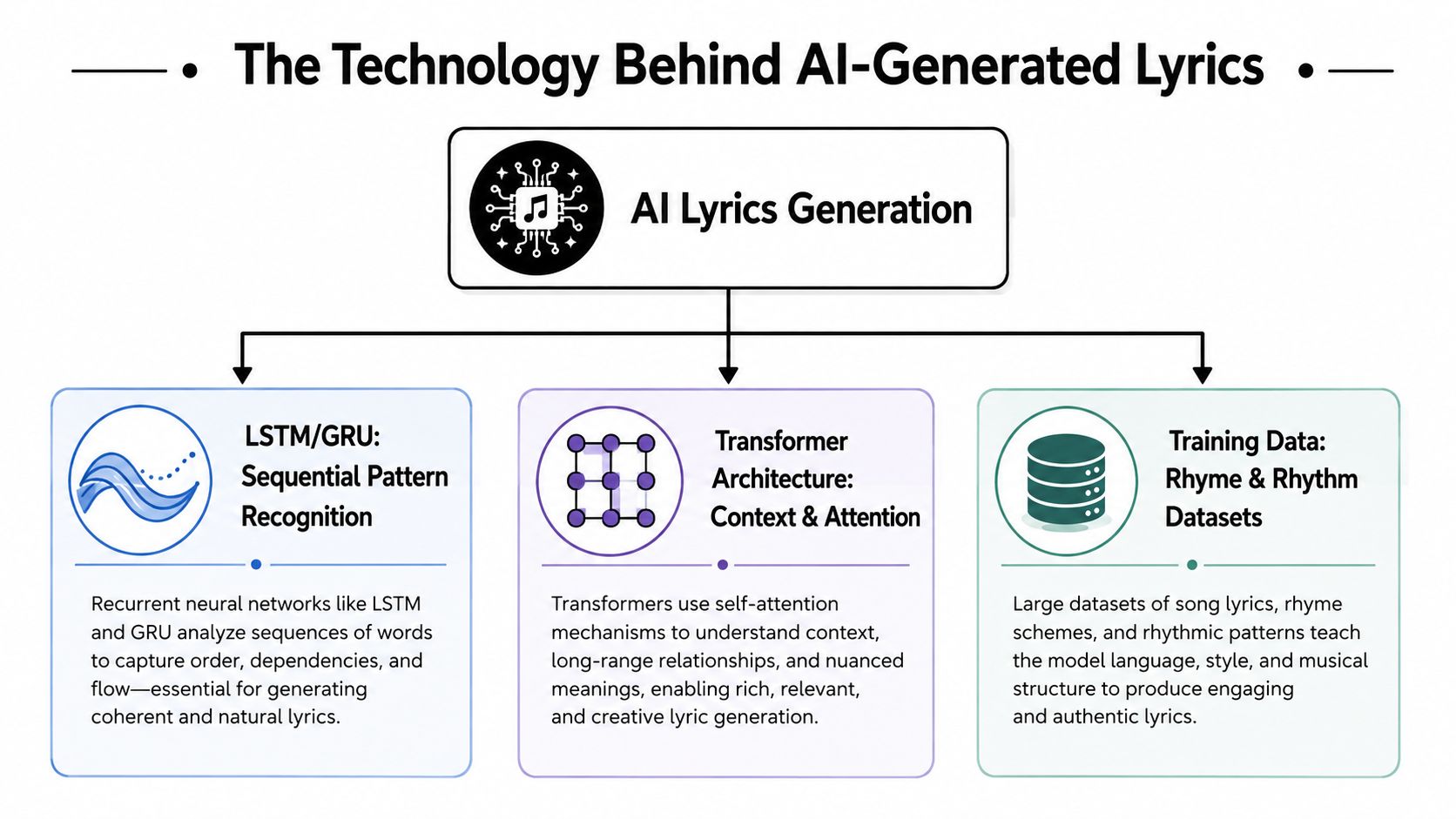 A diagram illustrating the core technologies behind AI-generated lyrics, including LSTM, Transformer architecture, and training datasets.
Fluency isn't the same as flow
A line can read cleanly and still collapse over a beat. Readability measures whether the words make sense on the page. Rhyme density measures how often the writing creates meaningful sound relationships. Beat alignment covers syllables, stresses, pauses, and line lengths working with the music.
These jobs can conflict. A polished sentence may place its stressed syllable in the wrong spot. Packing every bar with rhyme can make a verse cramped, predictable, or tiring. Strong output balances clarity, sound, and performability, then leaves room for a rapper's delivery to add force.
Structure-aware research shows why controls for rhythm and format matter. UniLG evaluates lyric output with PPL, Integrity, Format F1, Beat F1, and Structure F1. Its Lyric-to-Beat module reports average perplexity of 1.13 and 92.18% accuracy on its evaluated task, indicating how explicit rhythm and format constraints can improve organization rather than merely produce fluent text in the Stanford final report.
Research described in the Springer study used 17,014 unique songs across 14 genres, with emotion labels drawn from 15,114 songs through the same Springer reference. That dataset design helps explain why genre and mood instructions can change the result. “UK grime, cold delivery, clipped lines” gives the system different signals from “melodic pop, nostalgic, open vowels.”
The technology still has limits. Training on existing lyrics can reproduce familiar phrasing, rhyme habits, or distinctive patterns, so generated bars require human review for originality and possible plagiarism. A tool can imitate a texture without understanding why a line hits, which is why prompt specificity and final editing matter more than raw fluency.
For more context on how these systems fit into music-making workflows, see this guide to artificial intelligence in music composition. Use practical terms such as structure, stress, rhyme, and delivery, not only “creativity.”
Crafting Prompts That Produce Fire Bars
Most weak generations start with a weak brief. “Write a savage rap about my roommate” gives the model a subject, but it doesn't give it ammunition. The stronger prompt supplies a person, a relationship, specific evidence, a sound, a structure, and boundaries.
Start with the target and the situation. “My roommate” is a label. “My roommate who leaves plates in the sink, borrows chargers, and claims he's going to clean after every gaming session” gives the model scenes it can turn into punchlines.
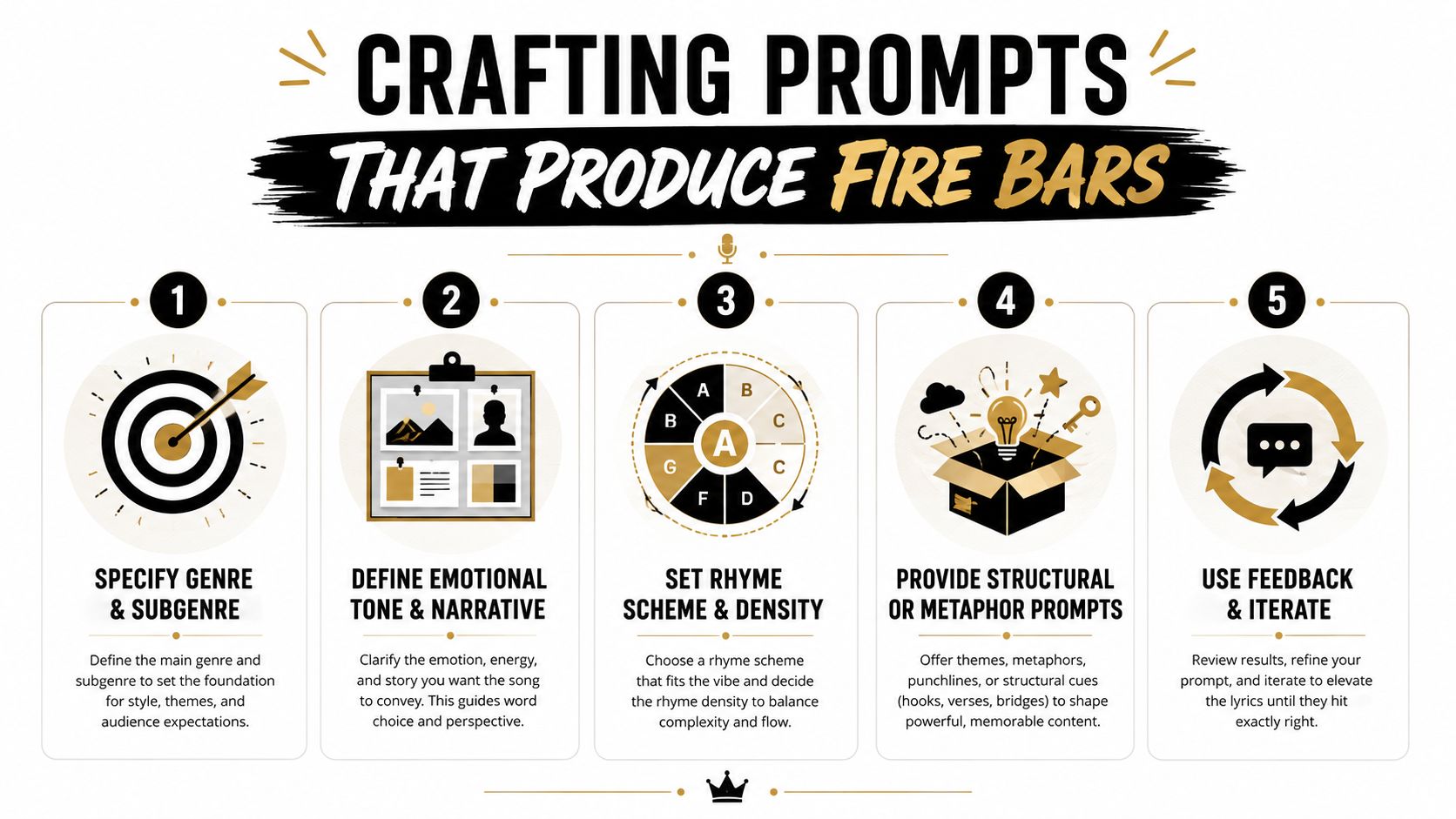 An infographic detailing five steps for crafting prompts that generate high-quality song lyrics and rap bars.
Use a battle writer's prompt frame
Build the request in layers:
-
Name the sound. Specify genre and subgenre, such as Old School Boom Bap, West Coast, UK Grime, or Trap. Add delivery notes like “dry and conversational” or “rapid, clipped, percussive.”
-
Define the relationship. Friend, rival, sibling, teammate, or fictional character changes the emotional temperature. A playful roast needs different language from a competitive battle verse.
-
Feed it details. Give the model habits, objects, locations, contradictions, and inside jokes. Concrete nouns create better targets than broad insults.
-
Control the structure. Request a verse length, hook shape, bridge, or alternating rhyme pattern. If you want a performance draft, ask for line breaks that make breath points visible.
-
Set the savagery ceiling. “Playful,” “sharp but friendly,” and “merciless fictional battle” are more useful than just demanding “fire.” Add exclusions, such as no threats, no protected-class attacks, and no references to private information.
Compare the difference:
- Weak: “Write a savage diss about my roommate.”
- Strong: “Write a playful but cutting West Coast diss about my roommate Jay, who leaves dishes for days, borrows my headphones, and says he's ‘basically a chef.’ Use internal rhymes, two setup-punchline pairs per verse, a four-line hook, and a relaxed delivery. Keep it funny, avoid threats, and don't use generic lines about being broke or fake.”
The second prompt gives the system a cast, props, comic contradiction, technical targets, and safety limits. It also leaves room for revision instead of pretending the first pass will be perfect.
Prompt trick: Ask for three different rhyme approaches, then keep the strongest angle from each. Don't ask for three complete songs and blindly choose the longest one.
Iterate on the line, not just the whole song
If the hook works but one couplet is dead, isolate the problem. Ask for five replacements that preserve the final rhyme, keep the same syllable range, and sharpen the image. Then read every candidate aloud over the beat. A line that looks clever in a chat window may drag when your mouth has to deliver it.
For creators writing promotional music or short-form content, studying AI hook ideas for ads can help with concise openings and repeatable phrases. Hooks need a different kind of force from verses. They should land quickly, survive repetition, and make sense before the listener knows the backstory.
Use the same discipline with a dedicated make-me-a lyric prompt. Give the generator a specific task, test a variation, and rewrite anything that sounds like the model is trying to impress you.
Real-World Use Cases for AI Diss Tracks
A streamer can turn a recurring chat joke into a short roast segment. The workflow is straightforward: collect the harmless running gag, define the streamer's persona, request a compact verse and hook, then cut the strongest bar into a clip. The AI supplies variations, but the creator decides whether the joke fits the audience and whether the target is in on it.
Party hosts can use the same process for birthdays, bachelor parties, and friendly competitions. The best material usually comes from shared memories, not random aggression. A prompt about a friend's legendary missed penalty, terrible karaoke, or obsession with a particular snack gives the verse a social texture that generic insults can't provide.
Creators, producers, and promoters
Producers and DJs may need a vocal concept before the final arrangement exists. A generator can draft battle-ready sections around a theme, suggest alternate hooks, or reveal where a beat needs a denser passage. The producer still has to test cadence, edit syllables, and make sure the words belong to the track rather than merely filling space.
Social media marketers can use roast lyrics as engagement bait, but the tone needs careful handling. A fictional brand rivalry, product-versus-product joke, or creator challenge is safer than targeting a private person with humiliating claims. The writing should invite participation without turning harassment into the campaign.
Creators who move from a rough diss concept to a filmed release will also need a production plan. Guidance on planning your next music video shoot can help translate a text draft into locations, performance setups, visual beats, and a workable shoot schedule.
Why the format travels
Diss tracks work because they combine a recognizable target with a repeatable performance shape. A hook gives the audience something to remember, verses provide escalating details, and a final punchline creates a clip-friendly ending.
That doesn't make AI a replacement for serious artistry. It makes the format easier to play with. Friend groups can collaborate on the prompt, creators can test multiple comic angles, and rappers can use the output as raw material when a deadline arrives before inspiration does.
Copyright and Legal Risks You Cannot Ignore
The dangerous assumption is that generated text is automatically yours because you typed the prompt. Current legal signals don't support that shortcut. U.S. guidance generally treats purely AI-generated text as not copyrightable unless a human contributes sufficiently creative authorship, while a Munich court found that an AI system's memorization and reproduction of copyrighted song lyrics can violate copyright law as summarized by the Library of Congress.
That creates several separate questions. Can you publish the words? Can you register them? Can you stop someone else from using them? Can you commercially license a track made with them? The answers can depend on the tool's terms, your jurisdiction, the source material, and how much human selection, rewriting, arrangement, and performance shaped the final work.
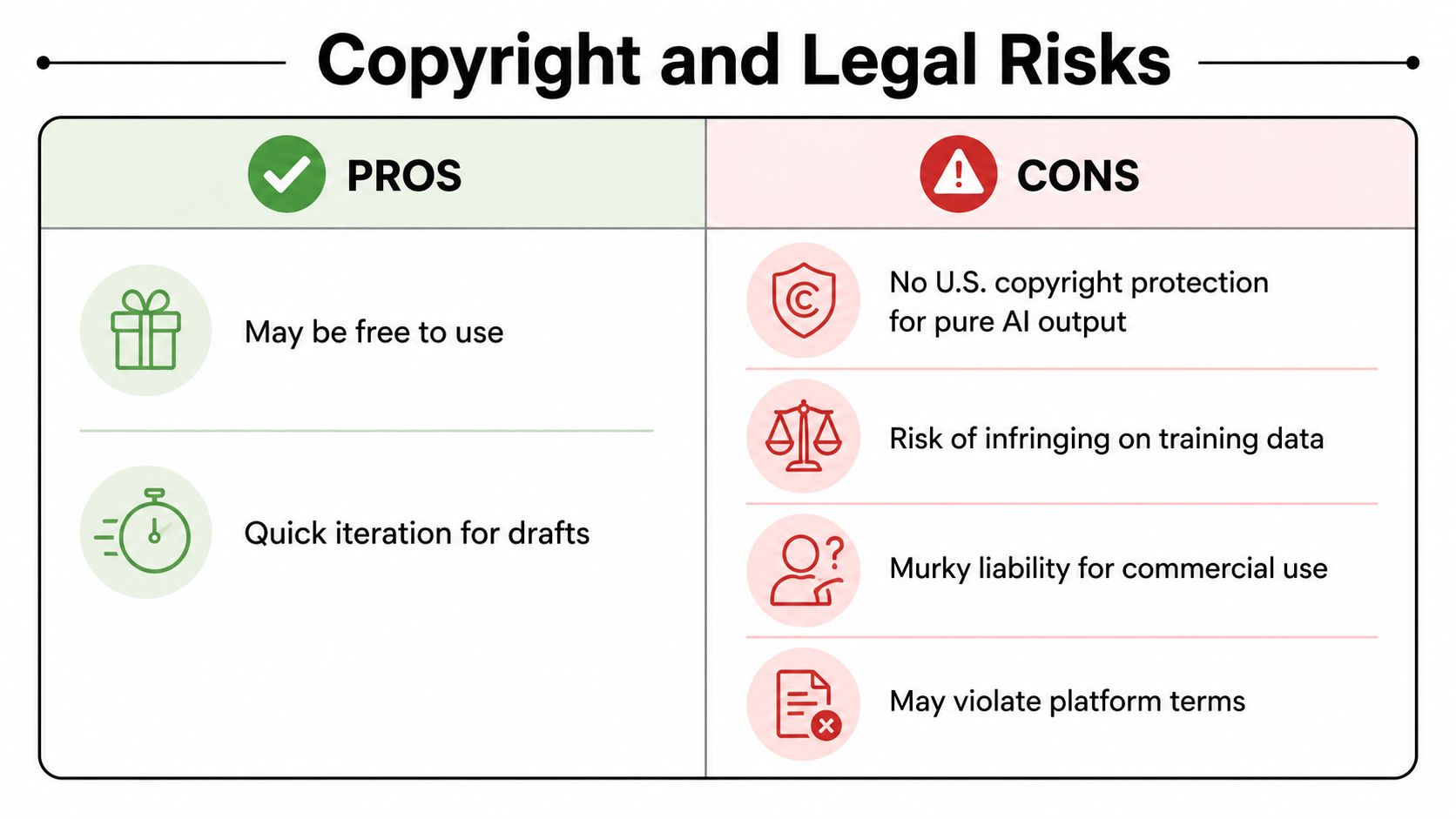 A comparison table outlining the potential pros and cons of using AI tools for content creation.
The plagiarism problem is practical, not theoretical
A model can produce a line that sounds familiar without copying a complete song. That still deserves investigation before release. Change suspicious wording, search distinctive phrases, compare the draft against your references, and keep records of your prompts and revisions. Don't ask a generator to continue, imitate, or reproduce a living artist's specific song.
The risk becomes more serious when a system outputs existing lyrics. Reporting on the Ivors Academy's concerns about Suno described a prompt that reportedly produced the full lyrics to Midnight Oil's “Beds Are Burning,” prompting calls for the company to remove its lyrics generator in the MusicTech coverage. That example shows why users need provenance checks before publishing, even when the output looks newly generated.
Before release: Search distinctive lines, replace anything suspicious, document your edits, and read the platform's commercial-use terms.
Human involvement can improve both the creative result and the authorship record, but editing isn't a magic legal stamp. Selection, arrangement, rewriting, and performance may matter, yet the threshold differs by jurisdiction and remains unsettled. If the release has meaningful commercial stakes, get advice from a qualified copyright professional rather than relying on a tool's marketing language.
Creators exploring sponsorships should apply the same caution to branded work. If you're researching opportunities such as Songfinch brand deals, check ownership, disclosure, licensing, and approval requirements before delivering AI-assisted lyrics to a client. For the publication question itself, this explanation of whether you can publish a song written by AI provides a practical starting point, not a substitute for legal advice.
AI Versus Human Lyric Writing
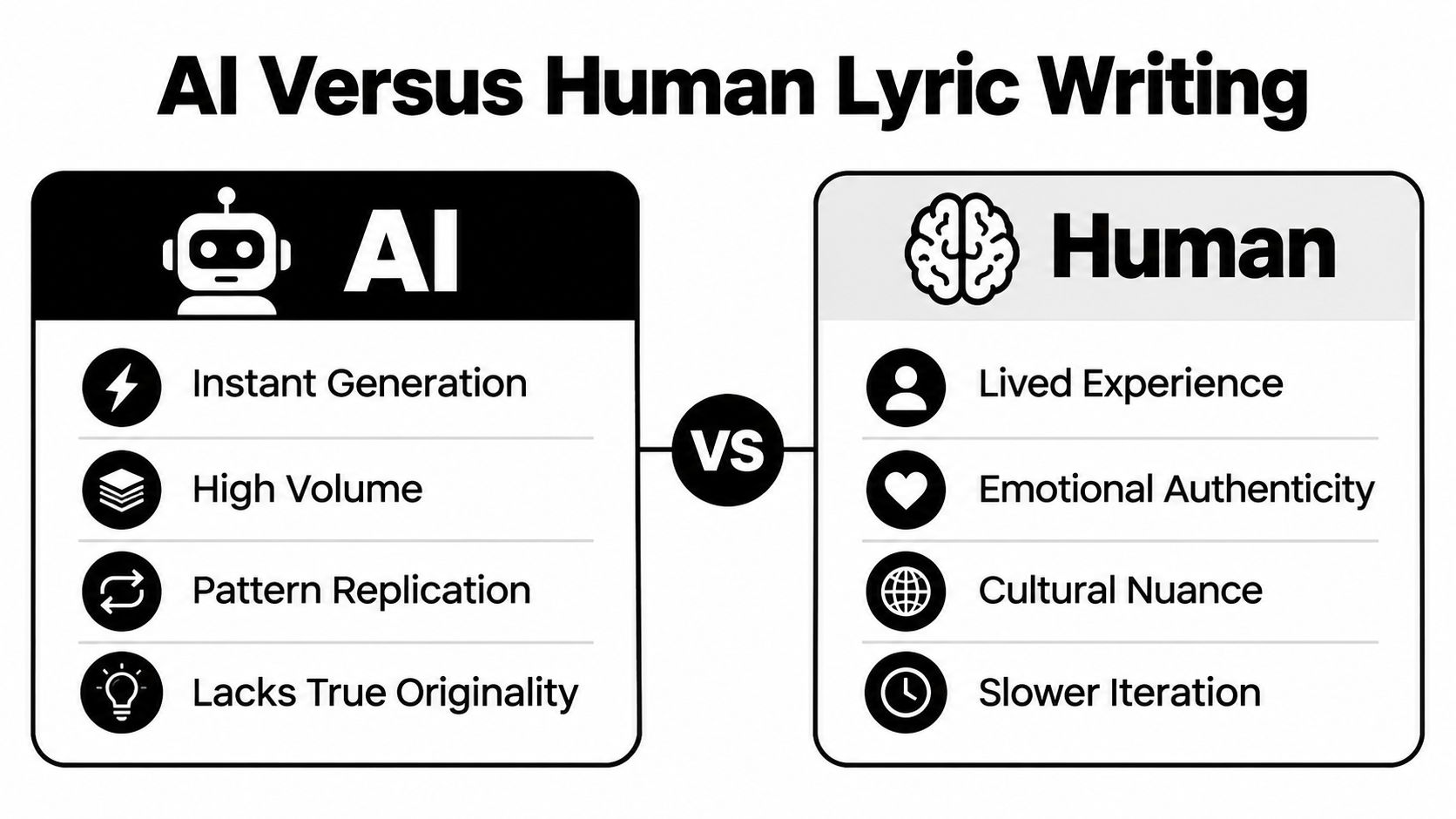
AI wins the first round on speed. It can produce multiple hooks, alternate rhyme patterns, and rough verse structures before a human writer has finished judging the beat. That makes it useful for breaking a block, testing a premise, or finding an unexpected metaphor.
Humans win the rounds that require lived knowledge. A model can rhyme “rent” with “bent” and “spent,” but it doesn't know which detail makes the joke specific to your crew. It can mention a sneaker, a neighborhood, or a cultural reference, yet still miss why that reference carries weight.
 A comparison chart showing the differences between AI and human songwriting with pros and cons listed.
Where each side performs best
| AI lyrics generator | Human writer |
|---|---|
| Rapid drafts and variations | Personal history and emotional truth |
| Pattern recognition | Cultural nuance and timing |
| Structural suggestions | Original perspective |
| Tireless revision options | Taste, restraint, and performance instinct |
The machine also tends to over-explain. Battle rap often depends on compression. One image, delivered at the right moment, can beat four technically competent lines that announce the joke before it lands.
The strongest workflow is collaborative. Ask the generator for angles, not identity. Keep the unusual image, throw away the filler, replace generic setups with details only you would know, and rewrite the punchline until it sounds like your voice.
Human advantage: The line hits harder when the writer understands why the target, room, and moment matter.
That division of labor preserves the useful part of automation without pretending that pattern replication equals authorship. AI can provide the skeleton. The human supplies the scars, references, choices, and delivery.
Your Workflow for Better AI-Generated Lyrics
Choose a tool by its controls, not its demo screen. Look for genre and mood settings, structural instructions, line-level revision, privacy terms, and clear commercial-use language. A full-song generator may help you hear a concept quickly, while a text-focused tool may give you better control over individual bars.
Use this repeatable process:
- Write the brief. State the target, context, genre, mood, structure, rhyme preference, and boundaries.
- Generate variations. Change one variable at a time, such as delivery, rhyme density, or savagery, so you know what changed the result.
- Mark the keepers. Save unusual images, strong internal rhymes, and hooks that survive a spoken read.
- Rewrite aggressively. Replace filler, remove clichés, sharpen verbs, and insert personal details.
- Test the beat. Read the verse aloud, then perform it at the intended pace. Fix crowded syllables and weak stresses.
- Check provenance. Search distinctive phrases and remove anything that resembles an existing lyric.
- Prepare the final version. Arrange sections, confirm usage terms, and keep your drafts and edits.
Don't let the generator write every part. One effective compromise is to generate chorus options while writing the verses manually. Another is to use AI for rhyme maps and transitions, then perform a human rewrite over the same rhythmic frame.
The professional habit is simple: never publish the first output untouched. The tool can accelerate the draft, but your ear decides whether the bar belongs on a beat.
DissTrack AI generates personalized roast lyrics with structured verses, hooks, and bridges from details such as a target's name, relationship, inside jokes, style, and savagery level. Visit DissTrack AI to turn a specific joke into multiple editable diss-track directions, then sharpen the lines until they sound like you.