How to Battle Rap Freestyle: A Step-by-Step Guide
Many will tell you to freestyle everything, trust your instincts, and let the bars appear. That advice sounds romantic, but it gets battlers outclassed. Modern battle rap freestyle is a hybrid craft. You write the ammunition, research the target, drill the delivery, then leave enough mental space to catch a contradiction, flip an insult, or ride a crowd reaction that nobody could have planned.
Freestyle still matters. It just doesn't mean the entire round arrived from nowhere. A University of North Carolina dissertation on battle rap describes freestyle as creating bars on the spot without prewriting, while also noting that contemporary battles have largely moved toward more complex prepared material. The practical lesson is blunt: prepare like a writer, react like an improviser, and perform like the room is part of the beat.
Why Modern Battle Rap Freestyle Is Mostly a Myth
Pure improvisation is only one part of what wins a modern battle. Off-the-dome rapping demands real-time control of language, rhyme, rhythm, and ideas. League battles also reward researched angles, memorized rounds, measured pacing, and punches strong enough to cut through a loud venue and a camera edit.
Prepared writing does not make a performance fake. It gives the MC enough control to build a clear attack, develop an idea, and place the strongest line where the room can catch it. Improvisation supplies the risk. A seasoned battler knows which sections can bend, when to answer a new claim, and when to pause because the audience is still reacting.
 An infographic explaining that modern battle rap freestyle blends preparation, research, and improvisation instead of pure improv.
What actually wins rounds
A strong round has a clear spine:
- A specific angle: The attack draws from the opponent's history, persona, habits, or public material.
- A developed scheme: Multiple bars reinforce one idea instead of stacking unrelated insults.
- A memorable payoff: The haymaker makes the setup feel necessary.
- Controlled performance: Breath, volume, eye contact, pauses, and movement help the crowd hear the writing.
- Live awareness: The MC spots a contradiction, catches an opening, or adjusts after the audience reacts.
A rebuttal can look spontaneous because the timing is exact. Sometimes the response is fully improvised. Sometimes the battler has rehearsed likely angle changes, memorized flexible fragments, or prepared several entries into the same subject. The reaction alone cannot reveal the preparation, so training should target usable options rather than the appearance of effortless genius.
Practical rule: Engineer the conditions for spontaneity. Do not expect improvisation to rescue weak preparation.
Treat freestyle as engineered spontaneity. Write material that works on its own, then leave deliberate gaps where you can change direction. Memorize ideas, transitions, and alternate endings instead of one rigid chain of words. That structure lets you answer a new line without throwing away the round.
The format has also changed over time. Battle rap became a major underground performance mode in the 1990s and early 2000s, then reached wider audiences through HBO, BET, MTV, and Eminem's 2002 film 8 Mile. As the audience expanded, rounds became more deliberate and the standard for writing rose with it.
The Roots of Battle Rap and What Freestyle Actually Means
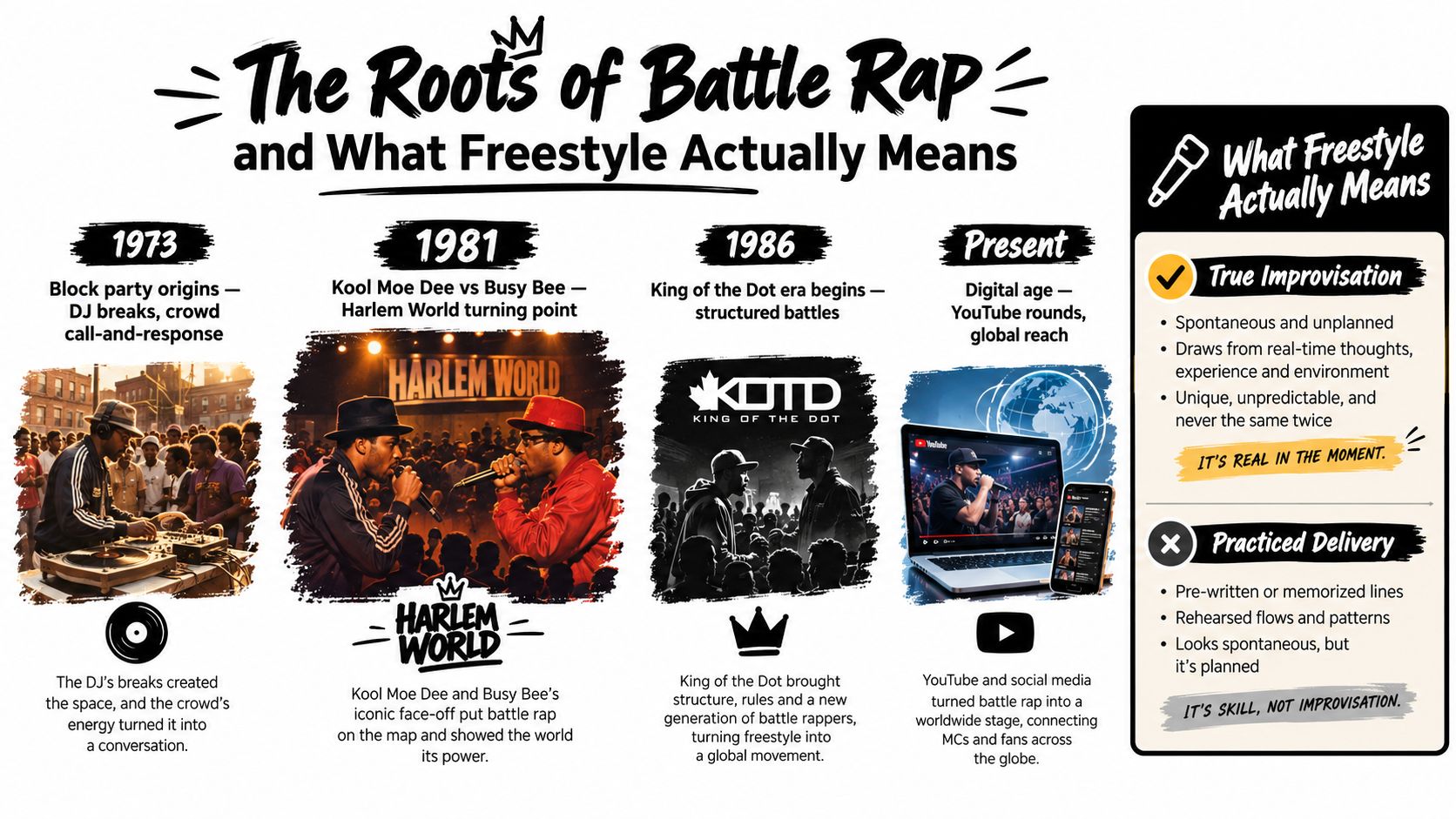 An infographic titled The Roots of Battle Rap explaining the history from 1973 to present.
Battle rap grew from the East Coast hip-hop scene in the late 1970s, but its competitive identity sharpened in December 1981, when Kool Moe Dee challenged Busy Bee Starski in one of the earliest widely cited modern battles. The recorded history of that battle's influence describes a shift from comedic, crowd-pleasing routines toward technical lyricism, storytelling, and direct competition.
That history matters on stage. Battle rap was never just speed or spontaneous rhyme. Presence, timing, and crowd control still matter, while the competitive focus rests on what the rapper can say about the opponent, how clearly the idea develops, and whether the final hit changes the room.
Freestyle once meant creating verses in the moment, often over a DJ's break. Current battle vocabulary uses the word more broadly, so separating the different skills makes practice more useful.
The working vocabulary
- True improvisation: Bars created live, without a written sequence controlling the language.
- Rebuttal: A rapid answer to something the opponent has just said.
- Flip: Turning the opponent's wording, insult, name, or claim against them.
- Angle: The central accusation or storyline organizing an attack.
- Haymaker: A high-impact punchline designed to produce a major reaction.
- Callback: A later reference to an earlier bar, event, or contradiction.
- Crowd read: Adjusting timing or material after seeing how the room responds.
A battler can perform a prewritten round and still freestyle inside it. They might shorten a setup, extend a pause, answer a new detail, or replace a planned closer with a live flip. Modern freestyle is therefore a hybrid craft, mostly written, strategically improvised, and shaped by opponent specificity and crowd response.
The international scene shows how this hybrid became organized competition. Red Bull Batalla de los Gallos began on September 30, 2005, in Venezuela, followed by its first international final on October 2, 2005, in Puerto Rico. Its competition's documented history records 18 editions and 19 champions. Organized circuits can preserve off-the-dome competition while still requiring repeatable performance, judging, and preparation.
Rhyme Schemes and Bar Structures That Land
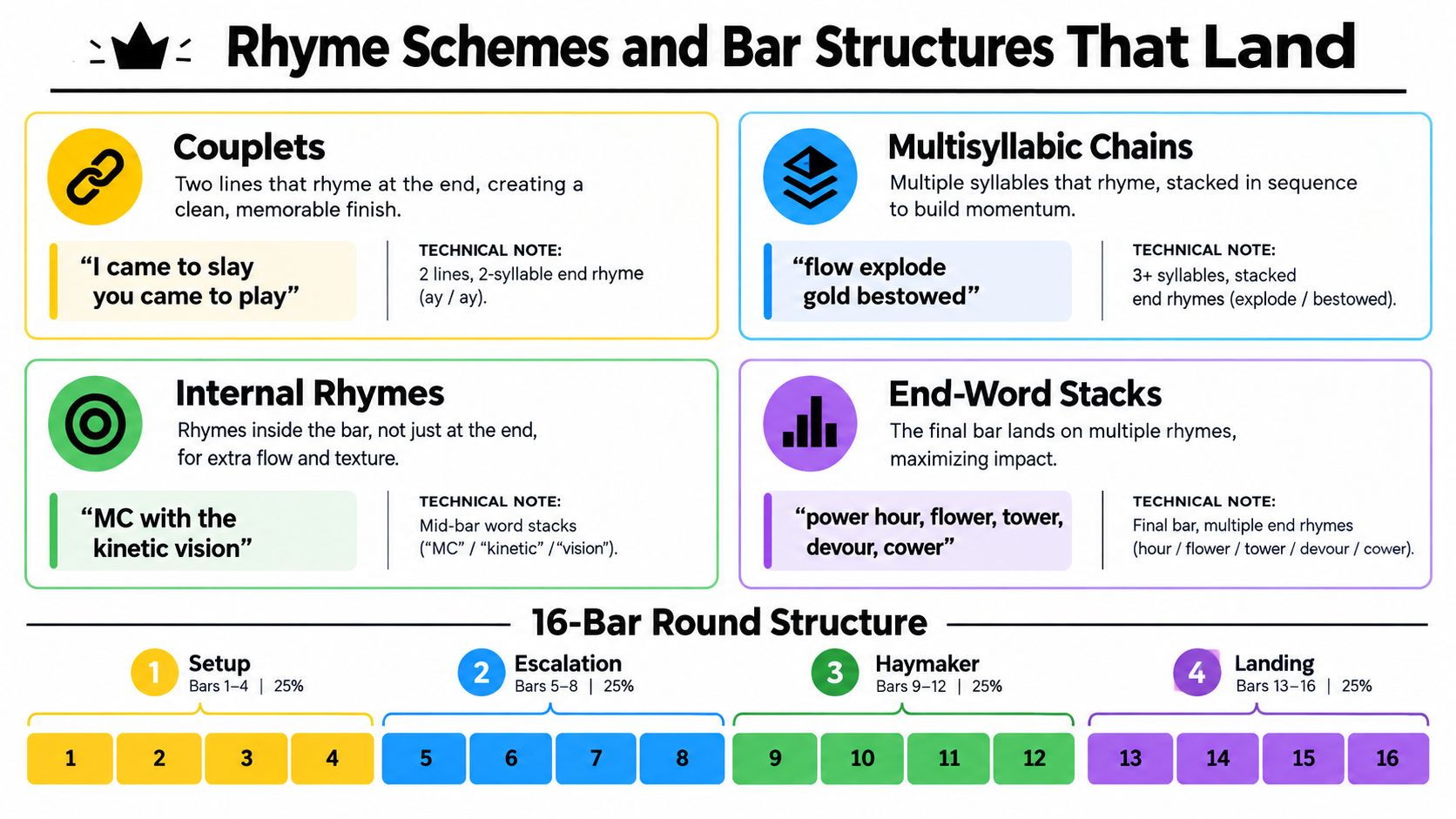 A structured infographic explaining advanced rhyme schemes, bar structures, and a 16-bar rap round layout.
A complicated rhyme scheme cannot rescue a weak angle. On stage, technical writing matters only when the room can follow the attack, recognize the opponent, and feel the punch arrive. Build the idea first, then choose sounds that sharpen it.
Four structures cover a lot of practical writing:
- Couplets: Two lines share an end rhyme and create a clear contrast. “I came to slay, you came to play” is simple, yet the symmetry makes the point easy to catch.
- Multisyllabic chains: Several syllables connect across successive bars. “Vacation, implication, graduation” gives a sound family that can carry a longer argument, provided the wording stays natural.
- Internal rhymes: Rhymes appear inside the bar, as in “MC with the kinetic vision.” Internal movement keeps a long setup active and gives you extra places to control cadence.
- End-word stacks: Consecutive lines use related end sounds, building expectation before the final line changes the meaning.
Build the round in movements
A 16-bar layout gives each passage a job:
| Round movement | Bars | Function |
|---|---|---|
| Setup | 1 to 4 | Establish the angle and identify the target |
| Escalation | 5 to 8 | Add evidence, detail, or a sharper comparison |
| Haymaker | 9 to 12 | Deliver the main flip or hardest punch |
| Landing | 13 to 16 | Close with a callback, image, or final button |
Treat that layout as a rehearsal map, not a mathematical requirement. Sparse couplets can give a haymaker room to breathe, while dense multisyllabics can show control during escalation. A strong round changes texture instead of forcing every bar into the same pocket.
Compare the loose version:
You talk about pressure, but you fold when it gets real, I write better rounds, and you don't know how to deal.
The idea works, but the language could fit almost any opponent. Tighten the image and give the rhyme more movement:
You preach pressure, then crease when the room gets heated, I turn fear into form, every weak point gets edited.
The second version creates a clearer contrast, adds internal motion, and leaves usable pauses for delivery. That last test decides whether the writing is ready: if the bar looks impressive but cannot be delivered cleanly at performance volume, the writing is unfinished.
Count syllables where they help, then adjust the pattern to your voice. Perfect symmetry can make a round sound mechanical. Run a dense chain, leave space before the punch, and change pitch at the turn. The rhyme should pull the listener toward the idea, not advertise a list of matching words.
Study these rhyme scheme examples, then rebuild each pattern around a specific opponent detail. A scheme that could target anyone usually hits nobody hard. Scheme serves the angle, never the other way around.
Pre-Battle Prep and Practice Drills That Stick
Preparation starts before you write a punchline. Research the opponent's public posts, previous rounds, interviews, performance habits, repeated claims, and obvious weak topics. Don't collect trivia for its own sake. Look for contradictions that can become a storyline.
Build the attack before the verse
Sort your notes into usable categories:
- Appearance: Details that are visible, distinctive, and easy for the room to recognize.
- Career: Claims about status, missed opportunities, weak releases, or borrowed credibility.
- Persona: The gap between how the opponent presents themselves and how they behave.
- Performance: Repeated delivery habits, predictable movement, choking points, or crowd dependence.
Choose a small group of primary angles, then create a rebuttal library of 20 to 30 pre-loaded bars across those categories. The point isn't to memorize every possible response. The point is to have flexible entries when the opponent steps outside your expected script. Put each bar on a card or in a note with its angle, rhyme pocket, and possible transition.
A judging framework used by BattleRapStats weights Content at 45%, Performance at 35%, and It-Factor at 20%. Its subcategories use a 0 to 10 scale in 0.5-point increments, with 5 as average, and explicitly consider originality and relevance. Use that framework as a diagnostic, not as a promise about every league. It reminds you that a technically dense verse can still lose if the content isn't targeted or the performance doesn't communicate it.
Three drills for live response
- The 60-second bar timer: Write one complete bar every 60 seconds for 10 rounds. No backspacing. Mark the bars with a clear angle afterward, then rewrite only the strongest ideas.
- The multisyllabic chain: Choose one ending sound and find five words or phrases that fit a three-syllable pattern. Turn the chain into a coherent attack rather than a rhyme list.
- The opponent-specific response: Pull a recent quote from your opponent and answer it cold in under 15 seconds. Record the attempt. Check whether the response addresses the quote or merely changes the subject.
On battle day, warm your breath and voice without forcing volume. Run tongue twisters, low-volume patterns, and several opening bars. Then rehearse three rounds with a beat or metronome, a stand-in opponent, and deliberate reaction gaps. Score yourself for scheme density, angle consistency, breath control, and crowd-reaction timing. A recording exposes rushed setups and fake pauses that feel fine in the booth.
Reading the Crowd and Owning the Stage
A room doesn't react to your intentions. It reacts to what it understood, when it understood it, and whether your delivery gave the reaction space to grow. Crowd reading is less about chasing noise than recognizing the room's current state and choosing the right adjustment.
Three problems require three responses
An empty pocket follows a weak or unclear bar. Don't panic and start speeding up. Return to your strongest established angle, restate the core idea with a cleaner image, then pause before the haymaker. The pause isn't dead air if the audience knows a hit is coming.
A hostile room gives your opponent extra oxygen. Don't yell at the entire crowd. Find one person in the opponent's section, direct a specific line at that block, and make the local loyalty look absurd. A focused confrontation can fracture a wall of noise better than volume can.
A mid-round reversal happens when the opponent flips your setup or reveals information you didn't expect. Abandon the planned angle if it no longer fits. Name the reversal, show that you heard it, then pivot to a persona-based closer or a contradiction that remains true.
Stage note: A crowd reaction is the useful signal. Your opponent's flinch might be acting, but a laugh, gasp, or chant tells you the room received the line.
Position changes meaning. Stand close enough to create tension without blocking the audience's view. Step forward on the key image, then stop moving so the punch has a visual frame. Keep your shoulders open when the camera is active, and don't turn a major line into a profile shot for the replay.
If a beat is present, treat the drop like punctuation rather than a metronome you must obey. Leave room before the drop, land the phrase into it, and let the audience hear the contrast. In acapella formats, create your own drops with silence, a change in cadence, or a sudden spoken sentence.
The best crowd control still serves the writing. Constant pacing, forced gestures, and exaggerated faces may create clips, but they can also make a targeted bar feel rehearsed in the wrong way. Use movement to underline an idea, not to compensate for one that never arrived.
On-the-Spot Rebuttals When a Round Goes Off Script
A rebuttal needs a structure you can access under pressure. Don't try to invent a new writing philosophy while your opponent is standing in front of you. Keep a few response formats warm enough that your brain can select one quickly.
Four formats worth drilling
The flip accepts their wording and reverses its value.
“You say I'm old, I'm seasoned. You're still raw, still waiting for the room to call you cooked.”
Agree and ascend concedes a small surface detail, then redirects to a harder truth.
“Yeah, I work a nine-to-five. You work a nine-to-none, all that free time and still no work gets done.”
The callback pulls an earlier bar into the present and exposes a contradiction.
“You said I couldn't hold a crowd. Funny, that same crowd just held your silence after my last round.”
The pattern interrupt breaks the rhyme scheme with a spoken line, then resumes on the next bar.
“You call that a rebuttal? No, that's a receipt with a microphone. Now watch me close the scheme.”
The examples are templates, not finished weapons. Replace the generic language with a detail only your opponent can own. A universal line can recover momentum, but specificity is what makes the room feel that the response couldn't have been used against anyone else.
Practice with a partner. Have them fire a generic insult, answer in under 10 seconds using one format, then switch formats immediately. Record the response and listen for three problems: did you answer the actual claim, did the punch arrive before the explanation ended, and did your voice signal the turn?
For more punch construction practice, work through these punchline writing techniques. Keep the 3-2-1 rule in your notebook: three rebuttal formats ready, two universal haymakers that can fit almost any round, and one pure-improv slot reserved for a moment only the live room can create.
Your Weekly Battle Rap Practice Plan
Use the week as a training rotation, not a random collection of freestyles. Log the bar, the angle, the delivery problem, and the reaction you wanted. If you can't describe why a line failed, you can't reliably fix it.
| Day | Main block | Practice target |
|---|---|---|
| Day 1 | 30 minutes | Couplets, internal rhymes, and clean end-word landings |
| Day 2 | 30 minutes | Opponent research and angle selection |
| Day 3 | 30 minutes | Rebuttal library, sorted by appearance, career, persona, and performance |
| Day 4 | 30 minutes | Multisyllabic chains and cadence changes |
| Day 5 | 30 minutes | Crowd-reading simulation with pauses, movement, and camera awareness |
| Day 6 | 45 minutes | Three-round mock battle with a stand-in opponent |
| Day 7 | 20 minutes | Review recordings and rewrite weak bars |
Set a trigger for each block. Start rhyme work after your first drink of water, research after you open your notes, and rebuttal drills before you touch a beat. Small routines reduce the chance that practice becomes optional.
During the mock battle, mark every reaction beat. Write down where the room laughed, where you rushed, where the setup lost them, and where you failed to pause. Review the recording without defending yourself. The bar either communicated or it didn't.
Keep the pre-battle checklist short
- Rest: Protect your sleep before the event instead of cramming a new round at the last moment.
- Hydration: Bring water and keep your throat comfortable throughout the day.
- Warm-up: Run breath patterns, low-volume bars, and your opening material.
- Materials: Carry your angle notes and rebuttal prompts, even if you plan to perform from memory.
- Arrival: Reach the room early enough to learn the stage, camera position, sound, and crowd layout.
- Mental reset: Stop rewriting once the material is stable, then focus on listening.
If you need a separate off-the-dome routine, use this beginner freestyle rap guide as a supplement, not a replacement for battle preparation. For additional writing reps, DissTrack AI can generate personalized roast lyrics and freestyle-style verses from a target's name, relationship, inside jokes, and selected styles, giving you raw material to edit into your own angles and delivery.
Use the next seven days to build one researched angle, a small rebuttal library, and a mock round you can perform without choking the breath out of it. Then visit DissTrack AI to generate battle-style starting points, test alternate rhyme pockets, and turn writer's block into material you can sharpen for the stage.