Rap Freestyle Battles: Format, Rules, and Winning Strategies
You're standing at the edge of a circle, trying to decide whether you've got enough nerve to step in. The beat is already moving, two MCs are trading lines, and the crowd answers each one with a roar, a laugh, or a silence that can feel louder than either. You know you've got bars, but the room doesn't know that yet.
That's the appeal and the pressure of rap freestyle battles. They're a contest of quick thinking, but also rhythm, memory, performance, and reading the audience. Learn how the format works, what makes a verse land, and how to write sharp material without crossing into harassment or unsafe personal attacks.
What It Feels Like to Step Inside a Cypher
You're in the circle now, and the room recalibrates around you. The beat keeps running. The last MC's line is still hanging in the air, and every face in the crowd is waiting to hear what you do with your first breath.
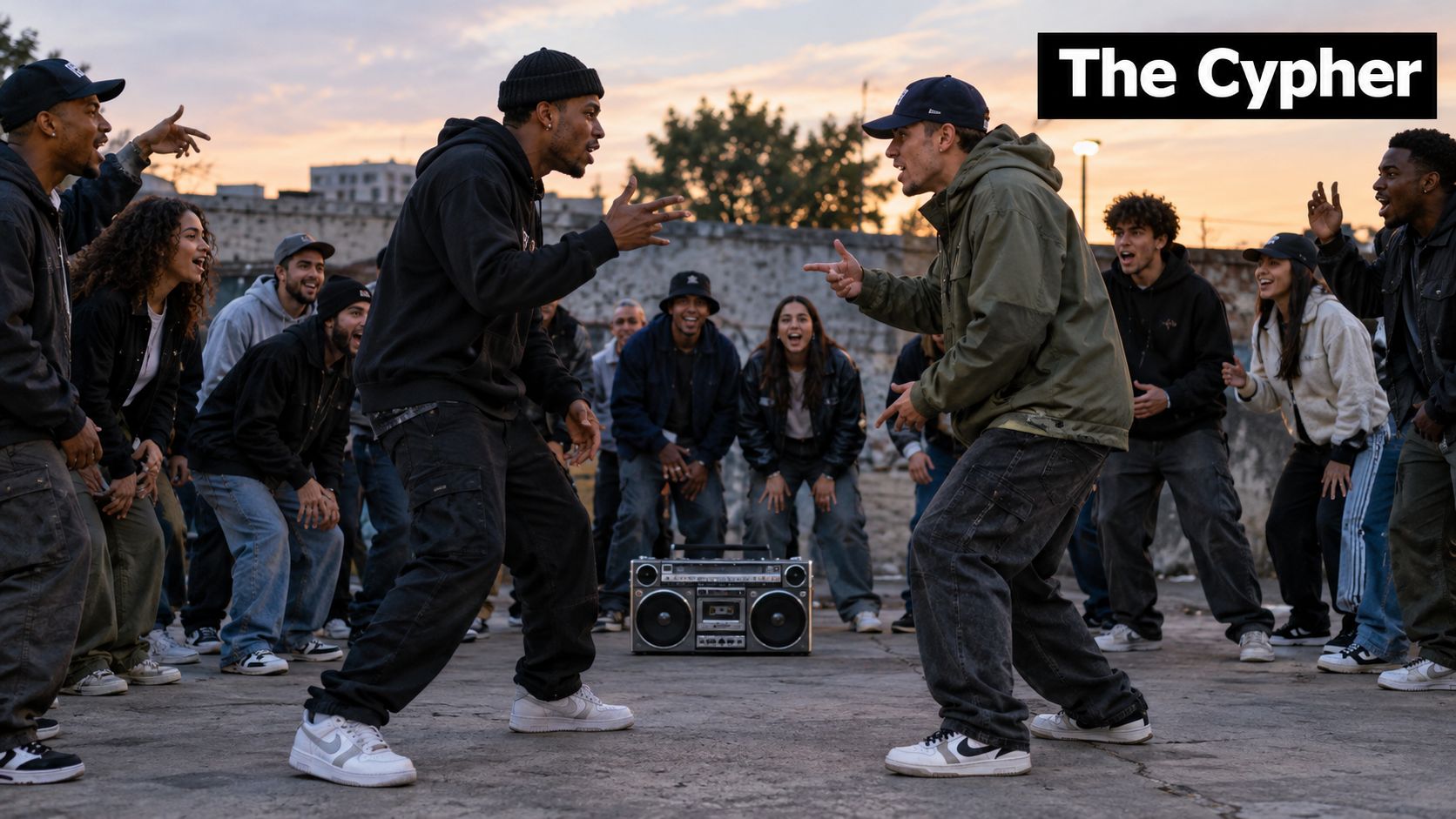 Two rappers engaging in an intense freestyle battle surrounded by a cheering crowd and a boombox.
A freestyle battle is a contest where MCs trade verses to outthink and outperform each other, often building lines on the spot. Freestyle grew out of hip-hop's improvisational culture, which took shape in African American communities in major U.S. cities during the late 1960s and 1970s. In a battle, the verses might target an opponent's words, their public persona, or something happening right there in the room.
Freestyle is both art and arena: you're composing in the moment, while the crowd decides whether the moment worked.
That crowd is part of the contest. Its reaction helps determine the winner, so you're performing for an opponent and a room at the same time. A punchline lands, the noise jumps, and now the next performer has to keep their footing, absorb all that energy, and find the next thought anyway. A battle combines real-time composition, rhythm, memory, rebuttal, delivery, and persuasion, all at once.
If that sounds like a lot, it is. So break it down the way a coach would. First you listen, catching details you can flip: a stutter, a boast, a contradiction. Then you compose, shaping a line that fits the beat and answers what you just heard. Then you deliver, because a great bar mumbled is a bar wasted. Watching skilled MCs, you'll also notice what they aim at. The material hits hardest when it goes after what an opponent said or did, not who they are, and that discipline is a skill you can learn.
The chess analogy fits, but only up to a point. You're anticipating your opponent's moves, yet the board keeps changing because they can say something nobody saw coming. Sparring fits too: you need technique, and you need composure when a punch lands. In a cypher, that composure is the craft.
The Format and Rules That Govern the Round
Before you prepare material, find out what kind of battle you're entering. "Freestyle battle" can describe an improvised exchange over a beat, while some events use written verses or other formats. The host or organizer sets the rules, so the setup from one event may not carry over to the next.
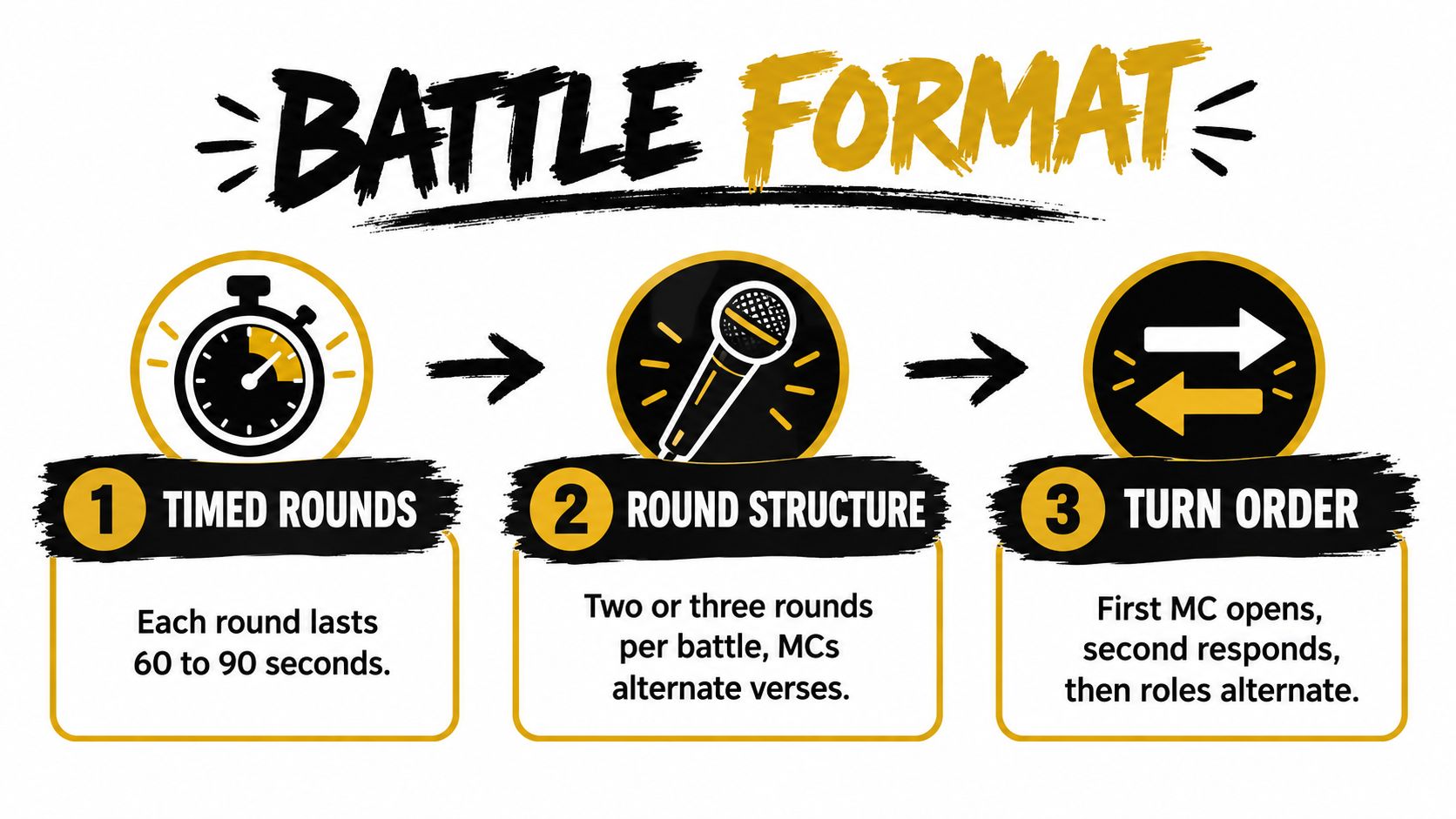 A graphic explaining the official format for competitive rap freestyle battles, detailing rounds, structure, and turn orders.
In a typical turn-based battle, one MC opens and the other responds. Performers alternate until the host calls time or the round ends. Some events use a beat; others run acapella. Hosts may flip a coin to decide who starts, and they will usually spell out the timing and turn order before the battle begins.
Read a format the way a jazz musician reads a setlist. The chart tells you the tempo, the key, and how long your solo runs, but what you play inside it is still yours. These three labels show up often:
| Format | What the MC does | What to confirm |
|---|---|---|
| Written battle rap | Performs prepared verses, often with room for improvised responses | Whether the event allows rebuttals and what the turn order is |
| On-beat freestyle | Improvises over a DJ's beat or backing track | Whether the beat is chosen in advance or played live |
| Written freestyle with a designated beat | Prepares lyrics to perform over a fixed beat | Whether the beat, tempo, and structure are fixed |
"Freestyle" trips up beginners because it can mean improvised lyrics, a loose performance style, or a specific event category. Ask the organizer what they mean before you prepare. A clean answer about the beat, timing, and whether written material is allowed can save you from showing up ready for the wrong contest.
One more question belongs on that list: which topics are off-limits. Organized events often set content boundaries, and learning them early lets you write aggressive material that stays inside the lines instead of discovering a rule mid-round.
The practical rule is simple: learn the event's format before you write, and rehearse to finish cleanly within the host's time limit.
How Battles Are Judged and Who Picks the Winner
Two MCs finish their rounds. One packed every bar with dense multis; the other landed three clean punchlines that made the room erupt. Score purely on technical density and the first MC wins. In many cyphers, the second one does.
There is no single scoring system that covers every cypher and league. Some events seat a judging panel with formal criteria; others hand the decision to the crowd. Freestyle is a social practice, and accounts of improvised emceeing consistently note that the audience commonly helps determine the winner.
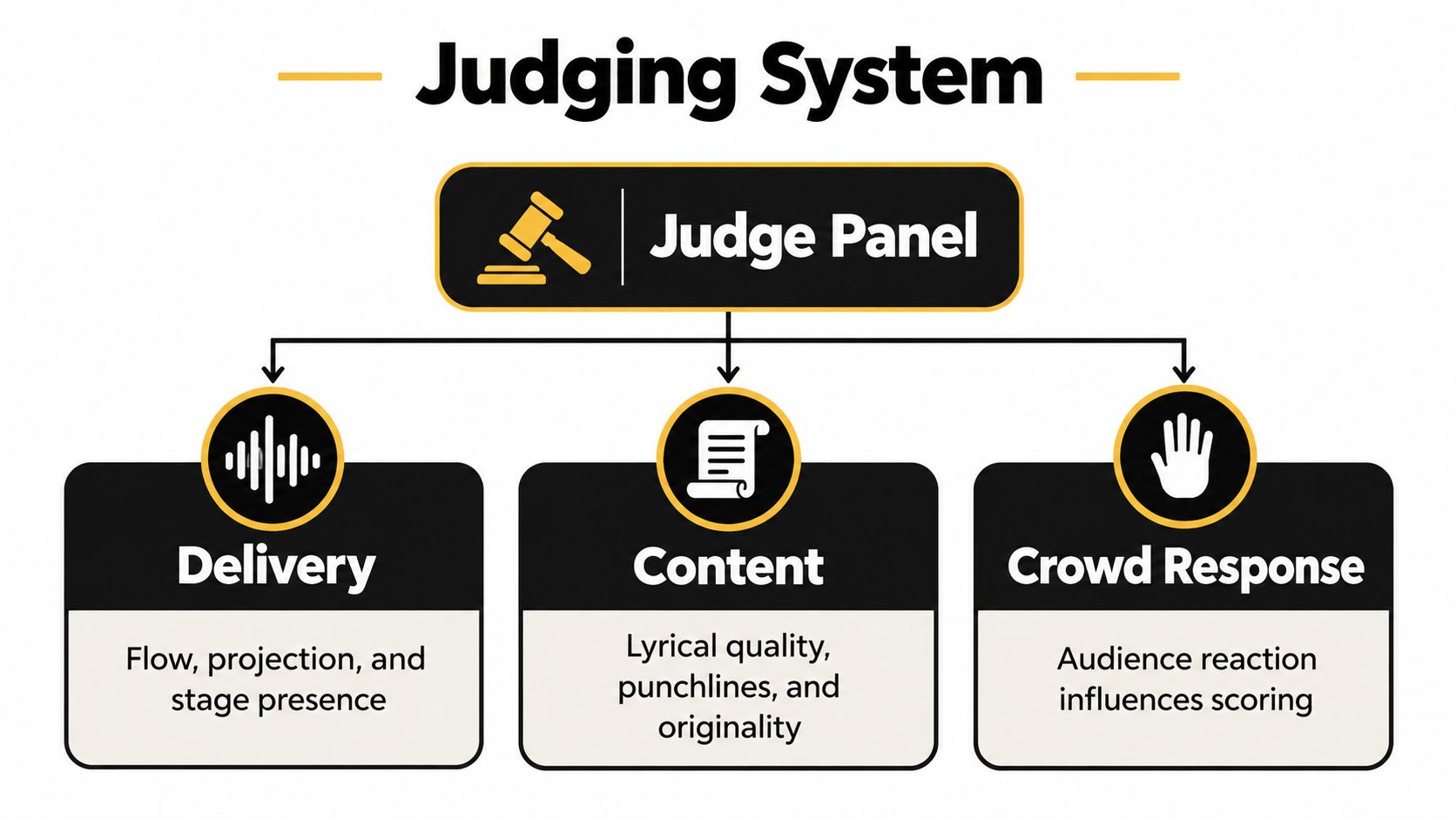 A diagram illustrating a three-part judging system for rap freestyle battles, including delivery, content, and crowd response.
A judging panel might weigh delivery, content, originality, and rebuttals. A crowd might vote directly, or its reaction might tip a close decision for the judges. Treat each factor the way a chess player treats pieces on the board: powerful only in combination. Did the MC's ideas make sense? Did the performance carry them? Did the room feel the impact?
What the room is listening for
- Punchline impact: Does the line deliver a clear, satisfying turn, or does the setup promise more than the ending gives?
- Wordplay and rhyme: Do the rhymes and flips add meaning, or are they decoration?
- Delivery and breath control: Can the audience hear every word? Does the MC hold a steady pace without rushing?
- Crowd response: Does the line connect in the room? A simple bar with a clear payoff often lands harder than a complicated line the audience cannot follow.
- Rule awareness: A bar that crosses the event's content boundaries can lose you the round no matter how hard it lands, and judges at organized events watch for that line.
Delivery works like a vehicle, and your writing is the cargo. If the vehicle sputters, the audience never receives the idea. If the cargo is empty, confident projection cannot create substance. And when the crowd is still roaring over your last punchline, you need the patience of a good sparring partner: hold your ground, wait for the pocket of quiet, then fire the next bar.
After each practice round, run a short self-check: Was the point clear? Could I perform it comfortably? Did I respond to what was happening? Crowd work is a trainable skill, not luck. Watch how people react, leave a beat of space after a strong punchline, and adjust your pace when the room gives you a signal. Close battles often go to an extra round, so stamina and reserve material matter as much as one hot verse.
Rhyme Schemes and Wordplay Techniques That Win Rounds
Rhyme schemes give your ideas shape. You don't need to cram every technique into every verse. Start with a simple pattern, make the meaning clear, then add complexity only if you can still deliver it cleanly.
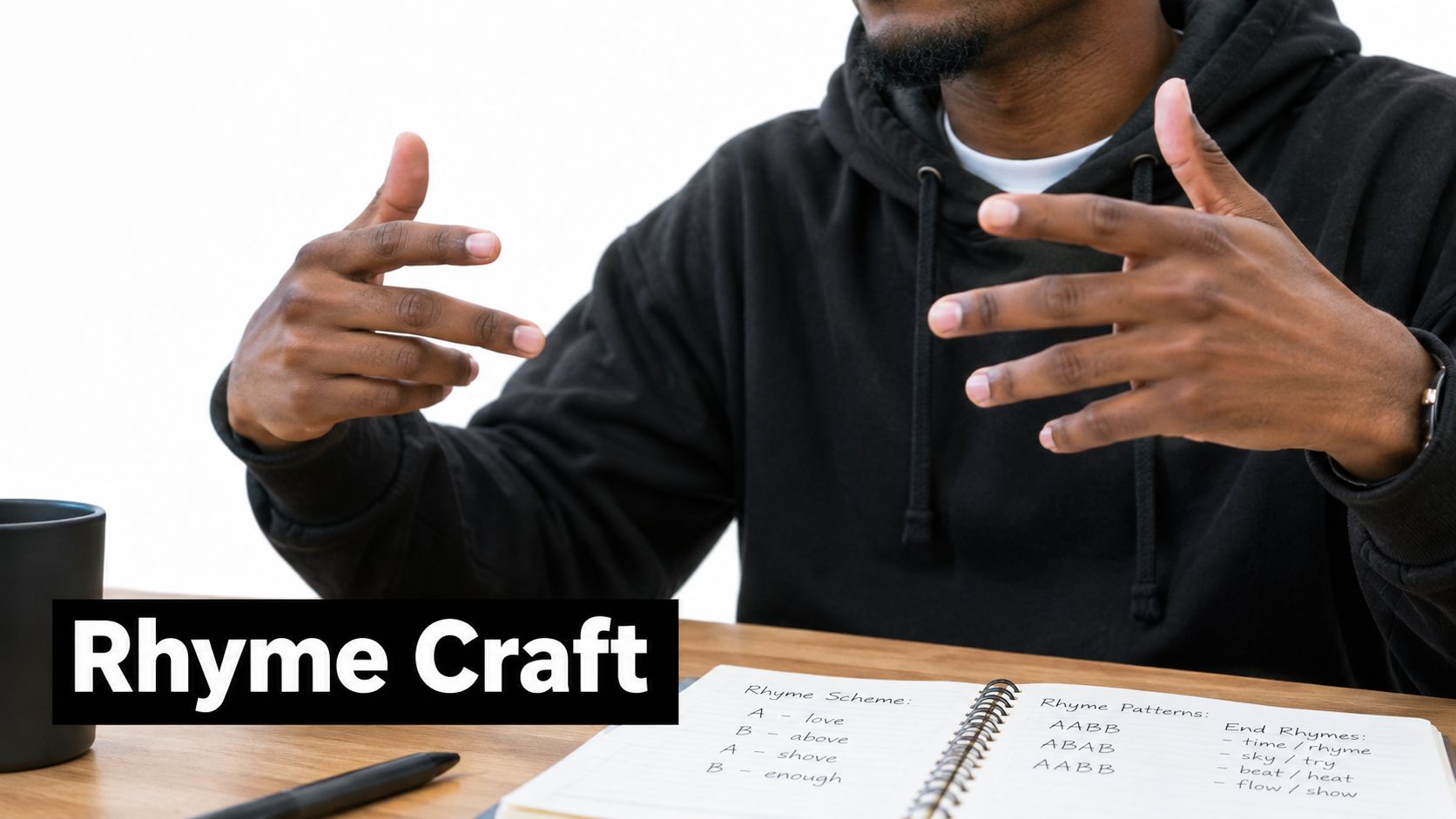 A person writing in a notebook about rhyme schemes and patterns during a rap freestyle session.
Build from simple rhymes
A couplet puts two rhyming lines together. For example: “You came to take the crown / Then lost it walking down.” The rhyme is simple, which leaves space to sharpen the image or payoff.
An alternating rhyme pairs the first and third lines, then the second and fourth. Here's a plain pattern: “You call yourself a star / But can't stay on the track / You practice in the mirror / Then freeze when crowds look back.” The structure helps a verse move rather than sounding like a list of separate lines.
Internal rhyme places rhymes inside a line instead of saving them for the end: “I write with a steady pen, then set the whole room to listening.” The matching sounds give the bar momentum. They're useful, but don't let sound bury the point.
Add multis and layered meaning
Multisyllabic rhymes, often called multis, match a run of syllables rather than a single ending sound. A basic example is “careful planning” and “share the landing.” In performance, the matching sound pattern should feel natural; if you have to contort the sentence to force it, revise.
A scheme is a sustained pattern or theme that links several lines. You might compare someone who claims to rule the jungle with a jaguar that moves with stealth and strikes with precision. The extended image gives the crowd something to follow beyond a single punchline.
A double entendre lets one phrase carry two meanings. For instance, “You say you run the show, but you can't control the scene” can refer both to performance and to someone's inability to lead. Keep the second meaning discoverable, not hidden under a pile of cleverness.
For more worked patterns, browse these rhyme scheme examples. Then try saying the line aloud. A dense multis can look impressive on the page and still collapse if you can't breathe through it.
Here's a practice example that combines a rhyme run with a clear image:
You talk like a ruler, but stumble at the gate, I move through the jungle, while you announce you're great.
Listen to a performance example, then notice how the rapper makes rhythm and phrasing carry the words. The audio can help you hear the difference between a rhyme that's technically present and a rhyme that feels natural in the mouth.
Treat rhyme as a tool for emphasis, not a scoreboard. A clear thought with a clean landing can beat a bar that has more syllables but no room to breathe.
Freestyle Versus Written Battle Rap and the Role of Preparation
Freestyle and written battle rap test different parts of the same craft. In freestyle, you make lines in real time and respond to what's happening. Written battle rap gives you time to shape the angle, test the wording, and rehearse how each bar will sound.
| Dimension | Freestyle | Written Battle Rap |
|---|---|---|
| Composition | Built during the performance | Prepared before the performance |
| Strength under pressure | Quick thinking and recovery | Precision and a planned structure |
| Practice focus | Rhythm, listening, and improvisation | Revision, memory, and delivery |
| Common challenge | Staying coherent when surprised | Sounding present rather than reciting |
Preparation doesn't cancel spontaneity. A bar bank, rhyme patterns, and practiced transitions give you material you can reach for without stopping to build every sound from scratch. Rehearsing a multis until it feels natural frees your attention to listen, watch the room, and answer your opponent.
The key is to prepare ideas without making yourself brittle. If you memorize a verse so rigidly that one interruption throws you off, it may not serve you in a live exchange. Practice recovering: lose your place on purpose, grab the next thought, and keep your rhythm moving.
Constraint can also improve a punchline. Choose a specific angle, a public-stage persona, or a fictional premise, then make the line work within that boundary. The limits force you to search for a sharper image or a better flip instead of reaching for a generic insult.
| If your event is… | Train first |
|---|---|
| Improvised over a beat | Listening, rhythm, and building coherent thoughts on the spot |
| Built around prepared verses | Writing, revision, memory, and performance |
| A mix of both | Strong preparation plus flexible responses |
Some tournaments blend prepared rounds with improvised moments. Ask the host what the event expects, then train the skill you'll use. The strongest preparation supports your performance; it doesn't replace your ability to pay attention.
How Local Cyphers Scale Into Global Tournaments
A local cypher can be a place to test your voice, but organized competitions can take the format much further. Red Bull Batalla de los Gallos offers a clear example of a tournament pathway: national qualifying events feed into larger competitions, and performers compete for a place at an international final.
The first international final took place in Puerto Rico on October 2, 2005. It had eight participants, and Argentina's Frescolate defeated Eric el Niño to become the inaugural champion, according to the Red Bull Batalla history summary. That bracket model turns a broad scene into a concentrated final, where a small group competes for the title.
The scale can be substantial. Red Bull reported more than 8,000 qualified applicants from more than 18 participating countries for the 2024 season, competing for a place in the global championship. For the broader 2019 competition, an earlier Red Bull account reported 17,000 rappers competing over the year, which ended with Mexico's Rapder winning the title. These figures describe organized competition, not a promise that any one local cypher leads to a global stage.
The same craft, a bigger room
At the local level, you may be trying to earn the next turn in a circle. A national qualifier adds a bracket and an advancing opponent. An international final puts representatives of different scenes in front of a larger audience. Across those stages, the essentials remain recognizable: make your ideas clear, control your delivery, and adapt to the opponent in front of you.
If you want to move up, build a record of strong performances rather than relying on one viral clip. Develop a recognizable approach, learn to handle different formats, and keep refining your live response. A signature angle helps people remember you, but it has to work alongside timing and composure. The local cypher isn't a guaranteed ladder; it's a place to practice the skills that a larger competition will test.
A Seven-Step Prep Method for Your First Cypher
Good intentions won't carry a verse through a nervous performance. A practical routine can. If you're new to the format, this beginner's guide to freestyle rap can help you build the basics alongside this prep method.
-
Make a bar bank. Keep a notebook of lines, rhyme pairs, images, and punchline ideas. Don't force every idea into a battle. Practice choosing what fits the moment.
-
Study the format and opponent. Find out whether you'll perform over a beat, acapella, or in a written format. If you know who you're facing, focus on public performance style and material you can address without reaching into private life.
-
Choose a focused angle. Pick a clear theme rather than scattering unrelated insults across your verse. A focused idea is easier to follow and easier to remember.
-
Train your breath. Rap over a steady beat or metronome and mark natural pauses. If a bar leaves you gasping, shorten it or rearrange the words.
-
Rehearse your entry. Your first line has to survive nerves. Practice beginning without a long wind-up, then continue straight into the next thought.
-
Visualize a recovery. Picture the room, the noise, and a moment when you lose your place. Decide how you'll take a breath, reset the rhythm, and keep going.
-
Warm up your body and voice. Stretch, drink water, and loosen your voice before you perform. A tense jaw or tight shoulders can make delivery harder.
Before you step in: Know the format, choose an angle, practice the opening, check your breath, and prepare to recover if a line goes wrong.
The Punchline Safety Framework and Why Constraints Make Bars Harder
A hard-hitting diss doesn't have to target someone's identity or expose something private. Once a clip is public, people who don't know the performers may interpret it without the context of the room. Reporting on freestyle's broad audience and online reach describes battles crossing generations and national borders, including a cited battle with more than 11 million YouTube views in coverage of the freestyle phenomenon. That reach makes it worth thinking about what your words could do once they travel.
Use a simple safety filter before you perform or share a roast:
- Target choices and public persona. Joke about a performance habit, a boast, a style, or a decision the person has made publicly.
- Avoid protected traits and private harm. Don't turn someone's identity, medical condition, or private trauma into a punchline.
- Keep identifying information private. Leave out addresses, phone numbers, and details that could expose someone's location or personal life.
- Reject credible threats and defamation. A battle is verbal competition, not permission to threaten someone or present damaging false claims as fact.
- Get consent for personal roasts. If you're roasting a friend or someone who isn't a public figure, check that they're comfortable with the joke, especially before sharing it.
That boundary doesn't make the writing softer. It makes you work harder for the laugh or the sting. A fictional exaggeration, a precise angle, or a layered double meaning can stay competitive without leaning on harassment. For more ways to build a sharp line, see this guide to writing punchlines.
Tools can help generate a starting point, but you're still responsible for what you perform or publish. DissTrack AI offers an AI Rap Battle Generator that creates simulated multi-round exchanges, with freestyle-style bars and options for AI-voiced audio battles; its generated material is a draft to review and edit, not a substitute for judgment. The discipline that makes an MC dangerous isn't the willingness to say anything. It's knowing how to land a sharp bar while choosing what not to target.
Practice a round with one clear angle, record it, and listen for places where your breath or wording gets in the way. When you want a starting draft for a roast or simulated battle, visit DissTrack AI, shape the material to your voice, and keep the punchlines within boundaries you're comfortable sharing.