How to Write Rap Lyrics That Hit Harder
You're on the couch with one loop on repeat, a notes app full of lines that looked sharp an hour ago, and a Friday deadline from a friend who already picked the beat. You tap the table. The first bar runs past the snare. The second one dies in the middle of a breath. The rhyme was never the problem. You wrote for the page, and the page does not have a tempo.
Say that friend sent a mid-tempo beat and asked for one verse, not a manifesto. You type sixteen clever lines, press play, and none of them sit in the pocket. Rap lyrics only become real when you say them on the beat. Breath, stress, and timing decide whether a bar hits or falls flat. If you can't tap it, you don't have it yet.
Rap Song Structure, Story and Punchlines
Count the bars on the beat before you write a line. A finished track on a common 4/4 grid already has a shape. Your job is to fill that shape with a story and a punchline, not to invent a new map every night.
| Song part | Typical length | Job in the track |
|---|---|---|
| Intro | 4-8 bars | Set the mood and let the beat breathe |
| Verse 1 | 16 bars | Introduce the story and your point of view |
| Hook | 8 bars | Repeat the most quotable line |
| Verse 2 | 16 bars | Escalate the story and add new detail |
| Bridge | 4-8 bars | Shift the tone or flip the perspective |
| Outro | 4-8 bars | Close on a punchline or a callback |
The verse carries the story and the proof. The hook hands the room one line worth repeating. The bridge changes temperature or switches who is talking. The outro ends on a punchline or a callback, so the last thing they hear is the joke they already know.
Sixteen bars split into four groups of four. That split leaves room for a setup, a development, a turn, and a payoff. A battle or a diss can stretch the verses and cut the hook down. A short clip can be one 8-bar hook plus a single verse. Once the lyric map is locked, Isolate Audio's walkthrough on how to make a rap song covers the path from the backing track to a full arrangement. For the skeleton of the lyric itself, how to structure a song lays out the same parts in more detail.
Map sixteen bars as a story
Bars 1-4 set place and time. Bars 5-8 add the conflict. Bars 9-12 show the turn. Bars 13-16 deliver the consequence. Fill this in before you hunt for rhymes.
At [place] around [time], [name] did [action]. The proof was [price, street, or object]. The stake was [money or reputation]. Then [unexpected rhyme word].
Say it's a Tuesday open mic. Bars 1-4 put Marcus in the corner booth at 9:40, hoodie still damp. Bars 5-8 show he told the host he wrote the verse on the train. The proof is a blank notes app and a $4 coffee he never opened. Bars 9-12 flip it. You were on that same train, and you watched him scroll someone else's caption. Bars 13-16 name the stake, his standing with that Tuesday crowd, and stop on one noun. The lock screen. The empty cup. The borrowed line.
Treat the punchline as a two-part joke
The setup builds an expectation. The twist lands on the final word, or on the last two syllables. One concrete noun exposes the confidence. A speech about honesty does not.
He swore the verse was fresh off the ride downtown, then the hook dropped and his lock screen still showed my old account.
Switch from observer to direct address and the same booth becomes a roast. "You" replaces "he." The coffee, the train, and the screen stay put. Spend the last stressed syllable on the joke, not on a filler verb like "did" or "was."
How to Write Your First Verse Step by Step
Pick the beat before the vocabulary. Flow is a beat-alignment problem, not a syllable-counting contest. The MCFlow corpus write-up reports that approximately one quarter of stressed syllables are rhymed, and a separate corpus-assisted study in that same write-up reports flow-analysis error rates as low as 15%, which is a reminder that a grid on paper still has to survive your mouth.
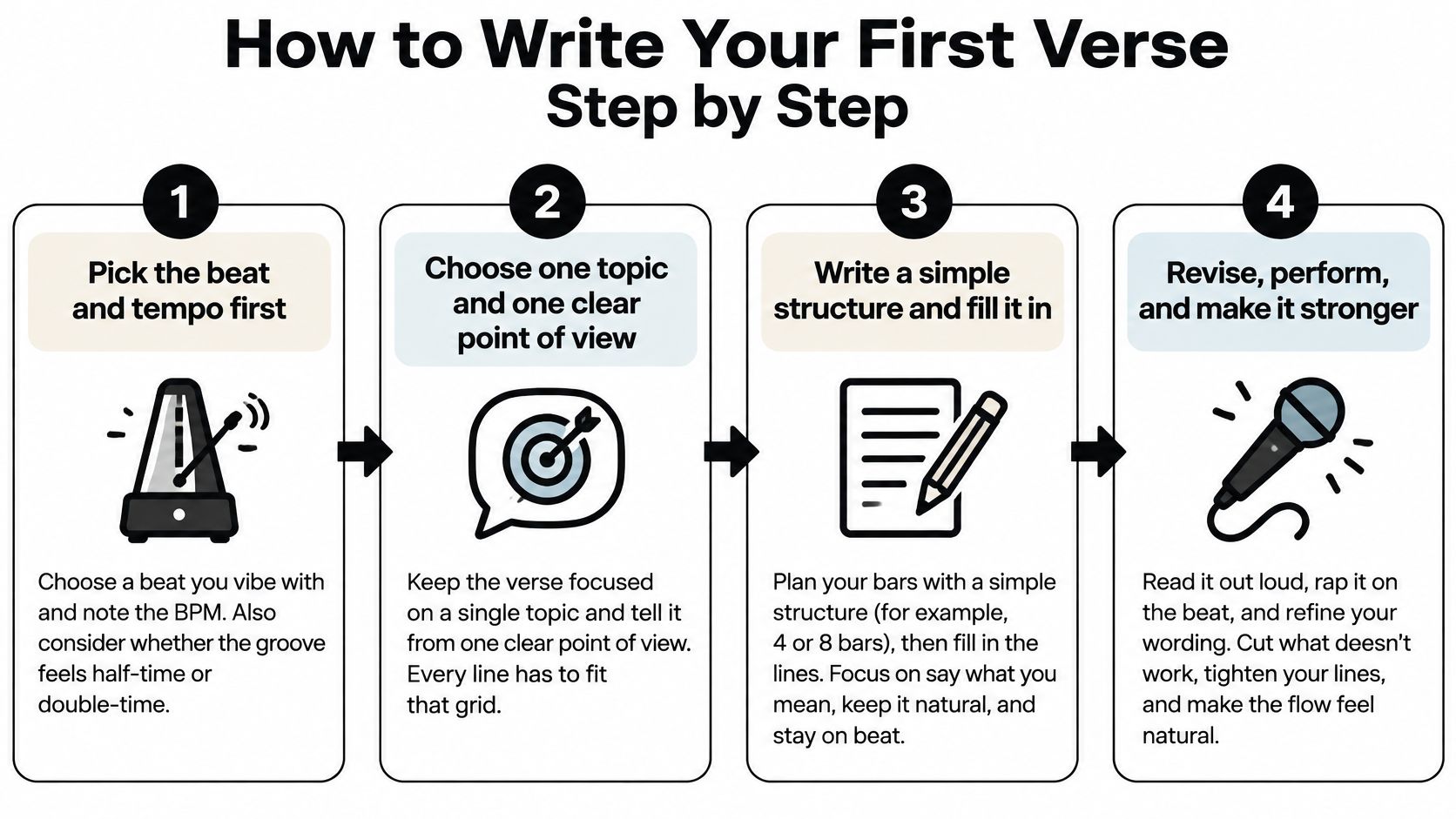 A step-by-step instructional graphic explaining how to write your first rap verse in four simple stages.
- Pick the beat and the tempo first. Note the BPM and whether the groove feels half-time or double-time. Every line has to fit that grid, because a bar that looks even on screen can still spill past the snare.
- Choose one topic and one point of view. A rival, a memory, or one embarrassing moment is enough. Write the goal of the verse in a single sentence so later bars can't wander off into a second argument.
- Brainstorm loose lines without rhymes. Collect names, places, prices, and times in a notes app. Concrete detail is what a listener repeats in the group chat the next day.
- Mark stresses and phrase boundaries. Sketch where end rhymes and internal rhymes will sit, and keep one idea per bar. Lock one pattern for the whole verse before you draft. AABB couplets suit a fast closer, ABAB suits a reflective verse, a mid-line internal rhyme adds speed, a chain of three or more matching syllables shows control, and a slant rhyme saves you when an exact match would sound forced.
- Draft one bar at a time to the length you marked. If a bar needs two ideas, it is two bars. The common slip is writing the whole verse first and forcing it onto the beat later, which stuffs every slot with extra syllables.
- Read it aloud at tempo and tap each beat. Circle any bar that runs long or leaves a dead gap. Ignoring accent and natural pronunciation is how a clean rhyme turns into a stumble.
- Record a rough take over the backing track, then revise crowded or breathless lines. Save the finished verse as a text file so the next draft has something honest to beat.
Forcing every bar into the same syntax, or stacking rhymes until the sentence disappears, is how a verse stops being sayable. Judge the take on breath, cadence, and whether the last word lands.
A short demo of saying bars against a click makes the grid obvious before you touch a microphone.
Rhyme Schemes and When to Use Each
Rhyme is a choice about sound, not a law. Start with the simplest pattern, then add complexity only when the bar needs a different feel. Match sound by ear, not by spelling. Two words can share an ending on the page and still miss when you say them.
| Rhyme type | Pattern | Example | Best use |
|---|---|---|---|
| End rhyme | AABB couplets | flow / go | Quick, punchy closers |
| Alternating rhyme | ABAB | rain / stone / chain / alone | Slower, reflective verses |
| Internal rhyme | Rhymes inside one line | I stack the bricks and crack the code | Adding speed mid-bar |
| Multisyllabic chain | Three or more matching syllables | fantastic / drastic / plastic | Showing technical skill |
| Slant rhyme | Close but not exact sound | love / rough | Keeping a line natural |
End rhyme in AABB couplets snaps a closer shut. "I let the whole room watch the flow / then left before the lights could go." Fast, obvious, done.
Alternating rhyme in ABAB slows the verse down. Rain, stone, chain, alone gives the listener a longer walk between matches, which fits a memory more than a knockout.
Internal rhyme puts a match in the middle of the line, so the bar feels quicker without you rushing the end. "I stack the bricks and crack the code" moves twice before the bar is over.
Multisyllabic chains match three or more syllables and read as technical skill when the sentence still means something. Fantastic, drastic, plastic only works if each word earns its place. A closer look at multisyllabic rhymes shows how to build those chains without turning the bar into a tongue twister.
Slant rhyme keeps a line natural when the perfect match would be nonsense. Love and rough are close enough if the meaning is the point.
Academic rap-corpus research summarized in an arXiv rhyme-analysis paper indicates that rhyme placement matters more than rhyme presence, with rhymed syllables commonly landing on or around beat four in rhymed couplets. Line the key rhyme up with that strong beat. Rank a line by whether the match is clear when spoken, how long the chain is, and whether the words still mean what you meant. A repeated vowel is not automatically a good rhyme.
Practical rule: Rhyme on meaning. Say each pair out loud. Don't reuse the same ending sound for more than three bars unless the repeat is the point.
The pitfall is forcing a rhyme word into a line that no longer makes sense. Quick drill. Pick one word, list five rhymes, and build a bar that uses two of them. If the second rhyme bends the sentence, throw it out.
Editing Lyrics Until They Hit Harder
Read the verse out loud on the beat before you touch a single word. Most weak verses fail in the mouth, not on the page. You'll hear the overrun, the early joke, and the bar that copies the one before it.
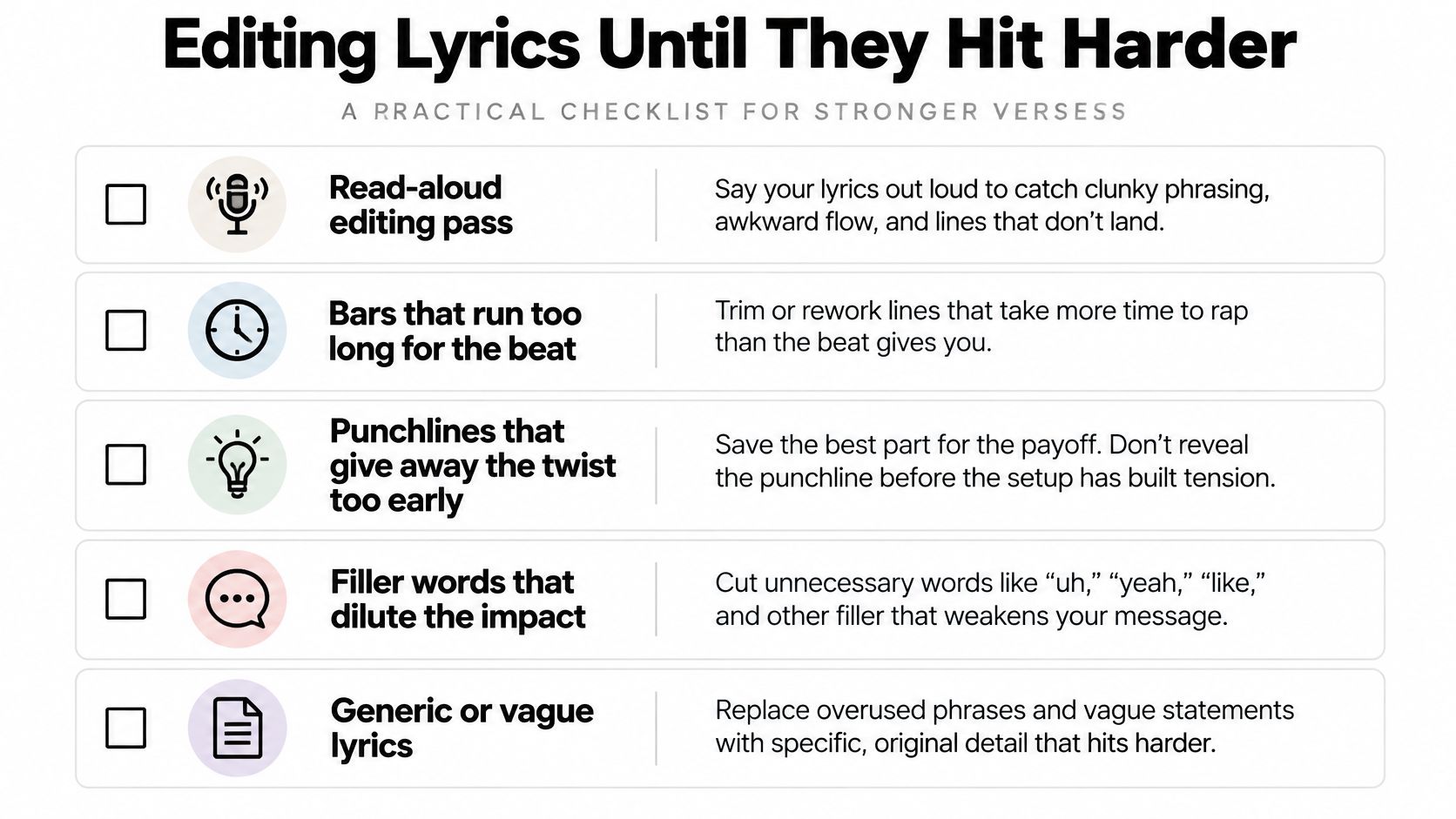 A checklist titled Editing Lyrics Until They Hit Harder, offering practical tips for improving rap songwriting.
| Problem | Why it happens | Fix |
|---|---|---|
| Bars run too long | Syllables overflow the beat | Cut one filler word and read the bar again |
| Punchline lands flat | Setup gives away the twist | Remove any word that reveals the joke early |
| Rhymes sound forced | Rhyme word chosen before meaning | Rewrite the line around what it means |
| Verse feels repetitive | Same sentence structure every bar | Vary the opening word and line length |
| Second verse loses energy | No escalation | Raise the stakes or add one specific detail |
| Delivery sounds mumbled | Too many syllables per bar | Split the bar or drop one rhyme |
Walk the problems in order
A bar that runs long usually hides one soft word. Cut just, like, or the, then read it again on the click. If it still spills, the line is two ideas wearing one bar's coat.
A flat punchline told the joke too soon. Strip any word that reveals the twist before the final beat. The listener should still be wrong about the ending when you hit the last stress.
A forced rhyme started with the matching word and built a sentence backward. Rewrite the whole line around what it means, then find a sound that can live there. If the second half of the verse sags, raise the stake or add one detail only you would know. A repeated sentence shape, every bar opening with "I," is why the back half feels copied. Change the first word and the length.
Five passes, then record again
Run a meter pass, a rhyme pass, a punchline pass, a clarity pass, and a delivery pass. Over-rhyming can make a verse unintelligible, so keep one clear idea per bar and put breath points where a listener needs them. Mumbled delivery is usually too many syllables, not a bad microphone. Split the bar or drop one rhyme. Re-record after each pass. The file from yesterday is the only honest judge.
Keep Your Voice When Using AI Lyrics
Say a café owner wants a playful roast of a rival's latte art. The AI returns six punchlines: foam, a failed pastry case, one cruel enough to start a real fight. The owner keeps the foam line, cuts the cruelty, and rewrites the setup so it sounds like something said over the counter. An AI draft is a pile of options, not the finished verse.
That matters twice as much on a diss, where a personal roast can be funny and still create a reputational mess if a claim is sloppy. Instant finished rap lyrics with no human hand doesn't match how working musicians talk about the tools. In a 2025 Finnish music-industry survey of 1,108 professionals, roughly 40% of rap, hip-hop, and R&B respondents viewed AI positively, yet 94% said permission should be obtained when copyrighted works are used as AI sources, and nearly as many supported fair compensation for creators, according to the Teosto AI survey.
Keep the draft on a short leash:
- Feed it real material. Memories, local slang, inside jokes, and the emotional stake. Generic internet slang is what you are trying to replace.
- Ask for several punchline directions, not one polished verse. You want forks, not a final.
- Check any claim that could be unfair or untrue before it stays in the lyric.
- Rewrite the best bars in your own voice and add one detail the tool could not know. You own everything the AI generates, and the business claims no rights to your lyrics.
- Disclose AI involvement when you publish. SleekPost's AI content creation tips for 2026 offer a practical companion for that visible human control. Keeping the point of view yours is the whole job of using your voice.
Read the verse aloud and ask whether a friend who knows you would recognize the speaker. If it still sounds like a caption, swap another line for a place, a memory, or a cost only you would name. Then say it on the beat. If you run out of air before the punchline, the line is too crowded no matter how sharp it looks on the page.
Start Your First Verse This Week
Give yourself thirty minutes, not a free evening. Choose one beat and one topic. Write the point of view in a single sentence. Draft one 16-bar verse with the four-part story map and a single rhyme pattern. Run the five editing passes, record a rough take over the beat, and listen back once without rewriting mid-playback.
If you want a faster start on a roast, DissTrack AI is one option. The Free plan costs $0 forever and includes 1 diss track. The Pro plan costs $9.99 per month and includes 15 diss tracks per month if you write often. The output is lyrics text you can export, edit in the app, or regenerate until you're satisfied, so the last edit is still yours. Say the new draft out loud in a room that isn't your bedroom. A short list of rehearsal spaces that fit your budget is enough to hear whether the bars survive a real speaker.
Write the first draft today, save the text file, and schedule the editing pass for tomorrow. A verse sharpens when you leave it alone overnight.
DissTrack AI turns a name, a relationship, and a few inside jokes into structured roast verses you can edit until they sound like you said them. If you've been staring at a beat and a blank bar, bring the target and the stake to DissTrack AI and leave with a draft you can say out loud tonight.