Battle Rap Lyrics: 8 Classic Diss Tracks to Study in 2026
Most battle rap lyrics fail for the same reason: they're generic. Call somebody weak, fake, or washed and you could be addressing half the internet. The surprise is that technical complexity doesn't automatically fix the problem: computational-creativity work on battle rap identifies rhyme structure, stress, and performance as useful evaluation dimensions while warning that dense rhyming can undermine clarity.
The best diss writing gives the audience something recognizable, then changes how they see it. A familiar boast becomes evidence of insecurity. A harmless habit becomes a running joke. A closing line makes an earlier setup suddenly mean something nastier.
That's what to borrow from these records. Not the slurs, threats, private allegations, or somebody else's signature phrasing. Borrow the machinery: the specific grievance, the rhythmic pressure, the callback, the carefully timed reveal.
If you can swap the target's name without rewriting the punchline, you probably haven't finished the punchline.
These tracks and performances offer different ways to make a verse unmistakably about its opponent. Each also suggests a usable writing pattern and descriptive style tags for AI-assisted drafting. Treat those tags as directions for rhythm and tone, not instructions to impersonate an artist.
Bring a beat, a defensible detail, and an editor's willingness to delete your favorite rhyme. Admiration is optional. Revision isn't.
1. Ice Cube – "No Vaseline"
Ice Cube's attack on his former N.W.A associates and Jerry Heller works through a sharply defined grievance. He doesn't merely announce that he's better. He frames the split as a dispute about independence, control, and who benefits from somebody else's work.
That gives the aggression a destination. The listener can follow the argument even when the delivery gets ferocious.
 A young man in a black hoodie rapping into a professional studio microphone while wearing headphones.
Steal the specific grievance
Start with a contradiction the audience can understand. Your friend calls himself the group's creative director but only contributes thumbs-up reactions. That's an angle; calling him talentless is just an adjective wearing boxing gloves.
Build the passage as claimed status → observable behavior → comic verdict. Keep the behavior accurate, then exaggerate the comparison rather than inventing misconduct.
For a fictional group-chat roast, an original draft might read:
You crowned yourself director, then approved the work with claps,
Your biggest contribution was reacting to the drafts.
The punchline belongs to that situation. Replace the target with somebody who does the work and it stops making sense.
- Keep: A concrete dispute and direct address.
- Cut: Background details the audience needs a family tree to understand.
- Prompt tags: West Coast Hip-Hop, blunt delivery, grievance-led, clear end rhymes.
- Remix instruction: Build around an agreed-upon habit and finish with an absurd job description.
Don't copy the record's discriminatory abuse. Its useful lesson is specificity, not permission to aim at identity. For a friendly roast, attack the self-appointed title; for a public release, verify the underlying behavior before making it your whole argument.
2. Canibus – "Second Round K.O."
A technically crowded verse can sound intimidating before the listener has unpacked the attack. Canibus uses that pressure against LL Cool J: internal echoes, extended rhyme sounds, and a competitive persona that makes verbal dexterity part of the challenge.
The trap for beginners is copying the density without preserving the sentence. If your audience hears impressive syllables but can't explain the insult, you've performed a tongue exercise.
 A workspace featuring an open notebook with handwritten lyrics, headphones, a laptop, and a professional studio microphone.
Write the insult before the rhyme chain
Suppose a fictional streamer promises nuanced commentary but spends every broadcast adjusting the setup. Write the plain thought first: the equipment gets more attention than the subject.
Then collect related sounds: calibration, demonstration, conversation. Choose only the ones that sharpen the angle.
All that calibration, still no conversation,
Your microphone's prepared; you're the missing preparation.
That's a draft, not a sacred object. If the ending feels stiff over your beat, replace it rather than defending the rhyme.
The useful distinction in strong battle rap lines is between a rhyme that decorates an insult and a rhyme that helps deliver it. Put the clearest word at the impact point; tuck supporting echoes inside the line.
Remix structure: Plain accusation → internal-rhyme buildup → short, intelligible verdict.
Style tags: Battle Rap, technical, internal rhyme, controlled acceleration, clean punchline.
Read the passage at performance volume. Mark where you run out of breath, where consonants collide, and where you accidentally stress a filler word. Technical battle rap lyrics should sound difficult for the opponent to answer, not difficult for the rapper to pronounce.
3. Tupac Shakur – "Hit 'Em Up"
The opening attack arrives without an invitation. Tupac establishes confrontation immediately, and the Outlawz reinforce the sense that the opponent is facing a collective challenge rather than an isolated complaint.
The reusable device is contrast: direct, chantable language against longer, more heated passages. You don't need to reproduce the threats or sexual allegations to understand why that contrast commands attention.
Make the refrain easier than the verse
For a consensual gaming roast, say your friend keeps declaring himself captain while blaming every loss on the connection. Your refrain should identify the joke before the verse complicates it.
Use a compact phrase such as captain of excuses. Return to it after passages about tactical speeches, abandoned objectives, and conveniently timed connection problems.
- Refrain: A phrase the audience can repeat without checking the lyric sheet.
- Verse: Concrete examples that make the refrain feel earned.
- Delivery: Strong projection without swallowing the final consonants.
- Beat choice: Enough space for the vocal to remain intelligible.
Don't write every line at maximum pressure. A clipped refrain followed by a longer sentence gives the performer room to change gears.
Performance rule: Aggression is a delivery choice. It isn't a substitute for an angle.
Remix structure: Direct challenge → recognizable refrain → escalating examples → refrain with a changed final word.
Style tags: Aggressive, chant-led, confrontational, short hook, forceful articulation.
Keep the target and the occasion in view. A private joke among consenting friends can feel ugly when clipped without context and posted publicly. Match the intensity to the relationship, and remove any line you'd need to explain away as merely being in character.
4. Nas – "Ether"
A diss gets repetitive when every passage makes the same complaint in different shoes. Nas's attack on Jay-Z offers a better writing lesson: change the category of attack while keeping the central challenge recognizable.
Status, credibility, dependence, and public image become different routes toward the same conclusion. The verse feels organized because the insults contribute to an argument rather than competing for attention.
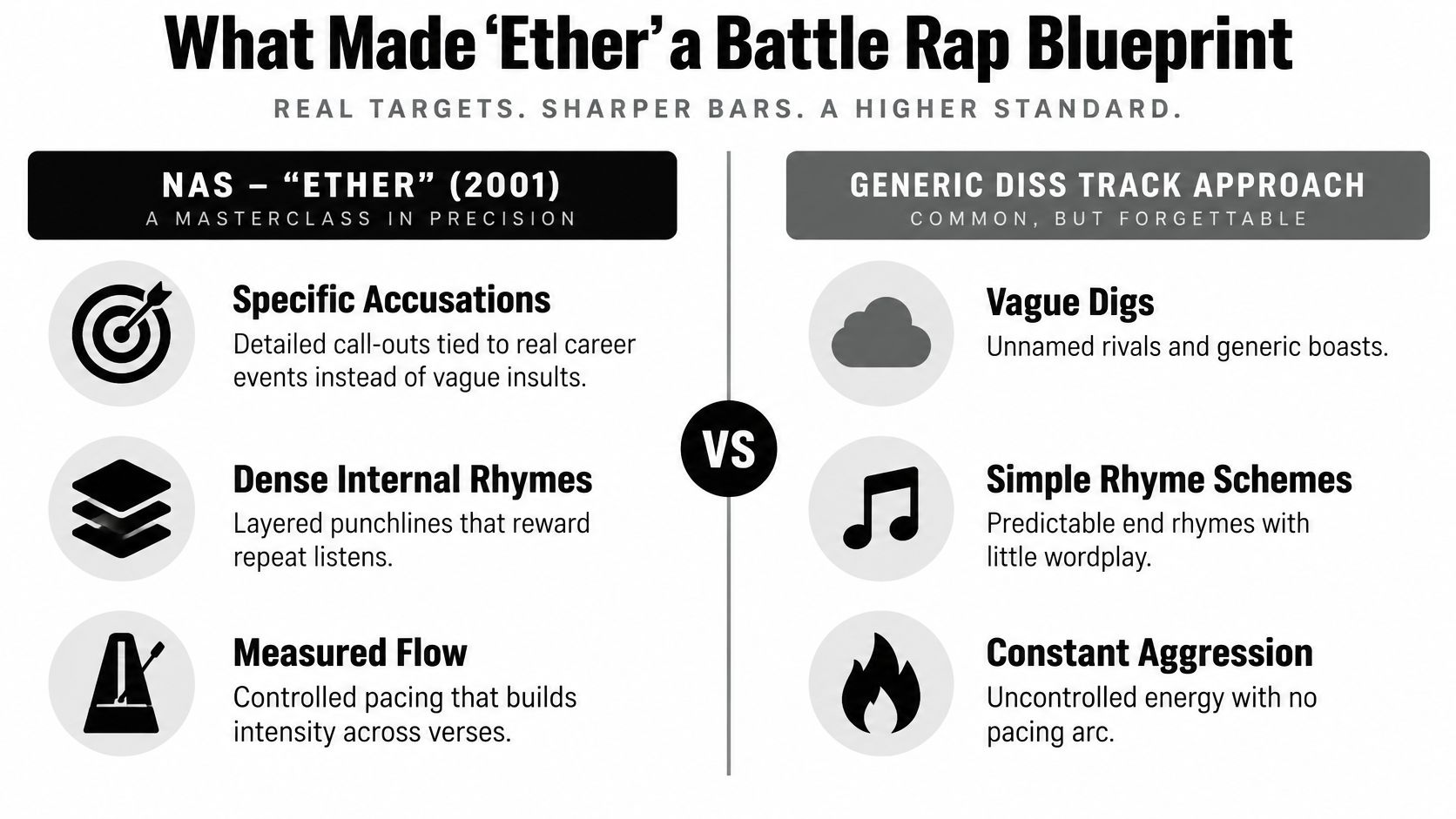 A comparison infographic showing why Nas's song Ether is a blueprint for effective, precise battle rap lyrics.
Give each passage a different job
Say you're roasting a fictional producer who describes every unfinished loop as a masterpiece. Begin with the grand claims, move to the abandoned sessions, then close on the distance between presentation and delivery.
Don't scatter those details randomly. Let the listener reach the verdict with you.
Remix structure: Establish the persona → expose the contradiction → broaden its consequences → deliver the closing judgment.
A possible ending:
Your folder says completed; every session says otherwise.
It's plain, but the preceding material can make it sting. Adding a tortured multisyllabic construction would probably weaken it.
When studying the greatest diss tracks, listen for how each passage changes the case against the opponent. Highlight repeated ideas, not merely repeated words.
Style tags: Battle Rap, argument-driven, varied punchline density, dry ridicule, decisive closer.
Leave yourself permission to write an unflashy setup. The audience needs to understand the premise before it can enjoy the reversal. Also separate observable contradictions from accusations: a satirical comparison is useful writing material, while an unsupported allegation can turn a verse into a problem you didn't intend to publish.
5. Jay-Z – "Takeover"
Where a frantic performance asks listeners to feel the anger, a composed performance asks them to accept the verdict. Jay-Z's conversational authority is the device worth borrowing from this attack on Nas and other rivals.
The important distinction is chronological as well as stylistic: don't study it as an answer to Ether. Study the controlled framing and the way an opponent's reputation becomes material for a dismissive assessment.
Turn the boast into the rebuttal
Suppose a fictional battle opponent keeps calling himself a perfectionist. Don't answer with a disconnected claim that he's lazy. Use his chosen word as the hinge.
You call it perfection; I call it never shipped,
The launch got postponed while the announcement got a script.
The reply stays attached to the boast. That connection makes the audience feel you listened, which is essential in a response verse.
- Capture the claim: Summarize what the opponent said without changing its meaning.
- Choose the contradiction: Find behavior that makes the claim look different.
- Return the vocabulary: Reuse a key term, then redefine it.
- Underplay the finish: Let the audience react before adding more explanation.
Remix structure: Opponent's self-description → calm acknowledgment → contradictory detail → dismissive redefinition.
Style tags: Old School Boom Bap, conversational, restrained, callback-driven, dry confidence.
Don't mistake composure for monotony. Change sentence length, place a pause before the reversal, and emphasize the borrowed word differently when it returns. You're aiming for somebody calmly dismantling an argument, not somebody reading an inventory of grievances into a desk microphone.
6. Eminem – Battle Scene in "8 Mile"
The useful move in B-Rabbit's final battle isn't insulting harder. He names vulnerabilities his opponent could exploit, accepts them, then redirects attention toward the opponent's constructed identity.
That's preemption. You take away the surprise before somebody else can sell it.
Watch how the scene makes disclosure part of a competitive performance.
Admit the obvious, then change its meaning
For a friendly roast battle, suppose everybody already knows you're chronically late. Opening with a defensive explanation gives the opponent more material. A brief admission followed by a relevant reversal gives you somewhere to go.
Yes, I'm late. You've made punctuality your art,
Always first inside the lobby, never ready when we start.
The admission isn't the punchline. It clears space for the distinction between arriving and contributing.
Understanding what a punchline does in rap helps you avoid ending on the confession itself. The audience needs the turn.
Own the vulnerability you're comfortable sharing. Don't disclose something painful just because a scene makes disclosure look victorious.
Remix structure: Anticipated attack → concise admission → change of standard → opponent-specific reversal.
Style tags: Battle Rap, self-deprecating, live-round pacing, escalating confidence, reaction pauses.
For delivery practice, a controlled study in Scientific Reports compared improvisation with rehearsed lyrics in 12 professional freestyle rappers with at least five years of experience, supporting attention to performance as well as text rather than proving a shortcut to winning.
Rehearse the pause after your admission. Don't rush through a reaction, and don't depend on getting one.
7. Kendrick Lamar – "Control"
This isn't a conventional diss record built around an intimate grievance. Kendrick's verse on Big Sean's track treats competition itself as the subject, naming peers while positioning the speaker as somebody determined to surpass them.
The reusable move is the declaration of stakes. Before the technical fireworks, the listener understands what the speaker wants.
Write the challenge in plain language
For a fictional producer showcase, the underlying claim might be that you respect the room but intend to leave with its attention. Everything in the verse should support that challenge.
Begin with acknowledgment. Shift into your standard for judging the competition. Then sharpen the delivery as you describe what you intend to do differently.
Remix structure: Respectful recognition → bold competitive claim → evidence of your approach → renewed challenge.
Cadence changes should follow those changes in thought. Use a roomier phrase for acknowledgment, tighter internal rhymes for the argument, and a short sentence to make the challenge unmistakable.
- Name selectively: Include peers only when naming them serves the premise, not merely to bait a response.
- Stay competitive: Challenge skill, output, or ambition instead of manufacturing personal misconduct.
- Earn the boast: Include concrete craft details that distinguish your approach.
- Prompt tags: Competitive, cadence shifts, rising intensity, declarative, performance-ready.
Don't confuse speed with escalation. You can intensify a passage by stripping words away, holding a pause, or changing the stress pattern.
For social video, the challenge should still make sense without a caption explaining the feud. If the viewer needs extensive background before understanding your ambition, simplify the setup. A broad competitive statement can travel; an unexplained roll call just sounds like attendance.
8. Pusha T – "The Story of Adidon"
A reveal changes the listener's understanding of everything that came before it. Pusha T's attack on Drake demonstrates that narrative power, but the private-information element is exactly what a responsible writer shouldn't treat as a default technique.
Borrow the delayed reinterpretation. Leave other people's private lives alone.
Reveal a contradiction, not a secret
For a fictional office roast, establish somebody as a fearless meeting leader. Describe the commanding invitations, the confident agenda, and the grand promises. Then reveal the harmless contradiction: the supposedly decisive leader turns every choice into another meeting.
The audience already has the relevant facts. You're arranging them so the final observation changes the portrait.
Remix structure: Public persona → supporting details → tension → harmless contradiction → brief callback.
An original closing thought could be:
You don't make decisions; you schedule their arrival.
That line needs the earlier setup. Without it, it's just a clever sentence looking for a target.
Style tags: Restrained, narrative, slow-burn, concise reveal, callback ending.
The U.S. Copyright Office's guidance on AI and human authorship distinguishes purely AI-generated material from qualifying human creative contributions, so generating a clever reveal doesn't automatically establish copyright protection for it.
Privacy and accuracy need their own review. Don't prompt a generator to invent secrets about a real person, and don't assume a joke label makes an allegation harmless.
A reveal can be an old boast reinterpreted, a prop finally explained, or a callback that exposes a contradiction. Suspense doesn't require doxxing. Often, the cleaner twist is the more reusable writing move.
How the eight battle rap lyrics examples compare by year, target, technique, and best use
| Item | Year | Target | Core Technique | Best For |
|---|---|---|---|---|
| Ice Cube – "No Vaseline" | 1991 | N.W.A and Jerry Heller | Specific personal attacks and punchy couplets | Direct, detail-based diss verses |
| Canibus – "Second Round K.O." | 1998 | LL Cool J | Dense multisyllabic rhymes and wordplay | Technical punchlines |
| Tupac Shakur – "Hit 'Em Up" | 1996 | The Notorious B.I.G., Bad Boy Records, and others | Aggressive delivery and chant-friendly hooks | High-energy performance |
| Nas – "Ether" | 2001 | Jay-Z | Specific accusations and layered punchlines | Structured, escalating battle verses |
| Jay-Z – "Takeover" | 2001 | Nas | Calm delivery, callbacks, and rebuttals | Composed responses and comebacks |
| Eminem – Battle Scene in "8 Mile" | 2002 | Battle opponents in the film | Setup, attack, and closing punchline | Learning battle-round structure |
| Kendrick Lamar – "Control" | 2013 | Several contemporary rappers | Rapid-fire flow and cadence shifts | Bold, challenge-driven verses |
| Pusha T – "The Story of Adidon" | 2018 | Drake | Concise storytelling and a dramatic reveal | Short, impactful diss tracks |
Your Turn at the Mic and Remix These Bars into a Verse That Hits
Start with the person, not the insult dictionary. Write down the habit, boast, contradiction, or agreed-upon anecdote that makes your target recognizable. Then decide what you want the audience to think about it.
Choose a main device for the draft. Specificity gives you a subject; rhyme pressure gives you momentum; a refrain gives the audience something to repeat. Argument structure keeps the verse coherent, while callbacks and reveals reward attention.
Keep the moves on your writing desk
- Specific grievance: Attach the attack to something observable, then exaggerate the comparison rather than the facts.
- Technical pressure: Build internal rhymes around a clear sentence, not in place of one.
- Chantable contrast: Make the refrain easier to remember than the surrounding verse.
- Organized argument: Give each passage a distinct purpose and reserve a clear closing judgment.
- Controlled callback: Reuse the opponent's vocabulary and change what it means.
- Preemption: Acknowledge an obvious vulnerability without turning the performance into an apology.
- Competitive declaration: Tell listeners what you're claiming and show why you deserve consideration.
- Delayed reinterpretation: Finish with a harmless contradiction that changes the setup.
Don't cram every technique into the same passage. Pick the move that fits the material, finish a clean draft, then decide whether another device improves it. A callback is useful when it rewards recognition; it's clutter when you're including it to demonstrate that you know what a callback is.
Read the verse aloud over the intended beat. Circle the words you stumble over, underline the words carrying the joke, and remove anything that separates them unnecessarily. If the punchline needs a spoken footnote, rewrite the setup.
Edit for the room you'll actually face
Match the savagery to the audience. A consenting friend group, a live competitive room, and a public social account aren't interchangeable. Keep private information out, verify factual assertions, and make sure the joke targets behavior rather than somebody's identity.
For an AI-assisted starting point, we offer structured lyrics and multiple variations through DissTrack AI, with styles such as Battle Rap and Old School Boom Bap, plus controls for savagery. You can edit the text in the app, regenerate, or export the lyrics; output is currently text, not generated audio.
Keep the version that sounds like something you'd say. Strong battle rap lyrics don't merely sound hostile. They make a precise observation, land it cleanly, and stop before the explanation ruins the laugh.
DissTrack AI turns target details and inside jokes into personalized roast lyrics with rhyme schemes, flow patterns, and multiple variations to edit. Visit DissTrack AI, choose your style and savagery level, and try building a verse around a specific contradiction instead of a generic insult.