
What Is Internal Rhyming in Rap and Battle Lyrics
Most writers think a battle bar needs a devastating end rhyme. That's backwards. Internal rhyme is what keeps the bar moving before the punchline arrives, and its roots run far deeper than modern rap. The device appears in older Germanic verse traditions, shows up in Samuel Taylor Coleridge's The Rime of the Ancient Mariner and Gerard Manley Hopkins's poetry, and was already visible in major English poetry by the early nineteenth century, as this history of internal rhyme documents.
A clean end rhyme closes a thought. Internal rhyming builds pressure inside it. In a battle, that difference can turn a basic insult into a bar that sounds packed, controlled, and dangerous.
Why Internal Rhyming Is the Secret Weapon of Elite Battle Rappers
End rhyme gives a battle bar its final hit. Internal rhyming makes the whole line feel armed before that hit arrives. Compare a bar built around one destination:
You talk tough, but you never bring the flame, I step up, then I leave you with the blame.
The structure works, yet the ear waits for flame/blame. Add sound connections inside the lines:
You talk tough, but your small bluff never brings the flame, I step in, let the wreckage begin, then leave you with the blame.
Now tough/small bluff and step in/begin create pressure before the end rhyme. Each pair acts like another foothold for the listener. The closing rhyme still delivers the payoff, but it no longer has to carry the entire performance alone.
 A male rapper with a beard performing on stage while holding a microphone and gesturing expressively.
The technique predates rap
Internal rhyme is not a trick invented for recorded music. It places matching sounds inside one line or between internal words across lines. The historical overview of the device traces versions of it through older Germanic poetic traditions and modern English poetry.
Coleridge used internal-rhyme pairs in The Rime of the Ancient Mariner, written in 1798. Hopkins built dense sound patterning into his nineteenth-century verse, and Britannica identifies internal rhyme in Percy Bysshe Shelley's The Cloud. A battler does not need to memorize that literary history. The useful lesson is simpler: internal sound links have long made language feel musical, tense, and urgent.
Why battlers lean on it
A battle verse must handle rhythm, character attacks, setup, misdirection, and a memorable finish without sounding forced. Internal rhyme helps several of those jobs share one bar. It can make a setup feel active while the punchline waits, or make a character attack sound more controlled and deliberate.
It also widens your word choices. If every rhyme has to appear at the line's end, you may bend the sentence toward one predictable sound. Internal rhyme lets matching sounds appear wherever the idea needs them, leaving the final word free to sharpen the attack.
Coach's rule: The end rhyme is the skeleton. Internal rhyme is the muscle, movement, and attitude.
To test possible sound chains, writers can use a tool for generating rap rhyme chains for starting material, then rewrite the results until the bar sounds personal, specific, and battle-ready.
Understanding Internal Rhyme vs End Rhyme
Internal rhyme happens inside the line. Matching sounds can connect words within one bar or link internal phrases across neighboring lines. End rhyme happens at the line's conclusion, usually on the final stressed word.
End rhyme functions like a period, signaling that a thought has landed. Internal rhyme works through the sentence like commas and semicolons, keeping momentum while giving the listener smaller moments of recognition. In a battle, that difference matters. The end rhyme marks the target, while internal sounds keep pressure on the opponent before the final hit.
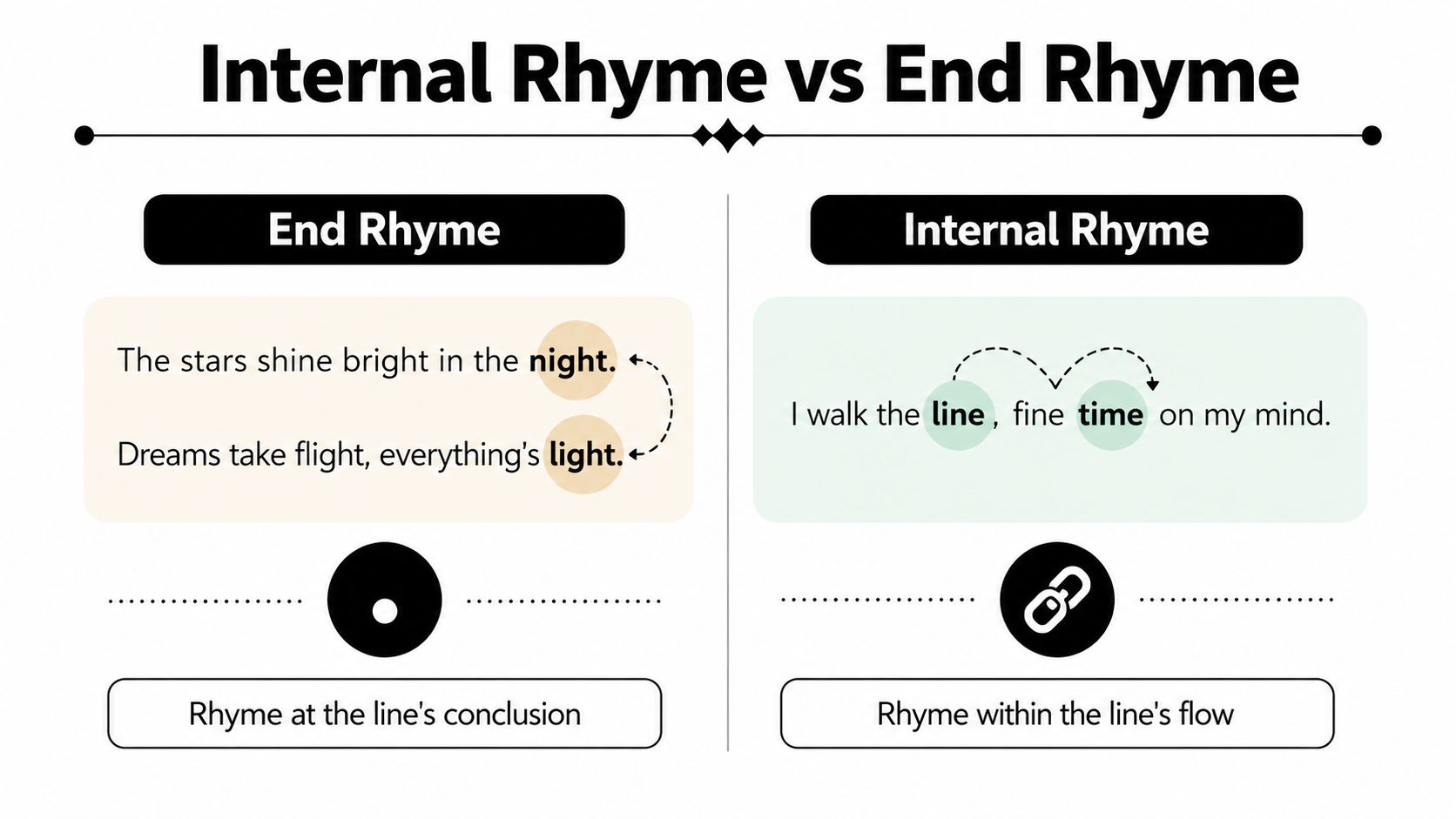 An educational infographic comparing internal rhyme and end rhyme with examples and simple definitions.
Hear the difference in the bar
Start with an end-rhyme couplet:
You claim you're sharp, but you never make a mark, I bring the heat and leave you in the dark.
The main sound lands on mark/dark, both at the ends of their lines. Add internal connections, and the same couplet carries more movement:
You claim you're sharp, but your cheap art never makes a mark, I bring heat, make your weak speech disappear in the dark.
The pairs sharp/cheap art and bring heat/weak speech appear before each line closes. They do not replace the end rhyme. They create extra sound landmarks, giving the rapper more control over the approach to the punch.
Internal rhyme can also connect words inside neighboring lines:
Your weak disguise gets exposed when the pressure arrives, My deeper replies leave a crack in the message you hide.
The repeated vowel and consonant sounds do not need identical positions. Their relationship comes from recurrence, stress, and delivery. A close sound placed naturally can strengthen a bar more than a perfect rhyme forced into the wrong sentence.
Why placement changes performance
End-rhyme-only writing can feel stop-start because the rapper builds toward one recurring landing point. Internal rhyme places sound matches earlier, helping the verse move continuously and giving each bar several points of emphasis. For a broader look at how rhyme patterns are organized across verses, review these rhyme scheme examples.
Read your bars aloud instead of judging them only on the page. Mark the words that share a sound, then check whether they arrive naturally or disrupt your cadence. A battle rapper should hear the internal rhyme as part of the attack, not as decoration pasted onto it.
Internal rhyme does not require every word to match perfectly. A close vowel connection may be enough, especially in the middle of a bar, where delivery, stress, and attitude shape what the listener hears.
Types of Internal Rhyme Every Lyricist Should Know
Not every internal rhyme does the same job. Some create bounce, some display technical control, and others protect the natural voice of the bar.
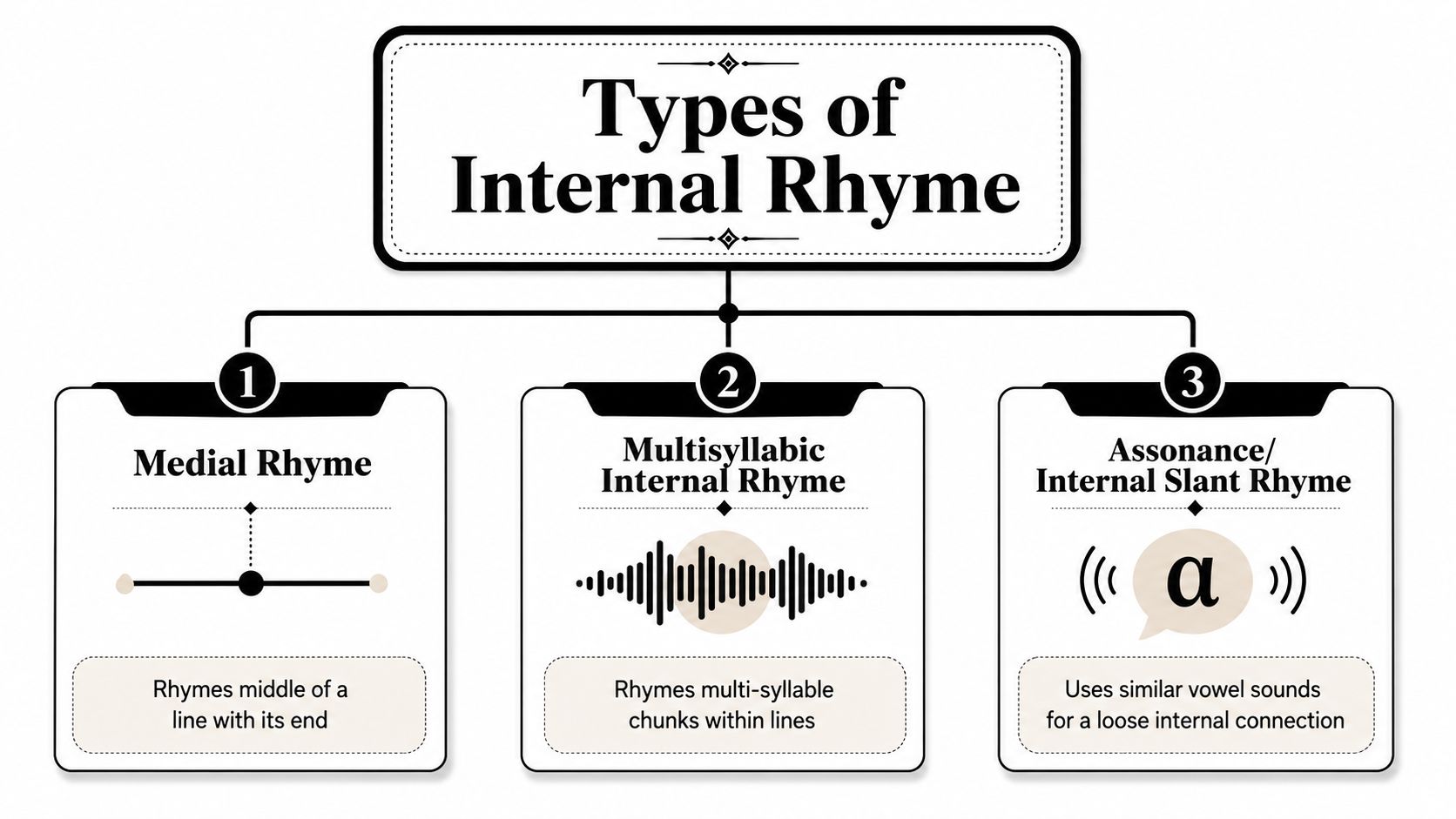 An infographic titled Types of Internal Rhyme, illustrating Medial, Multisyllabic, and Assonance or Internal Slant Rhyme types.
Medial rhyme
Medial rhyme connects a word in the middle of a line with the line's ending. It creates a natural bounce because the listener hears the target sound, then gets the answer before the bar closes.
You talk slick with a cheap trick, but the whole room knows your game.
Here, slick/trick forms the internal connection, while game can serve as the end-rhyme target for the next line. The sound arrives early, so the rapper can use the rest of the bar to sharpen the insult.
Use medial rhyme when you want a bar to feel spring-loaded. It works well in a setup where the internal pair creates speed and the final word delivers the angle.
Multisyllabic internal rhyme
Multisyllabic internal rhyme matches a sound pattern across multiple syllables inside the line. It's more demanding because you're matching a phrase rather than a single word.
Your fabricated reputation is a basic imitation, I turn your stage presentation into proof of hesitation.
The phrases fabricated reputation, basic imitation, and stage presentation share a broad sound structure. The exact pronunciation may vary with accent and delivery, but the repeated syllabic pattern gives the verse a technical texture.
This approach signals control, especially when the matching phrases still communicate a specific attack. Writers studying advanced patterns can use this guide to multisyllabic rhymes as a prompt for building longer sound chains.
Slant internal rhyme
Slant internal rhyme uses near-matches rather than identical sounds. You might repeat a vowel family while changing the surrounding consonants, or use assonance to make words feel connected without producing a polished nursery-rhyme effect.
Your cold stare says you're ready, but your slow hands tell the truth.
The sounds in cold stare and slow hands aren't a perfect match. They share enough vowel color and rhythm to create cohesion, while the looseness keeps the line conversational.
Slant rhyme is valuable in battle rap because a diss should sound like an attack, not a vocabulary exercise. Perfect internal matches can become obvious when you stack them too tightly. Near-matches leave room for natural phrasing, sarcasm, and a rougher tone.
| Type | Main effect | Best use |
|---|---|---|
| Medial rhyme | Creates bounce and forward movement | Fast setups and cadence changes |
| Multisyllabic internal rhyme | Displays technical density | Extended schemes and layered insults |
| Slant internal rhyme | Preserves natural speech | Menacing, conversational delivery |
Choose the type based on the moment. Don't use multisyllabic patterns just to prove you can. Use them when the sound itself adds force to the accusation.
How Internal Rhyming Shapes Flow and Punchline Impact
Internal rhyme turns a battle bar into a pressure sequence. It keeps the ear moving toward the punchline, so the final statement feels earned rather than dropped into silence. Listeners may not identify every matching sound, yet those echoes make the line feel connected and deliberate.
Compare these versions:
You act like a boss, but you fold under stress, I expose your flaws and dismantle the rest.
The idea is clear, but stress/rest carries most of the rhyme work. Add internal preparation:
You act like a boss, but your back starts to lock under stress, I expose those flaws, leave your whole pose lost, then dismantle the rest.
Now boss/back starts to lock and expose those flaws/whole pose lost create a runway for the closer. Each internal match works like another strike before the final blow. The punchline arrives with accumulated force.
 A male rapper in a beanie and chains gestures towards the camera against a brick wall background.
Density creates momentum
Internal rhyme increases sonic density while keeping the verse moving forward, a relationship examined in this research paper on rhyme placement in rap. That forward pull matters in a battle. The crowd must follow the thought long enough to catch the angle, understand the setup, and recognize the hit.
Density also affects breath planning. A packed bar may need one committed push, while a looser line can create room for a pause. Writing and delivery must agree. If the rhyme chain makes you gasp before the punchline, technical skill has started working against the attack.
Use contrast before the hit
Keep the sound activity uneven. If every bar is equally crowded, the ear loses escalation. A plain setup can make the next dense line feel quicker, while a pause gives the closer room to register.
Try this shape:
You built your whole image on rumors and dress, New pose, same holes, every move looks rehearsed, You wanted a clash, so I'm giving you less, One clean line, lights out, now explain your success.
The second and fourth lines carry the heavier internal movement. The simpler lines establish the accusation and leave space for the attack. For more ways to design the final hit, study these punchline-writing techniques.
Performance test: Record the bar twice. In the first take, emphasize the end rhyme. In the second, lightly punch the internal matches. Keep the version where the insult remains clear.
Practical Drills to Write Sharper Internal Rhymes
Internal rhyme improves through repetition, but random rhyme hunting wastes time. Use a target, write a plain version, then increase the sound density without sacrificing the meaning.
Drill one adds one internal match
Start with a simple couplet:
You claim you're the king, but you're missing the crown, I step into the room and I'm shutting it down.
Add one internal pair to each line:
You claim you're the king, but you're weak in the ring, missing the crown, I step in with a grin, make your best talk thin, then shut it down.
The goal isn't maximum density. It's learning to insert a sound match where the sentence still feels natural.
Drill two builds a multisyllabic chain
Choose a target idea, such as fake confidence. Write four bars around a repeated phrase pattern:
Your manufactured bravado is a standard rerun, That camera-ready shadow disappears when the pressure comes, Your calculated tornado is just wind when the battle's begun, I bring unfiltered facts, and your whole performance comes undone.
Underline the phrase groups that share a similar rhythm and vowel movement. Then read the verse slowly, at normal speed, and with an aggressive delivery. Keep the version where the pattern supports the meaning.
Drill three loosens a generic insult
Start with a flat line:
You're fake and everyone knows it.
Turn it into a slant-rhyme attack:
Your face stays polished, but the basic fraud shows whenever you speak.
The vowel relationship is loose, and the phrasing sounds closer to speech. That matters when the character of the diss depends on calm contempt rather than frantic speed.
Drill four tests stamina and variation
Write an eight-bar verse with at least two internal connections in every bar. Don't use the same rhyme sound throughout. Change the sound family, move the placement, and leave one bar relatively open so the listener can breathe.
Use this practice routine:
- Choose the end targets first. Give each bar a clear destination.
- Add internal matches second. Start with one pair, then add another only if the idea survives.
- Mark stressed syllables. The strongest rhyme should land where your delivery naturally emphasizes the word.
- Read aloud and record. Listen for swallowed syllables, awkward breaths, and forced vocabulary.
- Edit for the attack. Delete any rhyme that sounds clever but doesn't make the opponent look worse.
A rhyme dictionary can provide options, but it can't choose the right threat, image, or cadence for you. Your ear has the final vote.
Common Internal Rhyme Mistakes and How to Fix Them
Internal rhyme becomes harmful when the pattern starts controlling the writer. The bar should still sound like something a person would say while attacking an opponent.
Forcing a rhyme that weakens the meaning
Bad:
Your whole career is a mystery, I end your history with lyrical misery.
The rhyme chain is obvious, but lyrical misery says little. A sharper correction gives the insult a concrete direction:
Your whole career is a mystery, No proof in your history, just borrowed delivery.
The internal connection now supports the accusation. You're not merely saying the opponent loses. You're saying their identity and track record lack originality.
Overloading every bar
Bad:
You're a fake snake, cheap shade, weak fame, lame game, same face, no place, no name.
The sounds are stacked so tightly that the listener may hear the pattern before the point. Reduce the number of matches:
You play the same game, but the face changed and the room knows your name is borrowed.
One strong internal connection can sound more threatening than a pile of obvious matches.
Ignoring stress
A rhyme can look perfect on the page and disappear in performance if it lands on an unimportant syllable. Read the bar with the beat, then move the match toward a naturally emphasized word.
Weak placement: I'm exposing your mistake in a phrase nobody remembers.
Stronger placement: I break your mistake open when the room starts to listen.
The second version gives break/mistake more vocal force and makes the action easier to perform.
Forgetting the punchline
A dense setup without a destination sounds like exercise. Write the final insult first, then build internal sounds that point toward it.
Anchor: You're not a rival, you're rehearsal.
Setup: Your first verse, worst nerves, every boast sounds commercial.
Payoff: You're not a rival, you're rehearsal.
Editing principle: If removing an internal rhyme makes the insult clearer, remove it. Technique serves the diss.
Level Up Your Battle Bars with Consistent Practice
You now have a working answer to what is internal rhyming. It's rhyme placed inside a line or between internal phrases, rather than reserved for the line ending. In battle writing, medial rhyme adds bounce, multisyllabic rhyme adds technical weight, and slant rhyme keeps the attack sounding human.
The skill improves fastest when you train your ear and your mouth together. Mark sound matches on the page, perform them over different beats, and record yourself before deciding that a bar works. A pattern that looks impressive may still trip your delivery, bury the punchline, or leave no room to breathe.
Study battle rappers and lyricists actively. Don't only admire the finished verse. Track where the internal sounds appear, how long each chain lasts, when the writer simplifies the cadence, and how the final rhyme completes the setup. Then borrow the method, not the wording.
A useful weekly challenge is to write one complete diss verse using medial rhyme, multisyllabic internal rhyme, and slant internal rhyme. Test it aloud, cut the forced lines, and revise until every sound connection makes the opponent look smaller. If you need starting prompts or alternate rhyme paths, DissTrack AI can generate personalized roast lyrics with selectable styles and structured variations that you can edit into your own battle voice.
DissTrack AI creates personalized diss lyrics and roast verses with rhyme schemes, punchline variations, and style options suited to battle rap practice. Use it to break through a blank page, then sharpen the internal rhymes and delivery yourself by visiting DissTrack AI.