AI Music Copyright: Who Owns AI-Generated Songs
A track generated entirely by AI from a prompt isn't protected by U.S. copyright, but human-authored lyrics, arrangements, edits, and recorded performances can be protected when they reflect real human control. Your strongest claim is to the expression you created, not everything inside the exported file.
Say you've generated a roast about your friend's disastrous fantasy draft. The hook lands, you rewrite the verses, and you record a vocal in your bedroom. Then someone reposts it with their own name attached. Before you send an angry message, you need to know exactly what they copied: the machine's output, your words, your performance, or all of the above.
AI music copyright is an authorship question before it's an ownership argument. The useful evidence isn't just the finished track. It's the dated trail showing how you made it yours.
Who Owns AI-Generated Music Today
Human authorship is the dividing line. In its explanation of the Part 2 report, published January 29, 2025, the U.S. Copyright Office concludes that existing copyright law can resolve most AI-output questions, protecting sufficiently human-controlled expression but not wholly machine-generated material.
That means a registrar won't treat every file labelled “my song” the same way. Typing a target's name and selecting “battle rap” tells the software what you want. It doesn't necessarily make you the author of the particular rhymes, melody or backing track it returns.
Ownership by creation scenario
| Scenario | Copyright likely? | Why |
|---|---|---|
| Prompt and style tags only | Unlikely | Instructions alone give little expressive control |
| AI lyrics and AI beat used unchanged | No | Purely machine-generated expression is not protected |
| Your substantial lyric rewrite over an AI beat | Possibly, for your lyrics | Human authorship in the words can qualify |
| Your own arrangement, edits and selections | Possibly | Creative choices reflecting adequate human control can qualify |
| Your recorded vocal performance added | Possibly, for the recording | Human performance can contribute protectable recording authorship |
| Fully AI track with a name and cover art | Unlikely, for the music | Naming and artwork are separate creative elements |
The important word in those middle rows is your. If you replace generic insults with original setups, internal rhymes and a hook you wrote, you've introduced identifiable human expression. If you merely approve what the generator supplies, your role looks more like commissioning than composing.
Protection can also be narrower than the finished song. Your lyrics might qualify even when the backing track underneath doesn't. A protectable arrangement doesn't automatically turn every ingredient into your exclusive property.
Platform ownership isn't statutory copyright
Our policy at DissTrack AI is that users own everything the AI generates, and we don't claim any rights to their lyrics. That describes the relationship between us and the user. It doesn't override the legal requirement for human authorship or establish rights against unrelated copyright owners.
Commercial permission and copyright answer different questions: may you use something, and what can you exclusively control?
Start with the parts you can identify: your lyric draft, your vocal recording and your deliberate production changes. Don't claim the whole sandwich because you supplied the mustard.
How Much Human Control Makes a Track Protectable
Ordering dinner isn't the same as cooking it. You can specify spicy noodles, extra garlic and no mushrooms, but the chef still decides how the meal comes together. A prompt can work the same way.
The distinction becomes easier to remember in a kitchen.
 A woman in a blue shirt pointing at a menu in a home kitchen filled with fresh ingredients.
For a song, look for decisions about the actual expression: which words appear, how sections unfold, what gets cut and how a performance sounds. Time spent isn't the test. A long evening of clicking “regenerate” can leave less human authorship than a short session writing an original bridge.
Stronger and weaker contributions
- Stronger evidence: You rewrite the verses line by line, reshape the hook and record your own delivery. The finished expression can be traced to specific choices you made.
- A narrower contribution: You retain an AI verse but write an original bridge. Focus your claim on the bridge rather than treating it as a receipt for the entire song.
- Too thin to rely on: You swap a word or fix punctuation. Cosmetic changes aren't a dependable foundation for an ownership claim.
- Selection with more substance: Choosing a favourite output alone is weak. Cutting passages from different outputs into a creatively structured arrangement presents a different authorship question.
A recorded human performance over AI-generated music can introduce protectable recording authorship. A heavily edited remix may also contain original choices, but moving a volume slider isn't automatically composition.
For another way into the human-control question, consider this accompanying video.
There's no universal rewrite percentage to chase. Ask yourself: What did I decide? What did I change? Could I explain those choices to a judge? Those answers are more useful than counting keystrokes.
How to Document Your Authorship Step by Step
Say your first generated verse contains a forgettable joke about someone always losing. Your final version turns their habit of abandoning group chats into a running metaphor, changes the rhyme pattern and builds toward a callback. Keep both versions. The difference is your evidence.
ASCAP's explanation of the Copyright Office's AI report emphasizes that human-authored expression and meaningful creative modifications may qualify for protection, while prompts alone generally don't establish sufficient control. Your folder should show the modification, not merely announce it.
Build the evidence while you work
-
Save the original prompt and style tags. Put them in a dated text file before revising anything. This establishes your starting point; the common slip is preserving only a screenshot of the finished result.
-
Export every generated lyric version. Keep each output under a distinct filename rather than overwriting it. Discarded drafts help distinguish machine suggestions from your later choices, so don't delete them just because the punchlines were terrible.
-
Rewrite in a separate human draft. Use Microsoft Word's Track Changes, Google Docs version history or plainly labelled text files to make your wording visible. Editing directly over the only saved AI version erases the comparison you may later need.
-
Keep your raw vocal takes. Save the unedited recordings alongside the processed vocal and final mix. A polished export can hide the human performance process, while deleting the raw files removes useful evidence of what you recorded.
-
Maintain a dated arrangement log. Note changes such as removing an intro, moving the hook, chopping a phrase or replacing a drum passage, and save corresponding Ableton Live, FL Studio or other project versions. Avoid notes like “made it better”; describe what changed and why.
-
Store every relevant licence. Include sample permissions, loop-pack terms and any authorization governing a voice recording. Keeping the receipt without the licence terms is a common mistake because a payment record doesn't explain permitted uses.
-
Write an authorship note before release. Identify the AI material, your original lyrics and edits, your performance, and separately licensed contributions. Don't wait until a dispute to reconstruct the session from memory.
This visual routine can help keep the archive consistent.
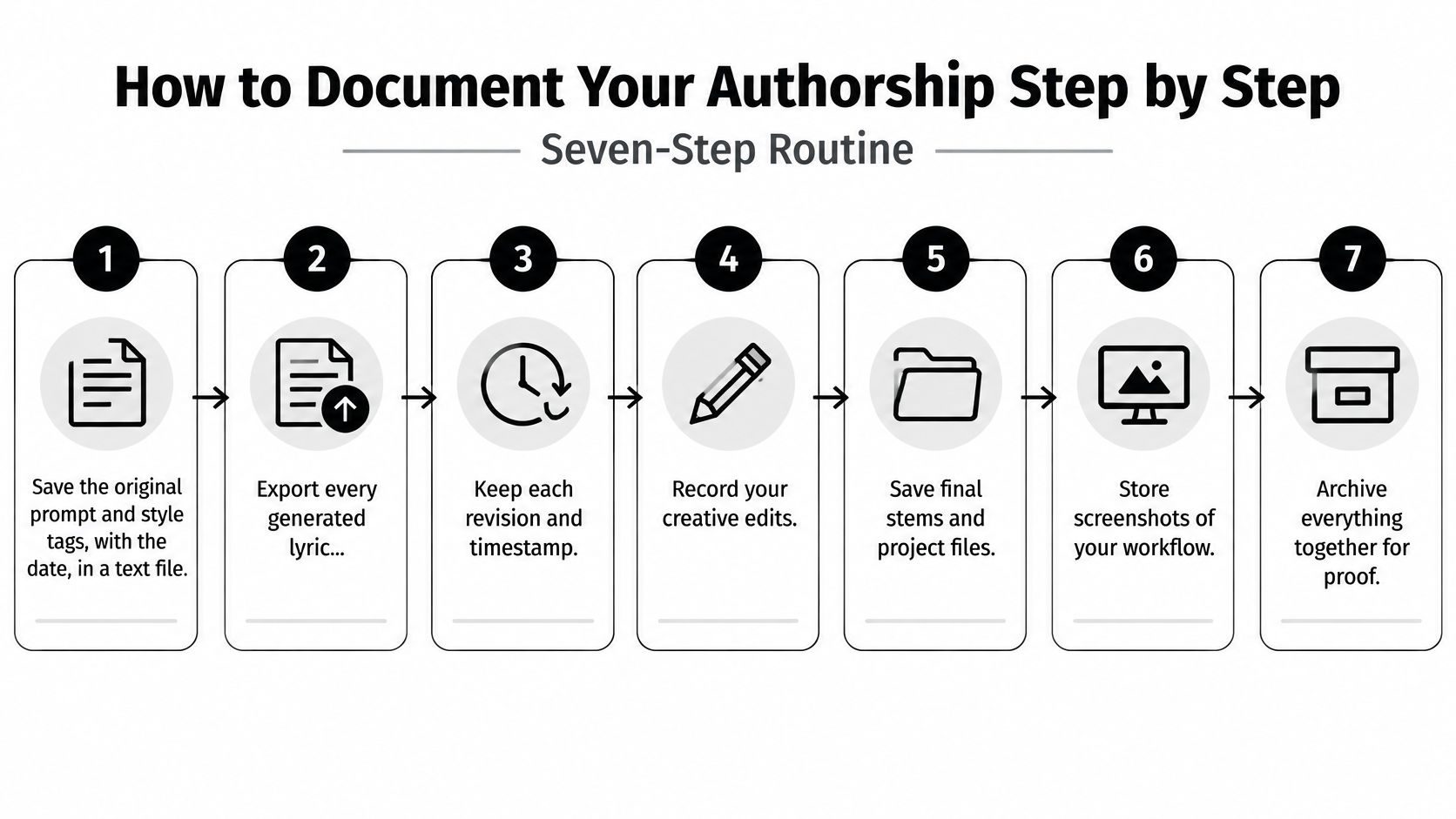 A seven-step routine guide illustrating how to document authorship and project files for AI-generated music.
What the finished folder contains
Keep the prompt file, generated versions, human drafts, version history, raw vocals, project files, licences and authorship note together, with a backup. Dates help establish sequence, though they don't guarantee that a contribution qualifies for copyright.
For a lyric-focused filing, use our guide to how to copyright lyrics to a song to organize the words separately from the recording. The objective is a readable record, not a digital junk drawer with a triumphant filename.
Registering Your AI-Assisted Track and Separating Rights Layers
A registration application isn't the place to round your contribution upward. Think of it as labelling the channels in a session: lead vocal, backing track, sample. If every channel says “mine,” nobody can tell what you created.
Describe authorship precisely, and check the Copyright Office's current instructions before filing. Forms and procedures can change, and the appropriate claim depends on the work you're registering.
Prepare a bounded claim
-
Separate the rights layers. Identify the underlying AI output, your original lyrics and creative modifications, and third-party material used under licence. Don't describe licensed ingredients as your own authorship, or assume a stylistic reference is something you own.
-
Describe the human contribution concretely. Use descriptions that match the work, such as original revised lyrics, creative arrangement or human-recorded vocals. “Concept and prompting” doesn't communicate the same contribution as writing the final words or performing them.
-
Identify and exclude AI-generated material from the claim. Disclose included AI content according to the current application instructions and limit the claim to eligible human authorship. The common mistake is submitting the complete track while implying that every audible element was human-created.
Your composition and recording also deserve separate attention. Writing a hook and recording a performance aren't interchangeable acts, even when both occur during the same bedroom session. If collaborators contributed, establish who wrote and recorded what rather than guessing when the application is open.
A worked filing description
Say you write an original replacement hook and record your voice over an unchanged AI backing track. Your description should distinguish the human-written hook and human recording contribution from the AI-generated backing track. If a licensed sample appears, identify it separately rather than including it in your authorship claim.
A commercial-use permission is a contract permission, not a registrar's finding that the entire track is copyrightable.
Registration is also different from collecting revenue. Our explanation of mechanical royalties can help you keep composition-related payments separate from the question of which material your registration covers.
Training Data and Copying Risks in AI Music
A song can lack its own copyright protection and still copy someone else's protected work. “I don't own this output” isn't a defence to “this output contains my chorus.”
The U.S. Copyright Office's annual report treats the use of copyrighted works in AI training as a separate issue from output copyrightability. That separation matters: evaluating your authorship doesn't settle whether a developer's training practices or a particular generated result raise infringement concerns.
Think of a band borrowing the general atmosphere of an era versus replaying a particular recording passage for passage. For AI music, broad genre vocabulary and recognizable reproduction require different levels of scrutiny.
Output types and copying risk
These are practical screening categories, not predictions of how a court would decide a particular dispute.
| Output type | Risk level | Reason |
|---|---|---|
| Broad genre feel such as trap or boom bap | Lower | General genre traits are generally not protected expression |
| Imitated flow and cadence | Low to moderate | Style alone is usually not protected, but close copies matter |
| Recognizable melody or hook | High | Can match protected musical expression |
| Near-verbatim lyric from a living artist | High | Copied lyrics can trigger infringement claims |
| Sampled or copied recording fragment | High | Requires rights clearance unless an applicable exception permits the use |
A trap rhythm doesn't identify a particular song by itself. A hook that makes listeners immediately sing the next line of an existing hit deserves closer inspection. Cadence falls between those examples: listen for whether you're borrowing a broad delivery approach or reproducing a distinctive passage alongside matching words or melody.
Memorization risk describes the concern that a model may reproduce material resembling a training example rather than create only a general stylistic resemblance. Don't assume a surprising resemblance must be harmless because nobody intentionally requested it.
Put checks before distribution
For developers, sensible controls include excluding unlicensed commercial recordings and lyrics from training, preserving dataset provenance, testing generations against reference songs and routing suspicious matches to human review. Block requests for protected lyrics and near-verbatim song continuations, including those involving living artists.
For creators, save the reference tracks you used, compare hooks and lyrics deliberately, and ask a collaborator to listen without telling them what to expect. Similarity tools can flag material for review, but they aren't legal clearance.
Playback rule: If the output makes you name a specific song, pause the release and investigate the resemblance.
Licensing, Samples and Voice Imitation Risks
In a 2025 survey of 11,500 musicians and music creators cited by the Musicians' Union, 93% said AI companies should pay when using compositions and recordings for training, and 92% said AI-generated music should be labelled for listeners. Those are creator attitudes, not legal permissions, but they make the commercial importance of consent and transparency plain.
A track can have original lyrics and still arrive carrying someone else's recording, composition or recognizable identity. Treat those ingredients separately rather than assuming the lyric rewrite cleared the entire session.
Licensing risks by track element
| Element | Main risk | Safe move |
|---|---|---|
| Sampled recording | Master and publishing rights owned by others | Clear the sample or replace it with original sound |
| Imitating a famous voice | Personality and publicity claims, separate from copyright | Avoid naming artists or cloning their voice |
| Licensed beat pack | Licence may bar commercial use or resale | Check the licence terms and keep a copy |
| Cover of an existing song | Licence needed to reproduce the composition | Obtain the appropriate licence before distribution |
| AI-assisted track | Listeners and platforms may expect disclosure | Label AI use plainly in credits |
For a sample, investigate both the recording and the underlying composition. Permission involving one doesn't necessarily resolve the other. For a beat pack, inspect the actual permitted uses, including distribution, monetization and whether you can resell isolated sounds.
A voice isn't just another instrument preset
Say your roast uses your own words but sounds like a famous rapper performed it. That raises a different concern from whether the words are original: listeners may identify a real person whose voice or identity you weren't authorized to use. The applicable protections depend on jurisdiction and circumstances.
When comparing cover-making tools, the AI Cover Studio on AI Tool Seekers listing is a useful starting point for identifying a tool to investigate, not evidence that a particular song or voice is cleared. Our AI rap voice guide can help you frame the creative choices without treating artist impersonation as permission.
Use specific credits: identify AI-generated backing material and human-written or performed contributions accurately. Disclosure helps listeners understand the process; it doesn't replace a licence.
Common Myths About AI Music Copyright
The confident comments under an AI song often sound like legal advice delivered through a broken megaphone. Test the slogan against the actual track before relying on it.
Myth-busting at the mixing desk
-
AI music is public domain, so anyone can use it. Lack of protection for machine-generated expression doesn't erase restrictions attached to copied or licensed ingredients. A generated track containing an uncleared recording fragment isn't suddenly clean because the surrounding beat came from a model.
-
Adding my name makes it mine. A credit identifies a claimed role; it doesn't prove authorship. Uploading an untouched output under your stage name is different from writing an original verse and keeping the draft.
-
Copying a style is always safe. A broad stylistic resemblance isn't the same as reproducing protected expression. A boom bap drum feel and a recognizable borrowed chorus belong in different risk conversations, even if the prompt describes both as inspiration.
-
The same rules apply everywhere. Don't treat U.S. registration guidance as a worldwide release clearance. A creator distributing internationally should check the relevant markets, particularly when voices, samples or training practices are involved.
These mistakes share a practical problem: they substitute a label for an examination of the ingredients. “Original,” “AI-generated” and “licensed” mean little unless you can say which material each description covers.
Test the claim against a real release
Suppose a streamer commissions a roast, writes a fresh outro and adds a famous vocal clip. The outro may be original human work, but it doesn't authorize the clip. Equally, permission to use the clip wouldn't establish that the streamer authored the generated verses.
The same care applies when a collaborator says everything is cleared. Ask for the licence file, authorship split and relevant permission, not a reassuring thumbs-up emoji.
Confidence isn't a chain of title. Calling a beat yours doesn't make it so, any more than writing your name on the studio refrigerator makes you the landlord. Use a release checklist before the upload button turns a private experiment into a public rights question.
Confirm Your Rights Before You Release Your Track
Your release decision should come from the project folder, not the excitement of finally getting the mix right. Run this check while you can still change the file without asking a distributor to take it down.
Check the release package
- Map every element. List lyrics, beat, vocals, samples and cover art, with the maker and permission beside each.
- Check the evidence folder. Confirm the dated drafts, raw recordings, project versions, licences and authorship note are stored together.
- Inspect recognizable passages. Compare hooks, melodies and lyrics against reference songs. Investigate suspicious matches rather than trusting a clean automated result.
- Read the governing terms. Check platform permissions, sample restrictions and collaborator agreements for the intended release.
- Finish the credits. Describe AI involvement accurately and credit human contributors.
- Escalate valuable or uncertain releases. Bring the actual files and permissions to an intellectual property lawyer. HeyAtty's guidance on evaluating legal fees and red flags can help you assess the engagement before hiring.
Keep a visible checklist beside the release files.
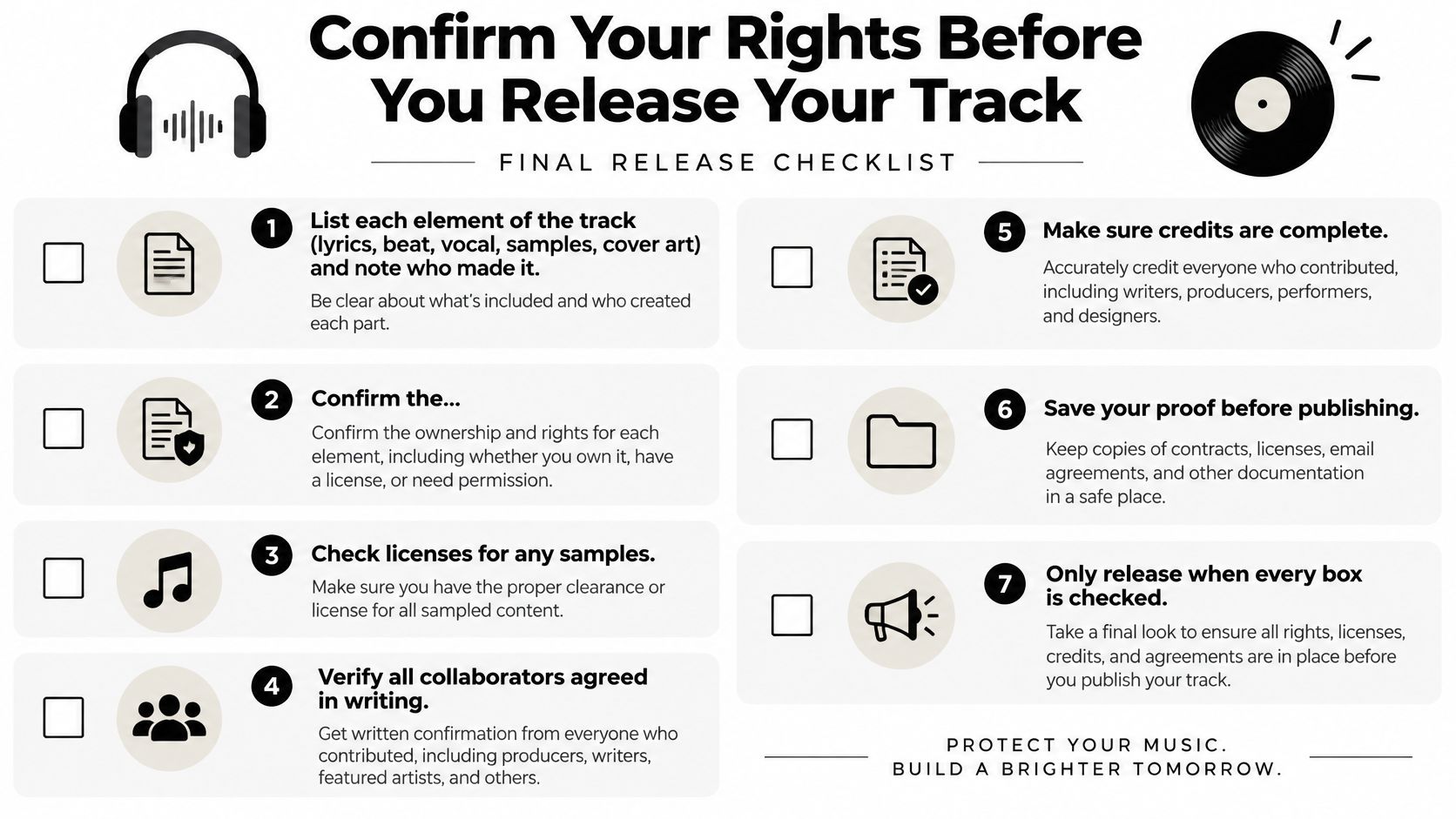 A checklist titled Confirm Your Rights Before You Release Your Track outlining seven steps for music creators.
Release when every element is documented and cleared. Revise when a hook or lyric is too close to an existing song. Hold when a sample or voice lacks clear authorization.
Our generated disses stay private: we don't share, sell or publicly display them, and targets aren't notified. You decide when to publish, so make that decision only after your rights checks are complete.
Use DissTrack AI to create personalized roast lyrics you can edit and export as text. Make the final words unmistakably yours, save the drafts that show your work, and check the rights before taking your roast from the group chat to a public release.