
Commercial License Training for AI Diss Tracks
Commercial use requires a Pro or Creator plan with commercial licensing; the Free plan covers a single roast for personal use, and you should upgrade before publishing. Don't assume that generating a verse for free gives you permission to turn it into a paid release.
Say you roast your friend's terrible jump shot, send the lyrics to the group chat, and get a message from a sneaker shop: “Can we sponsor the video?” Suddenly, the joke has a client, a soundtrack, and somebody's real name attached.
That's where commercial license training becomes useful. Treat your track like a chain of custody: the subscription, the generated lyrics, the beat, and the people mentioned are separate links. A receipt for one doesn't clear the others. Your punchline can land perfectly while your paperwork falls down the stairs.
Which DissTrack Plan Gives You Commercial Rights
This guide covers licensing for DissTrack AI roasts, not commercial driver's license (CDL) training.
The practical distinction is personal permission versus commercial permission, not merely how many times you can press Generate. Choose the rights your project needs before comparing output allowances.
DissTrack AI plans compared for commercial use
| Plan | Generations | Commercial licensing |
|---|---|---|
| Free | Single roast; current price not listed here | Not included, personal use only |
| Pro | Higher monthly limit; exact cap and current price unconfirmed | Included, subject to current terms |
| Creator | Higher monthly limit; exact cap and current price unconfirmed | Included, subject to current terms |
Choose permission before volume
A creator making occasional sponsored videos may need commercial permission more than a large generation allowance. Someone writing private party jokes may care more about available drafts. Those are different purchasing decisions, even when they share a checkout screen.
Prices and exact generation caps aren't established here. Check the current pricing page through the service's website rather than budgeting from an old screenshot. For a related creative expense, Department of Vibe's resource on budgeting for identity-preserving photo edits can help you keep artwork costs separate from lyric permissions.
The common trap starts innocently: you generate a private joke, then discover it could earn money. Don't assume a later upgrade covers earlier output. Ask whether the applicable terms expressly extend commercial permission to that existing generation; otherwise, generate a replacement under the appropriate plan.
The quick test: If money, a brand, or a client touches the track, choose a commercial plan.
That test identifies the starting point, not a promise that every ingredient in the finished recording is cleared.
What a Commercial License Really Grants You
Say a local barber commissions a roast of bad home haircuts. You deliver lyrics, the barber records them, and an agency asks whether it can reuse the recording in another campaign.
Your answer shouldn't be “I paid for the app.” It should come from the license's actual scope.
Think of a hotel. A free stay lets you sleep in the room. A hypothetical commercial-use arrangement might let you conduct business there. Neither arrangement makes you the owner of the building, and neither automatically lets you hand the keys to another company.
 A modern hotel room with an open laptop and key card sitting on a wooden nightstand.
Read the permission in separate parts
By Design Law Firm & Legal Consultancy, PLLC's explanation of using intellectual property in exchange for payment provides useful context for understanding licensing as permission governed by an agreement.
Check these dimensions in the current terms:
- Who can use it: Your account holder, collaborators, employees, or an outside client.
- What they can do: Perform, publish, monetize, transfer, or sell the lyrics as a standalone product.
- Where and for how long: Covered territories, permitted channels, duration, and any subscription-related conditions.
A paid contest entry, a downloadable lyric pack, and a client advertisement aren't interchangeable uses. Don't infer permission for all of them from a commercial badge.
The authoritative source is the current license and terms of service, not this summary. For music obtained elsewhere, understanding Creative Commons music permissions also helps you distinguish different licensing arrangements.
Permission to use words isn't proof that nobody else can receive similar words.
Back at the hotel, your key opens a room. It doesn't buy the whole floor. Likewise, commercial permission doesn't automatically establish exclusivity, copyright ownership, or rights in everything surrounding the generated text.
Where Commercial Use Stops and Myths Fail
A commercial subscription isn't a backstage pass through everybody else's rights. Say your verse uses an unlicensed backing track, names your former manager, and appears in a competitor's advertisement. Paying for the lyrics doesn't settle any of those separate questions.
The useful boundary isn't whether the track sounds funny. It's whether you can explain each ingredient without replacing evidence with confidence.
Check the ingredients before the punchline
- Real people: False factual allegations about a coworker, ex, or public figure can create defamation risk, while private disclosures raise separate concerns. Keep jokes recognizably comic, and don't invent misconduct to improve a rhyme.
- Named artists: Don't label output as a verse by 2Pac, Nas, Eminem, or Pusha T, or package an imitation to suggest their authorship or endorsement. Identity, publicity, and misleading-attribution questions need separate consideration.
- Beats and samples: Permission for generated lyrics doesn't clear someone else's beat or sampled recording. Obtain the relevant permissions for the actual recording you intend to release.
- Brands and trademarks: Using a rival's name in paid advertising can create confusion or trigger complaints. Have the client review the script and presentation before production.
- Threats and harassment: A license doesn't override applicable law or platform rules. Remove targeted intimidation and hateful attacks rather than trying to camouflage them as battle-rap tradition.
- Private information: Leave out home addresses, phone numbers, and minors' private details. A technically impressive rhyme isn't a reason to expose somebody.
The myths that cause preventable trouble
AI generated it, so it's free to use. Generation describes a process, not a clearance decision. The service's agreement still matters, and material added afterward needs its own review.
The Free plan gives me no rights. Personal-use permission is a real permission with a limited scope. Calling it worthless is as inaccurate as calling it unrestricted.
I changed a line, so everything is mine. Your edits can add creative expression, but they don't erase the checklist above. Replacing “terrible” with “catastrophic” won't clear a sample. Excellent vocabulary, same paperwork problem.
Once licensed, always safe. Preserve the terms that applied to your generation and release. Whether permission survives cancellation or covers a later use is a contract question, not something to guess from the word commercial.
A disclaimer in the caption protects me. A statement that something is comedy may provide context, but it doesn't automatically cure a false allegation, misleading artist attribution, or misuse of someone's identity.
Release check: Read the verse as the target, the sponsor, and the platform reviewer, not just as the person who enjoyed writing it.
A joke about your friend's cooking can stay exaggerated and playful without alleging a health-code violation. Roast the smoke alarm's overtime schedule, not an invented criminal record.
This is general information, not legal advice. Ask a qualified lawyer to review a release with money or a brand attached, particularly when identifiable people, disputed facts, or implied endorsements are involved.
Matching Your Project to the Right License
Find your project in the left column, check the plan in the middle, and use the risk level to decide how much review to arrange. These are practical starting points, not legal ratings or substitutes for the current terms.
Project types and the license each one needs
| Use case | Plan needed | Risk level |
|---|---|---|
| Private roast read at a friend's party | Free | Low |
| Public post on a personal account, no money | Free only if public sharing is permitted | Low |
| Monetized YouTube or TikTok video with ads | Pro or Creator | Medium |
| Sponsored or client content for a brand | Creator as a starting point, plus written client approval | Medium to high |
| Commercially released single or album | Creator as a starting point, plus lawyer review | High |
| Track built on a licensed or sampled beat | Commercial plan plus separate beat and sample permissions | High |
From party joke to public release
A private party performance sits at the low end of this comparison, provided the content itself stays within sensible boundaries. A public personal-account post needs an additional check: personal use doesn't automatically mean unrestricted public sharing.
For monetized YouTube or TikTok content, choose the commercial tier and review the music too. A small payment doesn't become noncommercial because it barely covers lunch.
Client work adds another participant with expectations. Get written approval of the lyrics, named targets, intended channels, and delivery rights. Creator is a planning recommendation here, not proof that Pro necessarily excludes every client project.
When the recording gets complicated
A commercially released single deserves closer review because distribution and promotion can make a mistake harder to contain. Audience reach and financial stakes can increase practical exposure.
For a beat-backed video, understand synchronization rights before treating a stripped-down track download as complete permission. A remix incorporating another artist's verse also needs clearance from the relevant rights holders, not merely approval from your generator account.
For a group track, get each contributor's written confirmation of their lines and the intended paid use. Friends can agree enthusiastically in the studio and remember the agreement differently when the invoice arrives.
How to Secure and Use a Commercial License Step by Step
Build a release folder before building a rollout. Keep the agreement, the generated draft, your edits, and the final audio together so you can answer a client's questions without searching through messages at midnight.
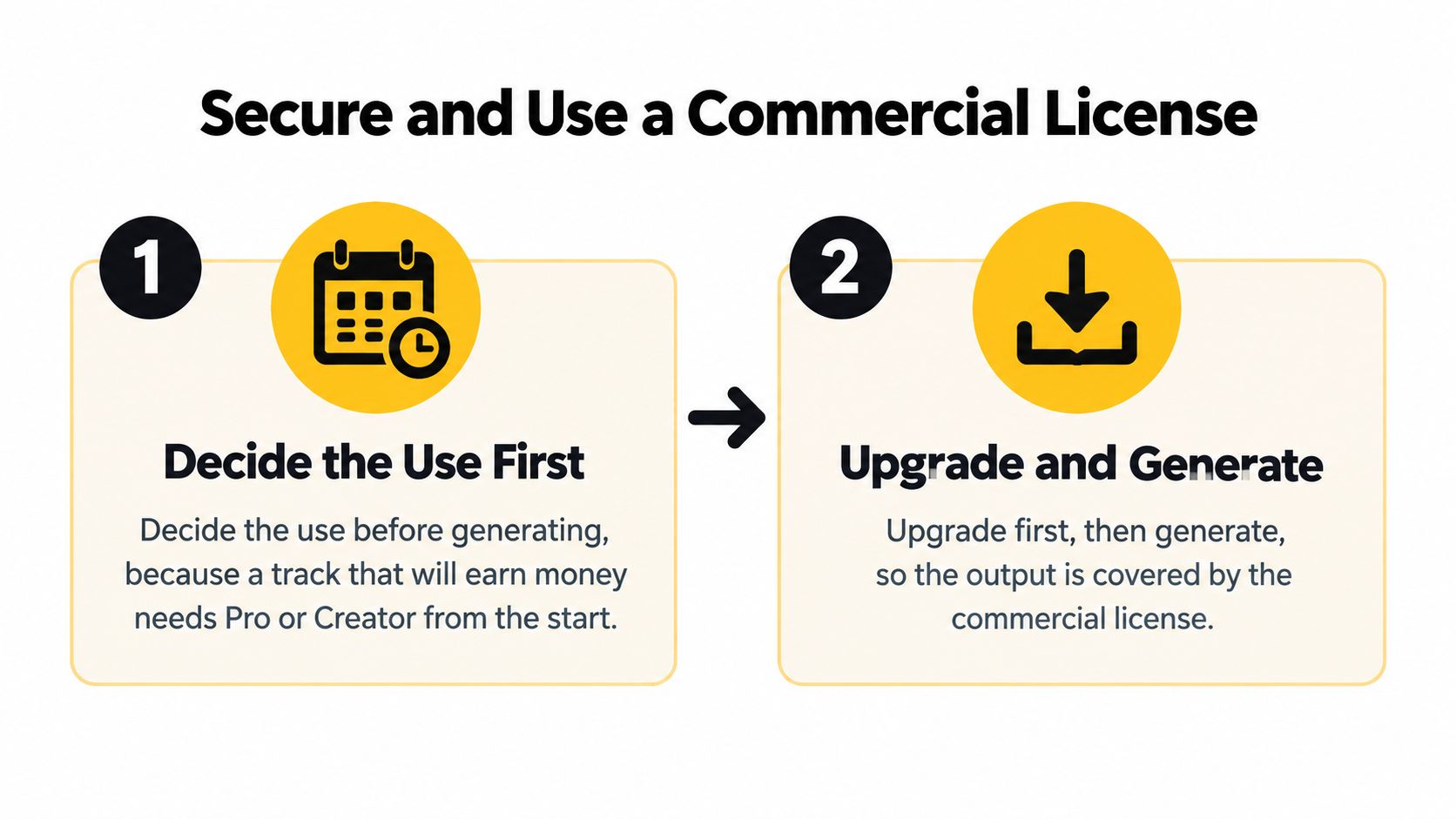 A two-step infographic showing how to obtain a commercial license by deciding the use and upgrading first.
Establish permission before production
-
Describe the intended release. Write down whether you're making a private performance, monetized video, client advertisement, or distributed recording. Include who will publish it, because your own upload and a client's campaign may require different permissions.
-
Choose the plan, then generate. Use the appropriate commercial tier for a paid project. If you already have a Free-plan draft, obtain confirmation about earlier-output coverage before relying on an upgrade.
-
Read and preserve the agreement. Save a dated PDF of the license and terms, including incorporated restrictions. BoloSign's explanation of why clickwrap contracts are legally binding provides context for taking checkout acceptance seriously rather than treating it as decorative friction.
-
Keep the draft private. Generations are described as private until you choose to publish; verify the sharing controls before sending anything outward. Use a private review copy rather than testing a risky line on your public audience.
Prepare a defensible final file
-
Edit for voice and accuracy. Add your own punchlines, read the verse aloud, and check every identifiable person against the boundaries checklist. Remove factual allegations you can't support instead of hoping a rhyme makes them harmless.
-
Clear the audio separately. Save the beat agreement, sample permissions, and any restrictions attached to them. Make sure those documents describe the recording and use you're planning, not merely a different demo.
-
Keep a compact evidence folder. Include the plan receipt, generation date, exported draft, final file, and a short edit log. Give files descriptive names so you can distinguish the approved version from the draft with the questionable bridge.
-
Check continuing-use conditions. Before a new paid use, verify your subscription status and whether ongoing permission requires an active subscription. Don't assume cancellation ends existing rights or preserves them; the applicable agreement must answer that question.
Good records won't fix an unauthorized ingredient, but they help you show what you obtained and what you delivered. When a platform or client asks for proof, an organized folder beats a confident explanation with no attachments.
Confirm Your Plan Before You Publish
Open the service's website and check the current pricing details and terms of service before generating your release draft. Prices and generation caps aren't listed here, and a plan name alone won't answer questions about client transfers, resale, or continuing rights.
Match your intended project to the use-case table, then verify any unresolved permission directly in the agreement. If the wording doesn't clearly cover your intended use, get written clarification before you spend time recording.
 A woman writing in a notebook at a desk next to a laptop computer and coffee cup.
Leave checkout with evidence
Keep the first generation private while you edit, review the targets, and assemble the audio permissions. Save the dated terms and plan receipt beside the exported file, not in a separate account you'll struggle to access later.
The discussion of publishing a song written by AI offers related context, but your release decision should rest on the permission that applies to your account and recording.
A release-ready track needs an explainable permission trail, not just an export button.
If you're facing a claim, a takedown, or a substantial commercial release, speak to an entertainment lawyer. Don't negotiate a disputed right by sending the other party a screenshot of a marketing headline.
Your next action is straightforward: open the current pricing page through the website, confirm the appropriate plan and its terms, and only then generate the track you intend to publish.
DissTrack AI generates personalized roast lyrics you can edit for a performance, video, or recording. Visit the site, open the pricing page, and confirm the commercial permissions before generating your release draft. Bring the punchlines, and keep the permission trail with them.