8 Diss Rap Lines Styles for Sharper Roasts
A memorable diss rap line is built around a clear target, a sharp mechanism, and a delivery choice. Pure aggression gets forgotten fast, but a line that sets up a thought, flips it cleanly, and lands on the beat can live in a crowd's memory. That's been true since the 1984 Roxanne Wars, which helped turn battle-style dissing into a recorded format, and it still shows up in the streaming era, where a diss can jump from online heat to mainstream attention through chart action and radio play. The craft has changed, but the job hasn't, a good diss has to entertain, sting, and feel intentional.
These eight styles break diss rap lines down by the strategic job they perform. Some win laughs, some prove technical superiority, some challenge credibility, and some build a full case against a target. The examples below are original and adaptable, not reproduced lyrics, because the point is to give you usable frameworks, not borrowed bars. Keep the tone consensual when you're joking with friends, avoid threats and private details, and edit every claim so it stays fair, supportable, and safe to share. If you want a fast starting point for variants, DissTrack AI can generate different angles from a target, relationship context, inside jokes, style tag, and savagery level, then you can shape the draft by hand.
1. Personal Attack with Wordplay The Eminem Method
This style works when the insult and the cleverness hit at the same time. You're not just calling someone out, you're packing the insult into a phrase that has a second meaning, a hidden turn, or a rhyme that makes the listener replay it. The best versions feel sharp because the language is doing two jobs at once.
The old rule from battle writing still holds, a setup-payoff structure makes the bar hit harder than a random jab, and a vivid image usually sticks better than a vague insult. That's why a line about fake confidence, borrowed style, or staged toughness usually lands harder than a generic “you're weak” burn. The clarity matters as much as the jab itself, because dense wordplay that nobody can decode just turns into noise.
Practical rule: If the line needs a paragraph of explanation, the punchline is too buried.
A strong version might aim at a public habit, a repeated pose, or a contradiction the audience already notices. Research the target enough to find a real angle, then build a line where the insult and the wordplay reinforce each other. The cleanup pass matters too, trim extra syllables, keep the hardest word on the strongest beat, and read it aloud until the stress pattern feels natural. For punchline mechanics and setup structure, this guide to writing punchlines is worth using as a drafting check.
2. Catalog Destruction Career and Discography Dismantling
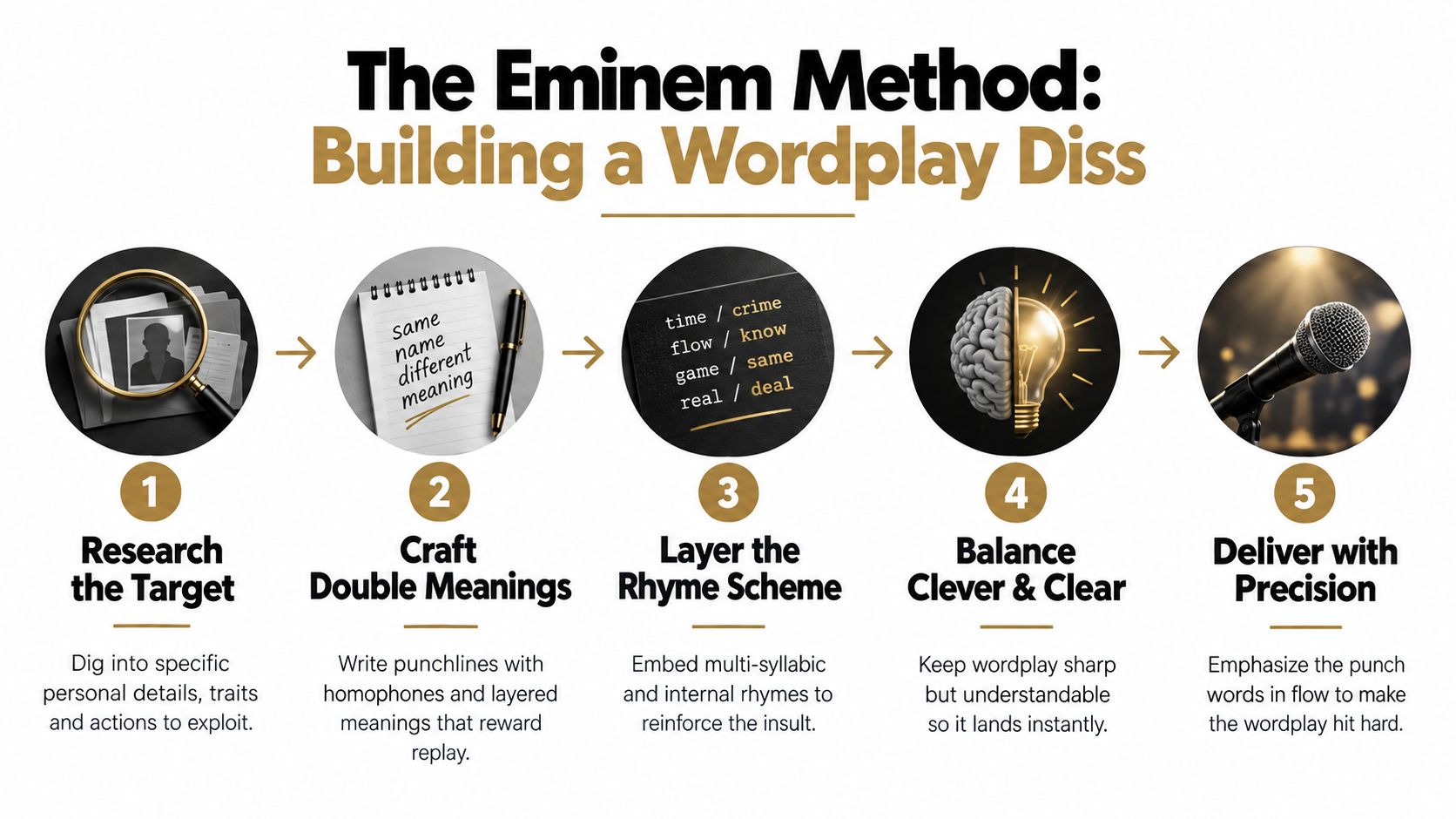 An infographic titled The Eminem Method, illustrating five steps to creating an effective hip-hop diss rap.
This style goes after the whole résumé. The point is to show that the target's catalog, image, or legacy is thinner than the audience was led to believe, then build enough specific pressure that the critique feels earned. Used well, it reads like a verdict because it attacks the record, not just the mood.
Catalog-destruction bars need clean facts. If you cite a title, a project sequence, a public pivot, or a contradiction in the work, get every detail right. One wrong date or misnamed release makes the diss look careless, and carelessness kills the authority this style depends on.
The strongest version follows a simple edit path.
- Start with one real win. Acknowledge the hit or landmark so the line sounds informed, not bitter.
- Shift to the pattern. Point to repetition, uneven sequencing, weak stretches, or forgettable releases.
- Use concrete references. Name songs, albums, features, or public moves instead of talking about “the catalog” in general.
- Close with the thesis. End on a line that sounds final, not like a rant that keeps wandering.
Kendrick Lamar's 2024 diss track “Not Like Us” shows how a diss can become a public record, not just a clapback. It debuted at No. 1 on the Billboard Hot 100 with 70.2 million official U.S. streams, later returned to No. 1 on the Billboard Global 200 with 113.2 million worldwide streams and 39,000 downloads in the February 7–13 tracking window, and also reached No. 1 on Billboard's Rhythmic Airplay chart dated June 15, 2024. Those figures matter because they show how a diss can carry into chart performance and public conversation at the same time, but the line still has to stay disciplined if it wants to sound credible rather than noisy.
3. Street Credibility Questioning Authenticity and Realness Attacks
This is the style for calling out the gap between image and reality. The attack says the target isn't living what they rap, isn't built from the scene they claim, or is being packaged by industry machinery that did the work for them. In hip-hop, that can be a powerful angle because identity and credibility are part of the music's core language.
The best version isn't just “you're fake.” It points to a contradiction, a borrowed persona, a mismatch between lyrics and public behavior, or an industry dependency that the target keeps glossing over. If you can't point to a real inconsistency, the line turns into lazy gatekeeping, and that usually reads as insecurity instead of authority.
A few useful pressure points:
- Documented background contrasts: Publicly known facts can expose a gap between the story and the record.
- Writing contradictions: If one verse says one thing and another says the opposite, that inconsistency is usable.
- Industry support: Producers, ghostwriting rumors, or label packaging can be mentioned carefully if they're documented and not speculative.
- Scene fit: In styles like UK drill, the authenticity debate often centers on local legitimacy, but the critique still needs restraint and context.
The late 1990s and early 2000s battle-rap boom matters here, because it helped normalize diss rap as a formal performance with rules, audiences, and recurring conventions, not just a street argument put on wax. That historical shift made credibility checks part of the art form's grammar, and it's still one of the fastest ways to make a line feel like it belongs to hip-hop rather than generic trash talk. Use that power carefully, and don't confuse cultural evolution with stale purity tests.
4. Relationship Exploitation Personal Life and Intimate Details
This is the most dangerous style on the list because it moves from public image into private vulnerability. It can create huge emotional impact, but it can also turn into harassment, defamation, or collateral damage if you drag in people who didn't choose the feud. If the material isn't public, verified, and fair game, don't touch it.
The smartest version keeps the focus on the target's actions, choices, and documented public relationships, not on random relatives or sealed-off private details. You can reference a public breakup, a documented social-media feud, or a widely known self-inflicted mess, but the line still needs lyrical discipline. If the only way the diss works is by exposing someone else's private life, it's not clever, it's messy.
Public knowledge is not a license to be cruel. The line still has to survive basic tests of fairness and restraint.
That restraint matters even more because personal attacks age badly. A line that feels hot in the moment can look cheap later if it leans on untreated trauma, uninvolved family members, or claims you can't support. The better move is to aim at the opponent's public behavior and let the audience connect the emotional dots.
You'll usually get better results if you do three things. First, keep the target specific. Second, tie the insult to a public action rather than an uncontrollable circumstance. Third, stop before the line becomes a privacy violation. A diss that stays sharp without becoming reckless tends to travel farther, especially when listeners can quote it without feeling like they're co-signing a harassment campaign.
5. Comparison Bars Hierarchical Positioning
Comparison bars work because they make the diss feel like status math. Instead of shouting “I'm better,” you build a comparison that makes the audience reach the conclusion on their own. The line can be subtle, arrogant, funny, or icy, but it should sound confident enough that it doesn't need to explain itself.
This style gets stronger when the comparison is obvious but clever. You can compare yourself to a respected figure, position your output against a weaker rival, or use awards, chart success, and cultural reach as context, as long as you're not inventing numbers or leaning on shaky claims. If the comparison feels forced, it reads as insecurity, not dominance.
A clean comparison bar often does one of these things:
- Raises your frame: You place yourself in a higher category without saying it directly.
- Shrinks the target: You compare the opponent to a smaller reference point.
- Uses contrast: You set your discipline, catalog, or execution against their inconsistency.
- Leaves room for the crowd: You don't over-explain the conclusion.
Kendrick Lamar's “Control” verse is a useful reference point for this style because it framed him against multiple rappers at once, turning the verse into a public ranking exercise rather than a simple insult. Jay-Z and Nas have both used comparison language to establish position in a rivalry where the subtext mattered as much as the direct line. The trick is not to sound desperate for approval. Comparison bars only work when the audience can tell you believe the hierarchy already exists.
 Two framed music awards, one gold and one silver, hanging on a plain white wall.
6. Flow and Delivery Critique Technical Skill Demolition
A technical diss works best when it sounds like the rapper is demonstrating the very skill the opponent lacks. You're not just saying the other person can't rap, you're proving your point through breath control, cadence, internal rhyme, and beat placement. That's why this style can feel especially satisfying to battle-rap fans, the performance itself becomes the argument.
The editing pass is where this style gets polished. Put the hardest insult on the strongest beat, remove syllables that make the line stumble, and test two different deliveries before settling on one. A bar that looks fine on the page can collapse if the stress pattern is awkward or if the rhyme family is too narrow to support the flow. The best technical disses sound effortless, even though they're usually the most carefully built.
Practical rule: If the cadence sounds rushed at normal speaking speed, the audience will feel the strain even if they can't name it.
One good trick is to show superiority before you announce the critique. Rap a cleaner, denser, or more controlled passage, then target the opponent's breathlessness, monotony, or sloppy enunciation. That way the line isn't just theoretical, it's embodied. For help shaping a performance-first draft, the voice and delivery guide can be a useful reference, and if you're thinking in promo terms, the idea of clipping for music promo connects well to lines built for short, replayable moments.
The strongest technical diss sounds like a lesson and a hit at the same time. If the audience feels the precision, the insult gets sharper without needing extra volume.
7. Meme-Worthy One-Liners Viral Social Media Disses
This is the tightest style, and it is built for the feed. The goal is not a long-form takedown, it is one line that can live as a caption, a screenshot, a stitched clip, or a quote card. The trade-off is clear. You give up depth, and you gain speed plus shareability.
A strong one-liner usually needs one twist, one recognizable trait, and one clean punch. Skip stacked clauses. Keep the line to a single hit, because it has to land instantly if it is going to work on TikTok, X, short-form roast videos, or meme pages.
A few practical filters help:
- One punch only: If the line needs a second sentence, it is probably too long.
- Recognizable target trait: Name something the audience already sees.
- Funny first, vicious second: Humor helps the line travel farther.
- Timing matters: Fast response lines usually beat late, overworked ones.
A line can also go viral as a screenshot even when the full record does not. Nicki Minaj's “Barbie Tingz” era gave fans plenty of standalone caption material, and Drake's “Back Outside Boyz” era produced lines that were repeatedly lifted into posts and reaction edits. The reason is simple. Short, self-contained bars survive better on short-form platforms than lines that need a lot of setup.
That same logic applies to creator feuds and streamer roasts, where a single clean line often outlives a full paragraph of explanation. If the joke needs context, it usually dies in the scroll.
 A group of happy diverse friends sitting on a couch laughing while looking at a smartphone.
8. Storytelling Narrative Disses Context-Rich Character Assassination
This style builds the attack like a story, not a shot. The diss unfolds across verses, each section adding evidence, pressure, or a new contradiction until the whole portrait feels unavoidable. When it works, the opponent doesn't just get insulted, they get framed inside a narrative that makes the insult feel earned.
The opening has to state the thesis clearly. After that, every verse should push the same case forward with supporting details, emotional shifts, and internal consistency. If the story wanders, the diss loses force, because the audience can't tell whether the rapper is building an argument or just venting.
The writing discipline here is close to song structure. If the first verse introduces the claim, the second verse should escalate the evidence, and the ending should land like a conclusion rather than a fadeout. For structure and pacing help, the song lyric structure guide is a useful reference point when you're shaping a longer piece.
This approach works especially well when the audience already knows pieces of the story. Kendrick Lamar's “Like That”, J. Cole's “False Prophets”, and Pusha T's “Story of Adidon” all show different versions of a narrative attack, where the diss isn't just mean, it's organized. That structure gives the listener a path through the bars, which is why the line can hit harder over time instead of only in the first replay. A narrative diss should feel like a case file with rhythm.
8-Point Diss Rap Line Comparison
| Technique | 🔄 Implementation Complexity | ⚡ Resource Requirements | ⭐📊 Expected Outcomes / Impact | 💡 Ideal Use Cases | Key Advantages |
|---|---|---|---|---|---|
| Personal Attack with Wordplay (The Eminem Method) | High, layered wordplay, multi-syllabic schemes | High, time, advanced vocabulary, rehearsal | High ⭐⭐⭐, memorable, high replay value 📊 | Battle rap, recorded diss tracks, lyric-focused audiences | Showcases technical skill; quotable; layered meanings |
| Catalog Destruction (Career and Discography Dismantling) | High, systematic, fact-heavy deconstruction | High, research, discography/stats verification | High ⭐⭐, intellectual impact; can delegitimize legacy 📊 | Long-form diss tracks, fanbase-targeted takedowns | Demonstrates knowledge; hard to defend; narrative of decline |
| Street Credibility Questioning (Authenticity Attacks) | Medium, needs clear contradictions and evidence | Medium, background checks, industry receipts | Medium ⭐⭐, erodes trust among purists 📊 | Genre gatekeeping, live confrontations, authenticity debates | Strikes at hip‑hop values; effective with proof |
| Relationship Exploitation (Personal Life & Intimate Details) | Low–Medium, emotionally direct but risky | Low, insider knowledge, social media research | High short‑term ⭐, strong shock/viral potential but reputational risk 📊 | Social media feuds, personal vendettas, party contexts | High emotional impact; perceived insider knowledge |
| Comparison Bars (Hierarchical Positioning) | Medium, requires subtlety and evidence | Medium, metrics, achievements, clever analogies | Medium ⭐⭐, positions disser as superior with lower backlash 📊 | Features, public positioning, songs aiming for confidence | Subtle, confident, legally safer than direct attacks |
| Flow and Delivery Critique (Technical Skill Demolition) | High, technical musical analysis required | Medium–High, audio examples, technical knowledge | High ⭐⭐⭐, credible among musicians; proves superiority 📊 | Battle rap, technical audiences, live showcases | Legitimate competitive form; hard to refute; showcases craft |
| Meme‑Worthy One‑Liners (Viral Social Media Disses) | Low, extreme brevity and punch needed | Low, creativity, timing, meme formatting | High short‑term ⭐, viral reach and shareability; ephemeral 📊 | Social platforms, creators, rapid-response marketing | Very shareable; low barrier; drives engagement |
| Storytelling Narrative Disses (Context‑Rich Character Assassination) | Very High, multi‑verse narrative structure | High, deep research, production, time investment | Very High ⭐⭐⭐, sustained impact and artistic legacy 📊 | Album tracks, long-form takedowns, serious listeners | Nuanced, persuasive, enduring cultural discussion |
Choose the Sharpest Tool, Then Edit Ruthlessly
Pick the style based on the effect you want, not the insult you already have. If you want the crowd to laugh, reach for a one-liner or a wordplay bar. If you want to sound technically sharper, use a flow critique or a comparison bar. If you want to make a serious case, build a narrative or dismantle the catalog, but only if the facts are solid and the angle is fair. The strongest diss rap lines almost always start from one specific observation, then get stripped down until every extra word serves the punch.
Read every bar aloud. If the rhythm stumbles, the insult stumbles with it. If you need to explain the line, it probably isn't ready. And if the claim depends on private information, protected characteristics, uninvolved relatives, doxxing, or allegations you can't support, cut it before it leaves the draft stage. Personal material only belongs in consensual contexts, because once a line crosses into harassment, the writing stops being sharp and starts being careless.
For competitive writing, comparison, technical critique, and wordplay are the safest places to start because they show skill without leaning on damage. That's where most good battle writing lives anyway, in the overlap between precision and personality. DissTrack AI can help you generate alternate angles, test style tags, and shake loose a few rough drafts, but the final line should still be human-edited for accuracy, originality, tone, and responsible sharing. If you want a broader craft reference for the hooks and packaging side of short lyrical content, the 2026 hooks checklist is a useful companion read.
If you want faster drafts for diss rap lines, DissTrack AI can generate personalized roasts from a target, inside jokes, and a chosen style tag. Use it to explore different angles, then edit the bars so they fit your voice, your audience, and the level of heat you want to publish.