
8 Rap Battle Insults That Always Land in 2026
The strongest rap battle insults aren't necessarily the nastiest. They're the best constructed. Academic work on battle rap describes a contest of verbal skill, flow, delivery, and audience response, rooted in African American traditions such as the Dozens, not a competition to say something crueler (Springer's chapter on battle rap).
Anyone can borrow a famous insult. Making your friend's abandoned podcast sound like an international infrastructure failure takes actual writing.
Think of Roxanne Shanté turning somebody else's premise against them, or Kendrick Lamar making an attack feel like a chant the room already knows. The useful inheritance isn't their exact wording. It's the format underneath it: rebuttal, repetition, contradiction, revelation, audience alignment, status reversal, exaggeration, and double meaning.
These formats work beyond serious beef. A consenting birthday roast, streamer rivalry, fictional character battle, or producer's competitive verse can use the same construction without importing somebody else's grudges.
- Borrow the mechanism, not the famous lyric.
- Personalize the premise, not just the name.
- Write for the listener's ear, not your notebook's approval.
Whether you're trading bars with friends or promoting rap tracks on SoundCloud, give people an original moment worth repeating. Start with a recognizable detail, bend it into an unexpected picture, and leave enough space for the laugh.
1. "Roxanne's Revenge" (Roxanne Shanté)
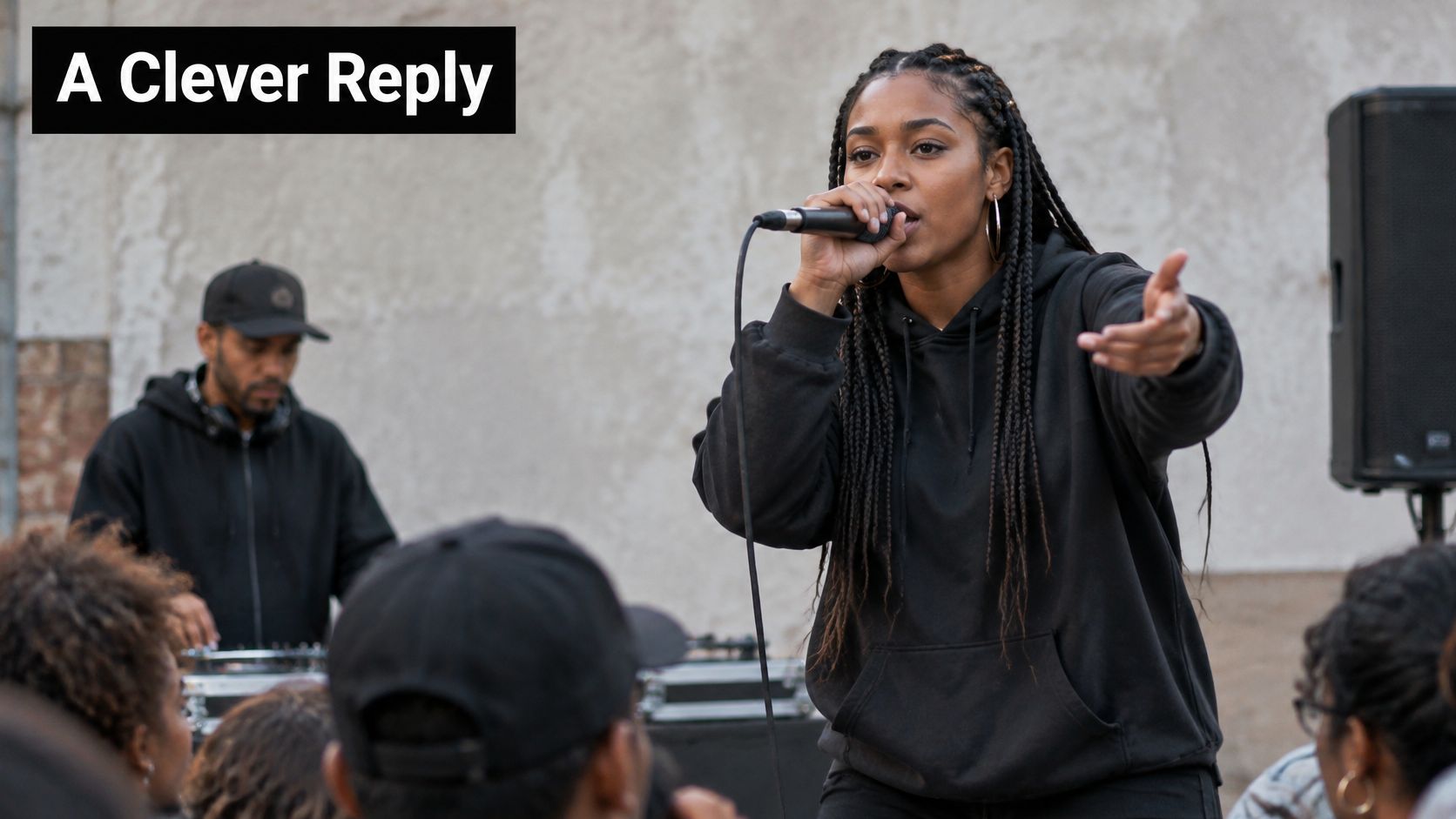 A young female rapper performs at an outdoor event while addressing the audience with a microphone.
Somebody tells a story about you. You walk into the story, take the microphone, and explain why the narrator shouldn't have been trusted with it.
That's the useful writing model in Roxanne Shanté's answer to UTFO's “Roxanne, Roxanne.” Instead of accepting the original record's perspective, the response makes that perspective the target. For playful writing, this becomes the claim flip: repeat your opponent's boast, then change what it means.
Say your friend keeps announcing that they run the group chat. Don't settle for calling them annoying. Turn their chosen title into a smaller, funnier job.
You run the group chat? Congratulations on the role.
You pin your own messages and call that crowd control.
Turn their introduction into your setup
The first line gives listeners something familiar. The payoff replaces the friend's imagined authority with the image of an overenthusiastic administrator. You haven't invented a scandal. You've challenged their interpretation of something everyone recognizes.
Build your version around their actual catchphrase, gamer tag, recurring boast, or favorite excuse. Keep the original wording recognizable enough that the audience catches the reference without an explanation.
Short bars help this format. If you need a paragraph explaining what your opponent said, choose a clearer claim. The audience should hear their boast, recognize the turn, and laugh before you've started defending the joke.
Use it when someone has already supplied your setup. A good rebuttal doesn't need to invent the door. It walks through the one your opponent left open.
2. "Hit 'Em Up" (2Pac)
A hook can make an insult feel less like a passing remark and more like the name of your opponent's entire operation.
The adaptable lesson from “Hit ’Em Up” is repeated framing with committed delivery, not its threats or personal allegations. Choose a narrow, observable target, then return to a phrase that summarizes it. You're building a roast with a chorus, not collecting unrelated complaints.
Say a friend constantly promises a podcast, clothing label, and gaming channel, but never releases anything. Your central phrase could be all launch, no landing. Every verse detail should support that image.
- The premise: They announce projects more often than they finish them.
- The hook: All launch, no landing.
- The supporting detail: Their promotional countdown outlives the project.
- The escalation: Even their coming-soon announcement needs a sequel.
Make each repetition earn its place
Try this original adaptation:
All launch, no landing, still polishing the brand,
Your trailer got a trailer, but the show ain't even planned.
The internal echoes give you momentum, while the final image makes the criticism specific. Deliver the hook firmly, then leave a pocket before the punchline. If you yell through everything, listeners can't tell which words deserve attention.
Keep the attack on the chosen behavior. Don't drag in unrelated friends, family members, or communities to make the verse seem bigger.
This format suits a friendly competitive track with a clear recurring joke. It's less useful when you've only got a vague grievance. Repetition can strengthen a premise, but it can't manufacture one.
3. "Ether" (Nas) and "Takeover" (Jay-Z)
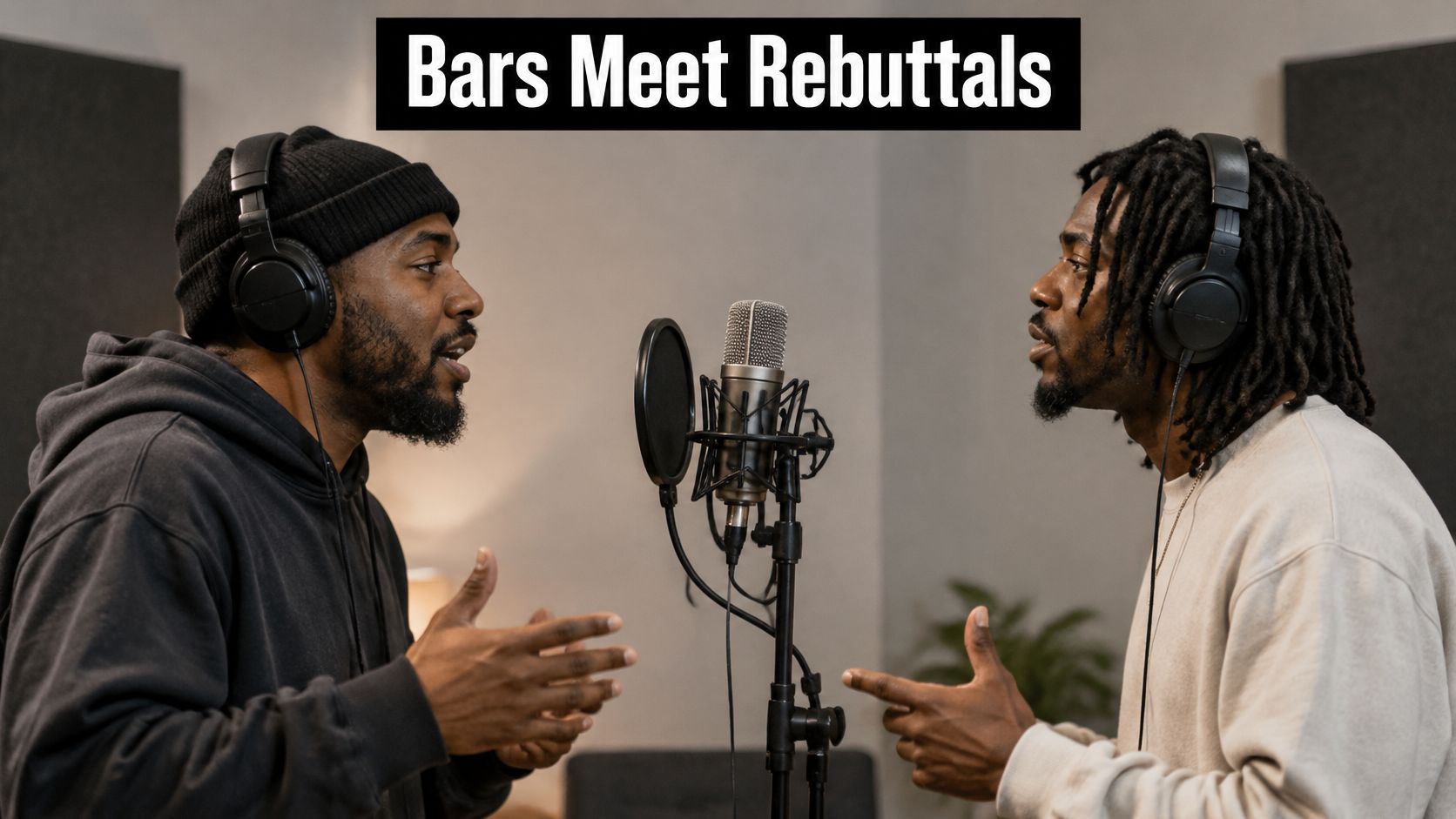 Two Black male rappers in a studio engaged in a rap battle with a central microphone.
The most useful thing to steal from the “Takeover” and “Ether” exchange isn't somebody's insult. It's the habit of treating an opponent's public persona as material you can examine, challenge, and reinterpret.
This is the contradiction audit. Your opponent says they're independent, original, unstoppable, or indispensable. You find a harmless, recognizable example that complicates the claim.
Say your producer friend calls themselves the architect of every session but always arrives after everyone else has arranged the song. The insult shouldn't just say they're late. It should shrink their grand title.
You call yourself the architect, directing every session,
You show up for the playback with a list of corrections.
Put the claim beside the behavior
A linguistic study of battle punchlines identifies value-based categorization and contempt among their pragmatic mechanisms, which helps explain why challenging someone's claimed status can be more pointed than generic name-calling (Revista de Estudos da Linguagem study).
For your own writing, build a private pairing: what they claim versus what they do. Then choose the contrast your audience can recognize immediately.
- Claim: They're the group's fashion authority.
- Behavior: They ask everyone else what to wear.
- Angle: The consultant needs a consultant.
Don't turn the verse into an evidence dump. Pick the clearest contradiction and develop it through fresh images. If you're planning a friendly response track, leave room for your opponent to answer the premise.
That's how a roast becomes an exchange rather than a monologue with a drum loop.
4. "The Story of Adidon" (Pusha T)
The room doesn't always need more volume. Sometimes it needs a smaller sentence.
The transferable device in “The Story of Adidon” is the focused reveal: organize the verse around a detail that changes how listeners understand the target's persona. For a friendly roast, that detail should be harmless and appropriate to share, not somebody's private life presented as entertainment.
Say your friend dresses like a meticulous luxury collector but keeps the decorative sticker on a cheap prop watch. You can build a reveal around the costume, not their income.
You gave that watch a backstory, a legacy, a name,
The sticker on the face still says it's from a party game.
Reveal the contradiction, not the secret
A discussion of diss exchanges in a linguistic analysis published by De Gruyter Brill warns that targets can suffer serious loss of social standing even when a genre permits insulting behavior. Permission to battle isn't permission to expose everything.
Use a shared joke, an agreed anecdote, or an obviously fictional scenario. Don't disguise an unverified allegation as a dramatic reveal, and don't publish sensitive information to imitate the scale of a famous feud.
When studying the greatest diss tracks, separate narrative control from personal exposure. You can learn the former without reproducing the latter.
Write toward your reveal backward. Draft the final image, add only the context listeners need, and cut anything that gives the ending away. Perform it calmly enough that people can hear the exact detail.
A controlled punchline doesn't need you shouting instructions about how devastating it was.
5. "Not Like Us" (Kendrick Lamar)
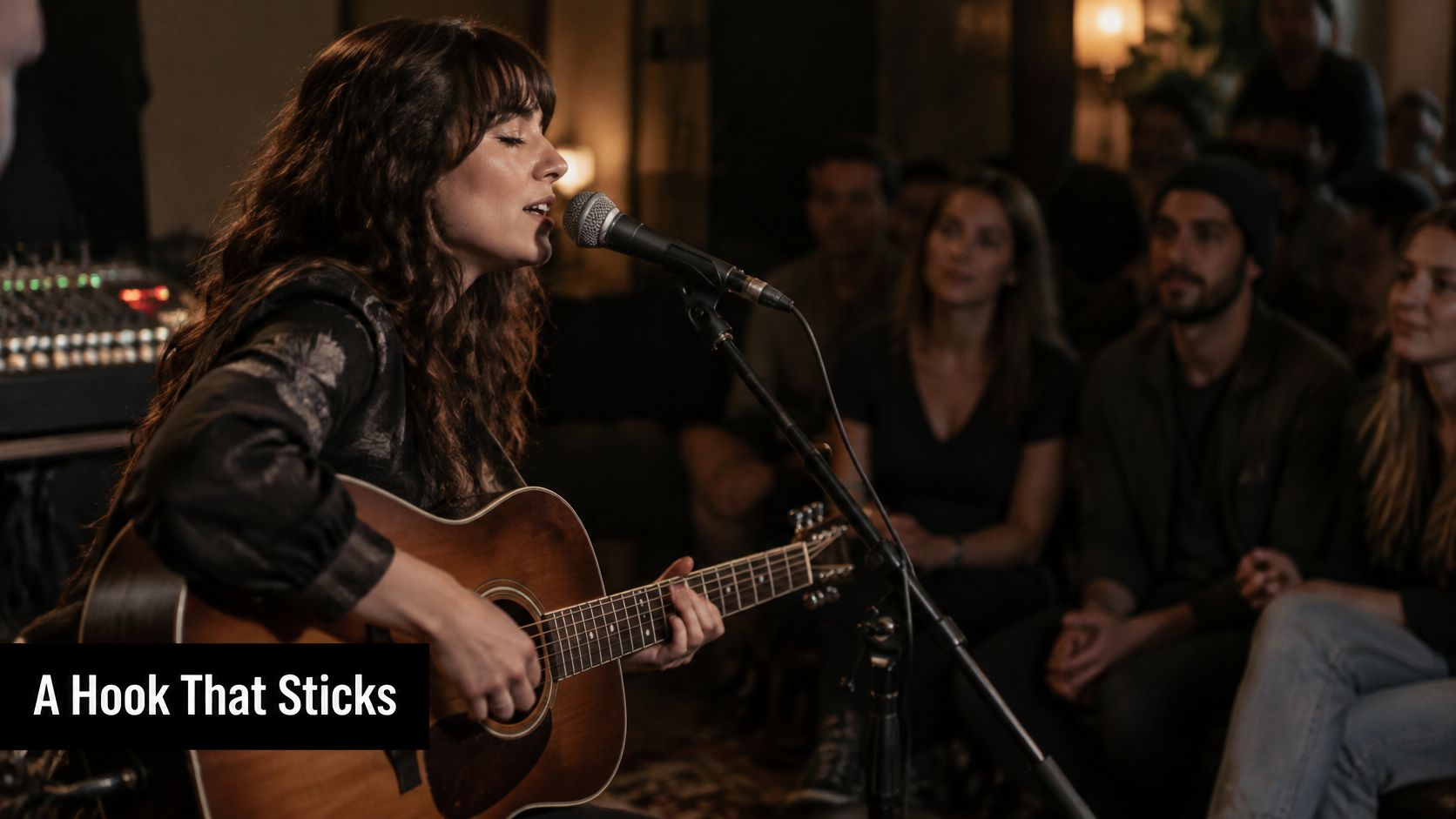 A female musician singing and playing an acoustic guitar during an intimate live performance for an audience.
A crowd can't chant your footnotes.
The practical lesson to take from “Not Like Us” is the audience-alignment hook. Instead of merely describing an opponent, write a phrase listeners can participate in. For a playful roast, the contrast might be between the friends who play the game and the friend who only delivers motivational speeches in the lobby.
Your hook could be all talk, no spawn. The joke works because the audience already understands both the setting and the behavior.
You coach us through the loading screen, then vanish when it's on,
We're fighting for the final round, you're fighting with log-on.
Give the audience something easy to carry
Unlike the repetition format, which keeps returning to your accusation, this format gives the room a role in delivering it. Leave a gap where friends can answer the phrase. Keep the wording clear enough that they don't need rehearsal.
- Use shared context: A game lobby, studio session, or group project gives listeners an immediate setting.
- Keep the target specific: Mock the teammate's disappearing act, not everyone who shares an identity with them.
- Test the isolated hook: It should still sound playful without the full verse around it.
A hook should summarize the joke, not ask strangers to join a pile-on.
Don't borrow the track's serious allegations as a shortcut to intensity. Borrow the musical construction: a clear phrase, a recognizable contrast, and space for participation.
For a short roast video, make the joke understandable before worrying about captions or effects. If the audience needs an explanation of the premise, the hook isn't finished.
6. "Nail in the Coffin" (Eminem)
Your opponent walks in wearing an imaginary championship belt. Your job is to reveal that it's holding up their imaginary trousers.
The useful format in “Nail in the Coffin,” aimed at Benzino, is status deflation. Don't reproduce the grievance. Study how you can question the importance an opponent assigns themselves, then make that mismatch visible.
Say your friend calls themselves the headliner at every karaoke night but spends the performance adjusting the microphone stand. Their chosen status is star performer. Your counter-image is equipment inspector.
You came to headline karaoke, gave the room your master plan,
Then spent the whole performance sound-checking the stand.
Start with the picture that makes you laugh
Write your strongest comic image before arranging the verse. Then build a setup that gets listeners there without announcing the ending.
The distinction matters when browsing the best battle rap lines: a strong payoff isn't the same as a shocking topic. You can make someone's inflated persona look ridiculous without reaching for identity-based abuse.
UCLA's Languaged Life discussion of insults in rap and media examines how misogynistic and homophobic language can reinforce harmful hierarchies. For your writing, aim the attack at the costume somebody chose, not an identity they carry.
Ask whether your joke still works after removing profanity. If it collapses, you may have written an attitude instead of a punchline.
This format suits a target with a theatrical persona: the self-appointed captain, the bedroom mogul, the amateur coach. Give that persona a smaller job, then let the audience notice the demotion.
7. The "Yo Mama" Insult Format
Your snack stash is so guarded, the biscuits need a pass.
That's the familiar exaggeration engine without making somebody's actual mother the subject. The classic “Yo Mama” format gives you a short setup, an exaggerated trait, and an absurd consequence. You can keep that rhythm while moving the target to an agreed subject.
A discourse analysis of FlipTop battle rap identifies attacks involving relatives or relationships among recurring insult strategies. Recognizing a convention, though, doesn't mean every friend wants their relatives included in the game.
Keep the structure and change the destination
Use your playlist, your gaming setup, your excuses, or your snack cupboard as the subject. Then exaggerate a harmless detail until the audience can see the impossible consequence.
For a friend who keeps every old charging cable:
Your cable drawer's so ancient, when you finally clear the floor,
A museum sends a curator to catalog the drawer.
The image needs tightening if you're performing it quickly, but the construction is clear: ordinary habit, enormous exaggeration, unexpected authority figure.
- Choose an observable quirk: They hoard cables, overpack, or label every kitchen container.
- Choose a scale mismatch: A drawer becomes an archaeological site.
- Finish on the image: Don't explain afterward that they keep old things.
Boundary rule: If relatives haven't agreed to participate, leave them outside the verse.
This format works well for party rounds because listeners can understand the setup immediately. Originality comes from the particular detail, not from adding a more vicious adjective.
Keep the delivery light enough that the exaggeration reads as a joke rather than a complaint you've been saving since last summer.
8. Double-Meaning Wordplay (Multisyllabic Punchline Technique)
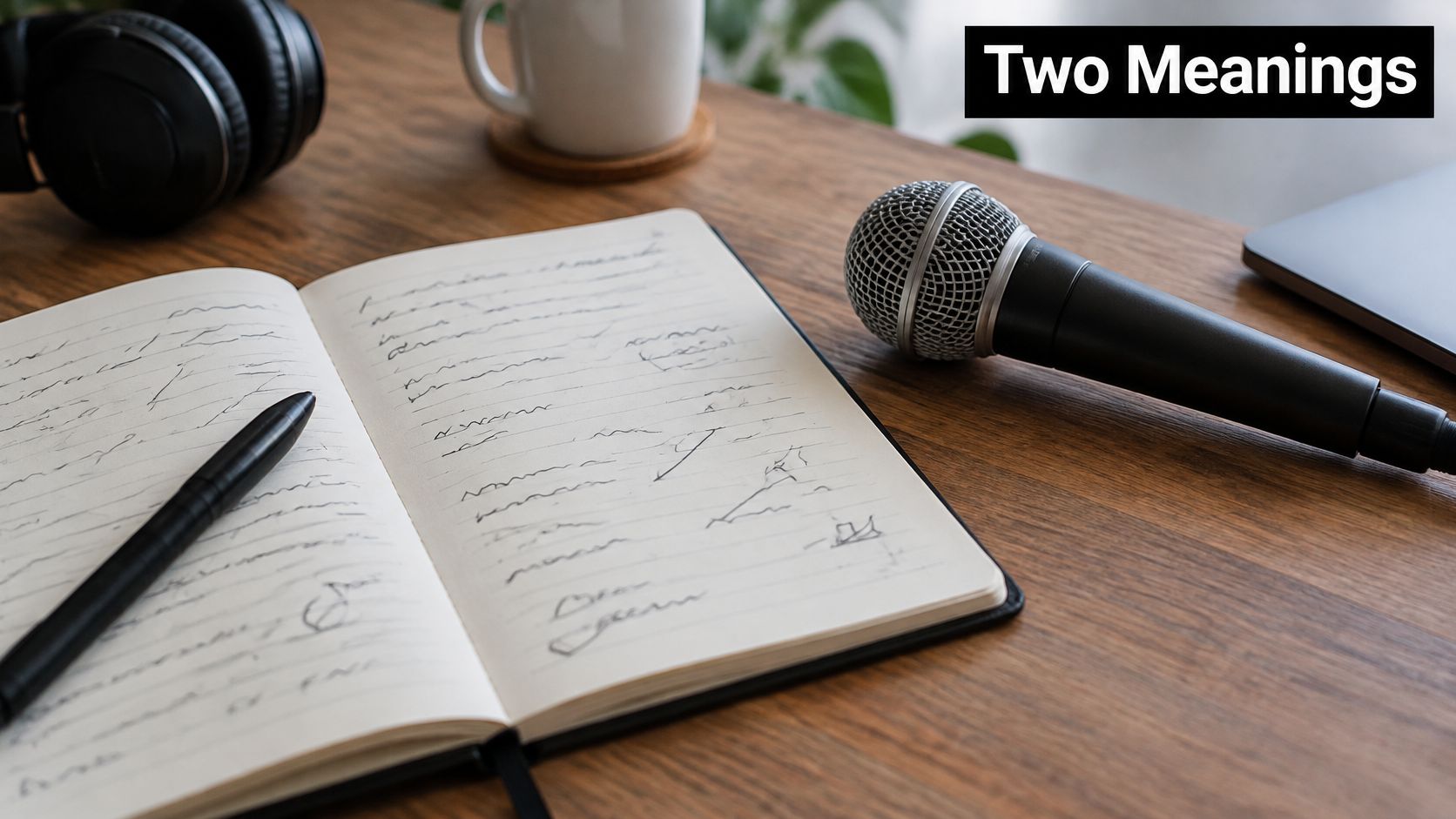 A wooden desk featuring a notebook with shorthand writing, a black pen, headphones, and a microphone.
Your DJ friend keeps talking about their flawless record. Unfortunately for them, record already has another job.
That's your opening for double-meaning wordplay. Find a word connected to the target's behavior that also belongs naturally in another setting. Then write a line where both readings contribute to the insult.
You brag about your record like you've never missed a cue,
But every time you touch the decks, that record skips on you.
The repeated word connects reputation with playback. It isn't complicated, but listeners don't need a translator standing beside the speakers.
Separate meaning from rhyme
A double meaning and a multisyllabic rhyme aren't interchangeable. The double meaning creates the conceptual turn; the rhyme pattern shapes how you deliver it. You can use either independently, then combine them when both remain clear.
Start with a vocabulary cluster connected to your target. For a producer, try track, mix, master, sample, and credit. For a gamer, try rank, carry, lobby, and save.
Explore multisyllabic rhymes after you've found the central joke. Don't force an awkward phrase into the verse just because its sounds match beautifully.
Read the line aloud without showing anyone the text. If the second meaning only works through punctuation, unusual spelling, or an explanation, revise it for the ear.
Then check personalization. Could you aim the same bar at anybody in the room? If so, add the DJ's recurring missed transition, the gamer's abandoned match, or the producer's famously unfinished mix.
The cleverest word in the dictionary still needs a reason to be in your battle.
8 Rap Battle Insult Formats at a Glance
| Format / Track | Core Technique | Difficulty | Best For |
|---|---|---|---|
| “Roxanne's Revenge” (Roxanne Shanté, 1984) | Direct callouts and punchy answer-record rebuttals | Beginner-friendly | Short, clever responses and quick roast verses |
| “Hit ’Em Up” (2Pac, 1996) | Aggressive delivery, explicit callouts, and a memorable hook | Intermediate | High-energy, memorable diss clips |
| “Ether” (Nas, 2001) and “Takeover” (Jay-Z, 2001) | Dense wordplay, catalog references, and back-and-forth rebuttals | Advanced | Layered insults and multi-round exchanges |
| “The Story of Adidon” (Pusha T, 2018) | Controlled delivery centered on one revealing claim | Intermediate | Focused, personalized roasts with a sharp central reveal |
| “Not Like Us” (Kendrick Lamar, 2024) | Catchy hook, repeated phrases, and strong production | Beginner-friendly | Shareable hooks and mainstream-friendly diss tracks |
| “Nail in the Coffin” (Eminem, 2002) | Aggressive flow, shock value, and punchline-heavy wordplay | Intermediate | Battle-style verses, memes, and short clips |
| The “Yo Mama” Insult Format | Simple setup followed by a comedic punchline | Beginner-friendly | Playful roasts, party jokes, and memes |
| Double-Meaning Wordplay (Multisyllabic Punchline Technique) | Layered meanings, multisyllabic rhymes, and end-of-bar punchlines | Advanced | Clever, memorable insults for experienced writers |
From Studying Classics to Writing Your Own Knockout Bars
Start with the friend who announces a podcast every month, the gamer who disappears at match time, or the producer who calls every unfinished loop a masterpiece. Those details give you something to write about. A name alone doesn't.
Choose the format that fits the material. Use a claim flip for a boast, a contradiction audit for a persona, or a double meaning for a detail with useful vocabulary. Don't force a dramatic reveal onto a situation that only needs a playful joke.
Build a verse you can actually perform
- Choose an agreed target and boundary: Confirm that a friendly roast is welcome and identify topics that aren't.
- Gather recognizable details: Use inside jokes, harmless embarrassing moments, recurring habits, and public creative choices.
- Draft the payoff: Find the image listeners should remember before writing the setup.
- Build toward it: Add context, rhyme, and rhythm without explaining away the surprise.
- Perform and revise: Record yourself, listen without reading, and cut words that block the joke.
At DissTrack AI, we offer a way to turn that material into a working draft. Our system was trained on thousands of diss tracks, including works by 2Pac, Nas, Eminem, and Pusha T; you provide the target's name, your relationship, and inside jokes, then choose styles such as West Coast Hip-Hop, Old School Boom Bap, Trap, Battle Rap, Drill, Emo Rap, or UK Grime and adjust the savagery level. It generates structured verses with rhyme schemes and flow patterns, provides multiple variations, and raps and mixes the track over a beat in seconds.
Treat those variations as material to edit, not a reason to stop listening critically. Keep the image that fits your target, choose the cadence you can deliver naturally, and rewrite anything that doesn't sound like you. Our generations stay private, aren't shared, sold, or publicly displayed by us, and don't trigger notifications to targets; our Free plan costs $0 forever and includes 1 diss track.
Before publishing your own export, consider how the joke sounds outside the original group. For video, use vertical formatting and caption tips to make the performance readable, but keep enough context that a friendly exchange doesn't resemble an unexplained attack.
The goal isn't to sound like somebody else's legendary beef. It's to make a line so specific that your friends know exactly who it's about before you even say the name.
Bring your target's harmless quirks, choose an insult format, and visit DissTrack AI to create personalized roast lyrics with adjustable style and intensity. Compare the variations, rewrite the punchline in your own voice, and give the room a joke worth running back.