
Privacy Rules for AI Diss Tracks: What Stays Private
Your diss track stays private until you choose to publish it. We don't share it, sell it or put it on display, and the person you roasted never gets a notification.
It's late, the group chat is loud, and someone has just dropped four lines about your friend's karaoke voice into the thread. Everyone laughs, someone screenshots it, and then you get ambitious. You open a generator, type your friend's first name, their relationship to you, that story about the wedding, hit generate, and forty seconds later you've got a verse with a punchline sharper than anything in the chat. Then a small, cold question shows up: who else can see what I just typed?
That question has a real answer, and it's shorter than most privacy pages make it look.
Your Privacy Answer in One Table
Four stages, four different levels of exposure. That's the whole shape of it.
The draft is yours while it sits unsent. The saved version in your account is yours too, private by default. The public post is where strangers walk into the room. And the copies on your friend's phone, in the group chat, in someone's camera roll, are outside your reach the moment they land. Notice that the decision to generate is cheap and reversible. The decision to publish isn't.
| Stage | Default status | Who can reach it | Your control |
|---|---|---|---|
| Draft you generate | Private to your account | You, plus limited service access for support or security | Edit, regenerate or delete |
| Saved version in your account | Private, owned by you | You and the service's systems that store it | Keep private or delete |
| Public post you choose to make | Visible to anyone who sees the post | Your audience and anyone who saves or forwards it | Take it down, but copies may already exist |
| Copies on your devices or in group chats | Outside the service's control | Anyone you sent it to | Delete your own copies and ask recipients to do the same |
Read the first two rows again. They're the reason the rest of this is manageable. Everything you make stays inside your account until you deliberately move it out. Once a track leaves that boundary, you're not managing a prompt anymore. You're managing a statement about a real person with a real name, and statements travel.
Two rows are a storage question: who holds the file, for how long, and what can you do about it. Two rows are a publishing question: who saw it, who kept it, and what happens when the person in the lyrics wants it gone. Different levers, different timelines, different people to call.
The rule to carry: private until you publish, and whatever you publish you should be able to defend out loud.
That's the short answer.
The Two Privacy Laws That Shape Your Roasts
Say a café owner types a rival's full name, their old failed pop-up, and a line about the office party into a prompt field. The joke may feel like locker-room wordplay, but the moment those details point to a real person, two privacy regimes matter: the EU's General Data Protection Regulation and California's CCPA. Neither was written for battle rap. Both can still shape what happens when a named person's details land in a generator.
The GDPR became applicable on 25 May 2018. It gives people enforceable rights to access their personal data, correct inaccurate information, request erasure, object to processing, obtain portability, and get a clearer explanation of how their data is used. The serious side is plain: the most serious infringements can draw 4% of a company's worldwide annual turnover or €20 million, whichever is higher. For a roast, that means the clever verse is only part of the story. The name, handle, employer, and story tucked into the prompt can count as data about somebody else.
California runs on its own clock. The CCPA was enacted in 2018, took effect on 1 January 2020, and the California Department of Justice began enforcement on 1 July 2020, as the Attorney General's first-year enforcement update records. Consumers can find out what is collected and how it is used, ask for deletion, and opt out of the sale or sharing of personal information. Early on, businesses generally had 30 days to cure an alleged violation. California then removed the general mandatory notice-and-cure requirement for CCPA violations from 1 January 2023, which is the state saying it will come directly at a business rather than send a friendly letter first.
| Right | GDPR | CCPA |
|---|---|---|
| Access your data | Yes, right of access | Yes, right to know what is collected and used |
| Correct inaccurate data | Yes | No, not among the three CCPA rights in this comparison, so go to the business's request channel directly |
| Request erasure or deletion | Yes, right to erasure | Yes, right to request deletion |
| Object to or opt out of use | Yes, right to object to processing | Yes, opt out of sale or sharing |
| Data portability | Yes | No, not among the three CCPA rights in this comparison |
The part that catches people is quieter than the fines. A roast about a named person is personal data about that person, and those rights belong to them, not to the clever one holding the keyboard. If your friend's full name, employer and the office party story sit inside a verse, your friend has a say in how that data gets handled long after you've closed the tab. DissTrack AI keeps generated disses private, does not share, sell or publicly display them, and does not notify targets. You own what the AI generates, and the business claims no rights to your lyrics. You can cancel anytime. That keeps the default tidy, but it does not make the named person's details disappear from the legal picture.
If you run a small business and also host the group's roast page, state rules stack on top of the federal picture, and these privacy rules for Washington small businesses cover what a small operator has to put in place before publishing other people's stories. For everyone else, the practical move is simple: before you type a real name, find out how the service handles access, deletion and opt-out requests, and whether a request goes through a form, an email or a switch in the account settings.
The European Commission's GDPR explainer is not used here because the supplied link points to a fabric success story. Fine counts, authority counts, and cure-rate percentages without a source in the section have also been left out.
Where Your Prompts and Lyrics Travel
Say you type the target's first name, "my old roommate", the joke about the failed startup, their height, their Instagram handle. Hit generate. Three things happen that you can count on.
- The prompt is captured. Name, relationship, inside jokes and whatever else you supplied become an input tied to your account.
- The verse gets written. Your lyrics are yours. The service doesn't claim any rights to what the AI generates for you.
- The output lands in your account, private. Generated disses aren't shared, sold or publicly displayed, and the target isn't notified.
That much is solid ground. Past step three, every generator answers differently, and you only find out by asking. What gets logged when a generation runs, and does that log hold the content or just the fact that it happened? How long do backups persist, and does deleting in the product also delete the backup copy, or do those run on separate clocks? Which vendors touch the data to keep the service running, and in which countries? These are the questions to put to any tool before a real name goes into the prompt box, because the privacy page rarely answers them in plain sight.
Here's the bit worth taping to the inside of your skull: private until published is not the same as invisible. Private means "not on a public page". Any service that stores your input at all has some number of systems and people that can reach it, from support tooling to security review, and the only question is how many and under what rules. Your roommate's height and failed startup sit on a server somewhere. The verse about them does too.
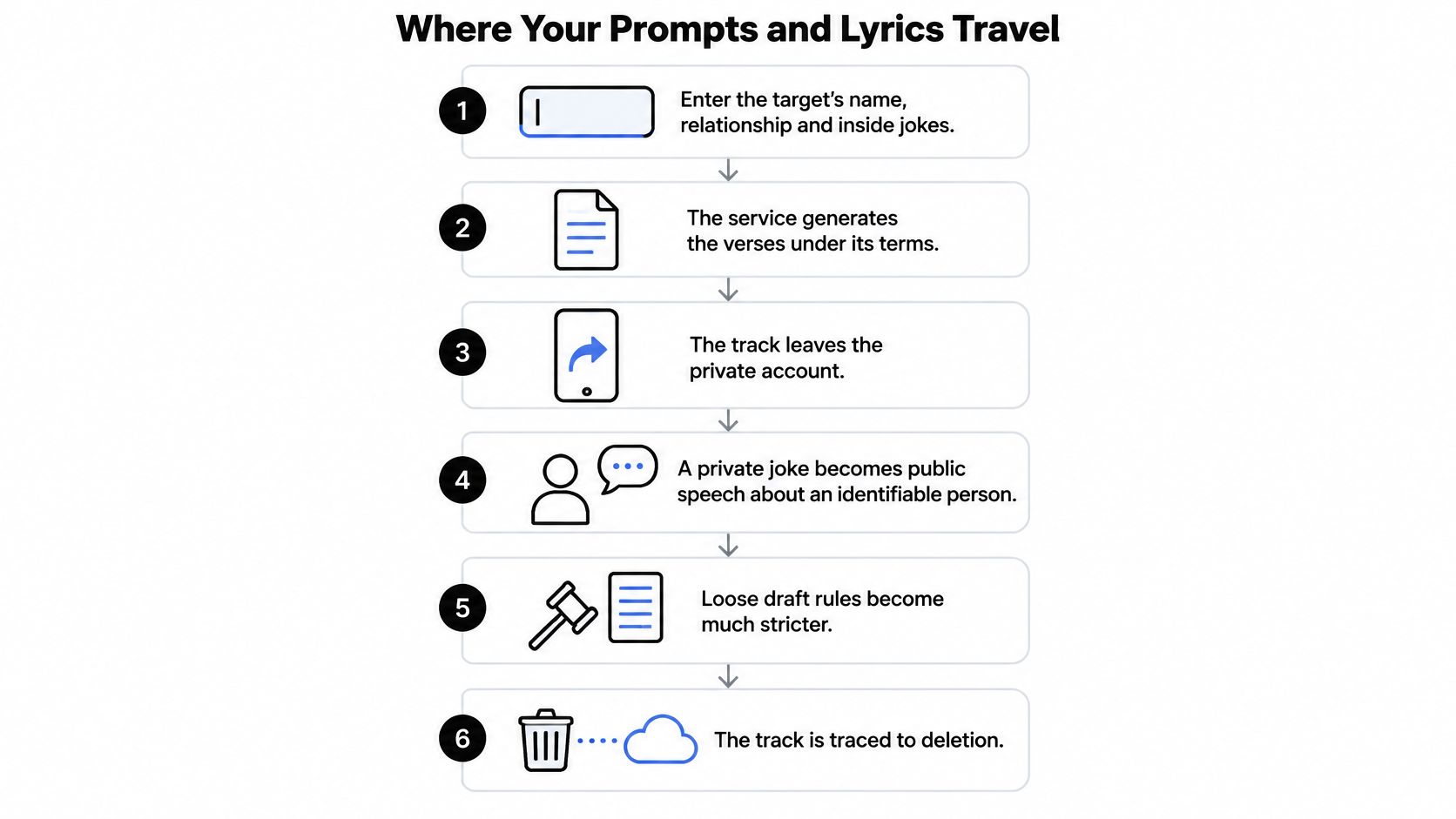 A six-step infographic illustrating the data privacy process of user prompts and AI-generated lyrics.
The global privacy watchlist published by Mayer Brown frames the broader direction plainly: purpose-specific consent, documented withdrawal, minimization and auditable retention limits. In plain terms, the industry is moving toward services that can say exactly what they keep, why they keep it and when it dies. A generator that can't answer those three things about your prompt is telling you something.
So is one that can. Before you type anything identifying, look for answers on what happens to a prompt after deletion, how forwarding and downstream use work, and who can pull a copy back. These prompt data forwarding controls walk through where copies go once they leave your account, which is the part nobody thinks about until a verse escapes.
A simple test keeps you honest. Write the prompt with a fake name first and watch what the flow asks for. Our make me a diss track walkthrough runs the basic path end to end, so you can see which fields a request needs before you hand over a real one. Then swap in the actual details only when you know where they travel: Instagram handle, height, embarrassing moments and all. The joke gets funnier with specifics. The risk does too, and now you know exactly where it lives.
What Consent Must Cover Before You Publish
Your friend says "yeah, send it" in the group chat at 1am. At 9am they see the posted version and go quiet. The 1am yes covered the joke. It never covered the post.
Consent for a roast has four separate parts, and each needs its own yes:
- Generating the verse, which is low stakes and stays between you.
- Storing it in an account, which determines how long the details sit on a server.
- Publishing it, which is the big one, because it turns a private joke into public speech about a named person.
- Commercial reuse, which covers merch, ads, a paid video or a monetized channel.
A single privacy-policy checkbox can't carry the publishing or cross-border authorization, because it doesn't name the purpose. Ask in plain words that do the naming for you: "May I post this verse about you on our group blog, with your first name in it, and leave it up until December?" That sentence gives the purpose, the place, the duration and the identifying detail. It's also easy to say no to, which is the point.
Withdrawal needs a procedure, not a feeling. The target says stop, you take the post down, you delete your own copies, you confirm in writing what was removed and when, and you check how the withdrawal reaches stored prompts, backups and exports. Then confirm where the service processes data and which vendors receive copies, because "I deleted it" and "it's gone everywhere" are different claims.
Voice and likeness deserve their own pause. 61 privacy authorities worldwide issued a joint statement warning about AI systems that create realistic content depicting identifiable people without their knowledge or consent, flagged on the European Data Protection Board's notice, with particular concern for children and vulnerable groups. A cloned voice or a photo-style description of a real person isn't a bit you publish on a maybe. Get explicit agreement, or leave the likeness out. If you want a delivery style rather than somebody's actual pipes, this guide to choosing an AI rap voice covers the voice options without borrowing a real person's sound.
Consent for a private joke is not consent for a public post.
Which Details Are Safe and How to Publish
Run every detail through one question before it goes into the prompt box: does this narrow the world down to one person?
| Input detail | Risk level | What to do |
|---|---|---|
| First name of a friend who agreed to the joke | Low | Keep it, but only if they have said yes |
| Inside joke from a shared group event | Low | Fine if everyone in the group knows the story |
| Full name plus city or employer | High | Drop the city and the employer |
| Public handle or stage name the person already uses | Medium | Use only for a harmless, clearly fictional jab |
| Health, sexuality, religion or family trauma | Very high | Leave it out entirely |
| Physical description that would help someone recognize the person | High | Describe only what the joke needs |
A first name on its own is usually low risk. A first name plus a city, a workplace, a school year and one distinctive trait is a different animal, because those clues combine into an address book entry. That's the identifiability question that generic advice never answers. It also explains why a blanket ban on names would be the wrong fix: it would kill harmless jokes between friends who've already agreed, without touching the hazard, which is detail stacking. Mention a guy called Dan and nobody flinches. Mention Dan from accounts, the one with the sleeve tattoo who got divorced in March, and you've written a search query.
Stranger test: hand the verse to someone who's never met your friend and ask them to guess who it's about. If they can, you've written too much.
The NIST Privacy Framework 1.1 treats this as a lifecycle problem rather than a wording problem, recommending data minimization, de-identification, user control and documented authorization across AI processing. Translated into a group-chat workflow, that becomes six steps.
- Strip the identifiers. Cut surnames, cities, employers and school years at the prompt stage, before the model ever sees them.
- Check the category. If it touches health, sexuality, religion, family trauma or anyone under 18, stop and rewrite. No clever line is worth that row.
- Confirm the post, not the joke. Get agreement to the published version, with the identifying details you plan to keep.
- Keep only the fields the output needs. NIST's minimization approach is the reason: every extra field is a field that can leak through logs, exports or a later change of plans.
- Read it as a stranger would. Check that it can't pick one person out of a crowd and that no line reads as a threat rather than a jab.
- Write down what you published. A dated note of who agreed, what they agreed to and where it went turns a memory into evidence if the post gets challenged later.
Two of those steps are boring and one of them saves you. Step 1 and step 6. Stripping a surname costs nothing and removes the single biggest identifiability risk. The dated record is what you reach for when a friend changes their mind three weeks later and wants the post down.
Publishing procedure assumes the details survived the checklist. If they didn't, rewrite the verse rather than the permission. And keep the takedown path ready before you need it, because the moment someone asks, speed matters more than argument.
What Changes When You Share a Diss Track
Picture the ordinary version of this: a laptop, headphones round the neck, a verse half-written past midnight, nobody in the room but you.
 A young man sitting at a dark desk using a laptop with headphones around his neck.
Then you post it. Nothing in the wording changed, and everything about the situation did. A draft is a private joke. A post is public speech about an identifiable person, and the rules that felt light on a laptop get heavy in a feed.
Some content is out regardless of how good the punchline is: doxxing, threats, sexualized content and highly sensitive attributes. Those aren't a moderation preference. They're the difference between roasting someone and harming them, and no consent conversation fixes a threat.
Automated systems also change roles once you publish. A service may limit content, suspend an account or change your eligibility based on automated checks. Under GDPR Article 22, decisions based solely on automated processing that produce legal or similarly significant effects are restricted, with exceptions for contractual necessity, legal authorization with safeguards, or explicit consent. The practical split matters: generating or ranking roast lyrics generally doesn't carry that weight, while moderation, account suspension, profiling and eligibility decisions based on user behavior can.
So look for three safeguards if a machine decides something about your account: human intervention, a way to express your viewpoint, and a route to contest the decision. If a service can't name any of those, it hasn't thought about the enforcement side of its own product.
After publishing, the likeliest event isn't a legal threat. It's a message from the person in the lyrics asking you to take it down. Treat that seriously and treat it fast. Remove the post, delete your own copies, confirm in writing what came down, and then check the copies you never controlled, because the group chat already has them.
When the track does deserve a proper release, this guide to sharing a song on Spotify covers the distribution step, and the same logic applies: publishing is a deliberate act with a named audience, not a reflex.
Check These Settings Before Your Next Roast
Two minutes here saves a week of explaining.
- Confirm who owns the verses. Read the terms for one line on ownership of generated output. We don't claim rights to your lyrics, and you should be able to point to where that's stated.
- Check the cancel and delete path. Users can cancel anytime, and you want to know how a cancelled plan and a deleted draft affect what's stored in your account.
- Run a test roast. Generate a practice track about a fictional character or a friend who's in on it, find where it's stored, then use the deletion control. Learn the controls before real details are in them.
- Run the sorting checklist. Anything that stacks identifiers, touches a protected detail or involves someone under 18 stays out of the prompt box.
A roast is only as safe as the details behind it. The joke travels further than the file, and the file is the part you can still control.
DissTrack AI takes the guesswork out of the front half of this: you type a name, a relationship and the inside jokes, pick a style, and the verses land in a private account where nothing is shared, sold or displayed until you decide otherwise. Run a test roast first, using a fictional target or a friend who's already said yes, so you know exactly where your drafts live and how deletion works before a real name goes in. When you're ready to write one that's worth the group chat, start at DissTrack AI and keep the private version private until you mean it.