
Pump Your Brakes: Origins, Slang Usage, and Diss Track Tips
You're in the room, the beat's still looping, and somebody gets cocky too early. Maybe it's the guy who just found his first pocket and starts talking like he owns the cypher. One line cuts through the chatter, “Pump your brakes.” The room feels it immediately, because that phrase doesn't just mean “slow down.” It sounds like a check, a warning, and a little bit of disrespect rolled into one. For battle rap heads, that's gold, and for anyone writing a diss, it's a loaded brake pedal waiting to be stomped.
If you want the historical flavor, a classic breakdown of the phrase's rise from literal driving advice to everyday English sits nicely in epicrapbattlesofhistory, which makes the wording feel less like random slang and more like a line with weight behind it.
Why Pump Your Brakes Hits Different in a Diss
A good diss line interrupts momentum. That's why pump your brakes lands harder than a plain slow down. It sounds like the speaker caught the other person moving too fast, talking too big, or reaching for status they haven't earned yet.
A cypher makes that effect easy to hear. One rapper runs their mouth, the next one cuts in with pump your brakes, and the room hears the correction before the bar even lands. The phrase comes off skeptical, confrontational, and ready for pressure, which is exactly why it works on wax. It carries a built-in challenge, like the speaker is saying, “You're moving reckless, and I'm the one stopping the car.”
That pressure matters because rap is as much about control as aggression. A line like pump your brakes works like a jab, a hook, or a warning shot. It tells the listener the target is overstepping before the verse even starts swinging, like a referee's hand dropping on an overconfident opponent.
Practical rule: If the bar needs to sound like a hand on somebody's chest, pump your brakes does that job without overexplaining itself.
The phrase also comes with sound. The p and b hits give it a blunt, percussive snap. On a mic, that makes it feel like contact, not commentary. That is why writers keep reaching for it when they want a phrase that lands with motion, attitude, and a little bit of menace. A classic breakdown of the phrase's rise from literal driving advice to everyday English sits nicely in epicrapbattlesofhistory, which makes the wording feel less like random slang and more like a line with weight behind it.
From Wet Roads to Mainstream Slang
The original meaning was literal. Before antilock brake systems, or ABS, drivers were told to apply and release the brake pedal repeatedly on wet or slippery roads so the wheels wouldn't lock and send the car sliding toward a crash. In other words, the phrase started as a survival move, not a punchline. The modern meaning survives because that physical action, applying pressure, easing off, then pressing again, maps cleanly onto social caution. The historical explanation makes the pathway clear, the maneuver became an idiom because the body remembers the feeling even after the machine took over.
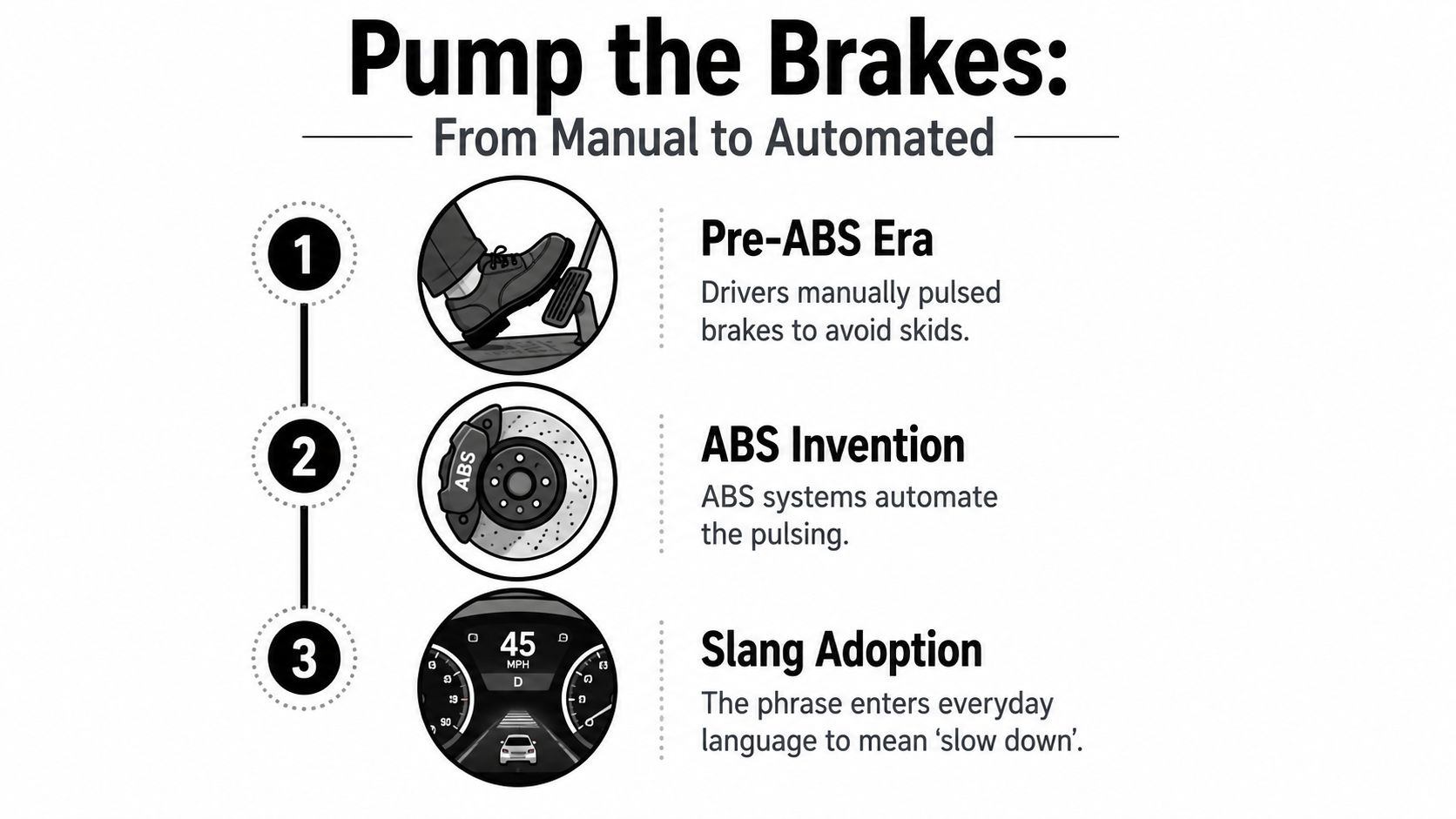 A timeline illustration showing the transition from manually pumping brakes to automated ABS and the phrase usage.
Why the phrase stuck
ABS changed the job. In modern cars, the system does the rapid brake-pressure modulation automatically, so drivers are told not to keep pumping the pedal when ABS is active. In non-ABS vehicles, the older pumping motion can still help prevent wheel lockup, which is why the phrase keeps its literal root even while the idiom took over daily speech. A technical note on brake bleeding also matters here, because trapped air can make the pedal feel soft and tempt someone to pump the brakes as a temporary workaround, even though that doesn't fix fluid loss or air in the system as described in the brake-service manual.
That mix of old-school driving and modern automation is why the idiom feels so physical. People in North American English still use it because it sounds practical, not abstract. It doesn't tell you to rethink your life in a soft voice, it tells you to back off before things skid.
And that's exactly why rappers like it. A phrase born from traction control already knows how to talk about control, pressure, and dangerous speed. It's got mechanical muscle built into the language.
Tone and Register Across Conversations
A friend catches your brag mid-sentence and drops pump your brakes with a grin. The room hears a tease, but the jab still sticks because it says you've started reaching. Put the same phrase in a boardroom and the edge hardens fast. It reads like a correction, a warning to stop pushing a shaky pitch.
Register does the heavy lifting. Pump your brakes sounds more corrective and more skeptical than slow down, so it fits a speaker who wants pushback, not just pacing. A softer line like let's reconsider asks for reflection. Pump your brakes delivers pushback instead, and it tells the other person they're moving too fast and the room noticed.
Writers feel that difference on the page. If the goal is to check someone's ego, the phrase lands cleanly. If the goal is neutrality, it can hit too hard. Tone lives in the speaker's stance, not just the words themselves, and RewriteBar's tone guide gives a useful way to sharpen that instinct.
The phrase positions you as the one who sees the overreach first. That stance matters in a cypher, because the rapper who spots the overreach first owns the room for the next bar.
Where it lands hardest
In everyday talk, the line can sound amused and skeptical at the same time. In sports commentary, it can carry the voice of a veteran cutting down hype before it runs wild. In rap, it can become a warning shot or a setup line, because the phrase brings rhythm and attitude with it.
That flexibility keeps it alive. The same words can feel like a laugh, a lecture, or a challenge depending on delivery. On a mic, the temperature changes with the pause before pump, the drag on brakes, and the weight you put on the final consonants.
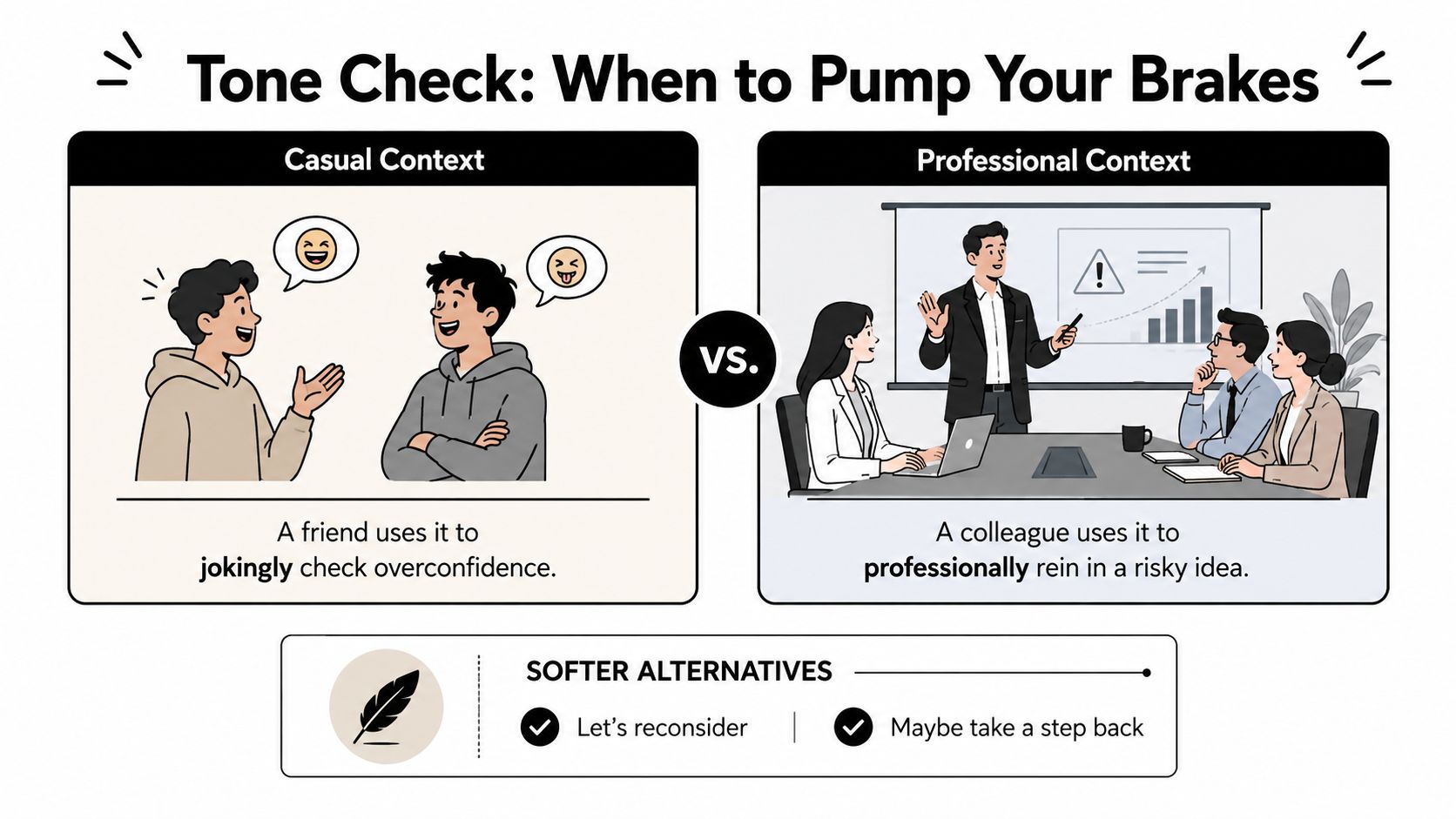 A graphic comparing the phrase pump your brakes in casual versus professional workplace conversation contexts.
A line like that also changes shape in a diss track, where timing matters as much as meaning. For a close look at how strong diss records are framed, greatest diss tracks and the mechanics behind them gives useful context for line selection and pressure building.
Annotated Examples in Rap and Dance Music
Dom Dolla's “Pump the Brakes” gives the phrase a modern club-life afterlife. The track was released on 26 March 2021 via Sweat It Out, later received an ARIA nomination for Best Dance Release in 2021, and was nominated for House Song of the Year at the 2022 Electronic Dance Music Awards. It also peaked at No. 39 on the New Zealand Hot Singles chart, which shows the phrase didn't stay trapped in idiom land, it crossed into global dance culture and kept its bounce source.
That matters for writers because the title itself works on two levels. In a dance record, it feels like a command with swagger. In a diss record, it feels like a warning with teeth. The same phrase can flip from groove to threat depending on the pocket.
Why it works on a mic
The phrase is built from sharp plosives, so it snaps when you hit it out loud. Pump, brakes, the consonants stop and restart like a car catching traction. That makes it useful for a hook, where repetition can turn a warning into a chant, or for a diss line, where the wording itself sounds like a cut-off.
You can also use it as a tempo cue in performance writing. A rapper can talk fast through the setup, then hit pump your brakes right on the bar line to slow the room down for the punch. That kind of shift gives the line more gravity than a simple insult.
For more context on how diss records build that kind of pressure, this diss track overview helps frame the mechanics without losing the musical edge.
Annotated move: When the phrase appears at the end of a bar, it works like a brake tap. The setup keeps rolling, then the line forces a hard listen.
In battle writing, I'd use it three ways. As a hook anchor, it becomes a crowd call. As a mid-round check, it breaks the opponent's rhythm. As a setup-to-punch transition, it lets you slow the verse just long enough for the insult to bite. That flexibility is why the phrase keeps surviving across genres.
Rhyme Schemes and Flow Patterns That Land
A lot of writers waste pump your brakes by dropping it too early. The phrase earns its place through momentum, not just placement. Build the line with internal rhyme first, then let the command cut straight through the bar. Place pump your brakes at the bar's close to create a hard stop, the listener feels the pause before the next bar lands.
Build the bar before the stop
Pair brakes with words that tighten the room, like fakes, stakes, and mistakes. That gives you a clean tail rhyme and keeps the phrase tied to the insult instead of floating above it. A line can move like this, “You chasing clout, stacking fake stakes, talking big, time to pump your brakes.” The rhyme chain gives the listener a path, then the phrase slams the door.
Multi-syllabic setup makes the stop hit harder. A phrase like time to pump your brakes on the fake mistakes keeps the cadence rolling before the command lands. The setup carries forward, then the phrase snaps the room into a pause.
Different styles, different pressure
West Coast writing can let the phrase ride a smoother pocket, almost conversational, then make it sound cold because the delivery stays relaxed. Boom Bap likes the phrase when it lands on a hard snare, because the stop-start feel matches the drum pocket. Drill can push it sharper and more clipped, using the phrase like a warning before the energy spikes.
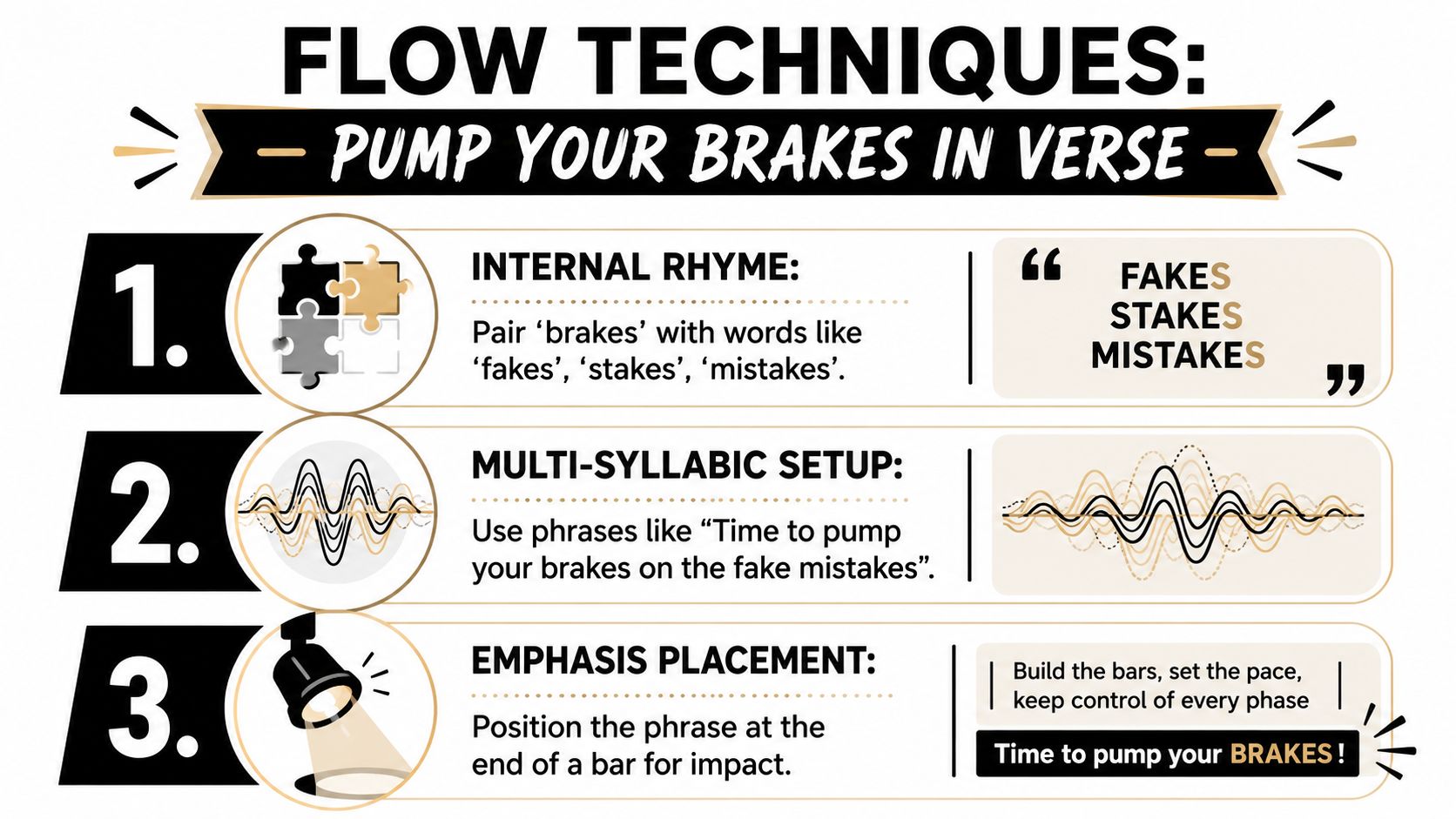 An educational infographic titled Flow Techniques illustrating how to use internal rhyme, multi-syllabic setups, and emphasis placement in rap.
Here's a clean way to place it:
- Internal rhyme: Weave fakes, stakes, and mistakes inside the line so the phrase feels embedded, not pasted on.
- End-of-bar impact: Put pump your brakes at the close of the line when you want the crowd to hear the pause.
- Callback value: Bring it back in a later verse when the target keeps overreaching, so the phrase becomes a recurring check.
For more pattern ideas, these rhyme scheme examples can help you map the cadence before you write the attack.
Quick-Ready Lines and DissTrack AI Integration
A few bars already carry the shape of the move. Use them as seed lines, then rewrite them until they sound like your mouth, not a template.
- “You sprinting to a loss, I'm telling you straight, pump your brakes.”
- “Every flex came fake, every boast came late, pump your brakes.”
- “You keep chasing a stage you can't even place, pump your brakes.”
- “That loud talk's cheap, the silence is deep, pump your brakes.”
Diss writing gets easier when you stop staring at a blank page and start working from structure. A tool like DissTrack AI can generate structured verses from a target's name, relationship, and inside jokes, then let you choose style tags like West Coast, Boom Bap, Drill, or Battle Rap. If you're comparing tools for creative output, top AI tools for creators is useful context for how these generators fit into a larger workflow.
Use the tool like a drafting partner, not a final voice. Feed it specifics, then trim anything that doesn't sound like you. If the line lands too neat, rough it up. If the rhyme feels crowded, strip a word and let pump your brakes breathe.
The video below shows how fast that workflow can move when you've got a target and a style in mind.
A clean writing loop looks like this:
- Enter the target details. Name, relationship, and any inside joke that gives the line heat.
- Pick a style tag. West Coast for glide, Boom Bap for pocket, Drill for edge.
- Tune the savagery. Keep it playful or push it harder, depending on the room.
- Edit for voice. Replace generic phrasing with your slang, your rhythm, your attitude.
If you want a broader writing workflow around that process, this song-writing app guide gives a useful lens on how lyric tools can support revision without flattening personality.
Keeping It Clever Without Crossing the Line
Roasting works when everybody understands the game. A sharp line can be funny, competitive, and memorable, but it stops being entertainment the second it turns into cruelty for its own sake. That line matters even more with a phrase like pump your brakes, because the wording already carries authority and correction.
Consent changes everything. If your friends are in on the joke, the check can feel playful. If you aim the same energy at a stranger who didn't ask for it, the joke can collapse into harassment fast. Good battle writing hits ego, not humanity.
Privacy matters too. Generations from DissTrack AI stay private until users choose to publish, which gives writers room to test angles before anything goes public. That's the right way to use a tool like this, draft, refine, and perform with control instead of tossing out lines that shouldn't leave the page.
The clean rule is simple. Make the bar sharper, not meaner. If the phrase makes the room laugh, think, and lean in, you're on target.
If you want to turn a phrase like pump your brakes into something that sounds personal, structured, and ready for the mic, try DissTrack AI. It can help you shape the setup, tune the tone, and generate bars you can edit into your own voice before you step into the battle.