
How to Write DJ Rap Lyrics for Live Sets
Most advice about rap lyrics starts in the wrong room. It tells you to write the cleverest verse you can, stack multisyllabic rhymes, and polish every bar until it reads beautifully on the page. That approach can work in a booth. Behind the decks, it can lose the floor before the punchline arrives.
DJ rap lyrics are a timing problem before they're a writing problem. Your words have to leave space for a transition, survive a loud room, fit around kick and snare hits, and give the crowd something they can recognize quickly. A complicated line that sounds impressive in headphones may become verbal traffic during a drop. A shorter phrase, delivered at the right moment, can move more people.
The culture has always understood the value of live competition and direct response. Hip-hop diss-track culture is widely traced to the Roxanne Wars of 1984, when Roxanne Shanté and Marley Marl's “Roxanne's Revenge” helped establish the modern diss record format, as documented in The Conversation's history of diss tracks. The lesson for a DJ is simple: a line becomes powerful when the setting gives it a job.
Finding Your DJ Persona and Lyrical Concept
Studio rappers can build a verse around private details, subtle references, and long-form storytelling. A DJ working a room has a different contract with the audience. You're not only delivering lyrics. You're steering attention while managing selections, transitions, levels, and momentum.
That means the first question isn't, “What's the hardest verse I can write?” Ask, “What should the crowd feel or do when I say this?” A chant, a warning, a self-introduction, a playful roast, and a transition cue each need different language. If the line doesn't support the movement of the set, it belongs in another song.
Existing rap-lyric coverage leans heavily toward quizzes and trivia, while practical questions about lyric timing, clean and explicit swaps, and crowd-specific phrasing receive less attention in the available coverage of rap content (TriviaCreator's rap category illustrates that imbalance). That gap matters because DJs don't need another archive of famous lines. They need words that work at a specific moment in a specific room.
Build the persona from the booth outward
Your sound should decide your vocabulary, density, and attitude.
- High-energy trap: Use compact commands, sharp internal echoes, and phrases that can sit above heavy low end without becoming muddy.
- Classic boom bap: Leave room for storytelling, dry humor, and more intricate rhyme movement. The crowd may reward a line that unfolds across the bar.
- Heavy bass music: Favor physical language, repetition, and vowel sounds that remain clear when the beats hit hard.
- Open-format sets: Write modular lines that can introduce a style change, acknowledge the room, or bridge two very different records.
Choose one dominant persona for the set. You might be the calm selector who controls chaos, the hostile battle host, the comic instigator, or the local guide who makes the room feel included. A persona gives every line a consistent point of view, which helps listeners understand you before they catch every word.
Practical rule: Write for the person moving near the speakers, not the person reading your lyric sheet.
Avoid building a full, dense verse before testing the concept. Start with a hook phrase, a response line, and a transition cue. If those pieces work aloud over the intended track, expand them. If they don't, no amount of extra wordplay will rescue the idea.
Matching Flow and Rhyme Schemes to the Beat
A polished verse can fail on the floor if its stresses clash with the beat. Treat the backing as a timing grid with openings for commands, pauses, and drop cues. Your vocal must support the DJ's control of momentum, not sit passively above the track.
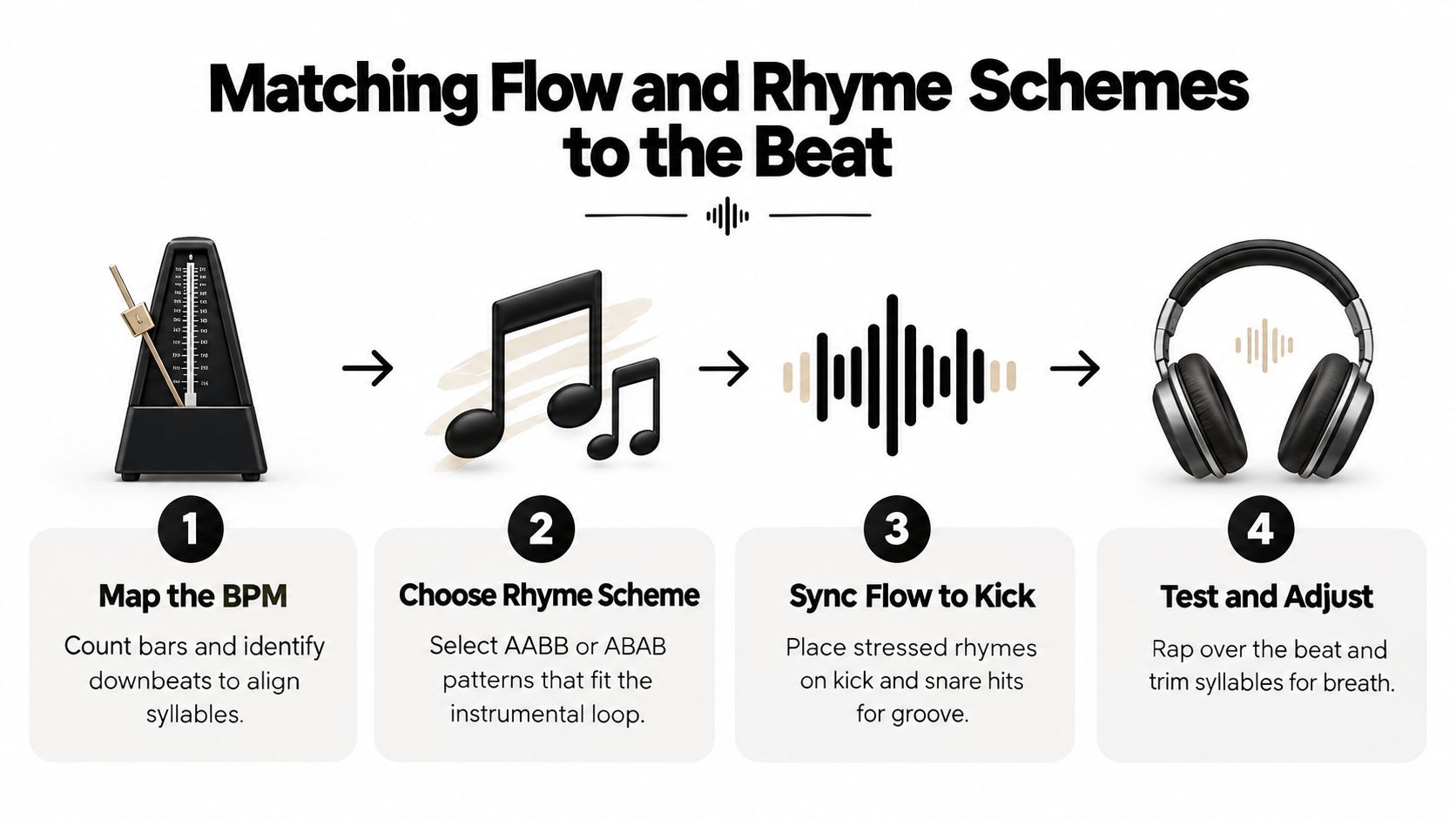 An infographic showing a four-step guide on how to match rap lyrics flow and rhyme schemes to beats.
Start with the bar, not the sentence
Loop the track and count the bars. Find the downbeat, then note the kick, snare, fills, and major changes. Every syllable does not need to land on a drum hit. The stressed words do need enough space for the crowd to hear them, especially during a transition or live drop.
Map the rhyme scheme bar by bar. The RhymeBook rhyme scheme analyzer outlines a useful method: identify each line's final word, assign rhyme labels, and inspect patterns such as AABB or ABAB. Apply the same attention to internal rhymes. They can drive a fast pocket, while end rhymes give the audience a clear point to anticipate.
Use this workflow:
- Mark the bar endings. Write the last stressed word in each line and label its sound.
- Circle internal anchors. Find recurring vowel sounds and consonant patterns inside the bar.
- Place the important words. Put names, commands, and punchlines where the beat leaves room for them.
- Read the line without the beat. Rewrite any phrase whose natural stress fights the intended emphasis.
- Rap it over the loop. Cut syllables until you can deliver the line while moving, cueing, or mixing.
Let rhythm bend the grammar
Lyric-analysis research examines features including rhymes per line, rhymes per syllable, internal versus end rhymes, average rhyme scores, and perfect-rhyme share when assessing complexity in rap lyrics (the ISMIR lyric-analysis paper). It also describes irregular placement of rhymed and accented syllables, plus looser alignment between syntax and meter, as tools for rhythmic effect.
Use that flexibility onstage. Delay a stressed syllable, cut a sentence short, or place an internal rhyme just before the snare. A written line is a performance map, not a rulebook. If a phrase reads well but makes you rush the drop, change the phrase.
Slower grooves allow stretched vowels and deliberate gaps. Faster grooves often need fewer articles, filler words, and connective phrases. The target is clarity, breath, and forward motion. Leave enough room to react to the room, extend a response, or hold a final word until the bass arrives.
Crafting Punchlines and Hooks That Move the Crowd
The line that works on paper often fails because it asks the crowd to do too much processing. A live audience may be dancing, talking, watching the DJ, and reacting to the drop at the same time. Give them a phrase they can catch on the first pass.
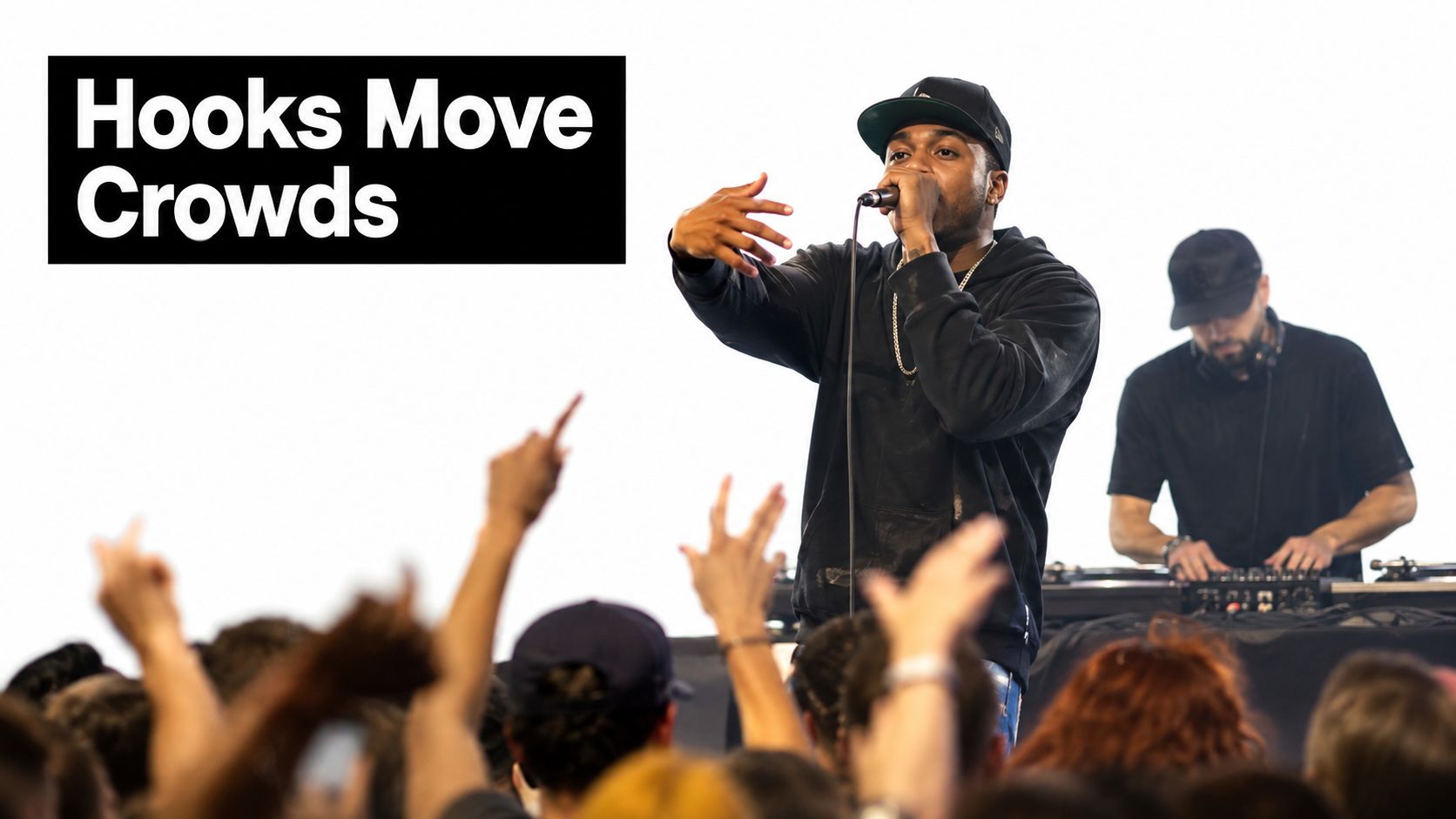 A rapper performing on stage while the concert crowd reaches their hands up toward the stage.
Consider a common transition. You're fading from a tense record into a heavier one, and the room is waiting for the bass to arrive. A studio verse might spend several bars explaining the setup. A DJ verse should create an obvious sequence:
- Establish the room with a direct observation.
- Repeat a short phrase so listeners know what to hold onto.
- Pull back before the drop.
- Deliver the final word or command as the bass lands.
The punchline doesn't need to be maximally offensive. It needs to be audible, relevant, and timed. If the crowd can repeat the final phrase, you've created a hook. If they only understand it after someone explains the metaphor, you've written a clever line for a different environment.
Build call and response into the wording
Write the audience's answer before you write your question. “Who came to move?” invites a broad response. A more specific prompt gives the room a clearer role, such as asking one side of the floor to answer another. Keep the response short enough that people can deliver it without learning a lyric.
For a playful battle moment, use a setup that identifies the target without burying the insult. Then leave a gap. The pause lets the crowd react and gives you a chance to read whether the room wants another jab or a return to the mix.
Battle-rap analysis increasingly separates writing, performance, structure, delivery, and adaptability, rather than treating aggression as the only measure of quality, a distinction reflected in the practical focus of Battle Rap Hub. That distinction is key for DJs. A personal line may be devastating in a direct battle but awkward during a public transition. A broad, playful angle may travel better because more people can join the reaction.
For a deeper breakdown of setups, reversals, and memorable finishes, use this guide to writing punchlines. Apply the same principle to a hook: one idea, one rhythm, one moment of release.
Don't stack five punchlines into the space before a drop. Choose the line with the cleanest ending, repeat its key words, and let the music provide the impact. The crowd should feel that you gave the beat a voice, not that you competed with it.
Generating Custom Verses With AI Lyric Tools
AI lyric tools work best as sparring partners for a DJ. They generate angles, rhyme families, and alternate wording quickly, while your ear decides whether a line survives the booth. A tool cannot hear the room, judge the timing of a transition, or know whether you can deliver a phrase while cueing a record and watching the floor.
Start with a performance brief. “Write a rap verse” gives the tool too little direction. State the job the verse must perform, then supply the musical and crowd conditions around it.
Feed the tool usable constraints
Include details such as:
- Set identity: boom bap, trap, bass-heavy, grime, or open format.
- Crowd function: introduction, call and response, transition, roast, or drop announcement.
- Tone: playful, competitive, confident, or restrained.
- Target concept: a rival DJ's predictable selection, a room that refuses to sit down, or your own reputation as a selector.
- Delivery limits: short phrases, space after each punchline, clean language, or easy breath points.
- Structural request: hook, setup, drop line, and alternate ending.
Ask for variations on one idea instead of unrelated verses. Comparing versions against the same concept makes cadence easier to judge. A line may read well and still fail at speed because its consonants collide or its stress falls before the beat.
 Screenshot from https://aidisstrackgenerator.com
Use generation as a selection process
Generate a small group of hooks around the same crowd action. Read each over the loop and keep the phrase that lands without explanation. Mark the words that naturally receive stress. If those accents fight the groove, request rewrites rather than forcing your delivery to fit the draft.
A useful prompt can request a compact transition verse with a repeated crowd response, a clear pause before the drop, and alternate clean phrasing. You can ask for rhyme variations around a chosen end sound, then reject anything weak in meaning, awkward in your accent, or too dense for live delivery.
The guide to AI content workflows supports the same working method: define the task, review the output, test it in context, and revise it. For DJ rap, context means the loop, the microphone, the transition, and the crowd's response.
DissTrack AI can generate personalized roast lyrics, battle-style verses, hooks, and variations from details such as a target, relationship, inside joke, and selected style. Its practical use is speed. Take the raw material, shorten it, remove weak lines, and fit the strongest version to your transition. The rap lyrics AI generator can provide alternate rhyme paths while keeping the concept intact.
Keep authorship in your hands. Replace generic boasts with details only you would say, remove borrowed-sounding habits, and perform every line before placing it in the set. A clever verse that misses the drop is still a failed DJ lyric.
Editing and Polishing Lyrics for Live Performance
A lyric that reads well can still fail under stage pressure. Dense consonants slow the mouth, long setups steal room from the drop, and a neat rhyme can force you to breathe before the thought is complete. AI-generated verses often repeat a pattern so strictly that the phrasing loses the music's natural swing.
Use rhyme density as an editing lens, not a target. Count the internal echoes, end rhymes, and repeated sounds that help a bar lock to the beat, then ask whether each one strengthens the image or only fills space. Modern rap can bend syntax and meter for rhythmic effect. Keep that tension when it sounds deliberate and repeatable. More rhyme does not guarantee more impact.
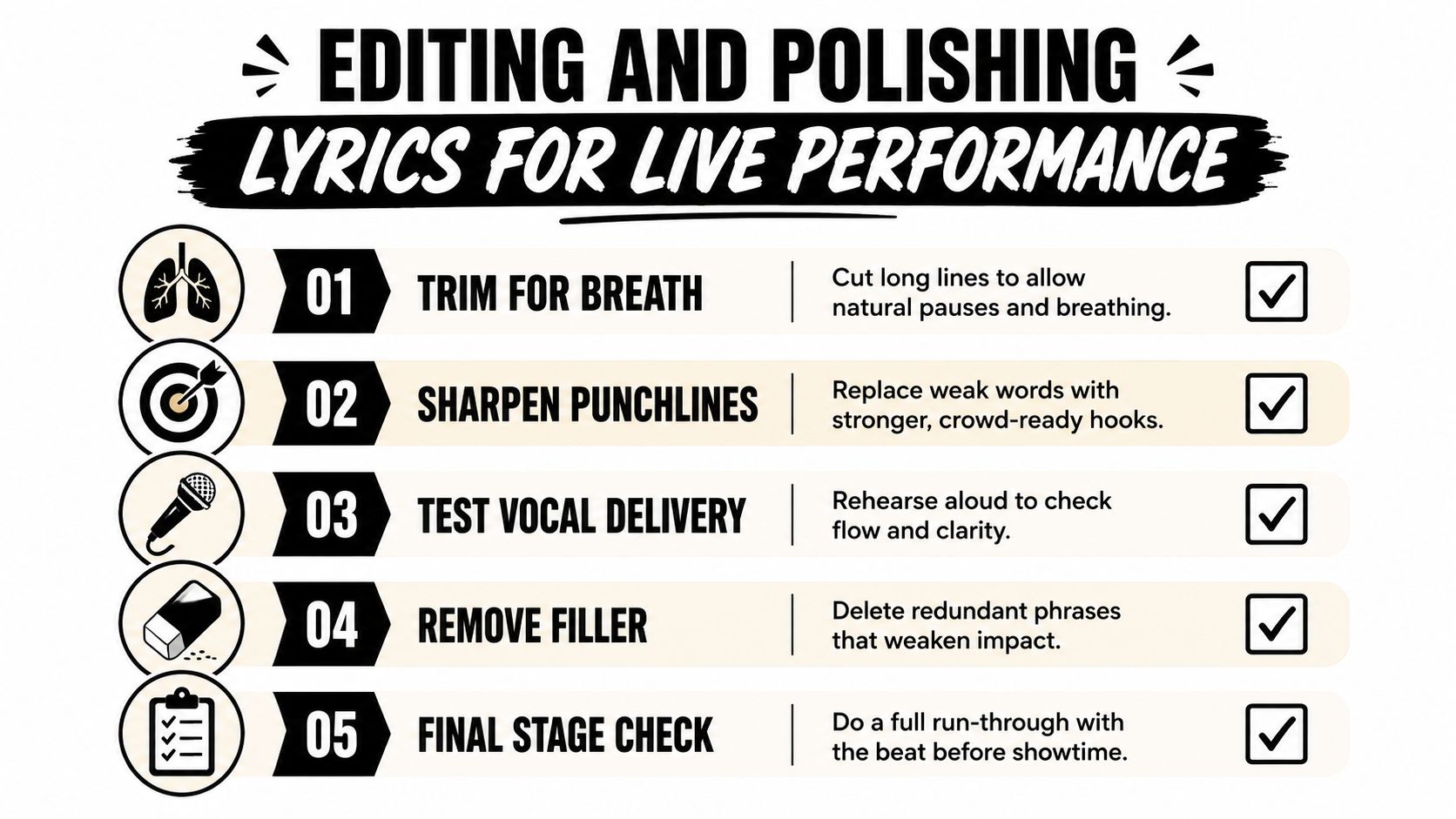 A five-step instructional guide on editing and polishing lyrics for a successful live music performance.
Edit for the body
Perform the draft aloud while standing, then repeat it while reaching for a control or preparing the next record. A line that works only with both hands free is not ready for a live set. Your delivery must survive the transition without losing the crowd's momentum.
Mark every breath directly on the page. Use a slash for a quick breath and a blank bar to build anticipation before the drop. Cut opening phrases that add no meaning. Replace a long expression with a shorter word when both carry the same emotional force.
Use this pass:
- Trim for breath: Remove spare syllables before cutting the central image.
- Sharpen the landing: Place the strongest noun or verb on the stressed beat.
- Check pronunciation: Replace words that blur at speed or over heavy bass.
- Protect the pause: Keep silence before a drop when it raises attention.
- Test the clean version: Write an explicit alternative and rehearse both versions.
A live lyric is a physical script. If your lungs, hands, and timing cannot execute it, the audience cannot receive it.
Keep the rhyme, lose the clutter
Read each bar twice. First, confirm that it makes one clear point. Then listen for stressed vowels, repeated consonants, and internal echoes that support the groove. A punchline may need fewer words so the final phrase arrives after the snare instead of getting buried before it.
Do not flatten every irregular rhythm for neatness. A phrase that pushes against the meter can add character when it resolves on a kick or snare. Test the same deviation across several runs. Keep it if you can repeat the timing and the crowd can catch the key word. Rewrite it if the effect sounds like a missed beat.
The guide to using your voice in AI-assisted writing can help you keep personal phrasing in an AI-assisted draft. Finish with a marked-up cue sheet, including emphasis, breaths, alternate words, and the exact point where you invite the crowd to respond.
Dropping Your First DJ Rap Track
Start with a reference vocal rather than a full production. Record the verse over the actual transition or loop, then check three things: can listeners understand the words, can you breathe without breaking the groove, and does the final phrase strengthen the moment when the beat changes?
Keep the first live test narrow. Use the lyric during a familiar part of your set. Watch whether people move, answer, laugh, or turn toward the booth, and mark where attention drops. A weak reaction may point to a shorter setup, a clearer vocal level, or different placement against the drop rather than a bad idea.
Before showtime, check:
- Persona: Does the wording sound like your DJ identity?
- Timing: Does each stress support the beat?
- Clarity: Can listeners catch the key phrase in a noisy room?
- Breath: Can you perform it while handling the transition?
- Adaptation: Do you have a clean swap or alternate ending?
- Reaction: Will you know quickly whether to repeat, extend, or abandon it?
Battle rap's modern competitive form is commonly dated to December 1981, when Kool Moe Dee challenged Busy Bee Starski in a landmark battle, according to the Battle rap overview. Its history reinforces a practical performance truth: words gain force through confrontation, timing, and response. Your DJ rap lyrics do not need to resemble a studio verse. They need to make the room feel that you chose the right words for that exact beat.
DissTrack AI can generate roast lyrics, battle-style verses, hooks, and alternate punchlines when you need fresh material for a DJ set. Use it to develop concepts for a transition, then edit every line until it sounds natural behind the decks.