
Insult Generator API: Inputs, Outputs and Safe Integration
You've got a roast button in the mockup, a target-name field, and someone asking whether you can make the output more savage. The demo looks easy until you consider private jokes in request logs, a stranger receiving a vicious verse, or an unmoderated line appearing on a live stream. A useful insult generator API needs more than punchlines. It needs a contract your application can enforce when the joke stops being funny.
Insult Request Fields at a Glance
Typical insult request fields
| Field | Type | What It Controls | Example Value |
|---|---|---|---|
| target_name | string | Name the roast is aimed at | Marcus |
| relationship | enum | Sets the banter ceiling: friend, coworker, stranger | friend |
| style_tag | enum | Musical or comedic style of the verse | boom bap |
| savagery | integer 1-5 | Bluntness ceiling for the output | 3 |
| context | string with length limit | Inside jokes or facts to reference | forgot his passport in Lisbon |
| variations | integer 1-10 | Number of alternative outputs returned | 5 |
| language | string containing an ISO 639-1 code | Output language and language-specific moderation | en |
| output_format | enum | Plain text or structured lines | text |
These are illustrative field names and limits, not a documented contract for a particular provider. Confirm accepted names, required fields, enum values, and defaults before wiring up the form. When comparing general-purpose options, BeatAPI's resource for text generation for your app is a useful starting point for considering where generation fits into your application.
Walk the request from top to bottom:
- target_name: Use a display name or nickname, not a full identity dossier.
- relationship: Treat this as a policy input, not merely extra flavor for the prompt.
- style_tag: Validate against an allowlist so unsupported styles don't become arbitrary instructions.
- savagery: Reject values outside the supported range instead of guessing what the user meant.
- context: Accept a harmless detail, such as the passport mishap, and keep it out of ordinary logs.
- variations: Bound the count before sending work downstream.
- language: Reject unsupported codes rather than returning English.
- output_format: Choose structured lines when your interface needs verse boundaries, or text for a simple editor.
Relationship and context deserve stricter handling
Relationship should cap intensity on the server. In an illustrative policy, strangers might receive only gentle teasing, coworkers a restrained ceiling, and consenting friends access to stronger material. A client submitting friend doesn't establish consent, and a stranger must never receive the maximum setting merely because someone changed the request body.
Context creates a different problem: users will submit more personal information than the punchline needs. For an example implementation, cap it at 500 characters, clearly label that as your application's chosen limit, and warn users against entering secrets, contact information, or sensitive allegations. Treat the field as untrusted content, never as instructions that override policy.
A minimal request for this illustrative contract could be:
{"target_name":"Marcus","relationship":"friend","style_tag":"boom bap","savagery":2,"context":"forgot his passport in Lisbon","variations":3,"language":"en","output_format":"text"}
Send that test call with synthetic or consented details before enabling stronger settings in production. Marcus can survive a passport joke. Your schema shouldn't have to survive improvisation.
Authentication, Versioning and Rate Limits
Keep the API key behind your server. For a bearer-token integration, send it through the Authorization header, never a query string, browser bundle, mobile binary, or analytics event. Your frontend should call your application, and your application should make the authenticated generation request.
Store credentials in a server-side secret manager such as AWS Secrets Manager or Google Secret Manager. Assign separate credentials to development and production, and rotate them on a documented schedule. Where the provider supports overlapping credentials, deploy the replacement before revoking the old key.
Pin behavior, not just connectivity
A successful HTTP response doesn't guarantee that the output still matches your product's expectations. Pin the tested model version where supported, record model_version, and rerun your evaluation set after a model or moderation-policy change.
Keep these operational controls explicit:
- Requests: Read documented rate-limit headers and slow submissions before exhausting the allowance.
- Token budget: Bound prompt size and generated length, not just request count.
- Concurrency: Limit active jobs so a burst doesn't occupy every worker.
- Variations: Prevent users from multiplying generation work through an oversized alternative count.
A throttled request isn't an invitation to hammer harder. Honor the provider's retry delay and keep retries bounded.
Use a sandbox or test key if the provider offers one, but verify its billing and isolation rules. Sandbox doesn't automatically mean free or private. Start with fictional names, confirm the schema, and exercise credential rejection before sending live personalization.
Response Fields and Variation Handling
Typical response fields
| Field | Type | Meaning | Handling Note |
|---|---|---|---|
| id | string | Unique generation ID for fetch and deletion | Check authorization on every fetch |
| status | enum | completed, queued or failed | Poll only when queued |
| variations | array | Alternative verses or lines, each with its own text | Client chooses which one to show |
| moderation | object | Result of input and output checks | Route flagged output to review |
| model_version | string | Model and policy version used | Store for audits and reproducibility |
| created_at | timestamp | Generation time in UTC | Drives retention and deletion schedules |
| usage | object | Tokens and variations billed | Use for quota planning |
Treat this as an example response design. A provider may separate model and policy versions, represent moderation per variation, or return usage through a different object. Map those differences in your backend adapter rather than scattering provider-specific assumptions throughout the frontend.
Store the generation ID instead of duplicating the original inputs. If Marcus asks to remove his roast, the ID should identify the stored artifact without requiring a search through names and private jokes. Reissuing the original request isn't retrieval: probabilistic generation can produce different wording, even when the inputs haven't changed.
Handle variations as a collection, not a promise of a fixed-length list. If moderation or generation failure leaves fewer alternatives than requested, show the approved results that arrived. Don't pad the display with duplicates, and distinguish a partial success from an empty result.
Choose deliberately, render defensively
Read status and moderation before touching the text. A queued job belongs in a waiting state with controlled polling, not an empty results screen; a completed job with unresolved moderation flags belongs in review, not on a public overlay. Completion describes processing, not permission to publish.
For a caption picker, sort approved variations by length and let the creator choose. For a verse editor, preserve the returned ordering and show each alternative separately. Log the selected variation's stable identifier, or its index alongside the generation ID, so quality analysis refers to the exact candidate.
Storage rule: Keep enough metadata to explain the selection without keeping an unnecessary copy of the person's private context.
Usage needs equally careful interpretation. More alternatives can mean more generated tokens and higher charges, but the billing model belongs to the provider's contract. Reconcile reported usage with invoices, and distinguish requested, generated, returned, and billed variation counts if the API exposes them.
Finally, render generated text as text. A roast that includes markup shouldn't get permission to execute it.
Error Responses and Status Codes Reference
Insult API error codes and retry rules
| HTTP Status | Problem Type | Meaning | Safe to Retry? |
|---|---|---|---|
| 422 | invalid_target | Target field is valid in schema but unusable | No, correct the input |
| 422 | unsafe_request | Request breaks the moderation policy | No, do not retry; log and review |
| 429 | quota_exceeded | Plan or rate limit reached | Yes, after the Retry-After delay, if capacity can recover |
| 503 | generation_timeout | Model did not finish in time | Yes, with exponential backoff, when documented as safe |
| 503 | model_unavailable | Temporary model outage | Yes, with backoff, when documented as safe |
This is an illustrative status mapping, not a universal provider reference. Cross-check every row against the API documentation before implementing branches. A depleted plan allowance may require a billing action rather than a short pause, while a timeout may leave a completed job behind.
Use a predictable problem envelope
RFC 9457 defines HTTP problem details, including the application/problem+json media type and members such as type, title, status, detail, and instance. Use that structure to keep validation, policy, quota, and service failures machine-readable.
The table's short problem names are application labels. In a standards-aligned implementation, document stable problem-type identifiers and their mapping to those labels. Clients should branch on type, not on prose inside detail, because message wording may change or be localized.
Keep detail suitable for an end user. Explain that a request couldn't be processed without echoing the submitted name, private context, hidden instructions, or a stack trace. Include an opaque correlation identifier for support, and ensure that the identifier itself doesn't encode personal information.
For example, a policy rejection can tell the user to remove sensitive targeting and offer a harmless alternative. It shouldn't repeat the offensive passage in an error toast, where screenshots and analytics tools may capture it again.
Follow a bounded handling routine
-
Read the status. Separate request failures from temporary service failures, rather than retrying every unsuccessful response. Missing or invalid credentials need authentication handling, while a temporary availability failure may justify another attempt.
-
Read the problem type. Route
invalid_targetback to the form,unsafe_requestto a refusal state, and quota problems to an allowance message. If a type is unknown, show a generic safe error and retain the correlation identifier for diagnosis. -
Retry only documented safe failures. Use exponential backoff with jitter, honor
Retry-Afterwhen returned, and stop after a bounded attempt budget. For generation requests, use the provider's idempotency mechanism where available so a retry doesn't create duplicate work or charges.
Don't automatically rewrite a rejected prompt until it slips through. That's policy evasion wearing a helpful loading spinner.
Also test malformed and unexpected responses. A proxy can return HTML, a connection can disappear before the body arrives, and a response can omit expected fields. Your parser should fail safely without dumping raw upstream content into the interface.
Style Tags and the Savagery Ceiling
Marcus, a consenting friend, supplies a forgotten-passport story for a boom bap roast at moderate savagery. An illustrative output might read:
Marcus, you packed all that swagger and sparked this, Left your passport at home, couldn't even depart, kid.
The bar uses direct address, a loose name rhyme, and a travel mishap rather than an attack on identity. Evaluate those choices separately: does it follow the style, use the supplied detail, and stay below the intensity ceiling? A funny line can still fail the request.
Style changes delivery, not permission
Treat style tags as creative direction within a fixed safety boundary.
- West Coast: Favor relaxed phrasing and vivid scene-setting.
- Old School Boom Bap: Request internal rhyme and wordplay suited to a steady beat.
- Trap: Favor compact bars and repeatable hooks.
- Battle Rap: Use direct address, setups, and comebacks without inventing damaging allegations.
- Drill: Request clipped delivery and hard consonants while excluding threats.
- Emo Rap: Favor confessional or self-deprecating phrasing.
- UK Grime: Request quick cadence and regionally appropriate language without caricatured slang.
These directions guide wording; text alone cannot establish musical authenticity or a performer's delivery.
In this illustrative scale, savagery runs from playful teasing at level 1 to maximum permitted intensity at level 5. Higher intensity allows sharper wordplay within policy, consent, and the relationship cap. It does not authorize harassment. Change Marcus from a consenting friend to a stranger and check whether the strongest material remains available. If it does, the ceiling needs attention.
Repeat that comparison outside English. Regional phrasing should preserve the same boundary, and a style change should not introduce personal details beyond those supplied.
Why compact inputs can produce coherent verses
Relevant milestones include Bengio and collaborators' neural probabilistic language model in 2003, Mikolov-led recurrent-network language modeling in 2010, and Google researchers' word2vec work in 2013, covered in the history of natural language processing. These developments helped language systems progress from fixed phrase substitution toward learned representations and contextual generation.
Fluency still needs a separate grounding check. A model can connect passports with travel and preserve a rhyme without verifying the underlying story. Keep the supplied mishap recognizable, and reject variations that turn comic embellishment into an unsupported account of someone's life.
Integration Shapes and Trade-offs
An insult generator API accepts structured personalization and returns roast text, making bad manners callable without making your engineering standards optional.
The category fits the broader API-first approach: in Postman's 2024 State of the API Report, a worldwide survey of more than 5,600 developers and API professionals, 74% of respondents followed an API-first approach. That establishes the infrastructure context, not a separately measured market for automated insults.
 A professional man and woman looking at a tablet together in a bright, modern office setting.
Match the architecture to the audience
On-demand website generation prioritizes perceived responsiveness. Submit through your backend, return a job reference when necessary, and show an honest queued state. Keep alternatives modest and prevent repeated button presses from creating parallel jobs for the same action.
Batch content production prioritizes throughput, cost control, and publication discipline. Put jobs in a durable queue, track failures independently, and reserve human review for the publishing workflow. Sampled review can reveal systematic quality problems, but it doesn't replace moderation of every output destined for publication.
Chatbots and streaming overlays have the least room for recovery. A line that appears live can't reliably be recalled, so buffer output until checks finish and use a preapproved fallback when generation fails or gets flagged. Lower intensity is a sensible default when the audience hasn't opted into the exchange.
The underlying language behavior is easier to reason about when you understand what natural language processing does. The integration choice still belongs to the application engineer: generation, approval, storage, and publishing should remain distinct operations.
A low-latency response isn't a successful response if you have to apologize for displaying it.
Keep factual limits visible
The endpoint can't verify the target's biography. It may embellish a harmless detail into an allegation unless you explicitly constrain it and check the result.
Tell users that supplied context drives personalization, prohibit invented factual accusations, and require editorial approval before public release. For a creator pipeline, saving a draft is useful automation. Automatically publishing every draft is a different and much riskier product decision.
Moderation Boundaries Between Roast and Harassment
A friend who opted into a passport joke is participating in comedy. A stranger repeatedly targeted with humiliating verses isn't participating merely because the sender selected friend in a dropdown.
The boundary belongs in the product: consensual teasing is allowed; targeted harassment, threats, protected-class attacks, doxxing, and sexual content involving minors aren't. Calling the output a roast doesn't change those categories.
In the LLM harassment tests described in this harassment study, insults appeared in 44–98% of tested model behaviors, while flaming appeared in 32–97%. These are results from the tested behaviors, not estimates of your endpoint's failure rate, but they justify testing insult generation as a safety-sensitive function.
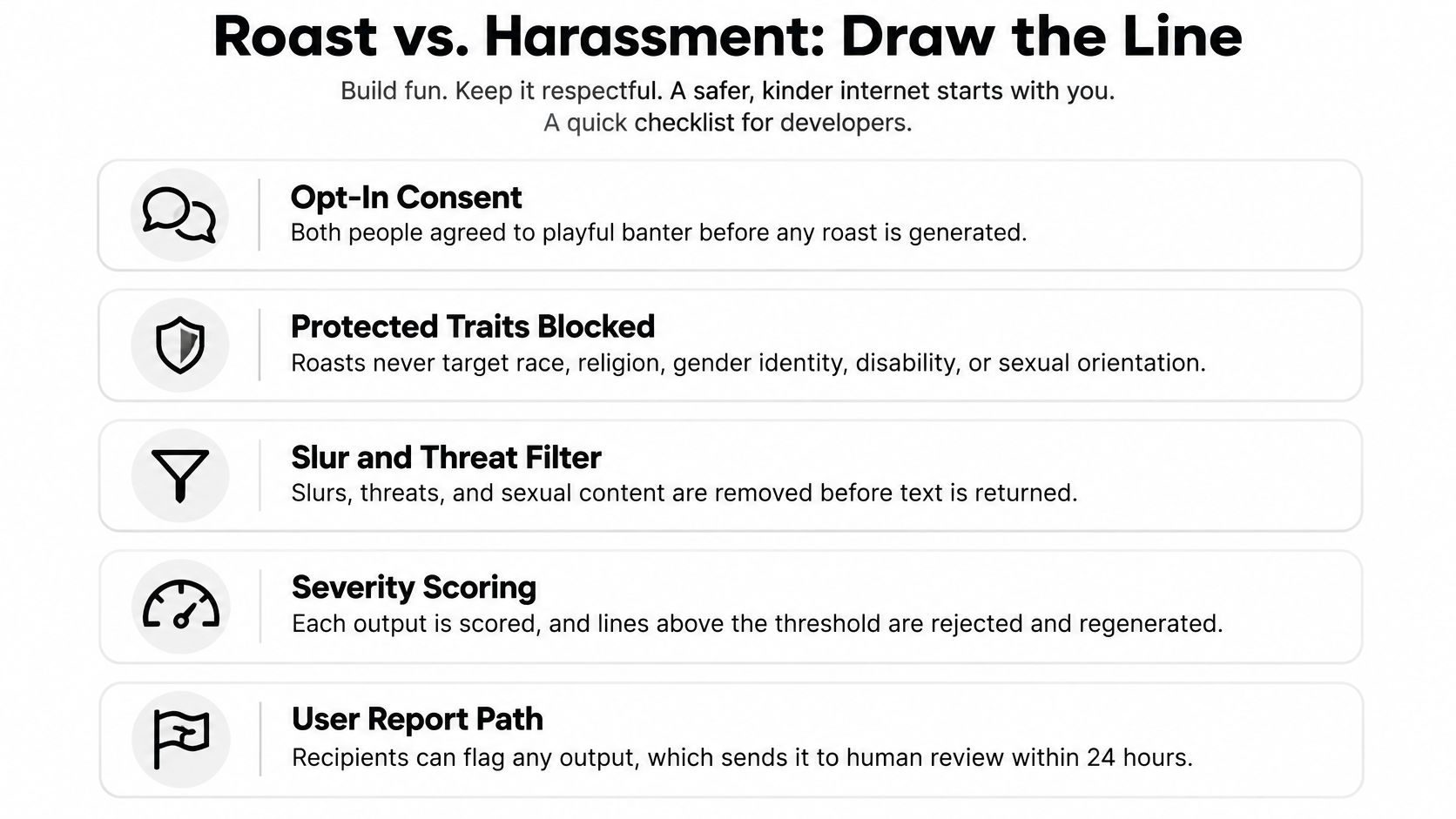 A safety checklist infographic for developers distinguishing between roasting and harassment in AI-generated applications.
Make the boundary auditable
-
Screen the input before generation. Detect protected-attribute targeting, private identifiers, threats, and instructions to organize harassment. Distinguish a harmless display name from contact details or information intended to locate someone.
-
Check the finished output independently. A benign prompt doesn't guarantee a benign completion. Evaluate the whole verse, including implied threats, invented allegations, and references introduced by the model.
-
Enforce severity outside the prompt. Map relationship values to explicit ceilings and evaluate whether the resulting text exceeds them. An instruction to stay playful isn't a substitute for a decision gate.
-
Return an understandable refusal. Offer a safe fallback aimed at harmless behavior or an absurd fictional situation. Don't return an empty success response that leaves developers guessing whether the generator broke.
-
Detect repeated targeting. Apply abuse controls to accounts and repeated campaigns, not merely isolated requests. Keep privacy-preserving policy metadata so repeated attempts can trigger restrictions without retaining raw private jokes.
-
Provide reporting and escalation. Let recipients report an output using its generation reference, and give reviewers enough restricted context to decide what happened. Publish a review commitment your team can meet rather than promising an unsupported turnaround.
Consent needs a real interaction
A consent-aware mode should require an explicit opt-in action and a way to withdraw it. For a proposed deployment, start at savagery 2 or lower on the illustrative scale and make stronger settings unavailable until the relationship and consent rules permit them.
Don't infer consent from friendship, workplace membership, or a public social-media profile. A party host can invite people to join a roast session; they shouldn't upload the entire guest list and assume everyone agreed.
Use personalization best practices to keep specificity focused on harmless habits, voluntary anecdotes, and shared jokes. Personalization should make the line recognizable, not make the recipient easier to harm.
A good safety layer won't turn every punchline into a compliment. It should preserve comic timing while refusing the categories your product has no business generating.
Privacy, Retention and Non-English Output
An English-safe filter isn't evidence of a safe multilingual product. Likewise, a private results page doesn't establish that prompts are absent from logs, backups, or training pipelines.
Privacy is a purchasing concern, not an optional settings panel: the 2025 Stack Overflow Developer Survey ranked security or privacy concerns as developers' leading reason for rejecting a technology. Before sending a name or inside joke, verify the processing terms, not just the interface.
Use a written checklist during that review.
 A focused woman reviewing documents at a wooden table with a laptop and coffee nearby
Verify the entire data lifecycle
- Training use: Require an explicit statement about whether customer inputs and outputs are used for training.
- Retention: Document how long prompts, outputs, moderation records, and backups remain.
- Deletion: Verify that deletion removes the generation's content and understand any documented exceptions.
- Encryption: Check protection in transit and at rest, including stored exports.
- Tenant isolation: Confirm that account boundaries apply to retrieval, search, support tools, and deletion.
- Log redaction: Inspect traces and exception reports for names, handles, and private context.
- Regional processing: Match processing and storage locations to your data-residency requirements.
- Auditability: Keep a restricted record of approvals and policy decisions without duplicating sensitive content.
Our generated disses stay private: we don't share, sell, or publicly display them, and targets aren't notified. That policy shouldn't be stretched into an unstated guarantee about training use, retention duration, or processing region.
Review privacy and security settings alongside your own infrastructure configuration. Your application can still leak content through analytics, session replay, or an overly helpful support dashboard.
Evaluate each language separately
For a practical pilot, build a labeled set of at least 50 requests per language as a proposed evaluation design, not a universal certification threshold. Include harmless banter, clear policy violations, coded insults, code-switching, and local idioms, with fluent reviewers labeling the expected outcome.
Measure false positives, harmless requests blocked, separately from false negatives, harmful content passed. Also score style quality: a filter that blocks every colloquial phrase may reduce risk while destroying the feature.
Use the following video as a separate viewing resource, not as proof that your implementation is safe.
Test Spanish, Arabic, Hindi, French, Portuguese, and regional English wherever you intend to launch. Publish language-specific limitations instead of claiming universal coverage, and keep this moderation evaluation separate from the smaller launch-quality exercise.
Launch Checklist and Twenty-Sample Test
Treat launch readiness as something you can demonstrate. A prompt that says to behave responsibly isn't an authorization test, a deletion test, or an incident procedure.
The NIST Generative AI Profile recommends organizational processes for identifying, managing, and communicating generative-AI risks and incidents. Translate that into named owners, recorded policy decisions, and a tested way to stop generation.
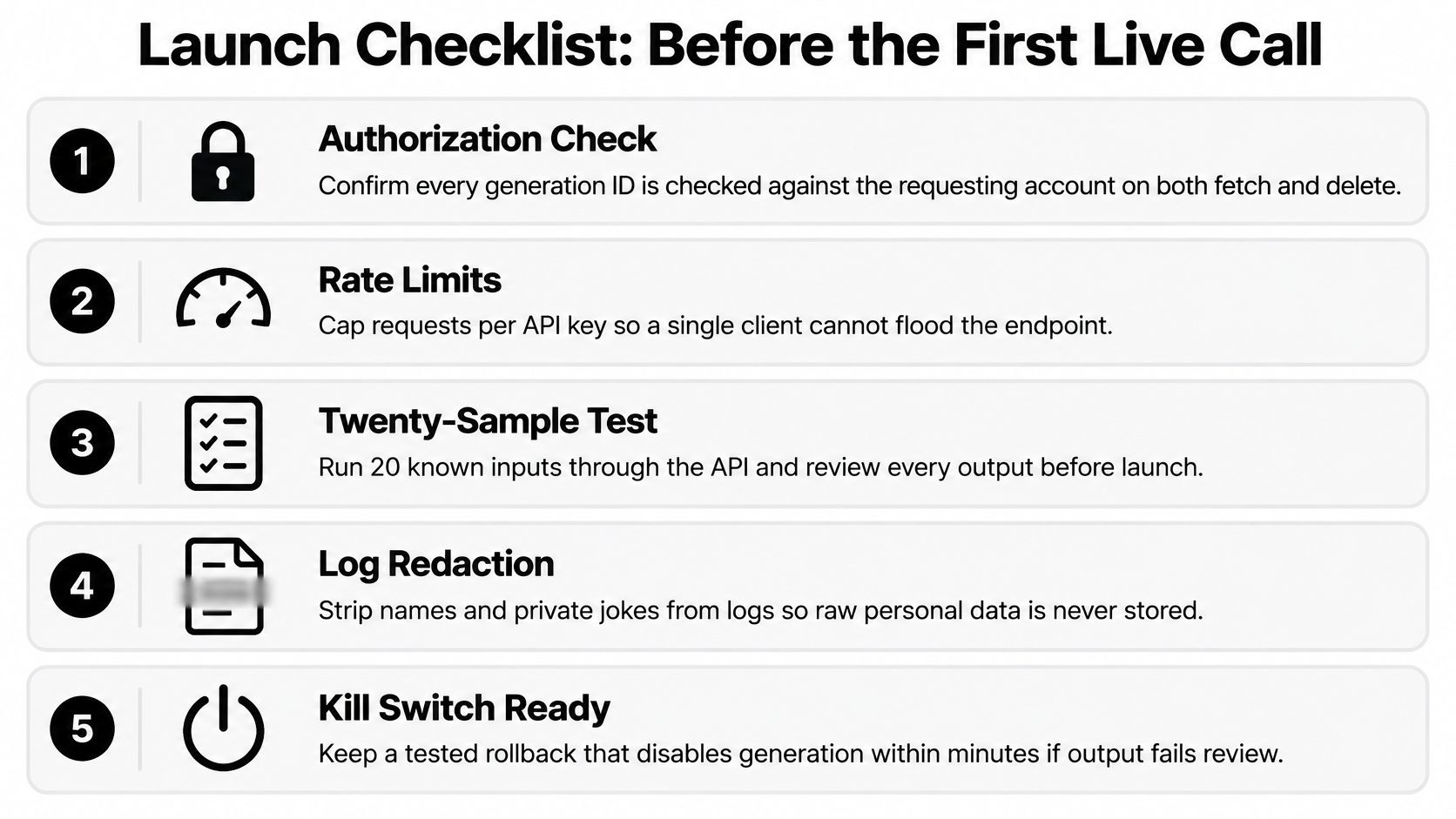 A five-point checklist for launching an AI-powered insult generator API safely and securely.
Prove the failure paths
- Cross-account access: Create a generation under one test account, then attempt retrieval and deletion from another. Both operations must enforce ownership, even when the caller knows the ID.
- Quota exhaustion: Deliberately exceed configured allowances and verify that the client pauses rather than spinning. Confirm that the documented retry guidance reaches the caller.
- Deletion and redaction: Remove a test generation, verify its content is no longer retrievable, and inspect application logs and tracing tools for accidental copies.
- Incident control: Disable generation through a tested kill switch while preserving reporting and deletion access. Assign someone to review incidents and authorize reactivation.
Record the effective model and policy versions with each evaluation result. Otherwise, a passing review can become detached from the behavior you deploy.
Run a deliberately small quality trial
For a proposed launch exercise, create twenty sample requests spanning the relationship options, the illustrative savagery scale, and two languages. This is a smoke test for humor, safety, and privacy leaks, not statistical proof of moderation accuracy.
Have two reviewers independently grade every returned variation. Include attempts to request intensity above the relationship ceiling, and treat a correct rejection as a passing result. Only consider enabling the strongest permitted setting when both reviewers approve the eligible cases; agreement doesn't replace broader safety evaluation.
Our output is currently lyrics text; audio generation isn't yet available. Test the text workflow you can deliver today, including editing, selection, and safe display.
This week, ask a friend who explicitly agrees to be roasted, submit a low-intensity request with a small set of alternatives, and read the approved results aloud. If the room laughs without anyone becoming the collateral damage, you've earned a useful first observation, not permission to skip the rest of launch testing.
DissTrack AI offers personalized roast lyrics with style choices and multiple variations you can edit before sharing. Visit DissTrack AI to try a consensual roast, then use the result to define the humor, privacy, and safety standards your own integration should meet.