
East Coast Styles: How to Pick the Sound
The usual advice is to grab a dusty sample, add hard drums, and write complicated rhymes. That gets you one East Coast sound, not the whole region. East Coast styles are a family of rap approaches rooted in New York City, with different ways to handle mood, rhythm, and verbal competition.
A cypher verse, a funny friend-group roast, and a Brooklyn-drill clip don't need the same beat. Choose the job first. Then choose a pocket that lets your words do that job.
Choose an East Coast Style by the Job
Think of the region as a building with different rooms. The jazz room invites conversation. The hardcore room demands attention. The drill room favors a quick entrance and a phrase people can repeat.
These are working lanes, not sealed historical categories. A producer can borrow jazz harmony for a grim street record. A rapper can bring intricate internal rhyme to a drill beat. The useful question isn't whether elements can mix. It's which element should lead.
Melodigging's East Coast hip-hop overview describes a regional tradition that includes stripped-down aggression, jazz-inflected looseness, grim street realism, and contemporary drill hybrids. That breadth matters when you're choosing a sound for a particular voice.
East Coast Lanes by Tempo, Drums, and Job
| Style | Tempo | Drum feel | Lyric focus | Best for |
|---|---|---|---|---|
| Classic New York boom bap | Measured boom-bap pace | Hard kick, crisp snare, chopped breaks | Dense multis and punchlines | Cyphers and full diss verses |
| Native Tongues jazz rap | Mid-tempo | Looser jazz loops and a live pocket | Playful internal rhyme and character | Abstract or personality tracks |
| Grimy hardcore street rap | Measured pace with room for narration | Sparse dark loops and heavy drums | Specific threats and street narrative | Serious roasts |
| DMV-influenced cadence | Set by the conversational phrase, with room for swing | Swung, conversational pocket | Local slang and personality bars | Character-driven jokes |
| Brooklyn drill | Fast hats, half-time body | Sliding low end and rapid hats | Short stacked rhymes and menace | Short-form diss clips |
The tempo column isn't a list of genre admission rules. In drill, rapid hi-hats can make the surface feel fast while the rapper moves slowly against the main pulse. In a conversational DMV-influenced pocket, the sentence's shape matters more than forcing it into a boom-bap cadence.
DMV means Washington, D.C., Maryland, and Virginia. Treat that lane as a neighboring regional influence, not another name for New York rap.
Match the Mood Before the Sample
For a competitive verse, classic boom bap gives you space to develop an argument. For an eccentric character, jazz rap makes room for sideways observations and playful wording. For a serious roast, grimy hardcore works best when the details are believable, not when every line announces how dangerous the speaker is.
A character-driven joke needs speech rhythm. A short clip needs an immediate point. Don't select a long-form storytelling beat and then wonder why your quick punchline feels stranded.
Selection rule: Choose the lane that makes your strongest line easier to hear, not the lane with the most familiar drum kit.
If you need to compare musical moods before writing, you can browse music by genre on LesFM. Listen for how much space each arrangement leaves around a voice, rather than treating a genre label as proof of regional authenticity.
Modern production still counts when the writing and performance have a coherent identity. Accent, sample logic, competitive lyricism, and neighborhood detail can carry that identity without a vintage filter. Pick a dominant lane, then borrow supporting colors deliberately.
The Bronx Party That Started It
The starting point was a party room, not a recording booth. History of East Coast Hip-Hop identifies the commonly recognized beginning as August 11, 1973, when DJ Kool Herc hosted a back-to-school party at 1520 Sedgwick Avenue in the Bronx, and places the Sugarhill Gang's mainstream breakthrough with Rapper's Delight in 1979.
The setting matters as much as the milestone. Herc isolated and extended the break so dancers could keep moving through the part they wanted most. The break became a dance floor stretched like a rubber band.
The origin graphic keeps the room and the DJ's action together.
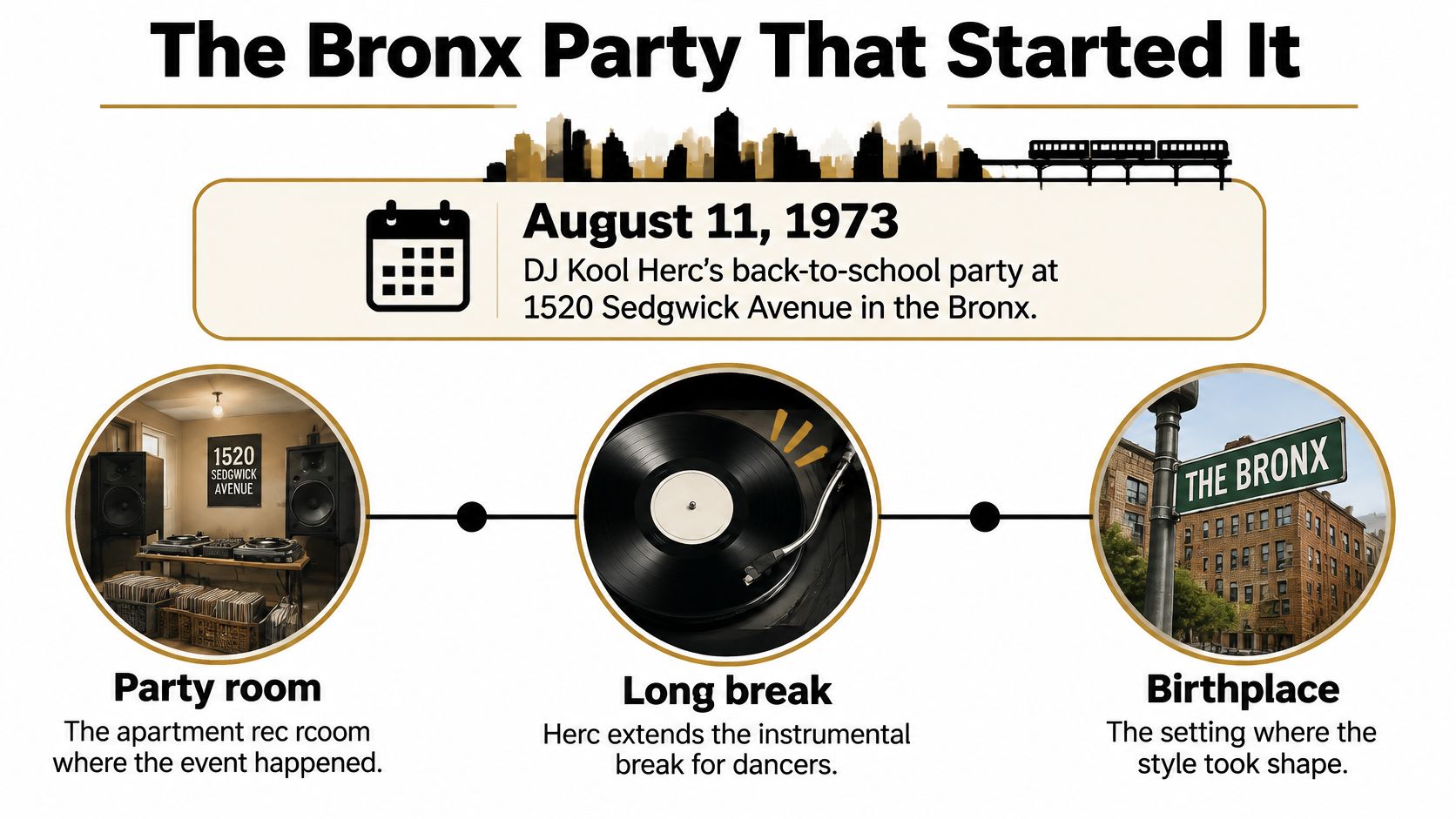 An infographic detailing the August 11, 1973, Bronx party that launched hip-hop culture at 1520 Sedgwick Avenue.
The DJ Built the Conditions
An extended break changes what a performer can do. Dancers get continuity. An MC gets a repeating musical surface that doesn't require a new melody for every phrase.
Say you're holding a microphone in a busy room. People are talking, moving, and watching each other. Your words have to register through that activity, so a clear attack and an intelligible phrase beat a clever sentence nobody catches.
Grandmaster Flash and Afrika Bambaataa helped expand DJ performance, break manipulation, and organizing practices across New York's boroughs. Crews and parties gave the culture places to develop before a commercial recording could carry it elsewhere.
- The room came first. Performance had to work for people standing nearby.
- The loop created continuity. A rapper could return with another phrase while dancers stayed engaged.
- The record changed the reach. A local party practice could travel beyond the neighborhood.
What a Writer Inherits
Later borough voices developed their own priorities. Queens lyricism and Brooklyn grit don't erase the Bronx origin. Neighboring regional pockets also deserve their own histories rather than being flattened into extensions of a single New York sound.
The inheritance is practical: make yourself understood, give the audience a reason to pay attention, and sound like you're speaking from somewhere.
Use the video as a listening companion to that party-centered origin.
If a verse has to win a room, clarity and competition matter more than whether the sample sounds old.
The Boom Bap Sound Behind the Bars
Boom bap is a recorded production approach, not a synonym for every East Coast record. The Wikipedia overview of boom bap places its golden-age prominence from the late 1980s through the early 1990s and gives a broader tempo range of approximately 85–100 beats per minute.
That measured pace leaves room for articulation. The rapper can connect rhyme sounds across a sentence without turning every word into a blur. But tempo alone won't create the feel.
The defining combination is sharply articulated drums, sampled breaks, repeating arrangements, and an MC-forward mix. You should hear the lyric clearly without losing the physical weight of the rhythm.
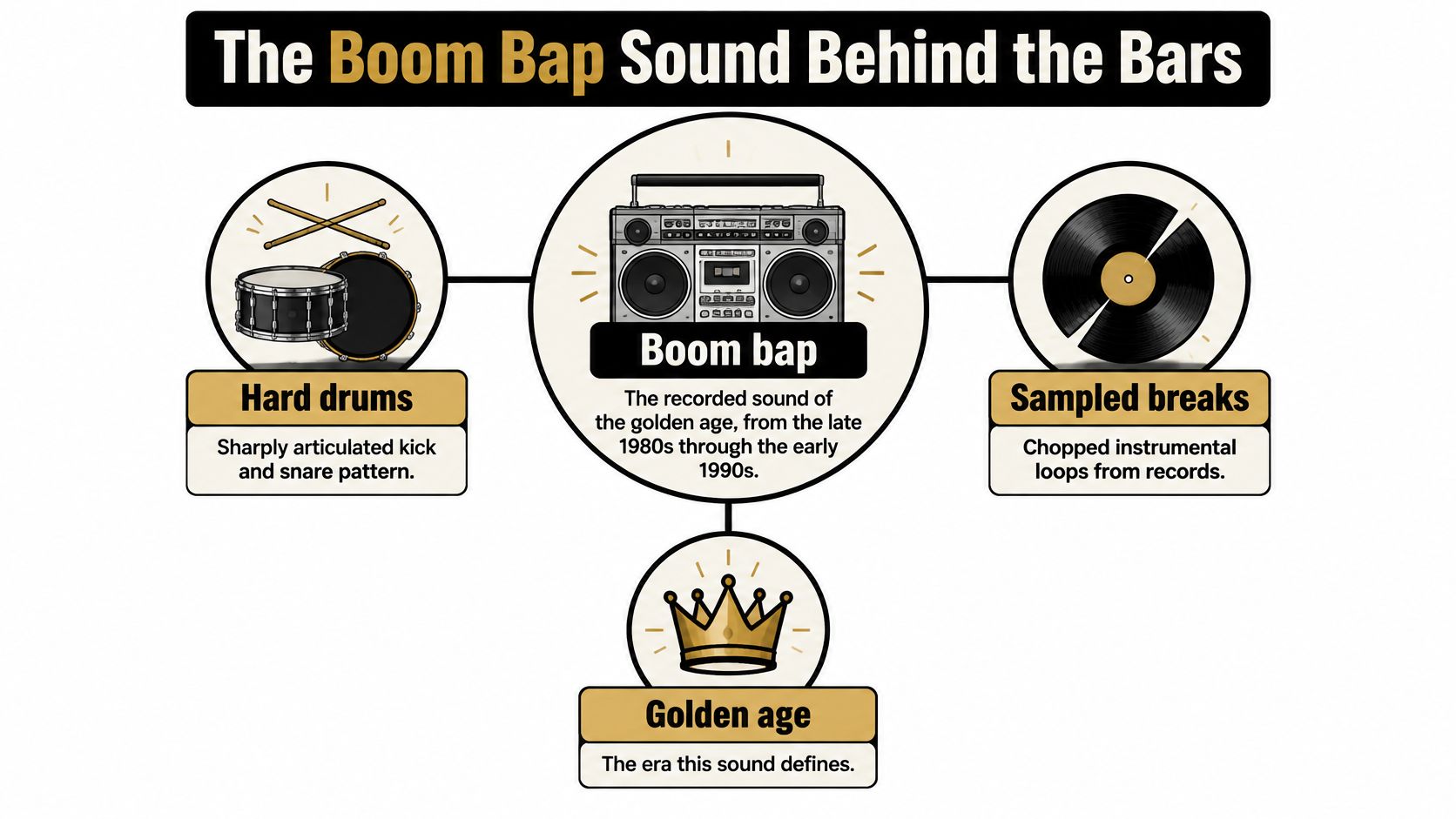 A diagram illustrating the elements of the Boom Bap hip-hop sound, including hard drums, sampled breaks, and its golden age.
Hear the Drum Before the Dust
A dusty texture is decoration. The important decision is how the drum hits speak.
Marley Marl's sampled-drum experimentation helped make the sound of the hit itself a compositional choice. A short kick leaves different space than a long, ringing kick. A dry snare gives the rapper a different point of emphasis than a snare buried in reverb.
- Kick definition. Listen for an attack you can locate, rather than low-frequency wash.
- Snare presence. The backbeat should remain audible when the verse gets busy.
- Loop restraint. A repeating sample gives the rapper a stable setting without demanding constant attention.
The beat is a boxing ring. The kick and snare mark the corners, the loop repeats the round, and the voice does the footwork. A crowded arrangement leaves less room to move.
Urgency and Control Aren't the Same
Eric B. & Rakim's Paid in Full is a useful reference for controlled phrasing. Follow how Rakim links sounds inside the line, not just at its ending. Multisyllabic rhyme means matching a sequence of sounds across syllables, rather than merely finding a longer word.
Run-DMC and Public Enemy offer different lessons in force. Run-DMC's direct attacks favor impact. Public Enemy's noisy, politically urgent arrangements show how intensity can come from a crowded sonic environment, provided the vocal still commands attention.
Manhattan's Chung King Studios belongs to this recording infrastructure, with projects such as Raising Hell and It Takes a Nation of Millions to Hold Us Back. Studios, producers, and performers developed these sounds together, not as isolated checklists.
Use the boom-bap songs guide to compare records by drum attack and vocal placement. Don't stop at whether they contain a sample. Ask whether the production lets the rapper sound precise, confrontational, relaxed, or some deliberate combination.
Why East Coast Bars Stay on the Grid
The coefficient of variation for note intervals was 0.457 for East Coast subjects versus 0.495 for West Coast subjects in a peer-reviewed phonetic study of 16 prominent performers. In plain language, the East Coast verses in that sample had less variation in the spacing between rhythmic events.
That's a tendency in a limited performer sample, not a test that every rapper must pass. It doesn't establish that West Coast rappers lack precision or that East Coast rappers never stretch a phrase. It gives you a useful writing target when you want a tightly organized delivery.
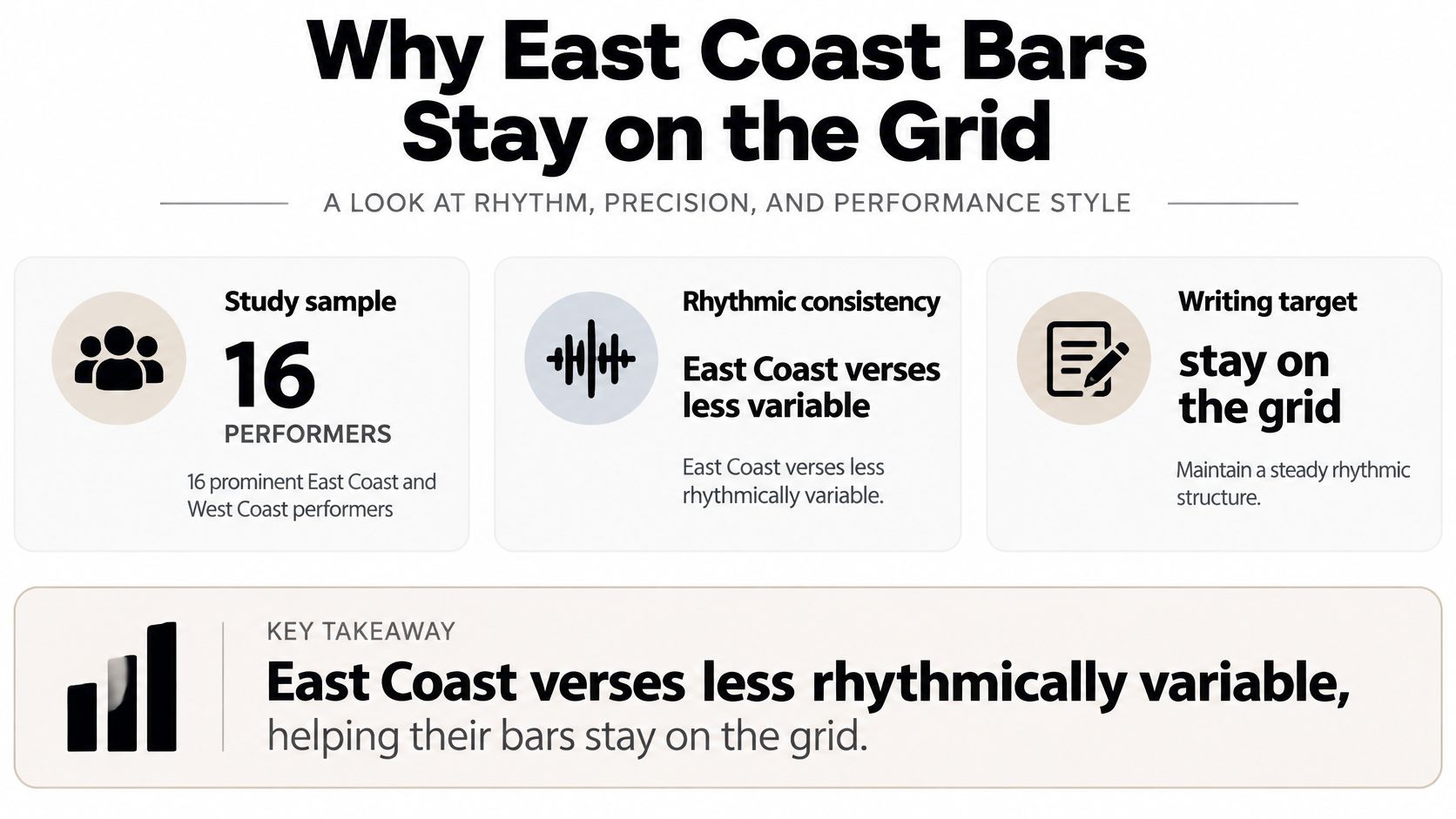 An infographic analyzing how East Coast rap verses maintain consistent rhythm and stay on the grid.
Establish a Repeatable Pocket
A syllable grid is the pattern of positions where you place syllables against the beat. Think of graph paper: the boxes help you align a drawing, but they don't decide what you draw.
Start by tapping the main pulse. Speak the line without performing it, then identify the words that carry its meaning. Place those stressed syllables where you can repeat them comfortably against the drums.
- Choose a subdivision. Draft most phrases against a consistent eighth-note or sixteenth-note pattern.
- Locate the important stress. Let the key noun, verb, or punch word meet a clear drum accent.
- Mark a rest. Leave breathing room where a listener needs to process the thought.
Don't confuse stable rhythm with identical syllable counts. You can leave a position empty, hold a word, or compress unstressed syllables while keeping the listener oriented.
Change the Detail, Not Every Foundation
Variety can come from sharper consonants, closer internal rhymes, or more meaning packed into a short phrase. It doesn't require a new rhythmic subdivision every time you start a line.
Say the joke concerns a friend who gives fitness advice but never takes the stairs. The revealing words are the advice and the avoidance. Give those words clear placement; don't bury them inside a long chain of rhymes about muscles.
Leave the listener a stable pocket, then surprise them with what you say inside it.
A looser West Coast delivery may sound more conversational as the phrase moves around the pulse. A tighter East Coast-style exercise keeps the main placement easier to predict, then uses a delayed entrance or clipped ending for emphasis.
Run a Two-Bar Self-Check
Loop a short passage and perform it repeatedly without reading. Notice whether your entrances stay deliberate or drift because the sentences won't fit.
If every line begins on a different part of the beat by accident, revise the wording before adding more rhymes. If an unusual entrance consistently makes the punchline stronger, keep it. Control means you can repeat the choice, not that every word lands directly on a metronome click.
Artists Who Prove the Split
A reference record should give you a usable technique, not a borrowed personality. Listen for a decision you can reproduce with your own subject: where the rhyme falls, how much detail the rapper includes, or how the beat frames a phrase.
Keep a notebook beside the session. Write down what the artist does, then translate that action into your own material.
 A focused man wearing a beanie writing lyrics in a notebook in a music recording studio.
Borrow Decisions, Not Identities
| Reference | What to borrow | What not to copy |
|---|---|---|
| Eric B. & Rakim, Paid in Full | Rhyme connections that continue through the sentence | Rakim's exact vocal mannerisms |
| Public Enemy, It Takes a Nation of Millions to Hold Us Back | The relationship between urgency and production pressure | Political slogans you don't understand or mean |
| A Tribe Called Quest | Playful phrasing that leaves the groove comfortable | Surface-level jazz decoration without character |
| Nas | Concrete observations that establish a place | Someone else's street biography |
| Pop Smoke | Compact phrases that remain legible against active drill drums | His voice, signature phrases, or persona |
With Tribe, pay attention to how a rapper can sound relaxed without sounding unfinished. A small conversational turn can reveal more personality than an elaborate boast.
With Nas, notice the specificity. For a fictional roast, a target's scuffed delivery bag or habit of guarding the wrong basketball hoop can establish character more effectively than a generic claim that they're weak.
Familiar New York Voices Still Reach Listeners
50 Cent ranked as New York City's most-streamed rapper in 2025 with approximately 1.9 billion global YouTube views, according to music analytics account Diverse Mentality as reported by The Source. That's a New York City artist ranking measured through global views, not a count of listeners inside the city.
For writing, borrow his economy. A plainly stated insult can work because the setup establishes exactly what makes it embarrassing. Don't imitate the biography or confuse a recognizable delivery with your own voice.
The West Coast rap style guide can help sharpen your listening contrast. Compare the placement of phrases rather than deciding that a particular bass sound belongs exclusively to a coast.
For the DMV-influenced lane, choose a reference whose conversational pacing you can clearly hear and understand. Don't paste unfamiliar slang into a New York verse and call it regional range.
Select a single reference track that matches your intended job. Too many references make it harder to hear which choice you're practicing.
How to Build an East Coast Verse
Open your DAW and a blank lyric document before browsing another pack of sounds. You need a beat you can perform over, not an impressive collection of unfinished possibilities.
The sample-based approach has a technical history. Michail Exarchos's chapter on boom-bap aesthetics and the machine connects its sound to sampler workflows, including the Akai MPC family, and to chopping, looping, quantization, and drum programming.
Build the Instrumental for the Voice
-
Lock the lane and length. Choose a full verse or a short clip before drafting. A clip needs a quick arrival; a longer verse can support a developed accusation and payoff.
-
Set a performable pulse. Speak your central line over the drums. For boom bap, adjust the pace until the consonants stay clear. For drill, follow the half-time body rather than trying to race every hi-hat.
-
Separate the drum roles. Give the kick and snare distinct attacks. Shorten a muddy kick tail, reduce unnecessary snare reverb, and check whether the words remain audible when both hit.
-
Leave deliberate negative space. Chop a break or sample into a repeatable motif, then remove competing notes around the vocal. Use small timing offsets and selective swing rather than moving every hit indiscriminately.
An MPC-style workflow encourages you to commit to a compact pattern and perform against it. You don't need the hardware to apply that discipline. A piano roll, sampler, and careful listening are enough.
Draft, Stress-Test, Then Decorate
-
Write the accusation plainly. State what the target does and why it's funny. If the plain version has no point, a complicated rhyme won't repair it.
-
Add rhyme around the meaning. Use internal connections and multisyllabic matches where they support the sentence. The rap rhyme patterns guide offers structures to practice without forcing every thought into an end-rhyme pair.
-
Make the target recognizable. Include a neighborhood detail and a personal habit where they're relevant. For a playful roast, attack the boast, contradiction, or behavior rather than inventing a serious allegation.
-
Perform the draft aloud. Record a rough take, listen without reading, and cut anything whose punch depends on seeing the text. Move a rhyme if it draws attention away from the actual joke.
Prompt test: Describe the voice you want clearly enough that another writer could perform it.
A concrete prompt might specify classic boom bap, a measured tempo, dense internal rhyme, dry humor, sharp but playful insults, and a familiar local setting. Add a target behavior, such as always giving directions while getting lost.
The substyle sets the approach. The target detail supplies the material. The read-through tells you whether they work together.
Pick a Lane and Generate the Verse
Your draft doesn't need to impersonate a historical record. It needs a consistent performance choice and a reason for the listener to care about this particular target.
Keep the reference track beside you while editing, but don't write replacement lyrics for it. Use it to judge whether your own phrase has enough room, whether the setup lasts too long, and whether the final word deserves its position.
Turn the Choice Into a Brief
Before generating or rewriting, collect the material that only you know. A name alone rarely gives a writer enough to make a personal roast.
- Relationship. Explain whether the target is a friend, teammate, sibling, or fictional rival.
- Inside joke. Supply the repeated behavior that everyone involved recognizes.
- Boundary. State what's fair game and what should stay out.
- Performance job. Identify whether you need a clip, a room-ready verse, or a character-driven joke.
At DissTrack AI, enter the target's name, relationship, and inside joke, then use Step 2 to choose rap style tags and set how savage the diss should be. Available styles include West Coast Hip-Hop, Aggressive, Old School Boom Bap, Trap, Battle Rap, and Comedy Rap, plus Drill, Emo Rap, and UK Grime, with different flows, vocabulary, and attack patterns.
Edit for the Lane You Chose
Use Old School Boom Bap for a classic or grimy verse, Battle Rap when competitive punchlines should lead, and Drill for the Brooklyn-drill lane. Treat those tags as directions for execution, not substitutes for specific material.
Review the structured variations and keep the phrases that sound like something you'd say. Generations remain private until you choose to publish, which suits a friend-group roast as well as a performance draft.
Generate a version in your chosen lane, read it on the grid, and cut anything that could belong to any target on any coast.
DissTrack AI turns a target, relationship, and inside joke into personalized roast lyrics with adjustable style and savagery. Visit DissTrack AI, choose the tag that fits your East Coast lane, and generate a draft you can sharpen aloud.