West Coast vs East Coast Rap: Sounds, Stories and Styles
Most advice about west coast vs east coast rap opens with a choice. Pick a side. East if you want bars, West if you want groove, and never let the two share a bar.
Run that advice on a real project and it collapses in about four bars. Say a friend's birthday is coming up and you want a roast verse with a California feel. You slow the beat, drop in a whining synth lead, add the lazy drawl, and the result sounds like a car rental ad at LAX. Tag the same verse East Coast and you get a guy from a borough who never existed, cramming eight extra syllables into every line until the vocal trips over itself.
Both outputs are costumes. Both come from the same error, which is treating a region as a personality rather than a stack of production and writing decisions you can swap in and out. The divide is real and it's measurable in tempo, syllable placement, drum pocket and subject matter. It just isn't clean, and the artists who made the most distinctive records were usually the ones stealing from the other coast.
West Coast vs East Coast Rap at a Glance
Here's the inconvenient part for anyone who has argued about this at 2 a.m.: the two coasts sound far more alike than the feud admits. Both grew out of the same drum machines, the same sample culture, the same 16-bar verse. What differs is where the emphasis lands.
This table sorts the five traits people mean when they say a track sounds East or West.
| Trait | East Coast | West Coast |
|---|---|---|
| Signature sound | Sample-heavy boom bap, lyric-first production | G-funk built on funk bass and synthesizers |
| Flow pattern | Steadier subdivision, tight bar-line alignment | More rhythmic variation, stretched phrasing |
| Lyrical focus | Street life and rhythm | Vulgarity, violence and hard-edged street narratives |
| Peak period | Cultural hub through much of the 1980s | Temporary commercial lead, roughly 1989-1997 |
| Defining anchor | Bronx origins and New York dominance | N.W.A and Straight Outta Compton (1988) |
How to read the rows
Every row describes a tendency with a wide margin, not a rule with a border checkpoint.
Take the signature sound. East Coast boom bap is built on chopped samples, a hard kick and snare, and a mix that leaves the vocal up front, because the vocal is the point. West Coast G-funk leans on funk-derived bass lines, synthesizers and longer melodic loops, so the groove carries as much weight as the rapper does.
The flow row is the one producers underrate. East Coast delivery favors a steadier subdivision and sharp alignment with the bar line, so each line lands like a stamp. West Coast delivery stretches phrasing and varies the rhythm across bars, which is why a West Coast verse can feel conversational and still sit perfectly in the pocket.
The lyric row carries the most stereotype and the least truth per word. Subject matter does separate the coasts in the aggregate, but individuals cross those lines constantly, and a style tag that pushes you toward caricature is worse than no tag at all.
Treat this as a starting map. A single track can match three rows and break the other two, and that's normal.
How Each Coast Built Its Identity
Say a Los Angeles listener in the late 1980s puts on N.W.A's Straight Outta Compton. The hard-edged street narratives and funk-derived production make a clear regional statement, putting Compton and South Central into the national rap conversation. New York had built hip-hop's early center of gravity, from the Bronx's block-party culture to its commercial and creative influence through much of the 1980s, as a regional history from Dominican University traces.
Los Angeles made its own argument in sound and subject matter.
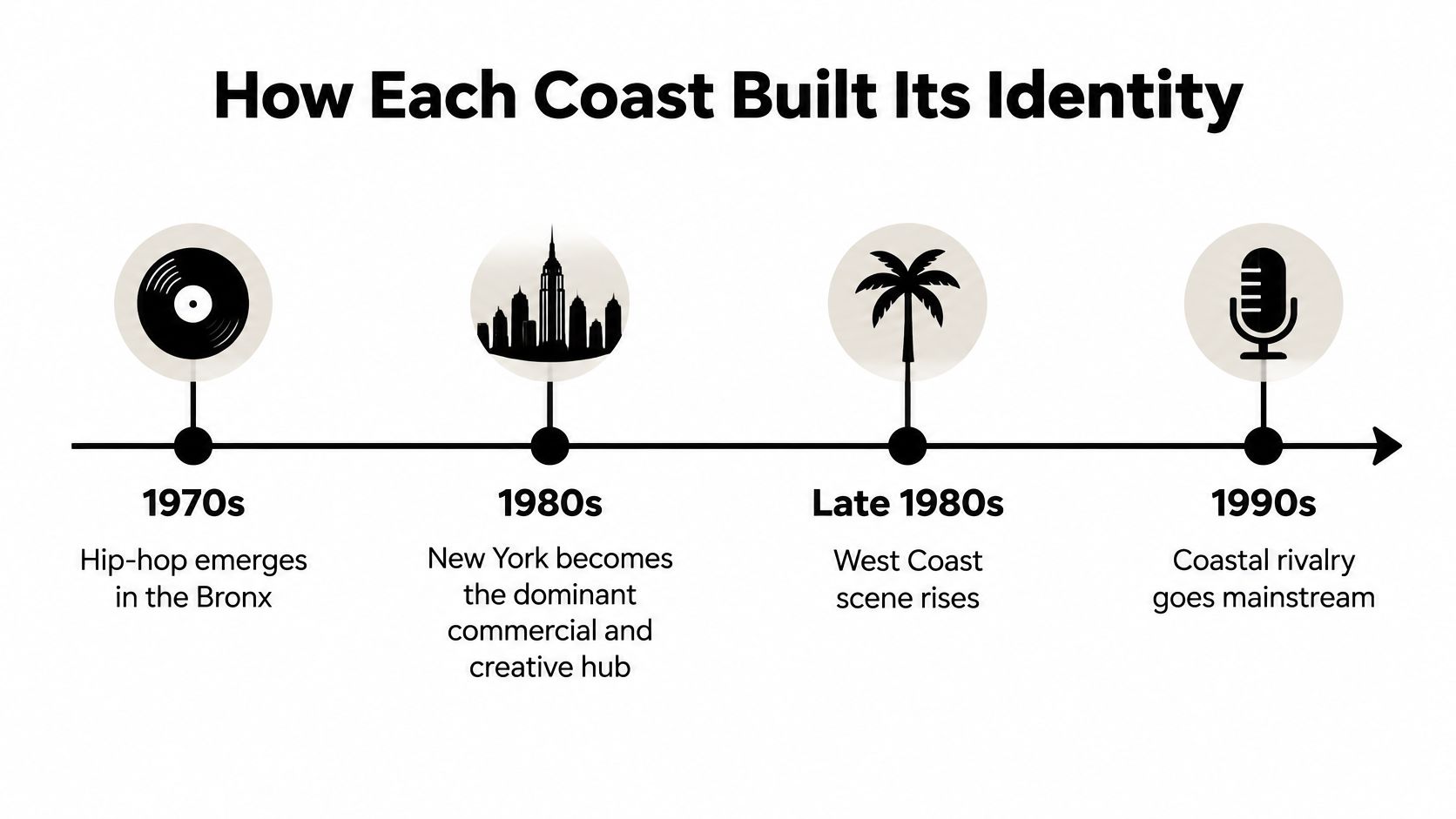 A timeline graphic illustrating the evolution of hip-hop history from the 1970s to the 1990s.
N.W.A's 1988 album challenged New York's cultural dominance and gave the West Coast a powerful new reference point. The record is a useful starting point for hearing West Coast rap style as a set of choices in production, voice, and storytelling, rather than one fixed mood.
From the Bronx to a national market
Dr. Dre's 1992 solo debut, The Chronic, helped establish G-funk as a defining West Coast sound. Its lead single, “Nuthin' but a ‘G' Thang,” reached No. 2 on the U.S. Billboard Hot 100. A regional style had reached a national audience.
The shift was shaped by more than records. Label competition and media framing influenced which coast received attention, while artists and industry ties kept the regions connected. Compton MC Eiht has described flying to New York for promotional runs because major labels were headquartered there, then recording with East Coast producers such as DJ Premier. The rivalry made a dramatic story, but the music also moved across regional lines.
The broad sequence is clear:
- 1970s: Hip-hop emerges from Bronx block-party culture.
- 1980s: New York remains a major creative and commercial hub.
- 1988: Straight Outta Compton brings Los Angeles into the national conversation.
- 1992: The Chronic carries G-funk to a wider audience.
These milestones mark turning points, not borders. Regional identity offers a palette of cues that artists can combine, reshape, or leave behind.
Tempo and Production Differences Compared
Say a producer is choosing between a compact boom-bap loop and a slower, bass-led groove. The BPM gives a useful clue, but it does not assign the track to a coast.
Berklee places classic East Coast hip-hop commonly around 100–120 BPM, while early West Coast hip-hop often sat near 90–100 BPM before the broader West Coast range expanded to 90–120 BPM, according to Berklee's breakdown of hip-hop tempo, instrumentation, rhythmic feel and sonic density. The ranges overlap, so tempo is a tendency, not a regional boundary.
| Scene or era | Typical tempo | What it sounds like |
|---|---|---|
| Classic East Coast boom bap | 100–120 BPM | Tight boom-bap pocket with dense kick and snare articulation |
| Early West Coast hip-hop | 90–100 BPM | Slower groove with room for bass, synths and stretched vocals |
| Broader West Coast range | 90–120 BPM | Wider tempo spread as the sound matured |
| Rap-war era, 1986–1998 study | East Coast tracks consistently faster | Analysis of 1,368 tracks by 32 key artists |
An analysis from Johannes Kepler University examined 1,368 tracks by 32 key artists from the East Coast and West Coast rap-war era of 1986 to 1998. It found that East Coast tracks were consistently faster than West Coast tracks in that sample.
What the numbers say
A 20 to 30 beats per minute difference changes what a rapper can physically do. At 110 BPM, a compact bar can hold dense internal rhymes without forcing the delivery. At 92 BPM, those same syllables need more space, or the rapper must ride the beat with a looser delivery.
That shift affects the writing, but it does not dictate it. A brisk track can still leave room for a relaxed flow; a slower one can carry tightly packed lyrics. Match the cadence to the groove rather than copying a regional stereotype.
Beyond tempo, three levers
Instrumentation, rhythmic feel and sonic density shape the production alongside BPM. East Coast boom bap often uses tightly articulated kicks and snares, while West Coast production may give funk bass, synthesizers and elongated vocal phrasing more room.
Practical rule: Choose a reference track and set a target BPM before writing. Then try the verse against the beat: if the syllables crowd the pocket, revise the cadence or tempo. For producers building from scratch, this guide to making rap beats covers how beat choices shape the pocket.
Use regional sound as a palette, not a box. A track can combine a brisk tempo with spacious bass, or pair a slower groove with crisp, dense drums. The beat's pulse, space and instrumentation make the distinction audible; no single setting defines either coast.
Flow, Rhyme and Lyrical Themes Side by Side
A rapper can keep the same beat and change the whole feel of a verse by shifting where the syllables fall. That makes flow a useful clue to regional style, though no single pattern belongs to only one coast.
 A young man with dreadlocks writing lyrics in a notebook at a desk with a microphone.
A comparative prosody study found that West Coast rap showed more rhythmic variation than East Coast rap. Melodic variation also trended higher on the West Coast, though the difference was not statistically significant, according to prosody research hosted by the Max Planck Society. These are tendencies, not coast-wide rules.
What rhythmic variation looks like in practice
Say a rapper begins one line behind the beat, then starts the next ahead of it and lets the final phrase spill over the bar. That shifting placement illustrates the rhythmic variation associated with a West Coast lean.
A more even subdivision and sharply defined bar lines can give a verse an East Coast lean, especially when dense rhymes and punchlines arrive in a tight, predictable pocket. Either approach can borrow from the other.
Listen for four features:
- Syllables per beat: how densely the words fill the groove.
- Onset deviation: how far syllables fall from the beat's grid.
- Pause frequency: how often the rapper leaves space.
- Melodic pitch movement: how the voice rises or falls across a phrase.
These clues describe a palette, not a binary. The same research reports overlap between regional practices, so a verse can combine loose timing with tightly packed internal rhymes.
Where themes divide and where they don't
A computational study of representative 1990s rap-war songs associated vulgarity and violence more with West Coast material, and street life and rhythm more with East Coast material. It also found West Coast tracks were generally slower, according to the study of lyrical topics and tempo. Those findings describe the songs examined, not every artist or record from either coast.
To study a verse, count syllables across eight bars and compare their placement with the beat. Mark where punchlines hit, then track how much phrase length changes from the first bar to the eighth. Common rap rhyme patterns can help you identify whether rhymes cluster at line endings, stack internally, or mix both approaches. The pattern matters more than a regional label.
Flow shapes how a rapper delivers a line; lyrical themes shape what the line addresses. Confusing those two turns useful clues into stereotypes.
The video below demonstrates how different flows sit against beats.
Rivalry, Legacy and the Modern Regional Map
By the mid-1990s, a difference in sound had become a fight over labels, cities and identity.
New York's Bad Boy Records and Los Angeles-based Death Row Records turned a personal and label dispute into a national coast-versus-coast story, with The Notorious B.I.G. and Tupac Shakur cast on opposing sides, as this regional guide to hip-hop in America describes. The conflict intensified after Tupac publicly accused people connected with the East Coast scene of involvement in a 1994 New York shooting. Diss records and relentless press coverage widened the feud.
Tupac was fatally shot in Las Vegas on September 7, 1996. The Notorious B.I.G. was fatally shot in Los Angeles on March 9, 1997. Their deaths turned a branding war into a human tragedy, while exposing the danger of treating regional rivalry as entertainment.
Scholarship describes the episode as an interaction among regional style, label economics, artist identity, press amplification and violence, rather than the result of a single cause. The two-coast frame was always incomplete: artists across the South and Midwest were shaping hip-hop, too.
The map after the feud
Streaming has helped regional sounds travel without requiring artists to stay inside one tradition. Reporting on the return of regional rap describes a more fragmented regionalism, with New York drill gaining wider attention through producers such as Cash Cobain and West Coast sounds remaining visible through California's dance-oriented and G-funk-derived traditions. TikTok, streaming and global collaborations let creators combine cues from different places.
The old catalog makes that mix easier to hear. Browse a West Coast rap legend's catalog, then focus on the writing rather than the production. Some lyrics may feel less tied to a single coast once the beat is out of the picture. Regional style works better as a palette of choices than as a pair of sealed camps.
Which Coast Fits Your Track or Project
The useful question isn't which coast is better. It's which palette the project in front of you is asking for.
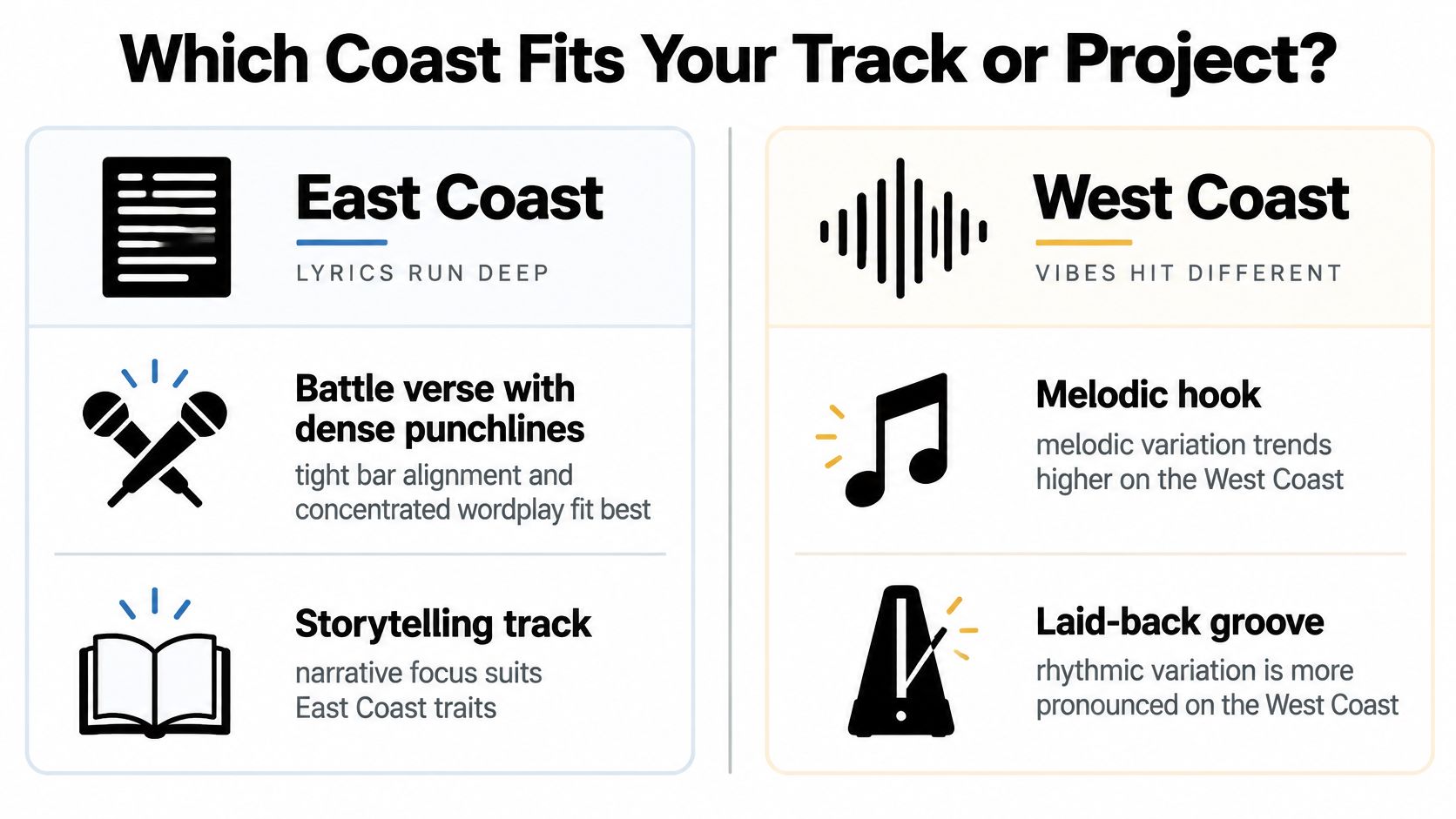 A comparison chart highlighting the stylistic differences between East Coast lyric-heavy rap and West Coast melodic production.
| Use case | Lean toward | Why it fits |
|---|---|---|
| Battle verse with dense punchlines | East Coast | Tight bar alignment and concentrated delivery land each line |
| Party roast or meme video | West Coast | Groove and bass leave room for timing and comedic pauses |
| Boom-bap beat for a producer | East Coast | Sample-heavy drums and steady pocket |
| Summer cruise or funk-driven track | West Coast | G-funk synths and elongated phrasing |
| Hybrid drill or global collab | Blend both | Combine palettes and tag both styles |
A battle verse wants the East Coast setting because the tempo does the work for you. At 100 to 120 BPM, the bar has room for stacked internal rhyme, and every punchline lands on a predictable beat for the listener to catch.
A party roast lives or dies on timing, and that argues for the West Coast palette. When the groove breathes, a comedic pause doesn't get swallowed by a wall of syllables.
Matching the project to the palette
Producers building a boom-bap loop should start East, since sample-heavy drums and a steady pocket are the whole point of that sound. A summer cruise track or anything funk-driven pulls the other way, because elongated phrasing sits naturally over G-funk synths and a slower groove.
The hybrid cases are where listeners often get stuck. A drill track with a global collab can carry both, and forcing a single coast onto it usually makes the result sound thinner than the idea.
Pick the palette after you know the job. A style tag chosen before you understand the project is a guess wearing a label.
When you generate with DissTrack AI, the style tag you pick sets that starting palette. The available rap styles include West Coast Hip-Hop, Aggressive, Old School Boom Bap, Trap, Battle Rap and Comedy Rap, and step 2 is where you choose the tags and set how savage the diss should be. Combined tags suit a hybrid better than a single label.
Pick a Coast Style and Test It Today
Reading about tempo and flow doesn't train your ear. Running a comparison does, and it takes about twenty minutes.
- Choose one track per coast from the same era. Note each BPM against the benchmarks above, and write both numbers down before you listen any further.
- Run the eight-bar check on each. Count syllables per beat, mark where punchlines land relative to the bar lines, and note how much phrase length changes bar to bar.
- Grade both against the at-a-glance table. Mark which rows matched and which broke, and be honest about the breaks, because the breaks are where caricature starts.
- Pick your palette from the use-case table. Battle verse, party roast, boom bap, cruise track or hybrid, then commit to the choice and stop hedging.
- Test it on your own lyrics. DissTrack AI generates a verse with the matching style tag and lets you set how savage the diss should be, with a free trial available and no credit card required.
A generated diss track takes about 30 seconds, so you can audition three palettes before you've finished your coffee. Keep what serves the track, blend when the blend sounds better, and let your own ear overrule every row in this article.
The coast divide gives you a vocabulary, not a verdict. DissTrack AI turns that vocabulary into something you can hear: pick a tag such as West Coast Hip-Hop or Old School Boom Bap, set how savage the diss should be, and get a structured verse over a matching beat in about 30 seconds. If you've just worked through the tempo and flow checks above, the fastest way to test what you learned is to run one verse through it and listen for which cues survived. Head to DissTrack AI and start with the coast whose palette fits the track in front of you.