How to Write Freestyle Battle Lyrics That Land Hard
Most advice about freestyle battle lyrics starts with the wrong challenge. It tells you to “just go off the top,” as if the best battlers win by waiting for inspiration to strike. That can help in a cypher, but serious battle rap is usually written, rehearsed, structured, and performed to sound spontaneous. Recent analysis describes major battles as prepared rounds built around narrative arcs and opponent research, not endless raw exchanges (Hip Hop Today's discussion of modern battle lyrics).
The useful question isn't whether your bars were improvised. It's whether they feel alive, specific, and impossible to ignore. You need an angle that matters, language that cuts, rhythm that leaves room for impact, and delivery that makes the room believe you. Treat the page as your workshop, then use the stage to disguise the engineering.
The Craft Behind Freestyle Battle Lyrics
Freestyle battle lyrics came out of East Coast hip-hop in the late 1970s. A widely cited turning point arrived in December 1981, when Kool Moe Dee challenged Busy Bee Starski. That battle helped move rap beyond party routines toward sharper lyricism, storytelling, and direct competition (the history of battle rap). The lesson still applies: crowd control creates the moment, while structure and wordplay give the attack staying power.
High-level freestyle battle writing is engineered before it sounds spontaneous. Draft the angle on paper, test the rhyme and cadence, then rehearse until the construction disappears behind personality. Raw improvisation has its place, but relying on it for every major exchange usually produces familiar insults, loose setups, and endings that arrive before the crowd can catch them.
A round needs four working parts:
- Angle: What are you proving about the opponent? “You're fake” is only a label. “Your tough persona vanishes when the crowd stops validating you” gives the attack a direction.
- Language: Which nouns, verbs, objects, names, and sounds make that argument visible? Choose words that carry weight in the room, not filler selected only to complete a rhyme.
- Beat: Where does each phrase sit? Find the pocket, mark your breaths, and leave space before the landing. A strong bar rushed through the beat loses force.
- Delivery: What do voice, posture, facial expression, and movement contribute? A clever line delivered without conviction sounds like a note copied from your phone.
The parts have to agree. A strong angle with weak language feels predictable. Strong language on the wrong beat becomes clutter. A clean scheme without character sounds like technical practice instead of an attack. Research on freestyle battles separates the craft into poetic, linguistic, musical, and performance dimensions, which maps closely to angle, language, beat, and delivery (freestyle battle analysis and its four dimensions).
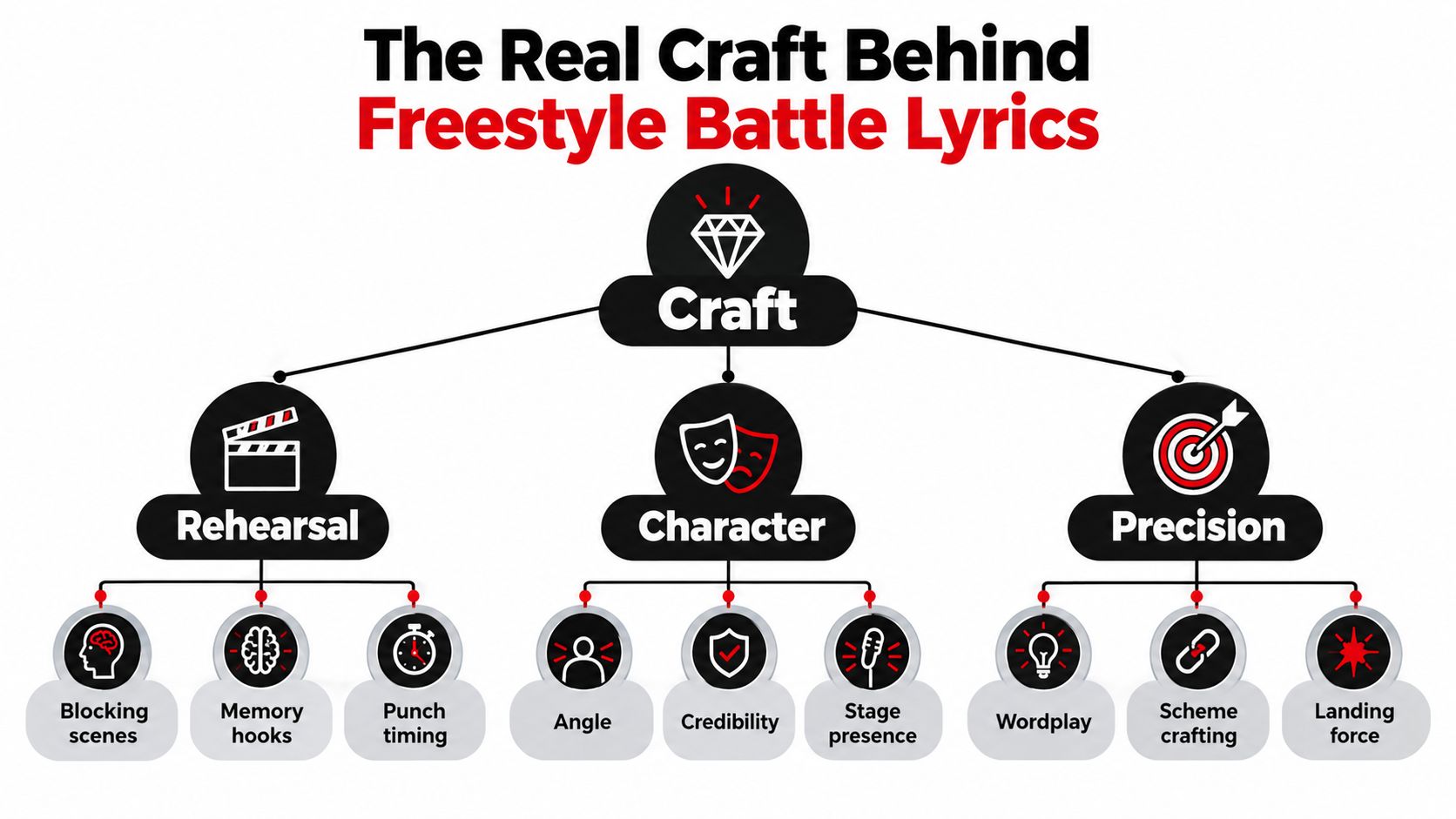 A diagram explaining the essential elements of freestyle battle lyrics, categorized into craft, rehearsal, character, and precision.
Run this diagnostic before you rewrite
Score your last performance:
- Angle: Can you summarize the central attack in one sharp sentence?
- Language: Did your strongest nouns and verbs create a picture?
- Beat: Did you pause before the key word, or rush to fit the rhyme?
- Delivery: Did your body reinforce the line?
- Escalation: Did each bar raise pressure, or repeat the same insult?
Practical rule: If you cannot explain what the round proves, you have not found the angle yet.
Build the attack, test its joints, cut weak material, and rehearse until the preparation sounds like instinct.
Bar Architecture and Punchline Engineering
A bar usually earns its reaction through setup and landing. The setup plants an image, assumption, or phrase. The punchline redirects that expectation and gives the audience a reason to react. Without the setup, a punch can feel random. Without the punch, the setup is just a sentence with rhythm.
Consider this original example:
You call yourself a king, but your crown came from a costume shop
One tug on the thread, and the whole royal image drops
The first line establishes the opponent's claim and introduces the costume image. The second line turns that image into a reversal, with “thread” creating a physical action and “drops” supplying the final stress. The rhyme is simple, but the picture gives the crowd something to see.
Now try a denser construction:
Your “iron” reputation bends under light pressure
Mine writes final chapters in a tight-letter measure
“Reputation” and “measure” create a loose multisyllabic relationship, while “bends,” “light pressure,” “final chapters,” and “tight-letter” provide internal sound echoes. The important stress points are iron, bends, final, and tight. Don't bury the attack beneath rhyme decoration. The rhyme should carry the idea, not replace it.
Three punchline families
| Punchline Family | Mechanism | Example Setup | Example Landing |
|---|---|---|---|
| Flip | Twist a familiar phrase or claim | You said you built your name from the ground | So every time you rise, the floor gets credit |
| Picture | Force the room to visualize a scene | You perform like a hero in a trailer | The full movie starts, and your character gets cut |
| Reversal | Turn the opponent's strength against them | You keep shouting that you bring pressure | Your loudest weapon is the panic in your voice |
Bar chaining keeps a full verse from sounding like disconnected jokes. Start with the opponent's claim, expose the contradiction, add evidence from their public behavior, then return to the opening image with higher stakes. Each line should answer the previous line with a sharper consequence.
A flat bar might read, “You talk tough, but you never fight.” Improve it in three passes:
- Vocabulary swap: Replace “talk tough” with “borrow menace.”
- Rhyme upgrade: Pair “borrowed menace” with “hollow sentence.”
- Concrete image: Show the borrowed toughness as a jacket, mask, or prop.
The rewrite becomes: “You borrow menace like a jacket, every threat a hollow sentence.” That line has a tangible object, a clearer accusation, and a tighter sound relationship. For more focused construction exercises, use this guide to write stronger punchlines.
Aim for at least three clear detonations across a 16, not because every verse needs a fixed formula, but because long stretches without a payoff make the crowd stop leaning forward. Space the punches so the verse breathes, then let the strongest landing close the sequence.
Structuring Three Rounds That Build to a Knockout
Major battle formats often favor three prepared rounds, and the strongest writers use those rounds as one argument rather than three unrelated rants. Spain's Red Bull Batalla de los Gallos helped formalize freestyle competition for Spanish-speaking audiences in 2005, while later tournaments and online circulation expanded the format across Latin America and Europe (historical overview of organized freestyle competition).
Use the round structure as an energy curve:
- Round 1, establish: Introduce your character, establish credibility, and reveal the angle. Don't spend your most replayable material immediately. Give the audience a reason to follow the argument.
- Round 2, escalate: Add layers, tighter schemes, and the strongest proof that your angle is accurate. You should place the material people quote afterward.
- Round 3, finish: Compress the message into memorable images and callbacks. Bring the opening idea back with a different meaning, then end on a line that sounds final.
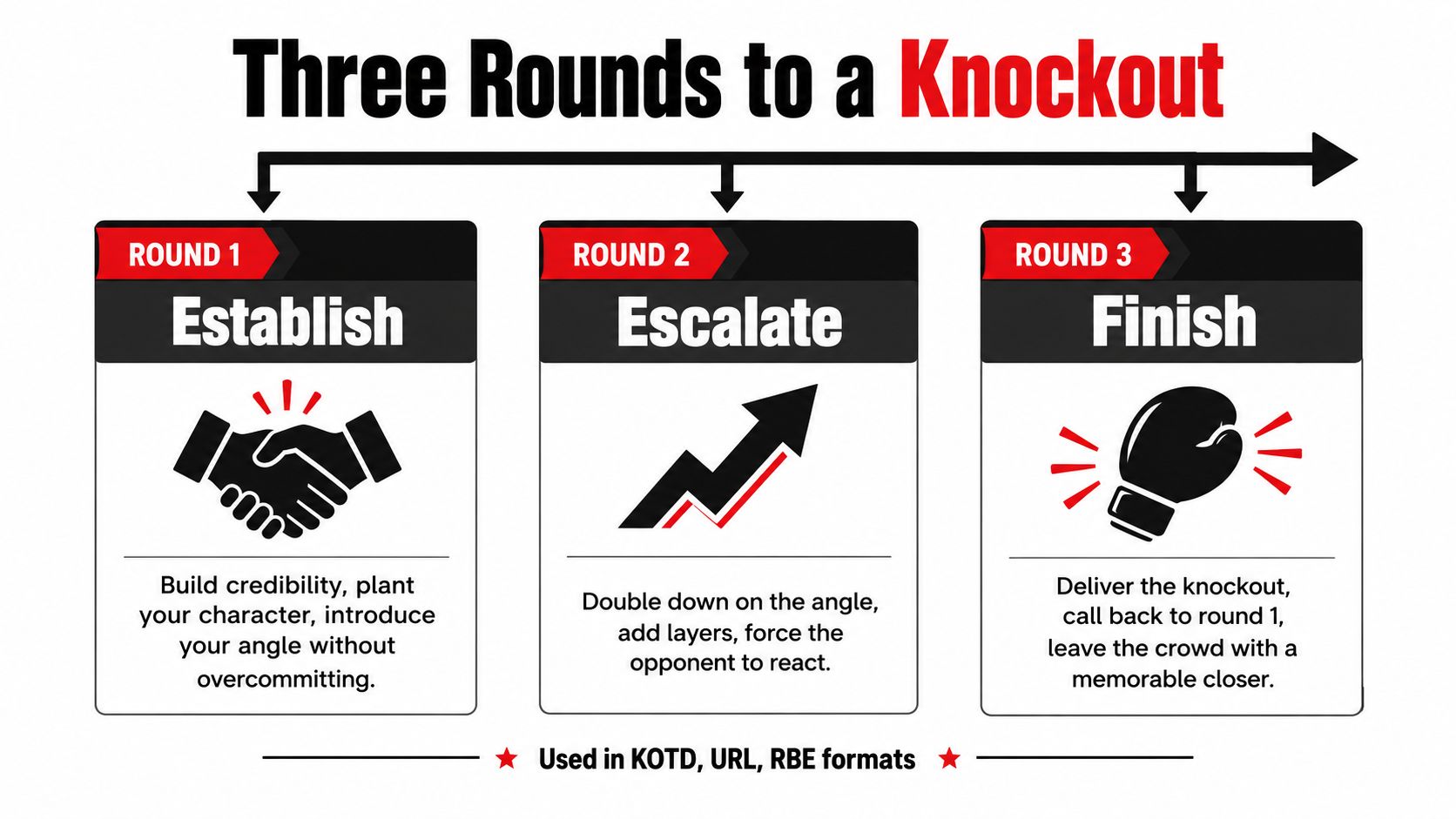 A diagram illustrating the three-round structure for a rap battle, including establish, escalate, and finish phases.
A reusable round template
For Round 1, draft a personal read, a character statement, and an angle introduction. Keep the scheme accessible enough for the room to understand while you're establishing your voice.
For Round 2, build a sequence rather than a pile. Start with the opponent's claim, provide a contradiction, develop a related image, then land the central punch. If the audience reacts, let the moment breathe instead of stepping on it.
For Round 3, use fewer ideas and stronger images. A closer about a mask, collapsing stage, counterfeit crown, or erased name can stay with the crowd longer than another general insult.
Order your material with discipline:
- Put the least essential material in the opening, while keeping the first impression strong.
- Reserve the sharpest scheme or most damaging proof for the middle.
- End with the most memorable image, preferably one that calls back to your first round.
- Cut any bar that only repeats an accusation without adding evidence or pressure.
The exact amount of writing depends on your format, beat, breath control, and delivery speed. Don't force a word-count target that makes the performance sound rushed. The round should feel like a controlled climb, not three separate notebooks emptied onto the stage.
Rhyme Schemes and Wordplay That Actually Land
A lazy couplet tells the audience where the rhyme is going before the punch arrives. Modern battle writing gets more mileage from multisyllabic chains, internal rhymes, stacked endings, and vowel movement because those tools let you control momentum without making every line sound identical.
Use each scheme for a job:
| Rhyme Scheme | Best Use |
|---|---|
| Perfect couplet | Clear setups, direct attacks, and simple crowd-readable endings |
| Multisyllabic | Technical pressure, extended schemes, and dense middle sections |
| Internal rhyme | Forward motion inside a long bar, especially before a delayed punch |
| Sliding or vowel rhyme | Flexible cadence, conversational delivery, and transitions between ideas |
Perfect rhyme is not amateur by itself. It fails when the rhyme becomes the most interesting part of the line. Multisyllabic rhyme also isn't automatically impressive. If the words sound impressive but don't sharpen the angle, you're polishing an empty weapon. A practical guide to multisyllabic rhymes can help you generate sound families, but you still have to choose the phrase that fits your character.
Wordplay moves with real impact
Homophones create quick pivots, but use them only when the two meanings remain clear in performance. Double meanings work best when the first interpretation supports the setup and the second one humiliates the opponent. Pop culture rewires land when the reference changes the audience's understanding of the target, not when you name a famous character.
Exaggeration becomes useful when it exposes a believable flaw. “You think you're important” is vague. “Your entrance needs a narrator because nobody notices the plot” gives the room a scene and a judgment.
Compare these rewrites:
- Flat: “Your music is boring.”
- Sharper: “Your whole discography's elevator music, even the breakdown waits for a floor.”
The second version adds a setting, a contradiction, and a final word that carries the image. Another example:
- Flat: “You copy other rappers.”
- Sharper: “Your style's a rental car, it looks fast until the owner comes back.”
The punchline pivot works because “rental” starts as a neutral object and becomes an accusation about borrowed identity.
What triggers a crowd reaction
| Move | Crowd response |
|---|---|
| Clear image followed by a short landing | Immediate recognition and noise |
| Personal contradiction tied to public behavior | Stronger attention because the attack feels earned |
| Dense rhyme with no clear meaning | Technical respect, but often limited reaction |
| Obscure reference without setup | Confusion or silence |
| Repeated generic threats | Diminishing returns and weaker credibility |
Write for the ear, not the page. A line that looks clever in a document may disappear once voices overlap, people react, and the beat shifts. Put the most important word where your breath and cadence can expose it.
Rehearsal Drills to Sound Spontaneous on Stage
Written bars sound spontaneous when your mouth knows the route well enough for your attention to stay on the room. Rhythm research on battle rap describes delivery as variable and often slower than ordinary rap, with pauses used deliberately for emphasis (rhythm, movement, and improvisation research). That supports a simple performance rule: don't fill every gap. A pause can make the next word feel heavier.
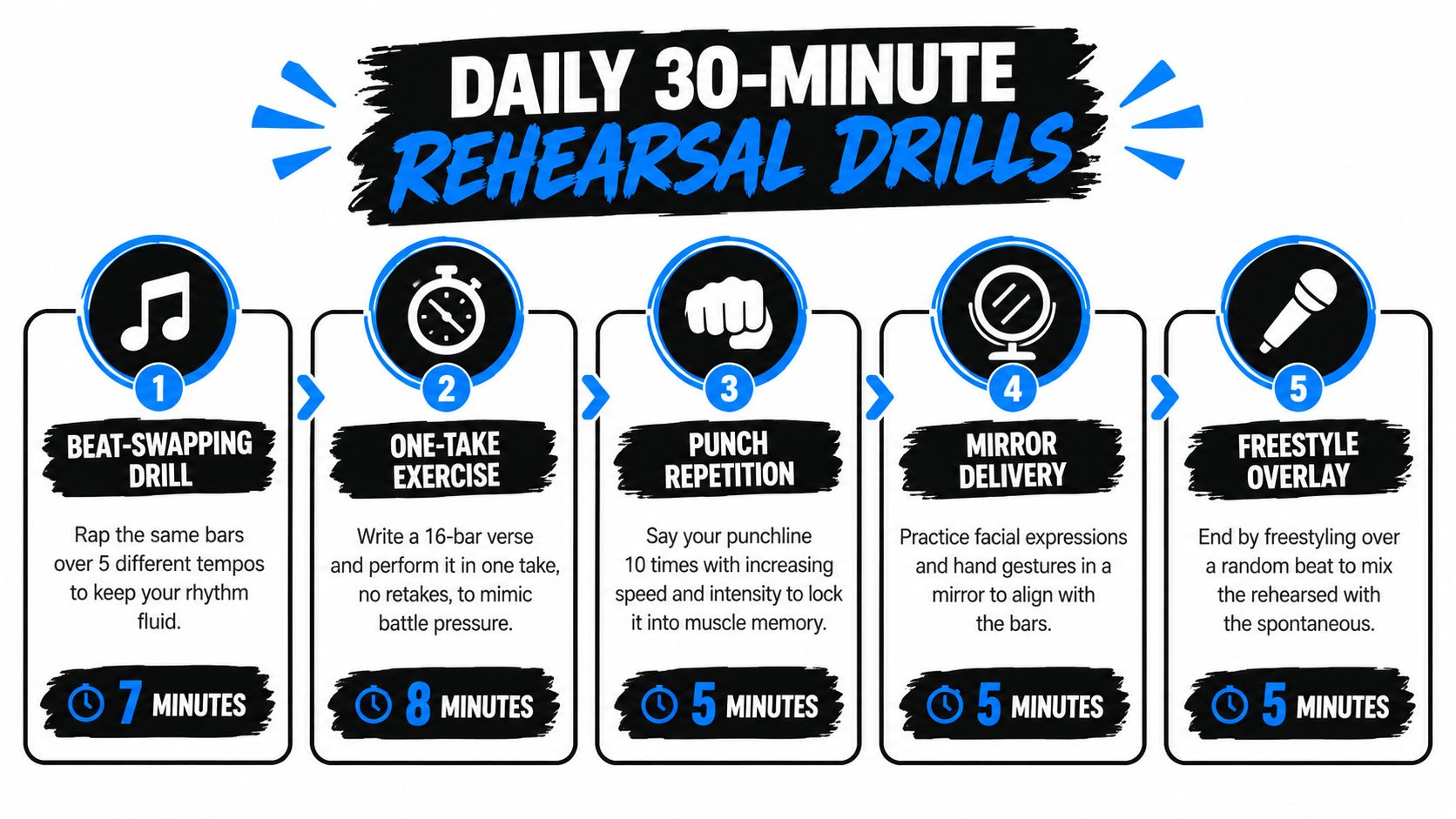 An infographic titled Daily 30-Minute Rehearsal Drills outlining five exercises to improve rapping skills and performance.
Run this practice stack:
- Beat swapping: Deliver the same passage over contrasting tempos. Your goal isn't perfection. It's learning which syllables are essential and which can stretch.
- One take: Record a complete verse without restarting. Mark every stumble afterward, but don't interrupt the rep. Battles don't offer unlimited retakes.
- Punch repetition: Repeat the key landing with changing intensity. Start conversational, then sharpen the final word, then perform it with a pause before impact.
- Mirror delivery: Watch your eyes, shoulders, hands, and stance. Remove gestures that happen on every line, then keep the movements that clarify the image.
- Freestyle overlay: Perform the written passage, then add improvised connective tissue around it. This is how prepared seeds begin to feel like live thought.
The rehearsal environment should become less friendly over time. Start with the mirror, move to a trusted friend, then perform for people who won't protect your feelings. Practice after physical fatigue too, because clean recall under pressure matters more than flawless delivery in your bedroom.
Improvisation research involving fMRI has linked elite freestyling with altered activity in prefrontal regions associated with conscious monitoring, while language, motivation, affect, and motor networks remain engaged (research on the cognitive basis of lyrical improvisation). In practical terms, automate the structure so your attention can respond to the opponent, DJ, and crowd.
Use freestyle seeds as controlled flexibility. Memorize a few images, rhyme families, and angle fragments, then connect them differently during practice. You won't sound like you're reciting a script, because the transitions remain alive.
Reading Your Opponent and Picking the Killing Angle
A killing angle isn't the cruelest fact you can find. It's the most useful contradiction you can prove in performance. The opponent may have dozens of flaws, but a buffet of weak shots creates no story. Choose one pressure point that fits your persona and can survive across the rounds.
Start with the public footprint. Review freestyles, interviews, battle clips, social posts, and released music. Don't collect gossip. Collect repeated behavior that the audience can recognize.
Build the angle stack
Create a scouting sheet with four columns:
| Observation | What it suggests | How to flip it | Likely counter |
|---|---|---|---|
| Repeated claim of authenticity | The persona depends on proving itself | Show how often the claim needs repeating | “You care too much about my image” |
| Familiar stage habit | The behavior is visible and recognizable | Turn the habit into a character symbol | “That's just performance style” |
| Old bar reused across battles | The writer relies on a safe idea | Frame repetition as creative limitation | “The line still worked” |
| Public contradiction | The audience has already seen both sides | Make the contradiction the round's spine | “People can change” |
Look for hypocrisy flips, credibility gaps, persona contradictions, recurring physical quirks, weak claims, and predictable defenses. The best detail is one you can revisit without repeating yourself. In Round 1, identify it. In Round 2, prove it with layered examples. In Round 3, reduce it to an image the crowd can repeat.
Your persona determines which angle you can sell. A calm technician should not suddenly become a cartoon bully. A comic battler can expose absurdity. A precise writer can treat the opponent's whole image like evidence in a case. The attack lands harder when the voice delivering it feels credible.
Prepare rebuttals before the rebuttal
Predict the opponent's likely responses and write them as extensions of your argument. If they say you're obsessed, answer that their repeated behavior created the evidence. If they claim the crowd already knows they're authentic, answer that reputation isn't proof. If they attack your research, turn that into another contrast between preparation and their lack of substance.
Avoid defensive wording. Don't sound like you're asking permission to make the point. Use the counter as a second setup, then return to the original angle with a new image.
Clean aggression lasts longer: Attack the public behavior, performance, writing, or artistic choices. Don't confuse private pain with battle material.
Family members, children, private trauma, personal addresses, and confidential information aren't clever targets. Never use real-world threats, doxxing, veiled calls for violence, or the outing of private trauma as ammunition. Those lines don't demonstrate sharper writing. They turn a competitive performance into real-world harm and can destroy trust with the room, league, and opponent.
League norms vary, but established battle settings generally reward competitive intensity with boundaries. KOTD, URL, and RBE audiences may tolerate severe character attacks, yet the crowd still recognizes the difference between a clean read and a cheap shot. A line aimed at public stage behavior can be devastating:
- Career-killing version: “Your family knows you're a fraud.”
- Clean character read: “You brought your private life onstage, then hid behind it when the bars got exposed.”
The second line attacks how the opponent uses their persona in public. It leaves room for performance, rebuttal, and judgment without dragging uninvolved people into the exchange.
Before finalizing each bar, ask:
- Is the target's behavior public and verifiable?
- Does the line advance my central angle?
- Could the audience understand it without private context?
- Am I attacking the opponent's choices, or exploiting someone else's vulnerability?
- Does the punch require a threat, private detail, or personal exposure?
- Can I defend the line if the opponent answers it directly?
If you cross a line in the heat of battle, don't double down. Stop, acknowledge the boundary, redirect toward the opponent's public choices, and let the next bar restore control. Recovery isn't weakness. It shows that you can manage the room instead of letting anger manage you.
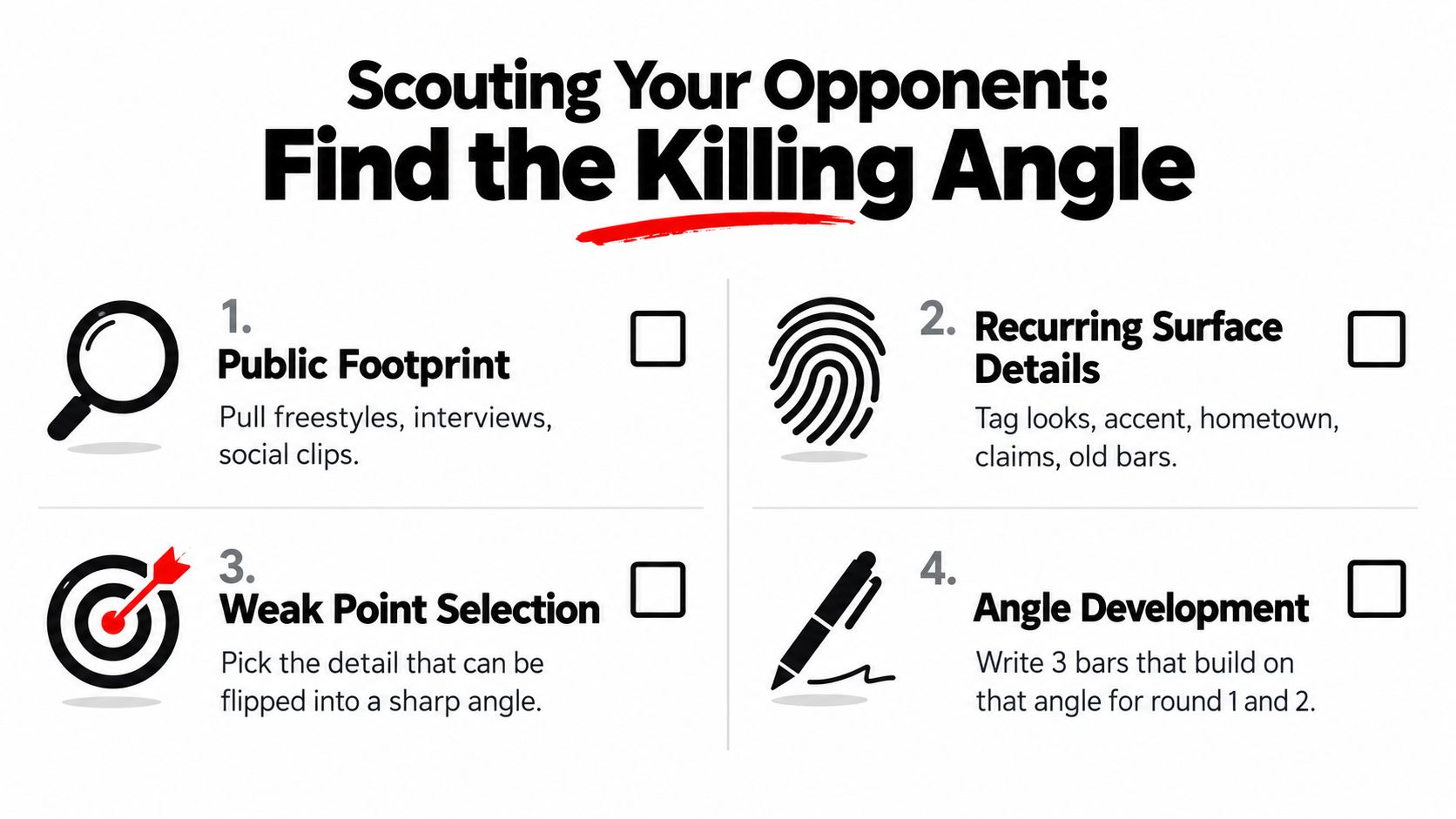 An infographic titled Scouting Your Opponent showing a four-step guide for writing rap battle lyrics and strategies.
Your Seven-Day Practice Sprint and AI Prompt Toolkit
Freestyle battle lyrics improve faster when the week has a job for every session. High-level rounds are often written, tested, and rehearsed until they sound spontaneous. Use the page to build material, then use the room to judge it.
- Day 1, angle mining: Collect public observations about a practice opponent and reduce them to one contradiction you can support.
- Day 2, architecture: Write setups, landings, flips, pictures, and reversals around that contradiction.
- Day 3, punchline sprints: Draft quickly, then keep lines with a sharp image, turn, or consequence.
- Day 4, rhyme ladders: Build perfect, multisyllabic, internal, and sliding-vowel families around your strongest nouns.
- Day 5, cadence cloning: Borrow the pocket of a reference bar, then write new content over its rhythmic shape.
- Day 6, counters: Predict likely attacks and prepare responses that return to your central angle.
- Day 7, mock battle: Perform a complete round under pressure, record it, and cut anything unclear, cramped, or too memorized.
AI helps with volume, not judgment. Give it a narrow task and reject anything generic. Useful prompts include:
- “Analyze this opponent dossier for public contradictions. Return angle ideas aimed at behavior, credibility, stage presence, or writing choices. Exclude threats and private information.”
- “Expand this angle into a four-bar sequence. Give me one picture punch, one reversal, and one callback.”
- “Rewrite this bar three ways. Improve image clarity and internal rhyme, while keeping the final word short and easy to emphasize.”
- “Generate multisyllabic rhyme families for these anchor words. Reject phrases that do not fit a battle-rap meaning.”
- “Clean-edit these bars for performance. Remove filler, protect the angle, mark breaths, and preserve the strongest landing.”
For broader ideation beyond rap, categorized writing prompts for any genre can supply a starting point. For battle-focused drafts, test the AI Freestyle Rap Generator, then rewrite its output until the voice, cadence, and angle belong to you.
Use this ready-to-paste prompt:
My persona is [describe voice, strengths, flaws, and delivery]. My opponent's public dossier is [paste public observations, claims, old bars, interviews, and stage habits]. The beat feels like [describe tempo, mood, and pocket]. Build a structured three-round battle draft. Round 1 should establish my character and introduce one central angle. Round 2 should escalate that angle with layered wordplay, internal rhyme, and a clear rebuttal. Round 3 should finish with a compact visual closer and a callback. Draft the first 16 bars only, label setups and landings, mark suggested pauses, avoid real-world threats, family targeting, private trauma, doxxing, and unverifiable accusations. Give me several alternatives for the final punch, then explain which one is easiest to perform live.
The room remains the final judge. A complicated scheme means little if listeners miss the premise or the landing. Record the draft, perform it for people who do not owe you applause, and keep the lines that make the room react.
DissTrack AI can help break writer's block by generating roast lyrics and freestyle-style verses from a target, relationship, inside jokes, style tags, and energy level. Treat the output as raw material. Edit the angle, tighten the cadence, and make the finished bars yours through DissTrack AI.