How to Write Funny Rap Lyrics That Actually Land
Your friend wants a roast verse before the burgers come off the grill. You open your phone, type three bars, delete them, type three more, and suddenly the beat has changed while your target is still waiting for a line that doesn't sound like a group-chat caption.
That moment exposes the problem with funny rap lyrics. A joke can look clever on a screen and still collapse when you rap it. The audience has to catch the setup, feel the rhythm, recognize the turn, and get a clean second to react. Comedy rap is writing plus timing, not a pile of insults forced into rhyme.
Why Funny Rap Lyrics Are a Craft, Not Just Jokes
I've watched strong writers lose a room because they saved the funny word for the wrong part of the bar. I've also watched an ordinary pun explode because it landed directly on the beat and everyone understood the image before the rapper moved on. The punchline is only half the job. Delivery decides whether the room hears it as a joke, a threat, or noise.
Rap has treated verbal competition as a serious performance skill for a long time. Battle rap's development is often connected to the December 1981 showdown between Kool Moe Dee and Busy Bee Starski, a moment later accounts describe as a shift toward sharper storytelling, commentary, and skill-focused lyricism. Those same tools still power comedy bars: timing, crowd control, fast responses, and punchlines. You can trace the later diss-track tradition through that competitive foundation in the history of battle rap.
The mid-1980s made the connection even more obvious. The Roxanne Wars produced over 50 diss tracks from 35 artists, according to The Conversation's history of the diss track. Comedy, insult, and lyrical competition weren't late additions to rap. They were woven into the format early.
Three ways beginners lose the laugh
- They confuse cleverness with humor. A complicated reference may impress one listener but leave a room cold if nobody understands the turn quickly.
- They ignore bar length. Extra syllables force the rapper to rush the setup, which hides the joke.
- They forget audience expectation. If the listener can't hear where the sentence is heading, the reveal won't feel like a reveal. If the writer telegraphs it too heavily, the line feels predictable.
A group-chat bar can die onstage because the audience doesn't have the surrounding context. A friend-group roast can succeed with a simple line because everyone knows the story behind it. Before chasing a rhyme, check four things: Who's listening? What do they already know? Where does the laugh land? Can you deliver the line without fighting the beat?
Practical rule: If the bar only works when you explain why it's funny, the writing isn't finished.
The Humor Techniques That Make Bars Actually Funny
Funny rap lyrics usually run on a small set of dependable engines. The trick isn't using all of them at once. Pick the engine that matches the target, then make the sound support the joke.
Surprise
A flat insult announces its destination too early.
| Technique | Weak Bar | Landed Bar | Why It Hits |
|---|---|---|---|
| Surprise | Your flow is weak, you should quit | Your flow is so refreshing, I almost took a sip, then heard the second verse | The compliment creates a safe expectation before the insult turns |
| Wordplay | You're bad, you're sad | Your tragic cadence had the whole room practicing patience | Internal sound echoes make the insult feel musical |
| Exaggeration | You're slow on the beat | You move so slow, even your shadow files a missing-person report | The image stretches the flaw into something visual |
| Callback | You brought that tiny notebook | Keep that tiny notebook close, you'll need every page to remember this loss | The earlier image returns as the closer |
The surprise bar works because the first half sounds generous. The listener lowers their guard, then the second half changes the meaning. Write the turn as late as possible without pushing it off the beat.
Wordplay
A synonym swap isn't enough. Strong wordplay creates two meanings or makes several sounds collide inside the bar. Try a phrase such as “tragic cadence had the whole room practicing patience.” The repeated sounds give the insult bounce, while “practicing patience” extends the image instead of merely labeling the opponent slow.
Use a familiar phrase, then bend one word. A name, job, hobby, outfit, or repeated habit gives you material that generic insults can't match. If the rhyme sounds impressive but the listener can't visualize the target, it's technical exercise, not a roast.
Exaggeration
Exaggeration gives the audience a picture they can see instantly. “You're slow” tells them the trait. “Even your shadow files a missing-person report” turns that trait into a scene.
Escalate in stages. Start with a recognizable flaw, add a consequence, then push the consequence beyond reality. The common tell is scale without specificity. Saying someone is “the slowest alive” is loud but empty. Naming the shadow, the report, or the waiting room gives the absurdity a handle.
Callback
A callback rewards attention. Introduce a harmless detail early, let the verse move somewhere else, then reload that detail as the final hit. It's especially effective in friend-group roasts because shared memories already carry emotional weight.
Don't repeat the exact first line. Change the function of the image. The tiny notebook begins as evidence of preparation, then becomes a record of defeat. That reversal makes the closer feel earned.
Building a Punchline That Lands on Beat
Write the payoff first. Put the knockout line on a sticky note, then build backward. If the payoff is “even your shadow files a missing-person report,” the setup should establish the target's slowness without using every synonym for slow.
A practical punchline workflow treats the bar as a setup-payoff problem. Build expectation, place the twist on the final bar or accented beat, and remove any setup line that doesn't point toward the reveal. A documented analysis of rap punchlines also emphasizes audio timing, transcription, rhyme mapping, internal rhyme, double meanings, and delivery cues. The joke exists in the words, but the laugh often arrives because the sound and placement make the reveal unavoidable. For extra practice with clean prose before you compress it into bars, study these sentences that actually land.
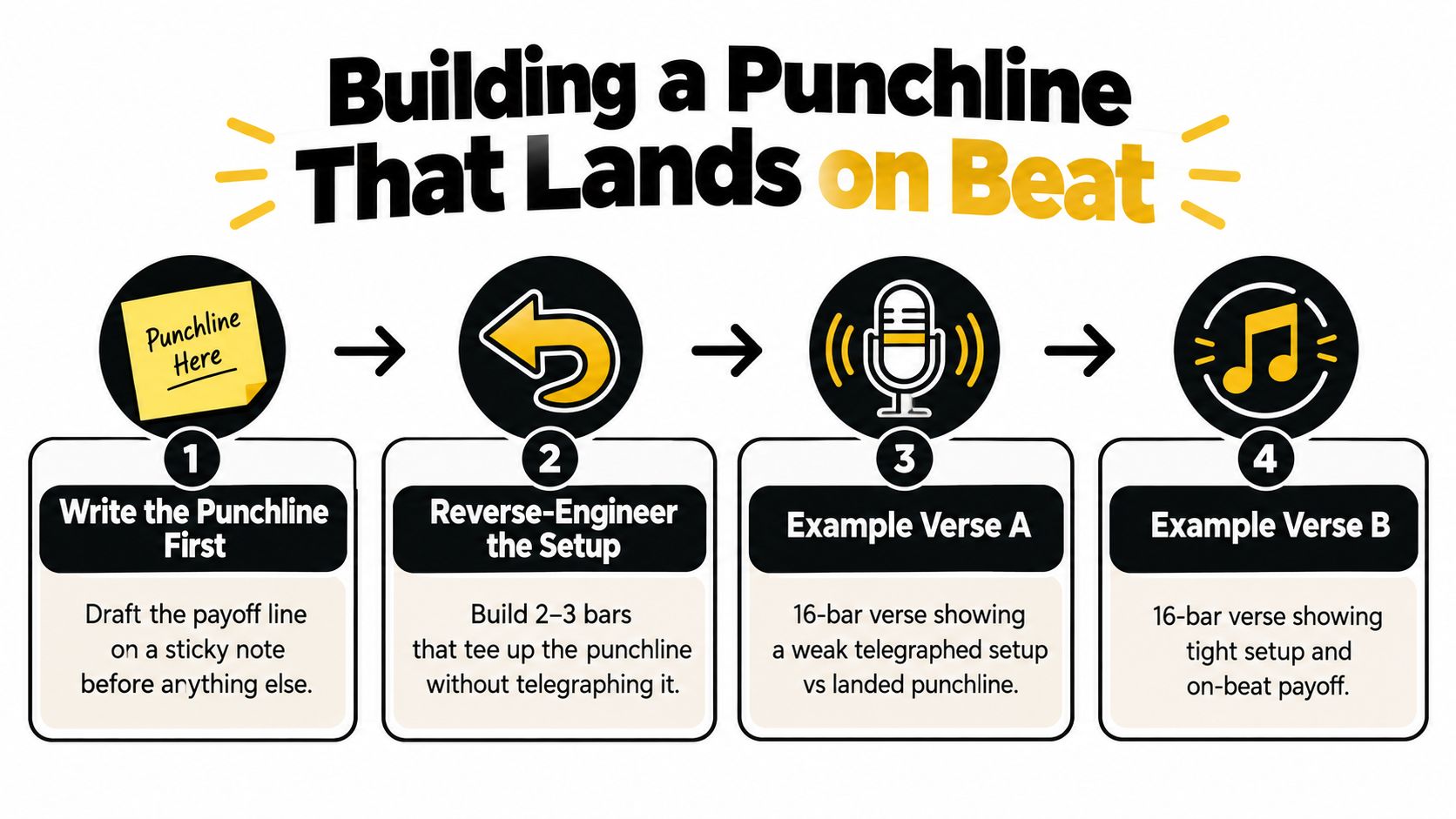 A four-step guide on how to build a punchline for rap lyrics that lands on beat.
A four-bar frame
- Setup: Establish a recognizable trait.
- Misdirect: Make the listener expect a normal compliment or insult.
- Reframe: Change the image or meaning.
- Knockout: Put the sharpest word on a strong beat.
Here's a friend-group roast built around someone who always arrives late:
You text “five minutes,” then vanish from the map
We save you a plate, you call that a trap
Your watch needs witnesses, your clock needs a guide
Even your shadow got here and waited outsideYou walk through the doorway like the guest of the year
We finished the stories, the snacks, and the beer
You say traffic was wild, like the road made a pact
The only thing moving on time was your excuse in the chatWe sent three reminders, you answered with “bet”
That word has more follow-through than you've shown us yet
Your calendar's fiction, every promise's a draft
You're not fashionably late, you're late with a staffSo raise up your cup, let the late king arrive
We've already had dinner, but your excuse is alive
The party clock stopped just to give you a chance
Even your entrance needed a second entrance
The setup establishes a repeated behavior, the middle escalates it, and the closer twists the entrance into a second entrance. The strongest hits arrive at the ends of lines where the listener can catch the image.
Now compare a battle-round closer:
You called yourself a problem, I checked and found a typo
Your big bad reputation came in wearing flip-flops
You flex like a headline, but the font is microscopic
I need a magnifying glass just to find the topicYou brought three loud friends, now the chorus got assistance
Still every bar you wrote is asking for forgiveness
Your punchlines need directions, your cadence needs a map
You don't command the room, you just interrupt the clapYou said you're next up, that's a bold prediction
Your whole career's buffering at the loading-screen position
I'd call you competition, but the word feels too grand
You're a rough draft with a microphone held in your handSo take that little victory lap, let the crowd enjoy the view
You're the only person here impressed by what you do
I won't say you lost, that would oversell the scene
You didn't lose the battle, you missed the venue entirely
The battle version uses more escalation and a harder final reframe. The friend roast protects the relationship by targeting habits and shared situations. If you want a dedicated breakdown of setup, misdirection, and payoff, use this punchline-writing guide for rap.
Put the payoff on beat three or four when possible. Give the crowd a fraction of space to react before the next bar carries them forward.
A landed punchline is specific, audible, and connected to the previous bar. A fizzle usually relies on a vague noun, arrives late, or resets the idea instead of escalating it. Read the verse over the backing track. If you have to sprint through the final phrase, shorten the setup rather than weakening the payoff.
Rhyme Schemes and Flow Patterns for Comedy
A dad joke becomes a cypher bar when the rhyme and cadence make the laugh feel inevitable. End rhymes can make a line easy to follow, but internal multisyllabic rhymes create pressure inside the bar. That pressure gives the punchline momentum.
| Feature | End-Rhyme Chain AABB | Internal Multisyllabic |
|---|---|---|
| Main placement | The final word carries the rhyme | Rhymes appear inside and at the end |
| Listener effect | Clear and simple | Dense, quick, and layered |
| Comedy advantage | Makes a basic joke easy to catch | Makes the turn feel sharper and more musical |
| Main risk | Predictability | Clutter that hides the punchline |
Take the same joke about a friend who overpacks:
Simple end-rhyme version:
You brought four bags just to stay one night, Your little weekend trip turned into moving day, right?
You packed every shirt, every shoe, every hat, We're going down the block, why you bringing all that?
The joke is understandable, but the rhyme is doing basic support work. Now add internal sound and a tighter cadence:
One-night flight, four bags tight, you packed the whole flat, Small trip, big grip, why you hauling all that?
The second version creates a bounce through repeated short sounds. “One-night flight” and “four bags tight” compress the setup, while “small trip, big grip” supplies a mini-turn before the final question.
Marking syllables can expose the difference:
- Simple: You brought four bags / just to stay one night, 8 syllables
- Dense: One-night flight, four bags tight / you packed the whole flat, 8 syllables
The counts are similar, but the internal echoes change the feel. Don't treat syllable counting as a prison. Treat it as a flashlight that shows where your delivery gets crowded.
Where the rhyme should land
Put the strongest rhyme on the last word when clarity matters. Put it on the final two syllables when you want a more polished snap. Put it in the middle when the punchline needs to arrive before the bar ends.
A bouncing single-syllable flow suits quick, obvious images. A triplet swing can make exaggeration sound cartoonish, but it also leaves less room for a pause. If the joke depends on the audience seeing the turn, slow the cadence around the reveal.
For a deeper look at trimming lines without damaging the central joke, Taja AI's song-cutting guide offers a useful editing mindset. You can also compare patterns in this guide to rap rhyme patterns.
Rewriting the Same Joke for Different Formats
The same target joke needs different architecture depending on where people hear it. A TikTok viewer may decide whether to keep watching before the setup finishes. A live battle crowd needs room to react. Friends already know the backstory, so you can skip explanation and spend the space on a sharper callback.
Use one premise: your friend dresses like they're attending a red-carpet event just to buy snacks.
TikTok clip
Bought chips in a tux, looking rich at the mart, Bro dressed for the checkout like the cashier's a star.
The hook arrives immediately, the image is visual, and the clip doesn't waste time explaining the errand. Keep the wording clean enough to understand through phone speakers. A quick pause after “tux” lets the visual land before “cashier's a star.”
Live battle
You dress for the corner store like cameras came to town
Tie tight, shoes bright, still the snack aisle shut you down
You wanted red carpet, got fluorescent lights instead
The only star you met was printed on the cereal box, bread
The battle version builds through several images and lets the crowd recognize the premise before the closer. It can carry more heat, but don't bury the first laugh while reaching for the last one. Read the room and leave space after each strong image.
Friend-group roast
You wore that velvet jacket for the corner-store run, Asked if the chips came plated, then bought the spicy ones.
The inside joke replaces explanation. The line can be gentler because the room knows the target and the shared context. Friendly roasting works best when the person can recognize themselves without feeling ambushed.
| Element | TikTok Clip | Live Battle | Friend-Group Roast |
|---|---|---|---|
| Hook | Start with the funniest image | Establish the target, then escalate | Use the shared reference immediately |
| Length | Keep it compact enough for a quick clip | Build across multiple bars | Stop once the group gets the joke |
| Language | Favor clear, broadly understandable wording | Match the room's tolerance and intensity | Use familiar language, avoid real insecurities |
| Audience distance | The camera is the audience | Pause for crowd reaction | Eye contact and personal timing matter |
| Don't | Explain the premise after the hook | Rush through every setup | Turn an inside joke into a public humiliation |
| Pause placement | Brief pause before the visual turn | Longer pause after the biggest hit | Pause where friends usually react |
A line written for one format can feel broken in another. Format isn't packaging added after writing. It changes the writing itself.
Editing, Templates, and Prompts to Speed the Process
The first draft is usually too polite, too long, or too eager to prove it's clever. Edit like the audience is impatient, because they are. Read every bar aloud over the beat and make the ear approve what the page claims.
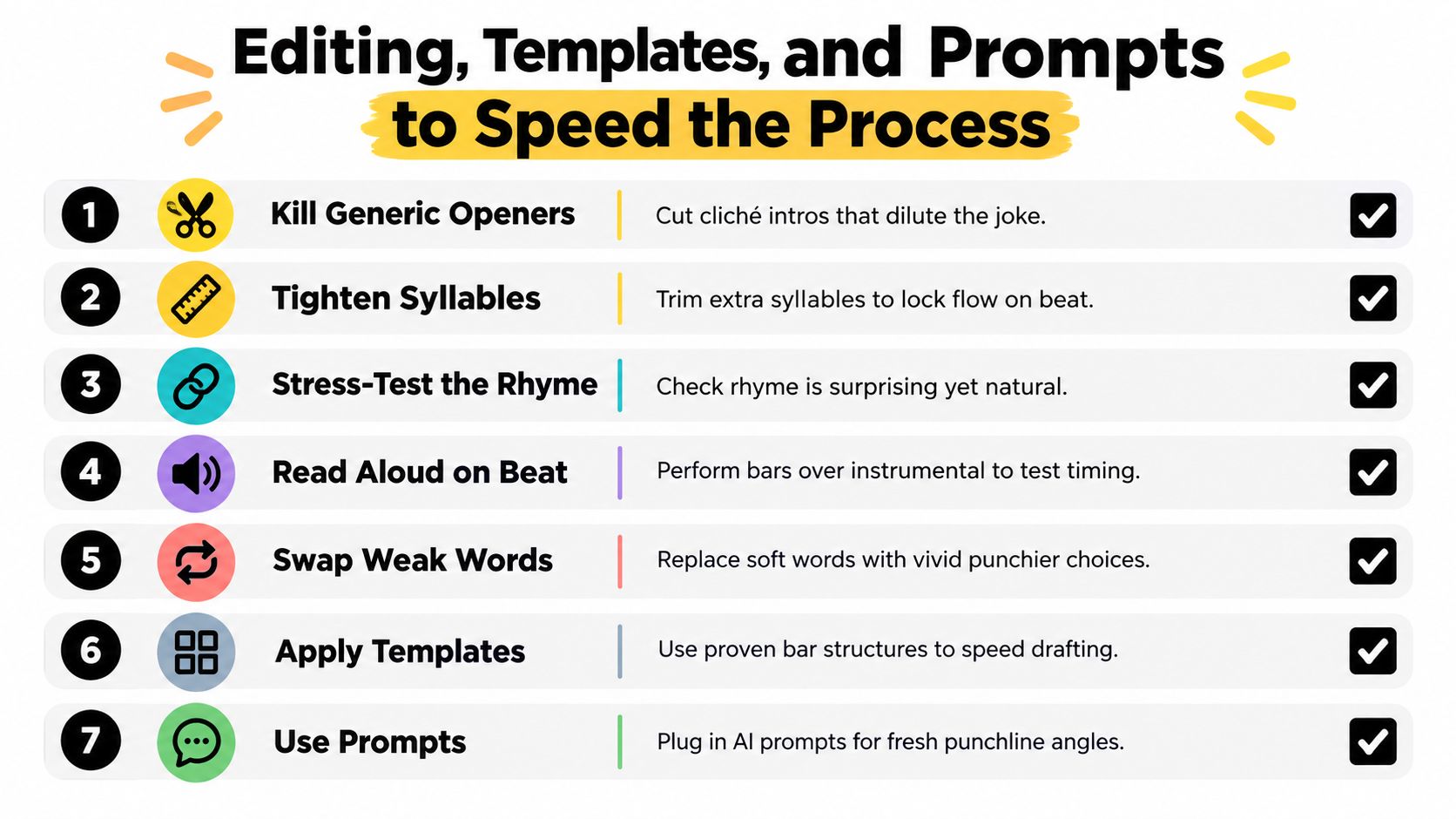 A checklist of seven steps for improving rap writing, editing, and using prompts to create better lyrics.
Seven cuts that improve a roast bar
- Kill generic openers: Replace “I'm here to tell you” with the first specific image. “You wore a tux to buy chips” starts inside the joke.
- Tighten syllables: Change “you are always moving very slowly” to “you move like the loading screen.” Fewer words leave room for delivery.
- Stress-test the rhyme: If the rhyme is obvious, add an internal echo or switch the final word. Don't protect a weak rhyme just because it arrived first.
- Read aloud on beat: Mark the word that receives the snare. If that word isn't funny, vivid, or surprising, move the punchline.
- Swap weak verbs: “You make excuses” lacks motion. “You manufacture excuses” gives the line a stronger action and a more flexible image.
- Check stale references: A reference should help the listener see the joke, not make them pause to remember why it matters.
- Sharpen the closing bar: Don't end with a summary. End with a reframe that changes what the listener thought the verse was about.
For first drafts, prompt an AI tool with constraints instead of asking for “a funny rap.” DissTrack AI can generate personalized roast lyrics from details such as a target's name, relationship, and inside jokes, with style choices that include battle rap, old school boom bap, trap, drill, emo rap, and UK grime. Treat the output as raw material. Your ear still decides what survives.
Try prompts like these:
Friend-group roast
Write a playful roast verse about a friend who arrives late, overpacks for short trips, and always says “five minutes.” Keep the tone affectionate, use specific visual images, build toward a callback, and avoid jokes about protected traits, serious illness, or private trauma. Give me several punchline options with different rhyme densities.
Battle round
Write a battle-rap round aimed at a fictional opponent who brags about expensive taste but borrows everyone's clothes. Use a setup, misdirect, escalation, and final reframe. Keep the punchlines specific, place the key reveal at the end of the bar, and provide alternate closers with different cadences.
TikTok hook
Write a short comedy rap hook about dressing formally to buy snacks. Start with the funniest image, keep the words easy to hear on phone speakers, include one internal rhyme, and provide versions that feel absurd, self-deprecating, and lightly insulting.
You can use an AI rap lyrics generator to break blank-page paralysis, then cut the generic lines, rewrite the strongest image, and perform the result before sharing it.
Your Shortcut to Sharper Punchlines
Run the process in this order tonight:
- Lock the format. Decide whether you're writing for a quick clip, a live battle, or people who already know the target.
- Draft payoff-first. Write the final image or reframe, then build the setup backward.
- Stress-test sound. Check the internal rhyme, final rhyme, syllable load, pause, and beat placement.
- Make the seven cuts. Remove filler, replace soft verbs, kill stale references, and sharpen the closer.
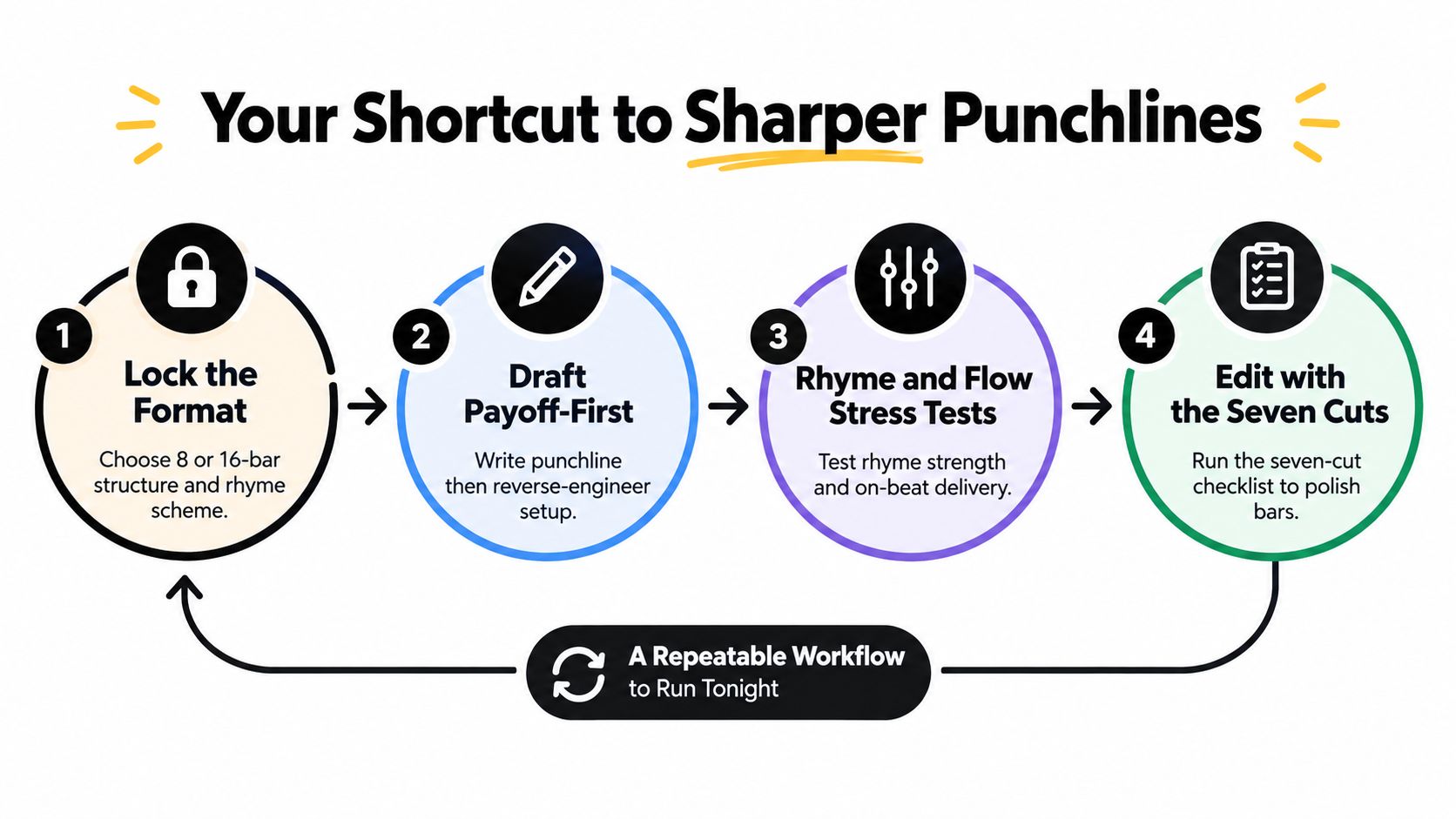 A four-step repeatable workflow diagram for writing sharper and more effective rap song punchlines.
Write more than you expect to keep. Funny rap lyrics improve through selection, not through worshipping the first clever line that appears. Draft a stack of options, perform them out loud, and keep the bars that still work after the novelty wears off.
The best tools speed up variation, but they can't replace taste. An AI draft may offer a useful angle, an unexpected rhyme, or a cleaner structure. You still have to hear whether the laugh arrives on the beat, whether the target is fair game, and whether the line sounds like you.
The crowd doesn't reward the line you admired in silence. It rewards the line they understood in time.
DissTrack AI can turn a target's details, relationship, inside jokes, and chosen rap style into structured roast drafts you can revise for a clip, battle, or party. Visit DissTrack AI, generate several angles, then keep your sharpest three bars and perform them over the beat before you share them.