Hip Hop Wordplay: Techniques, Examples & Practice Guide
A computational study found rhyme density in hip hop rose 34.2%, while three-or-more-syllable rhymes grew from 8.3% of all rhymes in the 1980s to 27.6% by the 2010s, more than tripling. That proves hip hop wordplay is a trackable, evolving craft, not just a gift some emcees are born with.
The beat drops, the room tightens, and an MC lands a line that works twice, first for the meaning, then for the sound hiding underneath it. The crowd catches the punch a breath later. That delay is the craft. Strong wordplay makes listeners process language, rhythm, image, and attitude at the same time.
Great bars don't depend on random cleverness. They use controlled rhyme placement, layered meanings, sharp imagery, and timing. A writer who understands those mechanics can create lines that sound natural on the beat while carrying more weight than a simple end rhyme.
What Is Hip Hop Wordplay and Why It Matters
Hip hop wordplay is the deliberate use of rhyme, rhythm, multiple meanings, metaphor, sound patterns, and imagery to make a bar hit harder. It can make a line funny, threatening, personal, reflective, or unforgettable without changing the basic subject.
A computational analysis of hip hop lyrics shows that writers have been building denser, more varied bars over time. Analysts found average type-token ratio, a measure of lexical diversity, rose from 0.56 in the 1980s to 0.69 in the 2020s, a 23.7% increase in vocabulary variation, as reported in the computational study of hip-hop lyrics. They also recorded a 34.2% rise in rhyme density across regions.
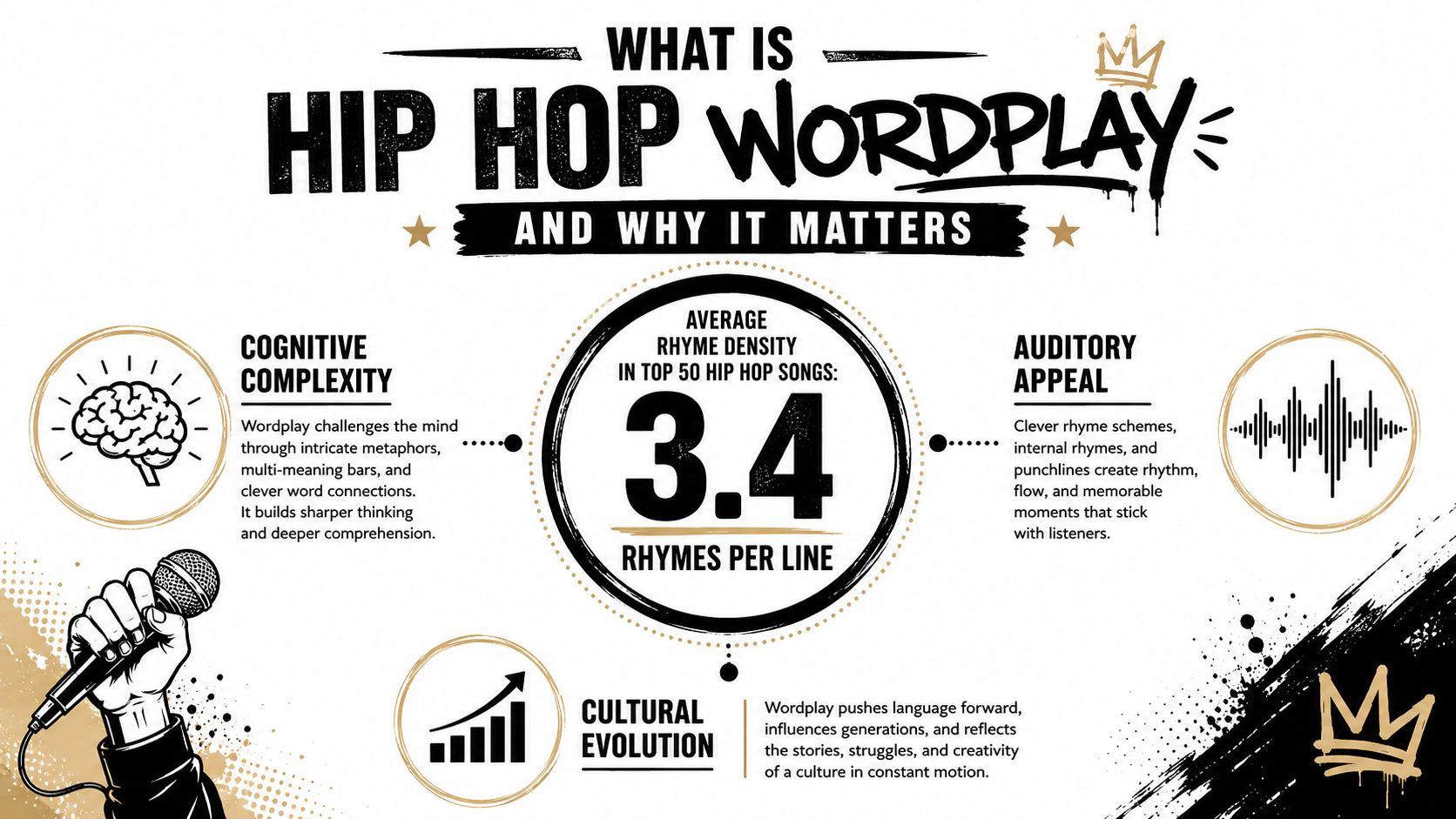 An infographic titled What Is Hip Hop Wordplay explaining its importance through cognitive complexity, auditory appeal, and cultural evolution.
Wordplay changes what a listener hears
Rhyme density is more than a technical score. It changes the texture of a verse. A basic couplet may land one obvious rhyme at the end of each line. A denser passage can place matching sounds inside the line, across stressed syllables, and over the bar line.
That extra layering changes how the ear tracks the verse. It can feel like the rapper is moving through several connected gears instead of waiting for the final word to create momentum.
Practical rule: If the punchline is the only interesting sound in the bar, the setup probably needs more engineering.
Wordplay also gives a rapper control over attention. A metaphor creates an image. A double entendre rewards a second listen. A multisyllabic rhyme makes the listener notice the architecture. The strongest lines combine those functions while still sounding natural on the beat.
The History Behind Hip Hop Wordplay
Hip hop wordplay grew out of competition. Scholarship traces hip hop's origins to the South Bronx in the mid-1970s, where local parks and community gatherings gave MCs space to perform before the culture moved into wider commercial visibility, as detailed in this academic history of battle rap and MC technique.
Early MCing focused on crowd control, repetition, and keeping energy high. That style required timing and presence, but competitive pressure pushed the writing further. A commonly cited turning point came in December 1981, when Kool Moe Dee challenged Busy Bee Starski. The clash is often discussed as a moment when MCs moved toward more aggressive, story-driven lyricism instead of relying mainly on party-focused chants.
That shift changed what an audience listened for. The listener hears observation, interpretation, and nerve all at once when a rapper starts making every bar do more than keep time.
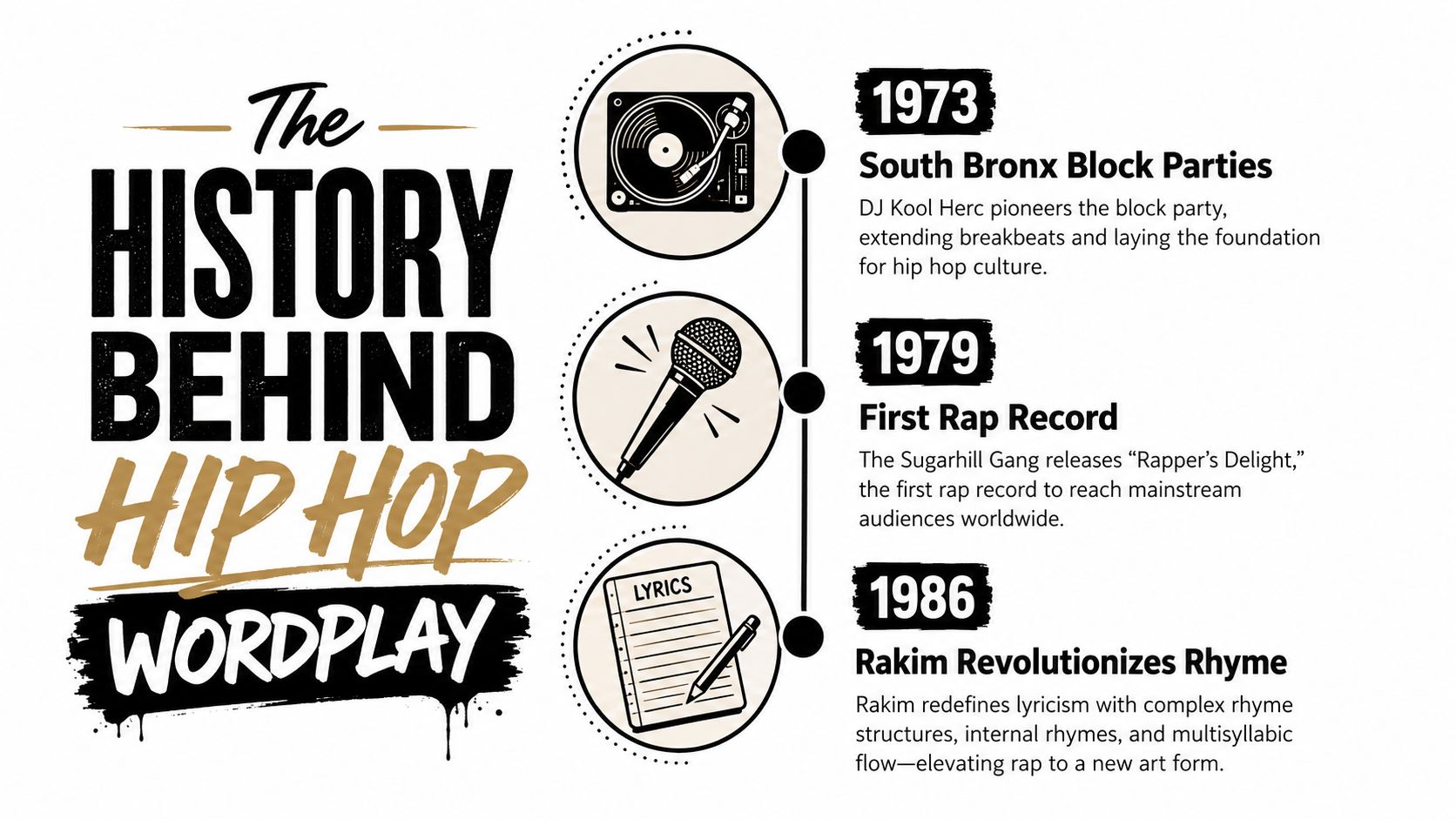 A timeline graphic illustrating the history of hip hop from 1973 to 1986 through key cultural milestones.
Competition sharpened the language
Battle rap made every weakness available for inspection. An MC needed to expose an opponent, control the room, and make the attack easy to remember. That environment rewarded lines with more than one layer, especially when the rhyme itself reinforced the insult.
Academic analysis identifies specialized strategies including compound internal rhymes, chain rhymes, and back-to-back chain rhymes, alongside metaphor, simile, irony, and imagery. Those tools matter because battle writing needs both precision and force. A clever line that doesn't target anyone feels decorative. A targeted line with no rhythm feels like an argument, not a bar.
The history also explains why technical wordplay stays tied to identity. In a cypher or battle, language proves preparation, nerve, and command. The crowd hears whether the rapper can observe, interpret, and respond under pressure.
Wordplay became a competitive skill because the audience could hear the difference between filling space and controlling it.
Core Hip Hop Wordplay Techniques Explained
A bar is easier to judge when you split it into sound, meaning, and placement. If you only chase end rhymes, you miss the work happening inside the line.
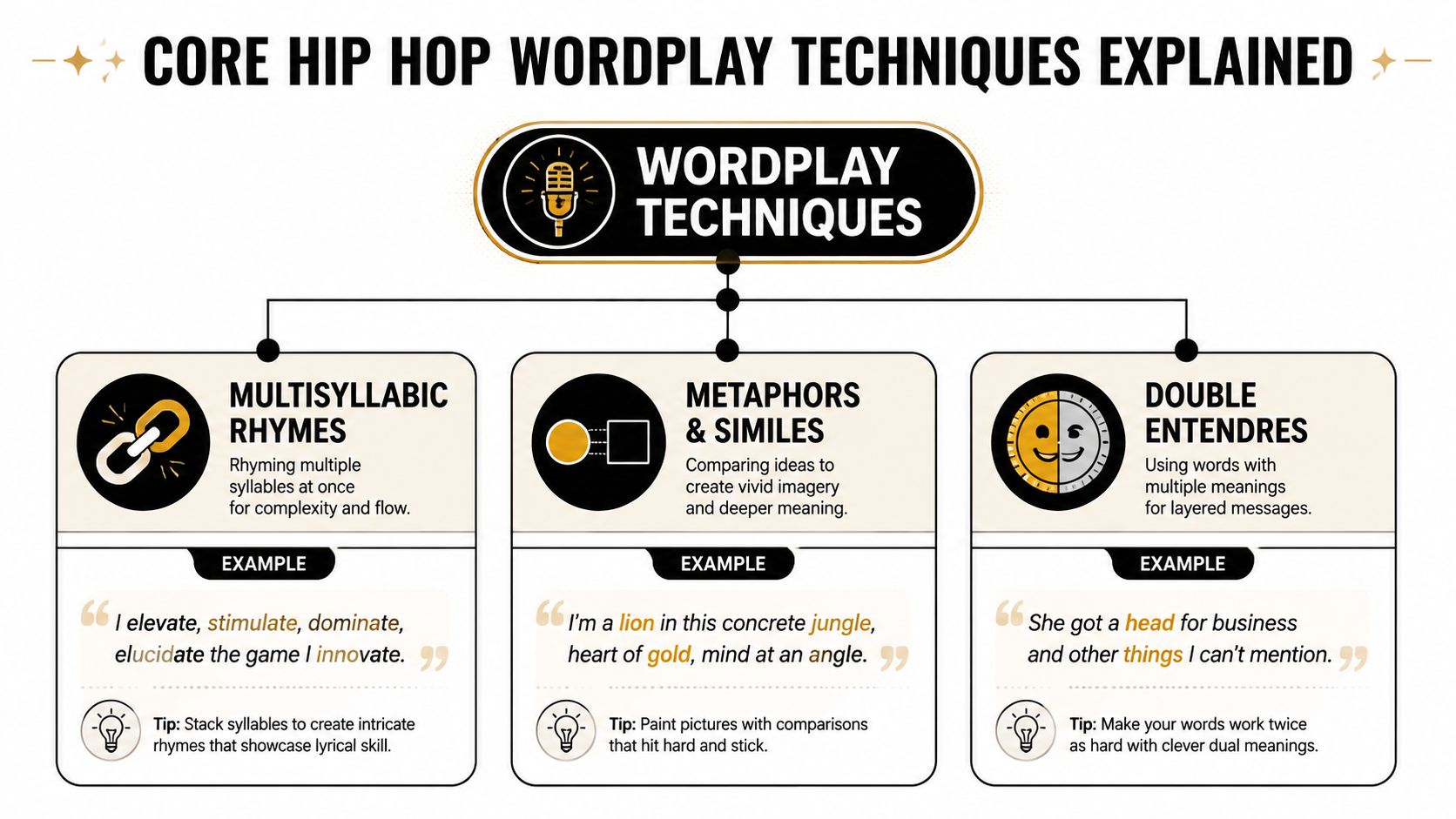 A diagram explaining core hip hop wordplay techniques including multisyllabic rhymes, metaphors, similes, and double entendres with examples.
Multisyllabic rhymes
A multisyllabic rhyme matches a pattern of sounds, not just one ending. “Critical condition” can answer “criminal ambition” because the vowel shape and stress pattern lock together across both phrases. It does not need to be identical. It needs to feel tight when delivered inside the pocket.
Modern writing leans hard on this. The multisyllabic rhyme guide helps with drilling sound families, but the rhyme has to carry an idea. A clean pattern with a thin thought still lands light.
Internal rhymes
Internal rhyme places matched sounds before the final word. A line like:
“Cold in the hallway, controlled when the call came.”
shows how repeated vowel and consonant echoes push the bar forward before it resolves. The technique works best when it follows the beat's natural stress points. If every syllable gets the same weight, the line starts to feel stuffed.
As noted earlier, computational lyric analysis shows internal rhyme became much denser over time. That means modern bars often carry about one internal match per line, instead of something closer to one every two lines in the 90s. The practical move is simple. Use internal rhyme for motion, not for clutter.
Metaphor and simile
A metaphor says one thing is another. A simile compares with “like” or “as.” “My notebook is a crime scene” gives the page tension and evidence. “I move like a locksmith in a sealed room” gives a different kind of control, built on access and precision.
Good imagery has a job. In a battle, “you're weak” is flat. “Your whole angle folds like a cheap card table” hits structure, confidence, and durability at once. The image works because the crowd can see the collapse.
Double entendres
A double entendre carries two meanings at the same time. The first reading should hit immediately. The second should open up after the listener catches it.
“I'm in the bank with a statement” can point toward money and a public declaration. The line gets stronger when nearby bars support both readings. Do not force two meanings into every sentence. Use the device where the split reading sharpens the target or the theme.
Chain and mosaic rhymes
Chain rhymes carry a sound from one line into the next, while back-to-back chains keep that sound moving through consecutive phrases. Mosaic rhymes stretch across multiple words, so the ear hears the match across phrases rather than inside one isolated word.
Most hip hop lyrics use rhymed couplets, with rhymed syllables often landing on or around beat four. Rap also uses three-syllable-or-longer rhymes and mosaic patterns, as explained in the analysis of rap rhyme and meter. Build from stressed pairs first, then extend the sound across nearby beats. That keeps density from turning into a rushed tongue workout.
Adapting Wordplay for Battle Rap and Diss Contexts
Studio writing gives you room to refine. Battle writing puts you in front of an opponent, a room, and a reaction that can shift while the bar is still in the air. The craft stays the same, but the priorities move to targeting, clarity, and timing.
A clever rhyme scheme will not rescue a generic shot. Start with specific material, an opponent's repeated phrase, public image, contradiction, known habit, or history with you. Then turn that detail into an image the crowd can catch without needing a note card.
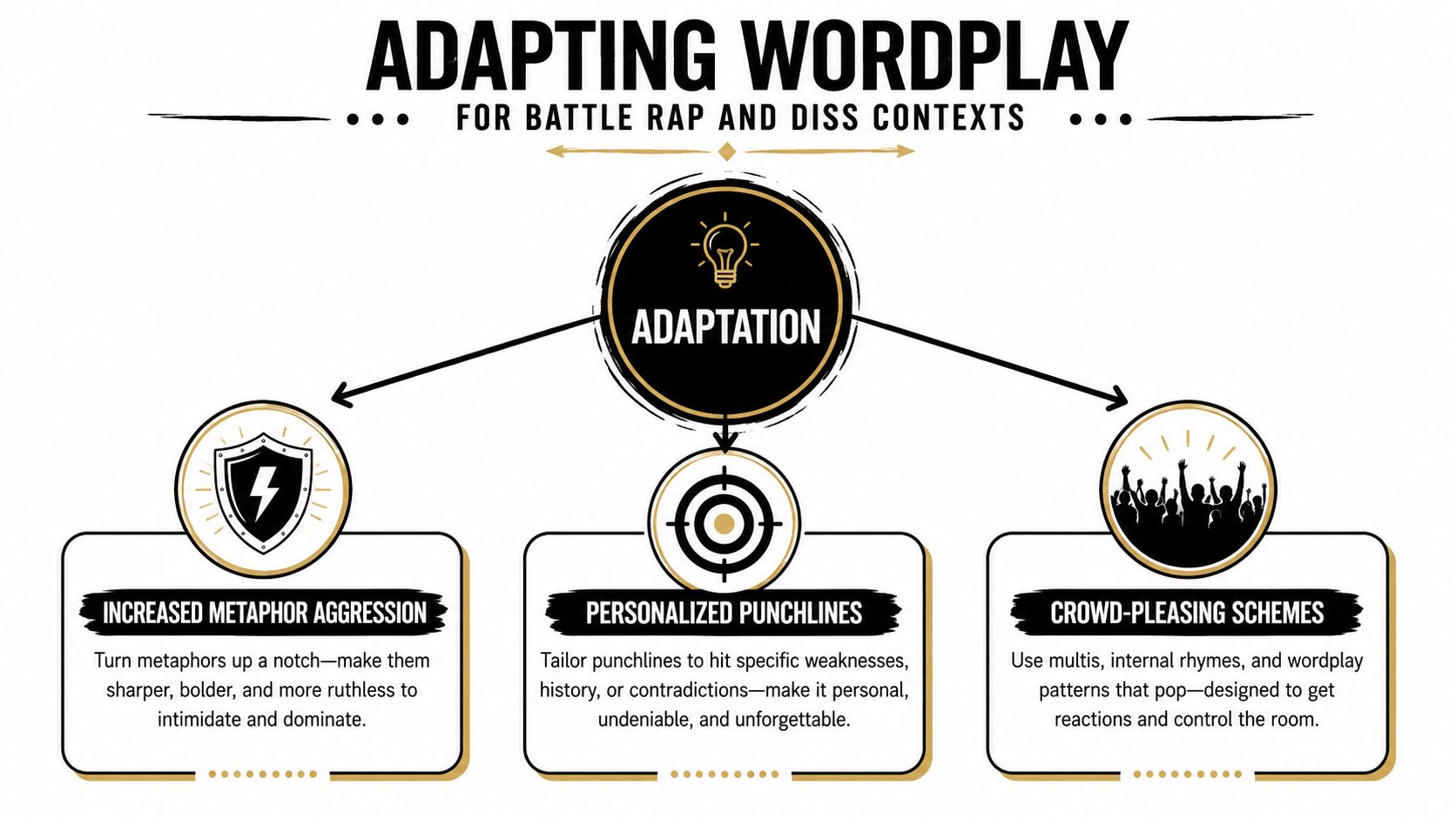 A diagram outlining three key strategies for adapting wordplay in battle rap and diss rap contexts.
Build the attack around the person
A personalized punchline usually needs three parts.
- The reference gives the audience a fact they recognize.
- The comparison turns that fact into weakness.
- The finish lands in a short phrase the room can repeat.
If an opponent keeps changing their story, “you lie” is weak sauce. Build around unstable architecture, broken directions, or a corrupted recording. The image gives the insult shape, and shape makes the bar stick.
The battle rap song guide can help organize a diss concept, but the sharpest material still comes from details only you noticed. Generic aggression is easy to copy. Specific observation feels earned.
Make the crowd part of the mechanism
Battle delivery rewards clean setups and obvious landing points. Shorten the setup before the punch, leave space after it, and do not hide the key word inside a dense rhyme chain. Technical skill should carry the crowd toward the hit, not force them to decode the line while you move on.
Call-and-response patterns help. Repeat a phrase, let the room expect the finish, then twist the last word. Cleverness gets respect, but timing gets the noise.
Battle rule: A complex bar gets attention. A clear, personal punchline gets the reaction.
Tone matters too. Savage lines work when the target deserves direct pressure, while a dry understatement can make an opponent look smaller without yelling. The strongest battle writers know when to stack imagery and when to end the exchange with one clean sentence.
Daily Practice Drills to Level Up Your Bars
Technique becomes reliable only after repetition. You don't need to wait for a perfect beat or a dramatic mood. Build small constraints that force your brain to search for sound and meaning together.
Train sound before you train polish
Pick an ordinary object, such as a key, a kettle, or a jacket. Write a sound family around it, then build lines that use related syllables without repeating the object itself. If the object is “jacket,” explore sounds such as “back it,” “traffic,” or “practice,” then connect those sounds to an image or argument.
The drill fails when you treat the rhyme list as the finished verse. Each phrase needs a purpose. Make the object the subject of a metaphor, the anchor of a story, or the hidden link between two unrelated ideas.
Keep a live phrase bank
Carry a notebook or use a notes app. Record overheard phrases, unusual names, accidental rhymes, and words with useful stress patterns. Review the list later and write one bar that flips each phrase into a new context.
Writers who want a broader workflow can also explore freelance writer tools for note capture, drafting, and organization. The tool matters less than the habit of preserving raw material before the clever connection disappears.
Add pressure deliberately
Use a timer for a short writing sprint. Give yourself a target sound, a topic, and a required technique. Then write without editing until the timer ends. The point isn't to produce a perfect verse. It's to practice making decisions while your first idea is still available and your second idea hasn't arrived.
Partner drills add another layer. Have someone name a topic, objection, or random word. Answer with a line that contains an internal rhyme and a clear image. Afterward, mark the line's stressed syllables and identify where the meaning became vague.
Reverse-engineer bars you respect
Take a favorite passage and write down:
- End sounds: Which syllables close the lines?
- Internal sounds: Where do matching vowels appear before the ending?
- Stress points: Which words receive the beat's weight?
- Meaning shifts: Where does the line change interpretation?
- Payoff: What information makes the final phrase hit?
Do this consistently, then write your own passage using the same structural idea without copying the language. Study gives your instincts more options.
Using AI Tools to Spark Creative Wordplay Ideas
AI works well as a sparring partner when you give it a narrow problem. Ask for sound families around a phrase, alternate metaphors for a theme, or several ways to connect two unrelated images. That can shake loose combinations you might not reach during a stalled writing session.
AI struggles with the part that makes a diss personal. It can arrange rhyme, imitate a broad format, and generate technically clean options, but it doesn't possess your history with the target or your instinct for what a room will find disrespectful, funny, or believable.
Use a three-pass workflow
Pass one is expansion. Give the tool a topic, a rhyme anchor, a tone, and a constraint. Ask for possibilities, not a finished identity.
Pass two is selection. Keep only the phrases that sound natural in your voice. Delete anything padded, predictable, or too polished to believe.
Pass three is ownership. Replace generic details with real references, alter the cadence, and add the image only you would choose. The final line should sound like a rapper using assistance, not software performing alone.
Creators comparing AI songwriting tools for 2026 should judge them by workflow control, editing flexibility, and how easily they let you reject weak suggestions. Generation speed isn't the same as lyrical quality.
DissTrack AI is one option built for roast lyrics and battle-oriented writing. It lets users enter a target's name, relationship, and inside jokes, choose styles such as Old School Boom Bap, Trap, Battle Rap, Drill, Emo Rap, or UK Grime, and adjust the level of savagery before editing the generated verses.
You can also use a focused wordplay generator to create prompts or rhyme directions. Treat every output as raw material. Your lived detail, taste, timing, and willingness to cut weak bars remain the deciding factors.
Your Next Move as a Lyrical Writer
Hip hop wordplay rewards the writer who maps sounds, studies battles, and drafts through awkward first versions.
A simple line can still hit hardest if the image is sharp, the target is clear, and the delivery lands without hesitation. Dense schemes help, but they do not save weak intent.
Pick one technique today. Write five bars around a single rhyme family, then rap them over a beat. Cut every forced phrase, keep the strongest image, and rewrite the ending until the punch lands clean.
Try a ten-minute drill: take one battle clip, pause on three bars, and write two alternate punchlines for each. That habit builds range fast, and it shows where your ears catch patterns before the crowd does.
DissTrack AI helps you generate personalized roast lyrics by combining target details, inside jokes, style choices, and adjustable intensity into structured verses you can edit. Visit DissTrack AI to spark battle-ready wordplay and shape the raw material into bars that sound like you.