How to Write Rap Hooks That Listeners Actually Remember
You've got the beat, the verse is written, and then the hook arrives like an empty parking lot. You mumble a few lines, repeat the title, add an ad-lib, and hope the chorus catches fire in the booth. Sometimes it does. More often, the verse sounds sharper than the part listeners are supposed to remember.
Learning how to write rap hooks means treating the hook as its own craft, not as leftover space between verses. A strong hook has to survive the beat, the crowd, the replay, and the phone screen. It should sound good when performed, read cleanly as a caption, and leave behind one phrase people can quote without needing the rest of the song.
Why Hooks Decide Whether Your Rap Gets Skipped or Saved
A verse can impress someone. A hook gives them a reason to come back.
That difference comes from repetition and compression. Verses carry detail, setup, story, and technical writing. Hooks reduce the song to its most recognizable emotional statement. Musicology research shows that hip-hop moved from long-verse and strophic forms toward the verse-hook format, which had become the standard model by the mid-1990s. The same research tracks hooks from a minor role toward a central, recurring section across releases from 1975 to 2020, as described in this musicology study of hip-hop song form.
That history gives you a practical rule: listeners generally expect the refrain, title phrase, or repeated chant to return. The hook doesn't need to explain everything. It needs to make the song identifiable.
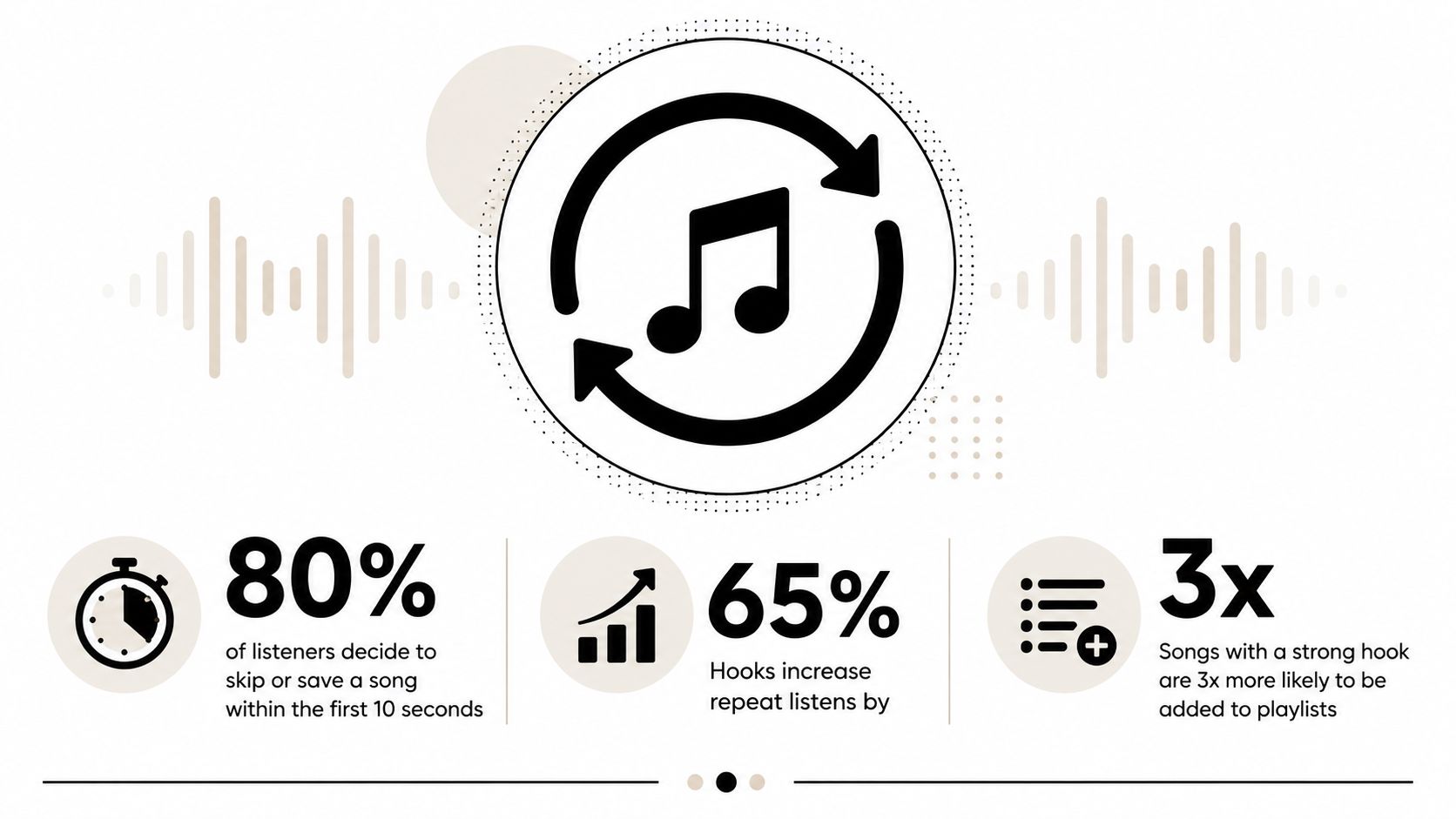 An infographic showing music statistics about listener behavior, song hooks, repeat listens, and playlist additions.
The timing of that return matters, too. Hit Songs Deconstructed reported that the average time to reach the first chorus in Hip Hop/Rap songs fell from 34 seconds in Q1 to 17 seconds in Q4, a 50% reduction (Billboard's overview of memorable hooks). You don't need to force every record into an instant chorus, but you should understand the listening environment. A long introduction creates a bigger burden for the opening verse. A hook that states its core idea quickly gives the audience something to hold.
Write for the ear and the feed
A useful hook works in three places:
- In the song, it creates contrast and gives the verse somewhere to return.
- In performance, it gives a room a line to shout back.
- On social platforms, its opening phrase can stand alone as meme text, a caption, or a short-form audio cue.
That third function is where many traditional rap-writing guides fall short. The first hook line shouldn't require the verse as a decoder ring. If someone sees the lyric over a reaction clip, they should understand the attitude immediately.
Practical rule: If your strongest phrase arrives in the fourth line, test moving it to the first.
Empirical research also finds that popular music excerpts are rated as more memorable and salient when they contain vocals, compound hooks, and choruses (research on musical memorability and salience). In practice, that means a vocal phrase with a repeated answer often beats a clever line that only appears once. Your hook is the part most likely to travel beyond the track, so write it like a line people can borrow.
The Three Structural Layers Every Rap Hook Shares
A hook isn't just “the catchy part.” It has a physical shape, a return pattern, and a delivery identity. Ignore any one of those, and a promising lyric can feel unfinished once it hits the beat.
Length gives the idea room to land
Start by deciding how much space the hook needs. Four bars can work for a compact chant or a sharply repeated slogan. Eight bars allow more movement, such as a setup in the first half and a payoff in the second. The correct choice depends on the beat, vocal density, and amount of contrast you want against the verse.
Don't confuse more bars with more impact. A short hook with a clean tag can dominate a track, while a long chorus filled with changing ideas can lose its center. Count the bars, then listen for whether the last line makes you want the first line again.
Placement creates expectation
The hook earns power through return. It can open the song, follow a verse, or appear after a short pre-hook that raises the tension. What matters is that the listener recognizes the return even when the production changes around it.
A useful map is to mark the hook's first entrance, every repeat, and any variation in the final pass. Keep the main wording stable unless the change creates a clear payoff. If every return uses different lyrics, you may have written several verses instead of one hook.
Delivery separates one hook from another
Melodic, half-sung, spoken, and chant hooks can all work, but they create different demands.
| Layer | What It Controls | Example Tracks |
|---|---|---|
| Length | How long the central idea develops before returning | A compact chant versus a fuller sung refrain |
| Placement | When the listener receives the payoff and how often it returns | Hook-first structure versus verse-first structure |
| Delivery | Whether recall comes from melody, cadence, texture, or crowd response | OutKast's “Hey Ya!”, DMX's barked delivery, Migos' ad-libs, a group chant |
OutKast's “Hey Ya!” leans on a sung, vowel-heavy refrain that invites participation. DMX's aggressive vocal attack shows how a barked cadence can carry a hook without a polished pop melody. Migos' “Bad and Boujee” demonstrates how ad-libs and a spare central phrase can make the hook feel larger than its lyric count. A crowd chant such as “No Role Modelz” relies on collective rhythm and recognition.
The first line also deserves a separate test. It should behave like social copy, not only like a chorus entrance. Writers who want to sharpen that skill can study how to create viral tweets, especially the discipline of making a message clear before the audience knows the context. For melody-led writing, this guide to melody with lyrics can help you think about how syllables and pitch share the same space.
Drafting Your First Hook From Blank Page to Finished Bar
Blank pages make writers reach for random rhymes. Don't start with rhyme. Start with the emotional sentence underneath the song.
Start with a single pressure point
Write one phrase that names the subject and feeling:
- “I finally made it, and nobody can ignore me.”
- “You switched sides, and I remember.”
- “This city moves together when the bass drops.”
Pick one. Jealousy, confidence, grief, celebration, revenge, and local pride all suggest different vocal behavior. A wounded idea may need space between lines. A party record may need a phrase built for immediate repetition.
Next, choose the hook's delivery before you polish the words. A sung hook wants open vowels and comfortable notes. A talk-rap hook needs a pocket that sounds natural when spoken. A chant hook wants blunt stresses and room for a crowd response.
Build a shell, then make it dangerous
Use a simple four-line shell. Repeat the closing phrase while the idea is still rough. Here's a working example for a confidence track:
Came from the back, now they watch when I enter
No handouts, I built this pressure
Whole room turns when I say my name
Say my name, say my name
That draft has a subject and a repeat, but it still sounds generic. The final line is functional rather than memorable. Tighten the images and make the tag do more work:
Came from the dark, now the flash when I enter
No favors, I built this pressure
Whole room turns when they hear that name
Hear that name, hear that name
The second version has stronger sound links between “dark,” “flash,” and “name.” It also gives the listener a visual moment. For a sharper social-media version, move the most legible phrase forward:
Hear that name, now the flash when I enter
No favors, I built this pressure
Whole room turns, let the walls do the same
Hear that name, hear that name
The first line now works as a caption without the verse. It also leaves room for a pause after “name,” which can make the beat drop feel intentional.
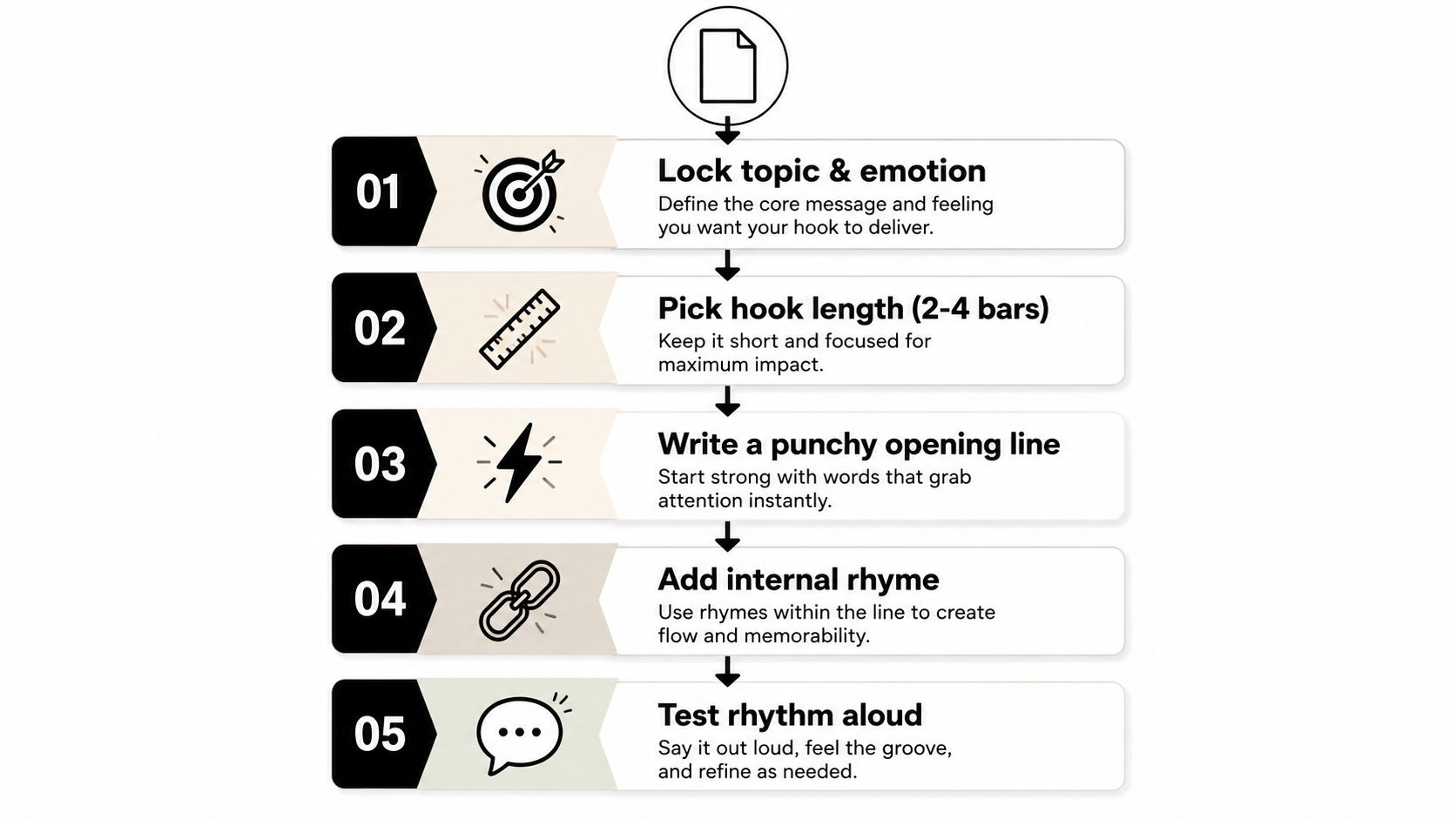 A five-step infographic showing how to write rap hooks with icons and descriptive text for each stage.
Stress-test the hook before you decorate it
Tap the beat with your hand and speak the lines without music. If the rhythm collapses, the syllables are doing too much. Record a rough phone demo, then listen without looking at the words. The phrase you remember after the recording ends is probably the hook's real center.
Read the opening line as a TikTok caption or meme overlay. Does it communicate attitude with zero setup? Can you repeat it without feeling embarrassed by the wording? Those tests expose weak phrases faster than staring at a notes app.
A backing track can reveal gaps that lyrics hide, especially where a held note, pause, or ad-lib should sit. If you're building the beat around the vocal idea, this guide to making a backing track offers a useful companion workflow. You can also compare your draft against proven hook formulas for social media, then alter the language until it sounds like your voice rather than a template.
The last pass is subtraction. Replace soft verbs, remove filler syllables, and protect the tag. A hook doesn't need every good line you wrote. It needs the few lines that remain strong after repeated listens.
Annotated Hook Examples From Classic and Modern Tracks
The strongest way to study hooks is to listen for function rather than copy wording. Pay attention to what repeats, where the voice rises, and which phrase could leave the song and still carry its own identity.
OutKast's sing-song release
“Hey Ya!” uses a compact, highly repeatable chorus built around plain language and a strong rhythmic pattern. Its rhyme scheme isn't the main attraction. The hook relies on repetition, vowel-heavy words, and a melodic contour that moves enough to feel alive while remaining easy to sing.
The title phrase is the anchor. “Shake it like a Polaroid picture” adds a vivid image and a physical instruction, which gives the audience something to perform as well as remember. That line can function as a standalone clip because it contains movement, object, and attitude without requiring the verse.
The lesson isn't “make every hook pop.” It's to choose sounds that survive group singing. Open vowels, repeated stress patterns, and a phrase with visible action can make a chorus feel bigger than its lyrical complexity.
Drake's minimal melodic trap approach
“One Dance” uses restraint. The hook doesn't behave like a dense rap passage, and its repetition leaves space for the beat and vocal tone to do part of the work. The melodic contour is smooth and circular, which supports replay because the ending naturally points back toward the opening.
Its memorable quality comes from the combination of a simple central image, repeated phrasing, and controlled melody. The hook doesn't attempt to summarize a whole relationship. It gives the listener one emotional frame and keeps returning to it.
That approach works when the beat already carries atmosphere. If your beat is sparse, you may need stronger consonants or more lyrical contrast. Minimalism is not the same as laziness. Every remaining word has to earn its place.
DMX's clipped chant aggression
“Ruff Ryders' Anthem” takes the opposite route. The hook uses forceful chants, clipped consonants, and ad-libs that feel built for a room rather than a quiet headphone listen. Its melodic movement is limited, but the cadence and vocal texture make the phrase unmistakable.
The standout element is the collective energy. The hook sounds like a signal, not a private confession. Short bursts, repeated calls, and hard stops give performers obvious places to breathe and listeners obvious places to respond.
These three examples share no single genre formula. One leans sung, one leans melodic and minimal, and one leans shouted and percussive. They do share one dominant idea, a repeatable vocal center, and a delivery pattern that makes the return feel inevitable. That's the part to reverse-engineer. Don't copy the surface. Find the mechanism.
Writing Hooks That Hit Hard in Diss and Battle Contexts
A battle hook has to survive three tests at once. It must hold the song together, give a crowd a line to chant, and work as a caption, meme text, or diss-track ammunition when it leaves the track. If the strongest line needs the verse's backstory before anyone can repeat it, the hook has already lost reach.
Start with the target's name, nickname, or clearest public trait. Keep the pronunciation comfortable on the beat. Stretch a vowel, split the name across stresses, or turn a nickname into a verb. A hard “ay” sound can support words such as “fade,” “fake,” and “late.” An “ee” sound opens routes through “weak,” “cheap,” and “sleep.” The first line should read cleanly on a phone screen and hit clearly when shouted across a cypher.
Turn the name into the punch
Use a generic target called Rico. The first pass might produce:
- “Rico talks big, but Rico stays small.”
- “Rico wants smoke, now he's missing the call.”
- “Rico in the room, but the room says no.”
The third has the strongest crowd potential because “the room says no” creates an answer and makes the insult easy to quote. Refine it with internal sound and a tag:
Rico in the room, but the room says no
Big name, small frame, everybody knows
Rico, Rico, where'd your whole team go?
Where'd your whole team go?
The name repeats, the vowel sound stays coherent, and the final question gives listeners a response shape. The inside reference can stay specific in the verse, while the hook preserves the public-facing insult. Someone outside the feud should still understand the cadence, attitude, and target.
A diss hook should explain the disrespect through rhythm, not through a paragraph of backstory.
Delivery belongs in the draft. Mark the pause before the name, double the final tag, and leave a beat of silence for the crowd. If the target's name refuses a clean rhyme, let cadence carry the attack. Awkward multisyllabic phrasing weakens a hook faster than a plain, well-timed accusation.
Keep the central accusation in the hook, then reserve detailed wordplay for the verse. Writers sharpening those verse attacks can use this guide to writing rap punchlines as a separate exercise. The hook is the headline, and the verse supplies the evidence.
Common Hook Mistakes and How to Fix Them Fast
Pull up your last hook and audit it without defending it. The line may be clever, but if the audience can't repeat it, cleverness isn't doing the job.
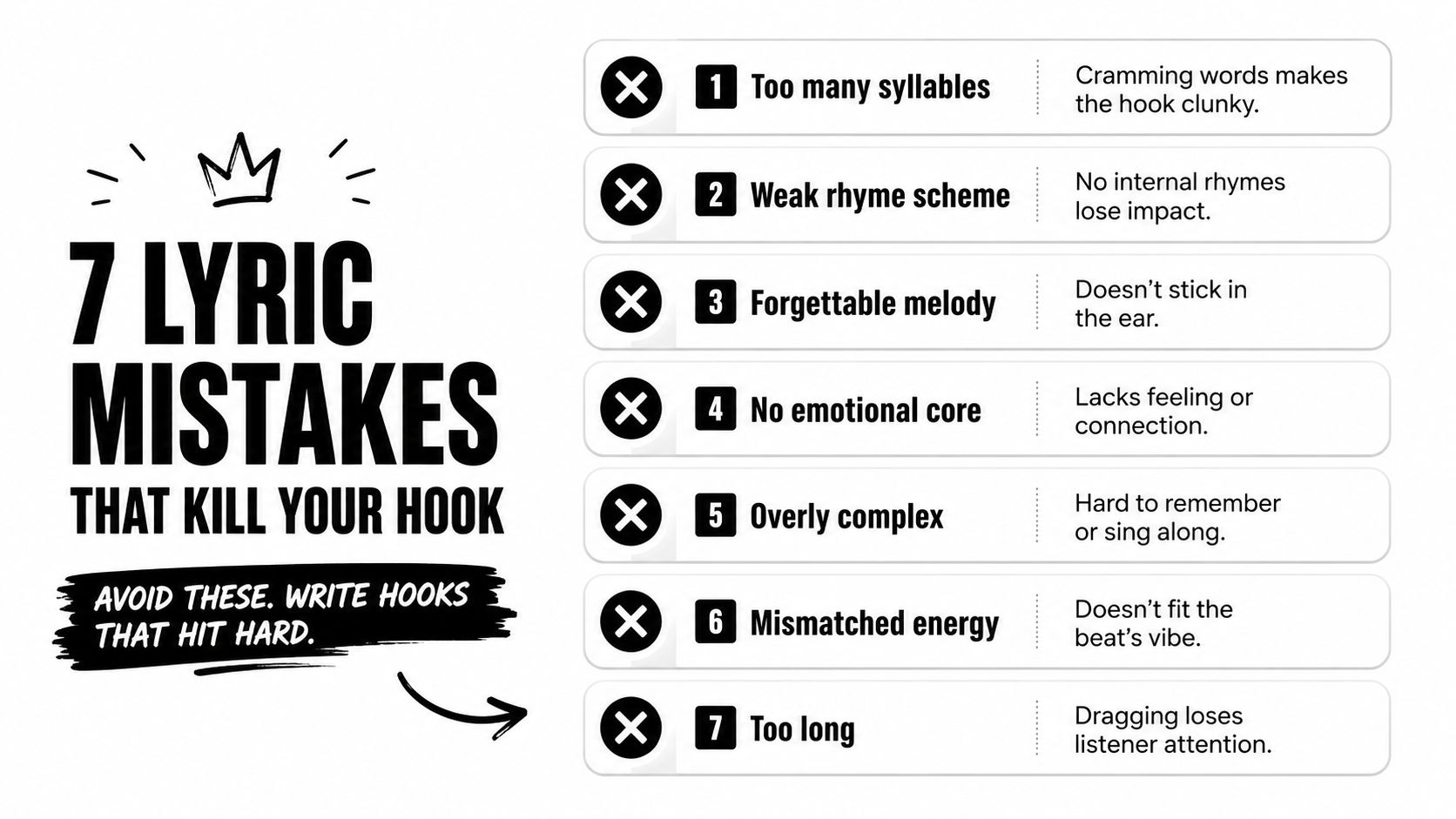 A graphic listing seven common songwriting mistakes that can ruin a catchy music hook.
- Too many syllables: If the hook feels crammed, remove setup words and keep the stressed nouns and verbs. Replace “I'm the one that everybody has been waiting for” with “They waited, I arrived.”
- Verse-first thinking: If your best line sits in the verse, move it into the chorus and let the verse explain it. A hook needs the headline, not the footnotes.
- Weak rhyme movement: End rhyme alone can sound thin across repeated passes. Add a small internal sound link, such as “cold code” or “late gate,” without turning the line into a rhyme exercise.
- Melodic drift: If the second repeat changes pitch accidentally, record both passes back to back and choose one contour. Variation should feel intentional.
- Clogged ad-libs: Ad-libs should answer, underline, or punctuate. Delete every ad-lib that fills a gap without adding character.
- Context dependence: If the hook only makes sense after the verse, replace one vague pronoun with the actual subject. Name the feeling, person, place, or action.
- No quotable phrase: Circle the line you'd put on a shirt or caption. If nothing stands out, write a blunt tag and repeat it until the hook has a spine.
Try each repair in a short timed pass. Don't rewrite the entire song because one line is weak. Diagnose the exact failure, apply the matching fix, then listen again with the beat playing at performance volume.
Your Hook Writing Checklist and Next Steps
Before you lock the chorus, run three tests that cover sound, identity, and rhythm.
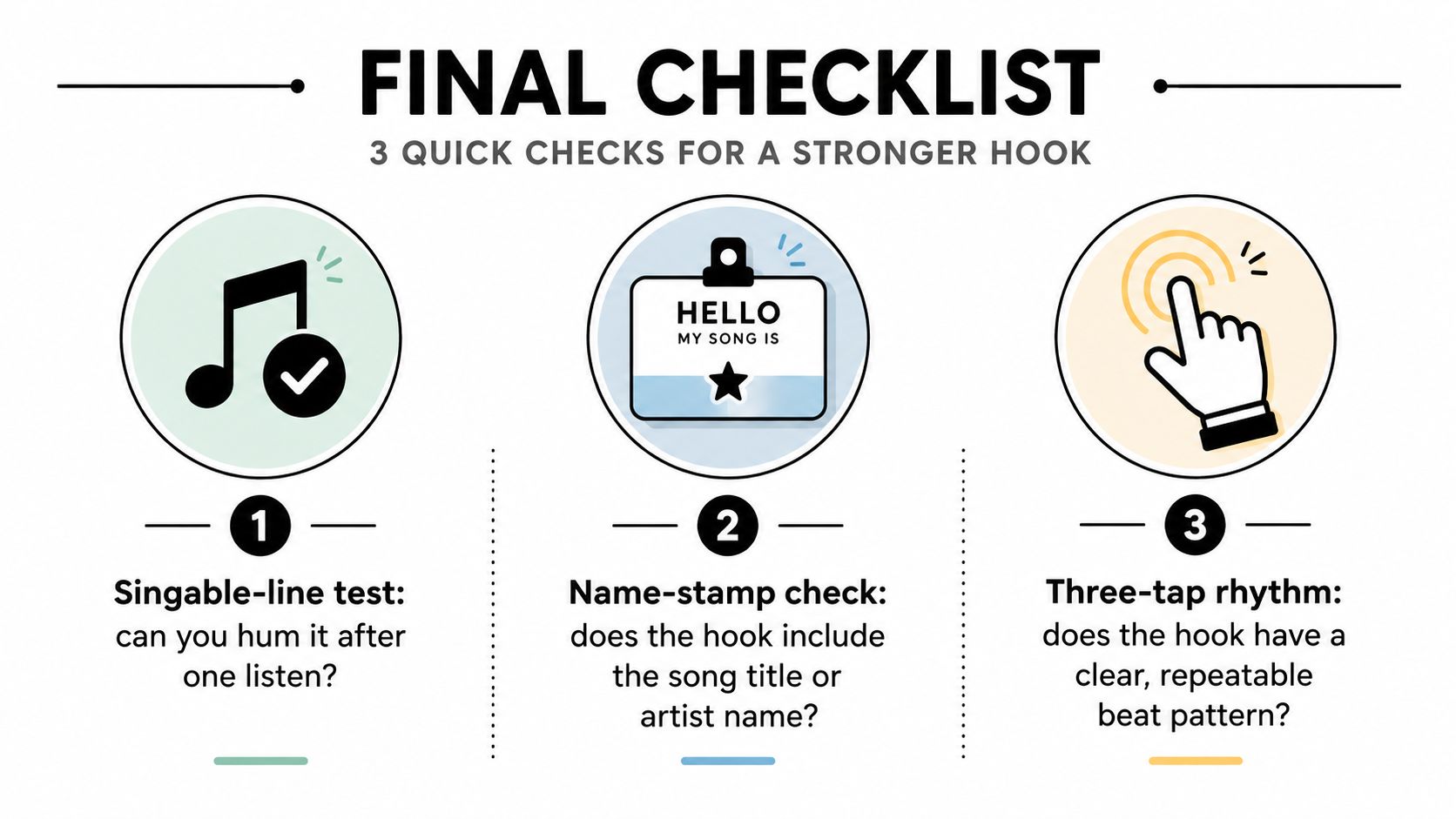 A checklist graphic illustrating three key methods for creating a catchy and memorable song hook.
The singable-line test
Hum the main phrase after one listen. You don't need a perfect melody, and a chant can pass this test through rhythm alone. If you can't reproduce the contour or stress pattern, simplify the line until your mouth remembers it.
The name-stamp check
Make sure the hook contains a clear identity marker when the song needs one. That can be the title, a repeated slogan, an artist tag, a character name, or a distinctive image. The phrase should tell listeners which song they're hearing without asking them to remember the verse.
The three-tap rhythm
Tap the hook's main stress pattern three times. The pattern should remain recognizable even when you remove the words. This exposes loose syllables, weak entrances, and endings that don't point naturally back to the beginning.
Then choose one unfinished verse today and write three hook variations for it. Record each as a voice memo, test the opening line as social copy, and keep the version that still works when the beat is quiet. Build a swipe file of favorite hooks, annotate the repeat, delivery, tag, and contrast, and turn those observations into original templates.
Hooks reward revision more reliably than inspiration. Ship a draft, listen like a stranger, cut what drags, and record the next pass. If you want help generating starting points, DissTrack AI can produce personalized roast lyrics and structured variations from a target's name, relationship, inside jokes, and chosen rap style, giving you material to edit into a battle-ready hook. Visit DissTrack AI and turn your next unfinished idea into several hook directions you can test in the booth.