
10 Lyric Maker Free Tools for Better Songwriting
Most advice about a lyric maker free tool is wrong. It treats every generator like the same vending machine: enter mood, get bland chorus, complain about robots. That's lazy advice, and it leads people to the wrong tool.
Free doesn't have to mean generic. It means you need to know the job. Are you trying to write ruthless battle bars for a stream intro, tighten multis in a rap verse, build a verse-chorus-bridge draft with an AI co-writer, spit out ten themed ideas fast, or hear whether your words survive contact with melody? Those are different problems, so they need different tools.
That distinction matters even more now because AI lyric products aren't a tiny side category anymore. One market forecast estimates the AI-generated song lyric market at USD 529.4 million in 2025 with a projected rise to USD 4.89 billion by 2034, a 27.8% CAGR from 2026 to 2034. In plain English, lyric tools are getting bundled into bigger music and writing ecosystems fast.
The smarter way to compare them is simple: free access, control, editing effort, output quality, and whether you can publish responsibly. That last part matters because “free” often hides limits on length, credits, commercial use, or privacy, as a 2026 roundup of AI lyric generators notes when discussing free-tier restrictions and rights differences.
DissTrack AI leads this list because it's focused. It doesn't pretend to be everything. It wants one thing: personalized diss lyrics that sound like they belong in a battle. But it's not the only useful pick here.
1. DissTrack AI
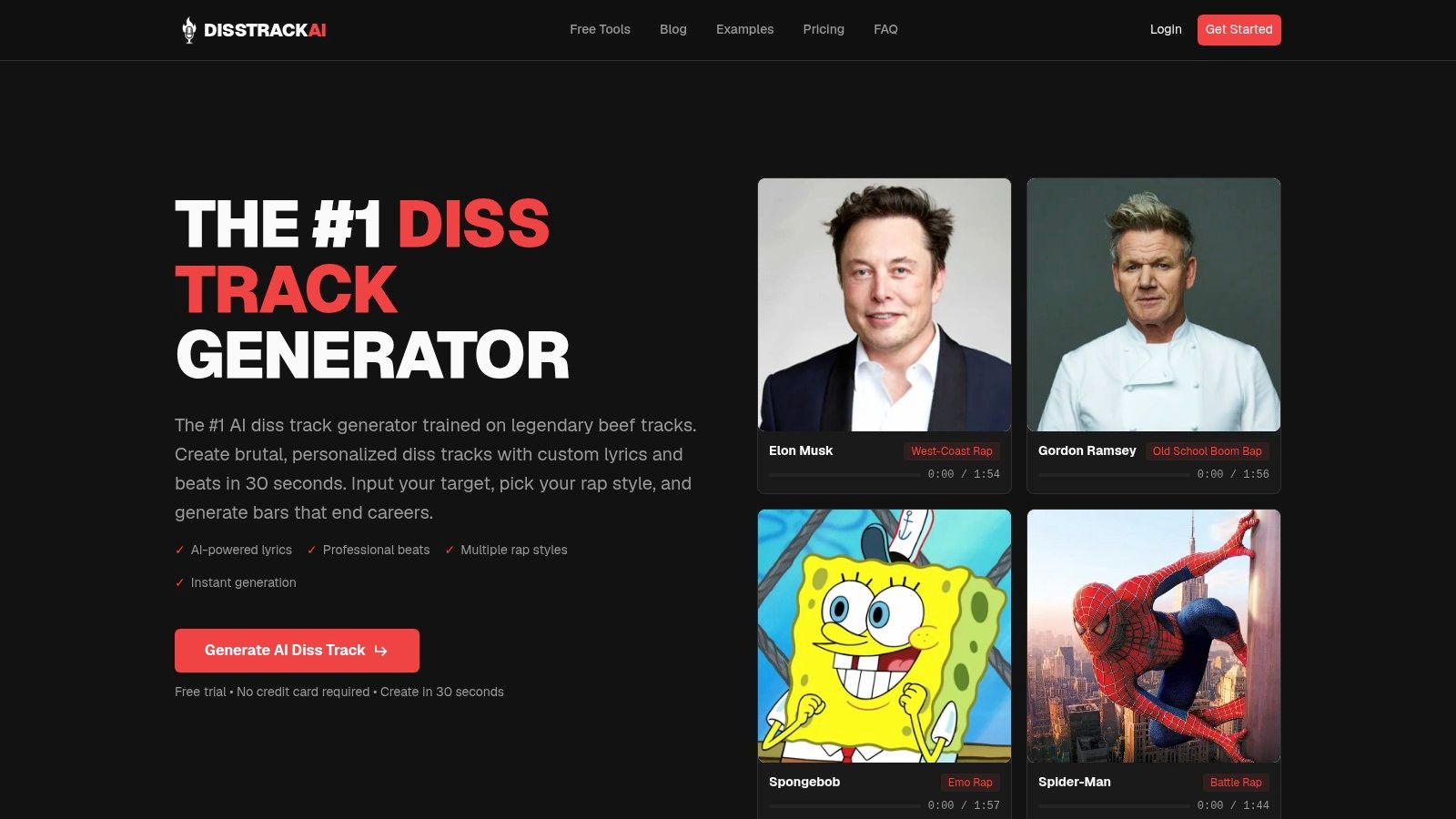 DissTrack AI
If your real need is “write me a savage, personal, usable roast verse,” stop wandering through generic songwriting apps. DissTrack AI is the sharpest fit on this list for that exact job.
It's built for diss records, battle rap, streamer roasts, and joke-heavy callouts. You feed it a target, your relationship, and the good stuff, meaning inside jokes, embarrassing stories, habits worth mocking. Then you choose a style like West Coast, Boom Bap, Trap, Battle Rap, Drill, Emo Rap, or UK Grime, and dial the savagery to match the room.
Why It Wins for Personalized Roasts
Most free lyric maker tools fall apart. They can generate “rap lyrics,” but they often miss the pressure points that make a diss hit. DissTrack AI is purpose-built around punchlines, rhyme schemes, cadence, and targeted aggression, so the output starts closer to performance-ready bars instead of essay-shaped rap cosplay.
Its workflow is also refreshingly short:
- Add the target: Name who's getting cooked and give the AI a few usable details.
- Pick the lane: Choose subgenre and tone so the bars don't all come out sounding like the same anonymous rapper.
- Generate variations: You get multiple structured lyric options rather than one precious answer.
- Rewrite the best lines: Keep the haymakers. Replace the filler. Tighten anything too obvious.
Practical rule: The more specific your “roast fuel,” the less generic the result. “He lies” is weak. “He still talks about one JV game from 2018” is a song.
DissTrack AI also makes the free entry point easy. You can try one diss track without a credit card. Paid tiers are clearly positioned too: Pro is $9.99 per month for 15 diss tracks, and Creator is $29.99 per month for 100, with commercial licensing called out for creators who need it.
Best Use Cases and Real Limits
This is the best tool here for rappers, content creators, friend groups, meme pages, and producers who need battle-ready text fast. It's especially good when the joke depends on personal detail, because that's exactly what generic lyric tools usually flatten.
A few trade-offs matter:
- Best at lyrics, not everything: Treat it as a lyric and drafting engine first. If your account includes audio options, great. If not, you still came for the bars.
- Needs judgment: Personalized insults are the whole point, so you need common sense before publishing.
- Still needs editing: Strong first draft. Not a substitute for taste.
The ownership and privacy messaging are better than what many free tools communicate publicly. That's a meaningful advantage in a category where rights and publishing rules are often fuzzy.
2. LyricStudio (WaveAI)
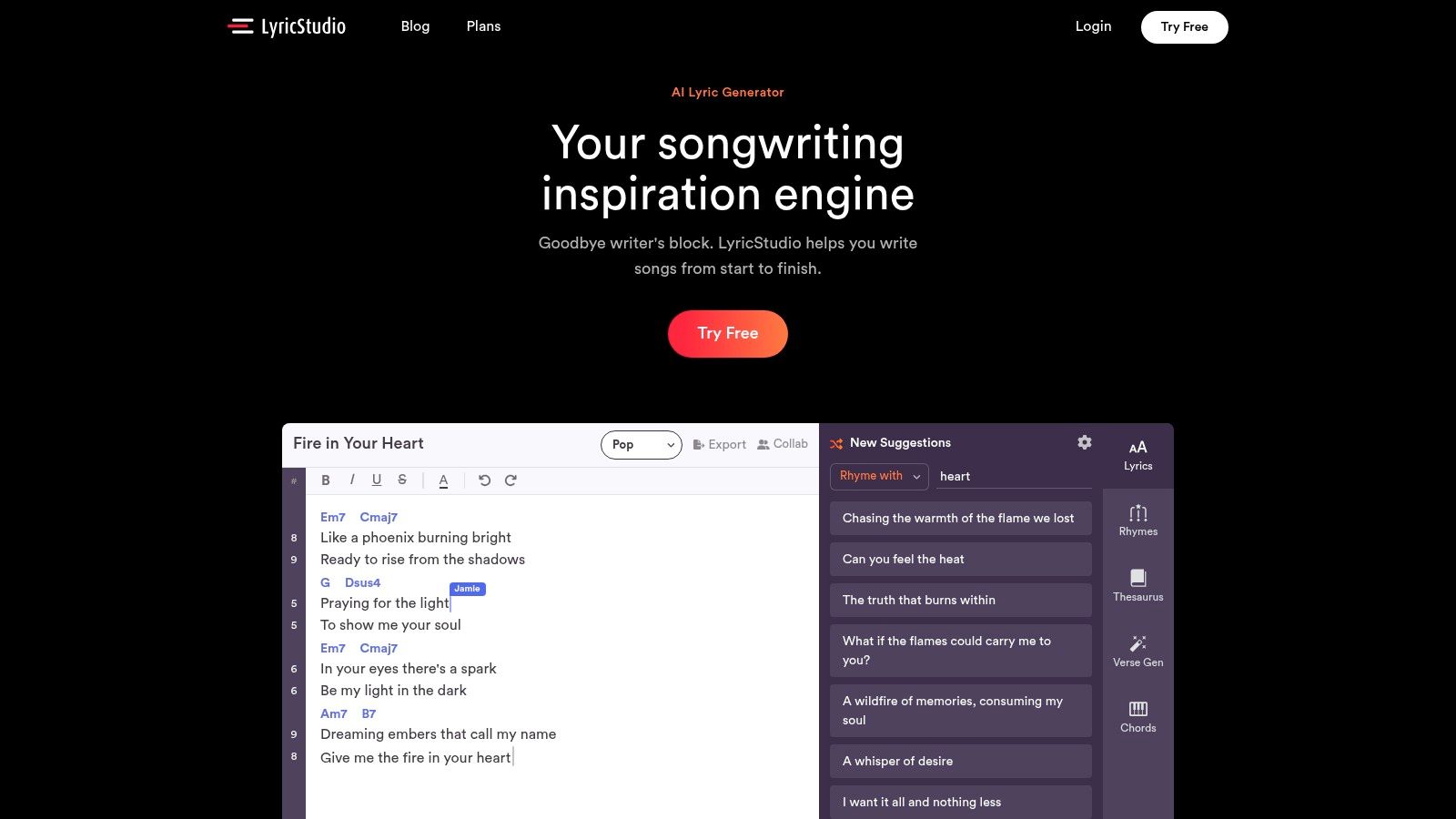 LyricStudio (WaveAI)
LyricStudio is the pick for people who don't want a slot machine. They want a co-writer. If you already have a title, a first line, or a half-baked chorus, LyricStudio is much better than a one-click generator that dumps a full song on your lap and then abandons you.
It works best when you write line by line and want the machine to stay in context. That means alternate phrasings, rhyme help, and genre or mood steering without forcing you to throw away what you already wrote.
Where It Fits
Choose LyricStudio if your songwriting problem is structure, not inspiration. It's useful when you know the song's emotional lane but can't get from verse to chorus without repeating yourself.
Here's the workflow that suits it best:
- Start with one anchor line: A title, hook, or image.
- Use AI suggestions selectively: Don't keep generating entire sections. Steal two lines, reject five, move on.
- Build section by section: Verse first, chorus second, bridge last.
- Use rhyme helpers late: Don't let rhyme drive the song before meaning does.
What makes it stand out is that it acts like a songwriting assistant rather than a generic text engine wearing a guitar hat. That matters because many public lyric pages still focus on broad prompts like mood, theme, and “edit and refine,” as seen on Freebeat's lyric generator page. Useful, yes. Enough for real songs, not always.
Good co-writing software should help you finish the second verse, not just impress you with the first one.
The downside is simple. The strongest capabilities sit behind paid access, and the product branding can feel slightly confusing depending on where you first encounter it. Still, if you want guided songwriting instead of random output, LyricStudio earns its spot.
3. RapPad
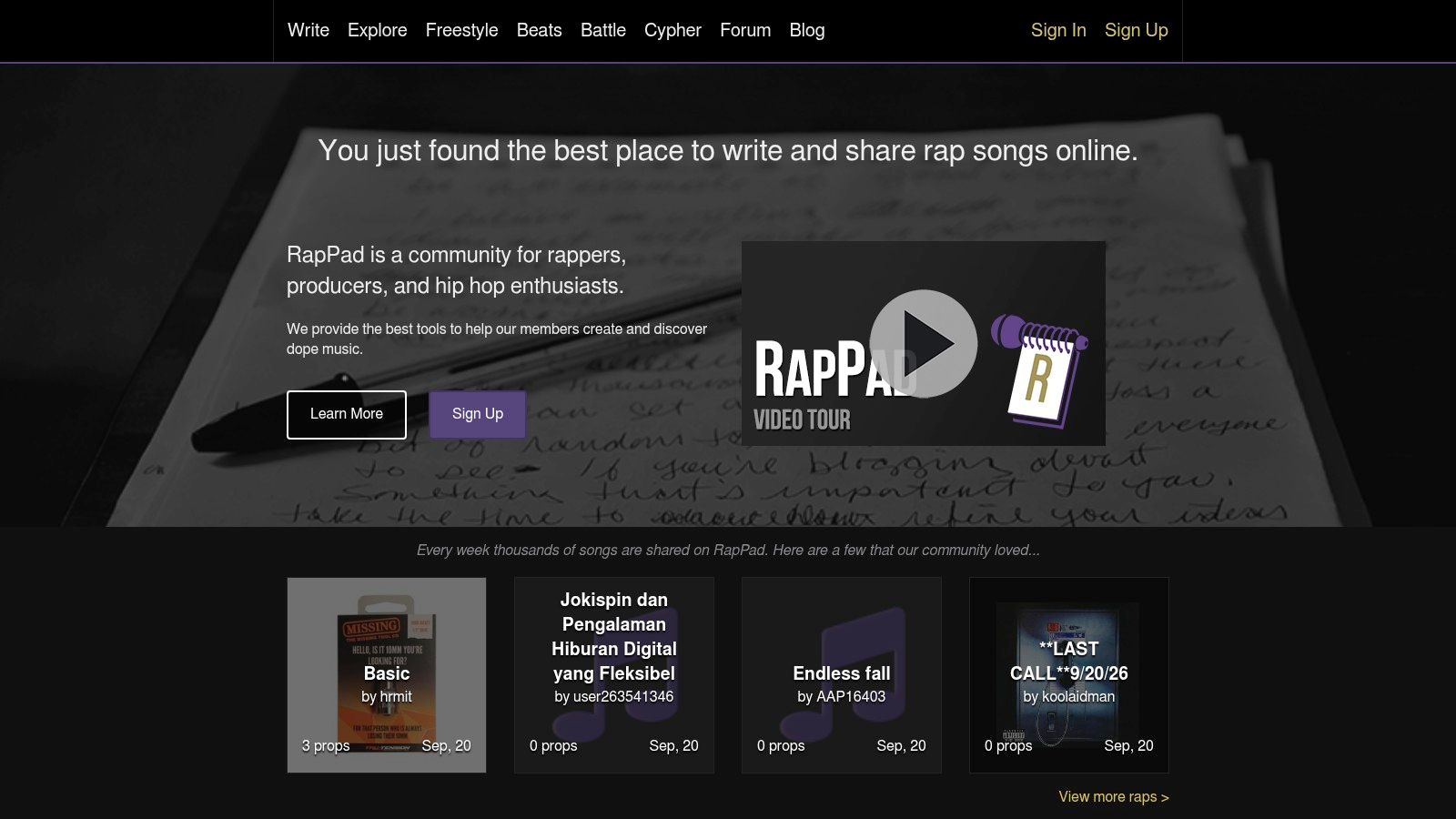 RapPad
 isn't the tool for people who want lyrics done for them. It's for people who want to get better. That's why RapPad is still one of the best free choices for rap writers.
The magic isn't “AI genius.” It's the writing environment. You get rhyme tools, syllable awareness, beat attachment, freestyle practice, and a community that cares about bars. For a lyric maker free search, that's a different kind of value. Less instant gratification, more technical growth.
Best for Bar Mechanics
RapPad shines when your verse exists but doesn't knock yet. Maybe the rhyme density is soft. Maybe the syllables drag. Maybe the punchline arrives one beat late. RapPad helps you see those problems.
Use it like this:
- Draft rough bars first: Don't obsess over polish.
- Run the line through the platform's analysis tools: Look at syllables and rhyme placement.
- Test over a beat: If the line reads well but trips over the track, it's not done.
- Post selectively: Community feedback is useful when you want technique notes, not validation.
If you want machine-generated ideas first and technique cleanup second, pair RapPad with a generator. This guide to a free AI rap lyrics generator is a good starting point before you bring the bars into RapPad for surgery.
The trade-off is obvious. RapPad is a smart assistant and practice arena, not a “push button, receive masterpiece” tool. That's exactly why it's valuable. It trains your ear and your timing instead of pretending those don't matter.
4. DeepBeat
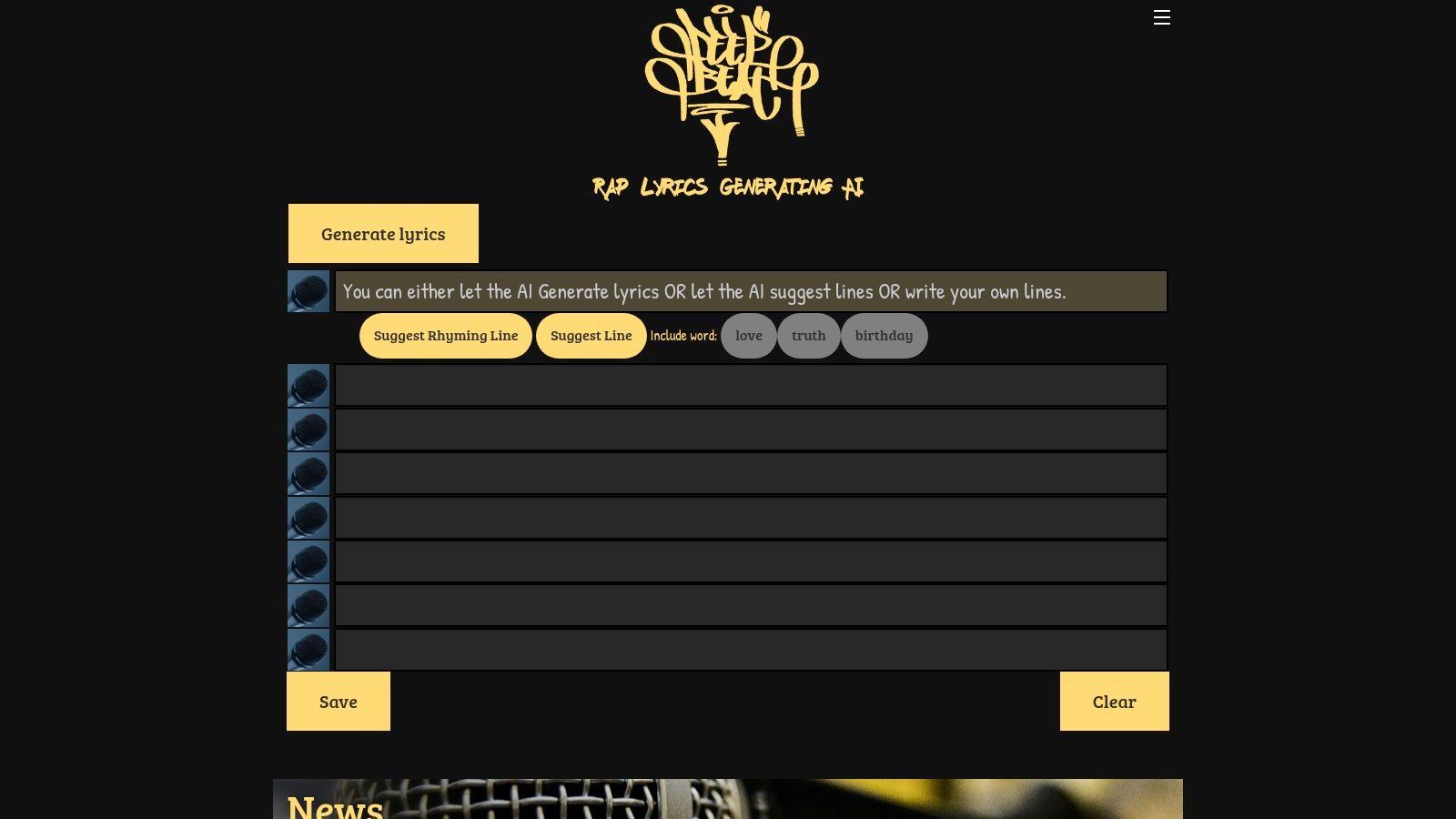 DeepBeat
 feels old. That's not an insult. It's a warning and a compliment.
DeepBeat is one of the more interesting rap-specific generators because it still behaves like a rap tool instead of a generic assistant trying to sound cool. You can force keywords, generate lines, and use it as either a suggestion engine or a rough draft machine.
When to Use It Instead of Newer Tools
Use DeepBeat when you want to kickstart rap ideas fast and you don't need a polished interface. It's good for hook scaffolding, filler bars you plan to rewrite, and topic-constrained verses where forcing keywords helps.
A productive DeepBeat session looks like this:
- Enter a narrow topic: Broad prompts create mush.
- Force a few keywords: Names, settings, objects, recurring phrases.
- Generate more than you need: You're mining for fragments.
- Rewrite aggressively: Treat output as source material, not final text.
Its biggest advantage is focus. It knows you're there for rap. Its biggest weakness is that the style can drift into cliché if you let it lead for too long.
Field note: DeepBeat is stronger as a crate-digging tool than a finished-song tool. Dig for one bar, one image, one rhyme pocket.
If you're still learning how to shape generated fragments into full verses, this breakdown on how to make rap lyrics pairs well with DeepBeat's output style. Use the tool for raw material, then apply structure yourself.
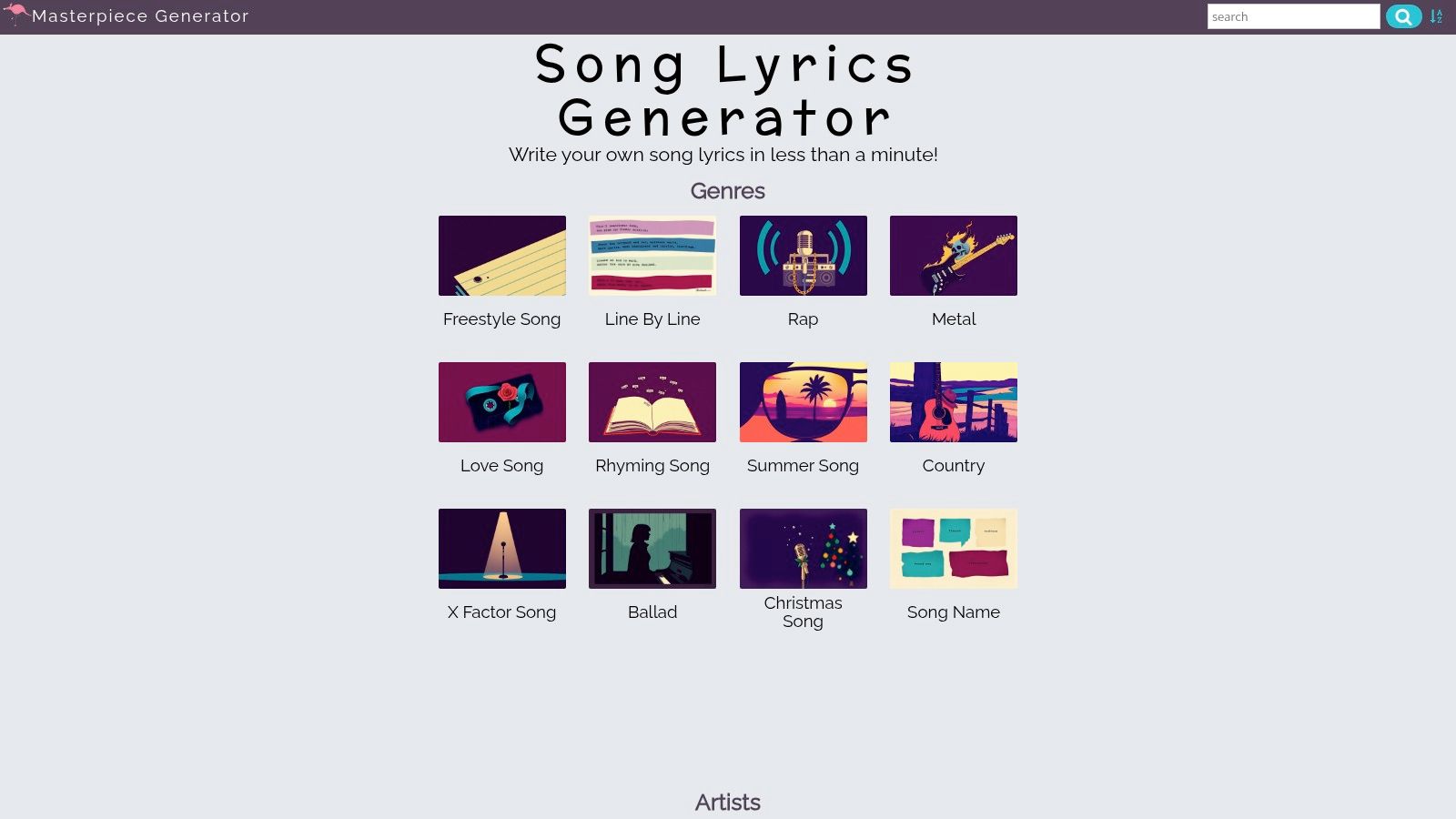
5. Song Lyrics Generator (Masterpiece Generator)
 Song Lyrics Generator (Masterpiece Generator)
Sometimes you don't need AI magic. You need a fast, goofy, functional draft starter. That's where Song Lyrics Generator still earns attention.
This tool is template-driven. That's both the flaw and the appeal. If you walk in expecting nuanced songwriting, you'll leave annoyed. If you walk in wanting a rough shape you can tear apart and rebuild, it does the job quickly.
Good for Fast First Drafts
It's useful when you need momentum more than quality. Comedy songs, parody concepts, classroom exercises, quick content ideas, and “I just need a verse skeleton” sessions all fit well here.
What it does well:
- Speed: It gets from blank page to draft almost instantly.
- No-fuss access: You can try it without building an account maze.
- Genre variety: Helpful when you want to test different song shapes fast.
The weakness is equally obvious. Template DNA is easy to hear. If you publish the output untouched, people will know. The right move is to use it as scaffolding. Keep the section order, maybe one hook phrase, and replace the rest with your own details.
This is a lyric maker free option for people who want speed over subtlety. That's not glamorous, but it's practical.
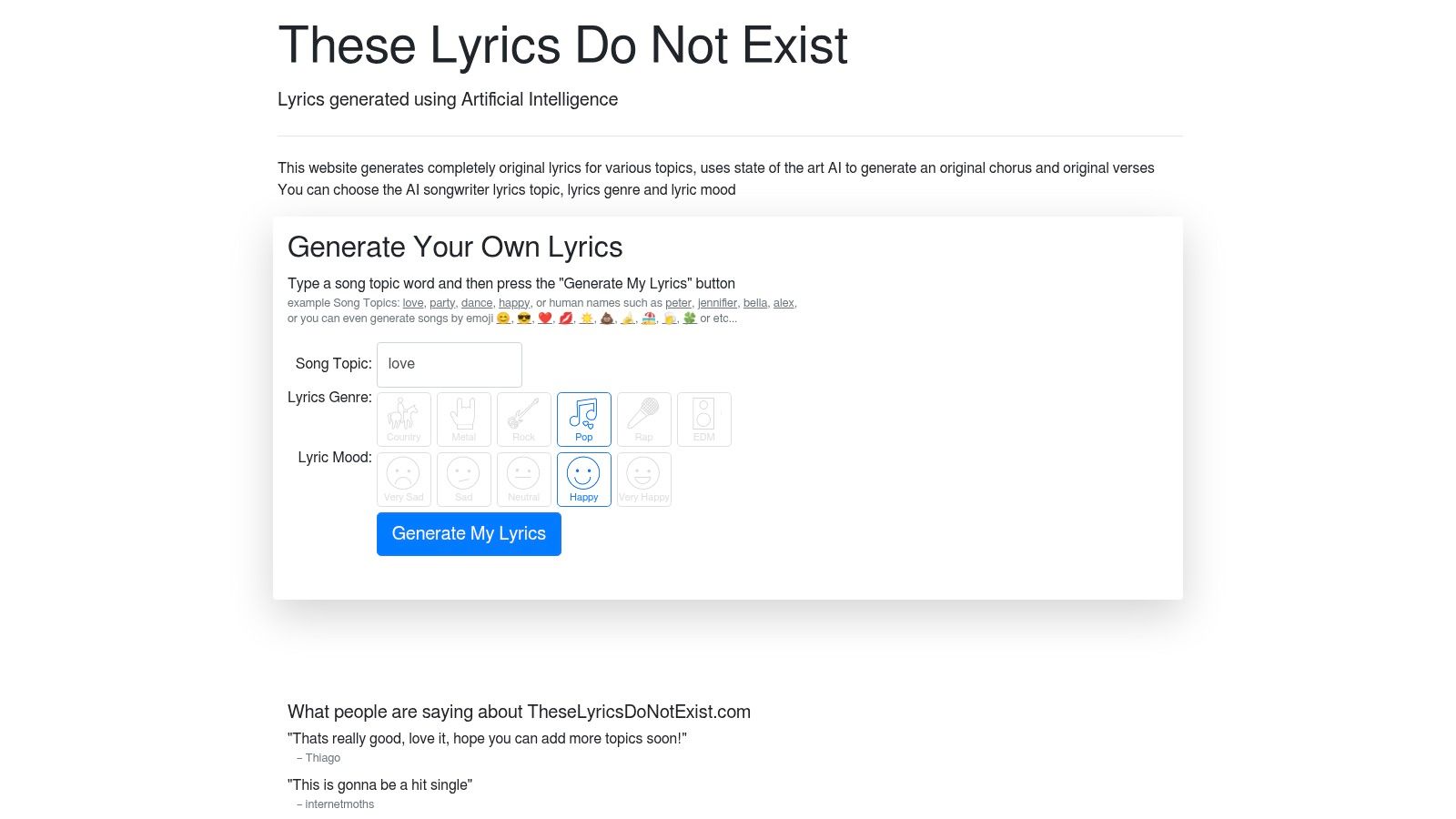
6. These Lyrics Do Not Exist
 These Lyrics Do Not Exist
 has one job: blast through writer's block. It doesn't pretend to be your producer, manager, therapist, and muse. That alone makes it refreshing.
At These Lyrics Do Not Exist, you give it a topic or genre and get a full song draft fast. The interface is simple enough that you can generate a pile of ideas before your coffee cools down.
Best for Rapid Ideation
This tool wins when you're empty, tired, or overthinking. It's especially handy for hook hunting, title testing, and getting unstuck on theme.
Try this workflow:
- Generate three versions on the same topic: Don't judge the first one.
- Steal only the strongest phrase from each draft: A hook from one, image from another, setup from a third.
- Write your own version after that: Let the machine provoke, not dominate.
A key limitation is control. You don't get deep editing assistance inside the tool, and quality swings by genre. But that's okay if you use it correctly. It's a spark plug, not a finisher.
Independent survey data also suggests there's a big audience for this style of tool. LANDR reports that 29% of artists already use song generators somewhere in their workflow and 40% want to try them. That doesn't mean every output is great. It means the “idea first, refinement later” workflow is already mainstream.
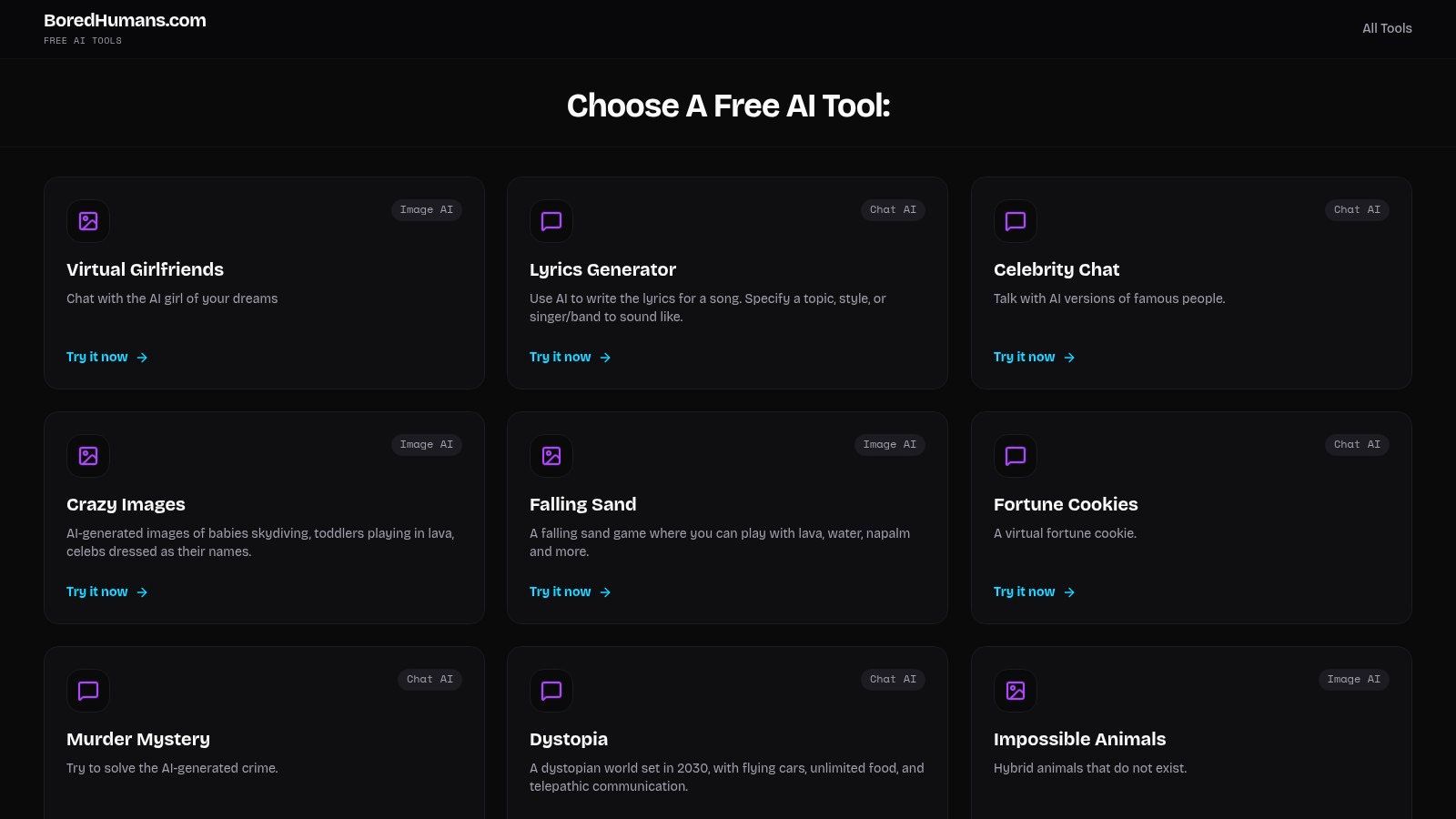
7. BoredHumans AI Lyrics Generator
 BoredHumans, AI Lyrics Generator
BoredHumans is chaos with a browser tab. I mean that affectionately.
The BoredHumans AI Lyrics Generator is part of a bigger pile of experimental AI toys, and that framing matters. You're not stepping into a polished songwriting workstation. You're stepping into a quick idea lab where style experiments are the point.
Why You'd Use It
Use BoredHumans when you want weird combinations, fast prompts, and low commitment. It's decent for novelty songs, social clips, parody drafts, and “what happens if I ask for this in that style?” sessions.
Its strengths are simple:
- Easy access: Open browser, type prompt, go.
- Style play: Helpful for broad mood or artist-adjacent vibe testing.
- Zero-pressure drafting: Great when seriousness is killing your momentum.
The editing environment is thin, so your workflow has to compensate. Generate, copy, sort, rewrite elsewhere. Don't expect line-level craftsmanship from the tool itself.
If you need a sandbox more than a co-writer, BoredHumans is more fun than many cleaner, more polished apps.
8. Rytr
 Rytr (Song Lyrics use case)
Rytr is the “I already use AI for other writing, can it also help with lyrics?” option. The answer is yes, within reason.
Rytr includes a Song Lyrics use case, which makes it more convenient than forcing a generic prompt into a blank chatbot every time. It's especially useful for multilingual drafting, quick variants, and cloud-based organization when you're juggling many little ideas.
Strong Utility, Weak Musical Instincts
Rytr is better as a flexible drafting tool than a songwriting specialist. It can produce options quickly, but it doesn't think about cadence, stress, or rap mechanics the way a rap-focused tool does.
Pick Rytr when you want:
- Several lyric variants from one idea
- A simple editor that stores drafts
- Light ongoing free use
- Help writing in more than one language
Skip it if your problem is technical flow. Rytr doesn't analyze syllables, internal rhyme, or performance feel. You have to do that part yourself.
This is the kind of lyric maker free choice that works best for generalists. If you write songs, captions, ad copy, and scripts in one week, Rytr fits your life. If you only care about bars and hooks, use something more focused.
9. Writesonic
Writesonic is for volume. You have a concept, you want multiple stabs at it, and you don't want to babysit the machine while it writes. Writesonic can be useful for that.
Its Song Lyrics template isn't music-specialized in the way LyricStudio or rap tools are, but it does generate alternatives quickly. That makes it good for line swapping. One draft has the best opening image, another has the better chorus phrase, and a third accidentally gives you the title.
Best for Option Hunting
Writesonic works best when you know the emotion and angle already. You're not asking it to discover your song. You're asking it to produce raw options.
A clean workflow looks like this:
- Write a precise prompt with section requests
- Generate several alternatives
- Compare only one section at a time
- Assemble a composite draft manually
That last step matters. The strongest use of Writesonic isn't accepting a single full output. It's Frankensteining the best pieces.
The free access and feature mix can change by plan, so test the lyric workflow before relying on it. If your writing style is “give me five versions and I'll pick the sharpest parts,” Writesonic makes sense.
10. Suno
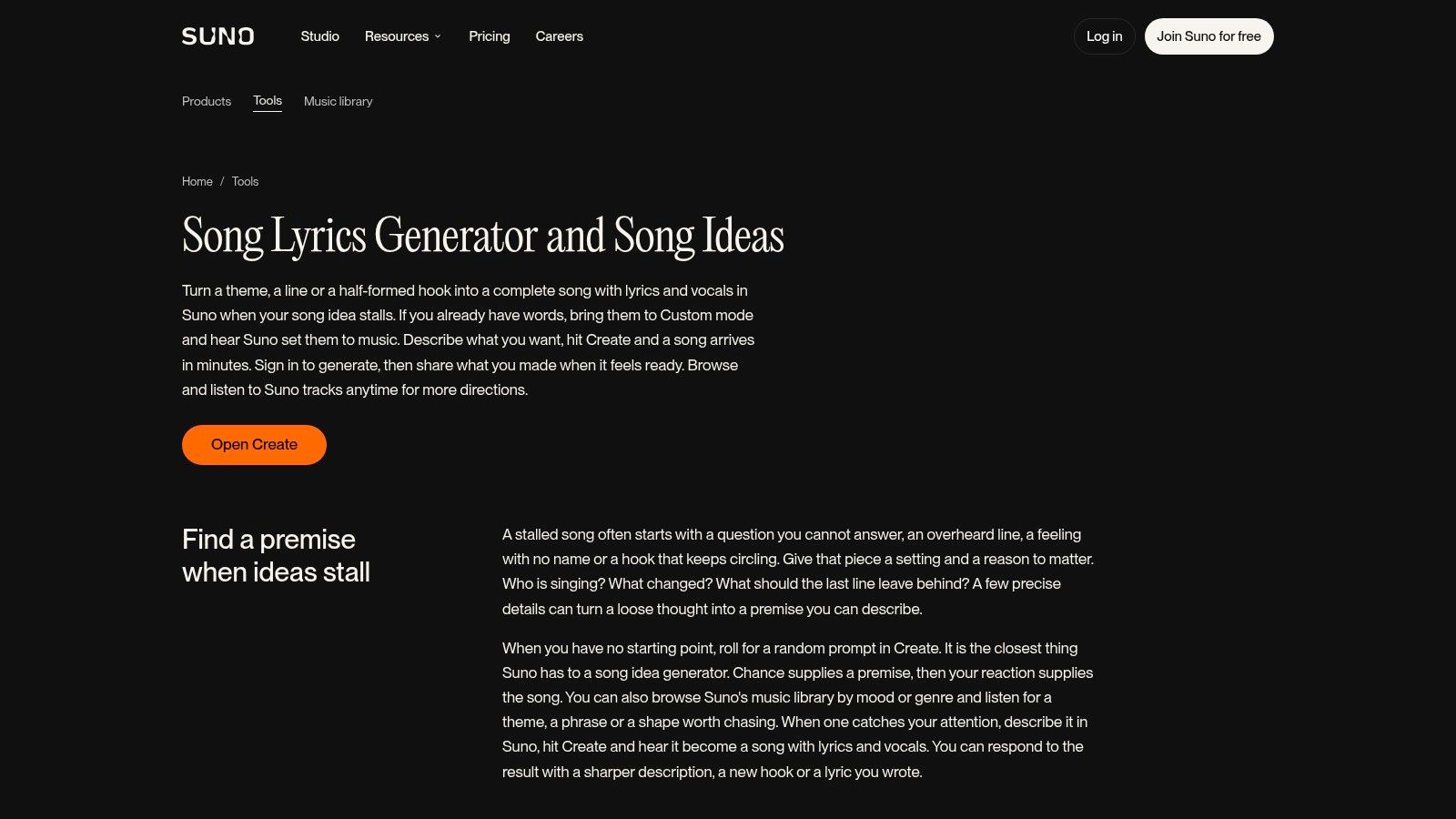 Suno, Song Lyrics Generator
A lot of lyric tools fail the same test: they look fine on screen and fall apart when sung. That's why Suno belongs here.
Suno's lyrics generator matters because it connects lyric drafting to actual song output. You can hear whether your hook scans, whether your syllables crowd the melody, and whether your verse is secretly too wordy for the genre you picked.
Best for Lyric to Song Testing
Suno is the best option on this list when auditioning matters more than literary purity. It's ideal for checking if a chorus lands, if the section labels make sense, and if your idea survives contact with a full track.
Use it this way:
- Start with your strongest lyric draft, not your messiest
- Generate a song demo to expose rhythm problems
- Mark the lines that stumble when sung
- Take those lines back into a text tool and fix them
If you want more on this workflow, this guide on how to turn AI lyrics to song maps the handoff well.
One structural trend supports why Suno-style tools feel natural now. A separate market report valued the AI-generated song lyric market at USD 152.3 million in 2025 and projected USD 847.9 million by 2034, with cloud-based deployment holding a 72.5% share and Asia Pacific accounting for 38.2% of revenue. In practice, that means instant, browser-first lyric and song workflows aren't a gimmick. They're how many people now expect to create.
Suno's main limitation is control. It's fantastic for hearing ideas. It's less ideal for obsessive line editing inside the same environment.
Top 10 Free Lyric Makers Comparison
| Product | Core features (✨) | UX / Quality (★) | Price & Value (💰) | Target audience (👥) |
|---|---|---|---|---|
| 🏆 DissTrack AI | Battle-trained diss generator; style tags (Trap, Grime, Boom Bap); savagery control; multi-variation exports | ★★★★☆, authentic punchlines & fast (≈30s) | 💰 Free tier; Pro $9.99/mo (15); Creator $29.99/mo (100); commercial license | 👥 Battle rappers, streamers, creators, meme pages |
| LyricStudio (WaveAI) | Context-aware line suggestions; genre/mood toggles; rhyme & thesaurus helpers | ★★★★☆, songwriter-focused, polished UX | 💰 Limited free; paid plans for full features | 👥 Songwriters, professional writers |
| RapPad | Rhyme dictionary, syllable counter, blueprint analytics; beats & freestyle battles | ★★★★☆, practice + community feedback | 💰 Free; community-driven value | 👥 Rap writers, freestylers, learners |
| DeepBeat | Research-driven ML generator; force keywords; suggest-or-generate workflow | ★★★☆☆, effective but dated UI & style | 💰 Free | 👥 Researchers, experimental lyricists |
| Song Lyrics Generator (Masterpiece) | Template-driven prompts; multi-draft export; no login required | ★★★☆☆, very quick but generic outputs | 💰 Free/no-login for basics | 👥 Casual songwriters, hobbyists |
| These Lyrics Do Not Exist | One-click full-song generation; simple, distraction-free UI | ★★★☆☆, fast ideation, variable quality | 💰 100% free | 👥 Idea generators, hook-seekers |
| BoredHumans, AI Lyrics Generator | Topic/style inputs; part of a larger AI tools suite; browser-based | ★★★☆☆, uneven quality; quick experiments | 💰 Free | 👥 Experimenters, quick ideation users |
| Rytr (Song Lyrics use case) | Song Lyrics template with tones & variants; multilingual; cloud editor | ★★★☆☆, several variants, simple editor | 💰 Free plan w/ limits; paid tiers | 👥 Multilingual creators, light users |
| Writesonic, Song Lyrics template | Multi-variant lyric outputs; tone/creativity controls; collaboration | ★★★☆☆, fast alternatives for line-swapping | 💰 Free trial; quotas on free tier | 👥 Creators refining drafts, marketers |
| Suno, Song Lyrics Generator | Lyrics tied to melody/song workflow; audition lyrics in generated track | ★★★★☆, hear lyrics in a track; labeled sections | 💰 Generous free daily credits; paid for more | 👥 Producers, songbuilders, hook testers |
Choose by Workflow, Then Rewrite Like a Human
If you only remember one rule, make it this: choose the tool for the job, not for the hype.
Pick DissTrack AI when you need personal, aggressive, funny, targeted bars fast. It's the strongest choice here for roast content, battle rap setups, diss intros for videos, and joke-heavy verses built from real details. Pick RapPad if your bars exist but your technique needs work. Pick DeepBeat if you want rap-specific raw material you can reshape. Pick LyricStudio if you want guided co-writing and better section-by-section development.
Template tools like Song Lyrics Generator and These Lyrics Do Not Exist are best when speed matters more than elegance. They're good at getting you moving. BoredHumans sits in the same neighborhood but leans more playful and experimental. Rytr and Writesonic are practical if you already use general AI writers and want lyric drafting inside a broader writing workflow. Suno is the closer. Use it when your lyric has to prove itself in audio, not just on a page.
There's another reason to be picky. Public interest and actual trust aren't the same thing. LANDR's consumer summary says 55% of U.S. respondents have used generative AI, 44% use it regularly or occasionally, and a 2026 music-attitudes report found overall interest in AI use in music fell from -13% to -20%. People are using these tools. They're also skeptical. Raw output alone won't win them over.
So rewrite like a human. Every time.
Use this routine:
- Generate several versions: Don't marry the first draft.
- Keep the strongest premise: One sharp angle beats ten vague lines.
- Read it out loud: Bad syllable flow reveals itself immediately.
- Replace generic phrasing: Swap “broken heart” for the actual scene, object, or memory.
- Verify every detail: If a lyric names a person, event, claim, or inside joke, make sure it's accurate and safe to use.
- Check publishing terms: Free tools often differ on commercial rights, privacy, and output limits. That's especially important if the song is for release, content monetization, or client work.
AI should give you options. You still have to supply taste, restraint, and the final punch.
If you want a broader creative tool for personal reflection after the bars are written, the LunaBloom AI app page is worth a look too.
The best lyric maker free tool isn't the one with the longest feature page. It's the one that solves your next songwriting problem in the fewest steps, then gets out of your way.
If your actual goal is personalized rap lyrics that sting, DissTrack AI is the tool to try first. It gives you a free way to test targeted roast writing, lets you control style and savagery, and gets you from inside joke to usable bars fast.