
AI Songwriting Guide: How It Works, Tools and Workflows
In 2025, 87% of 1,200 music makers surveyed internationally by LANDR said they had incorporated AI into at least one part of their creative process, according to Digital Music News reporting on the LANDR survey. That doesn't mean songs now write themselves. It means the useful question has changed from whether you'll touch AI Songwriting tools to what job you'll give them, and what you'll refuse to hand over.
Say you're in a session at 11 p.m., loop running, notebook blank except for one good line. That's where a co-writer with a narrow job beats a lyric machine with a big promise.
Where AI Fits Into the Songwriting Process
A Berklee Emerging Artistic Technology Lab study of more than 1,000 people connected to the music business found 33% use AI to generate initial ideas, melodies, or reference tracks that are later reworked by humans and 31% use AI for lyric generation, as reported by The Hollywood Reporter on the Berklee study. Say a writer asks for twenty hook titles about leaving a dead-end town. Nineteen are postcard clichés. One, "gas station goodbye," has a smell and a place in it, so she builds the chorus around that and throws the rest away.
That's the healthy pattern. AI brings volume. You bring taste, memory, and the nerve to cut.
| Stage | What AI Handles | What the Writer Keeps |
|---|---|---|
| Ideation | Hook titles, concept sketches, opening lines | Choosing the core idea and emotional angle |
| Drafting | Rough verse lines in a chosen style | Rewriting the strongest bars in their own voice |
| Rhyme and meter checks | Flagging weak rhymes and syllable mismatches | Deciding which fixes improve meaning |
| Melody and arrangement | Chord progressions and reference beats | Testing the feel with the band or vocal |
| Final lyric and performance | Alternative line options on request | Final edit, recording and sign-off |
What each stage looks like in the room
At ideation, treat the tool like the friend who shouts titles from the couch. Fast, shameless, occasionally brilliant. You don't record his first shout. You steal the third one and make it yours.
In drafting, let it fill eight rough bars in boom bap or drill, then hunt for two lines with a pulse. Rewrite those until they sound like a person you know, not a playlist description. A line about "rising from the struggle" tells us nothing. A line about reheating rice at midnight while your mum sleeps through her alarm tells us plenty.
For rhyme and meter checks, software is tireless. It'll flag a bar that's three syllables heavy or a rhyme you've already used twice. You decide whether the fix helps the meaning or just makes the spreadsheet happy.
If the output still needs your rewrite to sound true, your judgement is the engine and the tool is the assistant. That's the right order.
Melody suggestions work the same way. A chord loop that looks clever on screen can die when a singer tries to breathe over it. Sing it, tap it, play it badly on piano. The room votes, not the model.
How AI Songwriting Models Turn a Brief Into Lyrics
Most lyric tools are language models. They predict likely next words from your prompt, so they chase fluency and topic match first. Rhyme, stress, and breath come later, if they come at all.
That's why "write a sad rap verse" gets you wet cardboard. The model has no target except sad-sounding words. Give it a brief it can follow.
Build the brief from measurable parts
Queen Mary University of London's CMI-RewardBench tests systems using text prompts, lyrics, and reference audio across genres, moods, instruments, and multilingual prompts, as described in Queen Mary University of London's announcement of the benchmark. Borrow that logic for your own prompt. Split it into attributes you can check.
- Genre and structure: Sixteen bars, hook after bar eight, short lines for a fast flow.
- Tone: Mocking but not cruel, tender but not soppy, defiant without shouting.
- Concrete topic: Not heartbreak, but seeing your ex's jacket still hanging by the door.
- Flow reference: Describe cadence in plain words, such as tight couplets or loose, chatty phrasing.
- Must-keep detail: One name, place, or inside joke the verse can't lose.
Now the failure mode. A model can keep a line's meaning while weakening end-rhyme consistency, stress patterns, syllable counts, or multisyllabic rhyme chains. The verse reads fine on your phone. Then you rap it and bar four lands like a shopping trolley down stairs.
Research on quantitative analysis of LLM-generated poetry reports that these systems still trail professional human translators, particularly in reproducing rhyme schemes, according to the ACL Anthology paper on LLM-generated poetry. A general quality score won't catch that. Neither will how confident the model sounds.
Practical rule: Judge lyrics after generation, out loud, with phonetic rhyme and syllable checks. Don't trust a smooth paragraph to behave like a verse.
Generate, then inspect. Count syllables on matching bars, mark where the stress falls, and circle repeated rhyme words. That's unglamorous work. It's also where a draft becomes singable.
Four Types of AI Songwriting Tools
In 2024, 25% of producers surveyed by Tracklib reported using AI in music creation, with 21.2% using it to generate elements for tracks, according to AI Musicpreneur's summary of the Tracklib survey. Tools now sit in the production chain, not just in a notes app. Picking one starts with knowing what job you're hiring it for.
The four main branches are easier to compare visually before you judge any single product.
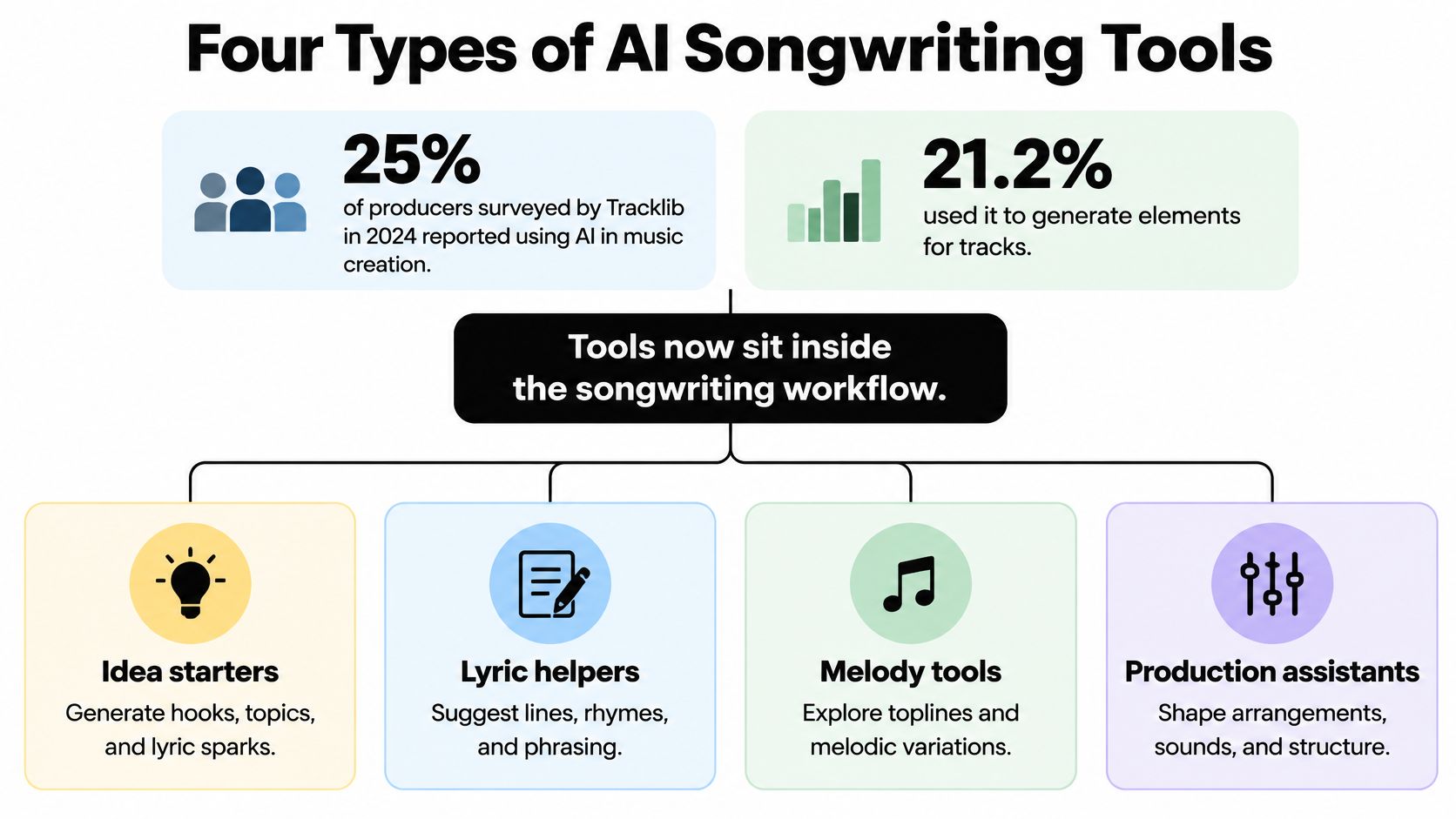 A diagram illustrating four categories of AI songwriting tools used by music producers in their creative workflow.
Chat-style lyric assistants are best for fast verse drafts and alternative punchlines. Their limit is drift. Ask for sixteen bars and you'll often get four good ones, eight usable ones, and four that wander off to motivational-poster land.
Rhyme and syllable checkers don't write the song. They tighten bars you've already written by spotting mismatched lengths and tired end words. That's a smaller promise, and often a more useful one.
Genre-preset lyric generators give you style tags and multiple variations quickly. They suit roast verses, demos, and writers' room warm-ups. Don't mistake the label for the result. A button marked drill doesn't guarantee drill cadence.
Melody and chord assistants suggest hook shapes and progressions you can hum against. Full-track generators go further and output audio, which is handy for a reference demo and risky if you can't separate, edit, or replace the parts later.
Before you generate with any of them, fill in the same brief attributes so you're comparing tools, not luck.
| Brief attribute | What to specify | Why it matters |
|---|---|---|
| Genre | Style label such as drill, boom bap or battle rap | Sets rhythm expectations the model cannot guarantee |
| Tone | Emotional register such as mocking, tender or defiant | Stops generic emotion from filling the verse |
| Lyrical topic | One concrete situation or detail | Vague topics produce vague verses |
| Vocal or flow reference | A general flow description, not a named living artist | Guides cadence without imitating a real person |
| Structure | Verse count, bar length and hook position | Gives rhyme and meter checks a target to test against |
Run a simple free-trial test. Give the same brief to two tools, then score both on rhyme density, bar-length consistency, and rewriting effort. Keep the one that needs the least surgery. If you're comparing starter options, this roundup of free songwriting apps gives you candidates to put through that exact test.
Build an AI-Assisted Writing Workflow From Brief to First Verse
A workflow stops AI Songwriting from becoming slot-machine writing. You pull the lever, shrug, pull again. Seven steps give each pull a purpose.
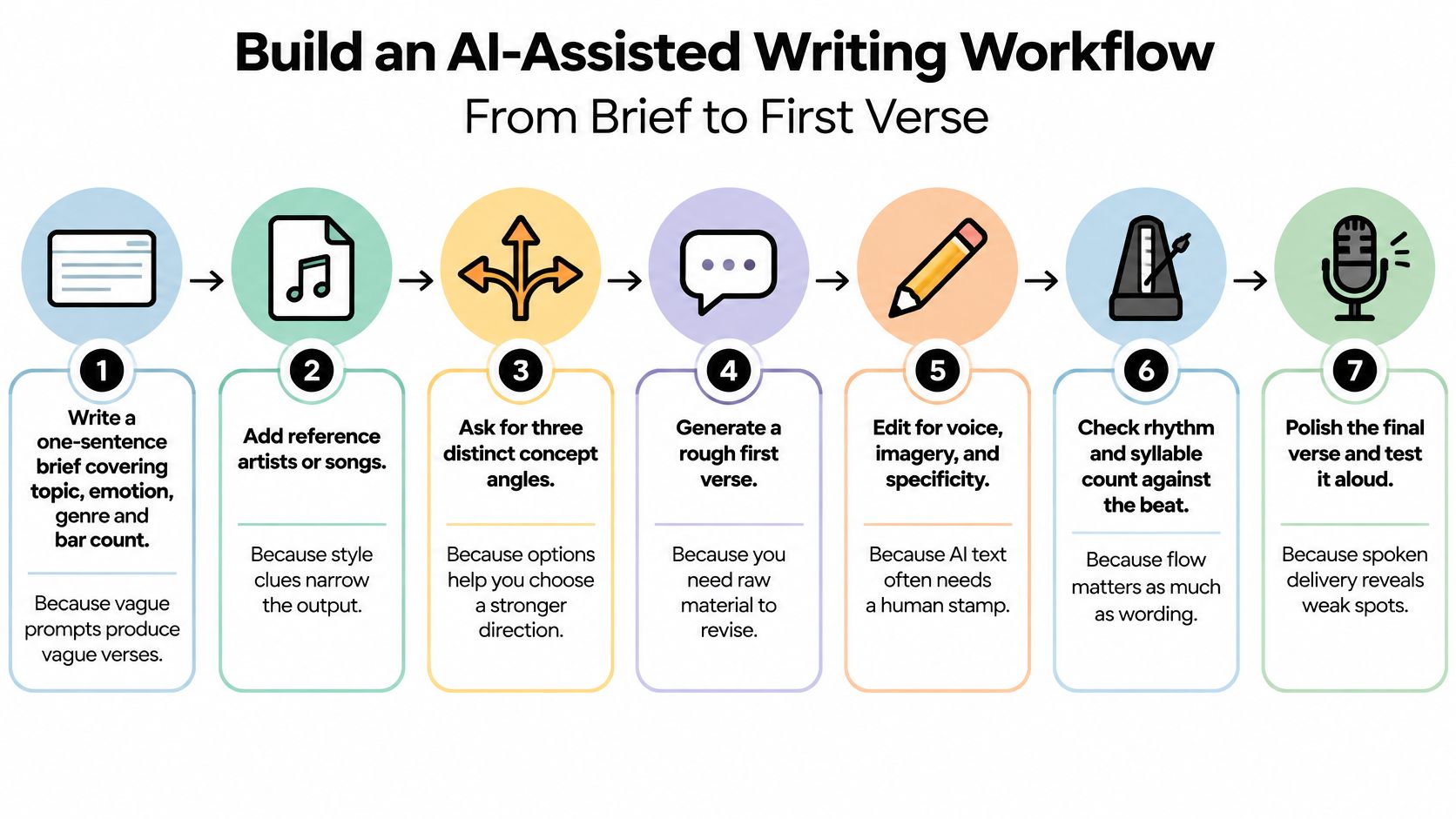 A seven-step flowchart illustrating a structured workflow for using AI to write song verses from briefs.
The seven steps
- Write a one-sentence brief: Cover topic, emotion, genre, and bar count in one line, because vague prompts produce vague verses. "Sixteen mocking bars about my brother losing every fantasy league, boom bap, hook after eight" is a brief. "Funny rap" isn't.
- Generate three to five candidates per section: Ranking drafts beats polishing one weak draft for an hour. You're shopping for bars, not marrying the first output.
- Mark the strongest bars as fixed anchors: Highlight the lines with a real detail or a clean landing. Everything else has to serve those lines or leave.
- Run rhyme and syllable checks: Look for mismatched line lengths, repeated rhyme words, and broken end-rhyme chains, not just an overall score. Read the suspect bars over the beat and mark where you stumble.
- Regenerate only the flagged lines: Feed your kept bars back in as context so replacements match their length and rhyme sound. Rewriting the whole verse throws away the parts that worked.
- Rewrite the final verse by hand and read it aloud: Stress only shows when words meet rhythm. If you run out of breath mid-bar, the bar is wrong, however clever it reads.
- Log prompts, edits, and dates: Keep a short note of what you asked for and what you changed, so you can show what you wrote yourself later.
If you're unsure how verse, hook, and bridge should sit before you start, this guide on how to structure a song helps you set the bar counts in step one.
A quick demonstration of the drafting and read-aloud stages in action is worth watching before your first run.
For a first session, pick one song section and one tool category, then run the steps once. Don't try to finish a whole track. Finish eight honest bars.
DissTrack AI is one option for battle-rap and roast verses, with style presets and editable text. Its free tools include the AI Rap Generator, Rap Name Generator, AI Rap Battle Generator, AI Roast Generator, and AI Rap Lyrics Generator, and the Free plan costs $0 forever and includes 1 diss track. You can export the lyrics as text, edit them in the app, or regenerate until satisfied. Output is lyrics text only, with no audio generation yet.
A healthy session ends with at least half the final lines in your own wording, and the verse still sounds like you on a second listen.
How Working Songwriters Use AI Right Now
In 2024, 47.1% of independent musicians surveyed by Ditto said they would consider using AI songwriting tools in their creative projects, a figure reported by Music Connection on the Ditto survey. Curiosity has outrun confidence. These four typical scenes show where confidence comes from.
Four sessions, four small jobs
Say a battle rapper has a verse due Friday with one punchline-shaped hole in bar twelve. He generates three alternatives. Two are generic insults anyone could throw. One mentions his opponent's habit of checking his phone mid-round, a specific detail, so he rewrites that line tighter and ditches the rest. The lesson lands quickly. Specificity wins battles, volume just fills the page.
Say a pop writer is stuck on a chorus about a summer that ended badly. She asks for twenty hook titles, reads them while making tea, and stops at one that stings a little. She builds the melody around that title and writes every lyric herself. The tool gave her a doorway. She still had to walk through it and furnish the room.
Say a producer needs a client demo by morning. He drafts a placeholder verse with an assistant, records a guide vocal, and sends it marked clearly as a sketch. The artist replaces the words with her own before release, keeping only the rhythm of two lines. Nobody got fooled, nobody got replaced, and the session kept moving.
Say a party host wants a birthday roast for a friend who once locked himself out in a towel. She feeds in three inside jokes, picks a playful preset, and edits out the one line that goes too far. On the night, the room howls at the towel detail, not at the rhyme scheme. She learns the jokes were the song all along.
When that host later turns the roast into a shareable clip, beat-synced video workflows from UberLLM show how to line the performance up with the beat for posting. The pattern across all four scenes is the same. Writers used AI for range and kept judgement about meaning for themselves.
Rights, Privacy and Platform Rules to Check
Most writers ask the copyright question first. Can I own this lyric? It's a fair question, but it isn't usually the one that stops a release on a Tuesday afternoon.
A Berklee study of more than 1,000 video creators, musicians, brand marketers, and music supervisors found 36.9% encountered at least one licensing or rights-management barrier, with cost, confusion, and inconsistent platform rules among the leading obstacles, according to Berklee's report on the BEATL study. Unclear provenance, privacy, publicity, and platform policy cause the practical headaches. A roast that names your cousin's real workplace is a privacy problem before it's a copyright problem.
| Use Case | Consent Needed | Disclose AI Use | Commercial Check |
|---|---|---|---|
| Private roast for friends | Yes, if real private details are used | Not usually required | Not commercial |
| Public social post or meme | Yes, for any identifiable person | Check platform rules | Often promotional |
| Client, brand or advertising work | Yes, with written permission | Usually disclose to client | Contract terms apply |
| Streaming or distribution release | Yes, for samples and likenesses | Check each platform policy | Check licensing and royalties |
| Lyric imitating a living artist | Avoid this approach | Not a safe substitute | High publicity risk |
Your pre-publish checklist
- Get consent first: Ask before naming a real person's private details, health, relationships, or workplace.
- Don't impersonate living artists: Describe a flow in plain words instead of borrowing a name or voice.
- Document prompts and human edits: Save dates and drafts so your contribution is visible.
- Check each platform's disclosure rules: Rules differ, and they change, so check on upload day.
- Separate private from paid use: A party joke and a brand campaign carry different risks and paperwork.
Reading a plainly written example such as Thareja Technologies' privacy policy is a useful way to see how a company states what data it collects and why, before you paste personal details into any tool. For the publishing side specifically, this explainer on whether you can publish a song written by AI walks through the release checks. Keep a short provenance note with every release and you'll answer most questions in one email.
Pros and Cons Worth Weighing Before You Write
AI Songwriting is neither a cheat code nor a con. It's a trade. You swap some blank-page pain for some editing work, and you'd better know the exchange rate before you start.
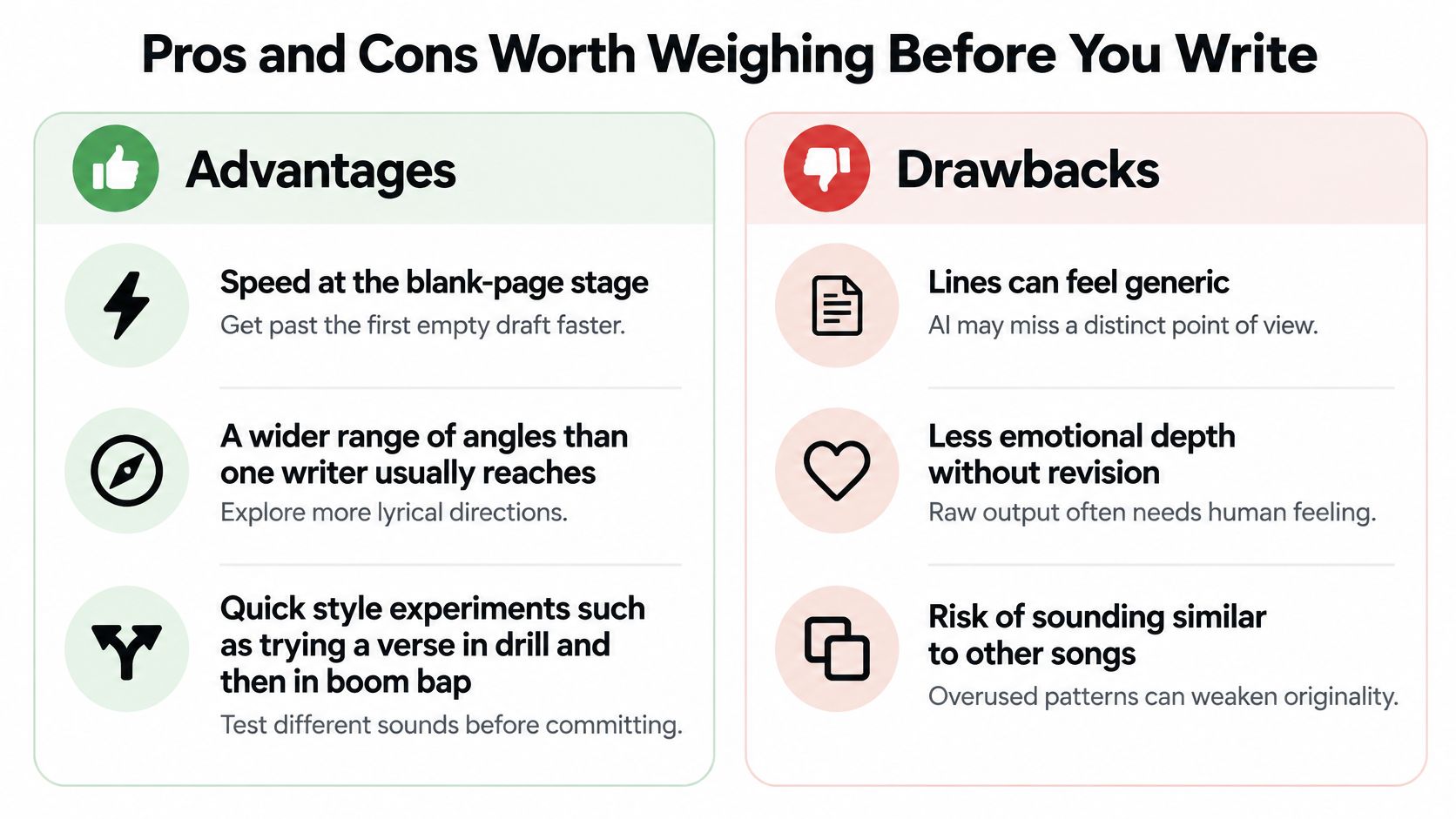 A comparison chart highlighting the advantages and drawbacks of using AI tools for songwriting and creative writing.
Where it genuinely helps
- Speed at the blank-page stage: Ten rough hooks in a minute beats staring at a blinking cursor for an hour.
- A wider range of angles: The tool suggests directions your habits wouldn't reach, including bad ones you can happily reject.
- Quick style experiments: Try the same verse idea in drill, then in boom bap, and hear which clothes fit the story.
- Fast reference drafts: Placeholder verses keep demos and client pitches moving while the lyric gets written properly.
Where it lets you down
- Generic phrasing: "Chasing dreams under neon lights" has been generated for a thousand other writers this week.
- Rhyme chains that fail over distance: Four tidy bars often become sixteen wobbly ones as the scheme breaks down.
- Weak emotional specificity: Without a detailed brief, you get feelings in bulk, none of them yours.
- Dependence on the tool: If every first idea comes from a prompt box, your own starting muscle gets lazy.
- The trust problem: Listeners who suspect a machine wrote the song may stop believing the singer, fairly or not.
Say you're writing a verse about your dad teaching you to drive. The tool can offer rhyme options for "clutch" all day. It can't know he went quiet at the junction where his brother crashed. That silence is the song. Write that part yourself, slowly, and let the machine carry the shopping.
Use AI where speed or variety matters most, such as hooks, drafts, and experiments. Keep the lines that carry your personal story in your own hand.
Before you open any tool, ask one question. Is this the part of the song where I need a range of options, or the part where I need my own truth?
Pick one verse you owe someone, write the one-sentence brief, and run the seven steps on it today with DissTrack AI, which builds structured, editable roast and diss lyrics from your target details, style tags, and tone settings. Generate a handful of candidates, keep the bars only you could have chosen, and rewrite the rest until the verse sounds like you on the second listen.