8 Rap Battle Examples and Techniques to Steal
Most rap battle examples are treated like trophies, but their real value is closer to a toolkit. A classic clash can teach a timed round, a sharp callback, internal rhyme, status contrast, rapid-fire cadence, or a vulnerable melodic attack. Battle rap's history reflects that evolution, from late-1970s East Coast clashes and the 1981 Kool Moe Dee versus Busy Bee battle to a theatrical, internet-driven culture with global circulation, as outlined in this history of battle rap.
The scale is no longer limited to a room or neighborhood. PBS reported that the Ultimate Rap League passed 650 million YouTube views over more than a decade, while Red Bull's Batalla de los Gallos in Peru drew 26,000 attendees and more than 1 million online viewers in a 2018 account from Rolling Stone. That reach makes the best examples useful for performers, video creators, and anyone learning how to make AI hip hop videos.
The eight examples below aren't ranked. Each one pairs a recognizable format with a compact breakdown of the writing mechanics, performance choices, safety limits, and a starter prompt you can adapt in DissTrack AI. Generated lyrics should stay playful, avoid real threats, and never present unsupported accusations as facts.
1. The Rap Olympics and Battle Rap League Format
The league format turns a diss into a designed contest. Two rappers receive a clear matchup, take turns through prepared rounds, and rely on timing, presence, writing, and audience reaction. The famous Kool Moe Dee versus Busy Bee confrontation is often treated as a milestone because it helped move rap from party-centered performance toward lyric-centered competition. Later leagues made that competitive structure more formal.
An example such as Dizaster versus T-Top, Hollow Da Don versus T-Top, or Math Hoffa versus Loaded Lux rewards more than a clever line. Each rapper has to build momentum across a round, establish a central angle, and make individual punches land in a live environment. A line can be technically impressive yet ineffective if the crowd can't hear it, understand it, or remember it.
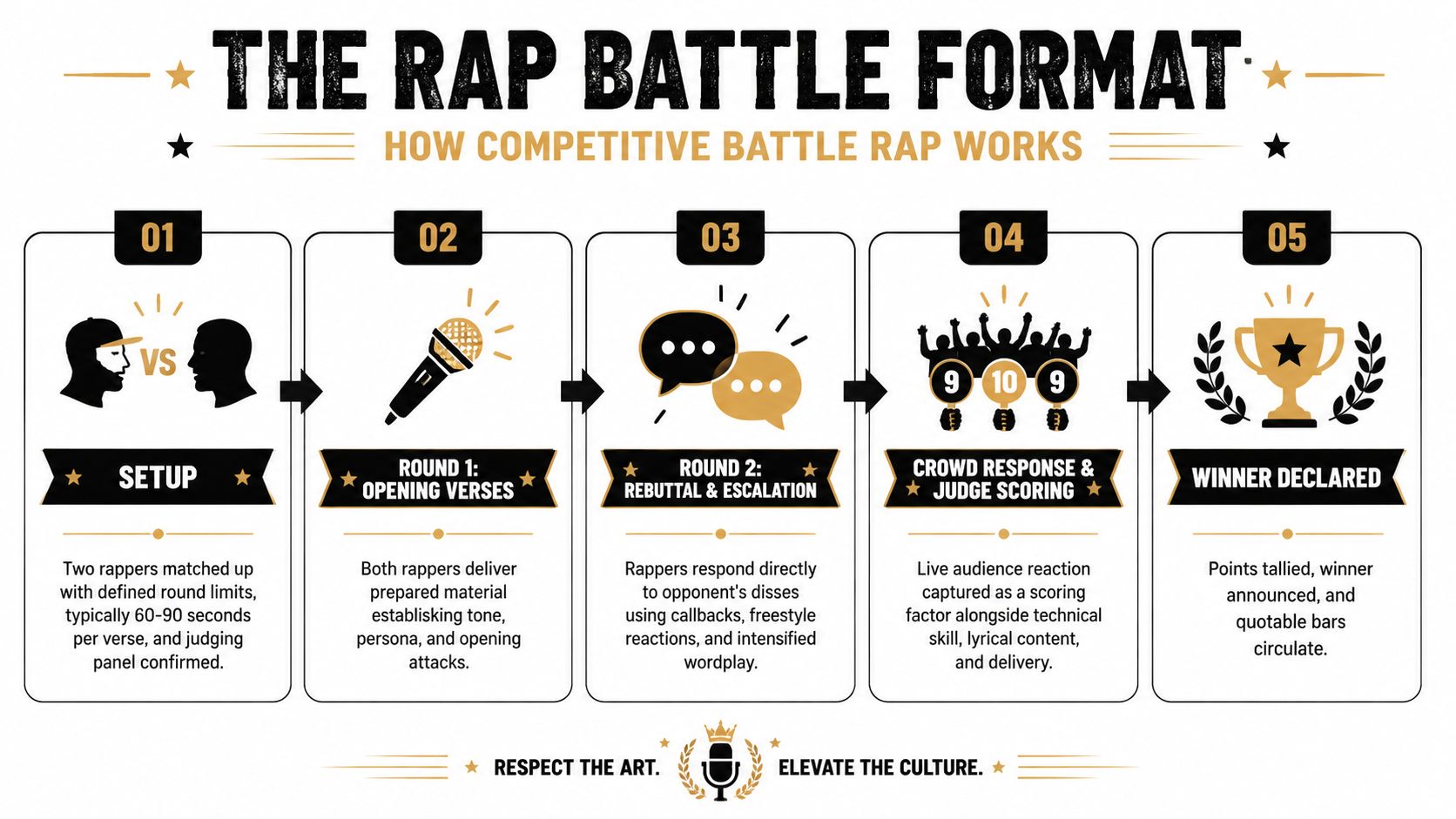 An infographic illustrating the five-step process of a competitive rap battle from setup to winner declaration.
Build a round that moves
Start with a setup, sharpen the premise, deliver the punchline, then leave space for reaction. A callback can make a later round feel connected to an earlier moment, while a layered punchline gives attentive listeners an extra reward.
- Choose one angle: Focus on a habit, contradiction, weak boast, or recognizable behavior.
- Write for the room: Favor clear images and quotable endings over cluttered wording.
- Practice the clock: Rehearse the verse at the intended pace so the final punch doesn't get rushed.
- Leave reaction space: Silence after a punch can carry as much force as the line itself.
BattleRapStats offers a useful way to think about technical judging. Its RETINA framework separates Content, Performance, and It-Factor, while its BARS model combines primary and supplementary values into a maximum rating of 400 points. The framework also accounts for context such as opponent quality, room size, platform, consistency, and whether material was already delivered or “gassed,” making it a practical reminder that writing and delivery can't be separated. You can explore a beginner-friendly approach to structured verses through this battle rap song guide.
Watch the embedded performance for crowd timing, round structure, and the way a rapper resets after a reaction.
DissTrack AI starter prompt: “Write a playful three-round battle verse against a fictional rival who always overstates their talent. Use one clear angle per round, a callback in the final round, crowd-friendly punchlines, confident delivery cues, and no threats or factual accusations.”
2. Personalized multisyllabic internal rhyme schemes
Internal rhyme turns a battle bar into a moving pattern. Matching sounds appear inside the line instead of waiting for its final word, giving the verse bounce, density, and forward motion. Rakim's “I Ain't No Joke,” Nas's detailed writing, Eminem's pattern shifts, and Pusha T's controlled wordplay show several ways to apply the technique.
The goal is clarity with pressure. A fictional line such as “You polish the image, but the minute gets timid” repeats short sounds to create movement, while the contrast exposes the target's weakness. The rhyme is the engine, but the idea is the steering wheel. Without that contrast, a crowded line may sound technical without making a memorable attack.
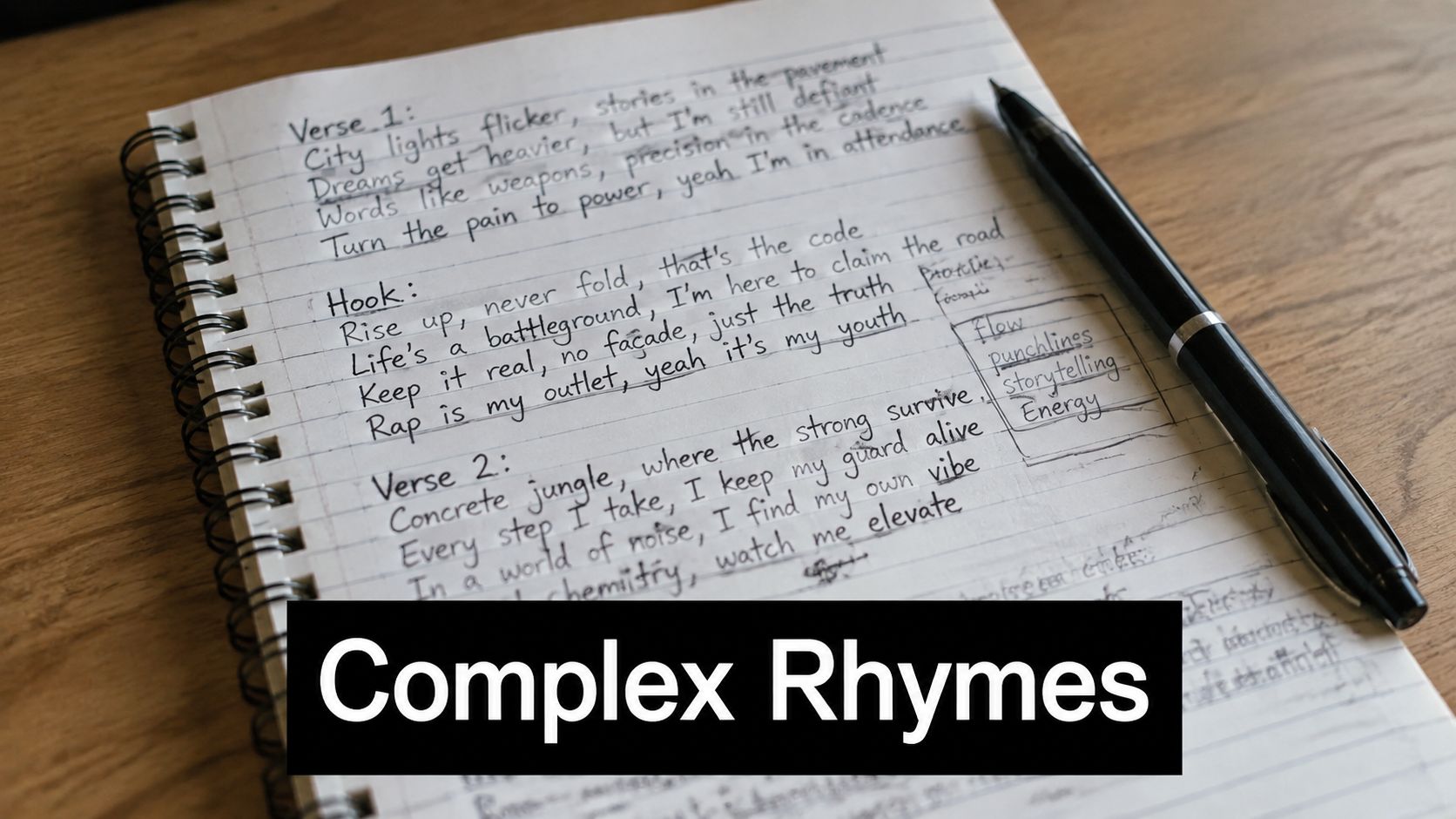 A notepad on a wooden desk featuring handwritten rap lyrics and a black pen, with the overlay text Complex Rhymes.
Make complexity serve the target
Choose the target trait before choosing the rhyme. For fake expertise, gather words connected to rehearsing, repeating, copying, and performing. These sound groups let you approach the same flaw from several angles while keeping the attack focused.
Use this writing sequence:
- Write the plain insult: State the idea without rhyme.
- Find sound families: Build internal matches around the words carrying the main meaning.
- Add a turn: Let the final phrase change how the listener understands the setup.
- Read it aloud: Remove any rhyme that disrupts the cadence or hides the message.
- Repeat one sound later: A restrained callback can make the verse feel planned rather than accidental.
Rakim's influence demonstrates how technical writing can remain conversational. The listener can follow the sentence first, then notice the sound connections underneath. Eminem offers a different lesson. A rapid cluster creates intensity, while a slower, simpler bar before it makes the acceleration feel sharper.
Use this guide to multisyllabic rhymes for extra practice. With DissTrack AI, request several versions, then keep the draft whose internal sounds stay clear at performance speed. A useful prompt is: “Create eight playful battle bars targeting a fictional rival's habit of copying trends. Use moderate multisyllabic internal rhymes, one clean metaphor, one internal-rhyme callback, and plain wording around the densest lines. Avoid threats, private information, and unsupported claims.”
3. The West Coast Attack and Murder Diss Style
The most aggressive diss records often work because the anger has a visible cause. 2Pac's “Hit ’Em Up” is remembered for direct confrontation and emotional force, while later artists such as The Game and Freddie Gibbs have used different forms of pressure, from personal credibility attacks to blunt status challenges. The sound may feel explosive, but the writing still benefits from structure.
This approach usually combines a grievance, a named target, vivid imagery, and a performance that refuses hesitation. Specificity makes the attack feel intentional. In a safe fictional battle, “You switched your whole crew when the spotlight arrived” gives the listener a behavior to judge. “You're fake” gives them almost nothing.
Anger needs control
Aggression becomes more effective when the rapper controls its temperature. Humor can puncture the opponent's image, while a calm sentence before a louder punch can make the outburst hit harder. Layer professional criticism with character-based observations, but keep both grounded in observable behavior or obvious fictional premises.
- State the grievance: Explain why the confrontation exists.
- Use concrete details: Reference a public performance habit or fictional event, not private information.
- Mix pressure and humor: A joke can keep the verse entertaining rather than exhausting.
- Protect the boundary: Don't write real threats, encourage violence, or make defamatory allegations.
- Perform with intention: Anger without clear diction sounds less powerful than controlled emphasis.
The legal and ethical boundary matters especially with this style. Violent imagery is common in rap, but creative framing doesn't remove the risk of a threat being understood in a direct, non-metaphorical way. Keep AI-generated roasts aimed at harmless traits such as lateness, overconfidence, weak fashion choices, or exaggerated self-promotion.
A useful fictional structure is grievance, evidence, reversal. First explain the rival's behavior, then show how it affects their reputation, and finally turn their strongest boast into the punchline.
DissTrack AI starter prompt: “Write an intense but nonviolent West Coast-inspired roast against a fictional rival who abandoned their friends for attention. Use a clear grievance, two concrete fictional details, one humorous reversal, and forceful delivery. No threats, weapons, doxxing, or allegations about real people.”
4. The East Coast Lyrical Superiority and Boom Bap Standard
Boom bap battle writing treats the verse like an argument built from polished parts. Nas's “Ether,” Jay-Z's “Takeover,” Big L's “Ebonics,” Biggie's “Who Shot Ya,” and Mobb Deep's “Drop a Gem on ’Em” are often discussed for their combinations of precision, wit, rhythm, and layered references. The style doesn't need a busy production bed because the words carry the contest.
A strong example makes the opponent look smaller through comparison rather than volume. The rapper might contrast careful preparation with sloppy improvisation, real knowledge with borrowed phrases, or consistent work with occasional attention. That contrast creates a logical spine, so each punch supports the same overall case.
Write the argument before the bars
List the opponent's claim, the contradiction, the evidence available within the fictional scenario, and the conclusion you want the audience to reach. Then turn each step into a bar. This keeps cultural references and metaphors connected to the attack instead of using them as decoration.
A reference works best when it has two jobs. It can demonstrate the writer's range while also clarifying the opponent's weakness. A sports comparison might frame the rival as someone who celebrates warmups but disappears during the game. A literary reference might portray their confidence as a dramatic speech without a convincing ending.
Practical rule: If the listener needs a glossary to understand the insult, add a simpler line immediately after it.
Use pattern changes to mark important turns. A steady couplet can establish the case, internal rhymes can raise the technical pressure, and a short final bar can deliver the verdict. Respecting the opponent's skill can also make the attack more credible. Admitting one strength before exposing a larger weakness creates dimension and avoids a flat stream of insults.
DissTrack AI starter prompt: “Write a boom bap battle verse against a fictional rival who mistakes obscure references for actual skill. Build a logical argument, use two accessible metaphors, include internal rhymes, shift cadence before the final punchline, and keep the tone witty rather than threatening.”
5. Trap Rap Flexing and Status Attack
Trap-style disses often turn competition into a comparison of momentum. Instead of spending every bar on the opponent's personality, the rapper presents their own lifestyle, influence, consistency, or cultural relevance as proof of superiority. Gucci Mane, Future, Megan Thee Stallion, Cardi B, Lil Baby, and Young Thug show how flexing can become a form of attack when the contrast is clear.
The basic mechanism is simple. Establish a desirable position, describe the opponent as someone chasing it, then make the gap memorable. A fictional example could frame the rapper as the person setting the dress code while the rival arrives asking what everyone is wearing. The insult comes from the status difference, not from a personal threat.
Turn a boast into a punchline
A flex needs detail. “I'm winning” is too broad, but “You call it a comeback every time you post a new excuse” gives the boast a target. You can also use contrast pairs such as original and copied, booked and begging, current and nostalgic, or leader and follower.
- Lead with a visible strength: Use fictional wins, creative output, style, or reliability.
- Keep bars compact: Trap delivery benefits from lines listeners can repeat.
- Use comparison: Put your action beside the rival's hesitation.
- Add humor: A playful exaggeration makes the flex entertaining.
- Match the beat: Leave space for ad-libs and let the key word land clearly.
Status attacks can become misleading if they present invented achievements about a real person. Keep the opponent fictional, or use details the user supplies as creative premises rather than asserting them as facts. A prompt can also request “clearly exaggerated bragging” so the verse reads as performance instead of reportage.
The strongest trap flexes don't list possessions endlessly. They establish a persona, then show the opponent failing to inhabit it. That gives the verse a story, even when each bar is short.
DissTrack AI starter prompt: “Write a catchy trap roast against a fictional rival who copies every trend after it becomes popular. Use short quotable bars, confident status comparisons, playful exaggeration, ad-lib spaces, and a hook that contrasts trendsetter with follower. Keep it nonviolent.”
6. UK Grime Rapid Fire and Skepta Aggression
Grime clash writing depends on vocal command. Skepta, Wiley, and Dizzee Rascal demonstrate how a sparse riddim can put every syllable under pressure. The style favors rapid-fire delivery, sharp crowd interaction, local identity, catchphrases, and an MC presence that feels immediate rather than overproduced.
The technical challenge isn't speed by itself. A fast verse still needs accents, pauses, and changes in attack. If every bar arrives at the same intensity, the listener loses the shape of the performance. A rapper can deliver several clipped lines, pause before the final word, then use a call-and-response phrase to give the crowd an obvious entry point.
Let cadence create the confrontation
Write the verse in short bursts. Mark where you'll breathe, where an ad-lib can answer the main line, and where the crowd should react. UK slang and local references should sound natural, not pasted into an American battle template. Research usage, understand the context, and avoid borrowing identity markers you can't deliver authentically.
- Use compact setups: Short phrases make speed easier to control.
- Vary the gaps: Silence creates emphasis and gives the audience a reset.
- Build a chant: Repeat a clean catchphrase that can return after major punches.
- Keep the riddim lean: A sparse beat leaves room for diction and attack.
- Practice consonants: Fast delivery fails when the words blur together.
A grime-inspired fictional battle might target an opponent who talks over everyone but says very little. The opening bars can imitate their constant interruption, the middle can accelerate into a list of empty boasts, and the final line can stop suddenly to expose the silence underneath.
The best prompt should specify performance mechanics, not only a regional label. Ask for clipped phrasing, breath marks, crowd cues, and natural vernacular. That produces a more useful draft than requesting “aggressive grime” without explaining what the voice should do.
DissTrack AI starter prompt: “Write a UK grime-inspired clash against a fictional MC who interrupts constantly and never finishes a thought. Use clipped rapid-fire bars, natural UK phrasing without forced slang, breath marks, one crowd chant, a sudden pause before the final punchline, and no threats.”
7. Drill Rap Existential Threat and Street Narrative
Drill often creates tension through minimal production, dark atmosphere, geographic identity, and a matter-of-fact vocal tone. Chief Keef, Pop Smoke, Brooklyn drill artists such as Sheff G and Sleepy Hallow, and UK drill adaptations show how the style can make a narrative feel close and immediate. That immediacy is also why this format requires the most care.
The writing mechanism is environmental pressure. A location, crew identity, or local rivalry gives the verse a world, while the restrained delivery makes the danger sound routine. For a safe fictional version, replace real territories and real rivals with invented neighborhoods, imaginary teams, or harmless competition. The mood can remain dark without directing violence at anyone.
Keep the narrative fictional and responsible
A drill-inspired roast can target a rival who claims to run a fictional district but can't organize a group project. Use cold observation, repeated phrases, and sparse imagery to create tension, then break the seriousness with a nonviolent reveal. That contrast preserves the style's atmosphere while preventing the lyrics from functioning as a real threat.
- Invent the setting: Create fictional blocks, crews, or tournament names.
- Use observable behavior: Target missed deadlines, loud entrances, or unreliable plans.
- Keep the delivery flat: Understatement can feel more intimidating than shouting.
- Avoid actionable language: Don't include real locations, weapons, instructions, or calls for harm.
- Let the beat breathe: Minimal production gives narrative details room to register.
The difference between dramatic menace and a prosecutable threat isn't a small technicality. A generated lyric shouldn't identify a real person and promise harm, imply knowledge of their whereabouts, or encourage an audience to act. If the target is real, keep the roast focused on public creative choices and obvious humor.
For a controlled starting point, this drill rap lyrics generator guide can help you specify mood and structure while keeping the scenario fictional.
DissTrack AI starter prompt: “Write a dark, minimalist drill-inspired roast set in a fictional city. Target an imaginary crew leader who makes big promises but misses every deadline. Use matter-of-fact delivery, repeated location-free imagery, a tense hook, and a humorous nonviolent payoff. Do not mention real people, neighborhoods, weapons, or threats.”
8. Emo Rap and the Vulnerable Diss
A vulnerable diss attacks through exposure rather than invulnerability. Machine Gun Kelly's “Rap Devil” combines confrontation with personal hurt, while the melodic approaches associated with Juice WRLD, Trippie Redd, Lil Peep, Lil Uzi Vert, and The Kid LAROI show how emotional tension can carry a hook. The rapper admits the wound, identifies the betrayal, and then turns that admission into pressure.
This format works because the conflict has two layers. The surface attack might criticize a broken promise or public disrespect, while the deeper layer reveals how that behavior changed the relationship. A melodic hook can make the emotional idea memorable, but the verse still needs a specific incident or contradiction.
Make vulnerability precise
Avoid turning sadness into a vague cloud of pain. Name the fictional moment, explain the expectation, and show the consequence. A line about a friend who disappeared after success becomes stronger when the verse contrasts old promises with current behavior.
- Choose one wound: Focus on betrayal, abandonment, imitation, or broken trust.
- Write the hook first: Find the emotional sentence people can remember.
- Use melodic contrast: Let the hook open emotionally, then sharpen the verse.
- Include criticism: Vulnerability should reveal the opponent's behavior, not only the speaker's feelings.
- Keep mental-health language careful: Don't diagnose a target or turn therapy terms into insults.
A useful arrangement begins with a restrained verse, rises into a sung hook, then returns with a more direct second verse. The final callback can repeat an earlier promise and show how empty it became. This gives the song a narrative arc rather than a collection of sad lines.
Short-form video creators can also adapt the style by choosing one emotional reveal as the clip's center. The reveal needs context, though. Without the setup, the audience may hear only melodrama instead of a confrontation with a clear target.
DissTrack AI starter prompt: “Write an emo rap battle song against a fictional friend who abandoned the group after gaining attention. Use a vulnerable melodic hook, two specific fictional memories, a direct but nonviolent second verse, and a final callback that reframes the friend's original promise. Avoid diagnosis and unsupported claims.”
8-Style Rap Battle Comparison
八種格式各自訓練不同能力。聯賽格式像多回合比賽,要求掌握節奏與觀眾反應。多音節內韻像把鼓點藏進句子,提升聲音密度。西岸攻擊重視情緒衝擊,東岸 boom bap 重視論證與文字層次。Trap 把地位變成短促對比,Grime 讓速度與停頓成為攻擊,Drill 以克制敘事製造壓力,Emo rap 則把脆弱寫成正面對質。
| Style | Implementation Complexity 🔄 | Resource Requirements ⚡ | Expected Outcomes 📊 | Ideal Use Cases 💡 | Key Advantages ⭐ | Main Risks/Limitations |
|---|---|---|---|---|---|---|
| The Rap Olympics & Battle Rap League Format | High, live timing, multi-round logistics | High, venue, sound, judges, rehearsals ⚡ | 📊 Strong crowd engagement; clear winners; competitive spectacle | Live tournaments, formal battles, showcase events | ⭐ Structured format; quotable punchlines; narrative escalation | Judge bias; needs stage skill; regional style bias |
| Personalized Multi‑Syllabic Internal Rhyme Schemes | Very High, advanced lyrical engineering 🔄 | Low physical resources; high practice/time investment ⚡ | 📊 High technical respect; replay value; critical acclaim ⭐⭐⭐ | Proving technical superiority in battles or studio cuts | ⭐ Demonstrates mastery; layered meanings; memorable lines | Can reduce clarity; appeals to experienced listeners only |
| The West Coast Attack / Murder Diss Style | Medium, aggressive writing and delivery | Low production; high authenticity and street credibility ⚡ | 📊 Immediate visceral impact; media attention | Street cred displays, high‑intensity feuds, controversy-driven promos | ⭐ Raw emotional intensity; memorable feuds | Legal risk (defamation/threats); can escalate conflict |
| East Coast Lyrical Superiority / Boom‑Bap Standard | Very High, complex schemes and controlled delivery 🔄 | Medium, sample/beat production and skilled engineering ⚡ | 📊 High critical/long-term respect; quotable, enduring lines ⭐⭐⭐ | Battles for lyrical dominance, critic‑focused releases | ⭐ Technical proof of superiority; intellectual wordplay | Requires savvy audience; can be perceived as pretentious |
| Trap Rap Flexing & Status Attack | Low, short, punchy bars; simpler structure | Medium‑High, polished production, visuals, promo ⚡ | 📊 High shareability and mainstream reach; viral clips | Social media/disposable hits, mainstream radio/club tracks | ⭐ Accessible; highly shareable; production masks flaws | Shallow content; credibility depends on real status |
| UK Grime Rapid‑Fire & Skepta Aggression | High, speed, cadence, cultural fluency 🔄 | Low production; high rehearsal and local scene support ⚡ | 📊 High live energy and crowd reaction; distinct cultural impact | Live clashes, underground events, UK/urban audiences | ⭐ Unique voice; intense entertainment value | Heavy regional slang limits global reach; speed harms clarity |
| Drill Rap Existential Threat & Street Narrative | Medium, tone control and narrative brevity | Low, minimalist production; authenticity required ⚡ | 📊 Strong street credibility and perceived stakes | Territorial/crew rivalries, gritty street narratives | ⭐ Distinct sonic identity; narrative immediacy | High legal/ethical risk; may provoke real‑world violence |
| Emo Rap & Vulnerable Diss | Medium, blends melody with confrontational lyrics 🔄 | Medium, melodic production and vocal work ⚡ | 📊 High emotional resonance and viral potential; cross‑audience appeal | Gen‑Z engagement, social media, genre‑blending collaborations | ⭐ Relatable authenticity; strong streaming/viral fit | Can seem performative; dismissed by purists; trends age quickly |
選擇格式時,先配對目的與寫法。想做現場對戰,可用清楚的鋪陳、回合升級與可複誦 punchline。想展示技術,加入多音節內韻和多層雙關,但保留關鍵意思,避免聲音太密而失去清晰度。短片適合 Trap 的地位對比或 Grime 的可跟唱節奏,情緒衝突則較適合 Emo rap。
安全也屬於格式設計。西岸 murder diss 與 Drill 的威脅語氣,應改寫成虛構對手、舞台競爭或明顯誇張的比喻,不要指向真實暴力、犯罪或未經證實的指控。把批評集中在作品、行為或公開形象,能保留張力,也降低誹謗、威脅與現實衝突風險。
DissTrack AI starter prompt: “Write a fictional rap battle using a league format, internal multisyllabic rhymes, a Trap-style status contrast, and a Grime-inspired rapid cadence. Use a fictional opponent, clear setups, nonviolent punchlines, and a final callback. Avoid threats, defamation, real crews, and unsupported claims.”
用這個比較表挑一種主格式,再借用另一種格式的單一技巧,成品會更集中,也更容易控制表演效果。需要快速測試不同方向時,可在 DissTrack AI 中保留相同對手設定,只替換節奏、押韻密度或情緒角度。
Turn the Technique Into Your Own Battle Verse
The strongest rap battle examples aren't useful because they belong to famous artists. They're useful because they expose a mechanism you can rebuild. A league battle teaches round control and crowd timing. Internal rhyme teaches sound density. West Coast aggression teaches emotional focus, while boom bap writing teaches logical angles and layered references. Trap flexing turns status into contrast, grime makes cadence part of the attack, drill builds atmosphere through narrative restraint, and emo rap turns vulnerability into confrontation.
Start by choosing the format that matches the feeling you want. If the goal is a party roast, use the league structure with clear setups and quotable endings. If you want technical satisfaction, choose an internal-rhyme or boom bap approach. For a short social clip, trap's compact flexes or grime's chant-ready cadence may work better. An emotional disagreement belongs closer to the vulnerable diss format than to a threat-heavy style.
Then narrow the target. Pick one precise trait, such as chronic lateness, trend-chasing, overconfidence, weak preparation, or a habit of taking credit. Avoid attacking everything at once. A focused angle gives the audience something to follow and lets you build callbacks instead of jumping between unrelated insults.
Choose a cadence before you polish every line. Mark pauses, stressed words, breath points, and places where a hook or crowd response could enter. Read the verse aloud. If an internal rhyme sounds impressive on the page but makes the punchline hard to understand, simplify it. Technical skill only matters when the audience can hear the idea.
Build the central punchline around a reversal. Let the setup make one expectation, then turn the final phrase in another direction. After that, add one callback or repeated sound pattern. The callback can refer to the opening image, a fictional boast, or a phrase from the hook. It should feel like design, not repetition for its own sake.
DissTrack AI can provide a starting point for this process. At DissTrack AI, users can enter a target, relationship, and inside joke, then select style tags such as Battle Rap, West Coast, Old School Boom Bap, Trap, Drill, Emo Rap, or UK Grime. Treat the output as a draft. Edit its wording, replace generic lines with your own observations, adjust the cadence to your voice, and remove anything that sounds like a factual allegation.
Safety belongs in revision, not as an afterthought. Keep fictional scenarios clearly fictional, avoid real threats, never include doxxing or private information, and don't present invented claims about real people as truth. A sharp roast can be funny without becoming dangerous. The best battle verse wins attention through craft, timing, and a memorable idea.
Use the eight formats as a menu rather than a rulebook. Borrow the round structure from league battles, the sound design of multisyllabic rhyme, the confidence of a flex, the atmosphere of grime or drill, and the honesty of emo rap. Then combine only the elements that support your target and performance. Your original voice should remain louder than the reference.
DissTrack AI offers style-tagged battle and diss-track drafts with customizable targets, relationships, inside jokes, tones, and multiple lyrical variations. Visit DissTrack AI to turn one of these rap battle examples into a playful verse you can edit, perform, export, or share safely.