Wordplay in Rap: Techniques, Examples, and Writing Tips
Many assume great rap wordplay comes from piling on complicated rhymes. The evidence points to a sharper truth: rhyme density is measurable, but density alone doesn't explain why a bar lands. Modern lyric analysis found rhyme density rising from 1.73 rhymes per line in the 1980s to 2.32 in the 2020s, a 34.2% increase across the study period, while broader research found that rap lyrics have also become simpler and more repetitive in vocabulary richness, readability, complexity, and repeated lines (modern rhyme-density analysis, Scientific Reports study). The lesson for a hungry MC is simple: wordplay in rap isn't just about rhyming more. It's about making sound, meaning, timing, and surprise work together.
A clean double meaning can beat a tangled scheme. A plain word can become dangerous when the setup makes listeners hear it twice. If you learn to measure your rhyme work while still protecting clarity, you can write bars that sound technical without sounding mechanical.
Why Wordplay Defines Great Rap
Wordplay separates a rapper who gets a reaction from one who gets studied. A crowd may remember a chant for a moment, but a precise line can keep revealing new angles after the beat ends. That shift became especially visible in the documented modern turning point of battle rap, when Kool Moe Dee challenged Busy Bee Starski in December 1981. Accounts of the battle describe a change from crowd-pleasing ad-libs toward commentary, storytelling, and sharper lyrical combat (history of battle rap).
 A vintage silver microphone stands on stage in front of blurry drums and an electric guitar.
The important point isn't that one battle magically invented lyricism. MCs had already used rhyme and personality. The battle showed performers and audiences that specific verbal attack could control a room differently from generic boasting. A rapper could identify an opponent's weakness, frame it through rhythm, and make the audience understand the insult before the next line arrived.
That pressure changed the craft. Once an MC could win attention through personalized angles, other MCs had to develop stronger setups, sharper rhyme patterns, and more memorable payoffs. Rhyme stopped functioning only as decoration. It became a delivery system for argument, character, humor, threat, and status.
Why technical skill still matters
The tradition that followed made layered rhyme schemes and internal patterns central to respect. Rappers such as Rakim, Kool G Rap, and Big Daddy Kane helped establish a performance standard where a line could carry several kinds of motion at once. The rhyme might sit at the end of the bar, echo inside it, and reinforce the image or accusation being delivered.
Academic analysis supports the idea that these patterns aren't merely subjective impressions. Research on rap lyrics found that rhyme complexity increased across the first 25 years of rap's existence, and an automated Rhyme Analyzer identified the creator of a query song from a group of 25 performers with over 50% accuracy. The same analysis distinguished old-school from new-school rap and detected ghost-written songs, suggesting that rhyme patterning can act as a measurable marker of authorship and style (academic analysis of rap lyrics).
Coach's rule: If the listener can feel the technique before they can explain it, the technique is doing its job.
Great wordplay doesn't require every bar to be a puzzle. It requires control. You choose when to make the audience laugh, when to make them rewind, and when to let one direct sentence hit with no camouflage. That balance is why lyrical craft survives changes in production, melody, regional slang, and delivery.
The Core Mechanics Behind Lyrical Wordplay
Wordplay is the deliberate use of language to create more than one effect at once. A word can carry two meanings, a sound can point toward several words, or a bar can place the reveal exactly where the listener expected something else. Think of it as a toolkit, not a single device.
The easiest way to understand the toolkit is through three kinds of manipulation.
Sound manipulation
Phonetic wordplay focuses on what words sound like. Homophones, assonance, consonance, internal rhyme, multisyllabic rhyme, and near-rhyme all belong here. A jazz musician bends a note without losing the underlying melody. An MC bends pronunciation and repetition without losing the pocket.
Take a simple sound family such as “plane,” “plain,” and “plan.” Those words don't mean the same thing, but they can sit in the same sonic neighborhood. A strong writer uses that neighborhood to move from an image to an argument:
“I made a plain plan, now the whole route's airborne.”
The line isn't a finished punchline, but it demonstrates the mechanism. The repeated vowel and ending sound create cohesion, while the shift from “plain” to “plane” gives the listener a possible meaning turn.
If you want to build longer sound chains, practice with this guide to multisyllabic rhymes. Don't chase matching syllables blindly. Mark the stressed sounds first, then decide whether the added rhyme strengthens the idea or merely fills space.
Meaning shift
Semantic wordplay changes what a word appears to mean. Double entendres, metaphors, similes, irony, and puns all depend on a listener accepting one reading before you reveal another.
A comedian uses misdirection by guiding the audience toward a predictable interpretation, then turning the sentence at the last moment. Rap does the same thing, but rhythm gives the turn a precise landing point. “I keep my word” could mean keeping a promise, protecting a lyric, or holding a written word in place. The surrounding bars decide which meaning becomes dominant.
Structural manipulation
Structural wordplay concerns where information appears. A setup can hide the subject until the last phrase. An internal rhyme can make a line feel faster without changing its tempo. A repeated phrase can gain a new meaning each time it returns.
An architect places load-bearing joints where a structure needs support. A lyricist places a key noun, rhyme, or pause where the bar needs impact. Study your line visually, then perform it aloud. If the best word arrives too early, the listener has time to predict it. If it arrives too late, the idea may collapse under the next downbeat.
These three pillars overlap. The strongest bars often manipulate sound, meaning, and expectation simultaneously. That overlap makes wordplay learnable: you can isolate one mechanism, drill it, and then combine it with the others.
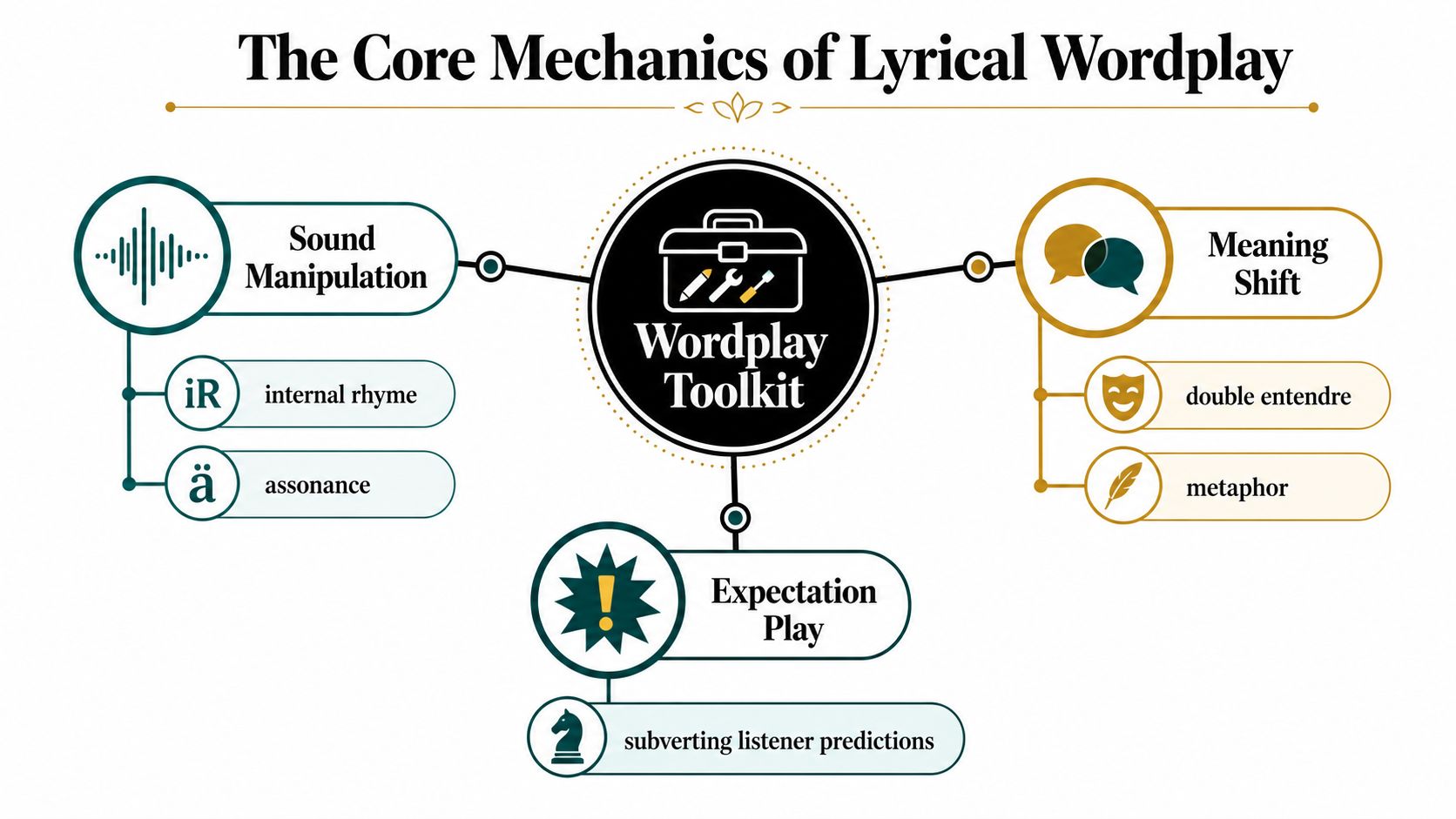 A diagram titled The Core Mechanics of Lyrical Wordplay showing sound manipulation, meaning shift, and expectation play.
Essential Wordplay Devices Every MC Should Know
Elite verses rarely rely on one device. They stack tools, then hide the construction inside natural speech. Start by learning what each device does before trying to combine all of them.
Double entendre
A double entendre gives one phrase two plausible meanings. Jay-Z's famous line, “I'm not a businessman, I'm a business, man,” works because the grammar changes the listener's frame. “Businessman” describes a person, while “business, man” turns the rapper himself into the enterprise.
The line is short, clear, and emotionally useful. It flexes status without explaining the joke. The pause does structural work, and the second reading arrives quickly enough for a crowd to catch it.
Homophones
Homophones sound alike while carrying different meanings. A writer might move between “sole” and “soul,” or “right” and “write,” then use the collision to connect a physical image with an emotional or intellectual one. MF DOOM often built dense chains from sound-alike language and character-driven references, making the listener sort through multiple meanings while the flow keeps moving.
The danger is confusion. If the surrounding context doesn't signal both meanings, the homophone may sound accidental.
Punchlines
A punchline is the payoff that changes the emotional temperature of the setup. It can be funny, hostile, revealing, or boastful. The setup creates a prediction, then the final phrase breaks it.
A useful test is to remove the last phrase. If the preceding material still says exactly the same thing, the setup probably hasn't created enough tension. For more examples and construction ideas, study this breakdown of rap punchlines and metaphors.
Metaphor
A metaphor declares or implies that one thing is another. “My pen is a locksmith” turns writing into access, control, and problem-solving. The image works when the comparison produces several useful associations, not when it merely sounds dramatic.
Simile
A simile uses an explicit comparison, usually with “like” or “as.” It can make a complex image immediate. “I move like a closing argument” tells the listener to hear the rapper as deliberate, final, and difficult to answer. Similes often help newer writers because the comparison stays visible, but the image still needs specificity.
Scheme
A scheme extends a sound or meaning pattern across multiple bars. Instead of rhyming one pair of words, you create a family of related sounds, images, or concepts. A scheme might begin with a courtroom metaphor, move through “case,” “appeal,” and “sentence,” then end with a verdict. The listener enjoys both the recurring sound and the developing idea.
Rhyme-stack density
Rhyme-stack density measures how many connected rhyme points you place into a line or passage. Internal rhymes, multisyllabic rhymes, and end rhymes can create a dense rhythmic surface. Modern analysis tracks features such as internal rhymes per line, rhyme length in syllables, rhyme density, and the share of perfect versus imperfect rhymes (battle rap and rhyme analysis overview).
The craft question is not “How many rhymes can I fit?” It's “Which rhymes help the listener follow the thought?”
| Wordplay Device | Primary Function | Setup Length (Bars) | Difficulty (1-5) |
|---|---|---|---|
| Double entendre | Flex, humor, misdirection | 1-2 | 3 |
| Homophone | Meaning connection | 1-3 | 3 |
| Punchline | Aggression, humor, impact | 2-4 | 4 |
| Metaphor | Storytelling, flex | 1-4 | 3 |
| Simile | Clarity, imagery | 1-2 | 2 |
| Scheme | Storytelling, technical flex | 4+ | 5 |
| Rhyme-stack density | Rhythm, technical flex | 2-8 | 4 |
Use the matrix as a training map, not a ranking of artistic value. A simple simile delivered perfectly can outperform a difficult scheme with weak subject matter. Device fluency matters more than device quantity.
How Wordplay Shifts Across Subgenres and Regions
Wordplay follows the beat, delivery, slang, and audience. A boom bap verse may give internal rhyme and an extended metaphor enough space to develop. Trap can make repetition, vocal texture, and a melodic double meaning carry the hook. Drill often compresses phrasing and relies on coded references, allowing menace to sit inside what the rapper leaves unexplained.
These patterns overlap. Artists cross styles, and regional scenes borrow from one another. Still, analysts can measure differences in rhyme practice. Midwest artists were reported at 3.04 rhymes per line in 2015–2020, compared with 2.83 on the East Coast and 2.12 in the South (regional rhyme-density analysis). The figures do not rank regions. They give writers a way to compare their own technical choices with a documented regional pattern.
Different priorities on different beats
| Subgenre / Region | Dominant Wordplay Devices | Avg. Rhyme Density (rhymes per 4 bars) | Stylistic Priority |
|---|---|---|---|
| Midwest | Internal rhyme, multisyllabic schemes | Not reported in the cited data | Technical density and layered phrasing |
| East Coast | Internal rhyme, metaphor, punchlines | Not reported in the cited data | Commentary and lyrical detail |
| Southern trap | Repetition, ad-lib interplay, melodic double meaning | Not reported in the cited data | Groove, memorability, and vocal feel |
| Drill | Compression, coded reference, restrained punchline | Not reported in the cited data | Menace, immediacy, and atmosphere |
| Multilingual rap | Puns, compound forms, code-switching | Not reported in the cited data | Local identity and language interplay |
The table does not pretend that the available evidence supplies a universal “rhymes per four bars” benchmark. The verified regional figures use rhymes per line, while the subgenre descriptions remain qualitative.
Use the numbers as a writing diagnostic. Count internal, multisyllabic, and end-rhyme points in a passage, then compare that density with the space your beat leaves for meaning. A sparse boom bap beat may support a four-bar metaphor with several connected images. A crowded trap arrangement can make the same density blur the hook. In drill, a local reference may hit harder than an elaborate explanation because the audience already shares the code.
Language creates new mechanics
Multilingual rap expands wordplay beyond English puns. A bilingual writer can rhyme a phrase in one language, then redirect its meaning in another. Code-switching may mark identity, conceal a threat, or make a reference clear to one audience while keeping it opaque to another. Research resources and academic discussion identify puns, compound forms, and code-switching in Vietnamese and Italian rap as important, understudied features (Rap Almanac research resource).
Slang carries the same technical risk. Learn a regional insult or term's social meaning and pronunciation before building a punchline around it. a guide that helps you understand opp in slang can help distinguish literal vocabulary from context-dependent usage. Then test the bar with listeners from that scene, and record whether the reference improves clarity, surprise, or rhyme density.
Writing Exercises to Sharpen Your Punchlines
Wordplay improves when you separate idea generation, drafting, and performance testing. Don't wait for inspiration to supply all three. Give each stage a constraint and a clock.
Start with the Object Flip
Choose a physical object near you, such as a key, mug, charger, or mirror. Write ten short bars that use the object as a metaphor for something unrelated. A key can become access, evidence, a musical key, or a solution. The point isn't to produce ten finished punchlines. It's to force your mind past the first obvious association.
Give yourself a short timed sprint, then circle the two images that create the largest meaning shift. Rewrite those images without the object named directly. If the listener can still recognize the object through the surrounding details, your metaphor has gained strength.
Build a Homophone Ladder
Pick one sound family and list every useful meaning you can find. For “sole,” you might explore a shoe sole, being alone, and the soul. Draft consecutive lines so each line advances the same sound while changing the subject.
Read the ladder aloud. Score each line from one to five for clarity, surprise, and connection to the central idea. A clever homophone that has no emotional or narrative purpose should be cut, even if the sound is impressive.
Apply Constraint Bars
Give yourself a rule that makes your normal habits unavailable. Try using only short words, placing a brand name in every line, avoiding end rhymes, or keeping one repeated phrase while changing its meaning. Constraints expose lazy choices and create unusual routes into a subject.
After the draft, underline every word included only to satisfy the rule. Replace as many as possible with language that sounds natural in your voice. The constraint starts the exercise, but the final version should feel intentional rather than imprisoned by the rule.
Reverse the setup and payoff
Write the punchline first. Make it a complete thought with a clear emotional effect. Then work backward and create a setup that makes the audience expect a different ending.
Test the line in three forms:
- On paper: Can a reader identify the intended turn?
- At tempo: Can you deliver the setup without rushing the final phrase?
- Without the beat: Does the punchline still have its own rhythm?
This reverse method teaches economy. You stop padding the setup with rhyme and start selecting only the details that increase the payoff.
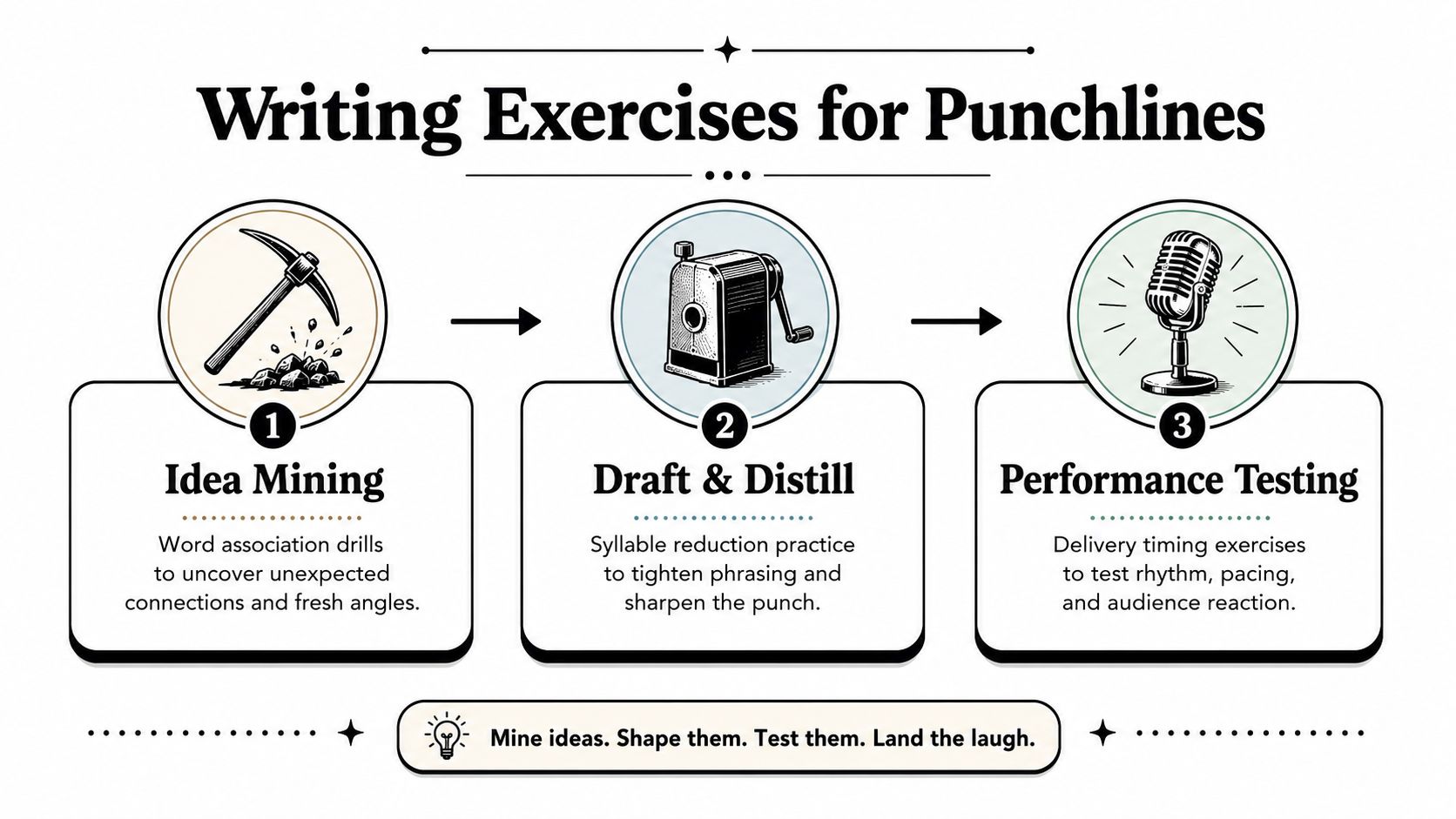 A three-step guide to writing punchlines featuring icons for idea mining, drafting, and performance testing.
Performance exposes problems that silent reading hides. Record a take on your phone, mark where you run out of breath, and note whether the intended word receives enough stress. You can also use a practical guide on how to write punchlines while building your own drill routine.
Keep a training log with the date, exercise, strongest line, weakest line, and one revision target. Your useful measure isn't how many bars you wrote. It's whether your revisions make the meaning clearer, the sound tighter, or the payoff more surprising.
Common Wordplay Mistakes and How to Avoid Them
複雜不等於有力。 四層雙關若現場無法被聽懂,效果未必勝過一次清楚的轉折。研究分析 353,320 首歌曲,指出饒舌特別重視詞彙特徵與押韻,同時也發現五十年間歌詞的簡化與重複增加(Scientific Reports analysis)。寫作者要在密度與可理解性之間校準:副歌或現場段落需要讓聽眾跟得上,地下 battle、英國 grime、台灣饒舌等場景則可依語速與語言聲韻,設定不同的內韻密度基準。
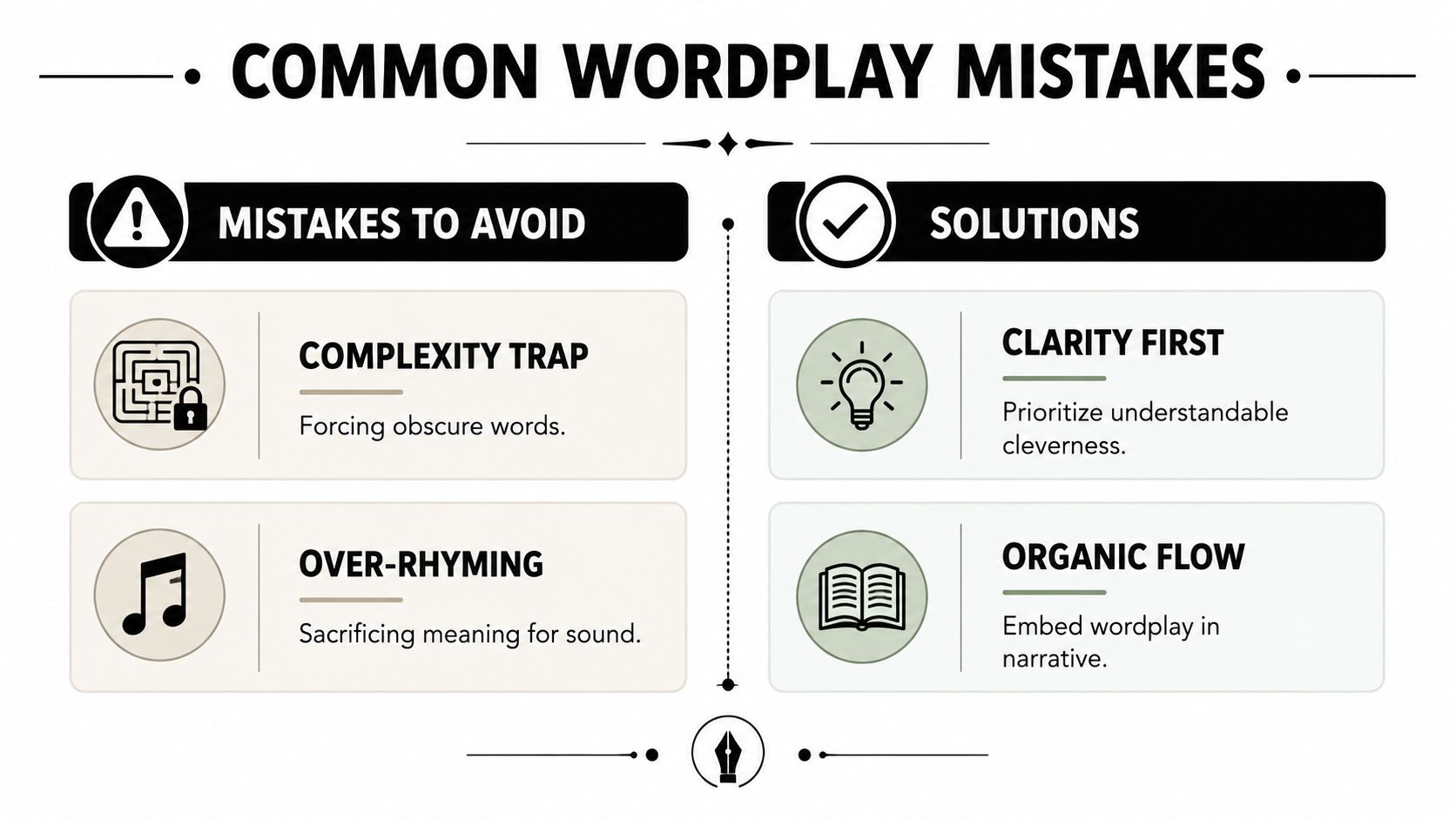 An infographic titled Common Wordplay Mistakes contrasting pitfalls like complexity and over-rhyming with solutions like clarity.
複雜化陷阱
弱句:「Your abstract, labyrinthine character collapses beneath categorical verbal architecture.」
較佳:「Your big words need a map, mine make the route disappear.」
後者保留抽象攻擊,卻換成可視化的路線意象,也讓對比更快被接收。記錄每四行的押韻音節,再比較不同子類型或地區場景的作品,能看出你是在增加有效密度,還是在堆詞。
強行押韻
弱句:「I enter the center with wintery splendor, surrender the tender agenda.」
較佳:「I enter the center, then leave with the answer.」
前句像押韻搜尋留下的痕跡,後句讓意思帶動聲音。若尾韻增加,卻使句意或節奏變模糊,就應刪掉裝飾。
忽略語境
嚴肅敘事突然插入玩笑,會削弱情緒。保留 clever bar 前,檢查 beat、敘事者、場景與語言習慣是否支持它。AI 歌詞工具能快速生成組合,卻不能替你判斷個人經歷、歌曲脈絡與現場表現。作者仍要決定哪一句值得留下。
Your Pre-Recording Wordplay Checklist
Before recording, audit the verse as both a writer and a listener. Read it aloud at the intended tempo, then record one dry take without the beat. The first pass reveals tongue-twisters and breath problems. The second shows whether the words carry rhythm without production support.
Use this final checklist:
- Meaning: Can a listener understand the main idea on the first pass?
- Turn: Does the double meaning or punchline arrive after a believable setup?
- Sound: Do internal rhymes reinforce the pocket, or do they crowd the sentence?
- Stress: Does your delivery emphasize the syllables that make the bar work?
- Economy: Can you remove a filler word without weakening the image?
- Context: Does the line match the song's mood, narrator, and subject?
- Originality: Is the comparison specific to your perspective rather than a familiar cliché?
- Performance: Can you deliver the line cleanly while breathing naturally?
- Audience: Would the bar still communicate without a footnote or explanation?
Use rhyme density as a benchmark, not a target you must obey. The modern study reports a rise from 1.73 to 2.32 rhymes per line across its historical comparison (rhyme-density study), but your ideal number depends on the beat, the subgenre, the language, and the emotional job of the verse.
Final test: If the bar sounds clever on paper but loses force when spoken, rewrite the delivery or rewrite the bar.
DissTrack AI can generate personalized diss-track verses from details such as a target's name, relationship, and inside jokes, with selectable styles including Old School Boom Bap, Trap, Battle Rap, Drill, and UK Grime. Use DissTrack AI to generate raw ideas, then apply the checklist, cut forced lines, and reshape the punchlines until the words sound like you.