How to Write West Coast Rap Lyrics That Hit Hard
Most advice about West Coast rap lyrics starts in the wrong place. It tells you to add a lowrider, a few threats, some neighborhood slang, and a reference to the 1990s. That produces a costume, not a voice.
True skill is controlled dominance. You leave room in the pocket, let the vowels ride, place the sharpest word where the beat can hold it, and build a scene that says more than a stack of borrowed clichés. Modern West Coast writing can sound hard without recycling violence, because authority can come through discipline, strategy, memory, humor, pressure, or a perfectly timed pause.
This guide treats the style as a craft you can practice. You'll trace the history, decode its signature traits, build a verse from beat to bar, sharpen diss-track punchlines, write beyond the stereotype, and use AI as a sparring partner instead of a replacement for your voice.
Why West Coast Rap Lyrics Still Hit Different
The line “I'm from the West, I'm dangerous, I ride low” sounds familiar because it borrows the costume of West Coast rap. It does not yet show a point of view. A listener can recognize the props and still forget the writer.
The stronger move is controlled dominance. A rapper leaves space around the kick and bass, lets the vowels stretch, then places one exact phrase where the beat has room to hold it. The delivery can feel conversational until the final word changes the meaning of the bar. Like a driver easing through a wide turn, the writer appears relaxed because every motion is deliberate.
That control gives West Coast rap lyrics their lasting force. The style is not limited to gangsta nostalgia or recycled 1990s violence. Contemporary West Coast writing can address street life, social commentary, cruising, romance, discipline, resilience, sobriety, and coaching the listener, while keeping its regional identity through attitude, timing, and musical space. (Melodigging's overview of West Coast rap)
The move underneath the slang
Slang works like seasoning. One local marker inside a specific scene can suggest place; repeated markers make the verse sound like a tourist brochure. Let the character, pressure, and cadence carry the identity.
Try the difference:
- Generic: “I'm posted with the crew, everybody knows my name.”
- More grounded: “Sun low, phone quiet, still they clear me a lane.”
The second line needs no threat. It gives us a time of day, a social detail, and a quiet sign of status. Its rhyme is selective, while the pauses leave room for the beat. That restraint creates more authority than announcing danger in every bar.
The rule: Don't imitate the props. Imitate the composure.
A current West Coast verse can sound hard through patience, observation, humor, memory, or strategy. The writer controls what gets said, what stays unsaid, and when the payoff arrives. That is the difference between regional decoration and a voice with command.
The History That Shaped the West Coast Sound
West Coast rap lyrics were built through local infrastructure before they became a national style. Southern California's first L.A. record is dated to 1981, and KDAY-FM became the first rap station in the United States in 1983. Radio, local records, and neighborhood competition gave regional artists a way to develop a shared sound and reach listeners beyond their immediate circles. (Historical overview of West Coast rappers)
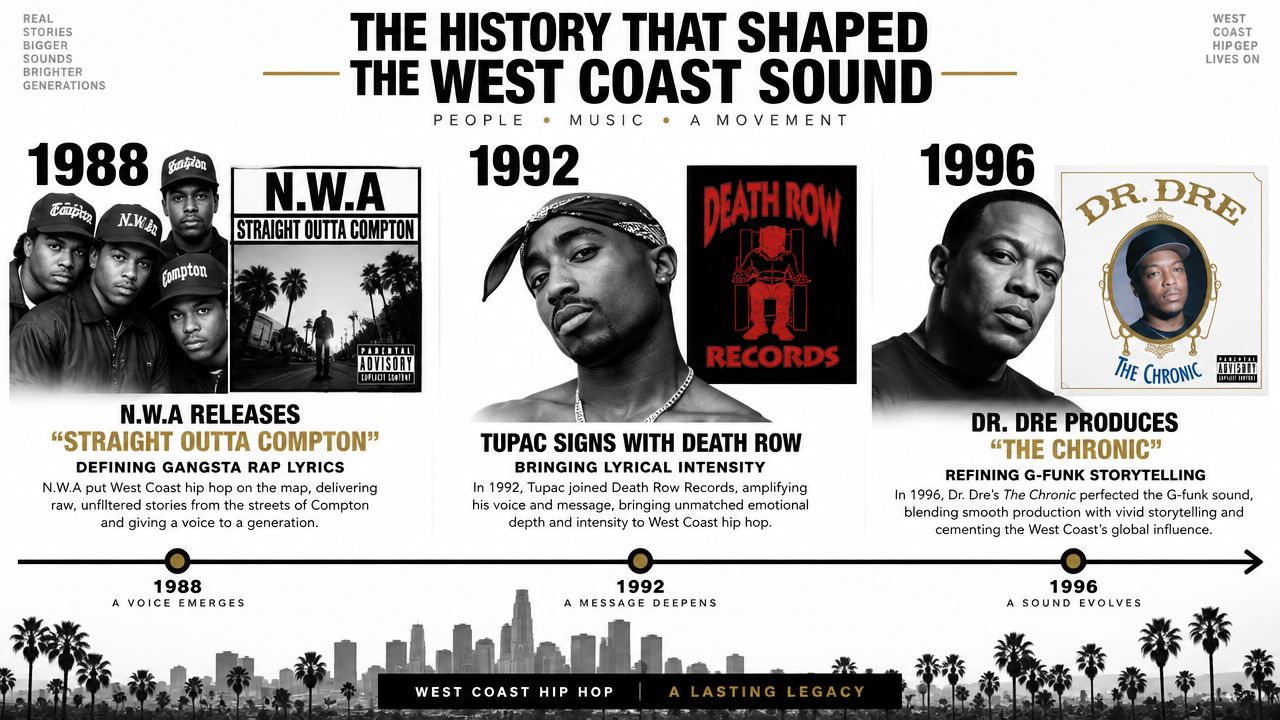 A timeline graphic depicting the history of West Coast hip hop, featuring key artists and landmark albums.
The decisive window
A major lyrical framework took shape between 1988 and 1992. N.W.A.’s Straight Outta Compton in 1988 placed the West Coast on the national hip-hop map through confrontational street realism, police hostility, and violent social commentary. The writing moved between “violent hedonism” and “righteously angry social commentary,” giving the region a voice that sounded dangerous, political, and direct.
Dr. Dre's The Chronic in 1992 established a smoother, still hard-edged G-funk template. For writers, the shift demonstrated how a verse could cruise instead of rush. Vowels could stretch, pauses could widen, and a relaxed surface could carry firm authority underneath. Snoop Dogg and later artists extended that balance between laid-back delivery and forceful presence.
Study the period from 1988 to 1992 for its construction, not just its nostalgia. The useful lesson is the blend of conversational phrasing, sharp observation, and a groove that leaves room for the listener. That combination creates controlled dominance without requiring every bar to announce danger.
Competition sharpened the language
The East Coast and West Coast rivalry traces to 1991, when Tim Dog's “Fuck Compton” is described as a starting point for the conflict. The feud intensified territorial language, insults, and competitive identity, elements that battle rappers still draw on. (The Guardian's history of Dr. Dre and the West Coast)
A West Coast diss can sound calm and still cut deep. The writer sets the frame, lets the opponent enter it, then delivers the turn with measured timing. The restraint works like a hand on the steering wheel. The car appears smooth, but every direction is deliberate.
For practical examples of regional writing choices, study this West Coast rap style guide. When you draft later, borrow the 1992 trick: relaxed surface, assertive underneath. Let the beat carry some weight, then make each selected phrase do more work.
The Signature Traits of Authentic West Coast Lyrics
Authentic West Coast writing starts with space, then uses that space with intent. A 2025 cross-coast study associated West Coast lyrics with a higher prevalence of a “Vulgarity and Violence” topic, while East Coast lyrics were more associated with “Street Life and Rhythm.” The analysis also found a slower tempo trend in West Coast tracks, leaving more room between syllables and punchlines. (2025 cross-coast hip-hop study)
That finding describes a tendency, not a rulebook. A West Coast verse can move quickly, but its power often comes from letting the groove carry part of the message. Hold a vowel, pause before the key noun, or leave a beat open after the setup. The listener leans toward the line, like a passenger waiting for the next turn.
Space isn't the same as emptiness
A breathing bar still needs structure. Use internal echoes, repeated vowel sounds, and a strong end word. Rhyme does not need to flash in every syllable. It needs to support the pocket and make the chosen words feel inevitable.
- Packed: “I calculate, dominate, traverse every avenue.”
- Breathing: “I took the long way. Still arrived first.”
The second line has fewer moving parts, yet the pause gives “first” greater authority. Modern writers can combine both approaches. A relaxed bar can establish the scene, then a denser internal-rhyme run can tighten the pressure without breaking the groove.
One large-scale lyrical complexity analysis found West Coast artists increased from 1.68 rhyme instances per line in the 1980s to 2.65 by the 2020s, while maintaining a laid-back cadence and still averaging below East Coast density. (Large-scale lyrical complexity analysis)
| Trait | West Coast | East Coast |
|---|---|---|
| Tempo feel | Slower, groove-led, spacious | More compressed and rhythmically packed |
| Rhyme density | Selective, increasingly layered | Often denser and more continuously stacked |
| Where authority comes from | Restraint, timing, and controlled emphasis | Verbal density, rapid turns, and stacked punchlines |
| Slang approach | Regional markers placed for cadence and scene | Regional markers often support punchlines and verbal texture |
Sound local without dressing up
Do not scatter slang across a verse to signal a region. Choose words you understand, place them where their vowels sit naturally, and connect them to a real action. A cruising scene can establish place through traffic, heat, music, storefronts, suspension, light, and conversation. Naming every familiar California symbol only makes the writing feel assembled.
The strongest signal is often the relationship between confidence and restraint. A line can describe a late drive, a hard decision, or a quiet threat without recycling 1990s violence. Let the speaker sound like someone who proved the point before the song began.
Your West Coast Writing Workflow From Beat to Bar
Start with the beat, not the topic. Choose a groove that leaves room for your voice, then speak nonsense syllables over it until your body finds the pocket. If you cannot pause without losing time, the track may be demanding a denser approach. Authentic modern West Coast writing builds technique inside that space, using control and layered storytelling instead of recycled 1990s violence.
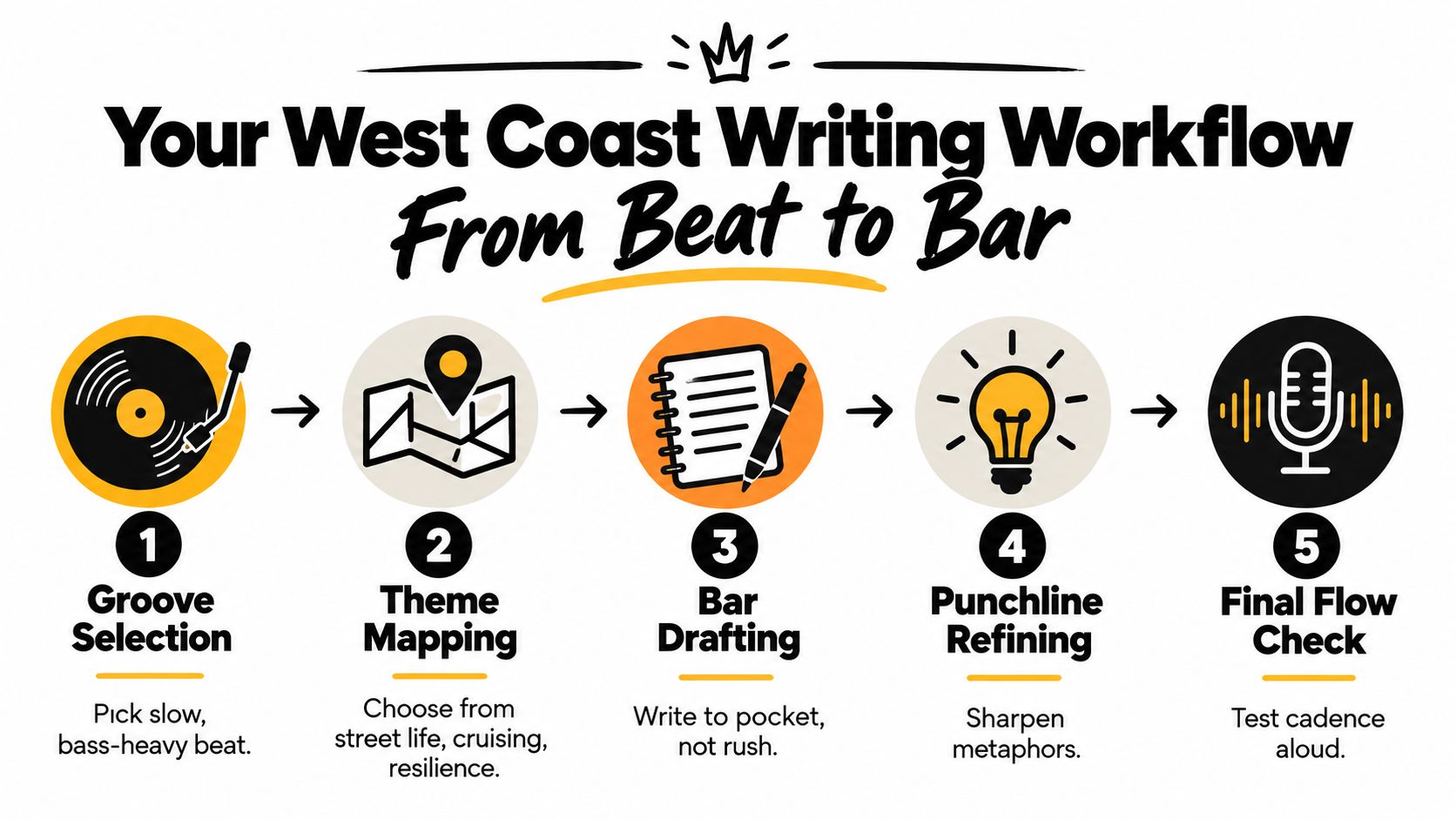 A five-step infographic illustrating a West Coast rap songwriting process starting from beat selection to final recording.
Find the groove before the subject
Hum a loose pattern first:
“Roll through the night, let the whole block breathe.”
That line is a pocket test, not a finished lyric. The open vowels and pause after “night” reveal where the beat leaves air. Once the cadence feels natural, choose a subject that can move inside it. The groove gives the idea its posture.
If production is slowing you down, this guide to how to make a backing track can help you shape the beat before committing to lyrics.
Map a scene, stakes, and payoff
Give the verse a small dramatic engine instead of stacking four unrelated boasts. Establish where the speaker is, what they want, what pressure blocks them, and what changes by the final bar.
- Scene: A late drive through a familiar neighborhood.
- Stakes: The speaker must prove they are no longer reckless.
- Payoff: Their restraint becomes the flex.
A flat draft might read:
“I'm driving through the city and I'm feeling real good.”
Add image and consequence:
“Streetlights on the hood, I leave the old route.”
The second line gives the listener a physical scene and raises a question. What was the old route? Why leave it? Those unanswered details create tension without relying on a familiar threat.
Draft lightly, then layer
Write the first pass with fewer syllables than you think you need. As the earlier rhyme-density data showed, modern looseness is layered on top of technique, not a substitute for it.
Begin with the clean version:
“I came back calm, they expected noise.”
Then add internal texture without crowding the cadence:
“Came back calm, no alarm, they expected noise.”
“Calm” and “alarm” add motion, while “noise” still receives space and weight. Keep an added rhyme only if your mouth can deliver it naturally. A clever page full of cramped syllables is not a strong verse.
Read it aloud and cut anything that trips
Your page can lie. Your mouth will not. Record the verse at the intended tempo, listen for rushed consonants, and mark every forced breath. Remove filler before adding another rhyme.
If you run out of breath before the end word, the bar is one syllable cluster too dense.
Check three things in the final pass: each line sits inside the pocket, the scene develops, and the strongest word arrives where the beat can give it weight.
Punchlines and Punch-Ups for Diss Tracks
A diss doesn't become powerful because it contains more insults. It becomes powerful when the target's image, habit, or contradiction gets compressed into a line they can't escape.
West Coast battle writing often works through controlled dominance. The setup can sound almost casual, even generous, before the final phrase changes the temperature. That delayed strike suits a spacious flow because the listener hears the turn clearly.
 A vintage-style studio microphone sitting on a wooden desk next to professional headphones with sound-absorbing wall panels.
Turn a broad insult into evidence
Weak:
“You talk tough, but nobody believes you.”
Sharpened:
“You rehearse that tough face. Even your mirror looks away.”
The revision changes three things. It replaces a general judgment with a visible action, puts the twist at the end, and gives the line a clean conversational shape. The mirror isn't just decoration. It turns the target's performance into the subject of the joke.
Another example:
- Weak: “You're not a leader, you just follow trends.”
- Sharper: “You call it a movement. I watched you wait for the crowd.”
The second version attacks a contradiction. It doesn't need extra profanity because the image does the work.
Build the setup like a calm walk
Use a three-part structure:
- Establish the target's claimed identity.
- Show a specific contradiction.
- Deliver the reframe.
For a fictional rival:
“You call yourself the captain, dressed for the parade.
I checked the route. You were asking who had made it.”
The lines don't rely on threats. They attack authority, then make the target look dependent. That kind of insult rewards a second listen because the scene carries the punch.
For more help tightening setups, reversals, and memorable endings, use this guide to writing punchlines.
Edit for placement, not just cleverness
Put the most important word where you naturally pause. If the punchline arrives too early, the rest of the bar explains what the listener already understood. If it arrives too late, the beat may bury it.
Read the line three ways. Stretch the setup, shorten the setup, then move the final word across the bar. Keep the version that makes the target's flaw feel obvious after the fact. Surgical beats loud when the listener can repeat the line later.
Writing Beyond the Cliché and Modern Themes
Knowing what to avoid is only half the craft. Kendrick Lamar's GNX coverage framed a West Coast revival built on strategy, ownership, economic pressure, and regional pride rather than recycled 1990s formulas. That shift gives modern writers a useful target: controlled dominance, space in the flow, and stories with more than one layer. (Coverage of Kendrick Lamar's West Coast revival in GNX)
Regional writing can start with ordinary pressure. A speaker might cruise home after an argument, measure a family member's discipline, or sit with the quiet work of staying sober. The beat can move lazily while the meaning keeps tightening. Leave room between phrases, then let a small detail carry the weight: a phone facedown, an empty passenger seat, a gate opening after midnight.
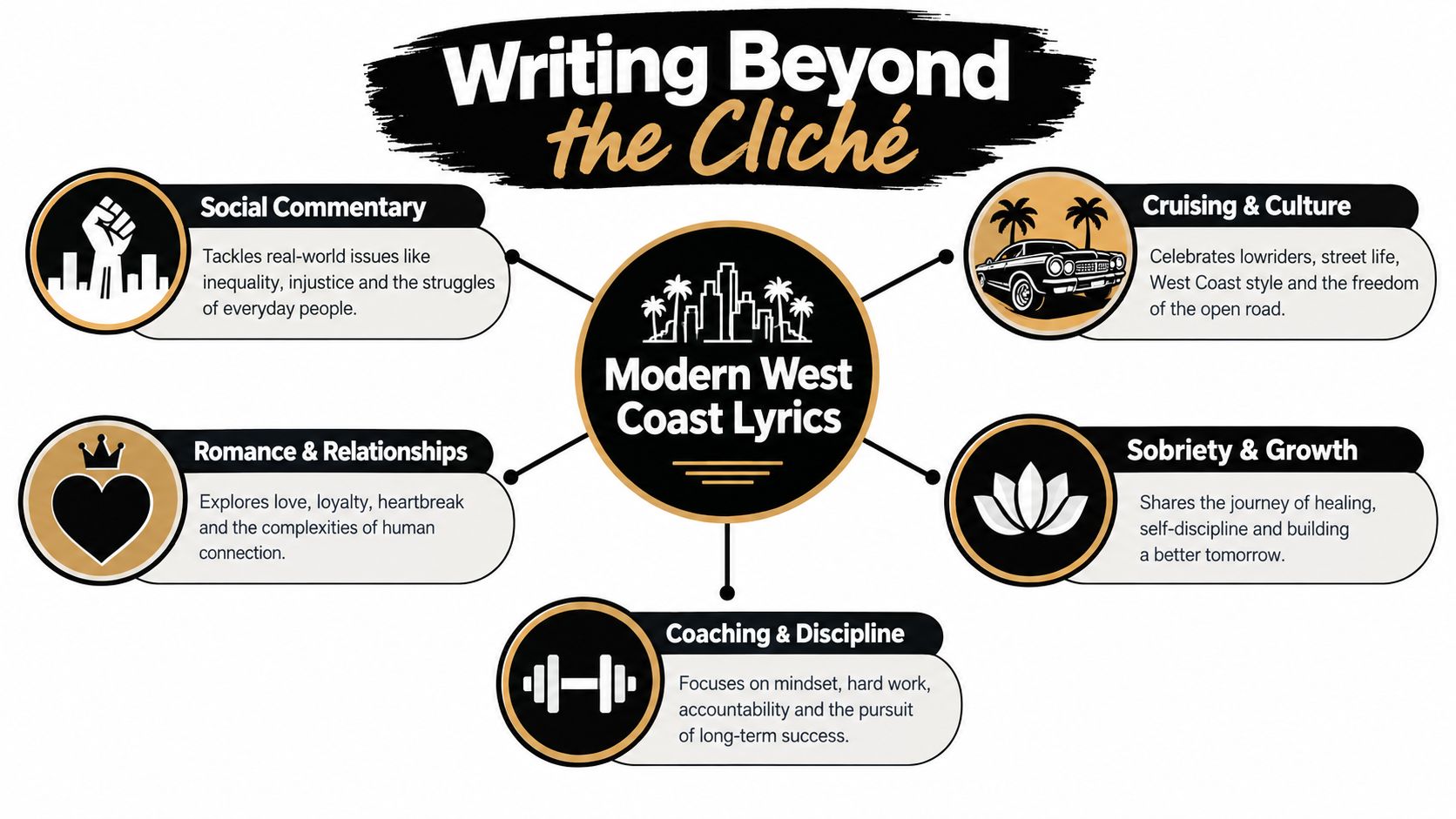 A diagram illustrating key thematic elements of modern West Coast lyrics, including social commentary, culture, and growth.
Write authority without recycled violence
Authority can sound like ownership of the scene. Use a calm voice, a deliberate pause, and an image that shows control without announcing it. “I left the block with the windows down, came back with the plan” carries more character than a threat because the movement contains a before and after.
Build themes through layered scenes:
- Introspection: Show a habit through an object or location, then reveal the changed behavior through action.
- Cruising scene: Follow one drive from departure to arrival. Add a sound, texture, person, and decision so the road becomes part of the story.
- Motivational bar: Begin with a setback, name a practical action, and make discipline feel like status rather than a poster slogan.
- Romance: Keep the regional pocket while letting distance, pride, or timing create the friction.
- Social commentary: Show one neighborhood consequence through the person living it before naming the larger issue.
A useful test is lyrical density. If every beat carries a boast, nothing has room to resonate. Let one bar establish the setting, the next expose the pressure, and a later phrase change how the earlier image reads. A slow tempo gives those turns space.
If you turn lyrics into social posts, Gainsty's guide to lyric captions offers context for choosing lines that stand alone. A strong caption, like a strong bar, gives the listener a clear image and a point of view.
Practice Drills and AI Prompts to Speed Up Your Writing
Build consistency with short, repeatable sessions. Start with a slow groove and freestyle using only images, not boasts. Then rewrite one line from an older song in your own situation, keeping the cadence idea while changing the language and subject. Finish by taking one of your own weak punchlines and giving it a specific object, contradiction, or reversal.
Keep a notebook divided into three columns:
- Pocket: Where the voice pauses, stretches, or enters late.
- Image: What the listener can see, hear, or touch.
- Turn: The word or idea that changes the meaning.
This prevents you from treating rhyme as the whole job. A West Coast verse needs sound, but it also needs a scene that can survive without the beat.
Use prompts as sparring rounds
DissTrack AI can generate personalized roast lyrics from a target's name, relationship, inside jokes, selected style tags, and a chosen savagery level. Treat the output as raw material. Keep the useful cadence or concept, delete anything generic, and rewrite the strongest lines until they sound like something you would really say.
Try prompts like these:
Friend roast
Write a playful West Coast roast for my friend [name]. We've known each other through [context]. Use these inside jokes: [details]. Keep the delivery relaxed, the insults clever rather than cruel, and end each section with a memorable reversal. Give me three different punchline options.
Friendly rivalry battle
Write a controlled West Coast battle verse aimed at [name], my friendly rival in [activity]. Highlight their habit of [specific behavior] and contrast it with my strength in [specific strength]. Use spacious phrasing, regional atmosphere without forced slang, and layered insults that become clearer on a second listen. Avoid threats and personal topics that aren't part of the rivalry.
Content-creator roast video
Write a short West Coast-style roast for a video about [creator or fictional character]. Focus on their public habits, recurring mistakes, and exaggerated persona. Include a calm setup, a sharp final turn, and several alternate endings. Keep the language suitable for a public comedy performance.
Don't publish the first draft untouched. Ask for a colder tone, fewer clichés, stronger scene details, or a more conversational cadence. Then perform the final test yourself, over the beat, with your own breath and timing.
The style is alive because writers keep changing what confidence sounds like. You don't need to recreate an old record. You need to understand the pocket, write with restraint, and give the listener a reason to replay the line.
DissTrack AI helps you generate structured roast verses with a West Coast style option, personalized details, and editable punchline variations. Try the workflow on your next beat, then visit DissTrack AI and turn one rough idea into a verse you can shape in your own voice.