8 Best 114 BPM Songs: Tempo Picks for DJs and Roast Verses
114 BPM sits squarely in the range listeners find easiest to track, making it one of the more versatile tempos in popular music. Listeners generally track beats most comfortably between roughly 30 and 240 BPM, with a particular preference for periodicities around 100 to 120 BPM, according to research on popular music meter in Music Theory Online. At 114 BPM, a quarter note lasts about 526 milliseconds and an eighth note lands every 263 milliseconds. That gives syllables room to register without making the groove feel sluggish.
That pocket turns up across funk, disco, pop, rock, and hip-hop. Each pick below works as a tempo blueprint: study the groove for DJ blends, production choices, and roast verses that place a punchline right on the beat.
For bookings, pair your set planning with EPKS tools for electronic performers. A sharp press kit should make the same impression as a clean transition.
1. Uptown Funk - Mark Ronson ft. Bruno Mars
Drop this at a wedding, a sports arena, or a block party and watch shoulders start moving before anyone decides to dance. This 2014 funk-pop hit rides at roughly 114 BPM on a bouncy, horn-driven groove, and its whole trick is confidence you can clap to. Bruno Mars isn't out-rapping anyone. He's showboating in short, rhythmic bursts, and the band answers every boast like a hype crew.
 A band of musicians playing jazz music together on stage during a live performance in suits.
Steal the Call and Response
That structure is gold for roast writing. Keep your setup line short, let the beat breathe, then let a friend, a sample, or your own ad-lib throw the punchline back. Crowds remember what they can shout, and this record is covered and remixed in celebration videos for exactly that reason.
- Short punchlines win: Match roast lines to the groove by keeping them tight and rhythmic, not dense and clever on paper.
- Build a shoutable hook: Use call and response for a line your whole group chat can repeat in a roast video.
- Contrast your tempos: If this pocket feels too bouncy, compare it with faster songs at 145 BPM to hear how much breath room you lose.
Practical rule: If your punchline needs a second breath at this tempo, it's too long. Cut it until a non-rapper can chant it.
I reach for this blueprint when a roast needs swagger over malice. You're not destroying your target, you're styling on them, and the horns do half the bragging for you. That trade-off matters for shareable clips, where a grin travels further than a mean bar.
2. Get Lucky - Daft Punk ft. Pharrell Williams and Nile Rodgers
Some records at this tempo shove. This one glides. Released in 2013 on Daft Punk's Random Access Memories, this disco-funk single sits at roughly 114 BPM, though some listings put it slightly higher. Nile Rodgers plays rhythm guitar like a metronome with a smile, and Pharrell floats just behind it, never fighting the pocket.
 A close-up of a person playing a sunburst electric guitar while wearing a black shirt
The song's global chart run in 2013 and its second life in lifestyle and fashion videos prove the same point. A smooth groove at this tempo reads as expensive. You sound like you're winning without raising your voice, which is a devastating tone for the right roast.
Play It Cool, Not Cruel
Use this pocket for playful, unbothered verses rather than harsh attacks. Write lines that sit inside the guitar riff's gaps, keep your consonants soft, and let the insult arrive with a shrug. The comedy comes from contrast, since your target is sweating while you sound like you're ordering another drink.
A separate catalog reports 22,905 verified songs at 114 BPM, spanning classical, rock, pop, jazz, country, and alternative, in Tempo Tunes' 114 BPM database. That range is your reminder that tempo alone doesn't set the mood. Arrangement does. The same grid that carries this record's silk can carry something far meaner, which is why picking your feel matters more than picking your number.
3. Billie Jean - Michael Jackson
Strip a beat down to drums, a bassline, and nerve, and you get this. From 1983 and the album Thriller, this pop and funk classic runs at roughly 114 BPM with almost nothing wasted. The bassline doesn't decorate the song. It stalks through it, and every vocal phrase has to earn its space on top.
 A sunburst electric bass guitar stands next to a music production workstation with headphones on a desk.
Songwriters still cite it as a model for narrative pop, and hip-hop and R&B producers have sampled and interpolated its DNA for decades. There's a lesson in that restraint. When the backing is minimal, your story has nowhere to hide, so your word choices get sharper or the whole verse sags.
Build Suspense on the Bassline
Write tight, repetitive phrases that circle the same accusation, then place your key punchline square on a strong bass beat. Repetition builds the pressure, and the downbeat releases it. Say you're roasting a friend who always dodges the bill. Repeat the setup across three bars, then drop the receipt, directly or lyrically, on beat one of the fourth.
If you want to feel how much tension this tempo adds, A/B it against material covered in this guide to 90 beats per minute. Slower grids give you room to explain. This one forces you to accuse, pause, and let the bassline do the staring.
4. Smooth Criminal - Michael Jackson
Where the previous pick smolders, this one attacks in a sharp suit. From 1988 and the album Bad, it runs at roughly 114 BPM with staccato vocal accents and a dramatic, theatrical arrangement. Every phrase lands like a heel click. Nothing slurs, nothing drifts, and that's the whole blueprint for writers.
Check how the delivery chops the beat into short, accented bursts:
Tribute acts and cover bands lean on this record because the drama is built into the rhythm, not the volume. Film and video editors borrow it for the same reason. You can feel an entrance happening before anything is said.
Write in Stabs, Not Sentences
- Chop your lines: Short, punchy phrases that land on accented syllables hit harder than one long, winding insult.
- Weaponize the pause: Let a beat of silence sit after the setup so the staccato punchline feels like a door slamming.
- Save your breath: This pocket punishes overpacked bars, so cut filler words before you cut jokes.
A staccato roast doesn't need more words. It needs better exits, one clean hit per beat.
I'd use this feel for a theatrical callout, the kind you'd perform at a party where delivery matters as much as writing. The trade-off is real, though. Choppy phrasing exposes weak jokes fast, because there's no melodic flow to hide behind.
5. Without Me - Eminem
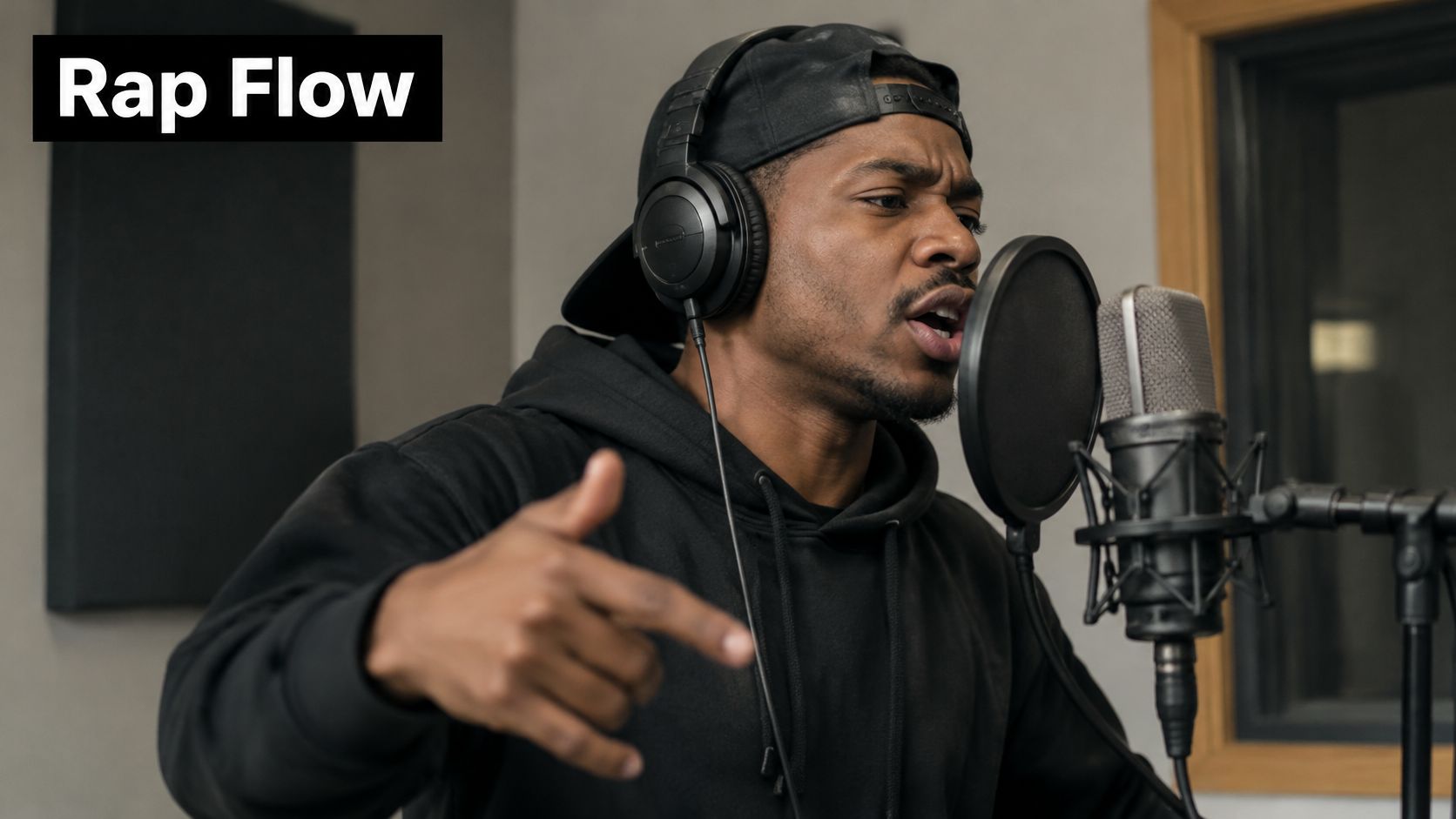
Eminem makes a moderate mid-tempo groove feel restless without losing its bounce. This 2002 single from The Eminem Show pairs a cartoonish backing track with densely packed verses, giving lyricists a useful lesson: rhythmic pressure can come from the writing, not just the BPM.
 A young Black man wearing headphones recording rap vocals in a professional music studio setting.
The hook stays simple while the verses show off. That contrast gives the listener a place to breathe and a line to remember. For a roast, pair a busy setup with a plainspoken payoff, then leave enough space for the punchline to register.
Density Needs a Release Valve
Internal rhymes can resolve mid-bar instead of waiting for the final word. Borrow that placement, not the urge to cram every beat. Build a couple of dense lines, then give the listener one clean, quotable hit aimed squarely at the target.
Compare that approach with the open phrasing of songs with 85 BPM, where longer syllables have room to stretch. In this moderate pocket, tightly packed rhymes can keep the verse lively, but too many obscure the joke. Keep the cleverness audible.
6. Rapper's Delight - The Sugarhill Gang
Before rap had rules, it had this party. Released in 1979 at roughly 114 BPM, this single is widely credited with bringing hip-hop to mainstream audiences, and its loose, flowing delivery still sounds like three friends passing a mic at a house party. That's not a flaw. It's the format your group roast should copy.
Hip-hop history lessons treat it as the first commercially successful rap single, and producers have sampled and referenced it ever since. Listen to how little pressure each verse carries. Nobody's proving they're the best alive. They're keeping the room moving, which is exactly the energy that keeps a friendly roast from turning sour.
Pass the Mic, Share the Joke
- Use call and response: Let one person set up the joke and the group deliver the tag, so the target is laughing with the room.
- Keep verses short: Tight, rhythmic turns suit party formats and vertical social clips far better than one long solo.
- Ride the bassline plainly: Simple end rhymes on the beat beat clever schemes nobody can follow over party noise.
Catalogs back up how deep this tempo's history runs. The University of Waterloo music database lists recordings within approximately 114 plus or minus 1 BPM from Perry Como in 1951 through David Bowie and The Smiths in the eighties. This record sits right in that lineage, proof that the grid was hosting parties long before it hosted battles.
7. Mo Money Mo Problems - The Notorious B.I.G. ft. Puff Daddy and Mase
Swagger doesn't have to shout. This 1997 single from Life After Death cruises at roughly 112 to 114 BPM over a glossy sample-based beat, and Biggie delivers like he's leaning back in a chair he owns. The flow is conversational, the pauses are confident, and the sharpest lines land because they sound effortless.
That relaxed posture is a delivery lesson most roast writers skip. When you rush, you sound rattled, and the target wins the exchange on body language alone. Slow your phrasing inside the same tempo and you sound like the outcome was never in doubt.
Let Tone Do the Cutting
Place your punchlines at the ends of phrases, where the ear naturally waits for resolution, and keep the setup in plain, conversational language. Say you're roasting a coworker who brags about money. Don't yell the joke. Smile through it, let the beat walk, and drop the expensive detail last, when there's nowhere left for them to hide.
The breadth of this tempo zone makes that tone flexible. Songdata's 114 BPM chart lists 15 examples spanning Mitski, Lana Del Rey, Nelly Furtado and Timbaland, Queen and David Bowie, and Michael Jackson. One grid, wildly different attitudes. Your delivery, not the number, decides whether the room hears menace or charm.
8. Sweet Caroline - Neil Diamond
Yes, a stadium sing-along belongs on a roast writer's study list. This 1969 pop anthem measures roughly 114 BPM depending on the analysis, and its chorus has turned sporting crowds and wedding floors into backup singers for decades. Viral crowd-singing videos keep proving the same mechanic. People will perform your hook for you if you make it simple enough.
That's the most underused weapon in roast content. A punchline one person delivers is a joke. A punchline thirty people chant back is a moment your target never lives down, in the friendliest possible way.
Turn the Room Into Your Hype Crew
- Write a chantable hook: Turn the chorus principle into a call and response roast line built for group videos.
- Keep it to a few syllables: The crowd can only repeat what it can remember after one hearing, so cut every extra word.
- Build in the pause: Leave space where the room answers, because that gap is where the clip gets its energy.
The crowd test: Say your hook once over the beat. If a friend can't shout it back on the second pass, simplify it.
Perception research explains why this works so well at this speed. A controlled study with 50 undergraduate participants comparing excerpts at 72, 114, and 184 BPM found tempo affected perceived duration, with moderate excerpts judged differently from slow and fast ones, as reported in the study indexed on PubMed. At 114 BPM, a hook feels substantial without dragging, so the chant lands and the song keeps moving.
8 Notable 114 BPM Songs at a Glance
| Song | Era | Genre Feel | Best For |
|---|---|---|---|
| Uptown Funk – Mark Ronson ft. Bruno Mars | 2014 | Funk-pop, horn-driven and upbeat | Playful roasts and crowd-chant hooks |
| Get Lucky – Daft Punk ft. Pharrell Williams & Nile Rodgers | 2013 | Smooth disco-funk with a laid-back groove | Cool, playful roast verses |
| Billie Jean – Michael Jackson | 1983 | Minimalist pop-funk with a tense, steady groove | Narrative roasts with rhythmic punchlines |
| Smooth Criminal – Michael Jackson | 1988 | Theatrical pop with sharp, driving rhythms | High-impact lines and staccato delivery |
| Without Me – Eminem | 2002 | Aggressive, satirical hip-hop with dense rhymes | Battle-style wordplay and confrontational roasts |
| Rapper's Delight – The Sugarhill Gang | 1979 | Party rap with a disco-influenced groove | Beginner-friendly, crowd-participation roasts |
| Mo Money Mo Problems – The Notorious B.I.G. ft. Puff Daddy & Mase | 1997 | Smooth, sample-based hip-hop | Sly, conversational roasts |
| Sweet Caroline – Neil Diamond | 1969 | Anthemic pop with a sing-along chorus | Group roast hooks and comedic remixes |
Turn This Tempo Into Your Next Roast
You now have eight different ways to sit on the same grid, and that's the point. 114 BPM songs aren't a genre. They're a shared pulse that funk showboating, disco glide, pop suspense, dense battle writing, and stadium chants all exploit differently. Steal the feel that matches your target and your room, not the one that merely shares a number.
For DJs, the move is pairing within the zone. Blend the horn-driven bounce of Uptown Funk into the guitar pocket of Get Lucky without touching your pitch fader, or use Billie Jean as the minimal bridge when the floor needs a breather that still moves. Same tempo blends only work when the energy curves match, so sequence by feel first and let the shared grid make the transition invisible.
A Simple Timing Framework for Writers
At this tempo, 16 quarter-note beats occupy about 8.42 seconds, so a four-bar phrase gives you a clean window to set up, escalate, and pay off. Aim for roughly 8 to 12 prominent syllables per bar for conversational battle rap, reserve beat four for your rhyme or comedic turn, and save faster fills for the one bar where you want aggression to spike. You can also flip the feel without changing the beat, since a half-time reading sits at 57 BPM for heavier delivery and a double-time vocal grid runs at 228 subdivisions per minute for technical bursts.
Preview every draft against an audible beat rather than trusting the BPM label on a screen. A line that reads brilliantly in silence can trip over its own syllables at speed, and you'll hear the problem in two bars. Record a rough phone take, mark where you gasp, and cut words there first.
Your Next Steps
Pick one blueprint from this list, write four bars against its pocket, and test the hook on a friend before you polish anything. If the blank page is the bottleneck, our generator produces diss tracks in about 30 seconds, writes custom lyrics, raps them over a beat, and mixes the result in seconds. Each generation delivers multiple variations, so you can keep the hardest bars, test them against a 114 BPM groove, and refine until every punchline lands exactly where the beat expects it.
Put these pockets to work today with DissTrack AI, where you can generate a custom roast in seconds, pick your style and savagery level, and choose the strongest bars from multiple variations. Drop your target's name, test the result against your favorite 114 BPM groove, and share the version the whole room ends up chanting.