UK Rap Lyrics: How to Write Bars That Hit Hard
You're sat in the kitchen with the beat on loop, headphones half off, and a notes app that already holds three false starts. The kick is doing its job. The pen is not. You know the picture, a mate who is always late for the train, but the bar either rushes the pocket or dies before the snare. That is the usual mess with UK rap lyrics. The words show up before the structure, a slang term gets lifted from a caption, and the punchline has nowhere to land.
The fix is boring in the best way. Decide the length, pick one point, and only then reach for a word you can explain. UK rap did not stay a pirate-radio hobby. Around 2003 and 2004, Dizzee Rascal, Wiley, Kano and Lethal Bizzle pushed grime into wider view, and Lethal Bizzle's "Pow! (Forward)" became grime's first UK Top 20 single in 2004, as the grime overview on Wikipedia records. The writing lesson is smaller than the chart story. Those bars worked because the MC knew the pocket, the target, and which words actually belonged to them.
Verse Structures UK Rappers Use Most
| Structure | Bar count | Typical use | Why it works |
|---|---|---|---|
| Grime solo verse | 16 bars (four 4-bar blocks) | Solo spit on fast grime beats | Room for one flow change around bar 8 |
| Drill hook and verse | 8-bar hook + 16-bar verse | Chanted or sung hook over dark drill beats | The hook carries the title line |
| Battle or clash verse | 16 to 24 bars | Targeted disses and call-outs | The target is named early, so the crowd knows who it is |
| Afroswing or garage hook | 8-bar hook + 8-bar verse | Melodic, dance-led tracks | Short verses keep the groove moving |
| Two-verse radio track | 2 x 16 bars + hook | Full releases and features | A new image at bar 16 stops the verse going flat |
The table is the decision. Pick the row before you write a line, or you will either cram the joke into the last two bars or pad the ending with "yeah" until the beat runs out.
Count the bars on the beat
Loop four bars. Count the beats in each bar out loud, one two three four, and mark where the drop or the switch lands. UK drill is often counted near 140 BPM and felt in half-time, so count the feel, not every click on the screen. Count the clicks and you will write twice the syllables the snare can hold. The verse turns into a tongue twister nobody asked for.
Words-first drafting is the slip that wastes the evening. You finish a page, then discover the idea needed eight bars and you wrote twenty. Run one test before you commit. If you can't state the verse's point in a single sentence, the structure is too long for the idea.
Match tempo and feel to the row, then give the idea only the bars it needs. A fast grime beat wants the 16 with one flow change around bar 8. A dark drill beat wants the hook to carry the title so the verse can tell one story. A clash wants the name in the first two lines, or the room spends the verse guessing. For hooks, features and full arrangements, the longer map sits in how to structure a song.
How to Write a UK Verse in Six Passes
A finished 16 is not one inspired blurt. It is six short passes, and each pass has a job. Skip one and you will hear it on the playback, usually as a breath you didn't plan or a rhyme you forced with "mate" because nothing else fit.
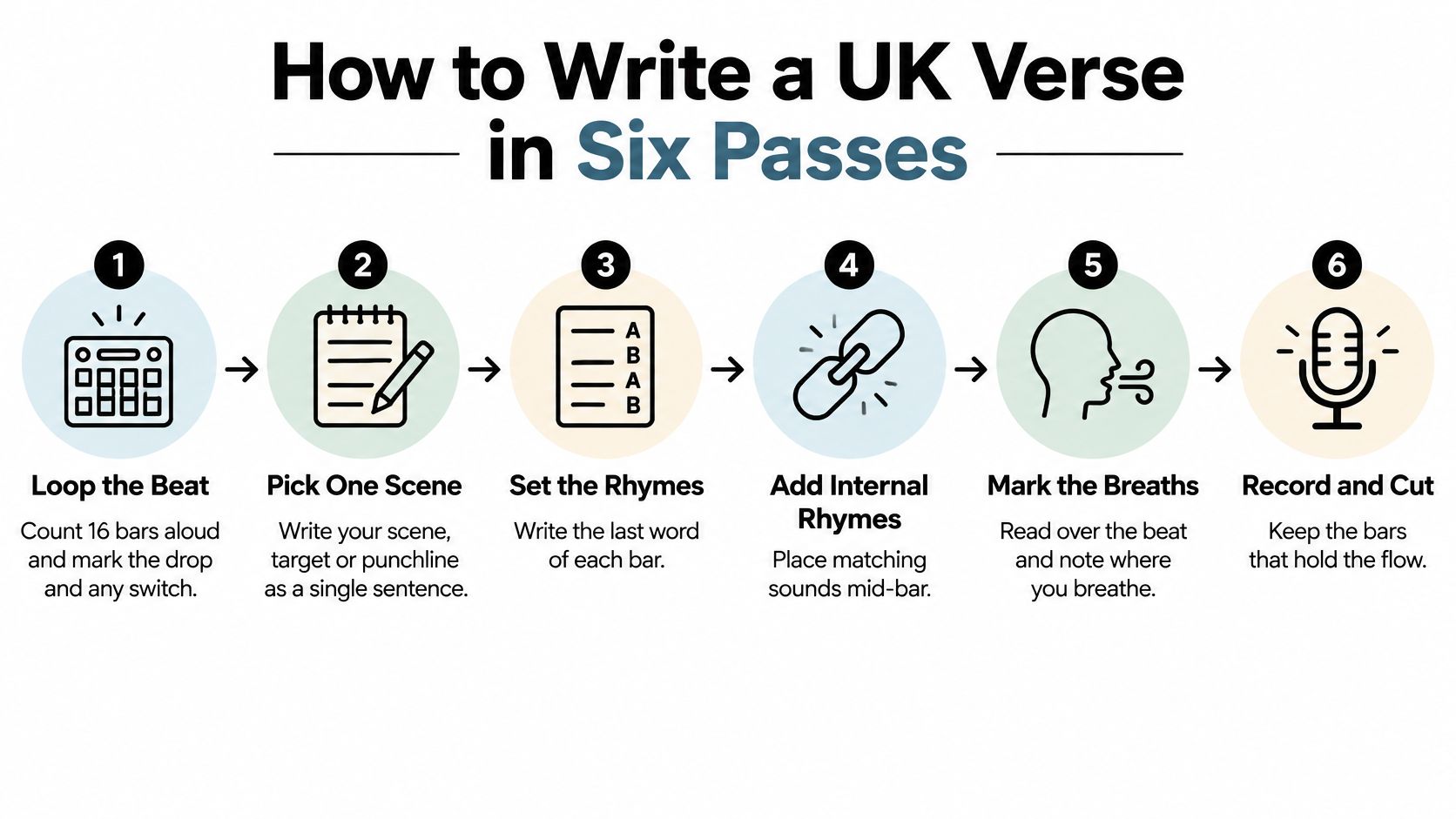 A six-step infographic illustrating the professional process for writing a UK rap verse, from beat to recording.
-
Loop the beat and count 16 bars out loud. Mark the drop and any switch so the pen follows the track, not the other way round. The slip is writing in silence, then discovering bar 9 lands on a breakdown where nobody can hear the words.
-
Pick one scene, one target or one punchline, and write it as a single sentence. "He's late again and the platform is the joke" is enough. Four competing pictures means the listener leaves with none.
-
Write the last word of each bar first. Build a bank of 16 end-words that rhyme in pairs or small sets, then stop. Filling the middles before the endings is how you get "cold / told / bold" glued on with filler, because the rhyme arrived after the sentence was already full.
-
Fill the middle of each pair with one image, not a new idea. Two bars can share a late train, a cold platform and a name. They should not also introduce rent, a rival crew and a car. New idea per line is how a verse becomes a list.
-
Add local slang only where it does a job. Naming a place, sharpening a joke, or marking who you are talking to is a job. Decorating a plain line with a word you half-know is not. If the term needs a footnote you can't give, cut it.
-
Record a rough take over the beat. Circle every breath, and cut any bar that makes you rush the next one. A line that only works if you skip inhaling is not a bar yet. It is a paragraph wearing a hat.
What the finished 16 should do
Every bar sits in the pocket you counted. There is one clear image about every two bars, so the listener can see the scene without a second pass. The last bar lands the sentence you wrote in pass two. If bar 16 introduces a fresh joke, you didn't finish. You started another verse and called it an ending.
Rhyme Schemes and Flow for UK Beats
A couplet can look perfect in the notebook and still collapse over the beat. The page shows matching endings; the drums decide whether those endings land. Say each bar over the backing track and mark the syllables that hit with the kick and snare. That mark-up is your flow map.
 A young man with dreadlocks writes lyrics in a notebook at a kitchen table with headphones.
| Approach | Pattern | How it sounds | Best for |
|---|---|---|---|
| Couplet | AABB | Two bars that land as a pair | Punchlines and quick jokes |
| Alternate | ABAB | Rhyme every other bar | Storytelling and scene-setting verses |
| Internal rhyme | Rhyme inside the bar | Dense, rapid-fire delivery | Grime spits and battle bars |
| Multisyllabic | Two or more syllables match | Chained wordplay that rolls | Clash verses and wordplay-heavy drill |
| Slant rhyme | Near-rhyme with a similar vowel or ending | Relaxed, conversational | Drill reflection and everyday UK settings |
Where the stress has to sit
Take a couplet that ends on cold and hold. If those two words land on the kick and the snare, the pair snaps and the joke is obvious. Shift either word one beat early and the rhyme slides past. The listener gets the meaning but misses the hit. Write both versions on the page, read them against the drums, and keep the one you can point at with a finger.
The table gives you shapes. Context gives you the words inside them. If a rhyme leans on slang, note who says it, where it comes from, and whether your use is literal, ironic or coded before building the bar around it. A word borrowed for sound can twist the whole scene.
Dense rhyme is the other trap. Internal chains feel sharp in a group chat and get muddy once a snare is involved. The DeepBeat ranking work frames lyric writing as a next-line choice problem. That task can reward a line that fits, while a performer still has to judge breath, stress and whether the joke survives the drums. Pack every syllable with a match and the listener has to work harder to find the sentence.
Density rule of thumb: In an eight-bar stretch, try heavy internal rhyme in one or two bars, then put a plainer bar before the punchline so the ear can reset. Adjust it by ear. It is a starting point, not a quota.
Close the pass with three checks. Rhyme the end-words. Mark the stresses against the kick and snare. Then read each bar aloud with the beat muted and confirm it still means something. If it only works as a sound effect, rewrite it. Pattern names and longer examples live in this guide to rhyme scheme examples when you want a second pass on the shapes.
A quick listen resets your ear faster than another ten minutes staring at syllables.
Regional Slang Without Sounding Like a Tourist
A mate once put "brown bread" in a bar and meant a loaf. He liked the sound. He had no idea it was old rhyming slang for dead, and the line turned a mild dig into a funeral. That is the tourist move. The phrase gets borrowed because it feels London, not because the writer knows who says it.
Treat every slang term like a feature with a label: mouth, map, mode. Mouth is who really uses it. Map is where it travelled from. Mode is whether the bar needs it literal, ironic or coded. If any label is blank, the word is decoration. Keep Tony Thorne's Independent piece on rhyming slang as a reminder that a phrase can be famous enough to headline a column and still fail inside a verse when the listener cannot place the speaker.
Sort the notebook into four piles before you keep a word.
- Patois-influenced words: Jamaican speech that travelled into UK rap and still carries weight. Use one only if you can say it cleanly and you know the tone, joke or threat, not just the spelling.
- Multicultural London English address terms: Words like bruv, man and fam. These mark a relationship. Calling a rival "fam" flips the line from a dig into a fake closeness, which can be the joke or a mess.
- Cockney leftovers: Phrases many listeners now meet as history first and slang second. Funny in the right room, dead weight if the bar has to land on first hear.
- Online and gaming talk: Fast, dated, and obvious when it is pasted in to sound current. Fine for a hook that lives for a month. Risky for a verse you want in a year.
Five questions before a word stays
For each term, answer who uses it, where it comes from, and whether it is literal, ironic or coded. Then ask what it signals, identity, threat, humour or status, and whether it will still make sense in two years. Address terms are not decoration. In grime they follow quiet rules tied to crew, rival, friend or target, so the wrong one changes the relationship the bar sets up.
Read the draft to someone from outside your postcode and ask what the line says about the speaker. If they hear a different relationship from the one you meant, the word is doing the wrong job. The same test catches the polite flatten where you explain a term so hard the bar stops sounding like anyone really said it.
If you can't say who uses a term and what it does in the bar, leave it out.
Common Lyric Mistakes and How to Fix Them
| Symptom | Likely cause | Fix |
|---|---|---|
| Bars feel stiff on the beat | Too many syllables for the pocket | Count syllables per bar and cut to the pattern |
| Rhymes sound forced | Filler words used as rhyme anchors | Start from the end word and build backwards |
| Lines miss the beat | Stress falls on the wrong syllable | Say the line over the beat and mark stressed syllables |
| Listeners outside London lose the joke | Local reference with no context | Add a context line or a clearer image |
| Verse sounds like US rap in a UK accent | American vocabulary used by default | Swap in UK terms only where they carry meaning |
| Punchline lands flat | Setup runs past one bar | Cut the setup to a single bar |
Two fixes you can do on the page
A stiff bar is usually an eleven-syllable sentence squeezed into a four-beat pocket. "He turned up late again with the same excuse" runs eleven. Cut it to eight and keep the picture: "Late again with the same excuse." The snare gets a word it can hit, and you stop gasping into bar two.
A forced rhyme hides in the filler. "On the road, in the cold, I was told" uses cold and told because they match, and neither is the point. Rebuild from a real end word. If the point is the late train, end on "platform" or "delay" and let the previous bar earn it. The rhyme lands as a payoff instead of padding the line.
The trap that sounds like research
Hearing a slang term a lot is no proof you can use it. Researchers pulled 589 address and reference terms from 16 songs by six artists across London, Cardiff and northern England, and the Aston grime study shows those terms follow quiet rules about who gets called what. A model trained only on US rap misses that. So does a writer who treats Multicultural London English as generic "UK slang."
Before a term stays in the verse, tag it. Who says it, where it comes from, and whether the bar uses it literal, ironic or coded. A word that reads as a joke in one crew's mouth reads as a straight claim in yours, and the listener clocks the difference even when you don't. If a bar fails two of those checks, rewrite that bar and leave the rest of the verse alone. When the setup is the problem rather than the slang, punchline shape is covered in how to write punchlines.
Warm Up With Five Prompts and Draft Tonight
Start with the train. He's late again, the platform is the whole world, and you have 16 bars to say that once. Opening line: "He swears the train left him, I watched him miss the doors." That is a grime solo verse. One scene, one target, a flow change around bar 8 if the beat asks for it.
 A young man sitting on a wooden park bench writing notes in a small black journal.
The other four are the same length of trouble, with a different job.
- Postcode without the name: Four bars that show the ends through a shop, a bus or a shortcut. Sample start: "Corner shop light still on, same man on the till." You are testing images, not a postcode badge.
- Battle opener: Name one habit in line one. "He talks loud, then checks who heard it." That belongs in a 16 to 24 bar clash, target first.
- Drill hook: Eight bars, one title line repeated. "Don't wait on the platform" can be the chant. The verse explains it once.
- Money verse, rationed slang: At most one slang word a bar, inside a two-verse radio track. Sample start: "Rent cleared, still counting the change in the jar." If the slang isn't doing a job, it doesn't get a seat.
A timed session, not a mood
If the page stays blank, DissTrack AI is one optional warm-up. It is an AI diss track generator with a UK Grime style tag and a free plan for a single roast. Generations stay private until you publish them. Use a draft to see how a verse is blocked out, then rewrite every line in your own voice and run the checks from this piece. A generator can hand you a shape. It can't hand you the postcode, the breath, or the relationship behind "fam."
Set 45 minutes. Write one 16. Run the six passes. Record a rough take. Cut any bar that fails the hand test, meaning you can't tap the stresses on your leg and still understand the line. One clean 16 tonight beats a folder of half verses you will not open again.
DissTrack AI turns a target's name, your relationship and a style tag such as UK Grime into a structured roast you can edit, so the clash shape is on the page before writer's block wins. Use it as a private first draft, then rewrite the bars with your own images, breaths and slang you can explain in full. When you want that starting verse, open DissTrack AI and run one roast through the six passes before you record.