Commercial Music Licensing: A Complete Guide for 2026
You've spent an afternoon cutting a product video, timed every transition, and found the perfect trending track for the final beat. The post looks polished, the brand account publishes it, and then the notification arrives: audio muted, video restricted, or copyright claim filed. The frustrating part is that you may have paid for the song, streamed it legally, or selected it from a platform's music library.
That's where commercial music licensing begins. Music isn't one object with one permission attached to it. It's a bundle of rights, and the permission you need depends on what you're doing, where the content appears, and whether you're using a composition, a particular recording, or both.
The market reflects how central this work has become. One estimate values global music licensing services at about $8.7 billion in 2025, with a projection of $17.6 billion by 2034, while another estimates USD 9.73 billion in 2026 and USD 14.84 billion by 2031. These are market estimates, not a price list for individual creators, but they show that licensing sits at the heart of recorded music, publishing, film, television, streaming, advertising, and social content. (DataIntelo market estimate, Research and Markets analysis)
Why Your Favorite Song Just Got Your Video Taken Down
Maya runs a small skincare brand and needs a short launch video for a new product. She cuts close-ups of the bottle, adds captions, and places a popular TikTok track under the footage. The post performs well overnight. By morning, the platform has removed the audio, stopped the paid promotion, and displayed a copyright notice.
Maya did not steal the song. She bought it for personal listening and never uploaded the file for sale. Her use changed when she placed the music in branded content. Personal listening and commercial exploitation are different activities, even when the same track is involved.
Music licensing works like renting a location. A concert ticket lets you enter and hear the performance. It does not let you rebuild that venue in an advertisement. In the same way, purchasing a track, subscribing to Spotify, or downloading a song usually gives you private listening access. It does not normally cover synchronizing the music with a product video, running that video as paid advertising, or using it in client work.
What counts as commercial use
Commercial use generally means music supports a business, product, service, campaign, monetized channel, or professional production. Examples include an Instagram Reel promoting a shop, a sponsored YouTube Short, a company podcast, a livestream with branded overlays, or a meme page paid to feature a product. The same question applies to AI-assisted videos: if a tool helps create the content, the music still needs permission for the final use.
Music can require several permissions because ownership may be divided. A songwriter may control the composition, a publisher may administer it, and a label may control the particular recording. Those rights can affect a short-form post, a stream, a client deliverable, or a campaign that moves between platforms.
Practical rule: If music helps sell, promote, monetize, or identify your content, treat it as commercial until the license clearly says otherwise.
Platforms can detect protected music automatically, but detection does not prove that you have permission. A claim may mute the video, redirect revenue, restrict distribution, or remove the post. If copied or unauthorized material is circulating, a business may need help with an expert DMCA content removal situation. Clearing the rights before publishing is usually the cleaner route.
The Three Rights You Need to Understand
A short-form clip can use one familiar song while involving several separate permissions. The easiest way to see the difference is through a restaurant analogy. The composition is the recipe, the master recording is one chef's preparation, and performance rights concern serving the finished experience to an audience.
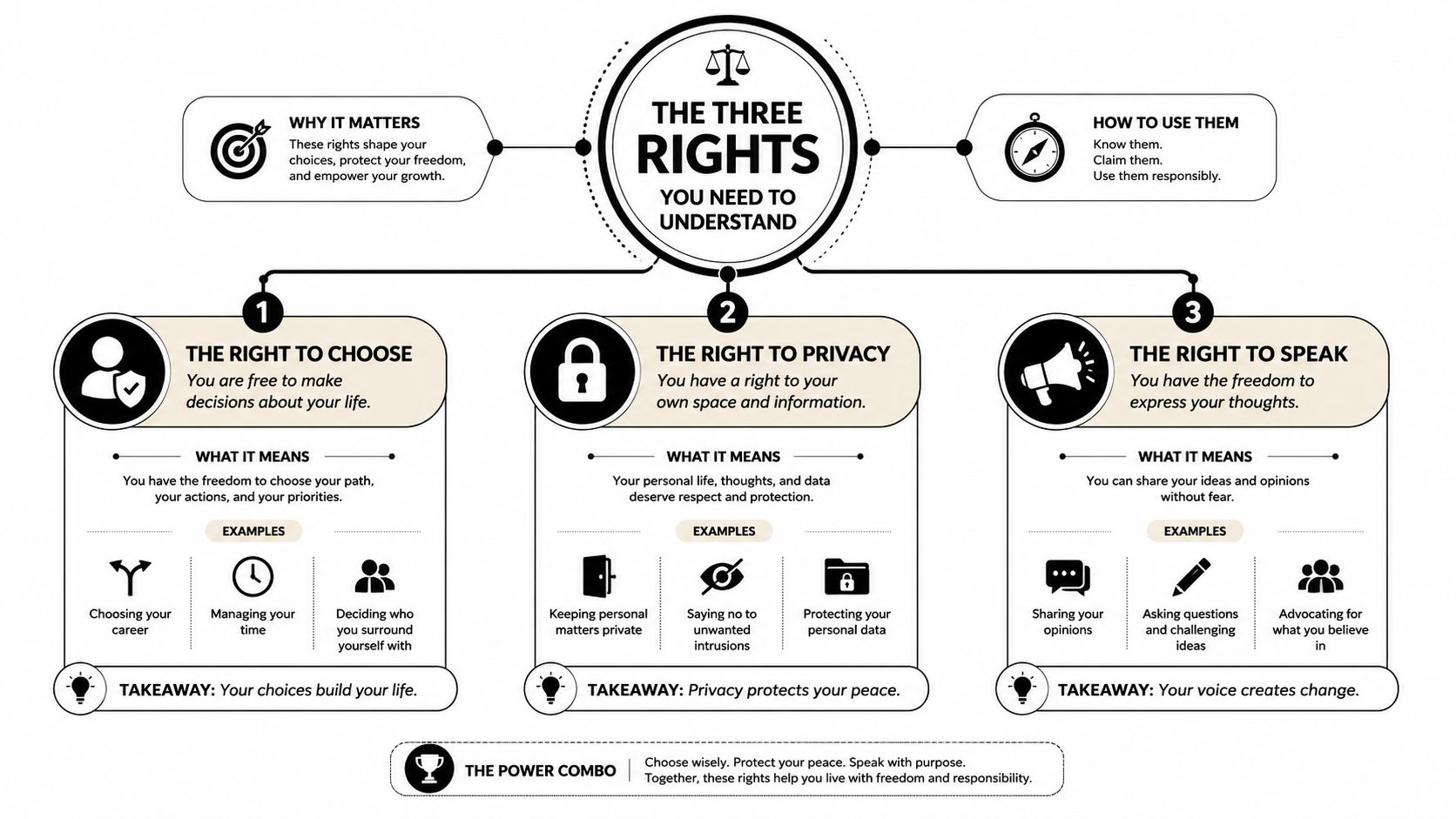 An infographic titled The Three Rights outlining the rights to choose, privacy, and speak with actionable takeaways.
The composition is the underlying song
Lyrics, melody, harmony, and arrangement make up the musical work. Songwriters may assign administration to publishers, so a creator might need to contact a publishing company rather than the performer's label.
Recording your own cover changes the audio recording, not the underlying song. The songwriters and publishers still control relevant uses. A sync request for an AI-assisted video, product Reel, or client edit therefore concerns the composition even if the original artist's audio never appears.
The master is one specific recording
The master is the recorded performance heard on an album, streaming service, or supplied audio file. A label may own it, an independent artist may own it, or a contract may divide ownership.
Using the original recording in branded content usually requires a master-use license alongside permission for the composition. A cover changes who controls the master, but it does not remove the composition rights. You changed the chef, not the recipe.
Performance concerns public playback
Performance rights apply when music is played publicly, broadcast, streamed, or otherwise made available to an audience, depending on the use and jurisdiction. Performing rights organizations, often called PROs, administer parts of these rights for affiliated writers and publishers.
Performance rights are one significant revenue layer in the music market. Analysts at Research and Markets report that performance rights represented 46.23% of music licensing revenue in 2025, while synchronization rights are projected to grow at a 10.12% CAGR through 2031. (Research and Markets rights analysis)
Use this map:
- Composition: the songwriters' and publishers' work.
- Master: the particular recorded performance.
- Performance: public playback or communication to an audience.
A TikTok ad can trigger composition and master permissions because it pairs music with visuals. A café playlist raises performance questions. A livestream or AI-generated video may involve platform terms, public communication, reproduction, and permissions attached to the recording. The exact workflow decides which rights matter, not just the app you publish on.
Which License Type Fits Your Project
A creator may use the same track in a short-form clip, a livestream replay, and an AI-assisted product video. Each format can trigger a different permission. Start with the action: pairing music with images, reproducing audio, playing it for an audience, or accessing a catalog under continuing terms. The license should match that action.
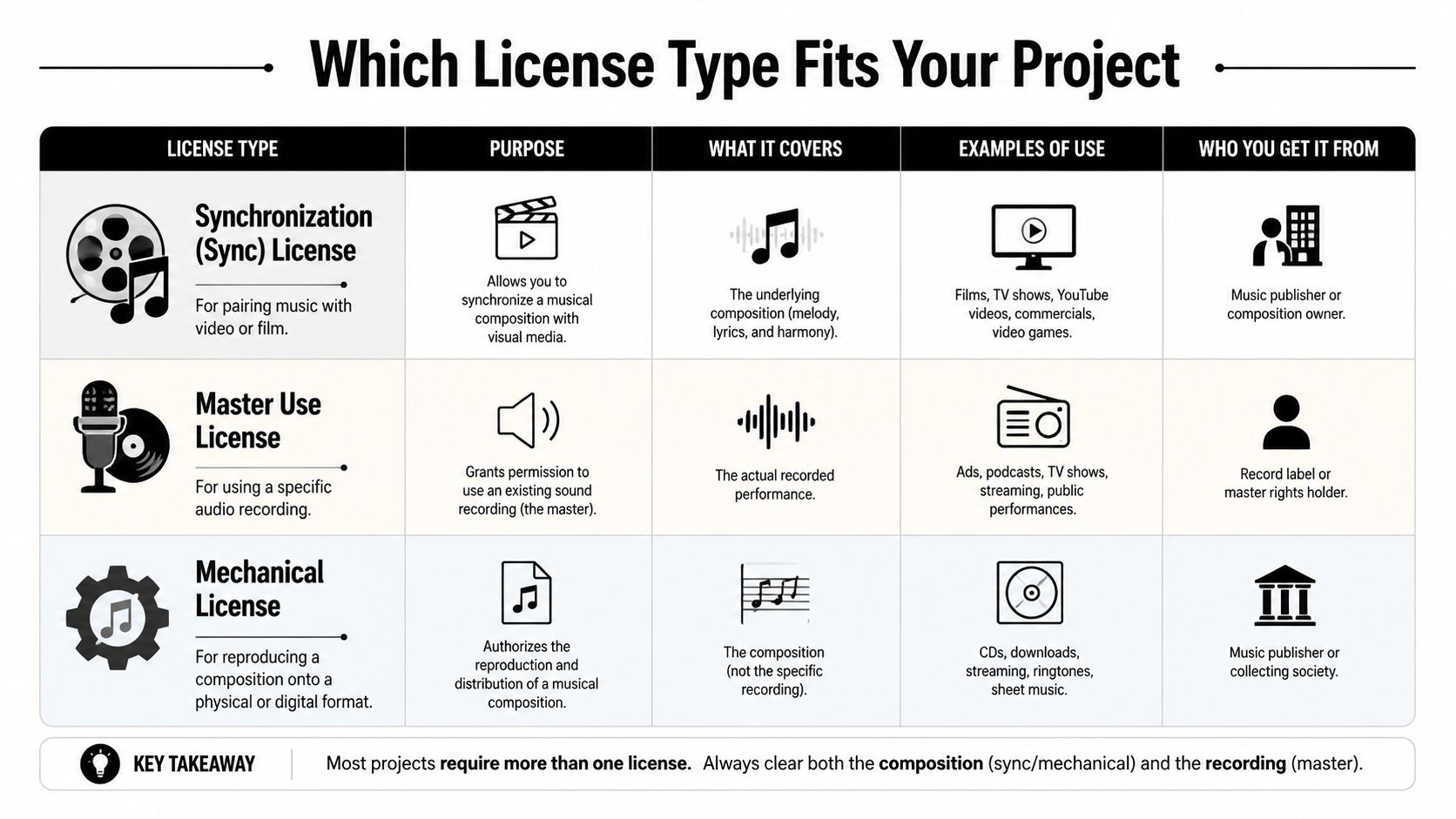 A table comparing music licensing types, detailing the purpose, coverage, usage examples, and sources for each.
Synchronization licenses
A sync license permits a composition to accompany visual content. Common examples include product ads, music videos, film scenes, YouTube uploads, branded memes, and short-form clips.
A fitness brand placing a song under a workout montage needs permission for the composition's use with those images. That approval does not automatically cover the original recording. If the brand wants the familiar studio version, it will normally need a master-use agreement as well.
Master-use licenses
A master-use license covers a particular recording. It applies when a project uses an existing released track, rather than a recording created for the production or a newly recorded cover.
A sync approval can therefore leave a campaign incomplete. A publisher might approve the composition while the label withholds the master, or the label might agree while a co-publisher remains unresolved. One approval is not necessarily full clearance.
Mechanical licenses
A mechanical license concerns reproducing and distributing a composition in an audio format. It commonly appears in physical releases, downloads, cover recordings, and certain streaming arrangements. A creator releasing a cover faces a different rights question from one placing that cover beneath a video, where synchronization permission may also apply.
For a practical explanation of these obligations, read this guide to mechanical royalties. The label identifies the general right involved, while the contract and delivery method determine the permission required.
Blanket and subscription licenses
A blanket license can provide continuing access to a defined catalog or rights category. PRO arrangements commonly relate to public performance rights. Music libraries and creator platforms may offer subscriptions covering selected uses under their own terms.
A subscription is not a universal pass. It may exclude synchronization, master, mechanical, paid advertising, client work, expanded territories, or commercial reuse. For a practical explanation of Creative Commons music and its licensing terms, check the license rather than assuming a free track is cleared for every use.
Before signing: Ask whether the license covers paid media, client projects, short-form platforms, livestream archives, territory, duration, edits, and monetization.
Contract wording matters when businesses negotiate broader commercial arrangements, and RNC Group international commercial law provides relevant legal context. Whatever the project size, save the license, read its exclusions, and match each permission to the content you will publish.
What Commercial Music Licensing Costs
There is no universal price for a song. The fee depends on the track, rights holders, territory, duration, audience, media, exclusivity, and whether the use is organic, paid, broadcast, or part of a client campaign. A short-form post, livestream archive, and AI-assisted video may each need different permissions, even when they use the same recording.
Some costs are easier to forecast than others. In the United States, statutory mechanical royalties for physical copies and downloads are 13.1¢ per track in 2026, or 2.52¢ per minute for songs longer than five minutes. Streaming mechanicals use a revenue-based formula that phases up to 15.35% by 2027 under Phonorecords IV. Read this guide to mechanical royalties for a practical explanation of how those obligations work.
A per-track rule creates a fixed liability for each qualifying unit. A percentage formula changes with service revenue, so forecasts can shift as distribution grows. International releases add another layer because territories may use wholesale price, retail price, per-download floors, VAT exclusions, or currency conversion. One industry reference lists Germany at 13.75% of Published Price to Dealers excluding VAT, the United Kingdom at **8.5% of PPD with a £0.02 per-track floor, France at 11% of PPD, and Spain at 10.25% for digital full downloads with a euro floor. (International mechanical royalty rate reference)
A budgeting table
| Use case | License type | Typical cost range |
|---|---|---|
| YouTube video | Royalty-free or platform creator license | Varies by catalog and terms |
| Podcast intro | Commercial library, direct permission, or commissioned music | Varies by rights and distribution |
| Short-form branded post | Sync and possibly master use | Varies by platform, campaign, and track |
| In-store playback | Public performance coverage | Varies by venue and licensing body |
| Regional commercial | Sync plus master use | Negotiated |
| National campaign using a known song | Sync plus master use | Negotiated, often substantially higher |
| App or game | Extended library or custom sync | Varies by distribution and scope |
A major commercial track can carry a serious fee because the rights holder is pricing the music, exposure, exclusivity, territory, term, and opportunity cost. For creators publishing across short-form platforms, streams, client channels, or AI-assisted productions, a library with express permission for commercial use, paid social, client work, and monetization often produces a more predictable budget.
“Royalty-free” describes the payment structure, not an absence of rules. You may pay once, while the license still restricts resale, broadcasting, advertising, modification, or use in templates. Keep the receipt and complete license text with the project records, rather than saving only the track title.
Your Step-by-Step Clearance Process
Clearance works best as a production task, not a last-minute legal emergency. Put the music decision into the brief before the editor locks the cut, because changing a track after launch can mean rebuilding timing, captions, transitions, and approvals.
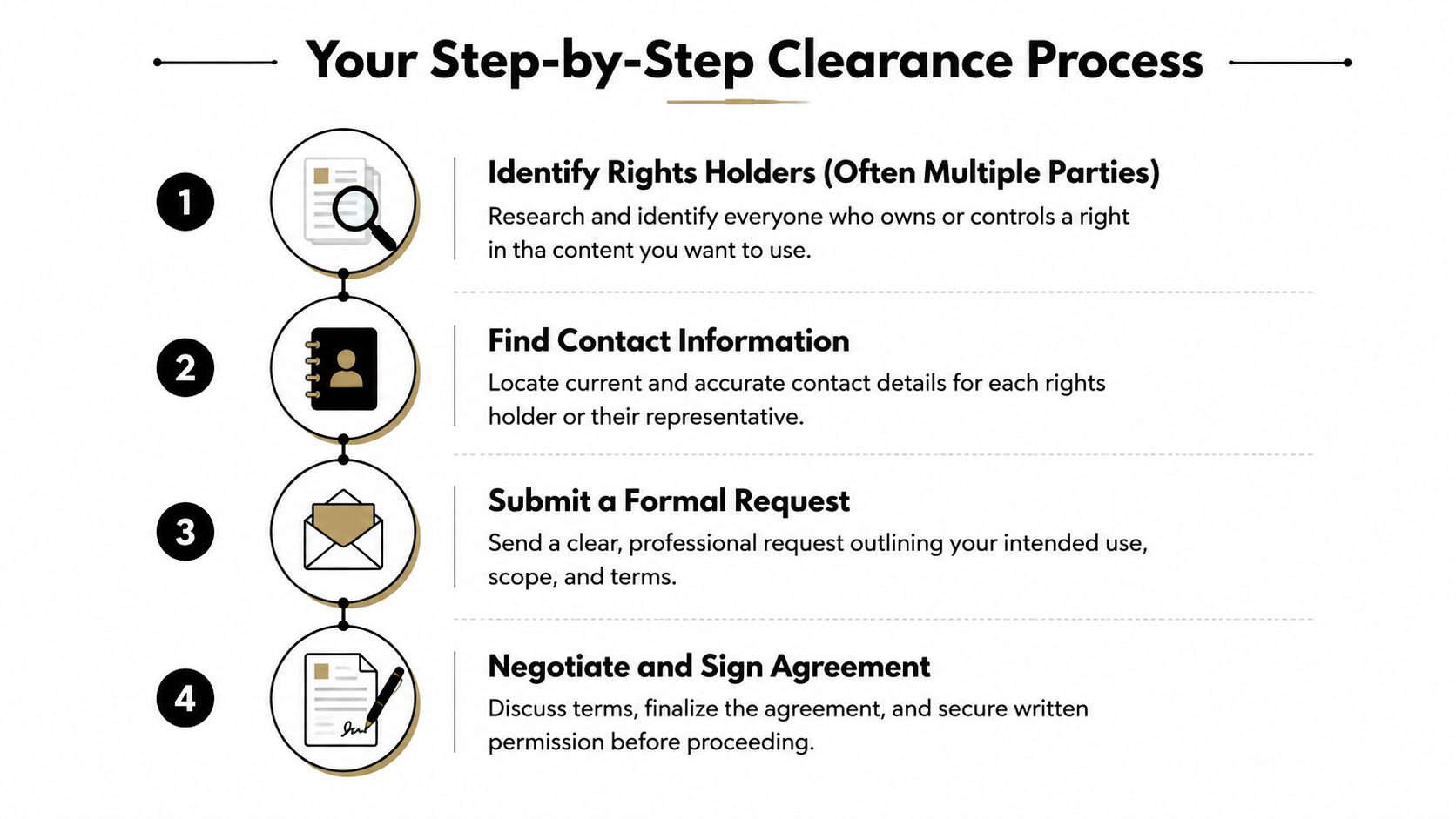 A numbered list illustration showing the four steps of the content rights clearance and licensing process.
Start with a rights inventory
Write down the title, artist, version, recording source, writers if known, and every planned use. Include organic posts, paid ads, reposts, client channels, livestreams, podcast feeds, websites, and archived content.
Then ask who may own each layer. A popular track can involve a label for the master, multiple publishers for the composition, and different administrators for territories. Don't assume the person who sent you the audio file can authorize everything.
Find the right contacts
Check the publisher's licensing department, label permissions team, artist management, production library, or platform license desk. Search official rights information first, and keep a record of the contact, date, requested use, and response.
If you're working with library music, download the license certificate and identify the exact plan or tier. A catalog's general marketing copy isn't a substitute for the terms attached to your purchase.
Send a complete request
A vague email creates slow negotiations. State:
- Project: What the content is and who the client or brand is.
- Media: Short-form video, paid social, website, livestream, podcast, or another channel.
- Territory: Where people can view or hear it.
- Term: How long it will remain available.
- Recording: Whether you want the original master, a cover, or a new commission.
- Edits: Whether you'll loop, shorten, remix, dub, or alter the track.
- Money: Whether the content is monetized, sponsored, or used in paid media.
A clear request lets the rights holder price the actual use instead of guessing.
Keep a clearance folder: Store the agreement, invoice, metadata, correspondence, renewal date, approved cut, and any platform restrictions together.
Sign before publication
Read the grant language, exclusions, attribution requirements, Content ID provisions, renewal rules, and takedown process. Confirm that every necessary party has signed. A producer's approval may cover the master, while a publisher's approval covers only the composition.
For a closer look at pairing music with visuals, consult this explanation of synchronization rights. It can help you distinguish a video-use question from a release or playback question.
This video can also help visualize the clearance workflow:
Dangerous Myths That Get Creators Sued
Myth one, “royalty-free” means unrestricted. It doesn't. Royalty-free usually means the license avoids recurring royalties under stated conditions. The agreement may still limit paid advertising, client work, broadcast, resale, templates, territory, or commercial redistribution.
Myth two, a short clip is automatically fair use. There's no universal safe-duration rule. A brief excerpt can still be central to a song's identity, and commercial context can complicate the analysis. Fair use is fact-specific, not a stopwatch exemption.
Platform libraries create false confidence
Myth three, if audio appears in TikTok's library, you can use it in an ad. Platform availability doesn't guarantee that your business, client, campaign, territory, or paid placement is covered. Some music is available for personal or platform-native use while advertising and off-platform reuse require separate permission.
The same issue appears with a livestream. A streamer may have access to music during a live broadcast, but that doesn't necessarily cover the saved replay, clipped Short, sponsor segment, podcast export, or repost on another service. Treat each distribution path as a question in the license review.
AI music isn't a legal force field
Myth four, AI-generated music never needs licensing. The output may be subject to the provider's terms, and the underlying process can raise separate questions about training data, imitation, samples, voices, or recognizable protected elements. An AI track that reproduces a protected melody, incorporates an uncleared sample, or imitates a performer too closely can still create risk.
Ask the provider what rights you receive, whether commercial use is included, whether outputs are exclusive, and what happens if a third party challenges the material. “Generated” describes how the file was made. It doesn't answer who can use it, where, or under which conditions.
Myth five, editorial labeling protects branded content. Calling a sponsored post editorial doesn't change its commercial purpose. The use, audience, sponsor relationship, and distribution determine the licensing conversation.
Your Quick Decision Framework for Any Project
Begin with one question: What is the use case? A branded Short, a Twitch stream, a podcast intro, an in-store playlist, and a film scene may all contain music, but they don't activate the same permissions.
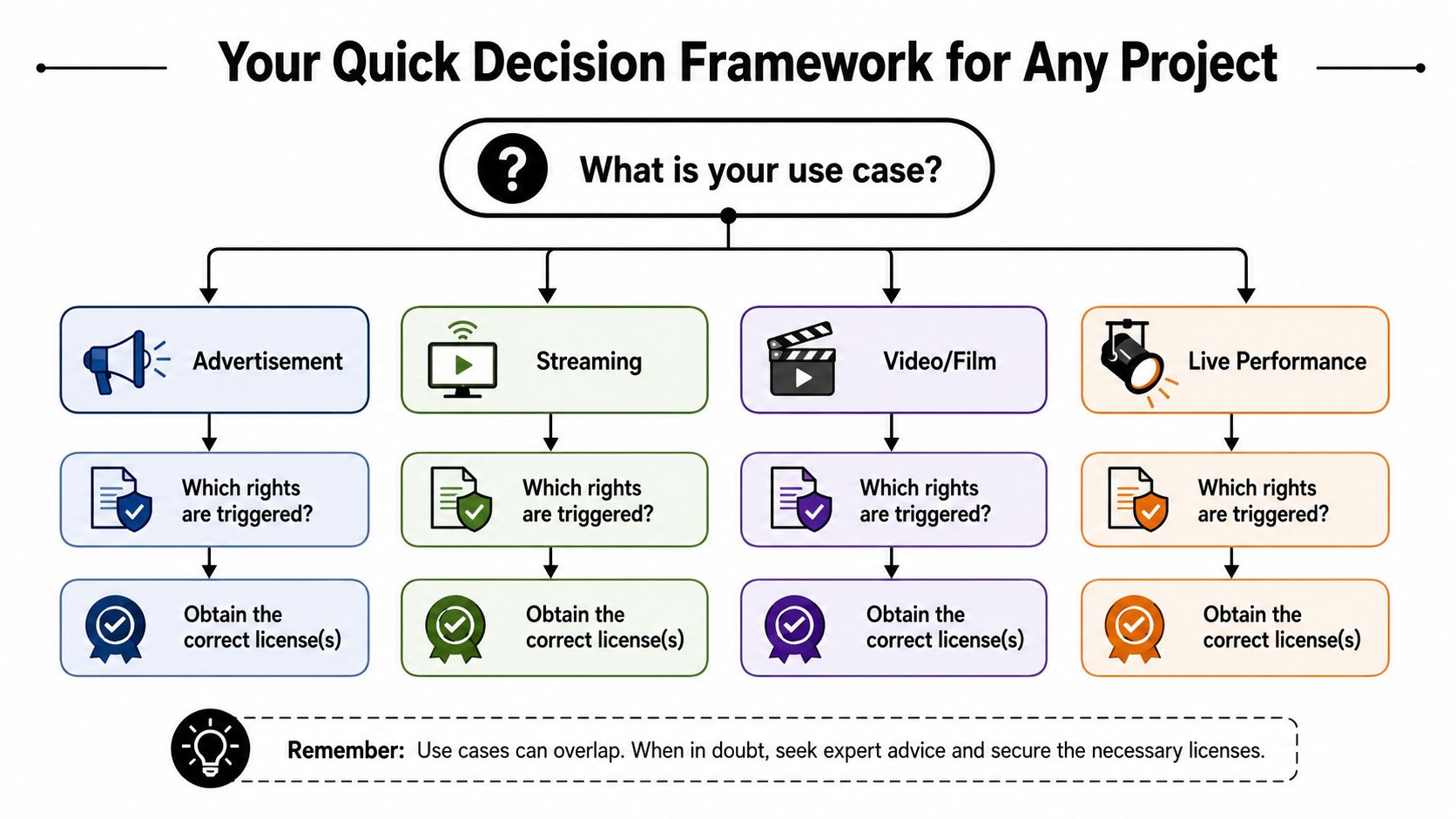 A decision framework flow chart illustrating the steps to determine and obtain music licenses for projects.
Match the project to the likely rights
- Advertisement: Expect composition and master questions when music is paired with visuals. Check paid media, territory, term, and client ownership.
- Streaming: Review the platform's creator or commercial terms, then check whether live playback, archives, clips, and cross-posting are covered.
- Video or film: Clear the composition and recording separately unless one provider explicitly grants both.
- Live performance or venue playback: Investigate public performance coverage and any venue-specific obligations.
Next, identify the source. An original commission may simplify ownership if the contract is clear. A stock library can provide defined commercial permissions. A famous recording usually requires direct negotiation with multiple rights holders.
Then inspect the license scope. Does it cover monetization, paid promotion, client work, edits, global access, archived content, and future reposts? If the answer is unclear, pause publication and request clarification in writing.
Solo creators often benefit from clearly documented library music. Marketing teams need a rights register that follows each campaign and version. Podcast producers should clear intros and recurring segments before distribution. Streamers should review not only the live broadcast, but also clips and recordings.
For creators making original roast lyrics and performance content, DissTrack AI offers generated diss tracks with paid-plan commercial licensing, allowing users to develop material for creative projects under its stated terms. Review those terms before release, just as you would with any music or content tool.
The fastest safe decision is rarely “pick a song and hope.” It's “define the use, list the rights, verify the scope, and save the proof.”
If you're creating roast videos, shorts, memes, or performance pieces, DissTrack AI can generate personalized diss-track lyrics and audio-ready concepts with commercial licensing available on paid plans. Visit DissTrack AI to create a track, review the applicable rights, and shape it into content you can publish with a clearer licensing workflow.