
Custom Rap Lyrics: How to Write Them in Minutes
The beat is knocking, your group chat is waiting, and the blank page is staring back like it knows you've got nothing. You've got a target, a memory, an inside joke, or a whole story ready to turn into bars, but the first line still won't land.
Custom rap lyrics don't come from inspiration alone. The strongest verses use constraints, sound patterns, point of view, and revision. AI can help you get moving, but it won't automatically understand why one punchline cuts deep while another sounds like a stock caption. You have to direct the tool, then bring the human ear back into the room.
The Art of the Custom Rap Lyric
Every writer knows the freeze. You hear the snare, catch the pocket, and mumble a rough cadence that feels dangerous. Then you open the notes app and type something flat. The problem usually isn't a lack of ideas. It's that the ideas haven't been given a shape they can move inside.
A personal verse needs more than a name dropped into a generic rhyme. It needs specific material, such as the late-night story nobody else knows, the habit your friend can't hide, the ambition they keep talking about, or the detail that turns a broad insult into a direct hit. Specificity gives the bar a fingerprint.
Practical rule: Start with the detail that only your people would recognize, then build the rhyme around it.
The useful constraint might be a playful roast, a serious battle verse, a romantic rap, or a story told from one sharply defined perspective. Each choice changes the vocabulary, pacing, and emotional temperature. A friendly jab can leave room for exaggeration and warmth. A battle verse needs tighter setups, cleaner targets, and punches that don't wander.
Why constraints beat a blank page
A blank page asks you to invent everything at once. A constraint narrows the fight. Give yourself a topic, a mood, a rhyme sound, and a structural job for each line. One bar can establish the target's habit, the next can twist it, and the next can deliver the payoff.
That approach also solves the gap between a lyric draft and a usable song. Recent coverage of AI rap generators describes tools that can produce lyrics, vocals, beats, and mixing from one prompt, while much of the practical advice still stops at generic prompting. A verse that reads well on a screen can still fail when the rapper has to breathe, emphasize a word, or fit the line into an actual arrangement.
Write for the mouth, not just the page. Read every line aloud. If the sentence looks clever but trips your tongue, it hasn't earned the beat yet. The craft lives where meaning, sound, and delivery meet.
Understanding Rhyme Schemes and Structure
A rap lyric has a skeleton before it has a personality. Bars carry the rhythmic units, a verse develops the thought, and a hook gives the listener a phrase worth remembering. You can bend that skeleton, but you need to know what you're bending.
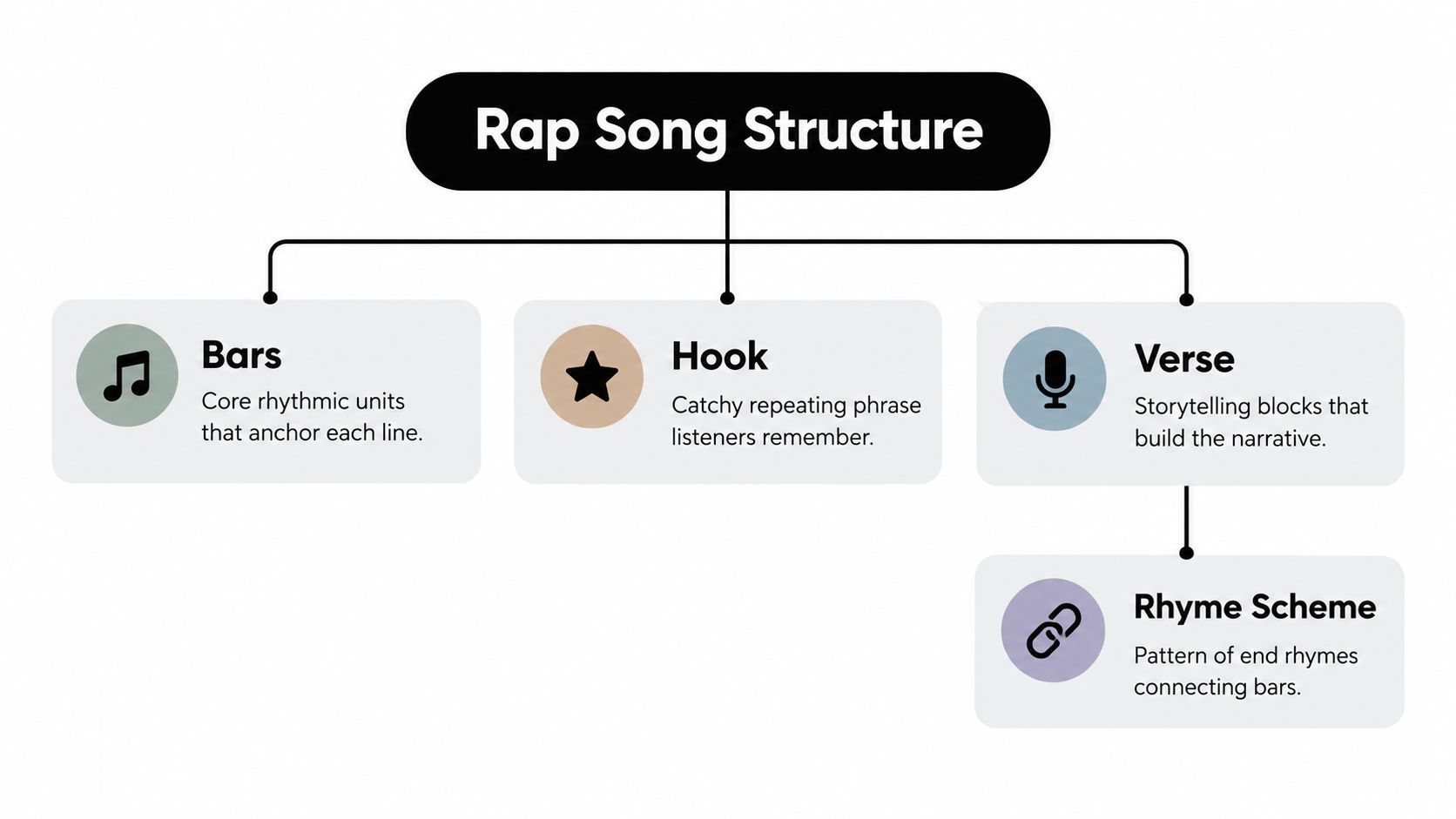 A diagram explaining rap song structure with components like bars, the hook, verse, and rhyme scheme.
Build the bar from the landing point
Start with the word or sound you want to land on. Then work backward to create the setup. This keeps the line from drifting toward whatever rhyme happens to arrive first.
A basic end-rhyme pattern can create momentum, but predictable pairs become childish when every line announces the same sound. Stronger writing adds internal rhyme, multisyllabic echoes, consonant texture, and changes in the position of the rhyme. The ear hears relationships between sounds even when the spelling looks unrelated.
Phonetics explains why. One technical approach evaluates rap lyrics through vowel-phoneme similarity, calculates rhyme density from the longest matching vowel sequence per word, and tracks end-of-line structure with CRP. In that framework, an ideal CRP of 0.5 represents an AABBCC-style couplet pattern, while a benchmark recorded 12.6% CRP for a model, 22.6% for real rap lyrics, and 8.0% for a baseline. The results show that measurable rhyme structure can improve without matching the complexity of human verses. The technical rap lyric evaluation paper lays out the phonetic method and those benchmark comparisons.
Give every section a job
Before generating or editing, assign a purpose to each part:
- Intro: Establish the voice, setting, or tension without spending your strongest punchline.
- Verse: Add details, escalate the idea, and vary the rhyme movement.
- Hook: Reduce the message to a memorable phrase with clear rhythm.
- Bridge or switch: Change the energy, perspective, or cadence so the track can breathe.
A generator often defaults to safe end rhymes because they're easy to recognize. You can push it further by asking for internal rhymes, varied line endings, and a controlled syllable range. A rhyme generator for rap writing can help you collect sound families, but don't let the word list write the verse. Choose the words that serve the character and the moment.
Read the draft over the beat at half speed, then at performance speed. Mark the stressed syllables. If the rhyme is technically impressive but lands in the wrong place, it's still the wrong rhyme.
Choosing Your Flow and Persona
The same insult sounds different in different mouths. A clipped, percussive delivery creates pressure. A relaxed West Coast pocket lets the rapper stretch vowels and let the beat breathe. A dense boom-bap cadence puts the spotlight on syllables, while a drill-inspired approach may favor short bursts, repetition, and stark imagery.
Don't choose a style tag because it looks familiar. Choose the speaking character first, then let the style support that character.
| Approach | Cadence and texture | Useful direction |
|---|---|---|
| West Coast | Loose pocket, conversational swing, open vowels | Let the setup breathe before the punch |
| Old School Boom Bap | Firm rhythm, dense wording, clear bar endings | Prioritize multisyllabic rhyme and wordplay |
| Drill | Short attacks, repetition, tense delivery | Keep phrases direct and leave space for impact |
| Emo Rap | Reflective phrasing, exposed emotion, melodic turns | Use concrete memories instead of broad sadness |
These are writing choices, not costumes. A friend roast works better when the persona understands the relationship. A playful roastmaster can exaggerate a harmless flaw. A stern battle character can sound colder, but that voice still needs a believable reason to care about the target.
Keep the voice stable
Give the system or yourself a short persona brief:
- Speaker: A competitive friend who jokes to show affection.
- Target: A friend who talks about fitness but avoids every pickup game.
- Mood: Playful, sharp, never cruel.
- Delivery: Relaxed pocket with a sudden punch at the end of each couplet.
- Forbidden territory: Private information, threats, and claims that aren't true.
A practical generation workflow can make those choices more controllable. A Stanford rap lyric generation project describes phoneme-level preprocessing and candidate scoring across language-model probability, line length, content relevance, end rhyme, internal rhyme, and syllable matching. It also uses a rhyme database and syllable counts, which mirrors how a human writer checks whether a clever line can actually be performed.
The persona is the lens. The rhyme is only the glass.
Write one sample line in the chosen voice before asking for more. That line gives the next draft a north star. If the tone changes from teasing to vicious halfway through, the listener hears the inconsistency before they notice the rhyme.
Using AI to Generate Custom Rap Lyrics
AI works best when you give it a brief that resembles a studio session, not a wish. “Write a hard rap about my friend” leaves too many decisions open. The tool has no reason to know whether “hard” means aggressive, funny, fast, gloomy, or triumphant.
Start with the material that makes the lyric personal. Name the relationship, the setting, the inside jokes, the target's public habit, the mood, and the intended audience. Then specify what the output must contain, such as a hook, verse, rhyme movement, point of view, and performance feel.
 Screenshot from https://aidisstrackgenerator.com
Use a brief with boundaries
Try a prompt like this for a light roast:
Write a playful rap roast for my longtime friend Marcus. He talks about becoming a professional chef but burns toast, orders takeout after buying expensive kitchen gear, and always arrives late to dinner. Use a relaxed boom-bap feel, clever internal rhymes, and a memorable four-line hook. Keep it affectionate, avoid threats, and make the jokes specific to those details.
For a sharper battle setting, change the relationship and the limits:
Write a competitive battle verse from the perspective of a calm, observant rapper addressing a fictional opponent named Vex. Focus on his repeated empty boasts and weak preparation, not protected traits or private information. Use tight multisyllabic rhymes, controlled aggression, and a hook that sounds confident rather than cartoonish. Give me two different punchline options for the final bar.
For a personal track, remove the roast frame:
Write a reflective rap about leaving my hometown, missing my closest friends, and carrying the sound of our old basketball court into a new city. Use a restrained, conversational flow, concrete images, internal rhyme, and a hook that can be sung without changing the meaning.
A purpose-built tool such as the AI rap lyrics generator can turn a topic, style, and extra context into a structured draft. Other AI songwriter tools from Isolate Audio may suit writers who want a broader songwriting workflow. Either way, generate alternatives instead of treating the first output as sacred. One version may have the cleanest hook, another the strongest setup, and a third the line worth keeping.
The video below shows the kind of generator-led workflow where a user can move from an idea toward a lyric draft, but the screen can't judge your breath control or whether a punchline sounds like you. Use the output as raw material, not a finished performance.
After generation, score the draft against your brief. Did it preserve the inside joke? Does the speaker sound consistent? Are the strongest details in the verses, or did the system bury them under filler? Prompt length matters less than constraint quality. A short brief with a clear perspective and a defined rhyme job usually beats a long paragraph full of vague adjectives.
Editing and Refining Your Bars
The first draft is where the clay appears. The finished lyric arrives when you cut the soft lines, replace borrowed-sounding phrases, and force every bar to earn its place.
Read the verse aloud over the intended beat. Circle every word that makes you hesitate. A line may have the right idea but too many unstressed syllables. Another may fit the pocket but use a rhyme that feels obvious. Fix the mouth problem before polishing the spelling.
Edit for sound before decoration
Use this pass order:
- Mark the stress. Tap the beat and underline the syllables that should hit.
- Trim the dead weight. Remove introductory phrases that delay the image.
- Replace the generic noun. “Car” becomes the actual model, dent, smell, or dashboard light if that detail matters.
- Strengthen the landing. Put the sharpest word near the point where the beat gives it attention.
- Test the breath. Perform the line without rushing. If you need to steal air, rewrite it.
AI often reaches for familiar phrases because they are statistically safe. Your job is to introduce the detail, slang, and odd comparison that belongs to your world. Don't add slang as decoration. Add it because the speaker would say it.
Internal rhyme should support meaning rather than turn the bar into a tongue-twister. If a line contains several clever sounds but no clear image, simplify it. The listener should catch the idea on the first pass and discover extra texture on later listens.
Make the performance visible on the page
Add light performance cues after the core lyric works. Parenthetical ad-libs, held vowels, pauses, and repeated words can suggest delivery, but they shouldn't hide weak writing. Try one dry read, one louder read, and one deliberately understated read. The version that makes the punchline feel inevitable usually has the best foundation.
A useful editing reference is this guide to making rap lyrics, especially when a generated draft needs to become something performable. Keep a clean version of the lyric and a marked performance version. That separation lets you revise the words without losing the timing notes that made the bar work.
Studio test: If you wouldn't say the line to a real person in your chosen voice, don't leave it in the verse.
FAQ - Custom Rap Lyrics Creation
What's the best place to start?
Start with one target idea and three concrete details. Decide who is speaking, what the listener should feel, and where the hook belongs. A small brief gives you something to judge, while a vague request produces interchangeable bars.
Is using AI cheating?
AI is a drafting tool. The authorship lives in the choices you make, the details you supply, the lines you keep, and the edits you perform. If you publish or perform the result, check the tool's terms and make sure the material doesn't expose someone's private information or imitate protected work too closely.
How do I make a generated verse sound less generic?
Delete the first obvious phrase that appears in a rhyme pair. Replace broad insults or emotions with observable details. Then change the cadence in at least one section so the verse has movement instead of marching through identical lines.
Should I ask for a whole song or one section?
Generate the hook and verse separately when you need control. A hook needs compression and repetition, while a verse needs development. Asking for every section at once can make the output structurally complete but emotionally flat.
What should I check before sharing it?
Run this final delivery checklist:
- Voice: Does the rapper sound like the intended speaker?
- Details: Are the personal references accurate and recognizable?
- Cadence: Can you perform every line without forcing the beat?
- Rhyme: Do the sounds support the meaning instead of distracting from it?
- Tone: Is the roast appropriate for the relationship and audience?
- Revision: Did you replace the safest lines with sharper, more personal choices?
A clean draft is useful, but your voice is the part nobody else can supply. Keep the line that only you would write, even when an AI alternative looks more polished.
DissTrack AI turns a target name, relationship, inside jokes, style, and roast intensity into structured verses you can edit, export, or share. Use DissTrack AI to break the blank-page freeze, then put your own cadence, details, and performance marks back into the bars.