
How to Write Fast Rap Lyrics That Actually Hit
You're in the booth, the beat is moving, and the first bars feel dangerous. Then your tongue catches on a consonant, your lungs start bargaining, and the rhyme you built on the page turns into “yeah,” “uh,” and whatever word arrives before the next snare. That moment isn't proof you can't rap fast. It's a diagnosis.
Fast rap lyrics work when speed serves the bar. The listener should hear intent, images, rhyme movement, and impact, not a syllable pileup. The craft is measurable, but the target isn't the highest possible count. The target is a line that still cuts when you slow it down.
Why Fast Bars Fall Apart and How to Fix It
The booth exposes shortcuts quickly. A line can look packed and impressive in a notes app, yet fail the moment you perform it at volume. Written rhythm and physical rhythm aren't identical. Your eyes tolerate crowded wording. Your lungs and mouth don't.
The first collapse point is usually consonant placement. Put too many hard sounds on the downbeat and the mouth has no time to reset. A phrase such as “black bricks break back” can sound sharp at a comfortable pace, but it becomes muddy when every stressed syllable lands at the same moment. The fix isn't always to slow down. Move one stress off the beat, or replace one consonant cluster with a cleaner vowel transition.
The second failure comes from overloaded multisyllabic rhymes. A rhyme family should pull the next bar forward, not force you to pronounce six awkward syllables merely to protect a pattern. If the internal rhyme sounds unnatural when spoken, the listener hears the construction before they hear the thought.
The third is a breath problem disguised as a writing problem. A long bar with no reset may survive in a whisper, then collapse under performance pressure. Mark the breath before you polish the rhyme.
Practical rule: If you can't deliver a line cleanly at a slower rehearsal pace, adding speed won't reveal skill. It will reveal the weak joint.
Try this rebuild:
- Circle the landing words. Keep the strongest image and cut decorative padding around it.
- Mark the mouth traps. Highlight repeated consonants, especially at stressed positions.
- Insert a breath cue. Use a slash where the lungs reset, even if the beat doesn't stop.
- Read the bar three ways. Speak it, rap it slowly, then perform it at tempo.
- Cut before you cram. Removing one weak word often restores more groove than adding another rhyme.
Fast writing starts with bars shaped for the lungs. Once the breath, consonants, and rhyme chain cooperate, speed becomes a delivery choice instead of an emergency.
The Anatomy of Fast Rap Lyrics
A fast line has three moving parts: syllable density, multisyllabic rhyme, and flow placement. Treat them as separate controls. If you adjust all three at once, you won't know why a bar works or fails.
Syllable density describes how much language occupies a rhythmic space. A useful practice range is 9 to 14 syllables per line, but the count only matters if each syllable carries sound, meaning, or momentum. Count spoken syllables, not the spelling on the page. “Every” may compress in performance, while a word with several written vowels may land more easily than expected.
Mark the stresses above the line:
I **CUT** through the **NOISE**, leave the **ROOM** with a **SCAR**
The unstressed syllables create movement. The bold stresses give the listener handles.
Multisyllabic rhyme works best as a chain rather than a single end-word trick. A family such as “fire / higher / desire” can become more elastic when interior sounds echo through the bar. You're not searching only for matching endings. You're building repeated vowel shapes that make the mouth anticipate the next landing. A practical reference for expanding those chains is this guide to multisyllabic rhymes.
Flow placement answers a different question: where do the stressed syllables sit against the beat? Two lines can have the same syllable count and feel completely different if one hits the snare while the other slides between kicks. Written rhythm is the blueprint. Performed rhythm includes drag, attack, silence, and breath.
| Component | Definition | Example From a Fast Bar |
|---|---|---|
| Syllable density | The amount of spoken language in a rhythmic space | “Cut through the noise, leave the room with a scar” |
| Multisyllabic rhyme | Repeated vowel and consonant sounds across several syllables | “fire, higher, desire” threaded through a line |
| Flow placement | The position of stresses, pauses, and attacks against the beat | Stressing “cut,” “noise,” “room,” and “scar” on selected rhythmic points |
Use two short test bars:
Black blips blur between blinking bits
8 syllables, with a repeated “bl” attack that creates speed through articulation.
I write with a wire in the tireless night
10 syllables, with “wire,” “tireless,” and “night” forming a loose internal and end-rhyme path.
The first bar gets its energy from consonant repetition. The second gets forward motion from vowel links. Those are different engines. Tune density for space, rhyme for memory, and placement for impact.
Speed Benchmarks From Rap God to Godzilla
Speed records give you useful context, but they shouldn't become a substitute for judgment. Guinness World Records lists Eminem's “Rap God” at 97 words in 15 seconds, or 6.46 words per second, and “Majesty” at 78 words in 12 seconds, or 6.5 words per second. On “Godzilla,” Guinness records 225 words in a 30-second segment, or 7.5 words per second. You can verify those milestones in the Guinness World Records entry for fastest rap in a No. 1 single.
Those are words-per-second figures, not syllables-per-second measurements, so don't compare them as if they were identical units. Rap speed has also been documented through syllables. Guinness recognized Twista in 1992 for 598 syllables in 55 seconds, while later summaries cite his “Victory or Death” at 12.8 syllables per second. NoClue briefly held the Fastest Rap MC title in 2005. The historical overview appears in WatchMojo's fastest rap verses list.
A corpus-based discussion places typical rap delivery around 4.5 syllables per second, while a commercial-discography analysis cited average English-language rappers at 4.13 syllables per second and Ab-Soul at 8.31 syllables per second. Those figures are discussed in Roomie's fast rap lyrics analysis on Genius.
| Artist | Track | Syllables/Second | Best Used For |
|---|---|---|---|
| Twista | “Victory or Death” | 12.8 | Record-style technical display |
| Ab-Soul | Commercial-discography outlier | 8.31 | High-density technical practice |
| Typical rap delivery | Corpus-based reference | 4.5 | Clear, controlled pocket work |
| Average English-language rapper | Commercial-discography analysis | 4.13 | Baseline delivery practice |
For practical training, think in tiers rather than worshipping a record. Around 4 to 5 syllables per second can support clean, punchy writing. Around 5 to 6 gives you room for a technical showcase. Above 6 demands exceptional diction, breath planning, or deliberate compression. Those are working targets, not universal laws.
A dense verse at a slower pace can hit harder than a faster verse full of filler. If the listener misses the punchline, the speed has become an obstacle. Choose the tier based on intent: clarity for storytelling, density for a technical display, and selective acceleration for battle pressure.
Breath Control and Cadence Drills That Actually Build Speed
Speed training should happen before your lungs are exhausted and before your writing session turns into a fight with the page. A compact daily routine can prepare the breathing system, wake up the articulators, and expose the exact beat where your delivery breaks.
Start with diaphragmatic breathing. Sit or stand tall, breathe through your nose for a 4-count, hold for a 7-count, then exhale through pursed lips for an 8-count. Repeat the cycle 5 times. Keep your shoulders quiet. If the chest rises sharply, reduce the effort and let the lower ribs expand.
The hold isn't a stunt. It teaches you to stay relaxed while air pressure changes. The pursed exhale trains control instead of dumping the whole breath at the start of the bar.
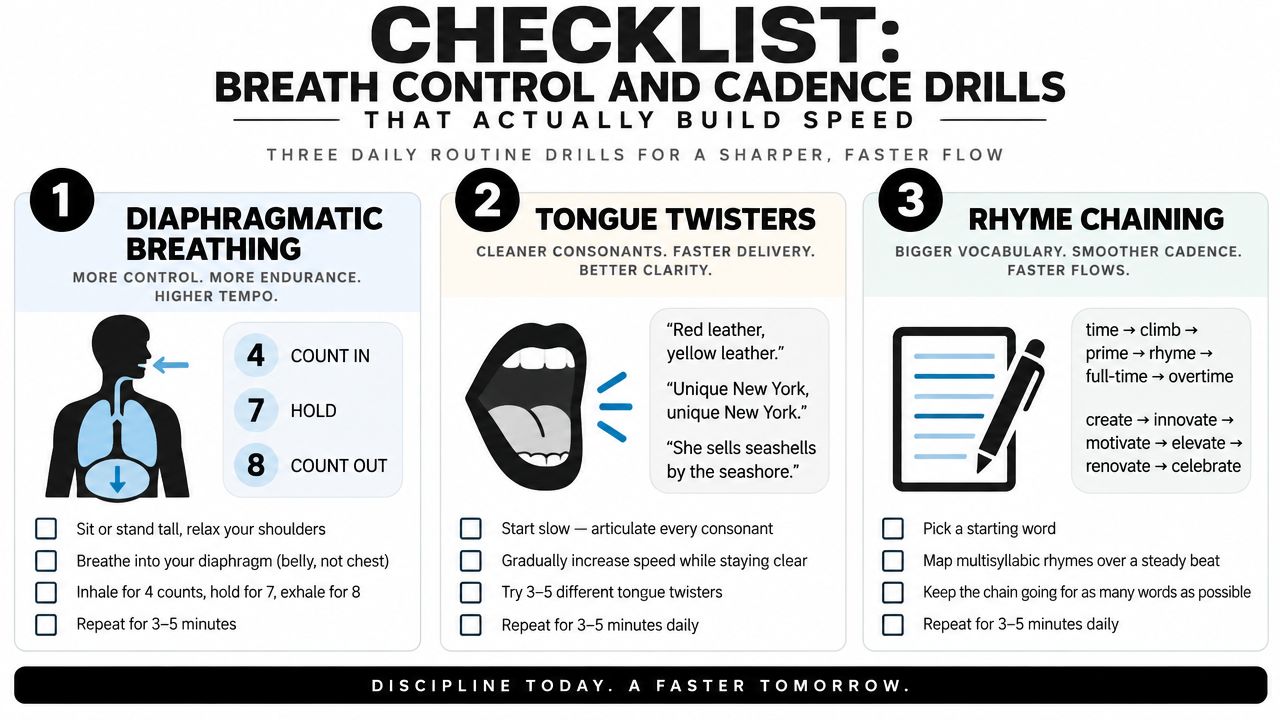 A checklist infographic titled Breath Control and Cadence Drills containing three daily exercises for improving rapping skills.
Wake up the mouth before demanding speed
Move to a tongue-twister ladder. Begin slowly with “red leather, yellow leather.” Focus on clean r, l, and y sounds. Then use a denser phrase such as “black blips blur between blinking bits.” Don't rush the first pass. Speed comes from removing wasted movement, not from forcing the jaw harder.
You can find more material for this kind of articulation work in this collection of dirty tongue twisters. Choose a phrase that exposes your personal weak consonant. Some rappers lose plosives. Others smear sibilants or swallow final consonants.
Turn one bar into a controlled sprint
For the cadence drill, choose one bar and perform it over a beat at 80 BPM. Repeat the bar until the stresses sit comfortably. Then expand the exercise to four bars at 160 BPM, using a double-time feel. Record each pass.
Listen for three failures:
- Gasping: You're spending air on volume instead of keeping the airflow narrow.
- Dropped diction: Your tongue can't reach the next consonant cleanly, so trim one word.
- Swallowed attacks: Restart the phrase on beat 3, or lower the tempo by 10 BPM and rebuild the movement.
A simple recording loop keeps the drill honest. Don't trust how clean the line feels inside your skull. Listen back for endings, downbeat consonants, and the moment your vowel shapes collapse.
For a visual demonstration of fast delivery and cadence practice, use this embedded performance as a listening reference:
Finish by writing down the exact word where the breath drops. That word is your edit point. Shorten the line, move a stress, or place a breath marker before repeating the run.
Two Fast Rap Verse Templates You Can Steal
Templates help when the blank page is louder than the beat. Don't treat these as finished lyrics. Treat them as scaffolding, then replace the nouns, images, and verbs with material from your own life.
 A male rapper in a black hoodie and cap performing with a microphone against a white background.
Template one uses a dense attack chain
- I light up the night with a blade in the black
- Then I strike through the static and circle right back
- Put a price on the panic, watch rivals react
- I'm precise with the pressure, no slack in the track /
- Every line gets a bite when I write it in flight
- Turn a doubt to a dent, then I send it out bright
- If they step in the frame, I reset the whole sight
- Leave the room with the proof that the pen still can fight
The speed lives in the compressed middle phrases: “strike through the static,” “price on the panic,” and “precise with the pressure.” The -ack family drives the first four bars, while the -ight family takes over in the second half. The slash marks the breath reset after bar 4.
Bracket map
- Bars 1 to 4: target 14 to 18 syllables each, primary rhyme family -ack
- Bar 4: breath reset after “track”
- Bars 5 to 8: target 14 to 18 syllables each, primary rhyme family -ight
- Delivery: continuous double-time with a hard landing on the final word
Template two creates contrast with pauses
- I move quick when the kick hits, then stop
- Let the room hear the thought before the drop
- Pack four little sparks in the pocket, don't rush
- When I open the throttle, they're already crushed /
- I don't chase every beat, I place what I mean
- Then I cut through the gap with a razor-clean stream /
- Slow voice, sharp choice, let the silence react
- Then I snap back into the pocket and crack
This design uses contrast, not uninterrupted speed. Bars 1 and 2 leave space. Bars 3 and 4 tighten the pocket. Bars 5 and 6 accelerate, then bars 7 and 8 use a pause before the final attack. The breath markers protect the switch points.
Bracket map
- Bars 1 to 2: target 10 to 14 syllables, spacious pocket
- Bars 3 to 4: target 14 to 18 syllables, compressed internal movement
- Bar 4: breath reset after “crushed”
- Bars 5 to 6: target 14 to 18 syllables, chained internal rhyme
- Bars 7 to 8: target 9 to 14 syllables, pause-led finish
Speed has more impact when the listener hears you choose it.
To personalize either template, swap every content noun for a specific reference from your world. Replace “room” with the venue, “frame” with the camera, or “track” with the project that matters to you. Change verb tense to match the story, then rewrite at least one rhyme so the verse stops sounding borrowed.
Using AI to Draft Fast Rap Lyrics Without Sounding Generic
AI is useful at the moment when you have a beat, a concept, and no opening line. It can generate combinations quickly, but it can't decide which image belongs to your voice. Use it to create raw material, not to skip the edit.
A general guide to AI-powered content generation from SleekPost can help you think about prompting as an iterative drafting process. For rap, the prompt needs tighter constraints than “write a fast verse.”
Prompt recipe one builds a rhyme bank
Generate a rhyme bank for the sound family “-ation / -action / -atic.” Give me multisyllabic phrases suitable for battle rap. Avoid “elevate,” “motivate,” “destiny,” “fire,” and “king.” Group the results by vowel sound and label approximate syllable counts.
The exclusions matter. Without them, generic filler returns because familiar motivational words are statistically easy. Keep only phrases you could say in your own accent and pocket.
Prompt recipe two repairs weak bars
Rewrite these two lines into three denser variations. Preserve the central image, add one internal rhyme per line, keep each line under 18 syllables, and avoid abstract nouns. Original lines: [paste your bars].
Don't accept the first variation automatically. Read all three aloud, steal one useful phrase, and rebuild the rest yourself.
Prompt recipe three plans the breath
Write an 8-bar fast rap verse about [specific subject]. Use a chained multisyllabic rhyme scheme, mark a breath cue after bar 4 and bar 6, vary the cadence between the bars, and keep every line under 18 syllables. Avoid generic boasts and include one concrete sensory image.
Then edit the output in this order:
- Check density: Tighten any line that exceeds 18 syllables.
- Replace noun stacks: Swap a string of vague nouns for one object the listener can see.
- Repace the rhyme: Move internal landings to match your chosen BPM.
- Test the breath: Speak the verse before recording. If a cue arrives too late, rewrite the line.
- Restore your fingerprints: Add an idiom, location, memory, or unusual word you'd actually use.
DissTrack AI can generate personalized roast lyrics and structured variations from details such as a target's name, relationship, inside jokes, and selected rap styles. That makes it a possible starting point for a battle-oriented draft, but the final performance still needs your edits, breath marks, and delivery choices. For another workflow, explore this AI rap lyrics generator guide.
The generic sound begins when you keep the draft word for word. AI can solve the first blank space. It can't supply the lived detail that makes a fast bar worth catching.
Your Fast Rap Practice Checklist
Use this as a notebook page, not a motivational poster. The point is to make every fast line answer a practical question: what does the speed add?
Writing
- Count the spoken syllables: Check each line aloud instead of trusting the page.
- Build a rhyme path: Use internal echoes that pull the mouth toward the landing.
- Mark the breath: Place a slash before your lungs force the decision for you.
- Cut padding: Remove weak adverbs, empty boasts, and rhyme words that don't sharpen the image.
- Keep the image concrete: One sharp object beats a stack of abstract claims.
Delivery
- Warm the articulators: Use tongue twisters slowly, then increase speed without losing consonants.
- Run the cadence: Perform a 16-bar passage at a slower pace before pushing the tempo.
- Record the failure: Note the exact word where diction, breath, or pocket falls apart.
- Protect the groove: Let some bars breathe. Constant acceleration makes the ear numb.
- Test half-speed clarity: If the line is still unintelligible at 75% speed, it isn't technical control yet. It's blur.
Iteration
- Trim one word first: A small cut often repairs the breath without damaging the rhyme.
- Compare one reference bar: Study where the stresses land, not just how fast the artist goes.
- Track your rate weekly: Use the same passage and listening conditions so your notes mean something.
- Rewrite the weak bar: More repetitions won't fix wording that fights the mouth.
- Keep the punch intact: Speed should intensify the thought, not hide its absence.
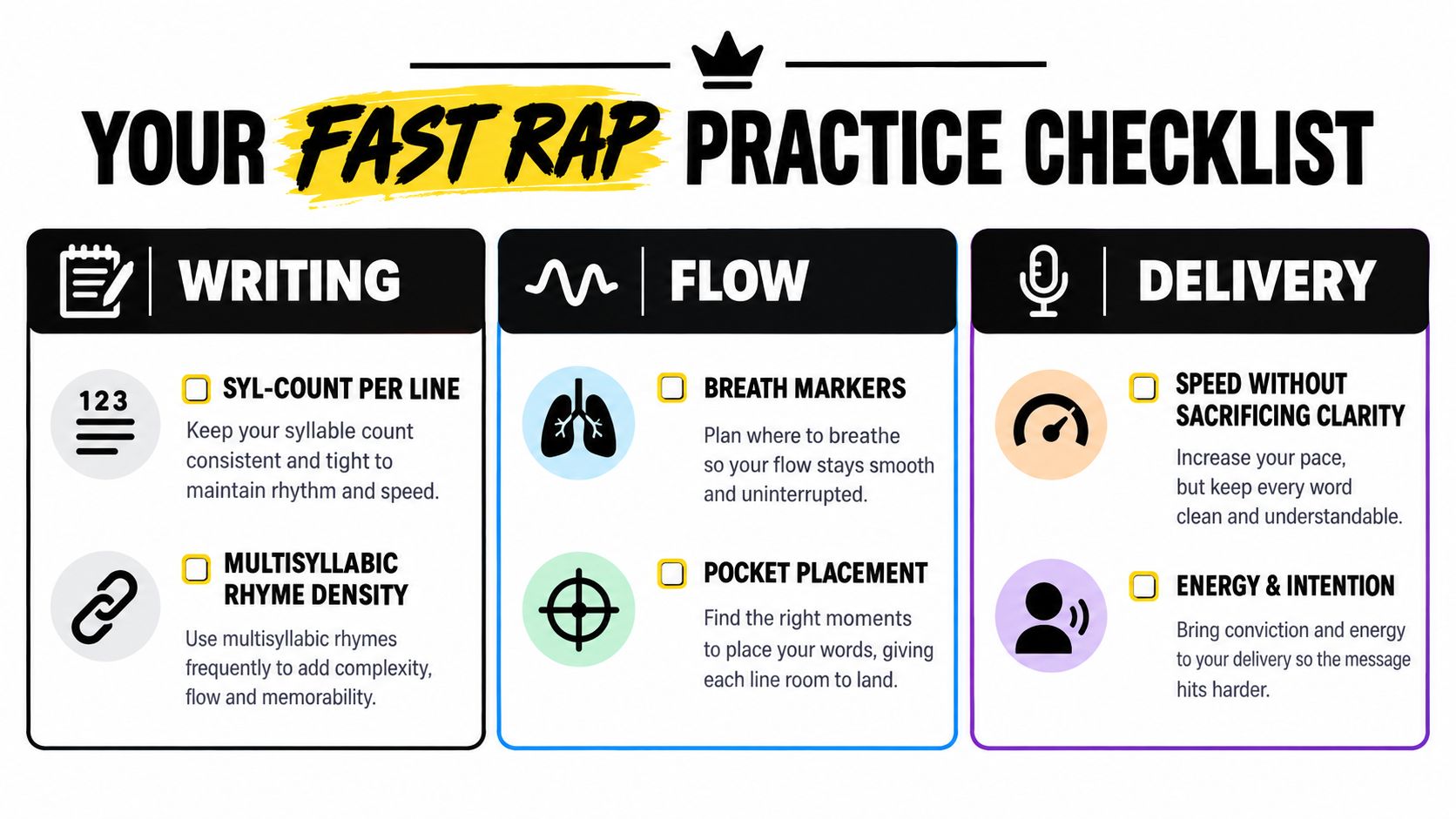 A checklist infographic titled Your Fast Rap Practice Checklist for improving writing, flow, and delivery techniques.
The hardest fast rap to write is the kind that still cuts when stripped down to half-speed. Give yourself a 7-day challenge: write one 16-bar fast verse, track the spoken syllables, record a clean take, then tighten every bar that blurs. Don't chase a record. Chase control.
DissTrack AI can give you a fast starting draft with personalized roast lyrics, battle-rap variations, style options, and inside-joke prompts to work from. Use it to break writer's block, then reshape the rhyme chains and breath points until the verse sounds like you. Visit DissTrack AI and turn your next blank page into a draft you can perform.